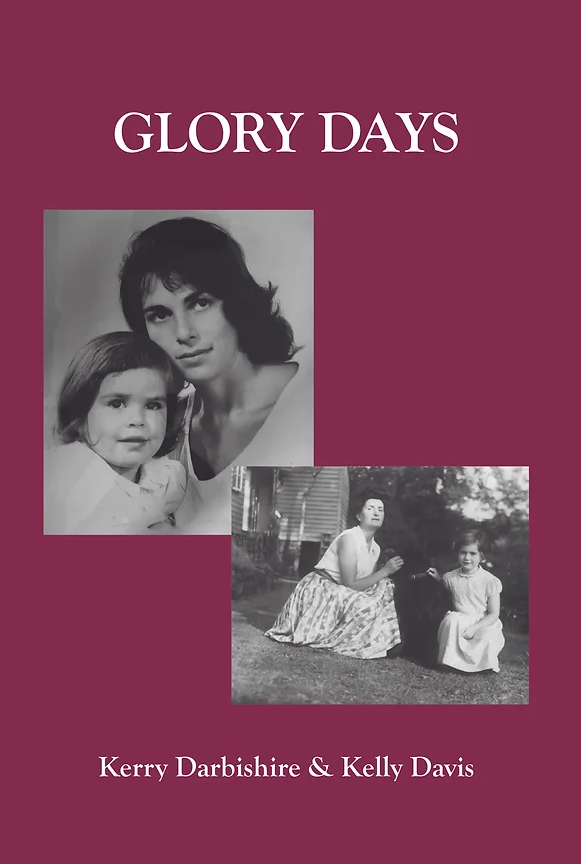
Wombwell Rainbow Book Interviews: The Lost Art Of Ironing by Kelly Davis, Glory Days by Kerry Darbishire and Kelly Davis

Kelly Davis

lives in Maryport, on the West Cumbrian coast, and works as a freelance editor. Her poetry has been widely anthologised and published in magazines such as Mslexia, Magma, London Grip and Shooter.In 2021 she came second in the Borderlines Poetry Competition and was longlisted for the Erbacce Press Poetry Competition. She has twice been shortlisted for the Aesthetica Creative Writing Award and she appears in the Best New British and Irish Poets 2019-2021 anthology (Black Spring Press). In 2021, she collaborated with Kerry Darbishire on their poetry pamphlet Glory Days (Hen Run).www.kellydavis.co.uk

The Interview

Q:1. When and why did you start writing poetry?

I always loved poems and rhymes as a child and I was lucky enough to have a father who read me Thomas Malory’s Le Morte d’Arthur when I was very young. I know I started writing my own poetry in 1972, aged thirteen, because I still have the book in which I painstakingly wrote my first few poems in calligraphic script. Like many teenagers, I mainly used poetry as an outlet for difficult emotions. Expressing grief and anger in words, and particularly in poems, made me feel better – perhaps because it helped me understand my feelings and gain some distance from them. 

Q:1.1. What was it about Malory’s poem that stayed with you?

I think the tragic love triangle between Arthur, Guinevere and Lancelot. I was too young to understand it at the time but I somehow sensed the enormity of the betrayal.

Q:2. So you would say this action of your father introduced you to poetry

I think it was less about poetry at that stage and more about the beauty of Malory’s  words and the power of the narrative. Many of my poems have a storytelling element so perhaps that early introduction to Malory’s epic somehow fed into my development as a poet.
Q:3. How did you decide on the order of the poems in both of your books?


My first pamphlet, Glory Days (Hen Run, Grey Hen Press, 2021), was a ‘poetic conversation’ with Kerry Darbishire about the stages in a woman’s life, and our relationships with our charismatic mothers. It was relatively simple to arrange the poems, beginning with memories of our teenage years, followed by finding love, then the experience of motherhood, coming to terms with getting older, and thoughts about our own mothers aging. Finally, there were some poems about losing our mothers. Thankfully, my mum is still alive but Kerry wrote very movingly about the things her mother left behind – a house full of memories and the dried flowers she left in her diary.

Arranging the poems in The Lost Art of Ironing (Hedgehog Poetry Press) was much trickier. This newly published solo collection has several themes and deals with other women’s lives as well as my own. I always knew I wanted the book to open with ‘To My Hands’, which is really my life story in a single poem and I was originally going to follow it with other poems expanding on particular aspects of my life. However, I sent the draft manuscript to Brian Patten (a long-standing friend and one of my all-time favourite poets). He was kind enough to read it and he thought the poem about Emily Dickinson was one of the strongest and should appear near the front. Once I’d moved that one, I realised that it would be much better to start with other women’s lives and go back to the autobiographical ones later. This arrangement somehow opens the collection out, making it more resonant for a wider audience. In the later part of the book there are certain poems that had to follow each other – for instance, the ones about my Jewish family history. ‘Prove your identity’ hints at later events, mentioning the necklace owned by my great-grandmother which features in the next poem. It also refers to my grandfather leaving Lithuania ‘in time’. This statement is unpacked in the third poem in this little sequence, ‘Trying to Edit the Holocaust’. I wanted to end the book with my modern versions of five Shakespeare sonnets. I love the sonnet form – and the themes of time, mortality and digital technology run through the whole collection – so the book ends with a final rhyming couplet:

‘At last we know that love is what life’s for,

and life is short – so we love even more.’


Q:4. How aware are and were you of the dominating presence of older poets traditional and contemporary?

I suppose the short answer is ‘very aware’. I studied English Literature at St Anne’s College, Oxford, and gained a pretty good knowledge of ‘the canon’, starting with Anglo-Saxon and Chaucer and covering a
range of Elizabethan, Restoration, Victorian and Georgian poets. I was there in the late seventies and the course was still very traditional then, ending with Yeats and Eliot. I had to go to another college to study the American poet Marianne Moore! My favourite women poets were Emily Dickinson and Sylvia Plath
and I loved the Metaphysical poets, particularly Donne, Marvell and Herbert. Outside university, I remember being electrified by seeing Ted Hughes read at a pub in Hampstead; and seeing the Liverpool poets (Roger McGough, Brian Patten and Adrian Henri) made me realise that poetry could break out of the rarefied realm of libraries and lecture halls – and speak to everyone. I love the idea of poets being in conversation with each other across the centuries, and ‘The Lost Art of Ironing’ includes poetic responses to Keats, Eliot, Anne Sexton and Shakespeare.  

 Q:4.1. What made  Emily Dickinson, Sylvia Plath and Donne, Marvell and Herbert your favourites?

In my poem about Emily Dickinson, I explain why I love her poetry:

‘I’d ask her to tell me her secret,

how to distil 200 words into 20,

how to capture a truth

before it slipped away – ‘

It’s also her incredible precision and fearlessness, when writing about huge subjects. I think ‘I heard a fly buzz – when I died’ is one of the best poems ever written about the process of dying. 

Sylvia Plath was also fearless and said things no woman poet had said before, smashing taboos and sometimes using shocking language and images, as in ‘Lady Lazarus’. But she could also be tender and lyrical, as in ‘Morning Song’. 

With John Donne, I loved the way he used bizarre metaphors, like a pair of compasses or a fly, to talk about love. His brilliant intellect was always at the mercy of his emotions, which gave his poems a sense of tension and struggle. Andrew Marvell created a feast for the senses, in a poem like ‘The Garden’, and also used the power of argument brilliantly in ‘To His Coy Mistress’. George Herbert was the most overtly religious  – but, again, his passion came through in poems like ‘Prayer’ and ‘The Collar’. 

Q:4.1. What “electrified” you about Ted Hughes reading?

The reading was in a small upstairs room and I was sitting quite close to him, looking up at his craggy face and listening to his deep, powerful voice. He had a very strong presence. At one point he read a poem called ‘February 7th’, about delivering a dead lamb, and the visceral language just floored me. I was left shaking, feeling as if I’d been in front of a firing squad. It was a revelation – that poetry could have such an impact. 

4.1.1. How is “the visceral” important in your own poetry?

I want to write poems that deal honestly with the messiness of life – the guts, as well as the head and the heart – so I’ve sometimes written about subjects like sex and menstruation, which used to be seen as
inappropriate in more censorious times. I think poetry can make us more aware of our shared humanity. We all inhabit bodies, and experience the world through our physical senses. Poetry often has an impact on the reader through the shock of recognition.

Q:5. What is your daily writing routine?

 I wish I had one! I still work from home as a freelance editor (https://www.kellydavis.co.uk/) and I help run the West Cumbria Refugee Support Network (https://wcrsn.org.uk/) so my poetry writing has to fit in when time allows. Occasionally I experience something that inspires a poem. If that happens I try to get a rough draft typed on my laptop straight away. Then I go back to edit it several times, at intervals. When I no longer feel the urge to make changes, I feel the poem is finished – and ready to share with others. I might road-test it at an open mic – and get feedback from poets I know and respect. I occasionally attend workshops and I have found the January Writing Hour (hosted by Kim Moore and Clare Shaw) a great source of inspiration. 

Q:6. How does the natural world feature in your poetry?

I rarely write descriptive nature poems and I certainly wouldn’t call myself a nature poet. Most of my work focuses on human relationships but I’m also interested in the way human beings interact with the natural world. I grew up in London and my husband sometimes teases me about my ignorance of wild flowers, birds, and so on – hence the opening of my poem ‘Cutting Through the Fields’…

‘Today I surprised you / by recognising a yellowhammer’s call’.

In a poem from Glory Days, called ‘Walking in the Languedoc’, the autumnal landscape reflects my feelings as a post-menopausal woman. I liken the vines to ‘aged ballerinas in green tutus’, whose ‘grapes are long gone’. I’m not sure whether that’s personification or pathetic fallacy or both! But it’s my kind of nature poetry. 

Q:7. How did you choose the titles for your books?

With ‘Glory Days’, I looked through the manuscript and noticed that my poem ‘Walking in the Languedoc’ ended with two particularly musical and evocative lines:

‘Their grapes are long gone

but the scent of their glory days remains.’

I loved the sound of ‘Glory Days’ and the phrase seemed to reflect our colourful, charismatic mothers, who are celebrated in several of the poems. I suggested to Kerry Darbishire that we should use it as a title for our pamphlet and she agreed. Neither of us realised that Bruce Springsteen had previously written a famous song called ‘Glory Days’! A male poet told me that title had already been ‘taken by the Boss’ but I don’t regret using it for our pamphlet.

For my solo collection, I knew ‘The Lost Art of Ironing’ was a key poem. It mentions women ‘creating order from heaps of chaos’ in the war years, and my mother-in-law using ironing to express her love for her children. As I worked on the book, I realised that my work as an editor featured in some of the poems and I felt that ironing could also be used as a metaphor for editing, in the sense of ‘smoothing’ something that is creased and crumpled. Then, by a stroke of luck, I found the perfect cover image – a painting by Edgar Degas called ‘Woman Ironing’. The title of the collection makes a lot of people smile, as many of us gave up ironing years ago, but it’s also quite poignant, as it makes one think of previous generations – and the losses as well as the gains. 


Q:8. How important is poetic form in these collections?

I mainly write free verse, with stanza breaks that correspond to changes in the line of thought or
mood or narrative, but I occasionally use a more traditional form, like a  Petrarchan sonnet (‘That Summer’) in Glory Days or the five Shakespearean sonnets at the end of The Lost Art of Ironing. Readers may also spot a couple of prose poems – ‘Snapshot’, which describes a childhood memory, and ‘Meeting in Deep Time’, about editing my husband’s book on Lakeland geology. In the latter poem, the prose form seemed to suit the flowing lava and geological strata I was describing. My new collection also includes a specular (‘mirror’) poem, ‘White Gladioli’, where the second half of the poem reverses the order of the lines in the first half. This poem is about a memory of a tragic accident – and it’s a bit like a film unspooling and rewinding (a metaphor I used overtly in another poem, ‘9th September 1972’).  In recent
years, I’ve become more aware of the power of repetition, rhyme and a good line break. To sum up, the content of a poem (thought/emotion/narrative) always takes priority – but I think my best poems are the ones where form and content fit perfectly and reinforce each other. 

Q:9. How do the writers you read when you were young influence your work today?


When I was young I read more fiction than poetry. I fell in love with the Narnia books and once spent quite a while in an old wardrobe with my best friend, trying to get to Lantern Waste! After that, books like ‘Lord of the Rings’ and ‘Gormenghast’ sparked my imagination, interspersed with Laura Ingalls Wilder’s tales of pioneer life in America. I was struck by the ability of these authors to paint pictures with words, to take me into other worlds and experiences. I try to do that in some of my poems, whether it’s taking the
reader into someone else’s life (like the woman who sat for Leonardo’s Mona Lisa) or back into one of my own memories (like watching Borg and Nastase play tennis at Wimbledon in 1976). I also loved Shakespeare from a young age – and I think his powerful imagery and use of iambic pentameter have found their way into some of my poetry. 

Q:10. Who of today’s writers do you admire the most and why?


 I’ve been lucky enough to meet some of the poets I most admire – at readings and workshops. Kim Moore has been a big influence on my writing. I think she goes from strength to strength, in terms of shining a light on the darker aspects of male/female relationships and making every word count in her poems. Her last collection, All the Men I Never Married, has had a big impact – and rightly so. She’s also a very generous mentor. Several poems in The Lost Art of Ironing were first drafted in her workshops. Another, very different, poet I admire is Alison Brackenbury. Her delicate, beautifully structured poems draw on her rural upbringing and family history. I love the way she often uses rhyme sparingly and to great effect. There are really too many wonderful contemporary poets to list – but a couple of others that stand out for me are Imtiaz Dharker (who brilliantly fuses Asian and Celtic culture) and John McCullough, who can be playful, funny, whimsical, touching, shocking and everything in between. John often shares his amazing work on social media and it always stops me in my tracks. 

 Q:11. How important is a “sense of place” in your writing?

I grew up in London and came to live in Maryport, a small fishing town on the West Cumbrian coast, 35 years ago. I love living by  the Solway Firth, looking across to southern Scotland, and I have written several poems about this place. West Cumbria is a ‘poor relation’ of the Lake District, with a lot of poverty and deprivation, but it has its own spare beauty. Glory Days includes a poem called ‘Liminal’, written during the pandemic, which has the following stanza:

‘A place of sand and marram grass,

mauve thistles and natterjack toads.

Flat and calm, with southern Scotland

visible across a silver strip of sea.

A liminal space, reflecting

the limbo we are in.’

Q:12. Why do you write?

I write because I feel the need to express myself creatively and communicate with my fellow human beings. It gives me great joy and satisfaction when a poem falls into place – ‘the best words in the best order’ as Coleridge put it. It’s wonderful when someone tells me that one of my poems
has moved them in some way or resonated with their own experience. 

Q:13. Why is family history in your poetry important for you?

I think we are all, to some extent, shaped by our families – for good or ill. I had a very happy upbringing, and I have a particularly close relationship with my mother, but all my family members are aware of our history as members of the Jewish diaspora. If my grandfather hadn’t left Lithuania when he did, he would have perished in the Holocaust, and none of us would exist. That is quite a salutary thought. My family also suffered a tragic loss on a family holiday in 1972, when my three-year-old sister drowned. It took me a long time to write about these very painful events but I think the poems dealing with them are among the most powerful ones I’ve written. When people come up to me after readings, those are the poems they often want to ask me about. Sometimes poems about grief and loss can be strangely healing.

Q:14. How did you collaborate with Kerry on “Glory Days’

It was a very easy, joyful collaboration. We already knew each other through workshops and poetry residentials in Cumbria – and we saw that Mark Davidson at Hedgehog Poetry was running a competition for ‘poetry conversation’ pamphlets. It turned out that we both had quite a few poems about our mothers and about the stages in a woman’s life – and I was delighted when Kerry invited me to collaborate with her. We started sending each other poems and they seemed to fit together very naturally. In the end, our pamphlet ‘Glory Days’ wasn’t selected for that competition but we both really liked it and wanted to find another home for it. Kerry showed the ms to Joy Howard at Grey Hen Press, who specialises in poetry by women over sixty. Fortunately, Joy liked it and agreed to publish it under her Hen Run imprint. She helped us arrive at the final order, gave us a few edits on individual poems, and published it in 2021. Kerry and I  did several readings together (both in person and online) and I think audience members enjoyed the fact that we had different voices and styles but similar concerns as women poets, and the book really was ‘a poetic conversation’.  

Q:15. What literary projects are you on with at the moment?

I have a pamphlet of poems about my father, which I’ve submitted to a few competitions. I also recently sent in an illustrated pamphlet about insects, animals and birds; and Kerry and I have been working on another collaborative pamphlet about food, cooking and kitchen implements. Meanwhile, I’m still working as a freelance editor. I mainly work on memoirs these days, but someone has just asked me to edit a poetry collection and I’m looking forward to doing that. 

Q:16. Once they have read your book what do you hope the reader will leave with?

I hope some of the poems will stay with readers – because they find them particularly moving or insightful or they echo their own feelings or experiences in some way. There are some funny and uplifting poems, between the harder-hitting ones, which should make the collection enjoyable. There are also certain themes, such as the role of digital technology in our lives and the way the Internet has changed our relationship with time, memory and mortality, which I hope will lead people to think more about these subjects. More than anything, I would like readers to feel that they have been on a journey with me – and that the journey has been worthwhile. 

Thanks again for spending time interviewing me about my poetry, Paul. Your website is a very valuable resource for anyone with an interest in contemporary poetry and I feel honoured to be included alongside many poets I admire a great deal. 
 

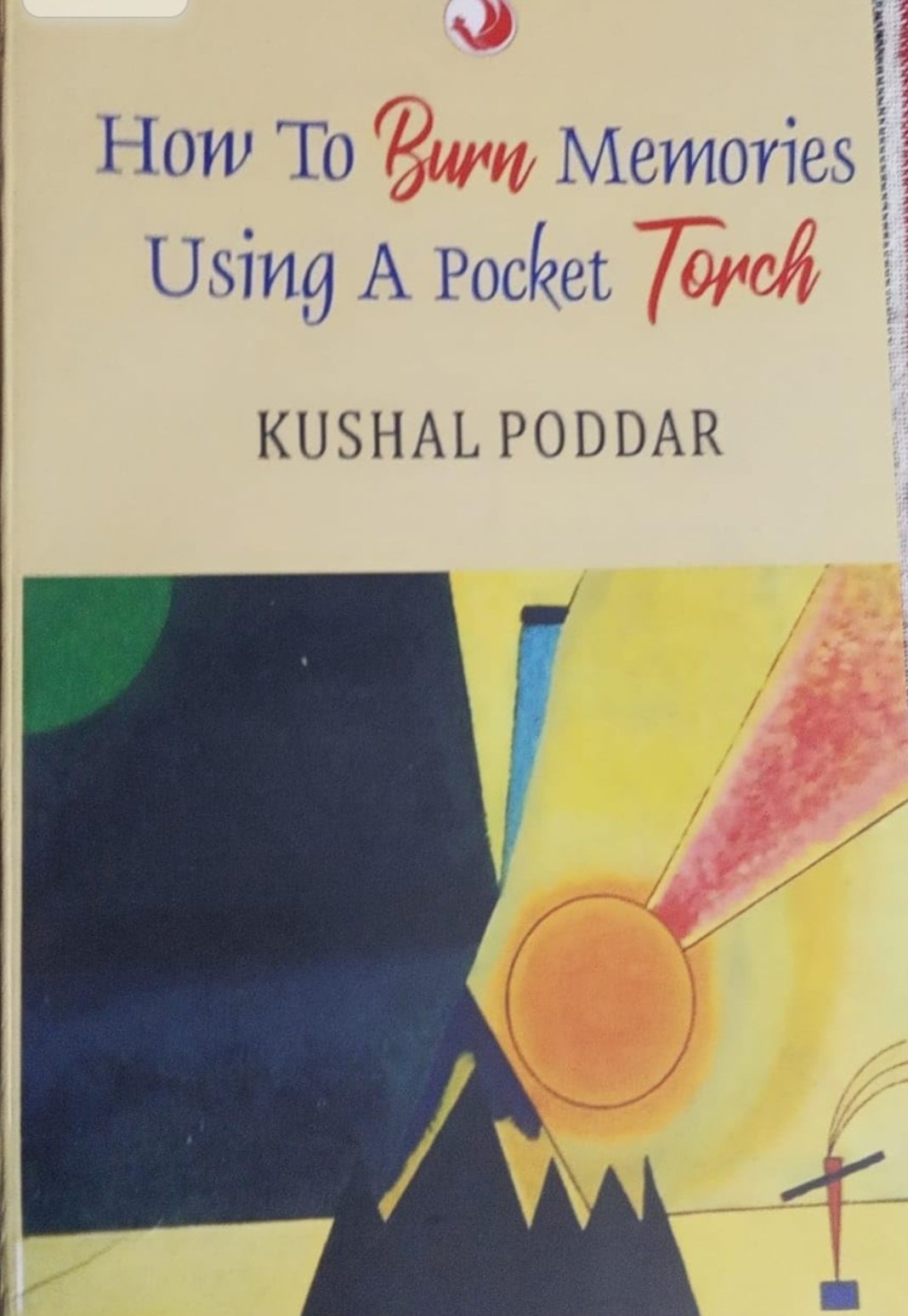
Wombwell Rainbow Book Interviews: How to Burn Memories Using A Pocket Torch by Kushal Poddar

Kushal Poddar

The Interview

Q:1. How did you decide on the order of the poems in your book?

They are more or less date wise. I often wondered if we write a single poem in parts throughout our lifetimes. Hence I often gather poems in the very order they were first drafted.

Q:1.1. Like a diary?

A journal, annotated observations of surroundings and news. Of course, the commentary climbs and crosses the wall between the world we see and the world we imagine.

Q:2. How important is form in these poetic “observations”?

I have been using both blank verse and free verse, rely on slant rhymes and ears for beats and meters , but barring a few sonnets I don’t bind my poems in strict forms.

Q:2.1. What appeals to you about the sonnet?

Sonnets provide a song to the neatness. I mean, the form is, unless you consider the deconstruction and modern variations like those written by Rita Dove, tight and gives you a sense of the undulation of iamb, and this neatness you carry with you when you are not writing a Sonnet. Even when you are free-versing you have a rooted sense of beats.

Q2.1.1. What do you mean by “rooted sense of beats”?

Beats and rhythms are everywhere. A musician hears them in the flow of water, wind passing through the leaves, dogs barking. Sonnet helped me, and I guess, listening to instrumental music in the background while writing too, to hear the echo of the rhythm and apply that in my word processing.

Q:3. How does the natural world feature in your poetry?

They are in seriatim- follow the events of my life and life at large as I witness, as I live.

Q:3.1. Autobiographical. If the natural world happens in the moments you live, it is included?

Nature, Paul, as Harold Proshansky would have pointed out, changes human mind, mind’s tolerance and impatience. I write outdoor mostly. The stories that are not mere personal are observed in the park, road or by the riverside. 

Now here is a two fold impact. I try to stay a neutral observer in the field watching human nature and the nature outside, and yet I myself become one dot in the cycle. Nature impacts my mood as well. I see the same event with either cheery or gloomy eyes depending on my mood.

Q:3.1.1:  “park, road and riverside” describe a vital sense of place in your poetry. How important is this to you?

When I began writing in English it was traversing beyond my boundary, but I carried the dirt of my land within me. The sense of place becomes stronger as I age. Now I journey  back to my city with the cairns, words and cultures from everywhere.

Q:4. When writing a poem what do you do to dislocate the reader’s perceptions to make them see the events you describe differently?

Perception, Paul, is a closed door compartment, a vault. It is a frame we put around a new artwork. I believe in avoiding sweeping statements even like theine just uttered. In writing, even in a medium as emotional as poetry I try to adhere to show more, tell less. It doesn’t dislocate a reader, rather a reader accepts it in his vault. A poem is a thousand poems according to thousand readers

Q:5. How does living in a city reflect in your poetry?

I see village people coming in search of something, and I observe their tiredness, dreams,  frustration etc. I go into a village with naive eyes and see the skin of reality, its green and beauty. I know what lies beneath but as a city dweller I have the advantage of being overwhelmed by what lies on top.

Q:5.1. Being “overwhelmed” is an “advantage.” How so?

It lets you feel effervescent, lets you detail the shine and the goodness instead of the pull of darkness that you may feel and that may drain all the words.

Q:6. Why is surrealism important to your poetry?
 
Surrealism stretches the possibilities beyond and beneath at once. It dives deep into our subconscious, tweaks our id and manipulates our ego. Surrealism flies on the far side of reality. It is an echo of reality and yet it adds to the same.
 
Q:7. Once they have read your book what do you hope the reader will leave with?
 
I hope my readers find an alternative reality or at least wings to fly beyond their own or gears to dive deep into their mind after reading my books.


Wombwell Rainbow Book Interviews: Velvel’s Violin by Jacqueline Saphra

Jacqueline Saphra

is T.S. Eliot Prize nominated, award-winning poet, a playwright, editor, agitator, teacher and organiser. She is the author of ten stage plays, four chapbooks and five collections. Jacqueline is a keen performer and collaborator, working with composers, musicians, visual artists and other poets. She offers mentoring and teaches poetry in all kinds of settings including The Arvon Foundation and The Poetry School.

Her fifth collection Velvel’s Violin is out from Nine Arches Press.

The Interview

Q:1. How did you decide on the order of the poems in your book ?

Just like an individual poem, a book goes through many formal changes in its development. Once I had a critical mass of poems ready for the book, I laid them out on the floor and tried to make some kind of sense of them. I put them together as a single document with no breaks, looking for poems that juxtaposed, connected and bounced off one another and (unusually) shared the manuscript with my husband. It quickly became apparent to both of us that there was too much complexity in this book and somehow it needed more space. I came up with the idea of using, as headings, excerpts some of the poems I’d been reading over the previous few years that had been influential on the book. This helped me to give the sections a kind of cohesion. I tried several different groupings and once I’d arrived at something I thought was workable, I drafted in my daughter Tamar, who is, handily, a dramaturg and theatre director and has an understanding of structure and narrative. She helped me take some poems out, add some poems I’d dismissed, and make sense of the sections. Of course sections are interesting in a poetry book, because the content of many poems can cross over from one section into another. So this became an endlessly reiterated and painstaking process of shifting poems around until they found their positions. Eventually, after editorial meetings and correspondence over a period of months with Jane Commane, my editor, the book reached a point where moving any one poem to another place had a disruptive ripple effect on all the others and upset the balance. That was how I knew the book was done. Although there was a very, very late change in the final manuscript when I suddenly realised the final two poems needed to be swapped around. That was a surprise! The same kind of surprise, in fact, that you sometimes get when writing an individual poem.

Q:2. How was the book shaped by current as well as past war and conflict?

I have always liked historical narratives because however terrible the stories might be, they are over! Notwithstanding, I had always intended and understood from the early days of writing this collection, that the past and present constantly bleed into each other and we fail repeatedly to learn from past conflicts. Just as I was building momentum in the writing of the book,, the Russian  invasion of Ukraine really sharpened and focused this view. It became impossible to carry on working on ‘Velvel’s Violin’ without letting the new, devastating war in Europe become part of it. Our current geo-political disturbances, ongoing wars in many different countries and our so-called ‘migrant crisis’ are also a big presence. My own relatives were murdered in concentration camps because they were not given sanctuary in other countries; there are so many parallels with our current moment. You’ll notice that ‘Prologue’, the first poem in the book, is focused on a profound sense of temporal dislocation. During the writing process, in my dreams, my nightmares, my work and my life, I was longer located in either past or present. Time became confusing, fluid and endlessly malleable.  

Q:3. How important is music in your collection?

Well, it is called ‘Velvel’s Violin’, and there is a painting by Marc Chagall, the ‘Violiniste Vert’ from 1947 on on the cover. The title poem, is about a violin that was buried at the start of World War Two and never recovered by its owner, who was murdered by the Nazis. I’m a big fan of Sholem Aleichem, the Yiddish short story writer and playwright, who wrote some unforgettable short stories set in the Eastern European shtetls (Jewish villages) in the early part of the nineteenth century. In fact his stories of Tevye the Dairyman, unsparing in the way that they describe the grinding poverty of the everyday lives of most Jews, were the inspiration for the somewhat sanitised musical‘ Fiddler on the Roof’ (which I’ve always loved). The title of the musical was probably inspired by Chagall’s paintings of violinists. Jews in The Pale of Settlement were forbidden to take up most professions but they were allowed to become musicians – and Jewish musicians, unlike most Jews, were permitted to travel. The lucky ones (often from Odessa), if talented enough, could make a good living as violinists and of course the instrument is small and portable. I myself learned the violin as a child and as you’ll see from the poem ‘Peace be Upon You’, I wasn’t great at it, but it felt meaningful and connective in some way. Klezmer music and the mournful sound of classical violin definitely formed the soundtrack in my consciousness while I was writing the book. A long time after writing it, I understood that the burial of the violin in the title poem represents to me the many buried victims, and all those voices that were silenced by the Nazis and their collaborators.

Q:4. What is the significance of poetic form in the collection?

There are some given forms in the book – but mostly I didn’t find even the sonnet, my go-to form for dealing with hot subject matter, particularly helpful. It was as if the constraints of form couldn’t hold the immensity of the material. The poems needed their own forms and often spilled over in unexpected ways. 

Q:4.1. How did it spill “over in unexpected ways.”?

‘Remains: Berlin 1945’ is a poem based on the end of the second volume of Volker Ullrich’s biography, ‘Hitler: the Descent’ was so filled with horror it took many drafts for it to find the scattered and uneven form.

‘1939’ was a piece I couldn’t corral into a poem shape – although I tried – and became a kind of hybrid form, what I often describe as a proem: something with the distilled quality of a poem but the appearance of prose.

“Going to Bed with Hitler’ became little squares of prose poems coming one after the other – again, a way of making sense of the senseless.

Q:5. How important is food in your book?

I’d say food is and has always been a big part of Jewish life. Useful as a cultural marker for both the observant and the unobservant. We always celebrate with food (or fast) and food has vast symbolic meaning – bread, wine and the seder plate with its metaphorically laden items: the egg, the matzo (unleavened bread), the charoset (mortar for slaves to build the pyramids). ‘Yom Kippur’ is of course all about fasting and how it concentrates the mind, and ’The Trains, Again’ explores the Sephardi (as opposed to Ashkenazi) traditional foods and their place in family life. So I’d say food is not a major component in the book but there is a nod to it in various places as being significant.

Q:6. Travel, especially by train is a running theme throughout. How deliberate was this?

The trains were not a motif I particularly thought of before I wrote the book, but trains of course exist in Jewish history as very significant, especially in relation to the Holocaust so I am not surprised they keep coming up. They exist both in literal, historical terms and also in the subconscious as mostly taking Jewish people to concentration camps and death, but also as a means to escape. When I wrote ’The Trains Again’ I was recalling a friend and I discussing the almost unbelievable sight of refugees being carried into Berlin to safety rather than out of Berlin towards annihilation. I was surprised how often trains appeared and thought of using that motif in the title although the violin won out in the end.

Q:7. Once they have read your book, what do you hope the reader will leave with?

This is a difficult question to answer as I wouldn’t presume to assume or know or even hope. The poem is always in the eye of the of the beholder. But I suppose I can allow myself to dream that the reader will come away feeling galvanised to make a better, more just and peaceful world and to take some responsibility for being a part of that. As Rabbi Tarfon put it – millennia ago – in the epigraph at the start of the collection ‘You are not obligated to finish the work, but neither are you free to abandon it.’

Jacqueline’s fifth collection Velvel’s Violin is out from Nine Arches Press.
Thankyou, Susan. I am humbled by your magnificent reading of my words.

https://www.podbean.com/ep/pb-fumgj-1653a7c

My Available Poetry Collections, So Far

The Fabulous Invention Of Barnsley, (Dearne Community Arts, 1993).

A World Where (Nixes Mate Press, 2017)

She Needs That Edge (Nixes Mate Press, 2018)

The Spermbot Blues (OpPRESS, 2017),

Please Take Change (Cyberwit.net, 2018)

As Folk Over Yonder (Afterworld Books, 2019).

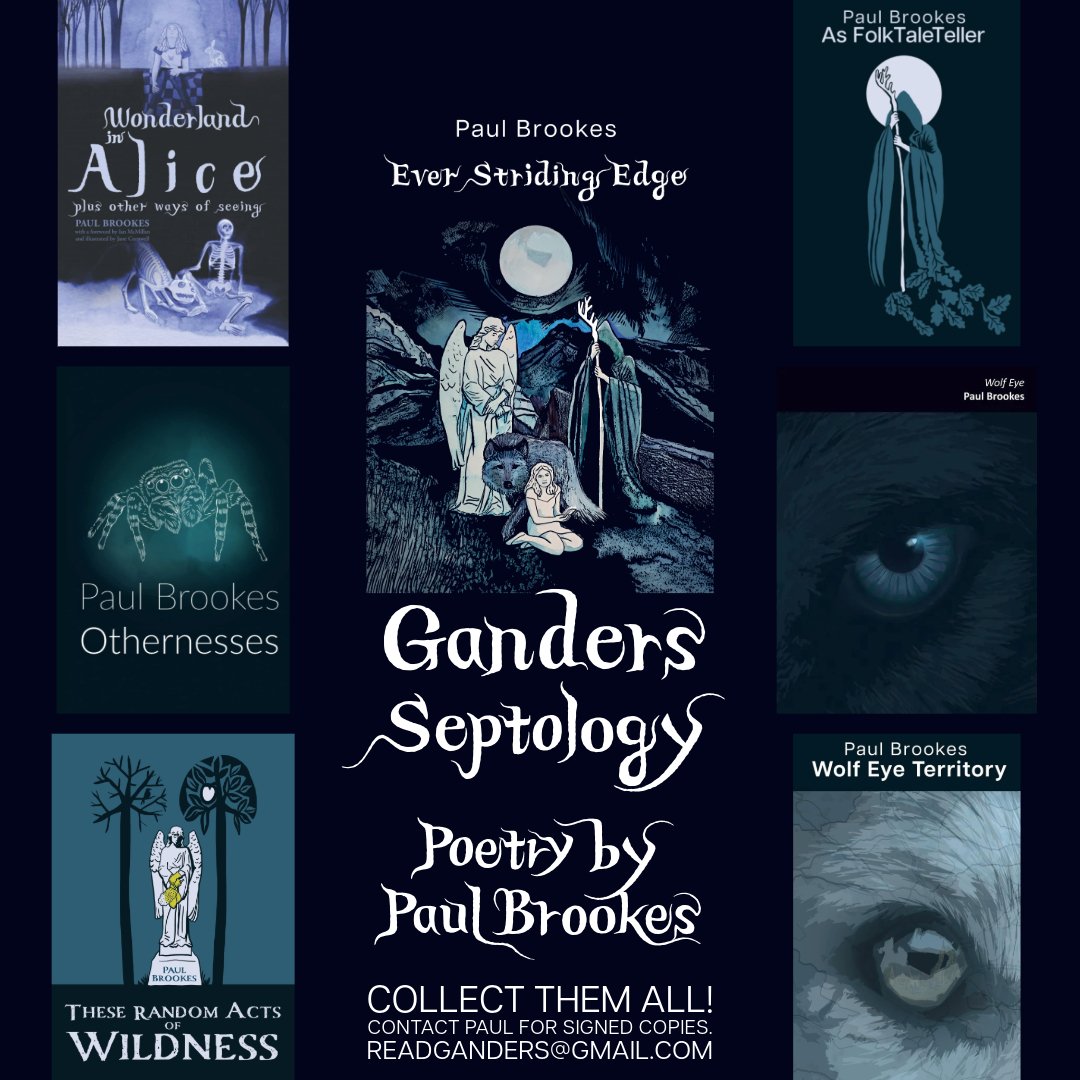
GANDERS: SEVEN CONNECTED BOOKS

Wonderland in Alice plus other ways of seeing (JCSudio Press, 2021)

As Folktaleteller (ImpSpired, 2022),

Othernesses (JCStudio Press, 2023)

Random Acts of Wildness (Glass Head, Press, 2023)

Wolf Eye, (Red Ceilings Press, 2023),

Wolf Eye Territory,(ImpSpired,  2024).

Forthcoming Ever Striding Edge, (Dark Winter Press, 2024).

Delighted and honoured to receive this review 9f “Wolf Eye” from the prolific Christine Tabaka.

https://www.theredceilingspress.co.uk/product-page/wolf-eye-paul-brookes

Ann Christine Tabaka – poet
Website: https://annchristinetabaka.com
Linktree: https://linktr.ee/christinetabaka *(all my sites listed in one place)

Ann Christine Tabaka was nominated for the 2017 & 2023 Pushcart Prize in Poetry; nominated for the 2023 Dwarf Stars award of the Science Fiction and Fantasy Poetry Association; winner of Spillwords Press 2020 Publication of the Year; featured in the “Who’s Who of Emerging Writers” 2020 and 2021. Selected as a Judge for the Soundwaves Poetry Contest of Northern Ireland 2023. She is the author of 17 poetry books, and 1 short story book. Her most recent credits are: The Phoenix; Eclipse Lit, Carolina Muse, Sand Hills Literary Magazine, Ephemeral Literary Review, The Elevation Review, North Dakota Quarterly.
*(a complete list of publications is available upon request)

Ganders: A Septology will be completed this September 2024 with the release of Ever Striding Edge by Dark Winter Press. Collect all seven. Get on the pre-order list for the final book.

Wonderland in Alice: Plus Other Ways of Seeing (Poetry from Jane’s Studio Press) https://amzn.eu/d/1nANJrJ

As Folktaleteller https://amzn.eu/d/fr2OoPf

Othernesses (Poetry from Jane’s Studio Press) https://amzn.eu/d/3pkMNvQ
https://www.theredceilingspress.co.uk/product-page/wolf-eye-paul-brookes
Wolf Eye Territory https://amzn.eu/d/3RmkRBM


Wombwell Rainbow Book Interviews: “Elemental” by Helen Laycock

Helen Laycock

is a Pushcart-nominated poet, recipient of the David St. John Thomas Award, nominee for the Dai Fry Award and recent winner of Black Bough Poetry’s Chapbook contest. Her poetry collections include ‘FRAME’, ‘BREATHE’, RAPTURE’, ‘13’, and most recently ‘ELEMENTAL’. ‘FRAME’ has featured as Book of the Month at the East Ridge Review and a forthcoming collection will be published by Black Bough.

Her writing has appeared at Reflex Fiction, the Ekphrastic Review, the Cabinet of Heed, Visual Verse, Onslaught Press, Folkheart Press, Prattlefog and Gravelrap, The Wombwell Rainbow, Poetry Roundabout, Spilling Cocoa Over Martin Amis, Paragraph Planet, Serious Flash Fiction, Flash Flood, The Best of CafeLit, The Beach Hut, Popshot, Lucent Dreaming, Full Moon and Foxglove, The Caterpillar, The Dirigible Balloon, Literary Revelations, Black Bough, The Storms Journal, Broken Spine Arts, Fevers of the Mind and will imminently appear at The Winged Moon.

Helen also writes children’s fiction and short stories for adults.

You can buy Elemental here: https://amzn.eu/d/7serHdU

The Interview


Q:1. How did you decide on the order of the poems in your book?

First of all, thank you, Paul, for inviting me to The Wombwell Interview to talk about my collection ‘ELEMENTAL’.

As the title suggests, the theme of the poetry is ‘The Elements’ – Air, Fire, Earth and Water.

I don’t know if there is generally a favoured order in naming these, but whenever I organise anything, be it written pieces, storage, or even shopping lists, I try to find some sort of logic. In the case of the themes in the book, I used spatial positioning as my logic, imagining Air in the highest position, coming down to Fire, grounding us with Earth, then taking us to the depths of Water. These make up the four main sections of the book.

As with all my collections, I introduce the change of themes with quotations which I feel allows breathing space and prepares the reader for a shift of focus.

‘Air’ opens with three poems about birds, from a dead bird to a caged bird to a free bird, so again, there is gradual change between their states which I think works better than poems so different that they jar against each other.

I then begin to draw attention to an increase of height with a poem about an aeroplane, which we imagine at around 30 000 feet. There is also reference to death in this piece (a true story, by the way!) which, perhaps, transcends physical measurement of height if we imagine the heavenward rising of souls.

The poetry that follows focuses on what is happening in the atmosphere and space.

With nowhere else to go, this completes the section on ‘Air’.

‘Fire’ has the fewest poems, each of which is independent of the others since they all consider fire in their own way. It encompasses light as a metaphor, the physical and mythical power of the volcano (one I wrote after visiting Mt. Teide), the damage wreaked and repercussions of recklessly starting a fire, and the sun as a maternal energy.

Originally, this collection was going to be entirely water-based, but I changed it to The Elements, just because I wanted to include a favourite poem of mine, ‘Hare’, which nestles in the middle of the ‘Earth’ section.

The organisation here begins with trees and forest, widening to include a greater view of the world before spotlighting living things in the wider sense – animals, then people. ‘Scaffolding’ wraps up this section, a poem which is set below the ground in the graveyard, so taking us right back to level ground before we dive into…

‘Water’, the final section, which ebbs from the tiny stream to the lake to the sea. I have a couple of favourite poems in this section, both about whales, each of which has such an interesting backstory. Finally, I bring it back to the swimming pool and people.

There is one last poem in the collection which I feel encompasses all the themes, so it stands alone as a final piece.

Q:2.How important is form in Elemental?

Without form, I believe, poetry is only doing half the job. It’s never just about words, is it? The space is so important as a playground for them, and even the placing of a word, or words, along a line can make for a more dynamic piece.

I had a great comment from Matthew MC Smith, editor of Black Bough, in relation to my poem ‘Stunned’ (the opening poem of the collection) when he hosted Top Tweet Tuesday a few weeks ago.

He said,

This is the real-happening stopped in sequence in words. Wham!

Some of the precision of this recalls the exactitude of *Wallace Stevens.

That’s a compliment for anyone.’

*Wallace Stevens won the Pulitzer Prize for poetry in 1955. Significantly, he experimented with form and imagery in Modernist poetry. An interesting quote attributed to him is that modern poetry ‘has to be living’, and I think that clinches it. I love the form of his poem ‘Six Significant Landscapes’ where many lines consist of just two words, but how they shine when given that platform!

The word ‘STOP!’ is surrounded by white space in ‘Stunned’ which empowers it and gives it physical capacity within the poem.

Another example as to how form can earn its keep as a poetic device is in the poem ‘Whale Fall’. It is constructed to slowly pull the reader down to the bottom of the ocean along with the whale. The word ‘falling’ is repeated on consecutive lines to reproduce real life experience.

‘Sky Stir’ relies on sparsity of description as it endeavours to capture that frisson in the atmosphere just before a storm, the type that makes arm hair stand on end! I wanted the poem to suggest rather than tell the reader how to feel, so there are snatches of description.

The spaces are designed to reproduce the tension of anticipation.

Having a single word on a line draws attention to it, but also endows it with weight. Often, it is an important turning point in the poem. In ‘Conflagration’, for example, the scene that we witness is of youths starting a fire which quickly gets out of control. Once they are aware of the scope of their exploits, they ‘flee’. This word stands alone. It is the first major action in the poem, and the last we see of the group until we are told of their consciences in the aftermath. When a word hangs like that, we are invited to contemplate what might have subsequently happened. For a moment, we follow the boys until they vanish from sight…

There is a wonderful freedom to experimenting with form, and also not having to comply with the constriction of rhyme. In the poems ‘Hare’ and ‘Watergasp’, I was able to create a sense of movement by creating diagonal lines of text, which was exciting, and in ‘Abduct…Adopt… Relinquish… Abandon…’ where the sea is seen as a captor of sorts, a kind of wave.

I will tweak a poem over and over until I feel the form echoes as much of the content as it possibly can. It’s a brilliantly creative and fulfilling endeavour for me!

Q:3. What is the purpose of the quotes at the beginning of the book, and throughout?

Including quotes is something I have done with all my poetry collections, with the exception of ‘13’, so I would say it’s a bit like having a brand, or something which links the books in some way.

There are several reasons for this.

Unlike a short story collection, I think a poetry collection has visual aesthetics. When you flick through, you see shape. I once bought a book , aptly entitled ‘Wonderbook’ by Jeff Vandermeer, purely because of the pleasure of flicking through and seeing something unexpected inside. I like the idea of sprinkling pages of poetry with a different condiment which catches the eye.

Secondly, they add the dimension of approaching the subject using prose, albeit quite poetic. It’s a glimpse at the subject from a different, or shared, perspective. The opening quotation on the title page is from Frederick Douglass, one which I selected as a kind of general introduction to the book as it conveyed the power and the thrill of the elements:

It is not light that we need, but fire; it is not the gentle shower, but thunder. We need the storm, the whirlwind, and the earthquake.’

This intensity is what stirs poetry.

One more quotation follows this, before the contents page, as I felt it summed up how crucial the elements are to our wellbeing:

To find the universal elements enough; to find the air and the water exhilarating; to be refreshed by an evening walk or an evening saunter…to be thrilled by the stars at night; to be elated over a bird’s nest or a wildflower in spring – these are some of the rewards of  a simple life.’

~John Burroughs

I think this is what poetry aims to capture… the wonder in everything that surrounds us.

The quotations make a much more pleasing change of shift than a set of ellipses, or a blank page, so for each section, I have chosen one which gives a sense of anticipation as to what is about to follow. They also provide breathers, or stopping places, before the change of focus.

I particularly like the quotation by James Gates Percival which precedes ‘AIR’, as it alludes to both air and poetry; it would also have served the ‘WATER’ section well:

The world is full of poetry. The air is living with its spirit; and the waves dance to the music of its melodies, and sparkle in its brightness.’

I like how succinct Tom Robbins’ quotation is which introduces the ‘FIRE’ section –

Three of four elements are shared by all creatures, but fire was a gift to humans alone.’

but I was also drawn to the human aspect which runs through the poems in this section, particularly in how the gift of making fire is abused in the poem ‘Conflagration’.

‘EARTH’ begins with eleven simple words from Khalil Gibran, ‘Forget not that the earth delights to feel your bare feet…’ . Such a wonderfully condensed statement which closely links humankind with the world and reinforces the concept of a symbiotic relationship. Love gives love.

The final quotation which introduces ‘WATER’ gives a sense of the mystery and scope of this amazing liquid which covers most of our planet. Underwater exploration is dangerous, yet enthralling. Another world exists beneath our feet. As Loren Eiseley points out: ‘If there is magic on this planet, it is contained in water.’

Q:4. How do you use the five human senses in ELEMENTAL?

I would like to say that all poets use all the senses, whatever the theme of a poem, but I don’t actually think that’s true. If they do, undoubtedly, it’s not in equal measures. Often the concentration is on probably just two, but don’t quote me on that!

My later writing has certainly been influenced by imagism (shoutout again to Matthew MC Smith), which I think tends to lean towards the visual aspect of metaphor.

As a poet, I feel like an observer, and, while that does immediately suggest ‘seeing’, if we give more thought to it, observation actually includes taking in as much as possible via any sense available.

How the senses influence my writing, however, is not a conscious acknowledgement of mine, so, to answer this question, I shall need to revisit the poems and come back to you…

Some time later…

The results are in!

SIGHT

As I suspected, visual detail takes the centre stage of every poem. Finding metaphor for what we see is probably the easiest pursuit. There is so much on hand to compare and contrast, whether it be by characteristics of shape, colour, material, etc.

SOUND

Sound is peppered throughout the poetry of ELEMENTAL, but, interestingly, I notice how much the lack of it is alluded to:

‘I cannot sing’, ‘shushed’, ‘The birds swallow/their last crotchet’, ‘silence teeters’, ‘the hawthorn sings/a silent spiderspin melody’, and the fox in ‘Winter Flame’ ‘pads silent on blunted ground’.

In fact, ‘Snow Song’ relies entirely on a lack of sound:

‘A duet

of snowfall

and silence.

The dawn sighs

into wakefulness.

Today,

colour is

too loud.’

There are degrees of sound, however. In considering walking through the forest upon coloured debris, in ‘On Binary Comment’, I write,

‘If leaves were bells,

our feet would make music’

Music is mentioned a few times:

The ‘music in the rafters’ in ‘Scaffolding’ has ‘long slipped through the cracks’ and the fish are described as the ‘cadence/of this ethereal music’ in ‘A Raucous Gull Shrieks Goodbye’.

Birdsong is occasionally mentioned as a backdrop, but ‘What the Gull Knows’ is actually quite  a noisy poem! ‘He screams of lurching masts whining with wind-ache’ and we hear ‘sailors’ snatched shouts’.

Twice in the book we hear a ‘shot’.

TOUCH

I tried to capture that frisson, the electrifying goosebumps we feel before a storm, in ‘Sky Stir’:

‘the pewter sky is

so

low

that it tingles my hair roots.

I feel it.’

There is gentle touching throughout the collection:

‘It is still warm/still soft’, about the dead bird in the opening poem. Other examples include: ‘tap the brittle shell’, ‘weightless fruit/ripe/in my palm’ and ‘cupping the stutter/of flame’, for example, but there’s also an element of unintentional brutality in ‘Collateral’, where, in talking about wildflowers, I write:

‘I must snap

the tender spines

of those on the periphery’

TASTE

The sea is described as ‘a pendulous pulse of over-seasoned stew’ in one poem, the implication being that the ingredients are the victims of shipwreck.

Taste is used, too, as a way of implying colour, as in ‘On Binary Comment’, where ‘sun syrup and rosewater’ describe the colour of painted treetops, for instance.

The poem ‘Foraging’ details the ingestion of psilocybin, the hallucinatory constituent of magic mushrooms, where a strange being ‘draped in leaf and mothwing’ ‘extracts soft tongues’ and ‘slips them/between my lips’.

‘Whale Fall’ perhaps dwells the most on the act of eating, herself becoming a banquet as she dies.

SMELL

Smell gets little airtime, although it is prevalent in ‘Man in the Woods’:

‘the pliant earth

which exudes a dank bouquet’

Other than the reference to ‘dirty breath’ in The Waking of the Dragon, there is little other acknowledgement of smell.

What an interesting exercise!

Q:5. Human impact on the natural world seems integral to the collection. How significant was this in putting it together?

When I wrote the poems, each one evolved separately without connection to any of the others, I thought… but when I decided on the ‘elements’ theme, these all seemed to fit. Unlike my collection FRAME, the focus of which is entirely ‘people’, the poems in ELEMENTAL don’t give them centre stage, although in several of the poems their presence is implied.

There are definitely poems which shine the light on human beings as perpetrators, such as ‘Jailbird’ where a caged bird is denied the freedom nature intended.

‘Stunned’ is an example of how we inhabit the place where nature could thrive. We build in its backyard, and, therefore, are in some way responsible for birds crashing into our windows, as happens in the poem.

We hear a ‘shot’ in ‘Hare’; it’s not aimed at the hare who, incidentally, escapes the danger of a human with a gun, but we can’t help wondering what was being shot at… undoubtedly an animal enjoying its habitat.

I mentioned, too, in an earlier response, the poem ‘Conflagration’. Humans are curious, perhaps moreso before adulthood, and this poem serves as an example of how they don’t always consider the outcome of their actions. They literally are playing with fire here, the consequences of which are devastating.

A poem which I found emotional to write was ‘Communion’. For as long as I have lived in my house, there has been a huge pine tree behind the boundary of my garden. One day, I heard a chainsaw and I looked out to see a man hanging from it. Horrified, I watched chunks of it fall out of my sight until there was nothing left.

I used one of the pieces of artwork – ‘Bent Cypress’ – from Karen Pierce Gonzalez, a wonderful artist, to write the poem ‘The Sadness of the Tree Spirit’. In the poem, are the lines:

‘as the forest thins

and thins…’

which we must attribute to man, and, significantly, because there is nowhere left for them to nest, just open space, the poem ends with the lines:

‘and the sound of

distant birdsong

is probably just

the wind’

The poem which perhaps demonstrates most what we do, and are doing, to our planet, is ‘Erasure’, the title of which implies both disappearance and forgiveness. Whatever we do to our planet, it

‘pledges a clean sheet:

no grudges

over and over again,

it gives us everything,

and is all

all

we have

beneath our feet.’

There are also poems included in this collection where nature has the upper hand, as in ‘Upright/Downfall’ which suggests a drowning has occurred, and again in ‘Abduct…Adopt…Relinquish…Abandon’ where the ocean gobbles up then spits out a human being. ‘The Waking of the Dragon’, too, shows the power harnessed by our planet, and the utter carnage it can unleash on humankind.

Q:6. How did you want to use white space in your book?

All poets acknowledge that the words are not the only constituent of a poem. It has shape and form, and a whole array of poetic devices which help squeeze out the intention and meaning.

A poem needs space to breathe… Lines that span a page edge to edge can come across as claustrophobic. This approach is not typical of the way I write poetry. I tend to clip my lines as though they are feathers, preventing escape or untoward roaming.

What can be effective is not only breaking lines for emphasis, but also leaving space between lines. These prolong the journey through the poem and provide a metaphorical bench for respite or contemplation.

I like very short poems to occupy the centre of the page, to be framed like a miniature work of art. I actually circled the untitled poem beginning ‘Muskmelon Moon’ to give it presence, whereas ‘Moon in Cloud’ quietly hovers on the page.

I don’t favour centring over left-side placing; the poem dictates that to me as I’m writing.

Q:7 Once they have read ELEMENTAL what do you hope the reader will leave with?

I hope that readers will

  • take away a new experience of poetry, perhaps discovering language and metaphor never before encountered;
  • feel an urge to revisit some, or all, of the poems, and perhaps remember a favourite in time to come;
  • deepen their desire for poetry, and immerse themselves in the wealth of fabulous contemporary poetry that is out there;
  • return to, and follow, my work and perhaps read what I have written on other themes.

Thank you so much for this opportunity, Paul. I have thoroughly enjoyed analysing the subconscious decisions in putting together this collection. The academic exercise gave my brain an excellent workout!

Here is a link to an earlier interview with Helen:

Wombwell Rainbow Book Interviews: Noah by Penelope Shuttle

Noah Front Cover

Noah can be purchased at this link:

https://www.brokensleepbooks.com/product-page/penelope-shuttle-noah

Bio and Links

Penelope Shuttle

lives in Cornwall.  Lyonesse, her thirteenth collection, appeared from Bloodaxe Books, June 2021, and was longlisted for the Laurel Prize. Covid/Corvid, in collaboration with Alyson Hallett, was published by Broken Sleep Books, September 2021. Noah, a pamphlet, appeared from Broken Sleep Books in September 2023. A new collection, History of the Child, is in preparation. Shuttle is a founder member and President of the Falmouth Poetry Group. A selection of her poems can be heard on the Poetry Archive website.

website: http://www.penelopeshuttle.co.uk

http://www.bloodaxebooks.com

http://www.brokensleepbooks .com

The Interview

Q:1. How did you decide on the order of the poems in your book?

The first Noah poem I wrote was deluge; I thought it was a standalone poem.  But about a year later I wrote a poem about animals, leaning towards their mythical and imaginal properties. I asked myself, why these animals, and why this expression of deep feeling about these animals? And a voice somewhere deep in me said, these animals are in Noah’s domain, and I realised that the deluge poem had been working away in my mind, and had engendered, maybe, the poem that I then called Noah’s notes (preliminary). Here I imagine the animals marching into the Ark, as Noah stands by the doorway, ticking them off a list.

At this early stage I thought of writing a short sequence of Noah poems.  A third poem turned out to be  a second animal poem, called Noah’s Domain, or Zooming-in on the Ark.

By now, out in the world, the pandemic had hit, and we were in lock-down.  Lock-down is a kind of Ark, and I’m sure the stresses of lock-down were alleviated, for me,  by the writing of more Noah poems.

I have, over the past ten years, become very involved with and engaged-by thematic projects in poetry:  Heath (with John Greening), Lzrd (with Alyson Hallett), Covid/Corvid: Pandemic Sonnets (with Alyson Hallett), Lyonesse… And I’m currently working on a long suite of poems titled History of the Child.  So I’ve developed, if you like, a poetics for the longish haul, liking to use the muscles of language and the overall theme’s gift of constantly-renewing energies.

So after three Noah poems I recognised the signs, and began to explore the whole legend of Noah, and write my way into and around it,

Timeline?  I’ve had to go back and look this up. Deluge was written in 2015, and then the two animal poems in 2016.  I continued to write Noah poems, as and when they arrived, i.e, of their own volition, though I had tuned myself to their possibility, and I found, by 2020, that I had 50 pages of Noah poems.  Some of these were edited out, others had their titles changed, all this taking me up to 2021, and then I began to sketch out a running order.  I decided to go for chronological order, opening with Captain Noah informing his community that the Flood is on its way.  The original deluge poem came in as the third poem in the pamphlet.

My friend and colleague Katrina Naomi did a peer-review of the poems, and she made the insightful comment that the pamphlet might benefit from a closing poem to show when the Flood recedes and the Ark makes landfall on Ararat.  I had not written such a poem.  Katrina’s comment was inspiring and I wrote two closing poems, An Sorrowfulle Acount, and exodus. Once I had these closing poems the running order slotted into place pretty much organically, and so the pamphlet had its shape.

Q:2. Most poets seem to enjoy writing about animals in the third person, at a distance. What do you enjoy about writing from the first person, animal point of view?

Over the five years I was working on Lyonesse I took breaks from it and worked on other things.  This process refreshes my senses and my writing energies for the main project. It’s really freeing to have a change of poetic scene; to feel able to let your hair down and play with language, which is what you can do with work at an early stage. That was where the animals in Noah came from but, as you said, Paul, I do have a project (it has been lying a bit dormant of late) where I’m working on a bestiary, an alphabet of animals which pre-dates Noah.  I hope to get it finished one day!

But my interest in writing about animals came from very far back; first of all as a reader. I read Marianne Moore when I was in my teens. She writes wonderfully about animals and she gives you lots of contextual footnotes. She employs a wry yet totally realistic approach in her poems, which are generous and wise poems. Denise Levertov has been a huge influence on me from early days, likewise, and she often writes about animals, mostly domestic animals.

Animals as a subject are intertwined with my life when I was mother of a young child. We would go out on family visits to wildlife parks, animal sanctuaries, zoos.  Animals begin to appear in my my third and fourth collections; The Lion from Rio in 1986 and Adventures with My Horse in 1988. In The Lion from Rio there’s  a poem about a water-snake called The Hellbender and in Adventures with my Horse there’s a poem called Horse of the Month, and other animal poems.

Not far from where we live in Falmouth, there used to be a place called Killiow House.  This had been a big estate, and when Zoe was young it had turned itself into a kind of mini-Longleat but with no lions.  But there were donkeys, chickens and, most importantly, pigs. At Killiow House there were some lovely pigs and as a family we became very fond of them.  I wrote a poem called Killiow Pigs (Adventures with my Horse) and two other poems , Alice, and Alice’s husband, where I imagine the private lives of Alice, mother of 15 piglets, and her views on her husband.

It is a strange thing, to me, but two of my animal poems have been on the exam syllabus in England and Scotland for over twenty years, they’re still on the syllabus;  Killiow Pigs, and Zoo Morning.

Zoo Morning was written after a family visit to London Zoo when Zoe became perturbed by the caging of the animals. In order to allay her fears her father (Peter Redgrove) made up a story in which all the animals regard being in the zoo as a form of show-biz.  But in the evening, when they are off-duty, they have interesting lives: elephants party all night, bears indulge in politics, monkeys are scholars. This poem appears in Taxing the Rain.

After these collections, and as our daughter grew up, animals as a theme goes into the background, mostly, in the collections that follow.

Why then do animals as a theme suddenly come back in the Noah poems?  I think one answer is television!  My late mother lived to the age of 100, and retained her memory and cognition till the very last weeks of her life.  I spent a lot of time with Mum over the last two decades of her life.  We were both widowed in the same year, 2003.  And when for many years I travelled for work, my mum’s house just outside London was a great travel hub!  Among the programmes Mum liked to watch were animal documentaries, David Attenborough, Monkey World, various animal sanctuary programmes. These programmes were often rich in detail and amazing visuals and they made their way into my poems, but for me they are woven in with all the emotions around the good times I spent with Mum, who was a lovely easy person to be with.  The subject material of animals is not solely about animals, then, but my connection to animals through Mum.

Writing about animals is a privilege; I try to give personhood to animals, and to speak for their right to exist in their animal kingdom, which as we know is being destroyed around them.  I’ve learned a lot through writing about the creatures with whom we share our planet.  Animal energies are good energies to translate into language-energy.  I find these creaturely beings fascinating, poignant, threatened, and wiser, often, than humans. Animals live very structured lives, instinctual lives, but often with a wide margin for innovation and for mischief.  Who wouldn’t wish to write about animals?

I think we often write from information and impulses from far back in our lives.  Peter Redgrove’s non-fiction book, The Black Goddess deals with non-human senses, and proposes that there are many degrees of perception and sensory organisation of their environment possessed by animals which we, human animals, have lost. Peter’s book opened my perceptions to and erased stereotypes of the ways in which animals experience the world.

When Peter was working on drafts of The Black Goddess we had many conversations about his research; we discussed how he would shape the chapters, so there’s a bit of me on the sidelines of that book!

We owe respect to animals who live on this planet with deeper wiser and more profound sensory experience than ours. Humankind has blocked out a many of our primal senses; when I write about animals in the third person I’m trying to explore their senses.

By using the first person I’m hoping to make a profound identification, as far as I can, with the particular animal and without exploiting that animal. I’ve tried to keep open a channel in my imaginative writing where a particular animal can have its own say. It’s very close, this first person stance, to a shamanic process, the opening of the self to a possession or a very close identification with the animal.

When I’m writing in the voice of Alice the pig at Killiow, or when at the present moment I’m writing from the perspective of a female giraffe, that writing has elements of a shamanic saturation in animal-experience and may enable me to find a vital pathway back to those too-successfully repressed animal senses.

Humans have created a very sophisticated but limited life experience, we have made a deal with the devil. We’ve agreed to give up many of our senses, and these buried senses come back to haunt us, as repressed material always does.   I’m trying to find lost things for myself and in myself in these animal-voiced poems.

Anything you write involves paradox.  There’s a question that’s there for me: how much of my own personhood is human and how much is animal?  I’m attracted to whatever modulates who I think I am.

A totem animal can also be a poet’s muse. I’m thinking, for example, of Jo Shapcott’s Mad Cow poems from a few years ago. Her powers of poetic articulation reach out to the creatures who suffered in the foot and mouth epidemic, and these poems also break new ground for voicing individual and collective female perspectives, using that voice of apparent madness which has reason at its core.

A while ago, in an email from my friend and collaborator, poet and essayist Alison Hallett, Alyson wrote of poetry as writing the spells that have not been written yet.  To get closer to the reality of Alice the mother pig, to bring animal energies into the language, to enter the animal energies as a writing space, to merge with Alice, is to engage with shamanic process and to participate in a spell-casting,  spell- writing.

Wordplay is active in these poems; by playing with language I play with what it might be to live Alice’s life, the life of any animal; to wear their skin, to know the richness of their senses, have access to different ways of experiencing the world; to retrieve an innocence which is grounded in lived experience.

Further Reading: An Immense World: A Journey Through the Animal Kingdom’s Extraordinary Senses (2022), by Ed Yong.  He leads the reader through the vast and eclectic sensory experiences of animals. Exploring the concept of umwelt – or ‘the sensory bubble that each species exists in’, Yong examines everything from the smell and sight experience of dogs to the electrically powered navigation abilities of the black ghost knifefish.

Q:3.  How important is form in Noah?

Pound famously said that the image causes form to come into being.  For me, the poem comes to life when form and content have found perfect equilibrium.  Each poem has to find the form it needs; the poet’s task is to elicit that balance from language, experience, chance, and a deal of hard work.

I rarely start out with a particular form in mind. Most of my initial drafts will arrive in one long unbroken stanza. I live with that for a while.  Gradually, as I rework and reflect on drafts, the poem will shape-shift into the form it needs. I like couplets, and use them quite a lot in Noah.

I like sequences of short poems, and I also like, sometimes,  to vary line length and the length of stanzas.  I dislike poems that look ‘blocky’ or over-dense on the page, or poems whose shape on the page feels willed rather than organic.  I work to give the poem a sense of light and space and depth; spatial value. I think working with language is similar to the way in which a potter works clay on a wheel.  I feel the texture and tone and the impact of the poem in my hands as a malleable element;  I’m shaping living language into a form that has purpose, coherence, wit, beauty.

Throughout Noah I’ve used a variety of forms and registers;  there’s the couplet form, already noted.  In firebird I’ve cast the poem as a mini-playlet, a conversation between Noah guarding the door of the Ark, and the phoenix, asking to be allowed in.  In God and Noah there is a snappy dialogue between these two venerable characters, where they riff competitively on the symbolic value of animals. The subject of Noah, full of drama and known narrative, offers great scope to draw widely on different forms.

In although the text of the play is lost I have created a found poem from the records of the Trinity House Guild of Master Mariners and Pilots at Hull.  This is to be found in Medieval Stage, vol.ii., Chambers. Historic texts are a great resource for the poet, and I have experimented with  them in various collections.

Varying form in a book or pamphlet offers the possibility of creating many different atmospheres and types of speculation and imaginal reach.  It is a vital part of the coherence and magic of poetry.  It is a process involving pleasure! As D H Lawrence says of writing, if it’s no fun don’t do it!

In several Noah poems I have employed the open field technique, opening poems up by using a lot of the white space of the page, escaping the restraint of that lefthand margin.  In the poems scenes from the ark i and scenes from the ark ii I have put the stanzas on alternating  left and the right hand margins.  I  inset three lines in the middle of a longer stanza, in Madame Spider’s diary (extract), and varied the length of the stanzas to make sure that quite long poem did not collapse under its own weight, to let it have an aerial quality.

I am very sparing with punctuation; for me, this enables the poem to flow, and to engage with ways of modulation and musicality without the interruption of punctuation.  When you choose to avoid punctuation you will need to take great care with the line breaks, as they will be doing much of the work of punctuation.  I think it is best to put information in the title and/or in a footnote, so the poem is not burdened with excess information.

In that she hadde a shipe hirselfe alone,  I use the dramatic monologue to allow Emzara, Noah’s wife, to speak:  she was reluctant to enter the ark; she says:  I want another ark…

At a late stage I wrote two last poems. The penultimate poem,  An Sorrowfulle Account, takes the form of a mock-heroic ballad, written in rhythming quatrains.  This came out of left field, a form I’d never tried to make work, nor ever been attracted to.  The poem is about an Ape, a scholarly ape, who  has loved the solitude of his cabin on the Ark. He grieves when the Ark comes to the end of its voyage.  Writing this poem reminded me that we should never rule out working in any form, even though it seems uncongenial, and very far from our natural voice.   There will always be discoveries, new ways of weaving form and content together.

The final poem is Noah is exodus; the animals rush out of the ark.  The form of this short poem is a sestude.  A sestude is a poem comprising  62 words only , excluding title and footnote.  The sestude was devised by John Simmons for projects written by the TwentySix Collective.  It has something of the discipline of the sonnet about it.  After writing a number of them you get a sense of what 62 words feels like, in your mind,  your inner hearing, your memory, your senses. Like the sonnet it is an intuitional machine, and likewise its brevity is a wondrous resource.

Having said all this, it sounds as if I sat down and worked out all the forms beforehand.  But of course I didn’t.  I’m constantly surprised by where the poem takes me.  This is an integral part of the buzz.  I love how a poem will suddenly flip from margin to margin, tense to tense, shape to shape.  I love the tightrope-walk of keeping the exhilaration of the first draft alive right through to the final version.  I love working with the poem, asking the poem what form it wishes to take.  The poem is the expert, not the poet.

Recently I found a phrase I’d scribbled in an old notebook, from a visit to a Surrealist Painters Exhibition:  creating new meanings through bizarre juxtapositions. I’m often struck by how, when editing and just doodling about the poem,  two words collide or embrace, as if of their own accord, and make a new meaning, forge a new way for the poem to resolve and to shine.

Conversely, to keep the balance,  all is mediated by the crafting;  the poem begins with the instinctual, is moved forward by juxtapositions and chance, and the poet’s track record;  but the closing stages of making a poem involve close and ruthless scrutiny.  I often cut opening stanzas, lines that over-explain.  I often cut closing lines, that give too neat and pat a closure.  Imagine that the poem is The Ancient Mariner, and the Passerby is your reader.  You must hook your reader in with immediacy and purpose.

Curiously, it is only, as I’ve written this third answer, that I realise the seed of these Noah poems may well have been Peter Redgrove’s 1977 collection, From Every Chink of the Ark!

Coda:

Both as a young poet and as a poet today I have benefited from the influence of Denise Levertov. I love her work.  Like Levertov I don’t write ‘free verse’ but as she defines it, poetry that employs organic form.  Organic form, she says: ‘’is a method of apperception, i.e., of recognizing what we perceive, and is based on an intuition of an order, a form beyond forms, in which forms partake, and of which man’s creative works are analogies, resemblances, natural allegories.’

She has been a great influence on me, and I go back to her all the time, so it may be worth quoting at length from her seminal 1965 essay Some Notes On Organic Form.

(Today’s readers will observe that Levertov uses the locutions man/he to cover poets of all genders; though this may read oddly to us today she is merely following the mode of her historic moment.  This should not lead us to retroactively downgrade her status as a leading poet of her day, who was also an outspoken opponent of the Vietnam War, and an activist across a wide and radical spectrum.

Levertov writes: (from Some Notes On Organic Form)

For me, back of the idea of organic form is the concept that there is a form in all things (and in our experience) which the poet can discover and reveal. There are no doubt temperamental differences between poets who use prescribed forms and those who look for new ones—people who need a tight sched­ule to get anything done, and people who have to have a free hand—but the difference in their conception of “content” or “reality” is functionally more important. On the one hand is the idea that content, reality, experience, is essentially fluid and must be given form; on the other, this sense of seeking out inherent, though not immediately apparent, form. Gerard Manley Hopkins invented the word “inscape” to denote intrin­sic form, the pattern of essential characteristics both in single objects and (what is more interesting) in objects in a state of relation to each other, and the word “instress” to denote the experiencing of the perception of inscape, the apperception of inscape. In thinking of the process of poetry as I know it, I extend the use of these words, which he seems to have used mainly in reference to sensory phenomena, to include intellec­tual and emotional experience as well; I would speak of the inscape of an experience (which might be composed of any and all of these elements, including the sensory) or of the inscape of a sequence or constellation of experiences.

A partial definition, then, of organic poetry might be that it is a method of apperception, i.e., of recognizing what we per­ceive, and is based on an intuition of an order, a form beyond forms, in which forms partake, and of which man’s creative works are analogies, resemblances, natural allegories. Such po­etry is exploratory.

How does one go about such a poetry? I think it’s like this: first there must be an experience, a sequence or constellation of perceptions of sufficient interest, felt by the poet intensely enough to demand of him their equivalence in words: he is brought to speech. Suppose there’s the sight of the sky through a dusty window, birds and clouds and bits of paper flying through the sky, the sound of music from his radio, feelings of anger and love and amusement roused by a letter just received, the memory of some long-past thought or event associated with what’s seen or heard or felt, and an idea, a concept, he has been pondering, each qualifying the other; together with what he knows about history; and what he has been dreaming—­whether or not he remembers it—working in him. This is only a rough outline of a possible moment in a life. But the condition of being a poet is that periodically such a cross section, or constellation, of experiences (in which one or another element may predominate) demands, or wakes in him this demand: the poem. The beginning of the fulfillment of this demand is to contemplate, to meditate; words which connote a state in which the heat of feeling warms the intellect. To contemplate comes from “templum, temple, a place, a space for observation, marked out by the augur.” It means, not simply to observe, to regard, but to do these things in the presence of a god. And to meditate is “to keep the mind in a state of contemplation”; its synonym is “to muse,” and to muse comes from a word mean­ing “to stand with open mouth”—not so comical if we think of “inspiration”—to breathe in.

So—as the poet stands open-mouthed in the temple of life, contemplating his experience, there come to him the first words of the poem: the words which are to be his way in to the poem, if there is to be a poem. The pressure of demand and the meditation on its elements culminate in a moment of vision, of crystallization, in which some inkling of the correspondence between those elements occurs; and it occurs in words. If he forces a beginning before this point, it won’t work. These words sometimes remain the first, sometimes in the completed poem their eventual place may be elsewhere, or they may turn out to have been only forerunners, which fulfilled their function in bringing him to the words which are the actual beginning of the poem. It is faithful attention to the experience from the first moment of crystallization that allows those first or those forerunning words to rise to the surface: and with that same fidelity of attention the poet, from that moment of being let in to the possibility of the poem, must follow through, letting the experience lead him through the world of the poem, its unique inscape revealing itself as he goes.

During the writing of the poem the various elements of the poet’s being are in communion with each other, and heightened. Ear and eye, intellect and passion, interrelate more subtly than at other times; and the “checking for accuracy,” for precision of language, that must take place throughout the writing is not a matter of one element supervising the others but of intuitive interaction between all the elements involved.

In the same way, content and form are in a state of dynamic interaction; the understanding of whether an experience is a linear sequence or a constellation raying out from and into a central focus or axis, for instance, is discoverable only in the work, not before it.

Rhyme, chime, echo, reiteration: they not only serve to knit the elements of an experience but often are the very means, the sole means, by which the density of texture and the returning or circling of perception can be transmuted into language, ap­perceived….

The complete essay can be found on the website of The Poetry Foundation.

Q:4. How did you create and develop your characters in the dramatic theatrical parts of Noah?

I think the creation and development of the characters in the drama of my Noah poems are deeply inspired by my love of the old mediaeval or Guild plays; and so much of the work of development had already been done for me there. In those plays the language is very vigorous and the characters are presented with remarkable living vehemence, so that was my starting point.

Then I followed my usual practise, which is to improvise around a theme or a character, to bounce images and depictions about to see what happens, and to play with the speech of one character or another, to find out where it leads me.

It’s always difficult to put yourself back into that initial fiery creative space of the writing.  You’re there in that vortex of energies, of verbal and linguistic adventure, and it is more akin to play than to anything else.  Serious play! So much of what I write involves delight and self-surprise in language.

I’m always curious about what will happen if I put this particular kind of language pressure on, say, the character of Noah.  Let’s think about the fact that he was the inventor of alcohol. According to the Bible, he discovered how to grow grapes, and to make wine from the grapes.  Noah is found drunk, sometimes, and I used this part of the bible story, and the old plays, where his sons have to restore him to respectable order when they find him flat out blind drunk.

But, to return to the difficulty of putting yourself back into the place of the poem’s initial making; for me it is like a place outside time and space, yet, paradoxically, the most real place of all.  The imaginal freedom and the pleasure and demands of invention, of making everything in the poem resolve to a core concentration; this is exhilarating, and profoundly engaging to me. I 1 hope the poems have absorbed that energy; and that it survives all through the editing process, and the refining-down into shape.  There is a particular need to discipline the exhilarating wildness of that original imaginal outburst.

There are coherences to be found, resistances to teased-out and resolved. There is another pleasure in the honing, and of making sure the research is correct.

I feel that human nature doesn’t change radically, and that the people appearing in the Noah story are both from ancient times and yet also very close to being our contemporaries.

I also enjoyed writing about the character of some of the animal kingdom creatures on-board, Madame Spider, and the complaint of the Ape who does not want the voyage to end, and, of course, that phoenix.  Every one of them surprised me, made me want to explore their character and voice further.

The past, even the far-off biblical past, is always, for the imagination, present in our present.  Peter and I once owned a book (which I now can’t find, alas) titled The Bible as Literature, and this is my approach with the Noah story.  I’m approaching it as story, as legend, and not a particularly theological matter, though in my sequence Noah and God do have a somewhat competitive relationship.

I am often guided in my writing by Denise Levertov’s observation that ‘the poet sees, and reveals in language what is present but hidden – what Goethe called the open secret…’

The more I wrote about Noah, the more I was able to discover new things in these characters, field mice take refuge in Noah’s sleeve, small dinosaurs enter the ark, Mrs Noah’s character became clearer to me. Poetry is always discovery, a pilgrimage through language.

To quote Levertov again:  she advises poets to use ‘the gift of the senses, the gifts of memory and language and intellectual discernment, and the gift of intuition which transcends the limits of deductive reasoning.’  She also speaks, often, of ‘the responsive imagination.’

The dramatic force of the characters is deeply addressed through the editing process.  I edit a lot, and I edit over quite a long period of time. Through this time the characters are modulated and crafted, they come into focus over long shifts of time, and this, I hope, has enabled a deep reshaping of the characters; it took time for me to discern the extent of Mrs Noah’s discontents, and her very real sense of injustice, and to voice them.  I loved weaving her voice into language so that she becomes present and very real to the reader, but also I was making sure that none of this carried the taint of polemic.  The taunt from Noah to his wife, that he supposes she wants an ark of her own, was a key entry-point into the poem where she voices this desire, and articulates her resentment in being forced away from her beloved home and into the ark Noah has built.

To sum up: I write headlong from instinct and intuition, and then in the editing and crafting phrase, I try to avoid the over-directional nature of narrative, but rather to inhabit individual facets of the story and to shed light on some of the humans and creatures who people the story.

Q:5.  Why did you consciously decide to mix modern references in with mediaeval language construction?

I’ve always been really interested in where our modern English tongue has come from, its roots, the words that lie beneath contemporary speech. I’m interested as a poet but also as someone interested in the emotional history of how our ancestors experienced the world, and their lives in the world.

I’ve always liked browsing my way through dictionaries and glossaries and exploring linguistics but in a kind of very relaxed and poet-centred way. I’ve recently written a poem about this, called written on a linden leaf. This poem looks at how writing poetry is as much an organic process as it is for a tree to put out leaves. I chose the linden tree because of the mythology surrounding it and the human stories that have been drawn from the Linden tree from time immemorial.

Following your question I’ve really been having a deep think about when drawing on mediaeval language came into my writing.

In 2017 I was invited by poet and anthologiser, Michael McKimm to write a poem for an anthology called The Tree Line. This anthology celebrated the 800th anniversary of the sealing of the Charter of the Forest in 1217. This Charter is equivalent to the Magna Carta and it returned to ordinary people the rights they had within the forests of the British Isles, which rights had been eroded over many years. (Bad King John, etc.)

We were sent a copy of the Charter. I found the language there very exciting and inviting. I came across words such as – ayries, chimmage, brushment, greenhue, justicers, verderers, catellan…

So, I was asked to write a poem celebrating trees. My poem is called Forest Diptych, and the first part is written in the voice of a forester’s wife, and the second in the voice of the forester. They celebrate their love, and the rights restored to them, very essential as their living depends upon the forest. I used these words such as brushment, greenhue cloth, purlieu, chines, vassal, panage, fee-farms etc, because these ancient words made these people more real to me, and made me re-value our language, both ancient and modern.

Here is the first half of the diptych:

Charter of the Forest Wife

I’ll have honey out of his forests,

my bed soft-made from feathers of his falcons,

eagles, herons. I’ll have the brushment borne on his back

for my fires, spin greenhue cloth to fashion

his ranger’s garb fifteen days before the hunting of deer begins

at the time of the year’s third Swanimote.

I’ll have the bride’s pannage, fee-farms and asserts.

I’ll lie with my verderer in the forest.

No abbot, prior, earl, baron, justice, sheriff,

or bailiff a better man than he.

Married law of the forest joins us.

Give me the Honour of Lancaster,

it would not outshine our realm of oak and ash,

holy as where we were joined at the church door,

forest customs being our liberty and state,

as the far-away king,

who makes legal bridges over legal rivers,

has said in the book of this land’s fate.

I carried forward my love of these old and resonant words, in which so much life is contained and enshrined, but they are also available to the poet as a rich resource, so long as we can find a good balance between the words of now and then. When they weave and work together, they make a third reality. I went on drawing upon these words, in my reading of elder texts, and in drafting my poems for Noah.

I recommend The Tree Line to you; all the poems are marvellous and hugely varied.

The Tree Line, edited by Michael McKimm, The Worple Press, 2017.

Q:6. Why the title “Noah”?

I like one word titles. I’ve used them before: Unsent is the title of my Selected and New Poems, and Lyonesse came out in 2021.

To use a one word title you have to have a very strong theme.

Unsent is drawn from the title poem of that volume. It is a poem- letter which I wrote to Peter, inspired by a visit I paid to Saint Julitta’s Rectory at Boscastle in Cornwall. This was where Thomas Hardy met his first wife. St Julitta’s Church was a very special place for Peter and me. The poem Unsent constellated the themes of grief and bereavement, themes which preoccupied me from 2005-2012; and the poem sustained all of these emotions for me. Peter and I never visited St Julitta’s Rectory because for decades it was a private house. Now it is a bed and breakfast, and I went there for a day with a writing group, and it spoke so deeply to me, I wrote the first draft of the poem there.

The decision to use the title Lyonesse for my 2021 collection was a no-brainer. The legendary submerged land of Lyonesse off the coast of Cornwall has everything to do with loss, with how everything becomes submerged by time, by history. I was able to bring together my own sense of loss, and also to draw upon planetary bereavement at loss of habitat. I was able to draw upon the oceanic and upon the unconscious, bringing together personal and transpersonal experience.

There’s a good history of one word titles, isn’t there? There’s Crow by Ted Hughes, and also his River. There’s Ariel by Sylvia Plath, and more recently Poor by Caleb Femi, Migration by W S Merwin, Felt by Alice Fulton, and Fiere by Jacky Kaye.

The flood story and the making of the ark is an ancient and archetypal story; it appears in many cultures around the world. It seems that in ancient times there was a global inundation that left a huge scar on the psyche of the survivors, whose testimony has come down to us.

Noah is the myth of the flood and the ark; the perceptual possibilities in this story are very rich. Therefore, the unadorned title seemed to be my only option. The flood story has fascinated me in my last two books. It is a story invested with warning and yet with wonder, enabling a poet to render the familiar strange, to give it contemporary relevance. Though I will add here, my current work-in-progress has moved away from floods and bible stories!

Q:7. Once they have read your book what do you want the reader to leave with?

First off, I hope the reader has had fun reading the book. I’ve always felt that reading is an essential and sensuous pleasure. I hope the reader feels energised by the poems, will be intrigued to see Noah in a range of different aspects. A reader might disagree with me on certain Noah matters perhaps, but I hope that we can meet one another in an exchange of ideas in the way that we sometimes debate, in our heads, with the author of the book we’re reading.

I hope it opens a door into perception about how great figures from ancient biblical legends can be closely examined, critiqued, re-encountered, played with, and turned on their head. Poked-at, if you like, to see what jumps out.

Thinking and imagining about Noah takes us to a place of rootedness , the ground-base for patriarchal attitudes. I wanted to chivvy along the patriarchy, to show how frail and shallow that patriarchy is, yet how it represses matriarchal energies. That is why I showed the daughters-in-law of Noah treating him as a kind of big baby, cutting his toenails, and plaiting his beard with loom bands. There are many ways of circumventing the patriarchy.

I have this picture, in my mind, of Noah, as if he was played by John Huston in a Cecil DeMille movie. I hope the reader find a cinematic atmosphere in the Noah poems, the technicolour and shadow-play of movies caught in language.

I also hope that readers feel from their reading experience of Noah that now they want to write something (on any subject) themselves. That is what happens to me when I read wonderful poems by poets such as Denise Levertov, Paula Meehan, Charles Olson. Frances Horovitz, Jane Burn, Geraldine Clarkson; their work always makes me want to go and write my own poems. That’s because reading a good poem lifts your energy, extends your reach, a good poem enchants you, it dances through you with its wonderful energising force, and it gifts you your own voice, renewed.

So these are the some of the things I hope for.