The Wombwell Rainbow Presents The Whiskey Tree Wave 2 Interviews: Mark Antony Owen

Mark Antony Owen

is the author of digital-first poetry project Subruria. He’s also the creator, curator and driving force behind two popular and successful online poetry journals: the quarterly poet library that is iamb, and the ekphrastically focused After…

The Interview

1. How did you decide on what poems to send?

Alan asked us to take the gloves off – to write or select poems we felt our usual readers might not expect from us. Poems which perhaps we wouldn’t even consider publishing at all: not because we worry about the quality of those poems, but because we fear how they (and we) might be perceived upon publication. At least, that’s what I took away from Alan’s injunction. It made me choose a trio of poems that aren’t typical of me: poems which take a bigger risk. More specifically, for this first volume of wave two of The Whiskey Tree, my decision was settled once I remembered I had a poem that took a slant view of something quintessentially British: the weather. More exactly still, rain. This could have been a somewhat prosaic, unpromising topic for a poem intended to be ‘untamed’. What stopped it from being so was the fact that the rain which inspired the poem came laden with pinkish Saharan sand, owing to a freak weather event in southern England a few years ago.

2. What poetic form did it take, and why?

As ever, my three poems each took one of my nine self-created syllabic forms. I wasn’t prepared to go THAT left-field for this project!

3. How did you use the whiteness of the page in your poem?

All of my poems rest on invisible lilos in pools of white space. This is how I like to write my poetry. And if I’m being completely honest, it’s also how I like the poetry of others to be written.

4. How did you decide on the title of your poem?

It was about as literal as I could make it – which was deliberate for two reasons. The first is that I knew the title could be misread: a hurried reader perhaps thinking this was a piece about it raining IN the Sahara. The second reason was that I knew right away that every line beneath the title was going to have to work hard – obliquely yet lyrically – to leave the reader satisfied that the promise of the poem’s title has been fulfilled.

5. Imagery, or narrative. Which was more important to you in writing the poem?

Narratively speaking, I had a vague idea from the off that I was trying to tell the story of this peculiar weather event in a sort of linear way. But I rightly trusted my intuition as the poem unfolded. Its main driver became its lyricism: image begetting story the way character begets plot.

6. What do you think of where your poem is placed in the collection?

It’s near the beginning … so obviously, I’m thrilled! However sensitive we poets are, however understanding, we still have egos as swollen as whales! They need feeding – and something as simple as where our work appears in an anthology makes for a lovely appetiser.

7.  Once they have read your poem, what do you hope the reader will leave with?

I guess the answer to this is the same as the answer I’d give if you asked me this question about almost any of my poems: I want the reader to leave feeling differently. Thinking differently too, of course, but if I can implant a feeling as a result of something I’ve written, I can be fairly certain my work – in whole or in part – will have made a genuine impression. A lasting one too, I hope.

Weblinks:

bsky.app/profile/markantonyowen.com

bsky.app/profile/subruria.com

bsky.app/profile/iambapoet.com

bsky.app/profile/afterpoetry.com

subruria.com

iambapoet.com

afterpoetry.com

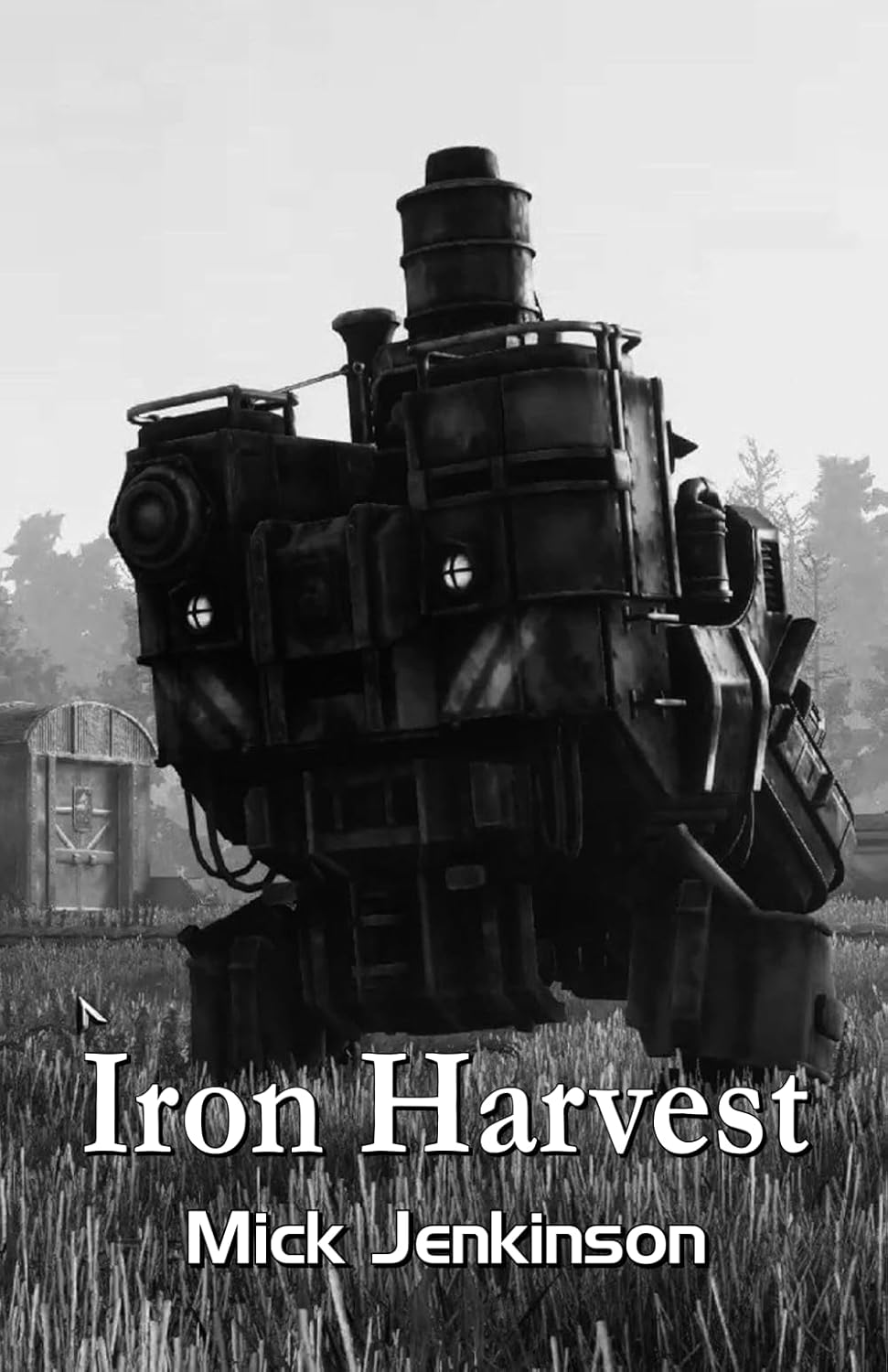
Wombwell Rainbow Book Interviews: “Iron Harvest” by Mick Jenkinson

Mick Jenkinson

is a poet, songwriter, musician & freelance arts practitioner from Doncaster. He is a member of a number of community groups whose aims are to increase arts engagement in the Doncaster region and he delivers song writing and poetry writing workshops. He was the director of Doncaster Folk Festival for 5 years and a founder member of the Ted Hughes Project in Hughes’ childhood hometown of Mexborough.
He is founder and MC of Well Spoken, a monthly poetry performance evening held at Doncaster Brewery, and a founder member of the South Yorkshire poetry collective Read 2 Write, a group mentored by Ian Parks. His first pamphlet, A Tale to Tell, was published by Glasshead Press in 2017, followed by When the Waters Rise, published by Calder Valley Poetry in 2019.
His poems have appeared in Pennine Platform, Dream Catcher, Dreich, Setu Mag, The Don and Dearne Collected Poems Vol 1, Black Bough Poetry’s Christmas & Winter Anthology Vol 1, and Christmas & Winter Anthology Vol 2, the exhibition these poets, our kin / these poems, our stories in the Frenchgate Shopping Centre, Doncaster, The Northern Poetry Library’s collaborative online work Poem of the North, and the book Tom’s Territory by Terry Chipp.
In 2017 Mick formed a songwriting partnership with the poet Ian Parks and received an Arts Council commission resulting in the album of songs and poems about their locality, Songs of Our Town. Mick has since released two further favourably reviewed solo albums, When My Ship Puts out to Sea and The Wheel Keeps on Turning. Find him at http://www.mickjenkinson.co.uk

The Interview

Q:1. How did you decide on the order of the poems in Iron Harvest?

There were a few key drivers for the order, but beyond that it evolved pretty organically, and was more to do with the indefinable feel of how it flowed as a reading experience.

Firstly, the opening and closing poems needed to be both strong, and at the same time to make some sort of statement. Although I’d no wish to create a themed collection, it’s undeniable that I write much that’s geographically rooted in some way, and more specifically, about my hometown. Opening with This River seemed quite natural as it’s a manifesto of sorts for my love of Doncaster and its landscapes, and readings have indicated that it connects with audiences very viscerally. At the other end of the book, Past Brodsworth is my most anthologised poem, it’s really been around the block and proved its worth! I see that as a sort of origin story for the town.

The second consideration was to give a flavour of the scope of the collection within the first few pages, so it was important that a variety of styles and subject matter were represented, but without it seeming disjointed.

Then, I specifically did not want the book to feel as if it was in themed sections, so other than a couple of instances where I thought a pair of poems belonged together, I was deliberate in interspersing poems that might be seen to have common subject matter.

There’s also a temptation to cluster the poems one regards as the strongest towards the front, and I did not want it to be like one of those vinyl LP’s where all the singles are on side one and no-one listens to side two! so balance throughout the collection was probably the strongest deciding factor for how it ended up.

Q:2. Why the title “Iron Harvest”?

All through the process of getting the material together for the collection, I’d used the working title This River, because I decided early on that would be the opening poem. But when it came to finalising the manuscript, there was a feeling that it was a bit too generic. I had a meeting with Ian Parks, who had really acted as de-facto editor and assisted me on every facet of the book’s production. Over a coffee and a scone at Doncaster Library we tossed around various options for a title that would be more impactful, and Iron Harvest just sort of emerged. As Ian states in his foreword, there’s a metaphor there for the poetic process of bringing to the surface what’s hidden. The icing on the cake was that the publishers, Cyberwit, came up with that beautiful cover image, which manages the difficult trick of being both enigmatic while also capturing the essence of what I was aiming at.

Q:3. How important is poetic form in this collection?

One essential element of convincing poetry, to me, is the matching of form to content, so in that respect I’d say it’s essential. I treat the formal forms of poetry as structures within which to arrange my thoughts, and I like that discipline of the framework being in place as a template or pattern. That said, a poem will usually begin more organically with an assembly of words, and at some point, it will either suggest a formal structure or it won’t. I have very rarely set out to write, for example, a sonnet or villanelle outside a workshop environment, but it gives me a sense of satisfaction when one materialises.

Q:4. How important is nature in your writing?

I suppose a cursory flick through Iron Harvest would answer that nature is
central to my subject matter, just as it is fundamental to my view of the
world. One of the reasons I write at all is to explore and discover what
spirituality means to me, and the natural world offers most to me to make
sense of that. I’ve always been an urban dweller, but easy and regular
access to countryside is essential to the way I live and it’s from those
environments that my poetry seems to arise most frequently. That’s not
deliberate, just the most forceful root of inspiration.

Q:5.  One poetic form occurs more often in this collection. What attracts
you to the villanelle?

I’m not a self-analytical poet, so it’s not easy for me to give a pat
answer. A couple of the first poems that made an impression on me when I was
young, Dylan Thomas’s Do Not Go Gentle into That Good Night and Auden’s If I
Could Tell You, were villanelles, and sometimes those early influences can
be the most potent ones. I think there is an elegance both in the way a
villanelle looks on the page and the circular nature of its repeating
structure. We often start with a significant phrase that becomes the key to
a poem, and the villanelle puts that phrase centre stage. The structure
dictates that you have a limited and finite number of stanzas and lines to
make sense of what you want to say, and an obligation to resolve it in some
fashion. I find that discipline very rewarding.

Q:6.  How has Edward Thomas influenced your poetry?

There are several aspects of Thomas’s poetry that I take as touchstones for
how I would like to be able to write. In no particular order, his insistence
on brevity and economy, the crispness of his language, his use of nature
both in literal descriptions and as a metaphoric tool, and his love of
strict poetic form (allied to the fact that he often ‘invents’ forms) and
how perfectly they reflect his subject matter.

Q:7. Once they have read your book what do you wish the reader to leave
with?

All the things we hope to get from good art, I suppose. I want to present a
view of the world that is personal and universal, and hope people can relate
and respond to it emotionally. I want people to me moved, interested,
challenged, entertained. Whatever they leave with, I would wish that people
consider it to have been a worthwhile experience.

New collection of poetry for 2025 Iron Harvest available from amzn.eu/d/2J5Xkhm

Wombwell Rainbow Book Interviews: Paul Robert Mullen

You can buy Paul’s book here:

https://amzn.eu/d/bhA7GsL

Wombwell Rainbow Book Interview 

it’s all come down to this: a retrospective (selected poems & writings [1999-2024])  

Paul Robert Mullen


Q:1. How did you decide on the order of the poems in your book?

Because this is collecting poems from a vast expanse of time (25 years), I felt that the only way to organise them was chronologically. It was a massive undertaking initially to find, organise, reread and rediscover everything. Actually, it’s made me very conscious about how I do this moving forward with new work. I reckon I’ve managed to find 95% of what I wanted to find. Unfortunately some work has been lost. That’s just the way it is – I can’t let it get me down. I’ve had poems and stories published since the age of 16, and some of those magazines, e-zines, journals and anthologies are now defunct, and with others I’ve lost hard copies down the years. Things are so different these days with everything being digital – we forget how the world was operated by paper!

The order of these poems is by collection … from the very beginning with ‘Issues, Tissues & The Senseless Comic’ right through to brand new work that I felt needed to be included. 

There are poems from all of my published collections:

curse this blue raincoat (2017)

testimony (2018)

35 (2018)

disintegration (2020)

Belisama (2021) 

There is also an array of stuff from unpublished collections. It’s a career spanning document, I guess. I felt that presenting them chronologically would demonstrate my development as a writer, my moods and interests at those periods in time, the fluctuations with style, and some sort of journey defined by what I was doing with my work during a particular era, or chapter of my life. 

Q:2. How do you think your poetry has changed over time?

I think I’ve learnt how to craft the line better. Narrative poetry, for me, is all about saying as much as possible with as little as possible. I think down the years I’ve learnt to edit better – the initial inspiration should be spilt on the page and then left for a while. Then it’s a case of revisiting what you’ve written and being pretty brutal with what is needed and what isn’t. Sometimes I can write a two page poem but realise I can actually say the same thing just as effectively with eight lines. I think I’ve gotten better at that, which has happened by process of pure practice and experience.

I also think my subject matter has changed over time. I’m an observational poet; I love to get out there in the thick of it and watch people. Observe what’s going on. Try to turn real life into cinematic snippets that work as poetry. That has meant that as I’ve got older and developed my skills as a poet I’ve started to move away from just introspection, and start to actually write about places and situations and people and everyday life. 

I’ve read widely down the years too, and I think that informs your subconscious. It means you learn that not everything you write has to be directly linked to your emotions. I’m pretty certain that has made my work more diverse and, hopefully, more interesting.

Q:2.1. What do you mean by “cinematic snippets”?

Well, I think observational poetry is about capturing moments in time as well as feelings and emotions. I like to think of some of my work as movie scenes – just very short snippets of something that is really happening. This stems from an obsession with the present, and how people and situations are shaped by everything going on around us. 

I love to sit in the shady corner of a pub or coffee house and observe what’s happening. The high flyer on business calls, the relationship break-up, the first date, the alcohol infused argument, the flirts doing the rounds, the loner in the shadows, the old widow waiting for death in the company of whiskey. Everyone has a story, and sometimes I like to borrow them – this is how real life becomes cinematic. 

Q:2.1.1. Why do you have an “obsession with the present”?

I think most artists have an obsession with the present – the time that we are living in is all we’ve got. We can’t step back into the past, and we don’t know what’s to come in the future. What we are currently living inevitably impacts the art – or our art of the time, whether that be the political climate, fashion, music, technology, social trends … everything helps create the “cinema” of real life that I’ve spoken about previously. The present is reflected in everything we do and the way we think.

I’m really interested in “now” because, I guess, subconsciously I’m fascinated by change. I’m also keen to see how people actually live in the present. People are living very differently these days even to, say, ten years ago. You don’t see people reading books anymore. It’s unusual to see someone smoking. The pubs are empty in the daytime now. There is fear on the streets – terrorism, crime, poverty, uncertainty. The world has become a parody of itself, what with Trump and our own governmental debacle, living life through a phone screen, people making millions as “influencers”, etc. I don’t mean this to be a nihilistic commentary … more so that the world RIGHT NOW is super twisted and therefore super fascinating. 

Q:2.1.1.1 How does this fascination with “change” include history?

History is irreplaceable, but it’s done. The good people amongst us try to learn from history and avoid making the same mistakes. There seems to be a mission these days to delete history, which I find troubling. Learning from history is paramount, not pretending it didn’t happen, or cancelling people because of things they did or said at a time that is no longer familiar to us. The world in which we live right now is proof that negative history does, unfortunately, repeat itself. I’m aware of history in all its forms, but I try not to dwell on it. 

Change is inevitable. Change needs history otherwise there is no such thing … but I guess my fascination with change stems from possibility. Not all change is positive, but it provides something to write about. I object to some of the technological changes that have stolen from our social and moral compass, but it provides great content to write about. Where do you draw the line? Who knows. Just write about it instead!

Q:3.  How important is nature in your poetry?


Nature is important to every artist in some way, shape or form. I think it’s on the conscience of most people actually if you think about nature in terms of the environment. Being out in nature can be very inspiring, and has often led to me writing poems. I’ve been very lucky too; I’ve seen all sorts of terrains and places throughout my travels. Spectacular mountains, lush beaches, rainforests that spark the senses, desert plains, magnificent rivers, cherry blossom in Japan, lush greenery and meadows, and sun-soaked paradise islands. I’ve been really lucky to travel so far and wide. Over 50 countries, in fact. They all conjure a reaction in some way, and provoke a creative response. 

Nature is full of symbolism and metaphor too. The idea of purity, escape, spirituality, savagery … I could go on. Nature is beyond explanation and unlimited in terms of creative freedom. Whilst it’s probably not one of my primary motives for writing, it’s certainly an influential interest. 

Q:4. The urban environment seems essential to your poetry, too?

Yes, for sure. I’m kind of obsessed with urban life. I love cities, and love to escape them too. It’s a bittersweet relationship. There’s something about a thriving city that really turns me on. The noise, the neon lights, the music, the excitement. I’ve been a barfly over the years too. It’s no secret that I love a drink. It’s where real life happens, and whilst there’s no substitute for the delights of a country pub, a rocking city bar or nightclub is a place that is full of fascination for me. Cities are pure filth and glory. 

Cities are so different too … London, Liverpool, Belfast, Dublin, Berlin, Paris, Prague, New York, Beijing, Tokyo, Madrid, Jakarta, Manila. I mean, different planets really. They each have their own smells, sounds, faces, styles, architecture, vibe. The “urban” is very much an innate part of my thinking in both a positive and negative way.

Q:4.1. How important is the idea of the other, the alien to your writing?

I guess “the other” is a key theme in my writing. I’m not always writing from my own perspective – I love to write from the perspective of others, and not always savoury characters. My poems are littered with all the sorts of people that make an impression on an observational poet; down and outs, drunks, hopeless romantics, sociopaths, lovers and lunatics … that’s as well as the postman, the barmaid, the teacher, the mother and the dog. I think poetry works on a spectrum, if indeed your poems focus on people and characters. Aliens and outsiders are vital in validating your main characters and alter-egos. An Alien identifies where the compass belongs.

Q:5. What is the significance of the quote from Roxy Music’s “Dance Away” lyrics at the beginning of your book?

The lyrics from Roxy Music’s “Dance Away” are lyrics that really resonated with me as soon as I heard them. I think they are genius in many ways – not only a true testament to the songwriting of Bryan Ferry, but also a validation that words are extremely powerful when used with deep thought. Dylan and Leonard Cohen and Joni Mitchell were pioneers of this type of lyric, which are poetic at the core. Ferry definitely captured it here.

The notion that “loneliness is a crowded room” is oxymoronic; but it sums up how many of us feel a lot of the time. We could be in a class at school, at a party, in a bar, in an airport … places packed full of people, and yet, regardless, we still feel lonely. Lots of people doesn’t automatically result in acceptance or companionship. Also, this idea that the room is full of “open hearts, turned to stone, all together, all alone” is a brilliant play on words, and a fantastic exploration of the isolationist concept that Ferry is describing. 

I used it because I loved it, essentially. It’s truly poetic and emphatic.

Q:6. Especially in poems towards the end of your book there are a lot of lists? What do you hope to achieve by using this form?

I like lists. They feel like momentos in a way that define a time or a place or a person. Lists can provide additional details that support or reinforce the narrative within a poem, or even give an insight into an author’s personality or state of mind. That’s certainly the case for me, especially when I’m revealing the types of musical artists I’m listening to, or films I’m watching, or books I’m reading, or places I’ve been. Lists help build an authentic profile of a writer, which can evoke emotions or feelings. It’s not a device that I’d be tempted to overuse, but it’s definitely a poetic device that has its place within my work. 

Q:7.  After they have read your book what do you hope the reader will leave with?

All I hope for from the reader after reading my book is a sense of fulfilment. Some sort of connection, or relatability, or appreciation for the words. I want them to feel like they’ve got something worthy in their hands – something that makes them smile, and think, and maybe even inspires them to write themselves.

But, also, saying that, these words belong to the reader now. It’s for them to deconstruct and wonder about now. I’m just so grateful to anyone who has taken a chance on my work and bought one. If my words connect and resonate with one soul, it’s all been worth it in the end. After everything is said, it’s all come down to this …

Happy Christmas/Saturnalia all. Here’s the first day of twenty-five in final issue of 2024’s The Starbeck Orion featuring stunning artworker @BerglundJerome Jerome Berglund:

Happy Christmas/Saturnalia all. Here’s the first day of twenty-five in final issue of 2024’s The Starbeck Orion featuring stunning artworker @BerglundJerome Jerome Berglund:
https://the880.substack.com/p/the-starbeck-orion-issue-7-not-advent

The Starbeck Orion #7 Final Issue of 2024. Looking forward to 2025.

#thestarbeckorion #7 and final issue of 2024 launches on  Christmas Day. Its featured artworker is the amazing photographer and poet @BerglundJerome Jerome William Berglund.

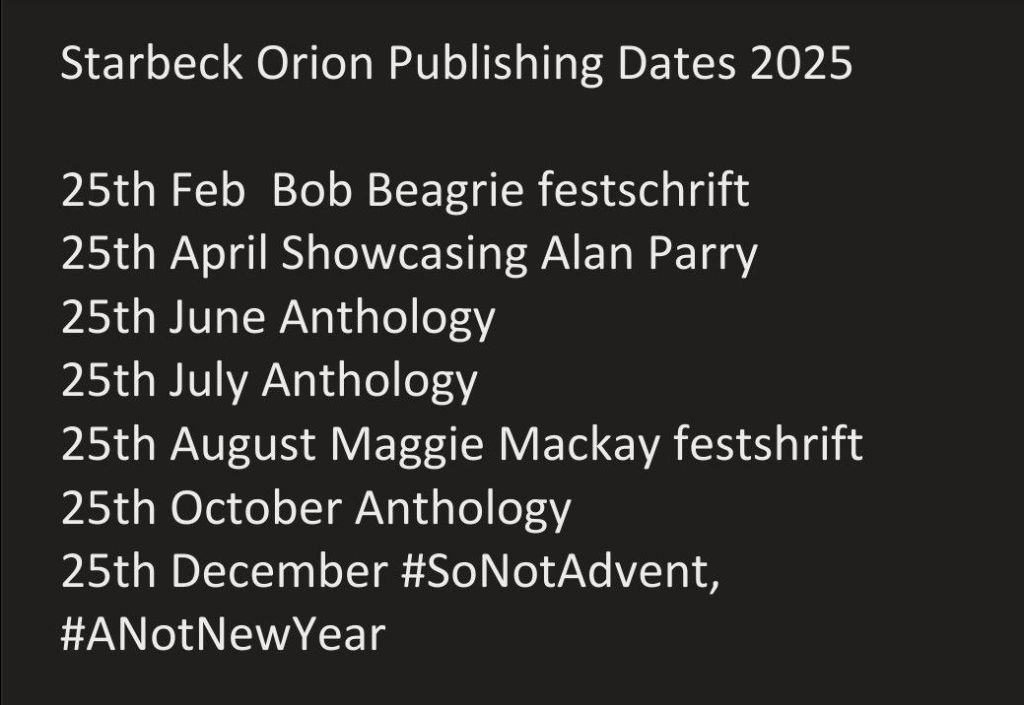
What’s Happening In 2025

25th Feb  Bob Beagrie festschrift
25th April Showcasing Alan Parry
25th June Anthology
25th July Anthology
25th August Maggie Mackay festshrift
25th October Anthology
25th December #SoNotAdvent, #ANotNewYear

SUBMISSION OPPORTUNITY. OPEN TILL DECEMBER 7TH. The Starbeck Orion is asking for #NotAdvent Poems, short prose, artworks about departure, disappearance, abandonment, withdrawal, exodus, evacuation, absence, Extinction Event. Closing date 7th December.

Here are the contribution details:

https://open.substack.com/pub/the880/p/contributions?utm_campaign=post&utm_medium=web


#thestarbeckorion  final issue of 2024 #7 is themed #NotAdvent. Closing date 7th December. Featuring your poems/short stories/artworks about loss and missing. The opposite of advent. Email me your contributions.

#thestarbeckorion  final issue of 2024 #7 is themed #NotAdvent. Closing date 7th December. Featuring your poems/short stories/artworks about loss and missing. The opposite of advent. Email me your contributions. Here are the contribution details:

https://open.substack.com/pub/the880/p/contributions?utm_source=share&utm_medium=android&r=33jsyn

Karen Pierce Gonzalez Reviews: Shiftings by Jenny Wong

More about Jenny Wong opencorners.ca/about

Shiftings & other coordinates of disorder https://pinholepoetry.ca/

Reviewer: Karen Pierce Gonzalez, Coyote in the Basket of My Ribs, RavenSong, Down River with Li Po. Editor, FolkHeart Press