The Wombwell Rainbow Book Interviews: Matt Nicholson

Matt Nicholson is a poet and performer from East Yorkshire. He published his fifth collection, Side-eye, on Yaffle Press, in the summer of 2025. He often performs with 3 other Hull poets as “The 4 Johns”. His work is sometimes dark and visceral, but also sensitive and heart-wrenchingly honest, and even sometimes funny, leading Helen Mort to describe his poems as “capable of breaking your heart and mending it again”. He has toured all around mainland Britain and loves performing to new audiences. For books and more information please visit http://www.mattpoet.com.

The Interview (Originally begun in 2023, updated by Matt in 2025)

Q1 (2023): I last interviewed you in 2020. Please tell me what you’ve been up to since then?

A1(2023): The big project that filled my writing time in 2020 and 2021 was writing and editing the poems that became my fourth poetry collection, “Untanglement”, and because it was very important to me that the poems stood up on the page as well as out loud, I attended many classes and workshops, including those run by Gill and Mark Connors at Yaffle, and mentoring sessions with Helen Mort. I also upped my reading of other people’s poems, pamphlets and collections by way of further ongoing poetry education. “Untanglement” was published by Yaffle Press in the Spring of 2022 and I took it around as many poetry events as I could. In the second half of 2022 I began working with three other poets from my part of the country – Peter Knaggs, Jim Higo, and Mike Watts – and calling ourselves “the 4 Johns”, we did a number of readings, shows and workshops together, and went on to write a Theatre/Spoken Word show, “All we’ve got time for” which premiered in the summer of 2023 and went on, via several theatre performances, to be part of The Morecambe Poetry Festival in that September.

Q2 (2023): How did you decide on the order of the poems in “Untanglement”?

A2(2025): The simple answer, for Untanglement, is that I had help. I think it’s important where poems sit in terms of an order and in relation to one another. I think poems can speak to one another in a collection but also, if you put the big important pieces too close to one another, they can make things imbalanced. As such one would be foolish not to take advice from those with more experience in such matters, and I sort guidance from the editorial team at Yaffle and from Helen Mort to help me get it right. I would like to add to this answer by saying that this is one of the hardest things to be sure about, and there do not seem to be any hard and fast scientific methods for it.

Q3 (2023/2025): How important is narrative in your poetry?

A3 (2025): Narrative has become more important to me during the writing of the last two collections. I wanted to tell more stories alongside the more lyrical poems that I continue to write. I felt able to be more open and honest with the reader by writing more narrative poems such as “Said big me to little me” and “I met him at a counter-demonstration” in “Untanglement”, and I felt that improved all my writing because of this more open, honest approach, and I hope that trend has and will continue.

Q3.1 (2023): How is opening the poem up, making them more story based important for live performance?

A3.1 (2023): I think you need to engage with an audience during a live performance / reading. It is likely, to me, that the poems you are sharing with an audience will engage them more if there is variety in terms of style and also intensity, and if some pieces are easier to engage with than others.

Q4 (2023): How important is form in your poetry?

A4 (2023): Because of the way an idea develops into one of my poems, starting off with how a line sounds to me out loud, and then getting the subsequent lines to develop from that beginning, and often in relation to that original rhythm, there probably aren’t many of my poems that adhere strictly to any classical forms. I do enjoy reading “form” poetry and have tried to write villanelles, sonnets and other forms in workshops etc. but they haven’t been the ones that I have had published, so as yet, it is not a strength I can claim. I think, because my poems all tend to start life orally, they do have elements of conversational/everyday speech in them and so there are bits of naturally occurring/accidental iambic pentameter, and some bits might resemble other elements of form too. And when the words make it onto the page, I find the shape of poems is becoming more interesting to me, but then I’m not sure that’s exactly what you mean by “form” in your question.

Q4.1 (2023): Why is it important that elements of conversation occur in your poetry? I am thinking particularly of Yorkshire dialect?

A4.1 (2023): I think it’s important for characters in poems (as in any literature) to be authentic and relatable, to use vocabulary and sentence structure that adds dimension to them for the reader. How a person speaks is often an immediate way to steer the reader to understand that character and to flesh out their world.

Q5 (2023): What do you think about the idea that a poem’s meaning should always be elusive?

A5 (2025): Over time, I have come to the conclusion that the problem with this notion is the “always” in the question. There are usually reasons why a poet does things in a poem the way they do and decides how to present their words and meanings. If it makes sense to the writer to keep the meaning of a poem elusive, be it for reasons of subject, sensitivity, to influence how a subject is thought about by a reader, or to create some kind of literary enigma for whatever reason, that is just as valid, assuming it’s done well, as it would be if the writer had been explicit and open about the meaning of a poem, as long as that is also done equally as well.

Q6(2025): How did you decide on the order of the poems in your latest book?

A6(2025): Side-eye was written over three years, from the end of 2022 onwards, and it resulted in approximately 350 poems being written for the final 60 to be chosen from. As a result of so many pieces hanging around and coming and going , they were initially separated into eight groups, to make them more manageable and to group poems into subsets by subject matter. As time went on, and as before, following conversations with Helen Mort and Mark Connors, those eight groups were whittled down to 4 by means of merging and rethinking their definitions, and the 350 poems were gradually reduced to about 120. Then as the title of the collection and the tone and themes began to present themselves from that 120, I was able to, with advice, get the number to 60 and to choose the order of the poems and, very late in proceedings, exactly what order those sections would appear in the book.

Q7(2025): What projects are you working on at the moment?

A7(2025): I am a little nervous to say too much about my current focus in case doing so were to jinx it, but I will tell you that it involves writing lots of poems about different fears and phobias, submitting those poems to relevant people and places, and then potentially creating a workshop format that will be based on the same subject matter. I am also looking out for some poets to mentor, who I can pass on all I’ve learned from so many great people over the last ten years or so as a poet myself.

The Wombwell Rainbow Book Interviews: Peter J Donnelly On His Collection “Bloom And Grow”


You can buy this collection here:
https://amzn.eu/d/50mr5eR


Peter J Donnelly lives in York where he works as a hospital secretary.  He has a degree in English Literature and a MA in Creative Writing from the University of Wales Lampeter. He has had poems published in various magazines and anthologies including Dreich,  Southlight,  Fragmented Voices,  High Window,  Lothlorien and Black Nore Review.  He won second prize in the Ripon Poetry Festival competition in 2021 and was a joint runner up in the Buzzwords open poetry competition in 2020. His first full length collection ‘Solving the Puzzle’ was published in 2023 by Alien Buddha Press, as was his chapbook ‘The Second of August’.

The Interview


Q:1. How did you decide on the order of the poems in your book?

The poems are grouped by theme so that one flows on from the last. At some stages there is a complete change of theme but I try to keep a link between each poem and the one that went before it wherever possible.

Q:2. How do you think that your poetry has moved on from your previous collection?

I think I have given up trying to use forms such as rhyme, sonnets etc. though a few rhyming couplets do work their way in occasionally.  Certainly none of the poems in this book were ever written intending to be rhymed or take any other form. Even though this collection is shorter than my last and indeed my first, there are fewer poems that I have felt unsure about, worrying that they were little more than chopped up prose. There are a couple I think that about, at least partly.  There are a lot of the same themes, places and people featured here that appeared in my previous two collections.  In some ways the book has been more inspired by more recent events,  which is I suppose inevitable,  though the distant past remains a feature of my work, which is also inevitable as other memories have come back to me since I wrote my last two books. I am definitely more aware of myself having aged and aging since I began writing, and I think this is reflected in my poems.

Q:2.1. How has aging affected this collection?

It contains a lot of poems about my childhood,  which is something that I am aware of slipping further an further into the past each day, and a lot of poems about death – though not my own, which – without wanting to sound too depressing, is something I am aware of getting closer to each day.  When I wrote the poem ‘Forty’ which is in my last book, I sounded quite optimistic.  I still do, or try to,  but I think I shall be writing quite a different sort of poem when I get to fifty. There are one or two poems about books and authors, and up until a couple of years ago I spent a lot of my reading time re-reading fiction.  I re-read poetry now but every novel I have read this year and I think last year has been one I haven’t read before.  I am aware that time is no longer standing still, and there are things I have to read while I am still able. This leads me on to one of the many physical signs of aging I have gradually begun to notice. I don’t think I will be able to cope without reading glasses for much longer.

Q:2.1.1. How has the awareness of time slipping by ever faster effected the writing of the poems?

It has reminded me that I can’t keep saying I have got lots of time left to write many more poems, though I hope that is the case. For too long I said I wasn’t writing anything at the moment but always meant or hoped to take it up again one day, when I found the  inspiration.  It has made me prioritise writing the next poem.

Q:2.1.1.1. How has this sense of urgency manifested itself in how and what you write?

It hasn’t made me feel that I must write something every day, even if it’s just a draft, or set aside a particular time each day or even each week for writing,  just to make sure I produce something. I do that with reading but not writing.  Though I do say to myself,  just because I wrote a poem yesterday doesn’t mean I can’t write one today as well. I have been known on rare occasions to write more than one on the same say. In terms of what I write, there are some things and people I have felt I can’t write about while those people are still alive, but if I wait for them to no longer be here then the poem may never get written,  not only because they could outlive me but I may forget the idea.  Once I get an idea for a poem in my head I have to at least try and write it then.

Q:3. How did you decide on the title?

As always,  I used the title of one of the poems in the book. I am not sure that ‘Bloom and Grow’ is the best one in the collection, but it is linked to many of the others by theme,  not just the people mentioned in it. There are not really any poems about plants here but there are ones that mention flowers – tulips and dandelions.  There are poems about fruit – wild raspberries in particular,  and one called ‘Growing Fruit’ although it isn’t about growing real fruit at all but makes mention of marzipan fruits and my first memories of them which brings me back to my grandmother who features in a few of the poems.

Q:4 Your poetry is very interrogative, asking questions of the person’s featured. Intentional?

To an extent I think it is intentional.  There are lots of things I have asked in a poem that I would never really ask the person in the poem, whether they are still alive or not. Many of the questions are rhetorical, asking things we can never know.
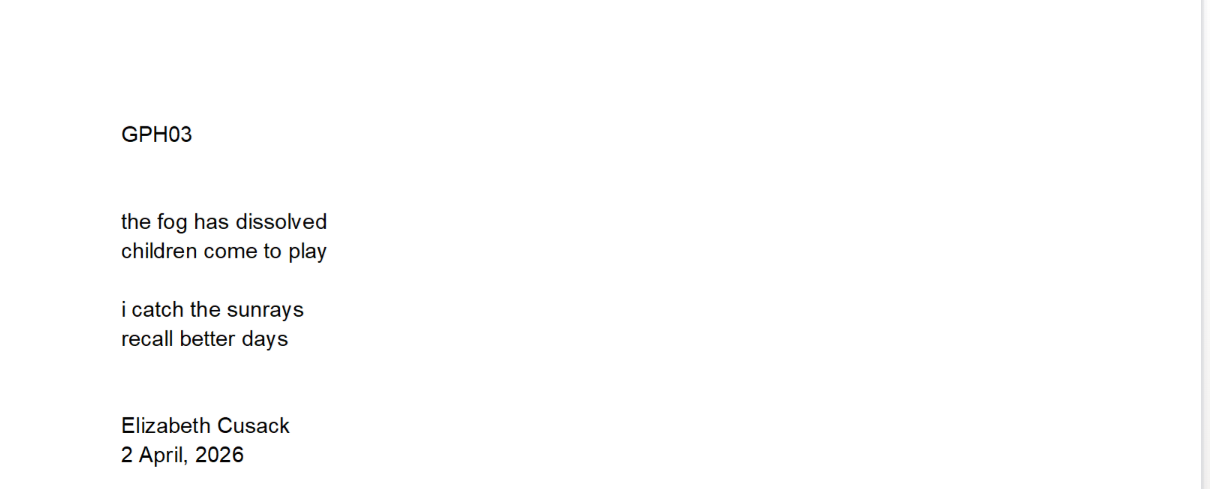
Q:4.1. How much do you think this reveals about N’s personality?

I presume you mean ‘N’ mentioned in the poem ‘Bloom and Grow’. I suppose that there were many things I didn’t know about him and couldn’t ask as neither of us felt comfortable discussing them. Though he wasn’t a blood relation, I did and do feel a lot like him, though in many ways we couldn’t have been more different.  I would rather not list the characteristics as it may sound like self-praise.

(Sorry, Peter. N is a technical abbreviation for Narrator. Editor)

To an extent I think it is intentional.  There are lots of things I have asked in a poem that I would never really ask the person in the poem, whether they are still alive or not. Many of the questions are rhetorical, asking things we can never know.
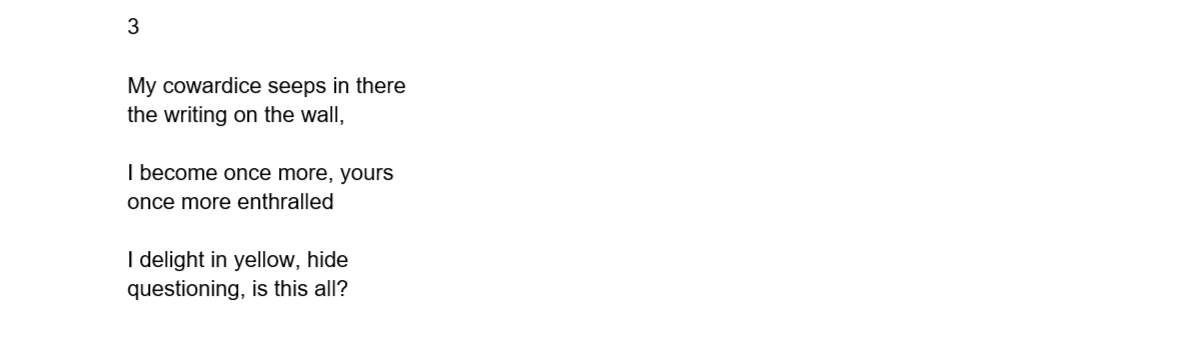

Q:5. Why do you think you are moving away from rhyming poetry?

One of the first things I was told about poems as a child was that they do not have to rhyme,  and yet I don’t remember reading one that didn’t rhyme until I was in my late teens. Back then I wasn’t able to distinguish between verse and poetry, couldn’t always see internal rhyme or half-rhymes. I think I came to believe that you could write anything and so long as it looked like a poem on the page you could call it one. But poetry is meant to be spoken and heard as well as read. I now see that chopped up prose is not poetry just as rhyming verse often is not. Sometimes it is a good idea to work to a form and within the constraints required,  but it doesn’t come naturally to me. I believe the use of similes, metaphors and alliteration, if used well and they don’t sound contrived, is more effective than rhyme or iambic pentameter.

Q:6. How far do you think the title “Bloom And Grow” refers to your own development as a poet?


It wasn’t intended to refer to my flourishing as a poet, but I don’t mind if it is interpreted that way. I wouldn’t say that my third book is my best one yet. As with all of them, I think some of the poems in it are better than others.  It is the shortest, perhaps ironically.  I hope it means that my development is an ongoing process, one that obviously will end one day as everything does, but hopefully not for a very long time.

Q:7. Once having read the collection what do you hope the reader will leave with?

I hope they will have a desire to read more of my work, including my first two books if they haven’t already done so. If they have read the others I hope they will see that my writing style has developed in the two years since my first one was published,  and that they will look forward to my next book, whenever that will appear.

*******

You can buy this collection here:

https://amzn.eu/d/50mr5eR

The Wombwell Rainbow Book Interview: Patrick Wright On “Exit Strategy”

Exit Strategy (Broken Sleep Books, 2025):

https://amzn.eu/d/6GUphS9


Patrick Wright

is an award-winning poet from Manchester, UK. His poems have appeared in Poetry Ireland Review, The North, Gutter, Poetry Salzburg, Agenda, and The London Magazine. His debut pamphlet, Nullaby, was published in 2017 by Eyewear. His debut full-length collection, Full Sight of Her, was published in 2020 by Eyewear and nominated for the John Pollard Prize. He has been shortlisted for the Bridport Prize and twice included in The Best New British and Irish Poets anthology. He teaches English and Creative Writing at the Open University.

The Interview

PB: How did you decide on the order of the poems in Exit Strategy?

PW:
Given that my book is about the grief process and a possible extrication or ‘exit’ from mourning, I had Elisabeth Kübler-Ross in mind, especially her five stages of grief. While I’m aware her model is subject to critique and perhaps an oversimplification of grief – it’s not, for example, and as some might assume she is saying, a linear process – I found it useful to divide my book into five sections. These don’t correspond directly with denial, anger, bargaining, depression, and acceptance – and I think there’s a few overlaps, callbacks, or foreshadowings – but these stages can be mapped onto my sections, albeit in a loose way. The section dividers – marked with an infinity symbol – are also meant to interrupt or subvert the notion of a linear path, with the suggestion of ongoing love and grief – the latter of which I’ve come to understand as the shadow of love or its extension: how the relationship goes on but operates on a spiritual level.

PB: How important is form in your book?

PW:
Incredibly important, as most of the poems are ekphrastic – looking to be mimetic of abstract or ‘formless’ artworks; not so much a representation as a re-presentation, in a performative way, of a visual art form that poets have rarely confronted. As such, in an attempt to evoke and forge a link with a specific artwork, I experimented with various forms, including sonnets (and near-sonnets), ghazals, prose poems, centos, and a new form I’ve looked to develop, which I call exploding form, where my words are scattered around the page, suggesting a violent detonation. Such forms offer temporary containers and serve as an analogue for grief. This includes my exploding form – since grief can be perceived as a centrifugal force involving dissolution and possible reconstitution. Our sense of identity, through bereavement, can be torn apart, though might, if we survive, form a new or emergent self. Abstract and ‘formless’ art can, likewise, present itself as a kind of metaphor for profound loss – inchoate and reaching towards meaning. My mode of ekphrasis sees such artworks as a prism for grief, and the poem as making sense of what’s refracted.    

PB: What do you mean by ‘an analogue for grief’?

PW:
I mean something – oftentimes a visual art form, or, as I suggest, a poetic form – that corresponds with the disorder, confusion, or ineffability brought about by loss. The bodily experience of grief, which can also be traumatic, is difficult if not impossible to represent straight away through signs; but the medium of the image can help us access unconscious thoughts and sensations – what can feel pre-verbal, somatic, and lodged inside us – and serve as a bridge towards elaboration through language. Mark Rothko’s late works, such as his Seagram Murals, offer obvious examples.

PB: To return to answer earlier comment you made about form. How did the new poetic form emerge?

PW:
Exit Strategy was written as part of my PhD in Creative Writing at the Open University, supervised by Jane Yeh and Siobhan Campbell. My work here (what’s sometimes called ‘practice as research’) focused on examining modes of ekphrasis in response to abstract and ‘formless’ artworks. At the same time, I saw such images as a lens for my personal experience of grief: how a painting could, for example, represent a profound state of loss. What I term exploding form is, as I understand it, imitative of certain modernist works, such as Cornelia Parker’s Cold Dark Matter, and, at the same time, visually re-enacts the disarray and loss of structure that can accompany major bereavement. 

PB: What is the role of Nature in this collection?

PW:
That might depend on how ‘Nature’ is construed. It’s a collection that’s quite introspective, with a focus on art galleries, books, postcards, and personal themes – the subjective experience of grief – so there’s little in the way of birds or wildlife, that kind of nature. There are occasional references, such as ‘A Distant Fawn’, where the creature – in this case, a young deer – becomes a symbol for something intangible or metaphysical. It’s as if one element of nature – such as the sea (which I write about quite a bit in response to seascapes, light, and atmosphere) – is a divine messenger or thing to be reckoned with through the anguish. There are also other ways to think of nature, such as human nature, perhaps rage at God and the all-too-human shaking of our fist at the sky. There’s the nature of reality, too (how we are subject to time and mortality), the nature of poetic form, the nature of art, and so forth. I think the collection is rather ambitious in this way, taking on these wider considerations.

PB: Why did you choose the Dostoevsky quote at the beginning of the collection?

PW:
It’s taken from The Brothers Karamazov and meant to evoke the cycle of suffering and redemption. I felt that my journey through grief was part of this age-old and human struggle, coming to terms with the evils of the world and the malice inflicted upon us – in my case, the loss of my partner to cancer. It’s possible others can relate to this – how life can be cruel and unjust to the point where we question everything, where meaning and our sense of self is obliterated. Personally, I reached this nadir. Though my partner and I were always believers in creativity and renewal, and so art and poetry presented themselves as a way out and through the crisis. While writing, I was also inspired by the phoenix motif – how we must go through an agonising phase of burning up and losing one identity before we can gain another; and this kind of regeneration is often necessary for those who experience a significant loss. As we often hear, and though somewhat of a cliché, it’s not that the pain of loss ever goes away or diminishes, but it is possible to grow around it.    

PB: How did you tackle the emergence of the phoenix from the flames, the recovery of meaning?

PW:
I think the artworks I responded to or anticipated had a significant role to play – the beauty of the paint, for example, or my reverence for ideals within Modernism; and the collection can certainly be seen as a homage to Modernism. My new and fragile identity – one that managed to survive the initial shock of bereavement – made use of such modernist artworks as a kind of crude armature; something to build myself around. My partner and I met as students studying the History of Art, and we maintained our love of modern art and design throughout our relationship. As such, after her passing, it felt like the works we admired and the principles of creativity we lived by were an intermediary; something left behind that still joined us, that kept her presence alive and gave me inspiration to move forward. It was almost as though the image served as a channel to hear her in spirit, a medium for her to find her way into my words. At the core of her beliefs was that art, including poetry, had the power to alchemise, to recover beauty from tragedy or disaster. That for me, if it can be accomplished, is the apex of meaning. I suspect it’s an idea that carried through from her inter-generational trauma – since her ancestors were victims of the Holocaust. If there’s been devastating loss – and that was also the case for her – there’s often a greater urgency in such individuals to find meaning, to make things make sense, given the risk of meaning collapsing into despair and nihilism. I’m again reminded here of Dostoyevsky and his statement that ‘beauty will save the world’. Since it’s what she would have wanted for me – to find redemption through art – I do my best to embody her wish, while also ‘resurrecting’ her in and through my poems. With all this, there’s also an echo of how Modernism itself, through its succession of -isms, was a glorious and in some ways failed attempt to fill the void – after Nietzsche’s proclamation that God is ‘dead’.        

PB: What is the significance of so many of the poems being “after (name)”, one being “before”, and another “alongside”?

PW:
As some readers will already know, the convention in ekphrasis (writing about artworks) is to use the epigraph ‘after’ under the title of the poem. This suggests a temporal stance, writing a poem in response to an image or object; that is, after the viewing. For others, it might also gesture towards the primacy of the originary work. As a challenge to this, my PhD project, developing other poets and writing practices over the last two decades or so, was in part an exploration of how ekphrasis can be more dynamic, emphasise process, collaboration, and a reciprocal exchange. Therefore, my poems at times were generated in situ, while in the gallery, where my experience with the artwork felt mutual – the image influencing me just as much as I was ‘representing’ it. To signify this two-way process, I’ve occasionally used an alternative epigraph, such as ‘alongside’. Other times, when the artwork was anticipated or imagined (ahead of, say, a gallery visit), and ‘seen’ in the mind’s eye, I’ve used the epigraph ‘before’. Exploring ‘beforeness’, I found support in the criticism of Thom Donovan and Lesley Harrison, who likewise argue that ekphrasis does not have to occur after the viewing; instead, it can precede it: the latter referring to this as ‘reverse ekphrasis’. What this also does is unsettle the idea of the poet in a state of rivalry or competition with the image; someone who might assume, perhaps unconsciously, a position of dominance or mastery over the artwork – the image traditionally seen as fixed, silent, and feminine. 

PB: Once they have read your book, what do you hope the reader will leave with?

PW:
As always, above all, I hope they’ll be moved by the poems. That’s what I always look for. I’ve had people say that my poems elicited tears, or they were emotive in another way, and that always feels like the greatest achievement – far more than accolades or the book’s perceived status. I find that awards or prizes mean less to me the older I get. Now, it’s about making an emotional connection with readers. I also hope that the book, in some way, resonates with the grief journey of others – and perhaps supports belief in the idea that experiences like grief or trauma can be worked through and written about. Art and literature are often partial and inadequate on their own; however, the kind of processes I’ve demonstrated – utilising abstract and modernist images as a conduit – can be seen as a possible, if somewhat fragile, bridge towards recovery and rebirth. As many therapists know, when we speak (or write), and articulate what’s so far been unspeakable, it can be healing.

Festschrift Penelope Shuttle I’m looking for writers who have something to say about the work of Penelope Shuttle.

Festschrift Penelope Shuttle

I’m looking for writers who have something to say about the work of Penelope Shuttle. What has been her influence on your work? What is inspirational about it? Also, academic essays. Unfortunately, I can’t afford to pay any contributors. Deadline is 7th Feb 2026.

You are invited to contribute to this celebratory Festschrift dedicated to Penelope Shuttle — poet, mentor, and imaginative force. Your reflections, memories, critical insights, or creative responses will form a rich tribute to her enduring impact.I am preparing a questions, prompts for you to select a few that resonate most with you. Your response can take any form: essay, anecdote, poem, letter, or hybrid.Please tell me below whether you would be interested in receiving these questions?

I’m launching my own micro press called “Shut Thee  Cake Oyle!” next year. The first two print publications will be anthologies of the best out of The Wombwell Rainbow and The Starbeck Orion. Book 1 2024, Book 2 2025. Festschrifts and Showcases choose 7 of their best. Anthology poets 1 of their best

Ekphrastic Challenge 2025. Day Thirty. Please join John Curry, Debbie Ross, Matt Guntrip, Anish Gupta, Phil Hyde, Donna Faulkner, Francis H Powell, Judy Smith , Sheikha A, Mick Jenkinson, Rituparna, Syephen Kingsnorth and I as we respond to the daily artworks of Sara Elizabeth Bell, Jenn Zed, and Spriha Kant. Day Thirty. April 30th.

JZ30

SK30

SEB30

Jz 30

Circle Among Squares

They built walls with precision,
measured every breath,
counted the spaces where longing could not spill.

I was the roundness they forgot to contain,
the soft defiance inside their hardened blueprints.

In a world of edges,
I chose to be a curve,
not by rebellion,
but because I remembered
what it felt like to move without breaking.

They watch,
they redraw,
they sharpen their lines.

I remain,
unfolding silently,
where no ruler can reach.


SEB 30

A Tangle of Dreams

The world fell quiet,
as the last thread of hope slipped through trembling fingers.
Beneath the heavy breath of forgotten trees,
I sank into a tangle of dreams,
hair woven with broken promises and half-remembered prayers.

Hands crossed, not in surrender,
but in a desperate attempt to hold together the pieces.
The wind tore at my skin,
but it was the silence that shredded my soul.

I could no longer tell where the earth ended and I began.
Roots tangled with veins,
stone pressed against bone,
and somewhere in the distance,
the sky forgot my name.

There was no struggle left,
only the slow ache of becoming invisible,
only the deep hunger to be felt,
even in vanishing.


SK 30

When silence turns into a river

There is a tearing,
not loud, not sudden,
but a rip somewhere inside the ribs
where the voice used to live.

Silence thickens, grows claws,
drags itself across the tongue,
scraping raw every memory we tried to bury
because we were too tired to fight for them.

The mouth splits open,
not to explain, not to beg,
but to let the flood strike,
to let grief pour out unstitched,
wild, rotten, alive.

I spit out the taste of steel,
of ground I knelt on for too long,
of hunger too deep for language to touch.

I drown. I rise.
Sometimes both at once.

There is no saving left,
no soft place to land,
only the river,
and the broken pieces of the ones
who learned too late
that water remembers
what the heart tried to forget.

-Rituparna

Processing the grief after the devastation of Storm Helene

-Debbie Ross

Artworker Bios

Jenn Zed
Ms. Zed is an artist, writer, and musician who lives in Bath, England, with the ghost of her cat.
She studied art, art history, and design MA at Bath and Cambridge Universities.

Sara Elizabeth Bell

Says:

I’ve always loved drawing. It’s a form of meditation for me and has now become a way for me to find peace and sanity when my world gets too overwhelming, which, as a single mom with a neuro-divergent teen, happens quite often. When it does, I follow John Muir’s quote, “Off into the woods I go to loose my mind and find my soul.”
The results of those trips are  sketches of the forests around me and photos. I work from the photos to create my watercolors and intaglio prints. I hope you enjoy them and can find a place in your home to adopt one or more.

Spriha Kant

Spriha Kant is an English poetess, book reviewer, and digital artist. She has been published in some anthologies — “Hidden in Childhood” and “We Are The Waves,” to name a few. Her poems have also been published in the seventh issue of “Reflections,” the well-known literary magazine “Prosetrics.” She has been the Guest of honor in the award-winning show “Victoria in Verse” (Bloomsbury Radio, London). Her interviews can be read at feversofthemind.com & and brokenspine.co.uk. Her quotes are published as an epigraph and a blurb in Magkasintahan Volume VI & Swiped Right [both books published by Ukiyoto Publishing, Philippines], respectively. Her artwork can be seen in a webzine called “The Starbeck Orion” and on thewombwellrainbow.com.

Writer Bios

Debbie Ross,

Debbie is a poet, author, artist, photographer, and baker. She lives 400m from the sea, in the far north Scottish Highlands, and can be mostly be found in the kitchen, at the beach, or at her writing table.

Matt Guntrip,

Matt Guntrip is a guitarist, song writer and indie musician from the UK. He has published four albums & five singles via CD Baby, available on most channels. He was a nominated solo artist on the New Music Generator Show, Cambridge 105FM.

Through creative writing he explores themes of nature, time, love, loss, rejection, injustice and hope, with a view to learning, improving and thus to writing better songs.

Matt’s writing has been published in The Belfast Review, The Broken Spine,  Fevers of The Mind, Folkheart Press Blog, GAS Poetry (YouTube), The Starbeck Orion (Substack) & The Wombwell Rainbow website.

Donna Faulkner,

Donna  Faulkner lives in a cottage in Rangiora, New Zealand with her husband , two sons and Emily, the black Labrador.  She’s been published in 300 Days of Sun, Havik, Windward Review, Havik, Fieldstone Review,  New Myths, Bacopa Literary Review and others. Her debut poetry book ‘In Silver Majesty’ was published by erbacce press(UK) 2024. 

Instagram @lady_lilith_poet/ Twitter @nee_miller. https://linktr.ee/donnafaulkner

Alan McGinn,

Anish Gupta,

Dr. Anish K. Gupta is an Indian urologist and an impassioned poet who writes mainly in English but also dabbles in Hindi and Urdu. His work seamlessly intertwines the exactitude of medical science with the subtleties of human emotion. Grounded in the complementary realms of medicine and art, his path reflects a profound quest for understanding, healing, and the expression of love and life. In the operating room or on the page, Dr. Gupta delves into the intricacies of both body and soul, approaching each with care, curiosity, and compassion. His poetry captures the subtle epiphanies of daily life, the fragility of the human condition, and the deep connections between love and existence. He goes by the #uropoet on X where his handle is @optionurol.

Phil Hyde,

GP Hyde was born on the Wirral and now lives in Grimsby. He studied art at Goldsmith’s and at the Royal Academy Schools. His fiction has been extensively published by Pure Slush. His poetry has been published by Black Bough Press, Hedgehog Press, Written Off, the Dark Poets and voidspacezine

Rituparna,

Rituparna Ghosh is an alumna of the National University of Singapore, an AI engineer, and the founder of Whizzstep. With a passion for poetry, she enjoys crafting verses, particularly in the genres of free verse and reflective poetry. A lover of nature, Rituparna finds peace in her walks by the beach, where the tranquility of the ocean inspires both her creativity and personal reflection. Coding is her profession, and she thrives on solving complex problems through technology. She also has a deep love for traveling, reading, learning new languages, and horse riding, connecting with the outdoors in a unique and fulfilling way.

Francis H Powell,

Judy Smith ,

Judy Smith lives in East Yorkshire. Retired from a career in health and education, she is an emerging poet. She has had poems published in several anthologies, including Spelt, 14, Black Bough, Artemis, High Wolds, Dreich, York Literary Review, The Starbeck Orion. She has a passion for wildlife gardening and community tree planting.

Sheikha A,

Sheikha A. is from Pakistan and United Arab Emirates. Her poems appear in a variety of literary venues both print and online, and some of them have been translated into 8 languages so far. More about her can be found at sheikha82.wordpress.com

John Armstrong,

John Armstrong is a poet whose work blends metaphysical inquiry with vivid, elemental imagery. Drawing from a deep reverence for nature, memory, and the cosmic, Armstrong’s poetry explores dualistic and trinitarian themes of love, transformation, and the spiritual texture of existence.Armstrong sees poetry not merely as a literary form but as a living, animistic force—language shaped by the earth itself. His work is a personal quest, a surrender to the unknown, finding beauty in ambiguity and meaning in the mist between words and life.

Spare time: He grows Cosmos flowers and wills them on way past the first frosts.

Saraswati Nagpal,

John Wolf

Creative writing tutor, poet, storyteller for Read To Write. Taught Beowulf, Odyssey, and Troy; Gilgamesh is coming in October. First poetry collection entitled Heroes (Glasshead Press, 2022). New collection, Historia, out summer 2025. Featured on Radio Sheffield, CAST, Little Theatre, Doncaster Ukranian Centre, Artbomb, Doncaster Foodbank Festival, Under Milk Wood and Women of Troy. 

Oormila V. Prahlad

is a widely published Indian-Australian artist and poet. She lives and works on traditional Gammergal land. Find her on Instagram @oormila_paintings

Ekphrastic Challenge 2025. Day Twenty-Ninth. Please join John Curry, Debbie Ross, Matt Guntrip, Phil Hyde, Donna Faulkner, Francis H Powell, Judy Smith , Sheikha A, Rituparna, and I as we respond to the daily artworks of Sara Elizabeth Bell, Jenn Zed, and Spriha Kant. Day Twenty-Nine. April 29th.

SEB29

JZ29

SK29

Donna Faulkner

Jz 29

She Speaks,They Point

She stands at the center,
not asking
not apologizing.

The stars on her hat burn brighter
than the ones on the flag they guard so fiercely
not for freedom,
but for order.

They taught her silence
dressed it up as grace,
wrapped obedience in silk
and called it tradition.

Now
her voice moves like a blade through fog.
They flinch,
not at volume,
but at clarity.

Every word she speaks
is a mirror they can't bear.
Their shame
her weapon.
Their history
her battlefield.

She does not scream.
She does not beg.
She points.

And in that gesture
they see themselves.

Not her.
The enemy within.
Them.


SEB 29

What Remains

They walk ahead,
unaware that I am still here.
Not lost,
but tethered to the sound
of footsteps no longer echoing.

I do not call out.
I wouldn’t know what to say.
The trees are bare
yet full of knowing.
They have seen
what I try to forget.

My hands remember warmth
that my skin can no longer find.
There was laughter here once —
fierce, whole,
shattering in its beauty.

Now,
only the hush of fallen leaves
pressing into soil
like the weight of names
we no longer speak.

They are not ahead.
They are within.
Moving where I cannot follow,
yet always beside me
in the ache of remembering.


SK 29

Unfolding Grace

She does not face the world,
not out of fear,
but because her spine has learned
to carry silence like a sword.

The petals behind her
are not wings—
they are what bloomed
when she stopped apologizing.

Her hair holds the wind
like a secret
she never owed to anyone.

And the roots,
those tangled green veins,
they do not ask permission to hold her—
they remember who she was
before she forgot.

-Rituparna

Artworker Bios

Jenn Zed


Ms. Zed is an artist, writer, and musician who lives in Bath, England, with the ghost of her cat.
She studied art, art history, and design MA at Bath and Cambridge Universities.

Sara Elizabeth Bell

Says:

I’ve always loved drawing. It’s a form of meditation for me and has now become a way for me to find peace and sanity when my world gets too overwhelming, which, as a single mom with a neuro-divergent teen, happens quite often. When it does, I follow John Muir’s quote, “Off into the woods I go to loose my mind and find my soul.”
The results of those trips are  sketches of the forests around me and photos. I work from the photos to create my watercolors and intaglio prints. I hope you enjoy them and can find a place in your home to adopt one or more.

Spriha Kant

Spriha Kant is an English poetess, book reviewer, and digital artist. She has been published in some anthologies — “Hidden in Childhood” and “We Are The Waves,” to name a few. Her poems have also been published in the seventh issue of “Reflections,” the well-known literary magazine “Prosetrics.” She has been the Guest of honor in the award-winning show “Victoria in Verse” (Bloomsbury Radio, London). Her interviews can be read at feversofthemind.com & and brokenspine.co.uk. Her quotes are published as an epigraph and a blurb in Magkasintahan Volume VI & Swiped Right [both books published by Ukiyoto Publishing, Philippines], respectively. Her artwork can be seen in a webzine called “The Starbeck Orion” and on thewombwellrainbow.com.

Writer Bios

Debbie Ross,

Debbie is a poet, author, artist, photographer, and baker. She lives 400m from the sea, in the far north Scottish Highlands, and can be mostly be found in the kitchen, at the beach, or at her writing table.

Matt Guntrip,

Matt Guntrip is a guitarist, song writer and indie musician from the UK. He has published four albums & five singles via CD Baby, available on most channels. He was a nominated solo artist on the New Music Generator Show, Cambridge 105FM.

Through creative writing he explores themes of nature, time, love, loss, rejection, injustice and hope, with a view to learning, improving and thus to writing better songs.

Matt’s writing has been published in The Belfast Review, The Broken Spine,  Fevers of The Mind, Folkheart Press Blog, GAS Poetry (YouTube), The Starbeck Orion (Substack) & The Wombwell Rainbow website.

Donna Faulkner,

Donna  Faulkner lives in a cottage in Rangiora, New Zealand with her husband , two sons and Emily, the black Labrador.  She’s been published in 300 Days of Sun, Havik, Windward Review, Havik, Fieldstone Review,  New Myths, Bacopa Literary Review and others. Her debut poetry book ‘In Silver Majesty’ was published by erbacce press(UK) 2024. 

Instagram @lady_lilith_poet/ Twitter @nee_miller. https://linktr.ee/donnafaulkner

Alan McGinn,

Anish Gupta,

Dr. Anish K. Gupta is an Indian urologist and an impassioned poet who writes mainly in English but also dabbles in Hindi and Urdu. His work seamlessly intertwines the exactitude of medical science with the subtleties of human emotion. Grounded in the complementary realms of medicine and art, his path reflects a profound quest for understanding, healing, and the expression of love and life. In the operating room or on the page, Dr. Gupta delves into the intricacies of both body and soul, approaching each with care, curiosity, and compassion. His poetry captures the subtle epiphanies of daily life, the fragility of the human condition, and the deep connections between love and existence. He goes by the #uropoet on X where his handle is @optionurol.

Phil Hyde,

GP Hyde was born on the Wirral and now lives in Grimsby. He studied art at Goldsmith’s and at the Royal Academy Schools. His fiction has been extensively published by Pure Slush. His poetry has been published by Black Bough Press, Hedgehog Press, Written Off, the Dark Poets and voidspacezine

Rituparna,

Rituparna Ghosh is an alumna of the National University of Singapore, an AI engineer, and the founder of Whizzstep. With a passion for poetry, she enjoys crafting verses, particularly in the genres of free verse and reflective poetry. A lover of nature, Rituparna finds peace in her walks by the beach, where the tranquility of the ocean inspires both her creativity and personal reflection. Coding is her profession, and she thrives on solving complex problems through technology. She also has a deep love for traveling, reading, learning new languages, and horse riding, connecting with the outdoors in a unique and fulfilling way.

Francis H Powell,

Judy Smith ,

Judy Smith lives in East Yorkshire. Retired from a career in health and education, she is an emerging poet. She has had poems published in several anthologies, including Spelt, 14, Black Bough, Artemis, High Wolds, Dreich, York Literary Review, The Starbeck Orion. She has a passion for wildlife gardening and community tree planting.

Sheikha A,

Sheikha A. is from Pakistan and United Arab Emirates. Her poems appear in a variety of literary venues both print and online, and some of them have been translated into 8 languages so far. More about her can be found at sheikha82.wordpress.com

Ekphrastic Challenge 2025. Day Twenty-Eighth. Please join Mick Jenkinson, Debbie Ross, Matt Guntrip, Anish Gupta, Phil Hyde, Donna Faulkner, Francis H Powell, Judy Smith , Sheikha A, Rituparna, John Armstrong, and I as we respond to the daily artworks of Sara Elizabeth Bell, Jenn Zed, and Spriha Kant. Day Twenty-Eight. April 28th.

SK28

SEB28

JZ28

Waiting to Love

Earth-rooted,
nourished
by all that has gone
before.

Waiting to burst
into new life,
learning
to love
again.

-Debbie Ross


Jz 28

Becoming the Storm

There was no moment of revelation.
No flash. No flame.
Just the slow unraveling of everything I was told to be.

They wanted softness,
so I gave them silence
until it broke my skin from the inside.

I cut my hair on a whisper
and painted my mouth with every word I never said.
Not to please,
not to provoke—
only to remember what it feels like
to own my face.

They called it rebellion.
I called it returning.

There is no calm in me.
Only the weight of swallowed voices
and the ache of a spine
that learned to stand alone.

I do not ask.
I do not wait.
I arrive.
And the sky opens
because I do.


SEB 28

Roots of Love

The tree stands bare.
Not lifeless. Just waiting.
Limbs stretched into a gray sky,
as if asking a question no one answers.

Below, where no one looks,
where silence thickens,
love pulses.
Quiet. Stubborn.

It does not seek light.
It does not beg to be seen.
It simply is.
Buried. Breathing.
A presence in the dark.

Not all love grows upward.
Some digs in.
Gripping soil, memory,
the ache of what might be.

People pass by the tree,
see branches empty,
call it forgotten.
But they do not kneel.
They do not touch the ground
where the truth lives.

Some loves wait
not to be returned.
Only to be real
in their own silence.


SK 28

The Lonely Chair


It wasn’t always like this.
Once, I held weight—
a child’s muddy feet,
a grandmother’s spine bent with stories,
the stillness of someone thinking.

Now, vines climb my frame like memories
trying to hold on.
Leaves press against my back
as if to say, we’re here,
but they don’t stay.

The butterflies come and go,
fragments of life flitting past,
not seeing what I’ve become—
a frame without purpose,
a silence too loud.

Still, I stand.
Rooted in soft earth
that forgets nothing.
The ant knows me.
The stones remember my name.

I watch.
The world spills color
and never asks if I want to fade.
-Rituparna

Seb 28

How far the roots of love
reach out
when each embrace
resonates
Each spoken words
brings us closer
all is draped
in harmony

Jz 28

Alice never learned
the language of love
black lipstick
shining like olives
gleaming in the sun

She once took me
by the hand
then crushed
into dust and sand
born from a viper’s nest
sweet Alice never cries 


-Francis H.Powell

Artworker Bios

Jenn Zed
Ms. Zed is an artist, writer, and musician who lives in Bath, England, with the ghost of her cat.
She studied art, art history, and design MA at Bath and Cambridge Universities.

Sara Elizabeth Bell

Says:

I’ve always loved drawing. It’s a form of meditation for me and has now become a way for me to find peace and sanity when my world gets too overwhelming, which, as a single mom with a neuro-divergent teen, happens quite often. When it does, I follow John Muir’s quote, “Off into the woods I go to loose my mind and find my soul.”
The results of those trips are  sketches of the forests around me and photos. I work from the photos to create my watercolors and intaglio prints. I hope you enjoy them and can find a place in your home to adopt one or more.

Spriha Kant

Spriha Kant is an English poetess, book reviewer, and digital artist. She has been published in some anthologies — “Hidden in Childhood” and “We Are The Waves,” to name a few. Her poems have also been published in the seventh issue of “Reflections,” the well-known literary magazine “Prosetrics.” She has been the Guest of honor in the award-winning show “Victoria in Verse” (Bloomsbury Radio, London). Her interviews can be read at feversofthemind.com & and brokenspine.co.uk. Her quotes are published as an epigraph and a blurb in Magkasintahan Volume VI & Swiped Right [both books published by Ukiyoto Publishing, Philippines], respectively. Her artwork can be seen in a webzine called “The Starbeck Orion” and on thewombwellrainbow.com.

Writer Bios

Debbie Ross,

Debbie is a poet, author, artist, photographer, and baker. She lives 400m from the sea, in the far north Scottish Highlands, and can be mostly be found in the kitchen, at the beach, or at her writing table.

Matt Guntrip,

Matt Guntrip is a guitarist, song writer and indie musician from the UK. He has published four albums & five singles via CD Baby, available on most channels. He was a nominated solo artist on the New Music Generator Show, Cambridge 105FM.

Through creative writing he explores themes of nature, time, love, loss, rejection, injustice and hope, with a view to learning, improving and thus to writing better songs.

Matt’s writing has been published in The Belfast Review, The Broken Spine,  Fevers of The Mind, Folkheart Press Blog, GAS Poetry (YouTube), The Starbeck Orion (Substack) & The Wombwell Rainbow website.

Donna Faulkner,

Donna  Faulkner lives in a cottage in Rangiora, New Zealand with her husband , two sons and Emily, the black Labrador.  She’s been published in 300 Days of Sun, Havik, Windward Review, Havik, Fieldstone Review,  New Myths, Bacopa Literary Review and others. Her debut poetry book ‘In Silver Majesty’ was published by erbacce press(UK) 2024. 

Instagram @lady_lilith_poet/ Twitter @nee_miller. https://linktr.ee/donnafaulkner

Alan McGinn,

Anish Gupta,

Dr. Anish K. Gupta is an Indian urologist and an impassioned poet who writes mainly in English but also dabbles in Hindi and Urdu. His work seamlessly intertwines the exactitude of medical science with the subtleties of human emotion. Grounded in the complementary realms of medicine and art, his path reflects a profound quest for understanding, healing, and the expression of love and life. In the operating room or on the page, Dr. Gupta delves into the intricacies of both body and soul, approaching each with care, curiosity, and compassion. His poetry captures the subtle epiphanies of daily life, the fragility of the human condition, and the deep connections between love and existence. He goes by the #uropoet on X where his handle is @optionurol.

Phil Hyde,

GP Hyde was born on the Wirral and now lives in Grimsby. He studied art at Goldsmith’s and at the Royal Academy Schools. His fiction has been extensively published by Pure Slush. His poetry has been published by Black Bough Press, Hedgehog Press, Written Off, the Dark Poets and voidspacezine

Rituparna,

Rituparna Ghosh is an alumna of the National University of Singapore, an AI engineer, and the founder of Whizzstep. With a passion for poetry, she enjoys crafting verses, particularly in the genres of free verse and reflective poetry. A lover of nature, Rituparna finds peace in her walks by the beach, where the tranquility of the ocean inspires both her creativity and personal reflection. Coding is her profession, and she thrives on solving complex problems through technology. She also has a deep love for traveling, reading, learning new languages, and horse riding, connecting with the outdoors in a unique and fulfilling way.

Francis H Powell,

Judy Smith ,

Judy Smith lives in East Yorkshire. Retired from a career in health and education, she is an emerging poet. She has had poems published in several anthologies, including Spelt, 14, Black Bough, Artemis, High Wolds, Dreich, York Literary Review, The Starbeck Orion. She has a passion for wildlife gardening and community tree planting.

Sheikha A,

Sheikha A. is from Pakistan and United Arab Emirates. Her poems appear in a variety of literary venues both print and online, and some of them have been translated into 8 languages so far. More about her can be found at sheikha82.wordpress.com

John Armstrong,

John Armstrong is a poet whose work blends metaphysical inquiry with vivid, elemental imagery. Drawing from a deep reverence for nature, memory, and the cosmic, Armstrong’s poetry explores dualistic and trinitarian themes of love, transformation, and the spiritual texture of existence.Armstrong sees poetry not merely as a literary form but as a living, animistic force—language shaped by the earth itself. His work is a personal quest, a surrender to the unknown, finding beauty in ambiguity and meaning in the mist between words and life.

Spare time: He grows Cosmos flowers and wills them on way past the first frosts.

Saraswati Nagpal,

John Wolf

Creative writing tutor, poet, storyteller for Read To Write. Taught Beowulf, Odyssey, and Troy; Gilgamesh is coming in October. First poetry collection entitled Heroes (Glasshead Press, 2022). New collection, Historia, out summer 2025. Featured on Radio Sheffield, CAST, Little Theatre, Doncaster Ukranian Centre, Artbomb, Doncaster Foodbank Festival, Under Milk Wood and Women of Troy. 

Oormila V. Prahlad

is a widely published Indian-Australian artist and poet. She lives and works on traditional Gammergal land. Find her on Instagram @oormila_paintings

Ekphrastic Challenge 2025. Day Twenty-Seventh. Please join Stephen Kingsnorth, Debbie Ross, Matt Guntrip, Anish Gupta, Phil Hyde, Donna Faulkner, Francis H Powell, Judy Smith , Sheikha A, Rituparna, John Armstrong, Oormila V. Prahlad and I as we respond to the daily artworks of Sara Elizabeth Bell, Jenn Zed, and Spriha Kant. Day Twenty-Seven. April 27th.

JZ27

SK27

SEB27

SEB27

-Stephen Kingsnorth

Butterflies


Fragile miracles
of metamorphosis.
Never judge
a caterpillar
for its diet.

-Debbie Ross


Jz27

Vacant Space
tidy empty bed
smooth silver-grey sheets
not all is black or white
absence not what it seems

-Judy Smith

Jz 27


Echo of the battles

the bed doesn’t ask
why I haven't moved in hours.
it holds my weight,
a silence too heavy to share.

the walls know the fog—
how it creeps in,
settling in the bones
and behind the eyes.

there is no scream,
only the hum of thoughts
that never quite quiet.

but I am still here.
and that
is something.


SEB 27

The Moment Before the Wings

there is a stillness
between who we were
and who we can become.

the roots hold tight—
not to trap,
but to remind us where we began.

the body carries memory,
some of it heavy,
some of it aching to be remembered.

the heart, tangled in old patterns,
wants to forget
but also hopes to understand.

and just as the weight feels too much,
a quiet strength rises—
not loud,
not sudden—
just enough
to lift.

not flying, not yet.
but the knowing.
the knowing that we can.


SK 27

Blooms from the Boot

They left the boots behind.
Mud-stained. Broken at the heel.
As if to say they were done walking through this world.

From the hollow of silence, color grew.
Not loud. Not proud. Just certain.

Petals unfurled from cracked leather,
as if pain had a scent.
As if absence could blossom.

Behind the smoke tower, the air remembers.
Breath that once built machines,
nurtured children,
held back tears.

The soil holds no grudges.
It takes rust and ruin,
and makes room for roots.

And somewhere,
in the stillness between loss and life,
a garden begins
where a soul once stood.

-Rituparna

Artworker Bios

Jenn Zed
Ms. Zed is an artist, writer, and musician who lives in Bath, England, with the ghost of her cat.
She studied art, art history, and design MA at Bath and Cambridge Universities.

Sara Elizabeth Bell

Says:

I’ve always loved drawing. It’s a form of meditation for me and has now become a way for me to find peace and sanity when my world gets too overwhelming, which, as a single mom with a neuro-divergent teen, happens quite often. When it does, I follow John Muir’s quote, “Off into the woods I go to loose my mind and find my soul.”
The results of those trips are  sketches of the forests around me and photos. I work from the photos to create my watercolors and intaglio prints. I hope you enjoy them and can find a place in your home to adopt one or more.

Spriha Kant

Spriha Kant is an English poetess, book reviewer, and digital artist. She has been published in some anthologies — “Hidden in Childhood” and “We Are The Waves,” to name a few. Her poems have also been published in the seventh issue of “Reflections,” the well-known literary magazine “Prosetrics.” She has been the Guest of honor in the award-winning show “Victoria in Verse” (Bloomsbury Radio, London). Her interviews can be read at feversofthemind.com & and brokenspine.co.uk. Her quotes are published as an epigraph and a blurb in Magkasintahan Volume VI & Swiped Right [both books published by Ukiyoto Publishing, Philippines], respectively. Her artwork can be seen in a webzine called “The Starbeck Orion” and on thewombwellrainbow.com.

Writer Bios

Debbie Ross,

Debbie is a poet, author, artist, photographer, and baker. She lives 400m from the sea, in the far north Scottish Highlands, and can be mostly be found in the kitchen, at the beach, or at her writing table.

Matt Guntrip,

Matt Guntrip is a guitarist, song writer and indie musician from the UK. He has published four albums & five singles via CD Baby, available on most channels. He was a nominated solo artist on the New Music Generator Show, Cambridge 105FM.

Through creative writing he explores themes of nature, time, love, loss, rejection, injustice and hope, with a view to learning, improving and thus to writing better songs.

Matt’s writing has been published in The Belfast Review, The Broken Spine,  Fevers of The Mind, Folkheart Press Blog, GAS Poetry (YouTube), The Starbeck Orion (Substack) & The Wombwell Rainbow website.

Donna Faulkner,

Donna  Faulkner lives in a cottage in Rangiora, New Zealand with her husband , two sons and Emily, the black Labrador.  She’s been published in 300 Days of Sun, Havik, Windward Review, Havik, Fieldstone Review,  New Myths, Bacopa Literary Review and others. Her debut poetry book ‘In Silver Majesty’ was published by erbacce press(UK) 2024. 

Instagram @lady_lilith_poet/ Twitter @nee_miller. https://linktr.ee/donnafaulkner

Alan McGinn,

Anish Gupta,

Dr. Anish K. Gupta is an Indian urologist and an impassioned poet who writes mainly in English but also dabbles in Hindi and Urdu. His work seamlessly intertwines the exactitude of medical science with the subtleties of human emotion. Grounded in the complementary realms of medicine and art, his path reflects a profound quest for understanding, healing, and the expression of love and life. In the operating room or on the page, Dr. Gupta delves into the intricacies of both body and soul, approaching each with care, curiosity, and compassion. His poetry captures the subtle epiphanies of daily life, the fragility of the human condition, and the deep connections between love and existence. He goes by the #uropoet on X where his handle is @optionurol.

Phil Hyde,

GP Hyde was born on the Wirral and now lives in Grimsby. He studied art at Goldsmith’s and at the Royal Academy Schools. His fiction has been extensively published by Pure Slush. His poetry has been published by Black Bough Press, Hedgehog Press, Written Off, the Dark Poets and voidspacezine

Rituparna,

Rituparna Ghosh is an alumna of the National University of Singapore, an AI engineer, and the founder of Whizzstep. With a passion for poetry, she enjoys crafting verses, particularly in the genres of free verse and reflective poetry. A lover of nature, Rituparna finds peace in her walks by the beach, where the tranquility of the ocean inspires both her creativity and personal reflection. Coding is her profession, and she thrives on solving complex problems through technology. She also has a deep love for traveling, reading, learning new languages, and horse riding, connecting with the outdoors in a unique and fulfilling way.

Francis H Powell,

Judy Smith ,

Judy Smith lives in East Yorkshire. Retired from a career in health and education, she is an emerging poet. She has had poems published in several anthologies, including Spelt, 14, Black Bough, Artemis, High Wolds, Dreich, York Literary Review, The Starbeck Orion. She has a passion for wildlife gardening and community tree planting.

Sheikha A,

Sheikha A. is from Pakistan and United Arab Emirates. Her poems appear in a variety of literary venues both print and online, and some of them have been translated into 8 languages so far. More about her can be found at sheikha82.wordpress.com

John Armstrong,

John Armstrong is a poet whose work blends metaphysical inquiry with vivid, elemental imagery. Drawing from a deep reverence for nature, memory, and the cosmic, Armstrong’s poetry explores dualistic and trinitarian themes of love, transformation, and the spiritual texture of existence.Armstrong sees poetry not merely as a literary form but as a living, animistic force—language shaped by the earth itself. His work is a personal quest, a surrender to the unknown, finding beauty in ambiguity and meaning in the mist between words and life.

Spare time: He grows Cosmos flowers and wills them on way past the first frosts.

Saraswati Nagpal,

John Wolf

Creative writing tutor, poet, storyteller for Read To Write. Taught Beowulf, Odyssey, and Troy; Gilgamesh is coming in October. First poetry collection entitled Heroes (Glasshead Press, 2022). New collection, Historia, out summer 2025. Featured on Radio Sheffield, CAST, Little Theatre, Doncaster Ukranian Centre, Artbomb, Doncaster Foodbank Festival, Under Milk Wood and Women of Troy. 

Oormila V. Prahlad

is a widely published Indian-Australian artist and poet. She lives and works on traditional Gammergal land. Find her on Instagram @oormila_paintings

Ekphrastic Challenge 2025. Day Twenty-Six. Please join John Curry, Debbie Ross, Matt Guntrip, Anish Gupta, Phil Hyde, Donna Faulkner, Francis H Powell, Judy Smith , Sheikha A, Rituparna, John Armstrong, Oormila V. Prahlad and I as we respond to the daily artworks of Sara Elizabeth Bell, Jenn Zed, and Spriha Kant. Day Twenty-Six. April 26th.

SEB26

SK26

JZ26

-Stephen Kingsnorth

Moonflower bed (SEB 26)

Moonflowers

Morning Glory
and night glory too –
scented food
for moths
and other pollinators too,
perfuming sleep
with fragrant dreams.

-Debbie Ross

Jz 26

Creation’s Curve

A hand rises.
Not to hold,
but to shape absence.

Fingers bend like questions,
curling around
what cannot be spoken.

Each line is a history
of unspoken things.
Each joint,
a hinge between making
and undoing.

This is not grace.
It is a reckoning.
The silent architecture
of desire,
loss,
and the will to shape
what has no name.


SEB 26

Moonflower Bed

She sleeps,
not in escape,
but in offering.

The earth cradles her, not as a guest,
but as one of its own.

Vines rise from her stillness,
curling toward the dark sky,
where no noise lives,
only breath and bloom.

The moonflowers do not ask
for light or attention.
They open because she is resting.

In her quiet,
moths find flight.
In her stillness,
the night learns grace.

What she gives is not action,
but surrender.
A body softened
into soil,
into story.

This is how we become
something more,
by becoming less,
by letting go.


SK 26

Lipstick on a Radish

She sits on the kitchen counter,
half-washed,
wearing yesterday’s sunlight on her skin.

Someone painted her lips red,
as if that would make her less bitter.
As if gloss could hide the sharpness beneath.

The leaves above her head,
stubborn, still green,
refuse to droop,
even though they know
they are no longer rooted.

She doesn't belong in the fruit bowl,
but she listens anyway
to their sugar-coated conversations.

There’s a seed inside her
that never wanted sweetness.
Just rain. Just earth.
Just truth.

-Rituparna

Artworker Bios

Jenn Zed
Ms. Zed is an artist, writer, and musician who lives in Bath, England, with the ghost of her cat.
She studied art, art history, and design MA at Bath and Cambridge Universities.

Sara Elizabeth Bell

Says:

I’ve always loved drawing. It’s a form of meditation for me and has now become a way for me to find peace and sanity when my world gets too overwhelming, which, as a single mom with a neuro-divergent teen, happens quite often. When it does, I follow John Muir’s quote, “Off into the woods I go to loose my mind and find my soul.”
The results of those trips are  sketches of the forests around me and photos. I work from the photos to create my watercolors and intaglio prints. I hope you enjoy them and can find a place in your home to adopt one or more.

Spriha Kant

Spriha Kant is an English poetess, book reviewer, and digital artist. She has been published in some anthologies — “Hidden in Childhood” and “We Are The Waves,” to name a few. Her poems have also been published in the seventh issue of “Reflections,” the well-known literary magazine “Prosetrics.” She has been the Guest of honor in the award-winning show “Victoria in Verse” (Bloomsbury Radio, London). Her interviews can be read at feversofthemind.com & and brokenspine.co.uk. Her quotes are published as an epigraph and a blurb in Magkasintahan Volume VI & Swiped Right [both books published by Ukiyoto Publishing, Philippines], respectively. Her artwork can be seen in a webzine called “The Starbeck Orion” and on thewombwellrainbow.com.

Writer Bios

Debbie Ross,

Debbie is a poet, author, artist, photographer, and baker. She lives 400m from the sea, in the far north Scottish Highlands, and can be mostly be found in the kitchen, at the beach, or at her writing table.

Matt Guntrip,

Matt Guntrip is a guitarist, song writer and indie musician from the UK. He has published four albums & five singles via CD Baby, available on most channels. He was a nominated solo artist on the New Music Generator Show, Cambridge 105FM.

Through creative writing he explores themes of nature, time, love, loss, rejection, injustice and hope, with a view to learning, improving and thus to writing better songs.

Matt’s writing has been published in The Belfast Review, The Broken Spine,  Fevers of The Mind, Folkheart Press Blog, GAS Poetry (YouTube), The Starbeck Orion (Substack) & The Wombwell Rainbow website.

Donna Faulkner,

Donna  Faulkner lives in a cottage in Rangiora, New Zealand with her husband , two sons and Emily, the black Labrador.  She’s been published in 300 Days of Sun, Havik, Windward Review, Havik, Fieldstone Review,  New Myths, Bacopa Literary Review and others. Her debut poetry book ‘In Silver Majesty’ was published by erbacce press(UK) 2024. 

Instagram @lady_lilith_poet/ Twitter @nee_miller. https://linktr.ee/donnafaulkner

Alan McGinn,

Anish Gupta,

Dr. Anish K. Gupta is an Indian urologist and an impassioned poet who writes mainly in English but also dabbles in Hindi and Urdu. His work seamlessly intertwines the exactitude of medical science with the subtleties of human emotion. Grounded in the complementary realms of medicine and art, his path reflects a profound quest for understanding, healing, and the expression of love and life. In the operating room or on the page, Dr. Gupta delves into the intricacies of both body and soul, approaching each with care, curiosity, and compassion. His poetry captures the subtle epiphanies of daily life, the fragility of the human condition, and the deep connections between love and existence. He goes by the #uropoet on X where his handle is @optionurol.

Phil Hyde,

GP Hyde was born on the Wirral and now lives in Grimsby. He studied art at Goldsmith’s and at the Royal Academy Schools. His fiction has been extensively published by Pure Slush. His poetry has been published by Black Bough Press, Hedgehog Press, Written Off, the Dark Poets and voidspacezine

Rituparna,

Rituparna Ghosh is an alumna of the National University of Singapore, an AI engineer, and the founder of Whizzstep. With a passion for poetry, she enjoys crafting verses, particularly in the genres of free verse and reflective poetry. A lover of nature, Rituparna finds peace in her walks by the beach, where the tranquility of the ocean inspires both her creativity and personal reflection. Coding is her profession, and she thrives on solving complex problems through technology. She also has a deep love for traveling, reading, learning new languages, and horse riding, connecting with the outdoors in a unique and fulfilling way.

Francis H Powell,

Judy Smith ,

Judy Smith lives in East Yorkshire. Retired from a career in health and education, she is an emerging poet. She has had poems published in several anthologies, including Spelt, 14, Black Bough, Artemis, High Wolds, Dreich, York Literary Review, The Starbeck Orion. She has a passion for wildlife gardening and community tree planting.

Sheikha A,

Sheikha A. is from Pakistan and United Arab Emirates. Her poems appear in a variety of literary venues both print and online, and some of them have been translated into 8 languages so far. More about her can be found at sheikha82.wordpress.com

John Armstrong,

John Armstrong is a poet whose work blends metaphysical inquiry with vivid, elemental imagery. Drawing from a deep reverence for nature, memory, and the cosmic, Armstrong’s poetry explores dualistic and trinitarian themes of love, transformation, and the spiritual texture of existence.Armstrong sees poetry not merely as a literary form but as a living, animistic force—language shaped by the earth itself. His work is a personal quest, a surrender to the unknown, finding beauty in ambiguity and meaning in the mist between words and life.

Spare time: He grows Cosmos flowers and wills them on way past the first frosts.

Saraswati Nagpal,

John Wolf

Creative writing tutor, poet, storyteller for Read To Write. Taught Beowulf, Odyssey, and Troy; Gilgamesh is coming in October. First poetry collection entitled Heroes (Glasshead Press, 2022). New collection, Historia, out summer 2025. Featured on Radio Sheffield, CAST, Little Theatre, Doncaster Ukranian Centre, Artbomb, Doncaster Foodbank Festival, Under Milk Wood and Women of Troy. 

Oormila V. Prahlad

is a widely published Indian-Australian artist and poet. She lives and works on traditional Gammergal land. Find her on Instagram @oormila_paintings