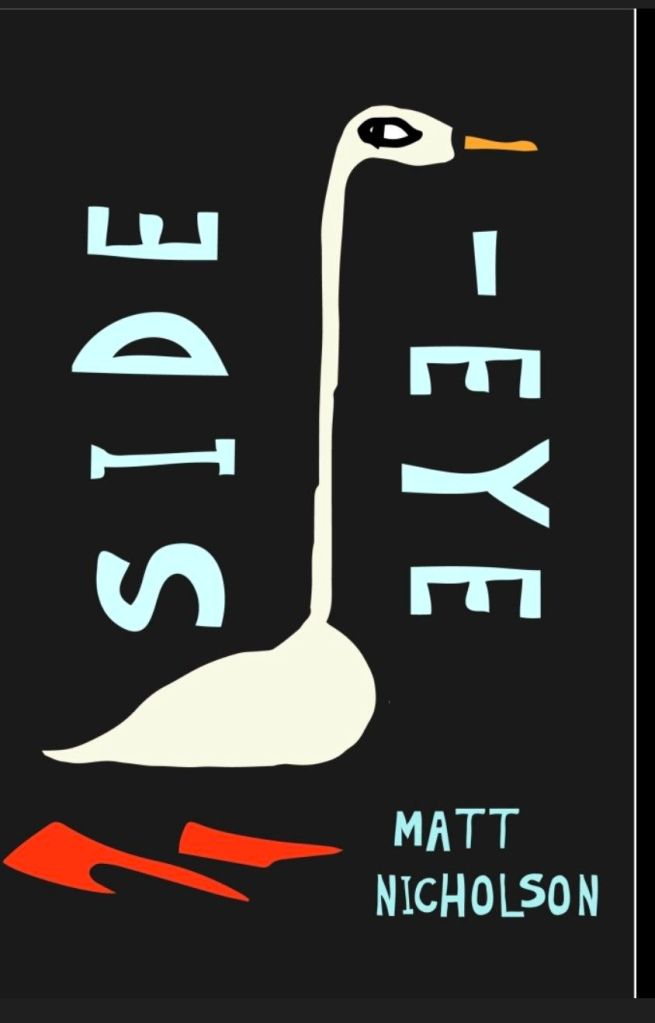
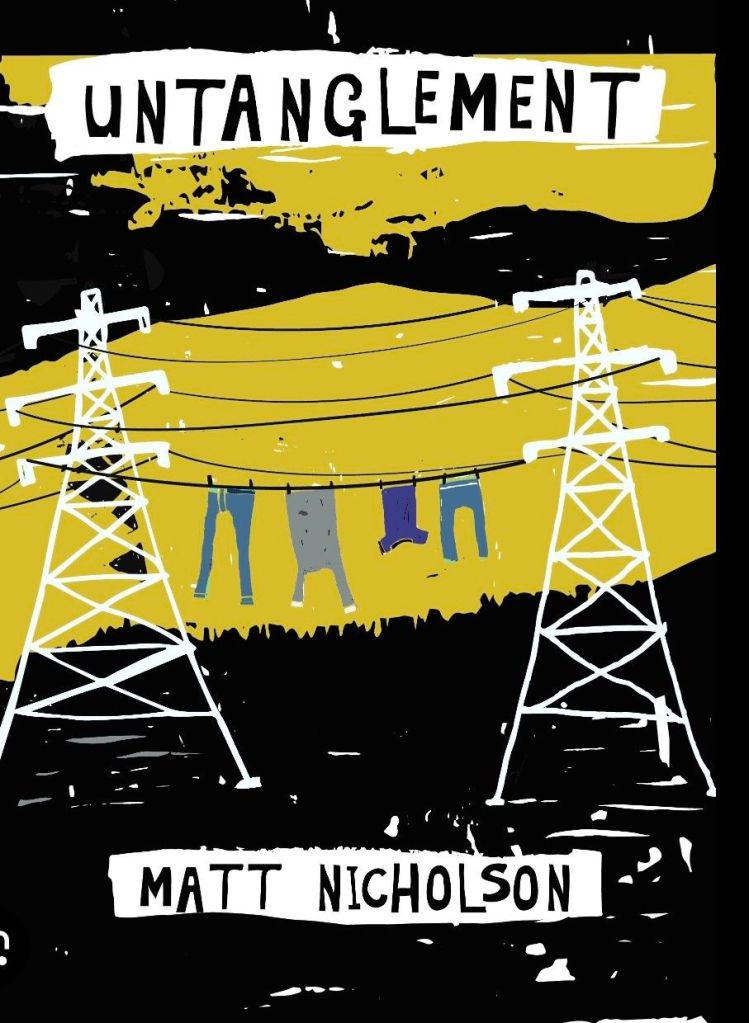
Matt Nicholson is a poet and performer from East Yorkshire. He published his fifth collection, Side-eye, on Yaffle Press, in the summer of 2025. He often performs with 3 other Hull poets as “The 4 Johns”. His work is sometimes dark and visceral, but also sensitive and heart-wrenchingly honest, and even sometimes funny, leading Helen Mort to describe his poems as “capable of breaking your heart and mending it again”. He has toured all around mainland Britain and loves performing to new audiences. For books and more information please visit http://www.mattpoet.com.
The Interview (Originally begun in 2023, updated by Matt in 2025)
Q1 (2023): I last interviewed you in 2020. Please tell me what you’ve been up to since then?
A1(2023): The big project that filled my writing time in 2020 and 2021 was writing and editing the poems that became my fourth poetry collection, “Untanglement”, and because it was very important to me that the poems stood up on the page as well as out loud, I attended many classes and workshops, including those run by Gill and Mark Connors at Yaffle, and mentoring sessions with Helen Mort. I also upped my reading of other people’s poems, pamphlets and collections by way of further ongoing poetry education. “Untanglement” was published by Yaffle Press in the Spring of 2022 and I took it around as many poetry events as I could. In the second half of 2022 I began working with three other poets from my part of the country – Peter Knaggs, Jim Higo, and Mike Watts – and calling ourselves “the 4 Johns”, we did a number of readings, shows and workshops together, and went on to write a Theatre/Spoken Word show, “All we’ve got time for” which premiered in the summer of 2023 and went on, via several theatre performances, to be part of The Morecambe Poetry Festival in that September.
Q2 (2023): How did you decide on the order of the poems in “Untanglement”?
A2(2025): The simple answer, for Untanglement, is that I had help. I think it’s important where poems sit in terms of an order and in relation to one another. I think poems can speak to one another in a collection but also, if you put the big important pieces too close to one another, they can make things imbalanced. As such one would be foolish not to take advice from those with more experience in such matters, and I sort guidance from the editorial team at Yaffle and from Helen Mort to help me get it right. I would like to add to this answer by saying that this is one of the hardest things to be sure about, and there do not seem to be any hard and fast scientific methods for it.
Q3 (2023/2025): How important is narrative in your poetry?
A3 (2025): Narrative has become more important to me during the writing of the last two collections. I wanted to tell more stories alongside the more lyrical poems that I continue to write. I felt able to be more open and honest with the reader by writing more narrative poems such as “Said big me to little me” and “I met him at a counter-demonstration” in “Untanglement”, and I felt that improved all my writing because of this more open, honest approach, and I hope that trend has and will continue.
Q3.1 (2023): How is opening the poem up, making them more story based important for live performance?
A3.1 (2023): I think you need to engage with an audience during a live performance / reading. It is likely, to me, that the poems you are sharing with an audience will engage them more if there is variety in terms of style and also intensity, and if some pieces are easier to engage with than others.
Q4 (2023): How important is form in your poetry?
A4 (2023): Because of the way an idea develops into one of my poems, starting off with how a line sounds to me out loud, and then getting the subsequent lines to develop from that beginning, and often in relation to that original rhythm, there probably aren’t many of my poems that adhere strictly to any classical forms. I do enjoy reading “form” poetry and have tried to write villanelles, sonnets and other forms in workshops etc. but they haven’t been the ones that I have had published, so as yet, it is not a strength I can claim. I think, because my poems all tend to start life orally, they do have elements of conversational/everyday speech in them and so there are bits of naturally occurring/accidental iambic pentameter, and some bits might resemble other elements of form too. And when the words make it onto the page, I find the shape of poems is becoming more interesting to me, but then I’m not sure that’s exactly what you mean by “form” in your question.
Q4.1 (2023): Why is it important that elements of conversation occur in your poetry? I am thinking particularly of Yorkshire dialect?
A4.1 (2023): I think it’s important for characters in poems (as in any literature) to be authentic and relatable, to use vocabulary and sentence structure that adds dimension to them for the reader. How a person speaks is often an immediate way to steer the reader to understand that character and to flesh out their world.
Q5 (2023): What do you think about the idea that a poem’s meaning should always be elusive?
A5 (2025): Over time, I have come to the conclusion that the problem with this notion is the “always” in the question. There are usually reasons why a poet does things in a poem the way they do and decides how to present their words and meanings. If it makes sense to the writer to keep the meaning of a poem elusive, be it for reasons of subject, sensitivity, to influence how a subject is thought about by a reader, or to create some kind of literary enigma for whatever reason, that is just as valid, assuming it’s done well, as it would be if the writer had been explicit and open about the meaning of a poem, as long as that is also done equally as well.
Q6(2025): How did you decide on the order of the poems in your latest book?
A6(2025): Side-eye was written over three years, from the end of 2022 onwards, and it resulted in approximately 350 poems being written for the final 60 to be chosen from. As a result of so many pieces hanging around and coming and going , they were initially separated into eight groups, to make them more manageable and to group poems into subsets by subject matter. As time went on, and as before, following conversations with Helen Mort and Mark Connors, those eight groups were whittled down to 4 by means of merging and rethinking their definitions, and the 350 poems were gradually reduced to about 120. Then as the title of the collection and the tone and themes began to present themselves from that 120, I was able to, with advice, get the number to 60 and to choose the order of the poems and, very late in proceedings, exactly what order those sections would appear in the book.
Q7(2025): What projects are you working on at the moment?
A7(2025): I am a little nervous to say too much about my current focus in case doing so were to jinx it, but I will tell you that it involves writing lots of poems about different fears and phobias, submitting those poems to relevant people and places, and then potentially creating a workshop format that will be based on the same subject matter. I am also looking out for some poets to mentor, who I can pass on all I’ve learned from so many great people over the last ten years or so as a poet myself.
 The Wombwell Rainbow