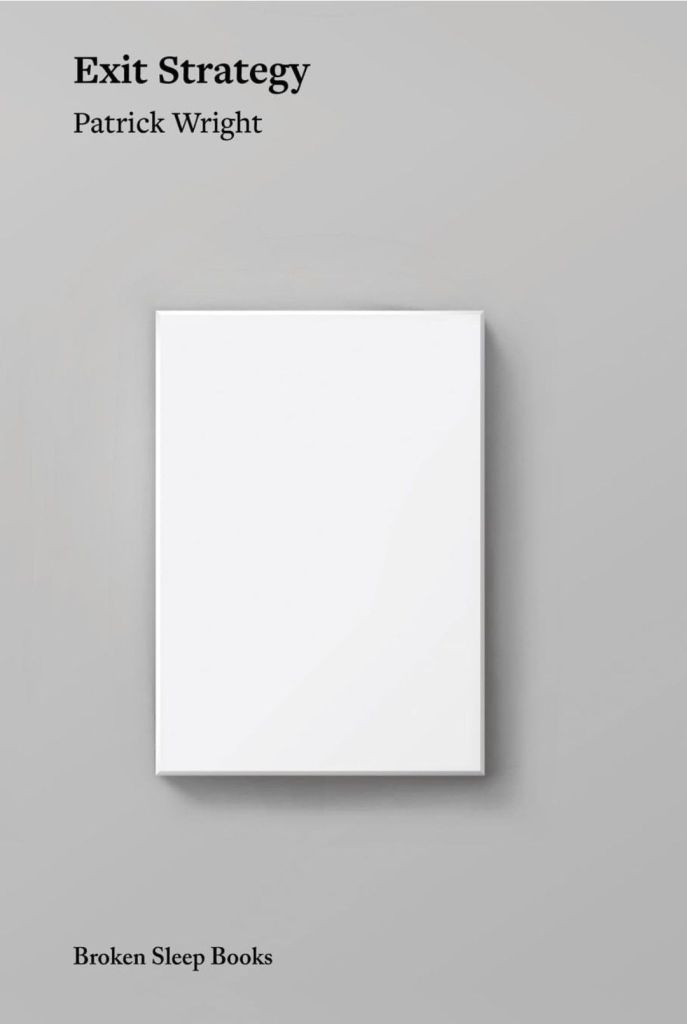
Exit Strategy (Broken Sleep Books, 2025):
Patrick Wright
is an award-winning poet from Manchester, UK. His poems have appeared in Poetry Ireland Review, The North, Gutter, Poetry Salzburg, Agenda, and The London Magazine. His debut pamphlet, Nullaby, was published in 2017 by Eyewear. His debut full-length collection, Full Sight of Her, was published in 2020 by Eyewear and nominated for the John Pollard Prize. He has been shortlisted for the Bridport Prize and twice included in The Best New British and Irish Poets anthology. He teaches English and Creative Writing at the Open University.
The Interview
PB: How did you decide on the order of the poems in Exit Strategy?
PW:
Given that my book is about the grief process and a possible extrication or ‘exit’ from mourning, I had Elisabeth Kübler-Ross in mind, especially her five stages of grief. While I’m aware her model is subject to critique and perhaps an oversimplification of grief – it’s not, for example, and as some might assume she is saying, a linear process – I found it useful to divide my book into five sections. These don’t correspond directly with denial, anger, bargaining, depression, and acceptance – and I think there’s a few overlaps, callbacks, or foreshadowings – but these stages can be mapped onto my sections, albeit in a loose way. The section dividers – marked with an infinity symbol – are also meant to interrupt or subvert the notion of a linear path, with the suggestion of ongoing love and grief – the latter of which I’ve come to understand as the shadow of love or its extension: how the relationship goes on but operates on a spiritual level.
PB: How important is form in your book?
PW:
Incredibly important, as most of the poems are ekphrastic – looking to be mimetic of abstract or ‘formless’ artworks; not so much a representation as a re-presentation, in a performative way, of a visual art form that poets have rarely confronted. As such, in an attempt to evoke and forge a link with a specific artwork, I experimented with various forms, including sonnets (and near-sonnets), ghazals, prose poems, centos, and a new form I’ve looked to develop, which I call exploding form, where my words are scattered around the page, suggesting a violent detonation. Such forms offer temporary containers and serve as an analogue for grief. This includes my exploding form – since grief can be perceived as a centrifugal force involving dissolution and possible reconstitution. Our sense of identity, through bereavement, can be torn apart, though might, if we survive, form a new or emergent self. Abstract and ‘formless’ art can, likewise, present itself as a kind of metaphor for profound loss – inchoate and reaching towards meaning. My mode of ekphrasis sees such artworks as a prism for grief, and the poem as making sense of what’s refracted.
PB: What do you mean by ‘an analogue for grief’?
PW:
I mean something – oftentimes a visual art form, or, as I suggest, a poetic form – that corresponds with the disorder, confusion, or ineffability brought about by loss. The bodily experience of grief, which can also be traumatic, is difficult if not impossible to represent straight away through signs; but the medium of the image can help us access unconscious thoughts and sensations – what can feel pre-verbal, somatic, and lodged inside us – and serve as a bridge towards elaboration through language. Mark Rothko’s late works, such as his Seagram Murals, offer obvious examples.
PB: To return to answer earlier comment you made about form. How did the new poetic form emerge?
PW:
Exit Strategy was written as part of my PhD in Creative Writing at the Open University, supervised by Jane Yeh and Siobhan Campbell. My work here (what’s sometimes called ‘practice as research’) focused on examining modes of ekphrasis in response to abstract and ‘formless’ artworks. At the same time, I saw such images as a lens for my personal experience of grief: how a painting could, for example, represent a profound state of loss. What I term exploding form is, as I understand it, imitative of certain modernist works, such as Cornelia Parker’s Cold Dark Matter, and, at the same time, visually re-enacts the disarray and loss of structure that can accompany major bereavement.
PB: What is the role of Nature in this collection?
PW:
That might depend on how ‘Nature’ is construed. It’s a collection that’s quite introspective, with a focus on art galleries, books, postcards, and personal themes – the subjective experience of grief – so there’s little in the way of birds or wildlife, that kind of nature. There are occasional references, such as ‘A Distant Fawn’, where the creature – in this case, a young deer – becomes a symbol for something intangible or metaphysical. It’s as if one element of nature – such as the sea (which I write about quite a bit in response to seascapes, light, and atmosphere) – is a divine messenger or thing to be reckoned with through the anguish. There are also other ways to think of nature, such as human nature, perhaps rage at God and the all-too-human shaking of our fist at the sky. There’s the nature of reality, too (how we are subject to time and mortality), the nature of poetic form, the nature of art, and so forth. I think the collection is rather ambitious in this way, taking on these wider considerations.
PB: Why did you choose the Dostoevsky quote at the beginning of the collection?
PW:
It’s taken from The Brothers Karamazov and meant to evoke the cycle of suffering and redemption. I felt that my journey through grief was part of this age-old and human struggle, coming to terms with the evils of the world and the malice inflicted upon us – in my case, the loss of my partner to cancer. It’s possible others can relate to this – how life can be cruel and unjust to the point where we question everything, where meaning and our sense of self is obliterated. Personally, I reached this nadir. Though my partner and I were always believers in creativity and renewal, and so art and poetry presented themselves as a way out and through the crisis. While writing, I was also inspired by the phoenix motif – how we must go through an agonising phase of burning up and losing one identity before we can gain another; and this kind of regeneration is often necessary for those who experience a significant loss. As we often hear, and though somewhat of a cliché, it’s not that the pain of loss ever goes away or diminishes, but it is possible to grow around it.
PB: How did you tackle the emergence of the phoenix from the flames, the recovery of meaning?
PW:
I think the artworks I responded to or anticipated had a significant role to play – the beauty of the paint, for example, or my reverence for ideals within Modernism; and the collection can certainly be seen as a homage to Modernism. My new and fragile identity – one that managed to survive the initial shock of bereavement – made use of such modernist artworks as a kind of crude armature; something to build myself around. My partner and I met as students studying the History of Art, and we maintained our love of modern art and design throughout our relationship. As such, after her passing, it felt like the works we admired and the principles of creativity we lived by were an intermediary; something left behind that still joined us, that kept her presence alive and gave me inspiration to move forward. It was almost as though the image served as a channel to hear her in spirit, a medium for her to find her way into my words. At the core of her beliefs was that art, including poetry, had the power to alchemise, to recover beauty from tragedy or disaster. That for me, if it can be accomplished, is the apex of meaning. I suspect it’s an idea that carried through from her inter-generational trauma – since her ancestors were victims of the Holocaust. If there’s been devastating loss – and that was also the case for her – there’s often a greater urgency in such individuals to find meaning, to make things make sense, given the risk of meaning collapsing into despair and nihilism. I’m again reminded here of Dostoyevsky and his statement that ‘beauty will save the world’. Since it’s what she would have wanted for me – to find redemption through art – I do my best to embody her wish, while also ‘resurrecting’ her in and through my poems. With all this, there’s also an echo of how Modernism itself, through its succession of -isms, was a glorious and in some ways failed attempt to fill the void – after Nietzsche’s proclamation that God is ‘dead’.
PB: What is the significance of so many of the poems being “after (name)”, one being “before”, and another “alongside”?
PW:
As some readers will already know, the convention in ekphrasis (writing about artworks) is to use the epigraph ‘after’ under the title of the poem. This suggests a temporal stance, writing a poem in response to an image or object; that is, after the viewing. For others, it might also gesture towards the primacy of the originary work. As a challenge to this, my PhD project, developing other poets and writing practices over the last two decades or so, was in part an exploration of how ekphrasis can be more dynamic, emphasise process, collaboration, and a reciprocal exchange. Therefore, my poems at times were generated in situ, while in the gallery, where my experience with the artwork felt mutual – the image influencing me just as much as I was ‘representing’ it. To signify this two-way process, I’ve occasionally used an alternative epigraph, such as ‘alongside’. Other times, when the artwork was anticipated or imagined (ahead of, say, a gallery visit), and ‘seen’ in the mind’s eye, I’ve used the epigraph ‘before’. Exploring ‘beforeness’, I found support in the criticism of Thom Donovan and Lesley Harrison, who likewise argue that ekphrasis does not have to occur after the viewing; instead, it can precede it: the latter referring to this as ‘reverse ekphrasis’. What this also does is unsettle the idea of the poet in a state of rivalry or competition with the image; someone who might assume, perhaps unconsciously, a position of dominance or mastery over the artwork – the image traditionally seen as fixed, silent, and feminine.
PB: Once they have read your book, what do you hope the reader will leave with?
PW:
As always, above all, I hope they’ll be moved by the poems. That’s what I always look for. I’ve had people say that my poems elicited tears, or they were emotive in another way, and that always feels like the greatest achievement – far more than accolades or the book’s perceived status. I find that awards or prizes mean less to me the older I get. Now, it’s about making an emotional connection with readers. I also hope that the book, in some way, resonates with the grief journey of others – and perhaps supports belief in the idea that experiences like grief or trauma can be worked through and written about. Art and literature are often partial and inadequate on their own; however, the kind of processes I’ve demonstrated – utilising abstract and modernist images as a conduit – can be seen as a possible, if somewhat fragile, bridge towards recovery and rebirth. As many therapists know, when we speak (or write), and articulate what’s so far been unspeakable, it can be healing.
 The Wombwell Rainbow