
Q:1. How did you decide on what poems to send?
When Alan told me about the theme I went back into my poems, thought I might have something that fit. I ended up picking ‘The Doghouse’ for submission as it’s kinda a meditation on the landscape, a rundown shack you see out your window when you’re zooming past on the road. I remember seeing that building or what was left of it just outside of Denver, no other buildings around for a few miles. At the time, I just wrote a few notes, the colour of the soil, the dog nearby, the sound of the insects at night. It worked out in the end as a kind of reclamation poem, the landscape un-taming itself. The only human involvement left being the wasting remains and the dog that’s trained to sit by the hearth
I thought it seemed to fit the call.
Q:2. What poetic form did it take, and why?
This poem is free verse as most of my work is. I find it less constraining being unbound by traditional form, rhyme scheme or meter.
Q:3. How did you use the whiteness of the page in your poem?
I don’t think too much of the empty space in a poem or experimenting much with the page format, but I have been fighting the fear of the long line. My early work looked like a bean pole! I think ‘Doghouse’ is a happy medium. I am cautious about leaving too much of the page blank. A page needs more pulp sometimes.
Q:4. How did you decide on the title of your poem?
I have a standard rule when I’m naming poems: If you can’t make it clever make it simple. I don’t think there could have been a better name for this piece than a “say-what-you-see” title.
Q:5. Imagery, or narrative. Which was more important to you in writing the poem?
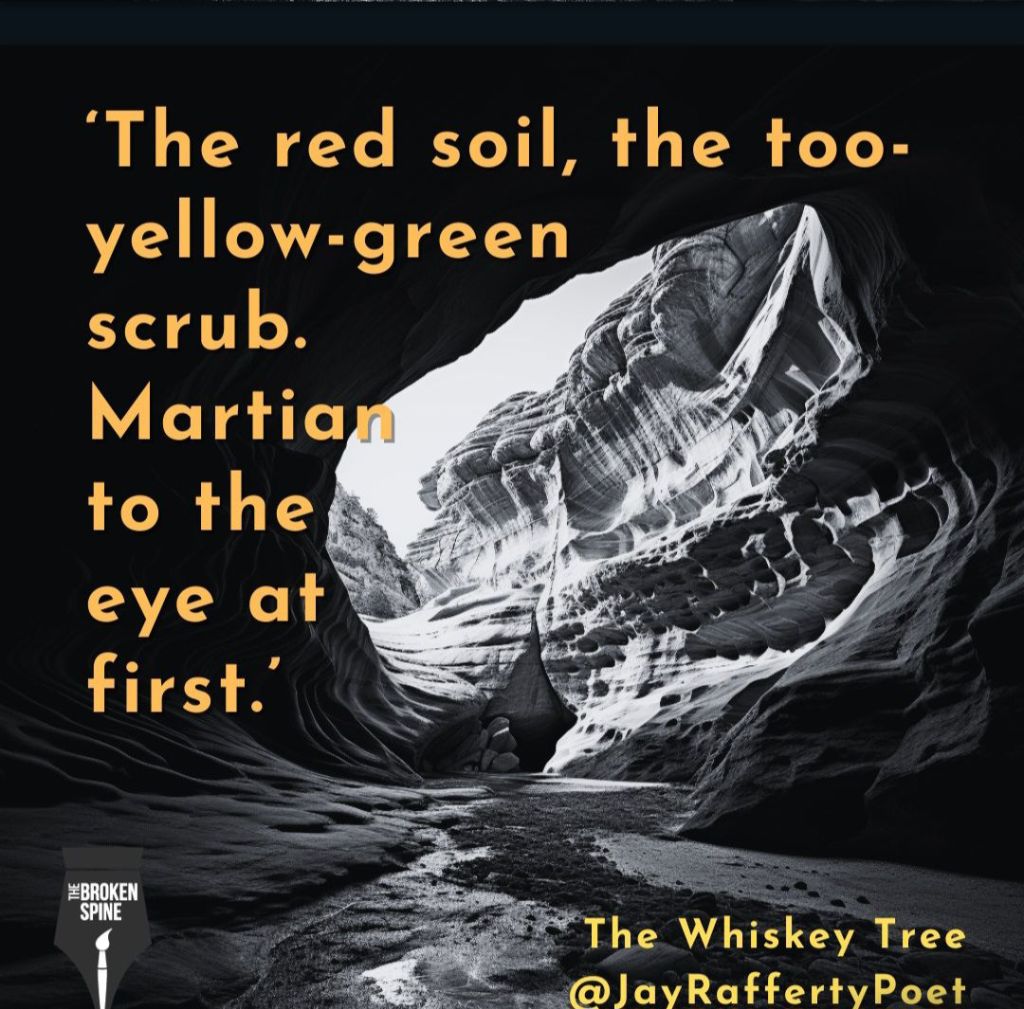
Absolutely imagery. Colorado is gorgeous and so alien to an outsider. The soil by itself is a whole pallette of dark blue-greens and straw yellows and iron reds. That landscape in a freeze frame, like a blurred photograph of the roadside when you’re going 60 MPH. That’s what I was aiming to capture. There’s no story here except a dog sleeping in the ruins of a shack.
Q:6. What do you think of where your poem is placed in the collection?
I don’t particularly think about where my poetry comes in a journal. Manuscripts are a different story but what matters for me mostly is the company the poem keeps and in TWT ‘Doghouse’ is in very good company.
Q:7. Once they have read your poem, what do you hope the reader will leave with?
Apparently the average person considers a single painting in a museum or a gallery for 15-30 seconds.
Every image in this painting, every colour in the soil, every insect screech, every plank and slate got mushed together into a few lines. I was careful. I tried to get it all right or as close to what I saw as possible. It was beautiful.
If a reader considers it, imagines something close to what I saw for 15-30 6 least, I’ll be happy with that.
Bio and Links
Jay Rafferty
is a redhead, an uncle, and an eejit. He is a guest lecturer on Irish Literature and a Programme Committee member for The John Hewitt Society. He is also the author of two published chapbooks, Holy Things (The Broken Spine, 2022) & Strange Magic (Alien Buddha Press, 2022). You can read his poetry, essays, and reviews in several journals, including FU Review Berlin, An Áitiúil Anthology, Unstamatic and HOWL New Irish Writing.
 The Wombwell Rainbow