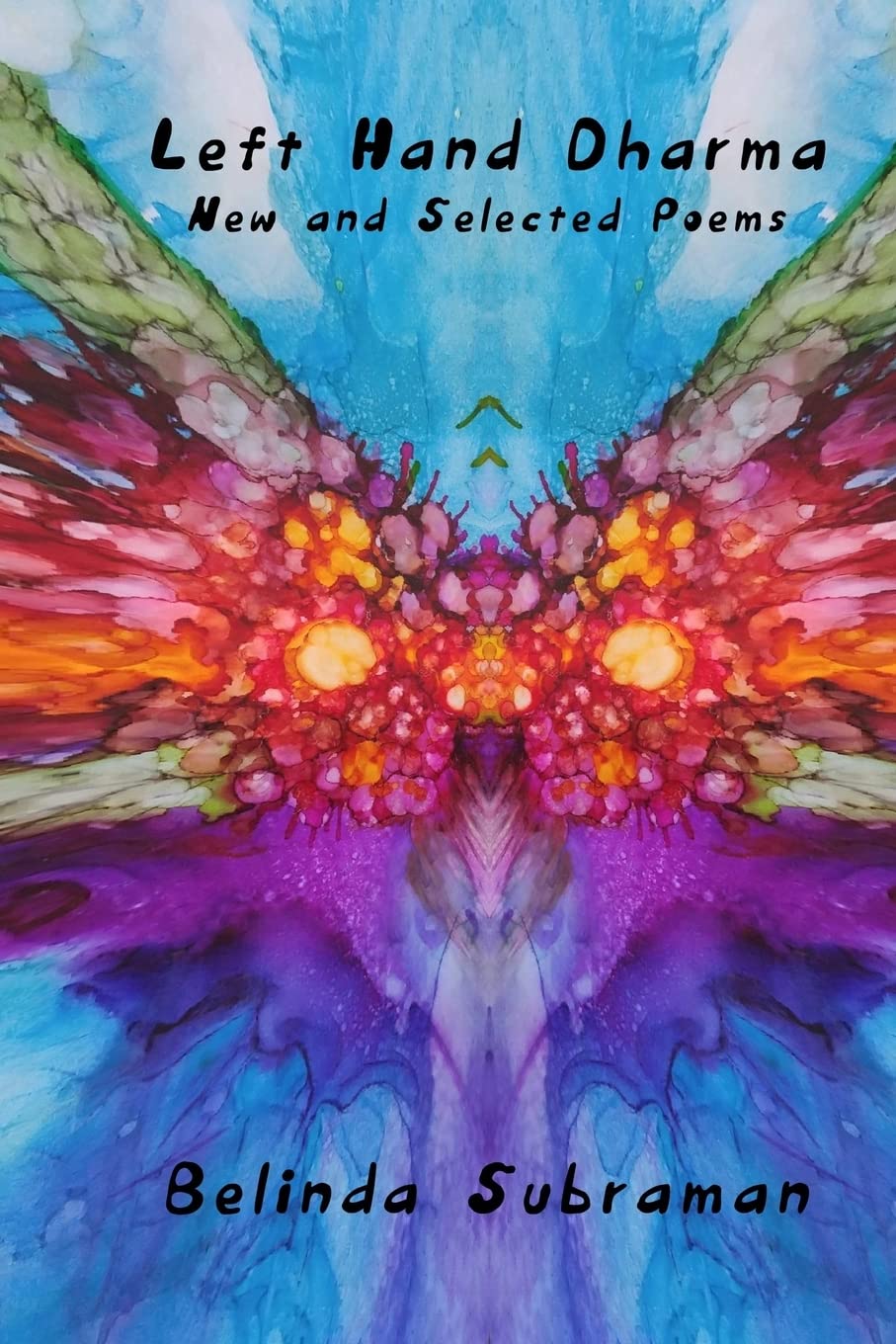
Belinda Subraman
While living in Germany in the 1980s Belinda began Gypsy Literary Magazine and Sanctuary Tape Series where she published writings and vocal performances of poets from many countries. Sanctuary ran about 6 years and Gypsy for 10 years before its resurrection in 2004. She also published many books under the VERGIN’ PRESS imprint including VOCES FRONTERIZAS, writings based on life on the U.S./Mexican border sponsored by the El Paso Public Library as well as THE GULF WAR: MANY PERSPECTIVES, EARTH TONES, IMAGES OF JIM MORRISON and HENRY MILLER AND MY BIG SUR DAYS.
Belinda’s own writing has grown to span a vast array of subjects, styles and publications. She has traveled in over 20 countries, lived in Europe for 6 years and was part of an East Indian family for 22 years. These cross-cultural experiences often inform her work as well as her experiences as a Registered Nurse. These days her poetry, stories, and art can be found in hundreds of journals, reviews, anthologies, books, chapbooks and easiness. Since 1994 her archives are housed at the University of New Mexico, Albuquerque, in the Center for Southwest Research.
The Interview
1.How and why did you start writing poetry and making art?
I remember reading poetry books in the 6th grade (around 11 years old). I dabbled in writing it around then too. It felt like a special form of communication I wanted to learn, to stir emotions in a few lines. Poetry soon became my companion.
I have painted off and on all my life but never considered myself an artist until these past few years after I started showing my work a bit and people started giving me feedback and buying my paintings. I go into my garage studio daily and place at least a few intuitive strokes. It is a conversation with myself, a slowly painted poem.
2.Who introduced you to poetry?
I think it was Mrs. Woodruff, my 6th grade teacher. I remember checking out poetry books in the library around that time. It was a very solitary pursuit. Other than a few humorous poems passed around in class when I was 12 years old, no one saw my work for years. And no, I don’t remember names of people who influenced me, who I read, except Anne Sexton and Marge Piercy. Everyone I came in contact with, every book I picked up, every experience I ever had were my influences.
3.Why do you think you remember Marge Piercy and Anne Sexton, particularly
Their clarity, power, intimacy, depth, artistry, and skill. They honed their poems to beautiful essence. They were excellent in editing their work, no sloppiness, no spew. I had one of Marge Piercy’s poems taped to the side of a file cabinet, next to a typewriter, for years.
“For the Young Who Want To” by Marge Piercy


Talent is what they say

you have after the novel

is published and favorably

reviewed. Beforehand what

you have is a tedious

delusion, a hobby like knitting.


Work is what you have done

after the play is produced

and the audience claps.

Before that friends keep asking

when you are planning to go

out and get a job.


Genius is what they know you

had after the third volume

of remarkable poems. Earlier

they accuse you of withdrawing,

ask why you don’t have a baby,

call you a bum.


The reason people want M.F.A.’s,

take workshops with fancy names

when all you can really

learn is a few techniques,

typing instructions and some-

body else’s mannerisms


is that every artist lacks

a license to hang on the wall

like your optician, your vet

proving you may be a clumsy sadist

whose fillings fall into the stew

but you’re certified a dentist.


The real writer is one

who really writes. Talent

is an invention like phlogiston

after the fact of fire.

Work is its own cure. You have to

like it better than being loved.


I was a little star struck when I interviewed her for the GAS 12 video show. I should have done a stand alone interview with her rather than a short segment.  If you're interested, it's here: https://www.youtube.com/watch?v=Yjam3U-kdNY&t=4s
4.At any point how aware are and were you of the dominating presence of older poets traditional and contemporary?
I was aware of many types of poets for decades. The first serious poetry I read was the old classics with rhymes and specific forms and I wrote in similar fashion in the beginning. Contemporary poetry appealed to me more. It set me free. Meaning as well as craft is far more important to me than specific forms.
5.Talking of the writing and artworks, what is your daily writing routine?
I’m not a daily writer. I probably only write a few pieces a month. I paint a little most every day. It’s writing with color, texture and shape for me. There’s the daily routine of cooking, cleaning etc. that has to be done and there’s a fair amount of time I use promoting others and that includes the GAS group. It’s more like a salon in my living room. To get in the group you have to acknowledge you’ve read and agree to the Guidelines which explains the kind of group I’m trying to have. Then there’s the GAS blogazine which has a lot of excellent poetry, art and music articles, interviews, occasional reviews and articles on small press history. https://gaspoertyartandmusic.blogspot.com
I did fifteen GAS video variety shows. (You were on one of my first ones.) I started it during the Pandemic. It was a good idea at the time. I’ll probably always do video projects including interviews and my poetry expressed with art and music. Here’s one I did recently. The music and poetry is mine and the art is by Van Goph: https://youtu.be/FH7VEg4T8YY
6.What motivates you to write, do artworks and promote the work of others through GAS?
None of that, really. My mind is a jumble of ideas all the time. I’m not a relaxed person. You can see it in my art, crowded overlayering thoughts. These days, and maybe always, I like to write when I can slow my thoughts, see them, when I can sit in relative peace and let them flow. When I catch a phrase or line I like, I write it down and go into a place or trance-like state to follow the stream that brought the first line. I catch other lines and bring them to a page. I continue until I feel the message that wanted to come is finished. Or something like that! 😊
7.How do the writers you read when you were young influence your work today?
I have no idea. That was decades ago. There is no denying that everything that passes through us affects us somehow but I have personally rejected as much as I’ve absorbed, I think, or maybe moved on to forge my own way. For a child who found being looked at painful (trauma stuff) and who was unable to talk to people, the goal back then was finding a way to communicate.
8.Who of today’s writers do you admire the most and why?
Oh dear, I have little time to read except for the people in my group. I like a lot of poets who have an unusual (almost abstract) yet powerful way of expressing themselves. Just a few I’ve read today and liked : Robert Wilson, Amelia Christine Matus, Nicca Ray, JD Nelson…
Here’s a short example of what I mean by Bengt O Björklund:
no title


she was stuck

in a tin foil fantasy

avoiding spiders

any kind of spider

selling comics

at the atomic market

she ran with old rainbows

selling her unique style

to any bystander

when winter came

she’d hibernate in cyberspace

calling all boys to the bonfire
9.What would you say to someone who asked you “How do you become a writer?”
Other than what I’ve said I don’t know. How to be a Published Writer is to be brave enough to send your work out and if you really know your writing is good and it gets rejected, keep sending it out to places. Rejection never feels great but know it isn’t always about the quality of your work. It could be any number of things like there are only ten slots for poems and 998 people sent in their work, could be the slant of the publication. It is always important to study a few issues before sending and Follow the Guidelines.
Here is the current GAS Facebook group. I don’t think you’ve ever posted in this one: https://www.facebook.com/groups/gaspoetryartandmusic
10.Tell me about the writing and artwork projects you have on at the moment.
I hope to get a book of poetry out this year. I’d like to do more projects combining my art with poetry or other people’s poetry with my art if anyone would be interested in that. I love collaborations. I have a category called Collaborations with other Poets, Artists and Writers on my YouTube channel. I’m always adding strokes to pieces of art, getting ready for an eventual art show this year.
 The Wombwell Rainbow