What a great question! When the invitation came, I felt the ears of a few poems perk up. Still shrouded in fog, lingering on sandstone outcrops of expression, they leaned over the jagged cliff of my awareness and jumped onto the page. What else could I do, but follow their trail?
Q:2. What poetic form did it take, and why?
Initially, this narrative was a running one to just keep up with the flow of information/sensations. But because many people may not know about Olmec deities, I realized I needed to slow the content down so people could take it in whether or not they were familiar with this magnificent creature. Choosing to do it in parts allowed both me as the narrator and the readers/listeners who would follow the lines on the page and opportunity to pause and reflect/take in more deeply what was being ‘said’.
Q:3. How did you use the whiteness of the page in your poem?
The whiteness is background music upon which the words (lyrics) are written (by a non-musician) in sync with the beats of my breath. (After all, it really is a song). There are times, such as in this piece, where too much focus or interplay with the background dilutes/distracts the immediacy of the words.
Q:4. How did you decide on the title of your poem?
This may have been my most intentionally strategic moment. I wanted to capture in as few words as possible this poem’s mythical time and space; anchor it in pre-Mesoamerica (Olmec) cosmology, gambling that the curious would take time to look up the word Olmec. More important to me, however, was how to handle the potential obscurity of Cipactli. I decided to make this being as accessible as possible by first introducing it as Crocodile, which most people are familiar with.
Q:5. Imagery, or narrative. Which was more important to you in writing the poem?
Honestly, my first task was to capture the basic heartbeat (pulse) and then, with focus, to flush out that tone with as much specific imagery (physicality) as felt necessary.
Q:6. What do you think of where your poem is placed in the collection?
God, Paul, I hope you don’t think I’m ‘way out there’ but my responses are true to my thinking & understanding of the way of the world. So: In the #6 spot, this poem is near the collection’s midpoint, which is between the book’s heaven and earth. A fitting place for a supranatural (not supernatural) meeting of human and deity. I think Alan did a masterful job of weaving the 14 poem strands together.
Q:7. Once they have read your poem, what do you hope the reader will leave with?
My hope is that readers experience a sense of the relationship (interconnectedness) of all things seen and unseen. That such interplay, which keeps us evolving, can be both harsh and wondrous.
Bios and Links
Karen Pierce Gonzalez
is an award-winning writer whose work has appeared in numerous print and online publications, radio shows, and podcasts. Her chapbooks include Coyote in the Basket of My Ribs (Kelsay Books), True North and Sightings from a Star Wheel (Origami Poems Project), and forthcoming Down River with Li Po (Black Cat Poetry Press). Writing credits also include several short plays staged through Fringe Festival of Marin (USA).
With degrees in creative writing, anthropological linguistics, and folklore, she is also a former journalist and folklore columnist who now hosts a quarterly ‘Get Ekphrastic with Folk Art’ blogzine on FolkHeart Press. Other current projects include a series of videos based upon 1) original folktales/legends and 2) imagined prequels/sequels to fables and fairy tales.
Her visual artistry focuses primarily upon assemblage art based upon elements found in nature (tree bark, bird nests, etc.). To date, 50+ of her art pieces, including six cover images, have been or are scheduled to be published in a range of literary journals/magazines.
And she gets to do all that in the verdant rural landscape of San Francisco’s North Bay.
I took a chance on a poem that came from a dream. I had always liked it because it framed a moment and a feeling for me, and I wanted to see if it would resonate with anyone else. I love that it did!
Q:2. What poetic form did it take, and why?
No particular choice was made, but I could see it needed to be two stanzas as it evolved because I wanted to break the poem into two different parts with a definite pause to it.
I changed the line breaks when I spotted that some of the images I had originally seen as one thing spoiled the look on the page. They also slowed the poem down when split, which made it a win-win!
Q:3. How did you use the whiteness of the page in your poem?
I was happy with the way the two stanza format sat on the page. I hadn’t planned for the lines to make it look jagged, but I rather liked this when I noticed and felt it reflected the antlers!
Q:4. How did you decide on the title of your poem?
I took the main image from the poem and used this like a label for the title. I asked myself if I would read a poem with this title to check it worked.
Q:5. Imagery, or narrative. Which was more important to you in writing the poem?
For me there always has to be a narrative and a story based meaning in my poetry, but I like to be as sharp as I can on the images with the hope the reader gets a glimpse of what it looks like to me. Narrative comes naturally to me, but I have to check my imagery.
Q:6. What do you think of where your poem is placed in the collection?
I just love the fact it is there.
Q:7. Once they have read your poem, what do you hope the reader will leave with?
A desire to read it again. A sense of the layers to the poem.
Bios and Links
Sue Finch’s
first poetry collection, ‘Magnifying Glass’, was published in 2020, and her second full collection is due to be published in Spring 2024. Her poems have also appeared in a number of online magazines. She loves the coast, peculiar things and the scent of ice-cream freezers. ‘Vortex Over Wave’ was published in 2023 and features a selection of her #ElasticBandPhotos and poems for the full moon. You can often find her on Twitter @soopoftheday.
A number of concerns have dominated my poems in recent years: the family; the body and ageing; nature under threat; Dublin’s topography. Given the overall theme of the chapbook, I looked at those poems that address the climate crisis which were written since the publication of my most recent collection, Liffey Sequence, in 2021. I submitted three of these for consideration.
Q:2. What poetic form did it take, and why?
My first impulse is always toward free verse. I play freely on the page with thoughts, images, sounds, verbal clusters. It’s only once a certain ‘critical mass’ has been accumulated that I begin to play with form, so I guess I’m a believer in getting the clay onto the potter’s wheel before shaping the artefact. While I rarely go for preconceived forms or full-on rhyme, qualities such as rhythm, assonance and other acoustics are key to a poem’s evolution.
Q:3. How did you use the whiteness of the page in your poem?
In some of my poems, I’m very aware of how the poem will appear on the page, and play with the interaction between type and silence. In others, this interaction isn’t a consideration. ‘Cutting the Turf’ is among the latter, though I’d hope the regularity of line-length to some extent mirrors the laying out of parallel rails of wet turf.
Q:4. How did you decide on the title of your poem?
There’s a fine tradition of harnessing the ambivalence of the gerund in English poetry – think of Seamus Heaney’s ‘Seeing Things’, which hovers between both being objective and hallucinating, or Philip Larkin’s ‘Church Going’, which covers both the poet’s activity and the state of disuse of the chapel visited. In much the same way, ‘Cutting the Turf’ may be read as purely descriptive of the time-honoured process described – the Irish tradition of cutting and saving turf as a fuel from the local bog. This tradition is under fire as hazardous both to the local ecology and to the climate, so that the activity is in conflict with EU directives that we should be ‘cutting the (usage of) turf’. A ban is in place on the commercial harvesting of our bogs.
Q:5. Imagery, or narrative. Which was more important to you in writing the poem?
Interesting question. Having recently gained first-hand experience of the contemporary process in rural Kerry, I wanted to capture the various stages involved – bogs are no longer initially dug by hand, but the laborious technique of stacking the turf in ‘stooks’ to dry out the sods persists. At every stage I looked for imagery that might suggest something pernicious to nature, culminating in the stooks viewed as “box-braids/ on the scalp of the drying bog”. There is an ecological drive to re-wild and rewet Irish bogs which has run into considerable localised resistance.
Q:6. What do you think of where your poem is placed in the collection?
The order in which a poet, or editor, places the poems of a collection or anthology is always of interest. Different resonances are set off depending on which poems are placed contiguously to a given poem. This is not just a matter of themes – considerations such as voice or point-of-view, form and length also come into play. I was interested, and pleased, to find ‘Cutting the Turf’, which hints at the ecologically damaging practice of draining native bogland, was placed between two poems which have an arid setting – the ‘red soil, the too yellow-green scrub’ of Colorado in Jay Rafferty’s ‘Doghouse’ and the ‘orangey-yellow expanse’ of sand in Sue Finch’s ‘Desert Antlers’. The theme is later taken up in Vikki C’s ‘The Great Desertification’ and Paul Brookes’ ‘Sup A Well Earned’ Indeed, the final word of the chapbook is ‘wilderness’.
Q:7. Once they have read your poem what do you hope the reader will leave with?
Poetry, as Auden famously stated, makes nothing happen. To imagine that by articulating unease about climate change, say, a poet might in some way effect change in a reader’s politics is fanciful. That said, perhaps the point of poetry is precisely to ‘make happen’ an ambient ‘nothing’ – a space that allows the chosen subject to stand out for contemplation. If the reader comes away with an awareness of my thoughts on experiencing contemporary turf cutting practices, I’d consider the poem a success.
Bio and Links
David Butler
(born 1 January 1964) is an Irish novelist, short story writer, playwright, poet and actor. He has won several literary prizes, such as the Ted McNulty Award from Poetry Ireland and the Féile Filíochta International Award and the Fish Short Story Award.
When Alan told me about the theme I went back into my poems, thought I might have something that fit. I ended up picking ‘The Doghouse’ for submission as it’s kinda a meditation on the landscape, a rundown shack you see out your window when you’re zooming past on the road. I remember seeing that building or what was left of it just outside of Denver, no other buildings around for a few miles. At the time, I just wrote a few notes, the colour of the soil, the dog nearby, the sound of the insects at night. It worked out in the end as a kind of reclamation poem, the landscape un-taming itself. The only human involvement left being the wasting remains and the dog that’s trained to sit by the hearth I thought it seemed to fit the call.
Q:2. What poetic form did it take, and why?
This poem is free verse as most of my work is. I find it less constraining being unbound by traditional form, rhyme scheme or meter.
Q:3. How did you use the whiteness of the page in your poem?
I don’t think too much of the empty space in a poem or experimenting much with the page format, but I have been fighting the fear of the long line. My early work looked like a bean pole! I think ‘Doghouse’ is a happy medium. I am cautious about leaving too much of the page blank. A page needs more pulp sometimes.
Q:4. How did you decide on the title of your poem?
I have a standard rule when I’m naming poems: If you can’t make it clever make it simple. I don’t think there could have been a better name for this piece than a “say-what-you-see” title.
Q:5. Imagery, or narrative. Which was more important to you in writing the poem?
Absolutely imagery. Colorado is gorgeous and so alien to an outsider. The soil by itself is a whole pallette of dark blue-greens and straw yellows and iron reds. That landscape in a freeze frame, like a blurred photograph of the roadside when you’re going 60 MPH. That’s what I was aiming to capture. There’s no story here except a dog sleeping in the ruins of a shack.
Q:6. What do you think of where your poem is placed in the collection?
I don’t particularly think about where my poetry comes in a journal. Manuscripts are a different story but what matters for me mostly is the company the poem keeps and in TWT ‘Doghouse’ is in very good company.
Q:7. Once they have read your poem, what do you hope the reader will leave with?
Apparently the average person considers a single painting in a museum or a gallery for 15-30 seconds. Every image in this painting, every colour in the soil, every insect screech, every plank and slate got mushed together into a few lines. I was careful. I tried to get it all right or as close to what I saw as possible. It was beautiful. If a reader considers it, imagines something close to what I saw for 15-30 6 least, I’ll be happy with that.
Bio and Links
Jay Rafferty
is a redhead, an uncle, and an eejit. He is a guest lecturer on Irish Literature and a Programme Committee member for The John Hewitt Society. He is also the author of two published chapbooks, Holy Things (The Broken Spine, 2022) & Strange Magic (Alien Buddha Press, 2022). You can read his poetry, essays, and reviews in several journals, including FU Review Berlin, An Áitiúil Anthology, Unstamatic and HOWL New Irish Writing.
I was appointed Poet Laureate of the town, Bellmullet, in North Mayo in 2021. It’s a beautiful wild and rugged part of Ireland. The poem I sent in was one of a few poems I wrote about the area so I felt it was very suitable for this anthology.
Q:2. What poetic form did it take, and why?
It took the form of couplets, no major reason why, that’s just how it went from my head to pen to paper.
Q:3. How did you use the whiteness of the page in your poem?
I didn’t think about how I used the whiteness on the page. It just is.
Q:4. How did you decide on the title of your poem?
I wanted the poem to be a blessing from Mayo, hence the title.
Q:5. Imagery, or narrative. Which was more important to you in writing the poem?
Both were as important as each other. I wanted to use imagery from the Wild Atlantic Way to write a blessing to anyone who is grieving.
Q:6. What do you think of where your poem is placed in the collection?
I’m very happy with where it is in the collection. It’s a privilege to be included alongside some very fine poets.
Q:7. Once they have read your poem what do you hope the reader will leave with?
I hope it will console the reader in some way if they are grieving and for the general reader that they are left with a sense of the healing power of the wilderness and maybe it might entice some to come and explore the wild and wonderful west of Ireland!
Bios and Links
Anne Walsh Donnelly
lives in the west of Ireland. She writes poetry, prose, and plays. She describes her writing process as ‘Bungee jumping, naked, off the Cliffs of Moher.’ Her poetry is wild and wonderful, honest and brave.
She was shortlisted for the Hennessy/Irish Times New Irish Writing Award in 2019 and selected for the Poetry Ireland Introduction Series in the same year.
She was awarded a Words Ireland Mentorship in 2020 and a bursary from the Dublin Gay Theatre Festival.
Her first full length poetry collection, ‘Odd as F*ck,’ is published by Fly On The Wall Poetry Press in May, 2021
She is the author of the poetry chapbook, “The Woman With An Owl Tattoo” (Fly On The Wall Poetry Press, 2019), which is a reflection on her growth since the ending of her marriage, an exploration of her sexuality and coming out in mid-life. The collection was awarded second prize in the International Poetry Book Awards in 2020.
She is also the author of the short story collection, “Demise of the Undertaker’s Wife” (Blue Nib, 2019).
Anne travels purposely in life towards an as-yet-unknown destination.
Q:1. What was the origin of the idea for the anthology?
The Whiskey Tree (TWT) marks a significant milestone for The Broken Spine (TBS), as it is not just another anthology in our catalogue, but a distinctive project that is the first to be entirely shaped in my image from its inception to its final manifestation. This anthology stands as a personal and professional triumph, as I have been intimately involved in every facet of its creation, from design to production, ensuring that every inch reflects a vision that is uniquely mine, yet resonant with the values and aesthetics of TBS.
The concept behind TWT at TBS stems from our enduring fascination with a ‘sense of place,’ yet it ventures beyond traditional boundaries. TBS, known for its edge, finds in TWT an embodiment of this spirit. The anthology delves into the natural world, but through a lens that uncovers its more intriguing and less explored aspects. The poets, responding to my brief, sought to create a collection that, while slim in volume, is dense with power and impact.
Each poet featured in TWT is a testament to the extraordinary talent we aim to cultivate and showcase at TBS. Their response to the brief I gave them has been both varied and profound, offering work that is edgy, captivating, and showcases immense talent and craftsmanship. This anthology is not just a collection of poetry; it’s a harbinger of what each of these writers, with their exceptional abilities, could potentially achieve, possibly leading to their own future collections under the TBS banner.
In essence, TWT is more than an anthology; it’s a reflection of a deeply personal vision, a manifestation of what TBS stands for – innovation and quality, all intertwined with a commitment to pushing the boundaries of conventional storytelling.
Q.2. Why the title, The Whiskey Tree?
The Whiskey Tree is a title that reflects the TBS approach to indie publishing. In creating a new title, there’s excitement in crafting something unique, both visually and conceptually. This process is more than just naming; it’s about capturing our press’s spirit.
The name was inspired by the many unique and unusual names that already exist in indie publishing. I’m looking at you Atomic Bohemian, Bath Magg, and Butcher’s Dog Publishing. I felt it was important to choose a name that was intriguing and mirrored our ethos. More, the spelling of ‘whiskey’ was chosen for its visual appeal, how it looks on the page.
Q:3. How did you choose the poets for TWT?
This project? It started as a bit of a challenge to myself – could I pull off curating and editing this collection on my own? It’s been a busy few months, a real deep dive into the nitty-gritty of putting it all together.
I reached out to poets I’ve been following for years and the ones I knew had the right touch for our theme. It’s all about trust, isn’t it? Our lineup is a mix of familiar faces we’ve published at TBS and some new ones who’ve been turning heads with their work on our socials. Their work isn’t just good, it stays with you.
Not everyone we invited could make it. Some were still working on their pieces, and others were just too swamped, especially in the lead up to Christmas. That’s just how it goes sometimes.
Really, this was about seeing if I could bring together a diverse group of talented writers, all focused on one theme. I kept things tight, manageable, with thoughts of maybe doing it all over again with a new group of writers. The best part? We’ve built this amazing little community. Writers who’ve never met are now connecting and collaborating. We’re all excited about what we’ve put together – it’s meaningful, it’s accessible, and we’re hoping it hits the mark with our readers just as much as it has with us.
Q:.4. How did you come up with the theme?
Well, when we run our user-generated content initiatives, particularly #PoemsAbout, it’s the natural prompts that tend to resonate the most. There’s a vast amount of potential in them, almost overwhelmingly so. I did feel the need to refine that to narrow our focus down to something that aligns more closely with the ethos of our press.
We’ve conducted market research on various themes in the past. However, the thought of an entire anthology dedicated to a single element like water didn’t really appeal to me – it might become a bit monotonous. That’s why I opted for wildness. It’s succinct, yet expansive enough to spark creativity.
The goal was to strike a balance – offering something that appeals to our readership while providing a stimulating prompt for our writers. All the while ensuring it reflects our unique approach: focused, streamlined, yet rich in content.
Q:5. What poetic forms were acceptable, what weren’t, and why?
In my role at TBS, especially for the TWT project, I’m drawn to narrative, imagistic, and free verse poetry. The work can be terse or sprawl pages, that’s not a concern. But the lack of form is, it resonates with me because it offers a kind of freedom and authenticity that traditional structures might inhibit. TWT was about capturing wildness, just for a fleeting moment, and the poems had to showcase a free-flowing attitude and creativity. There could be no constraints.
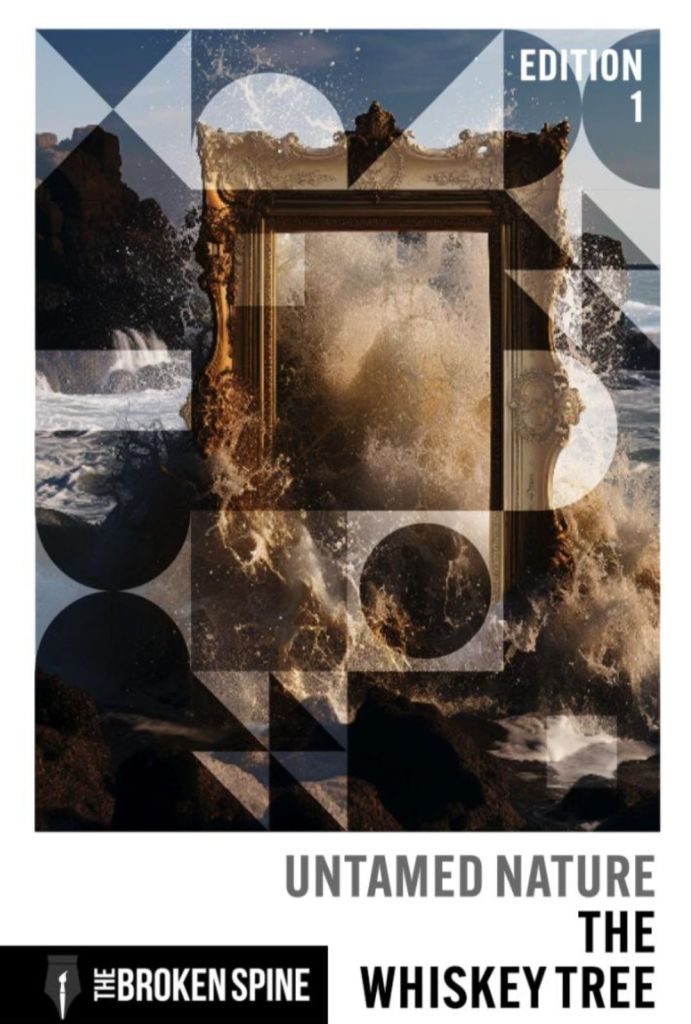
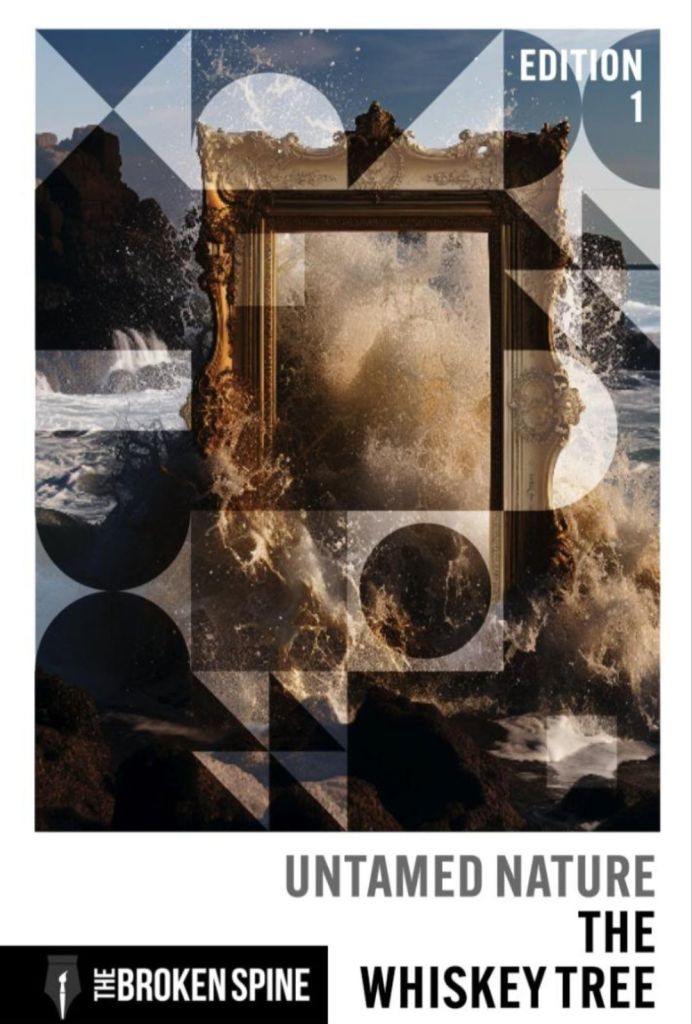
The cover of TWT’s first edition, depicting the ocean breaking through a picture frame, perfectly symbolises my vison for this project. I want poetry to be like those waves – uncontained and powerful. Traditional forms like sonnets and haikus, while they have their place, often feel too rigid for the kind of expression I’m seeking for TWT.
For TWT, it’s all about capturing the essence of experiences and emotions in a way that’s as real and unfiltered as possible. Unfettered. That’s the heart of this project – it offers a platform to voices that are bold, raw, and unafraid to break the mould.
Q:6. How did you decide on the order of the poems?
Deciding on the order of the poems in a collection like this cannot just about the pieces themselves. It’s quite a meticulous task. I must make sure the poems fit the pages exactly how I envision them. In a compact collection, presentation is just as crucial as the flow of the content.
The layout is key. For instance, I’m adamant about that we do not needlessly include a page turn mid poem. If a reader must turn the page to finish a poem, it should only be for longer pieces that extend to a third page or more. This is a primary concern for me, it impacts how I consume what I’m reading.
Then there’s the balance of gender representation in the order of the poems. I’m careful to avoid having a gender-heavy concentration at either the beginning or the end of the collection. It’s these behind-the-scenes, somewhat unglamorous details that are vital. I’m lifting the lid here. I talk a lot about inclusivity. It really does impact everything I do.
Of course, I think about pacing and mood – that’s a given. But that usually comes into play once the more mechanical aspects of the collection are sorted. It’s about getting that foundation right first, then building the emotional and thematic journey from there.
Being an editor is great, truly, but it’s not always the most fun. It’s a role filled with these intricate, often unseen tasks that make all the difference in the final product.
Q:7. Once they have read it, what do you hope the reader will leave with?
I really hope readers come away with a sense of awe, the same kind our poets felt when they saw the whole thing pieced together. This alliance of poets, if I may call it that, has poured their individual talents, experiences, and literary backgrounds into crafting this document that captures the essence of the wild and untamed.
Nature, in this collection, isn’t always blatant. Sometimes it’s hinted at through surreal, oblique references. The aim is to stir something in the readers, to make them view the world from a fresh perspective, see things in a new light. This anthology is an invitation to view the world differently.
I want readers to feel that they’ve stumbled upon something extraordinary. I envision them recommending it to friends, gifting copies, sparking conversations. Discussions could range from the intricate links between women and water to the rugged landscapes of Northern Ireland, or how the metaphor of the natural world can offer insights into the experience of loss.
I’m excited for readers to get their hands on this work. There’s a real buzz in thinking about the impact it could have, the discussions it could start, and the new perspectives it might offer. This isn’t just a collection of poems; it’s a conversation starter, a new lens to look at the world, and a testament to the power of words in capturing the untamed aspects of nature and life.
Bio and Links
Alan Parry is a Merseyside-based writer, editor, and lecturer. His writing embraces gritty realism, open-ended narratives, and the musical stylings of 60s girl groups. Published by esteemed platforms like Dream Noir, Streetcake Magazine, and Ghost City Press, Alan’s work showcases his talent for evocative prose and poetry. Inspired by Alan Bennett, James Baldwin, and Stan Barstow, he crafts compelling stories that resonate deeply. His debut poetry collection, Neon Ghosts (2020), and subsequent works like Belisama (2021) and Echoes (2022) demonstrate his creative prowess. Alan’s latest collection, Twenty Seven, was published in December 2023. In summer of 2023, he performed his debut spoken word poetry and prose show, Noir, at the Morecambe Fringe Festival. With an expanding repertoire and a distinct voice, Alan Parry is an emerging force in literature and performance.
is a poet, filmmaker, and multi-disciplinary artist. His work has published in journals and anthologies, and shown at international film festivals. He finds it easy to speak in the third person, thinking of life as unmerited poetry.













 The Wombwell Rainbow