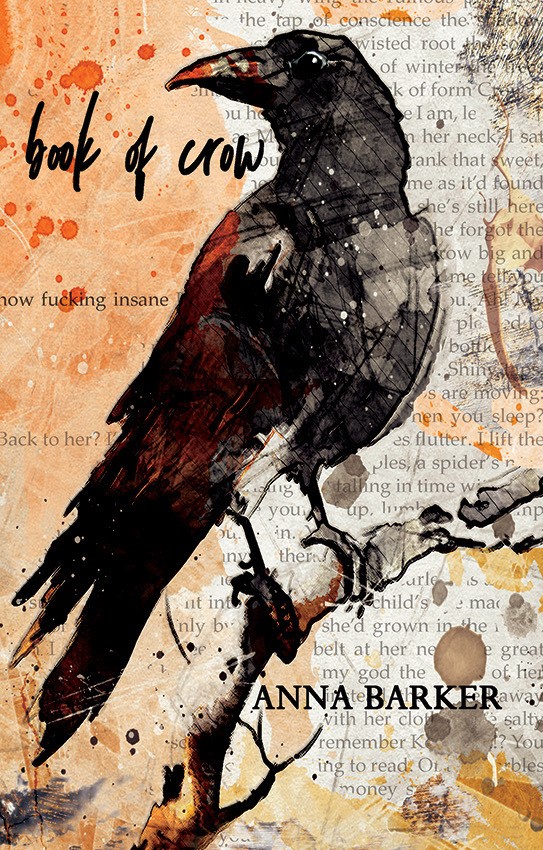
Anna Barker
Anna has a doctorate in creative writing, is an award-winning author and has extensive experience in teaching academic writing to undergraduates, postgraduates and early career researchers.
Following a successful career as an award-winning feature writer and investigative journalist, Anna published two novels. The Floating Island (Arrow, 2008) won a Betty Trask best debut award from the Society of Authors. Her second novel, Before I Knew Him (Arrow, 2009) was shortlisted for a Good Housekeeping Good Read award.
You can pre-order this debut collection here:
https://indigodreamspublishing.com/anna-barker
The Interview
1. When and why did you start writing poetry?
Book of Crow actually began life as a novel during the first Covid 19 pandemic lockdown. I had written two novels already (The Floating Island and Before I Knew Him as Anna Ralph) as well as book of short stories (Rain Hare) but try as I might, the character of Crow resisted prose. He just wasn’t having it! So I began experimenting with his voice in the form of poetry. I’d never written poetry before, so I had a lot to learn, but as soon as I changed the form, Crow came to life. It also helped that writing poems fit much better with the demands of that time, home schooling, daily walks etc.
2. Who introduced you to poetry?
My mother, the novelist, Pat Barker, bought a book for me called I Like This Poem which is a collection of poems for children, chosen by other children. I was probably six or seven years old. Of all the poems in that book it was Lone Dog by Irene Rutherford McLeod that stayed with me. I loved the music of it. I can’t say in all honesty my love of poetry stayed strong through school though, particularly secondary school, perhaps that’s true of a lot of people. I can’t recall poetry ever being read in class, really performed as I believe it should be.
3. How aware are and were you of the dominating presence of older poets traditional and contemporary?
I think one of the ‘problems’ I had with poetry in school is that it seemed to be something men wrote a long time ago and while I admired the poets who wrote about nature – Seamus Heaney, Ted Hughes, Edward Thomas, in particular – I didn’t really know any other kind of poetry. That’s of course down to the range of poets I was exposed to then. When I rediscovered poetry as an adult, I could read what I liked, such freedom!
4. What is your daily writing routine?
First of all, it isn’t daily – such are the demands of earning a living as a writer! When I am able to focus on writing, I’ll try to keep mornings free as I find that’s my most creative time. Freewriting is a wonderful tool, so versatile, and so valuable in helping a writer find their voice so I make that a regular habit, if not daily, then whenever I’m feeling stuck or blocked.
5. What subjects motivate you to write?
Nature is probably at the heart of everything I have written, from poetry to short stories and novels. I’m always interested in writing about nature in ways that can say something about ourselves, to help us think of ourselves as animals first and foremost.
6. What is your work ethic?
Whatever I am writing there’s always a point when it is no fun. The words don’t come. The structure is a mess and I’ve long forgotten what it was about the project I first fell in love with. That’s when the work ethic comes in. I’ve learned over many years of writing that the single most important thing you can do to guarantee the success of a project, is to keep showing up. There are always days when I would rather do anything else than keep raking over the same words, but it’s only by staying with it (and staying close to what really interests me) that sees me through to the end.
7. How do the writers you read when you were young influence your work today?
The rhyming poetry I read as a child was, when I think about it, nature poetry. That terrific poem, Lone Dog – a sleek dog, a meek dog, cringing for my meat, not for me the fireside, the well-filled plate, But shut door, and sharp stone, and cuff and kick, and hate. When I started writing poetry a few years ago I felt unsure about rhyming. Would I be taken seriously as a poet if my poems rhymed? Not for me to say, perhaps, but I am glad for the poems I read as a child and how the Lone Dog poem I pestered my Mum to read me again and again, taught me to love the shape of words in my mouth, the sound of them at my ear. That’s what I hope readers will get from reading Book of Crow, poems that invite you in, that feel good reading aloud.
8. Whom of today’s writers do you admire the most and why?
Wow, this feels like one of those questions where you have to give the top five albums of all time. I always stress over the answer, ha! Here goes – Jane Burn, Kathryn Bevis, Clare Shaw, Kim Moore, Andrew McMillan, Imtiaz Dharker, Di Slaney, Tania Hershman – those are the poets who I read again and again for the sheer love of their poems but there are many more I could mention. I have a serious poetry book buying problem. What do these writers have in common? I’m not sure! They’re all wonderfully inventive with language and they all write nature very well indeed. I’ve been fortunate enough to hear all of them read their work – it was probably how I discovered them in the first place. There’s nothing quite like hearing a poet read their work.
9. Why do you write, as opposed to doing anything else?
I was going to say because I am foolish and I don’t mind being poor! The truth is that writing is how I make sense of the world. I think of it as another sense – like smell, or sight. Writing allows me to get under the skin of something, whether it is a feeling, a moment in nature, something that puzzles or interests me. Writing is way for me to turn up the colour saturation on the world.
10. What would you say to someone who asked you “How do you become a writer?”
I don’t think there are any guidelines, certainly none that you could apply to everyone. It’s a very poorly paid profession these days – poets more than any other – so money can never be a motivation. So, perhaps you become a writer because you are compelled to do it. An addiction or an affliction, sometimes the lines are blurred! It’s a form of expression though and as such adheres to no rules that I know of. That’s not to say that you can’t do plenty to help yourself learn the craft. Attend courses, by all means, there’s so much to learn, but above all, read. Read what you love, learn from other writers and then write what really moves you. Write the thing that only you can write is a well-worn piece of writing advice, but true.
11. Tell me about the writing projects you have on at the moment.
I’m writing a ‘novel’ at the moment though I say that tentatively because I suspect – and indeed hope – it will resist being so neatly categorised. There are trees that speak, for example – I’m quite excited about what that will look and feel like on the page. Whatever it becomes, and I’ll resist trying to shape it for a good while yet, I don’t want write something that obeys the ‘rules’ of form. Perhaps it will say ‘this is a poem’, or ‘this is prose.’ Perhaps it will hybrid, but even that suggests a definition I don’t yet want! What do I know is that nature’s voice will run through it as Crow’s runs through The Book of Crow. His parting gift to me – disobedience, wouldn’t that be nice?




 The Wombwell Rainbow