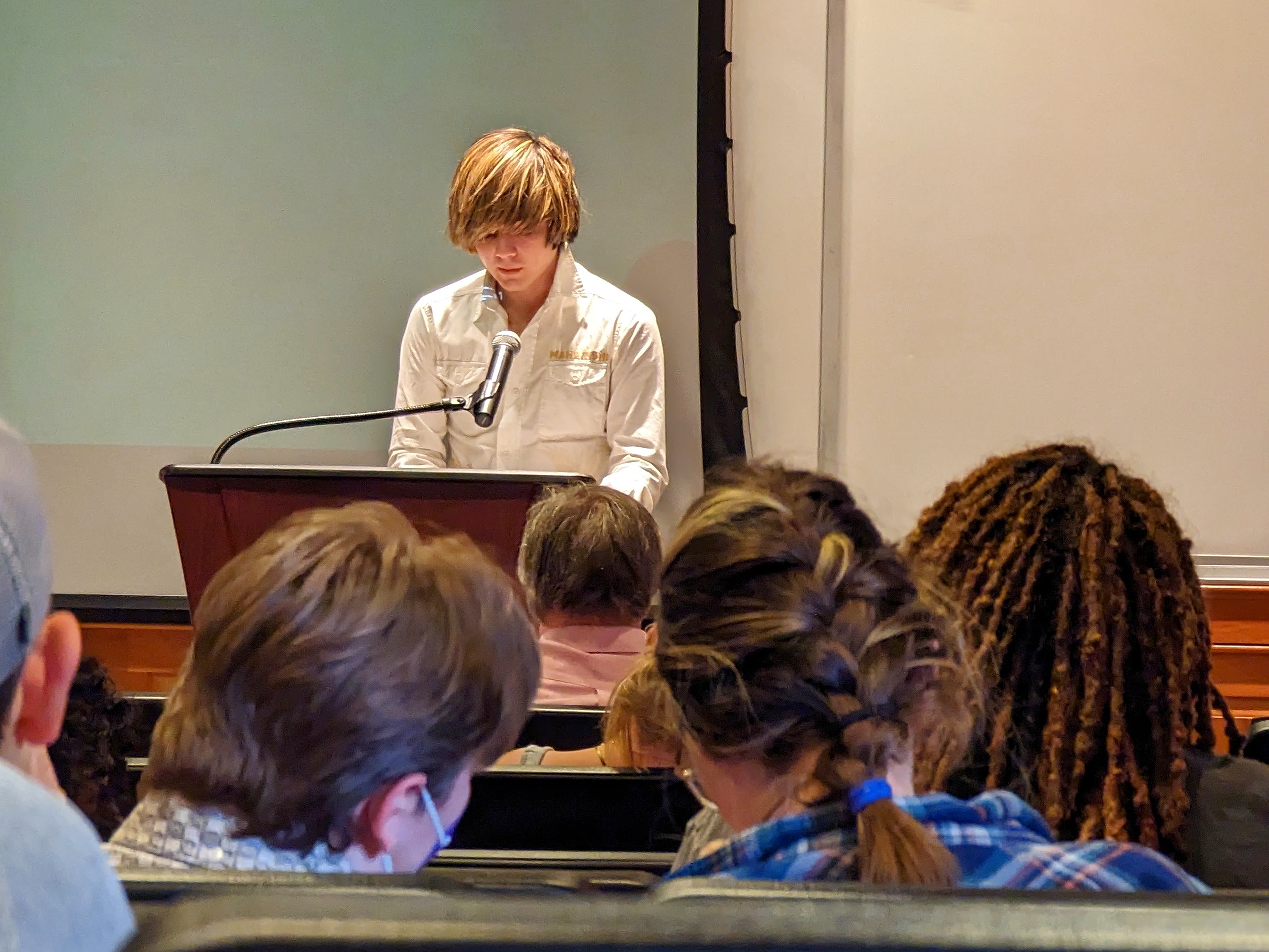
Alexander Lazarus Wolff’s writing appears in The Best American Poetry website, Poets.org, The Citron Review, NDQ, The Westchester Review, South Florida Poetry Journal, Main Street Rag, Serotonin, and elsewhere. He graduated with honors from the College of William & Mary, where he won The Academy of American Poets Prize. He is a poetry editor for The Plentitudes and on the editorial board for Black Fox Literary Magazine. An MFA candidate, he teaches and studies at the University of Houston, where he is the recipient of three fellowships. You can find him on Facebook: https://www.facebook.com/wolffalex108/ on Instagram/Twitter: @wolffalex108 and at http://www.alexanderlazaruswolff.com
The Interview
1.When and why did you start writing poetry?
I started writing when I was 19, and I did so at the insistence of my younger brother. During that time, I was a very serious Buddhist practitioner—even practicing as an ascetic in Thailand. I would post Buddhist/spiritual musings I had on Facebook, and I gained a good number of followers. I thought I was profound but, truthfully, I was deeply troubled and engaged in a lot of what they call “spiritual bypassing.” My poem “The Temple in the Jungle”—which won the Academy of American Poetss Prize— discusses my fall out with Buddhism, a religion with which I have a very complicated relationship. Reflecting on my Buddhist musings, I now know that I got so much attention on social media because I had a way of making things sound nice. Having attended the Colburn School at 15, I’m particularly attentive to the sonic qualities in poetry, and it is this musical facet of poetry that makes me return to the craft again and again.
Q:1.1. How did attending “the Colburn School at 15,” make you “particularly attentive to the sonic qualities in poetry”?
It was a music conservatory in Los Angeles. It’s called the “Juilliard of the West Coast.” I should correct myself and say that my natural predilection toward music has kept me engaged with poetry. I’m interested in what is intensely personal; my roots are in the confessional poets. You can achieve a personal quality with creative nonfiction, which I also write, but it doesn’t demand musicality and rhythm like poetry does. I have a few videos me playing the clarinet at 15:https://www.youtube.com/watch?v=9LpfT4tLBMQhttps://www.youtube.com/watch?v=rh8O5DC4Tqs
Q:1.2. What drew you to the “confessional” poets?
To be blunt, my struggles with mental illness. I was in so many treatment centers for an eating disorder, psychotic depression, and borderline personality disorder that I developed an identity around being a patient. What a lot of people don’t realize about mental illness is that it is very easy to identify with it and incorporate as a tenant of yourself. Anne Sexton, who is a much better writer than I, felt that she had “found a home” in the poetry realm particularly because of her struggles with mental illness. I wrote in my poem “Having It Out with Anorexia” (a titled based on a Jane Kenyon poem; a title I deeply regret) that I saw “suicide as something chic, an ornament to the self.” I don’t have a major mental disorder anymore, and I function as anyone else would at this point. Though my struggles are a footnote to the book of my life.Confessional poetry reclaimed emotion, and grated against the notion that emotions are something dangerous or bad. It was a reaction against Eliot’s notion that poetry was “not an expression of personality; it was an escape from personality.”
Q:2. Who introduced you to poetry?
I never really had a formal introduction to poetry. My younger brother, who is a visual artist, recommended I write poetry. I wrote some poems (I was 19 at the time, in a terrible depressive and bulimic episode), and I submitted to a small competition on Facebook. I ended up winning and was published in an anthology. I was being treated by Steven Levenkron—the same therapist that (unsuccessfully) treated Karen Carpenter—and he said my writing sounded like Sylvia Plath “before she went crazy.” Levenkron was a very unethical therapist, often too egoistic and self-involved to actually treat me. I ended treatment with him, and then entered a really unhealthy relationship that lasted for the time I was 20. I stopped writing during that time, but picked it up again when I turned 21.
3. How aware are and were you of the dominating presence of older poets traditional and contemporary?
I wouldn’t consider their presence dominating. I think an artist must have an initial template from which they work; often, this is an older, more accomplished poet. For me, James Merrill, Brigit Pegeen Kelly, David Lehman, and to some extant Plath, impacted me. I was the private student of David Lehman for over two years, and I’m indebted to him for much of my success. He was the best teacher I’ve had, and he instilled in me a respect for tradition. He said the most important writers for a novice poet to read were W.H. Auden and Marianne Moore. While Auden and Moore aren’t my favorite poets, I think they have an influence that spreads out into contemporary poetry, much like Emily Dickinson and Walt Whitman, the mother and father of American poetry. I think it’s important to appreciate tradition, learning to write by its rules, before you go off and try to craft your “voice” (an ever-troubling term). Creativity is an economy in which many ideas are constantly recycled. As writers, we are summations of what we’ve read and experienced. This isn’t to say that people don’t have their own particular “voice,” but it means that we shouldn’t hastily discard writers like Shakespeare and Milton.
4. What is your daily writing routine?
From 12 p.m. to 1 p.m., I read and study poetry. I then write from 1 to 2, returning to reading from 2 to 3. At 3 p.m., I’ll either prioritize submitting to literary journals, going on walks, or getting miscellaneous tasks done. At 4 p.m., I return to write until five. I keep track of everything I do with habit trackers. I also log the number of hours spent in writing in a tracker. I live to work. On days when I don’t write, like today, a feeling of dysthymia permeates me. Writing structures my life. It’s only through a regimented routine that I’ve been able to find some semblance of mental stability.
5. What motivates you to write?
The ability to develop and refine my skill. I have a passion for skills, and this showed early on when I started playing the clarinet—eventually getting accepted into The Colburn School when I was 15. I’m also motivated to write to forget about life. As I said before, writing structures my life and, in those moments in front of the keyboard, there is an escape from reality. Or perhaps it is confronting reality. In any case, writing is engaging.
6. What is your work ethic?
That’s up for the reader to decide.
7. How do the writers you read when you were young influence your work today?
The first writer I was invested in was Sylvia Plath. While she isn’t a favorite anymore,but the strong I-persona in her poems is a key entity in my work. I came to writing at 19, so I can’t say that there were many influences that were noteworthy.
8. Who of today’s writers do you admire the most and why?
That’s a hard one. I admire my former teacher David Lehman for his work ethic and commitment to the world of literature. I also respect Rachel Hadas and AE Stallings for continuing to write in formal verse, which many literary magazines don’t care for. Overall, I admire the writer who is genuine to themselves and sticks to the subject they find most resonant. What I dislike is the trends and identity politics in writing, and I see a lot of writers using their ethnicity, gender identity, sexuality, or political stance to promote their verse. It’s shallow and disingenuous. I don’t feel that poetry should advance a political agenda. In the end, it’s skill and self-honesty that makes me admire a writer.
9. Why do you write, as opposed to doing anything else?
Writing structures my life, and I was lucky to find success early on. Buddhism was a previous pursuit—I practiced for a decade (though I have a complex relationship with Buddhism”. Had I had succeeded in attaining the awakening of which the Buddha spoke, I would still be in Thailand. But I haven’t; thus, I am here. (And I certainly don’t have many complaints!) I’ve always required a focal point for my intensity. My craft becomes my life, as I noted earlier with regards to the clarinet. I dropped out of Colburn because of mental illness—and my relationship with Buddhism is an entire story. I’m going to be teaching at the University of Houston soon, and I don’t know if I see myself as a writer or teacher. Perhaps a bit of both.
10. What would you say to someone who asked you “How do you become a writer?”
Well, you need to get into the habit of actually writing. Many people make outlines or read books and claim that this makes them a writer, but it really doesn’t. It’s an excuse to not actually do the work. And many people avoid it out of laziness or anxiety. It’s an excuse. So, I tell them to write. It’s very rare to find a person that can actually keep a consistent commitment to their passion. While actually writing is the central tenet, “becoming a writer” (a phrase I detest) encapsulates the submitting process and activity within the literary community.
11. Tell me about the writing projects you have on at the moment.
Right now, I’m working on metrical poems. I’ve spent much of the summer writing in form to increase my literary dexterity. While I’m not aligned with New Formalism, I always love the formal polish by master technicians such as Rachel Hadas and James Merrill.
 The Wombwell Rainbow