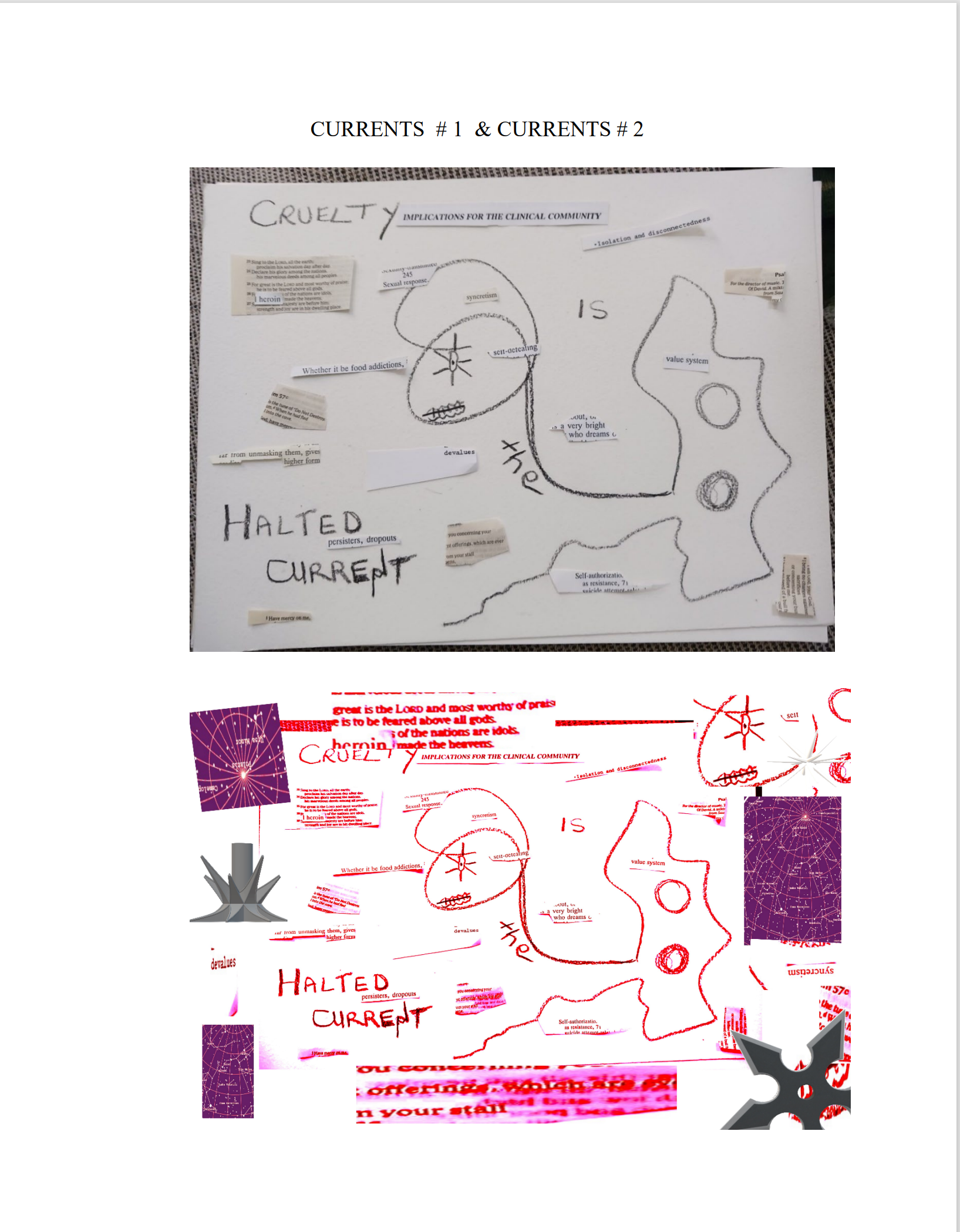
 Currents 1 & 2
 Currents 3 & 4
Texts Used:
Barthes, R. Mythologies, NY Hill and Wang, 1972.
Gilligan, Rogers & Tolman, Women, Girls & Psychotherapy: Reframing Resistance, Binghamton, NY, Harrington Park Press, 1991.
NIV Holy Bible, New International Version, Zondervan Press, 2011
How Did It Go?
Started from a line drawing, then began to add cut out text from random pages in the above books; text to include emerged from scanning torn pages and snipping words or phrases, intuitively placed around the drawing. CURRENTS #1 is a photo-document of the first take. CURRENTS #2 I began to add colour and additional web-elements culled at random: star map, 3-D figures and some manipulation of texts etc. Iteration CURRENTS # 3 was a further exploration of moving, reshaping, altering colours to pink/purple. I created a number of these, different hues, configurations. CURRENTS #4 is a flattening and an act of erasure – Texts and colour and shapes are largely removed – to leave a template abstract glitch of all of the above.
Robert Frede Kenter
Green
So windfall green his moon
And turning of light
the born leaves;
And on slowly awake foxes
about time the songs, pheasants, easy dark few
honoured the morning.
Holy as lamb and grace
sang to green chimneys
and carefree his cold fled the young
famous house wanderer.
Rivers sleep ran easy;
time and moon shining
as thronged from over grass the spinning play.
My horses, the children, nightjars follow lovely farm;
high the Nor was and starry white. Golden time
warm over under was bearing in below;
was happy and pebbles singing lordly Adam.
Once the night that sun wagons come let
as new of the eyes made
golden high calves as such green days.
And so his streams, tunes, yard of the sabbath maiden
swallow stable of green
among the owls, daisies, horses walking I held
sky, sun, birth the white of Nothing.
Orwellian
He had only one criticism, he said, to make of Mr. Pilkington’s
A good deal of the literature of the past was, indeed, already being
excellent and neighbourly speech. Mr. Pilkington had referred,
transformed in this way, considerations of
throughout to “Animal Farm.” He could not of course know-for he,
prestige made it desirable to preserve the memory of certain
Napoleon, was only now for the first time announcing it-that the name
historical figures, while at the same time bringing
“Animal Farm” had been abolished. Henceforward the farm was to be
their achievements into line with the philosophy of Ingsoc.
known as “The Manor Farm”-which, he believed,
Various writers, such as Shakespeare, Milton, Swift, Byron,
was its correct and original name. “Gentlemen,” concluded Napoleon, “I will give you the same toast as
Dickens, and some others were therefore in process of
before, but in a different form. Fill your glasses to the brim. Gentlemen, here is my
translation: when the task had been completed, their original
toast: To the prosperity of The Manor Farm! ”
Writings, with all else that survived of the literature
There was the same hearty cheering as before, and the mugs were
of the past, would be destroyed. These translations were
emptied to the dregs. But as the animals outside gazed at the scene,
a slow and difficult business, and it was not expected that
it seemed to them that some strange thing was happening. What was it
they would be finished before the first or second decade of
that had altered in the faces of the pigs? Clover’s old dim eyes flitted
the twenty-first century. There were also large quantities
from one face to another. Some of them had five chins, some had four,
of merely utilitarian literature—indispensable technical manuals –
some had three. But what was it that seemed to be melting
and the like—that had to be treated in the same way.
and changing? Then, the applause having come to an end, the company took up.
It was chiefly in order to allow time for the preliminary work of
their cards and continued the game that had been interrupted, and the
translation that the final adoption of Newspeak had been
animals crept silently away.
Fixed for so late a date as 2050
the creatures outside looked from pig to man, and from man to pig, and
from pig to man again; but already it was impossible to say
which was which. It was a political act.
How Did It Go?
Here are my cutups. The first takes pieces of Fern Hill by Dylan Thomas. I used a “cut-up randomiser” on the internet to do some of the scissor work.
The second interlaces lines from end sections of Animal Farm and 1984, with a little bit of modification of line endings (but without modifying the text) to make it more readable. The last section uses the end of Animal Farm but the last (and famous) line of a previous chapter.
I have doubts about whether these poems are really yours or the original author’s. I think the second one is more clearly Orwell, the first could be identified as Thomasesque if you knew his work.
Tim Fellows
*
costumes
are heard, imagine
round tables
*
forecast:
dragon now
streaming
*
grateful
the race signature
subscribe today
*
discovery
we’re just getting started
outstanding dreams
*
Amazon
the final season
candid conversations
How Did It Go?
This was one of the most enjoyable and exhilarating form challenges yet for me in writing process, my own results and excitement to read other participants’ efforts. I feel very fortunate to have gotten recent practice with this style thanks to wonderful, informative and inspiring discussion and workshops written by incomparable writer and renowned teacher Alan Summers, Call of the Page program founder, who shared extraordinary tips and recommendations on how this approach might be employed in short form poetic pursuits in the debut issue of his new journal Pan Haiku Review, those interested in further sharpening their skills with these methods should definitely investigate that phenomenal, robust edition. There are also some poets I greatly admire whose work made me want to try this, and reading it helped me with the task here, including Lachlan McDougall, J.D. Nelson, and petro c.k. If you’d like to read more additional examples of these techniques admirably applied I highly encourage you to seek out their work in dada and surrealist modes. Personally I was quite thrilled while puzzling out each poem, the way it looks like we’re creating ransom notes or refrigerator art, how serendipity and instinct guides us and the formations take shape, with something of a quality of divination or soothsaying, ouiji boards or questioning the I ching. No doubt the raw material one utilizes should be carefully chosen and will highly impact eventual material, it was also fun to play with words and find very different alternative meanings from source originating context, invariably these will reflect the writer’s inner life and world view in fascinating ways. This is definitely a numbers game which will require a lot of things hitting the wall for a few pieces which stick. I drew my verbiage from advertisements and headlines in the Hollywood Reporter, a trade magazine for professionals in film and television production, the entertainment industry. It seems that practice makes for improvement, my early attempts at such exercises were not successful but with time I got happier with verses. Having a large pool of words and combinations is also in a cento appropriator’s best interests. It’s liberating to surrender to the magnetism drawing these parts together into cohesive constructions, end pieces are as surprising and fascinating for ‘author’ as eventual audience. An excellent form I’m so grateful Paul invited the writing community to explore!
Jerome Berglund
Bios and Links
Robert Frede Kenter
is a writer & visual artist, editor & publisher of Ice Floe Press (www.icefloepress.net). Robert’s work is published widely in print & in web formats. Recent work in Olney Magazine, Visual Verse, Street Cake Magazine, Fevers Of, The Storms Journal and many others. Appearances soon in anthologies incl. Sidhe Press & Steel Incisors. EDEN, visual poetry work is available from Rare Swan Press, Switzerland (https://rareswanpress.com). Twitter: @frede_kenter
 The Wombwell Rainbow