Ryan Quinn Flanagan
is a Canadian born author presently residing in Elliot Lake, Ontario Canada. His work has been published both in print and online in such places as The New York Quarterly, Windsor Review, Vallum, The Antigonish Review, CV2, Horror Sleaze Trash, Evergreen Review, Your One Phone Call and In Between Hangovers.
The Interview
1. How did you decide on the order of the poems?
Flow is very important to me. I treat it like building a music album in many ways. Outside of that prime focus, I also try to avoid theme-related poems being too close together in the book. I am also always conscious of the letter of the alphabet that the title of the poem leads off with and split the poems up this way in a secondary fashion to ensure the reading experience is also more aesthetically pleasing that way as I personally find repeat letting in titles back-to-back very obvious to me when I am reading someone else’s work. Outside of that, there are not many other deciding factors. Flow is key to everything, really!
2. How important is form in your poetry?
Whereas flow is of central importance, form is much less so. I enjoy the differences in aspect and even just visually on the page, but outside of aesthetics, form is not a key consideration for me unless I am writing a book of more experimental poetry (of which I’ve done twice before). Form is key to those more experimental offerings where I tend to get much more playful with form within the medium. But overall, form plays a minimal role with the majority of my work.
3. In your book there is a focus on relationships between men and women, usually from the male perspective. Hoe important is this for you?
I personally feel the dynamic between men and women is both central to lots of art and quite comical at times. Our human fallibility really seems to come through in such relations which is great when expressing it in writing or art etc. I write almost solely from the male perspective because that is what I know best as a man. That old adage: write what you know. But yes, for me the men/women thing provides great lessons and far greater comedy. It is a messy existence we lead indeed.
4. How important are American idioms in your poetry?
American idioms do play a prominent part in my poetry, as do Canadian ones. But being a Canadian writer, having the US as a big brother right next door ensures that familiarity with and common usage of such American idioms inevitably seeps into your work. Al Purdy, one of my favourite Canadian writers, was a Canadian cultural nationalist in many respects and railed against dominance or intrusion into Canadian art and expression. While I really enjoy Purdy’s work, I do not share his hang ups with American dominance dwarfing Canadian expression. I can see where he is coming from, but for me it is all writing and part of who I am and I feel no need to be simply a Canadian writer or champion. Additionally, my wife and I travel (before Covid) to the States quite a bit, so there is plenty of writing about our time there that reflects that as well as our time in Europe. I am a Canadian, but I am of the world first and foremost. Without strict adherence to borders or culturally-specific fare.
4.1. Why do American and Canadian idioms play such a prominent part in your poetry?
American idioms do play a prominent part in my poetry, as do Canadian ones. But being a Canadian writer, having the US as a big brother right next door ensures that familiarity with and common usage of such American idioms inevitably seeps into your work. Al Purdy, one of my favourite Canadian writers, was a Canadian cultural nationalist in many respects and railed against dominance or intrusion into Canandian art and expression. While I really enjoy Purdy’s work, I do not share his hang ups with American dominance dwarfing Canadian expression. I can see where he is coming from, but for me it is all writing and part of who I am and I feel no need to be simply a Canadian writer or champion. Additionally, my wife and I travel (before Covid) to the States quite a bit, so there is plenty of writing about our time there that reflects that as well as our time in Europe. I am a Canadian, but I am of the world first and foremost. Without strict adherence to borders or culturally-specific fare.
5. Domestic detail is very important, it seems, bugs in the ceiling light, how to balance a drink in a chain link fence. What fascinates you about this kind of detail?
Writing for me is all about capturing a moment in time, the smallest of details that stand out to me. I enjoy elevating those details to a standing they may not seemingly possess in everyday life so that I can try to use such detail to capture something beyond simple surface reiteration. That is where the poetry often lies for me, in the minutia of things that get highlighted in the way I come at things. Domestic detail is very important as well since it is often what is most central to all of our lives and therefore a simple and relatable. To capture the seemingly mundane in an interesting and artful way is of prime importance to me in my writing.
6. Why do you prefer narrative poetry to imagistic poetry?
I write both narrative and imagistic poetry, but I do tend to write more narrative poems because I feel that is the best way to be most relatable to the reader. Like that old saying about a Lou Reed song and how he made it feel like he was sitting right next to you on the couch in conversation, I really enjoy the idea of that kind of intimacy, even at a distance. The more imagistic poems are fun to write because I like to wander in my writing and sometimes just let the language and fast rush of images lead me wherever they wish to go. That can happen a bit with narrative as well, but the conversational/straight narrative skeleton is already there to work with, which is often not true with imagistic poetry I feel. But yes, relatability for the reader is something I take into consideration when writing and narrative poetry seems to me to be a good vehicle to achieve this.
6.1. The narrative delivery I find very like that in Raymond Chandler’s hard boiled detective novels. What do you think about this?
I think that is probably an apt comparison. Although mine are not detective novels, I do view writing (and life) as a sort of investigation of things, and therefore a detective novel of sorts in some strange way. Curiosity is at the heart of most writing I think, and art for that matter, so such a narrative delivery in my particular work seems quite natural to me. It is also the way I speak/spoke and those around me often did as well so it is the most natural way for me to express things personally. I really enjoy Raymond Chandler’s work, so the comparison is a nice one to have made as well
7. Why is it called “Eye Flusher”?
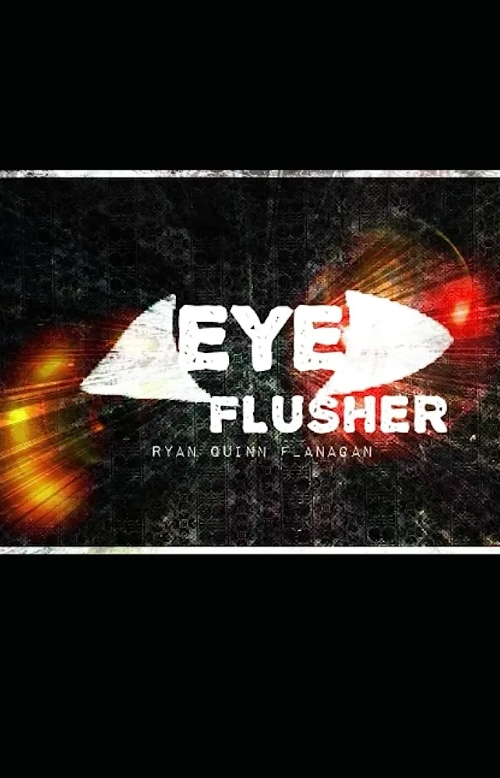
The title of the book is meant to not only signify a cleansing of my eyes through the physical act of writing it out, but also the word “flush” is used to mean “full” as well. Since a lot of the poems possess strong observational aspects, it hints at a bit of sensory overload in many respects, one that I try to capture as best I can in the book. The artwork for both the cover and interiors was done by fantastic artist Jeremey Moore after brief consultation with both myself and Mike Zone, the super cool editor-in-chief at Dumpster Fire Press. It was a real team effort, which was very cool! Overall, the title is meant to suggest a sensory experience, at least that was my intention.
9. How important is political poetry in your writing?
Politics plays a very small part in my writing. I am not a political person, have never once voted for anyone in any election in my life. Personally, I feel politics is just a dirty rigged system whereby the rich enrich themselves at the expense of the poor. As such, I find partisan political poetry of little interest to me and tend not to write about such things. I much prefer to focus on people and their lives (mine included), instead of dirty divisive politics. I have always felt that politics is the toilet brush of the people. I refuse to partake, both in my life and my writing.
10. What do you hope future readers will see in the wealth of your poetry publications
Above all else, I hope they see a certain level of truth and sincerity in my writing, as well as a biting humour that I hope gives them a good laugh. Humour is very important to me; I think a simple honest laughter is great for the soul. I hope readers also see quality work from someone who takes their craft seriously, but little else. I am a joker at heart.
11. Once they have read Eye-Flusher want do you want the reader to leave with?
I hope the reader leaves with a good laugh and an appreciation of some kind of truth I have tried to capture in the work. I try to be as relatable as possible in much of my writing and I hope that helps to add to an overall appreciation of the work as well.
 The Wombwell Rainbow