Bob Beagrie
“These Random Acts of Wildness’ is a chapbook by Paul Brookes, recently published by Glass Head Press. A recommended read, which contains thirty eight sonnets (or sonnet-style poems) of varying varieties and adaptations, showing Brookes’ skill and control over the form. What is particularly resonant about the poems is their focus upon small, incidental, and ordinary occurrences and events, such as cutting the lawn, observing wildlife in the garden, polishing furniture, making a cup of tea, raking leaves, putting the bins out, sitting in the sun, washing up, vacuuming, ironing, etc.
The form, with its strict demands of rhyme, metre and space, under Brookes’ alchemical treatment, transform these ordinary, everyday chores and moments into bubbles of zen-like contemplation, where attention to detail forces the reader to reconsider the act as a ritual, where the profane is cast in the light of a sacred rite. The compression of the language required by the sonnet also produces striking images and unexpected collocations. He often expertly uses the title of a poem as the opening, and deftly employs enjambment to break expectations and disrupt the predictability of the form’s standardised patterns of sound and stress. There is a Hopkins and Dylan Thomas quality to the sprung rhythm and condensed lyrical image-making, which delights the tongue with alliterative and assonantal echoes, and deserves a little unpacking on a second reading. It is also nice to see the Northern phraseology within the work, of dialect being owned and applied to the adaptable and venerable poetic form. You can see all these strategies at play in poems such as ‘Inhale Dappled Sun’, which copy here as one of those that particularly stood out for me.
Inhale Dappled Sun
Cast perfumed air, through illuminated windows of tree crowns, birdsong lilts blossom fall. Keys all senses keener. Created sung day sees claw hunt feather and fulsome
feathered mams rescue bairns from hungry sharp
talons. Bigger birds to feed their young snatch open beaked fluffy kids from nests, daysong dark.
Nigel Kent
Jan 28
As contemporary poets invent more and more forms for their poetry, it is perhaps surprising that the sonnet is undergoing something of a revival. Last year saw the publication of Hannah Lowe’s superb, award-winning The Kids , which demonstrated so well how this traditional form can be used for current content and now we have Paul Brookes’ Shakespearian sonnets in is latest collection, These Random Acts of Wildness (Glass Head Press, 2023) , which treat a range of enduring issues such as our experience of being alive and the nature of the natural environment.. His use of the form is as adept as Lowe’s, often concluding in memorable rhyming couplets, such as: ‘We collect the wild as ornamental/ Domesticate, put on a pedestal’; ‘My hard weight tames the uneven and wild/ makes it all proper, gentle meek and mild’; and ‘The wild dance of the swifts amongst the dead/ reminds us life goes on restless to be fed.’ The sonnet is clearly alive and well and has much to offer poets today.
What I find most impressive about Brookes’ first group of sonnets is his ability to elevate the domestic and to give the ordinary a lasting significance. He writes about cleaning windows, mowing the lawn, washing up, dusting and ironing. These are relatable experiences which he uses both to examine the experience of life today and to explore our relationship with the world around us. Lawn Cutting, the poem that begins the collection, sets the tone. Brookes describes a husband who has been asked by his wife to cut the lawn, insisting on ‘straight lines’. He is observed by a young boy next door, who imitates him with his mother, as they too ‘strip the wildness out of their lawn’. All the characters in the poem share this desire to tame their environment: they, like so many others in this first section, are seeking to secure some sort of control over the uncontrollable, for as the poem concludes ‘We all want the wild to be uniform’. This, however, is presented as no easy task: though the lawn is ‘short shorn’ today, it will not be long before the husband will have to mow it again. Furthermore, the boy next door is presented as acquiring some insight into the problematic task, with which he will have to come to terms as he grows up. His toy mower doesn’t cut, ‘so he stamps and bawls when his world don’t/ conform to his straight lines, because it’s bent’. The excellent Leaf Raking develops the notion of this struggle and its futility. In this poem a gardener is raking up leaves, trying to restore order to his garden. It is a task that never ends: ‘I gather with my plastic rake again,/ / and again.’ Each time he forms a stack of leaves a gust of wind destroys it and he has to start over. This is typical, for in Brookes’ poems life and nature are chaotic and to some degree anarchic, and life is a series of minor battles to secure some control. The war, however, is never won.
Having said that, there are poems in this collection focussing on the natural environment which record and celebrate its beauty. Brookes is a keen nature photographer and his powers of observation are reflected in the quality of his descriptions. The opening stanza of Cemetery Swallows captures brilliantly both in rhythm and imagery the erratic flight of these birds: ‘the morning in a swoop, bank turn over,/ around gravestones, between crowns swifts gulp light,/ arc over quietness, never hover/ dash between stillness, catching the quick bright’. Furthermore, in The Birdsong we find a vivid synaesthetic soundscape with some stunning images: ‘Dovesong fat as strawberries and cream’, ‘Wagtail umami, sour sweet, salty dream’, ‘Prickly, velvety, bumpy, blackbirdsong’. There is an inventiveness here which is impressive and rivalled in the image of the ‘Blackbirds on unused terrace chimneys/ enigmatic variations in touch/ with other bough bright orchestral voices’ in When Making Senses. In such lines Brookes invites us to admire elements of the natural world but he is no romantic. He is fully aware of the reality that he describes. Death is as much a part of the environment as life. Consequently the poem ends with the sober imperative: ‘Inhale sweetness of flourish and decay,/ sugar entices small deaths each sunned day.’
The collection concludes with more intimate poems: those that reflect upon personal experiences and upon the lives of former Wombwell residents. Given the subject of Brookes’ drop-in last week I‘m going to concentrate on the former, many of which treat the subject of isolation, examining both its causes and effects. I found Intimacy Shy particularly moving. It describes a relationship between a boy and a mother, focussing on the boy’s inability to accept the affections of his mother, which later manifests itself in an inability to form relationships with women generally because of a painful shyness: ‘What do I say to women? Argued I/ couldn’t afford to wine and dine, talked/ myself out of talking to strangers./ Why/ I spent so long on my own. My words walked.’ The line division here and the closing image combine to convey both the physical and emotional aspects of isolation. The poem climaxes with the statement: ‘Always tongue tied, mind blank, touch, caress, wary./ Keep to myself, but hunger there, scary.’ Scary indeed and the sense of frustration that emerges is so sad. His other poems in this section explore different reasons for such isolation. As the title suggests Bullies tells the painful story of the victimisation of a child by other children that leaves him alone at the front of all classes pelted ‘with screwed up/ paper, board rubbers until staff turn up’; in Difference it is the school’s setting arrangements for History and his parents encouragement to work ‘towards best for us’ that leaves the speaker ‘bewtixt/ and between’ and the other pupils thinking ‘tha’s better ‘n us’; and in ‘No Time for Me, the speaker is left feeling like ‘plain wallpaper’ as if life is passing him by because he’s been abandoned by old mates due to family commitments and the demands of their partners. The speaker pithily concludes ‘Loneliness is sometimes a form of grief.’
In conclusion These Random Acts of Wildness’ is full of economic, resonant and highly relatable sonnets. Their subjects find life at times cruel and chaotic. Some try to seek control in daily domestic acts, and some by making the most of the pleasures life offers. These are sonnets of survival, of lives ‘salvaging what’s worthwhile’ that cannot fail to connect with the reader.
Review of Paul Brookes’s book “These Random Acts of Wildness” by “Spriha Kant”
This book consists of a collection of poetries.
The poet in some poetries makes his readers travel in, around, and out of the different portions of the home including lawns, backyards, kitchen, etc., in some of which he shows glimpses of the chores and concludes the bitter truth of the world and/or one of the fundamental truths of existence that whatever is created is meant to be destroyed the one or the other day. Quoting the following few words and stanzas from a few such poetries:
“His toy won’t
cut grass but safely glides over its length,
so he stamps and bawls when his world don’t
conform to his straight lines, because it’s bent.
My wife says “Better” to our short shorn lawn.
We all want the wild to be uniform.”
“Organic time tamed, all about decay
not growth. Imagine accurate time based
on a gradually emerging way.
However, all things reduce to waste.
Our Dandelion’s blown clocks are seeds
to be uprooted as unwanted weeds.”
“A wave that washes away proof
that any effort has taken place, stacks
temporarily, finds another use,
elsewhere that is not always clear, and might
be mistaken for anarchy, or loss
of control, not wise, sensible foresight,
briefly anthologises summer’s floss.
Never enough time to read the new
collections before gust edits the view.”
In a few of his poems, the poet has described the cruel and violent behavior of birds and animals such as in the poetry “The Hedgehog,” the intense fighting sequences can be seen. However, a few words from the poetry “Inhale Dappled Sun” are influential to bring tears to a compassionate heart, as quoted below:
“Bigger birds to feed their young snatch
open beaked fluffy kids from nests”
The poet has mixed many different horrible flavors in his different poetries, such as the poem “Polishing Me” which has a blood-curdling hysterical flavor. Similarly, the acerbic flavor in the last stanza of the poem “I Put My Bins Out” can be felt, and many other different flavors are worth reading in this book.
Both poets and poetesses sometimes do work like abstract painters by leaving their poetries to the interpretation of readers. The poet has done so in his poetry “My Vacuuming” by concealing many stygian truths beneath it. The comprehension of the quantity or quantities of stygian truth(s) and the stygian truth(s) comprehended varies from reader to reader.
Apart from concealing stygian truths beneath the poetry, the poet has also directly pointed to the messes encompassing the world in his poetry “My Window Cleaning” and a few words he used in this poetry are very deep and hard-hitting and, in the end, he states the question whose answer is unknown to him that shall remain unknown to everyone forever.
The title of this book “These Random Acts of Wildness” kept by the poet is apropos to the shades the poet has used to paint his poems and he just wants to see the wildness vanish from this world that he stated in a few poems. Quoting a few words from the poem “Ironing” depicting the efforts the poet makes to reduce the wildness of this world:
“My hard weight tames the uneven and wild,
makes it all proper, gentle, meek and mild.”
However, merely, a shade is not appealing to the eyes in any painting. So, to add beauty to this poetry book, the poet also added tints in a few poems. The next two stanzas unfurl a few tints the poet added to a few poems. The pan containing shades was meant to be heavier than the tints in the beam balance of the poetries in this book as the poet desires to see the world without wildness and hence constantly tries to reduce the wildness.
Personification is usually used to make the readers visualize the beauty of nature in the poems but the poet in his poetry “In Washing Up” has beautifully used personification to add enthusiasm and to motivate the spirit of readers.
As it has been stated in the few words from the preceding stanza that “Personification is usually used to make the readers visualize the beauty of nature in the poems” so is the case in the poetry “Wildlife Map” except that the beauty is about the interaction between the light and slug windows.
The poet has shone a very few poems with a beauty whose intensity is high with the size of a tiny thermocol ball, quoting such few beauties from different poems below:
“Butterfly briefly stainglasses our window.”
“A specialist shop
had a bud float in my clear cup unfurled
before my eyes.”
The poet has used very easy words with brevity to express the message he wants to convey to his readers. The use of easy words with brevity being one of the peculiarities of this book makes it suitable to be easily understandable by even non-poetic minds.
Book of the Month
May 2023
Paul Brookes ‘These Random Acts of Wildness’ published by Glass Head Press.
£5.00. Contact poet to purchase (links at the bottom of this article).
How do we live with the wildness on our doorsteps and in our hearts? Paul Brookes grapples with these poignant human questions in a touching, meditative, thought-provoking collection of sonnets. He takes a microscopic look at the daily things we do unthinkingly, how we try to tame our environment through cutting grass, ironing clothes, washing pots and binning our waste.
‘We all want the wild to be uniform’ he observes in ‘Lawn Cutting’. Later, he watches dandelion clocks flying over ‘powerhosed driveways’ destined to be ‘uprooted as unwanted weeds’, and even apologises to a sycamore tree for pulling up ‘its young’.
Elsewhere Brookes draws an unsentimental picture of the wildlife around him, of baby birds ‘falling into soft jaws of cats as gifts’ and of a young hedgehog who eats its siblings. ‘I chirp and whiffle, splat out quills and sigh’. In ‘I make a cuppa’, he remembers how his seaman father brought home ‘carved elephants for the sideboard’ and concludes ‘we collect the wild as ornamental/ domesticate, put on a pedestal.’
The poet’s style is refreshingly loose and conversational within the constraints of the sonnet, and sometimes veers toward a sly, choppy poetic shorthand. In the childhood poem ‘In Washing Up’, he observes ‘Metal scouring pad wool stings doing pans.’ The very act of cleaning itself is transformed by his imagination. Boldly assuming the identity of a vacuum cleaner, a speaker of one of the poems states ‘I inhale your decay. It spins around/inside me.’ And cleaning, he concludes, may be a sign of a deeper want, reaching ‘places of loss with perfumed polish.’
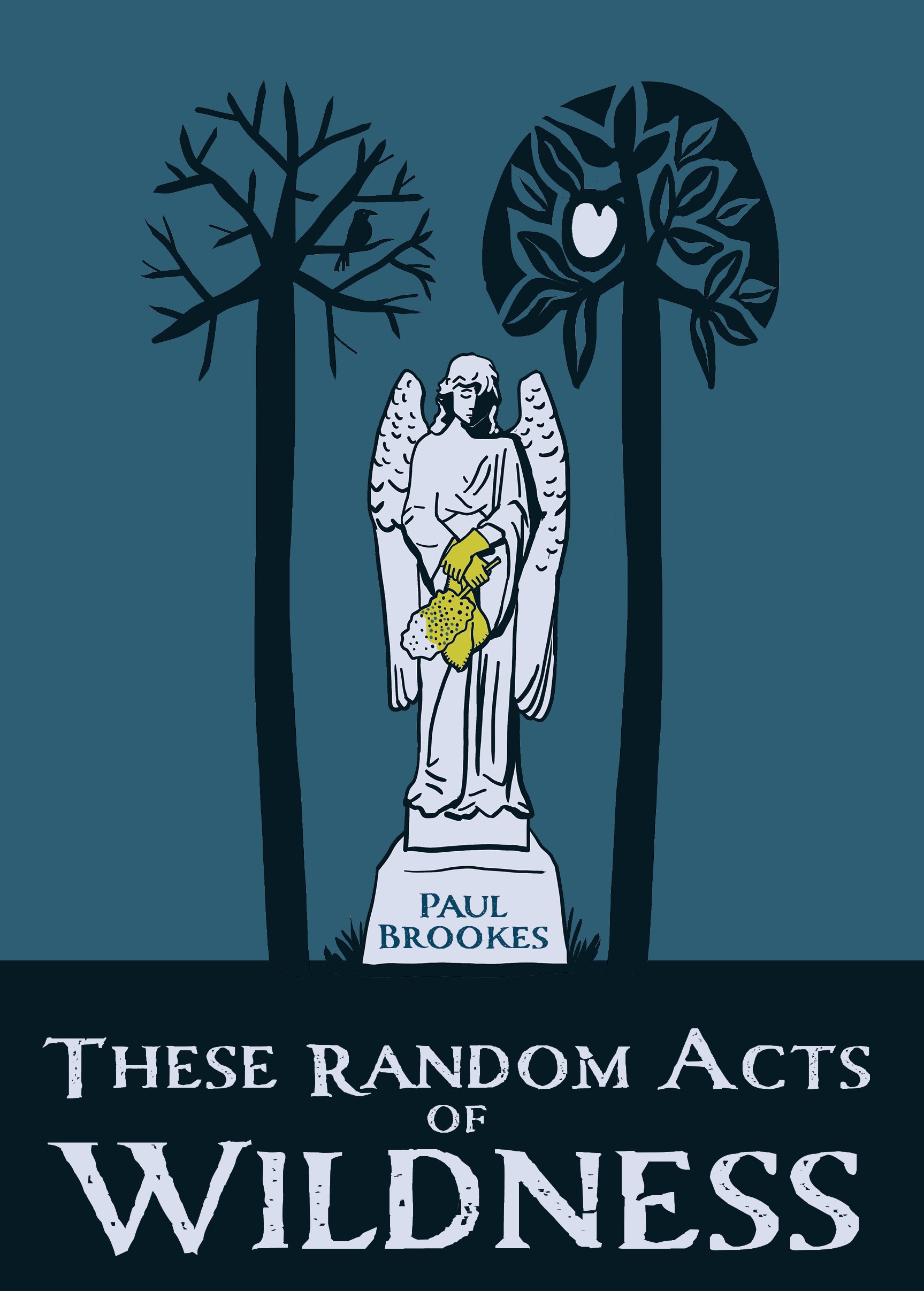
The sonnets contain vivid poetic images of nature, Swallows as ‘vital/boomerangs spinning back on themselves’, and dove-song ‘fat as strawberries and cream’. The gorgeous graphic art on the cover by Jane Cornwell reflects the mood of the poems, showing a graveyard angel wearing marigold gloves and clutching a duster. Above him are two trees, one dead and the other one leafy, with a human heart shining in its branches.
This collection is about the duality of life – our attempts to clear away mess and the inevitability of its creation through human activity and death in nature. One of my favourite poems is ‘The Surfaces’, a meditation on polishing and our ludicrous expectations of how we can rub away eveything bad. ‘Sanitise life’ it orders. ‘Every deep rub brings out the grain/ let’s dust away death, and begin again’. It is especially poignant to me, whose mother cleaned constantly, with undiagnosed Obsessive Compulsive Disorder throughout her life.
Other human concerns are expressed in this collection. ‘Holgate’ describes bullying at school and its effects on a child: ‘I need to stay silent. Any words break’. Other poems deal with intimacy and grief, with moving tales of local men who died from a lightning strike, war or typhoid.
This is an eye-opener of a collection. Paul Brookes, always a generous, selfless promoter of other poets, has laid bare our daily struggle to tidy up and tame the wildness of our lives.
by Lesley Curwen
Paul Brookes’ These Random Acts of Wildness is an amazing tour de force. In this collection, Brookes manages to explore nature in all its wild glory and the human compulsion to tame it within the confines of the sonnet form. Along the way, he explores family life, grief, love, loneliness, death, and memories.
In “Wildlife Map,” Brookes’ wit shines through:
“Fledglings step or are pushed over the brink,
by anxious mams wanting an empty nest. . .
brought into the home for the owners screams
To register a culture shock of extremes.”
In “I Make A Cuppa,” Brookes reveals truths in his poignant poem–
we drink tea at the cost of workers who harvest it, and at the risk of remembering—
“We collect the wild as ornamental,
Domesticate, put on a pedestal.”
This collection bravely reveals childhood and adult loneliness and being bullied, but it is “My Bella” that affected me the most. Anyone who has had a beloved animal companion will understand.
“Now nothing calms my heart, as she once did,
Hollowness in my lap, no soft greeting
as I arrive. No brushing my cheek . . .
When I don’t see her for days I’m alone.”
Merril D Smith
Civilization and Wildness delicately intersect in Paul’s latest collection of sonnets These Random Acts of Wildness. Musicality and form-discipline attend these urban vignettes where the cultivated “wildness” is part of being “civilized and urbane”, a mode of living; pared down nature for contemplation and joy in landscaped settings; a style quotient, standardised and uniform, in commercial communities.
“A different colour every note.”—a haunting line from “The Birdsong” informs each sonnet, a distinct song: an individual country of remembrance, memory, history, heritage, feeling; a typical Paul country of the living and the dead; the lingering presence of an aching absence; the yearnings for “the quiet presence of the dead…” in a culture of erasure, kind of continuity, personal and social and familial; isolated moments of existence crying for contact, a situatedness
Crying for contact, a situatedness where “Loneliness is sometimes a form of grief”—poetic syntax for/of the postmodern/ post industrial societies revolving around individualism and its horrors; and, overall, springing out of this grim reality, a deep desire for connections with both past and present, for embracing life in all its richness and contradictions, for being human and relevant, in an age of amnesia and instant delete.
It is also a concomitant desire for the sun, wind, sky, laughter, meaning and transcendence of the immediacy; to find beauty in the mundane.
Wombwell is the daily canvas for these deep meditations on meaningful living amid ruins and live memories and, in a way, this Wombwell becomes a universe that resonates globally for the discerning audiences in its wide ranging appeal.
An uplifting experience!
A book that elevates the daily into the high art.
Sonnet as a genre of cognition and critical communication could not find a better artist than Paul Brookes.
A must for seekers of serious
Writing!
—Sunil Sharma, poet-academic editor
In ‘These Random Acts of Wildness’, Brookes’ deeply thoughtful poetry tasks the containing form of the sonnet with making sense of the animal mess of living—and of dying. This distinctive and reflective collection holds multiple lives: human, animal, even sentient object, each looking for its way to reconcile what cannot be tamed with our need to impose order enough to understand it, and to make our peace. Brookes examines every stone he turns with clear eyes, layered language and deft allegory. There is a strange intimacy at the core of this collection: domestic and wild meditations, the poet’s ability to take up the mantle of hedgehog or hoover with convincing embodiment, allow a delicately prosaic, personal making-sense of difficult human subjects—the split home, bullying, awkwardness, loneliness, and grief.
Brookes’ skill with this form is simply remarkable, and its constraints seem a basket self-weaving as we watch. The cadence treads perfect sync with his contemplative storytelling, to cradle, not cage it, with respect for the poet’s own craft. And these are indeed stories, ongoing: even in the closing cemetery, haunted by the artfully drawn lives of local soldiers, cricketers, labourers, and fiddlers, even with ‘so much promise / gone, now curtains are drawn beside the pits’, what we’ve learned from their immortaliser is that, messy or not, ‘Belief is true’ and so we must believe ‘The wild dance of the swifts amongst the dead / reminds us life goes on restless to be fed’.
By Ankh Spice
 The Wombwell Rainbow