Trimeric

Jane Dougherty's avatarJane Dougherty Writes

This was the form Paul Brookes chose last week. The structure of the trimeric is simple, three of the four lines of the first stanza repeated in a cascade, heading each successive stanza. Trimeric poems tend to be short and imagist (as in my first poem), but there’s no reason why they can’t be denser (second poem). I enjoyed this form and will probably use it again.

January, early morning

Night is over,
light frozen at grey dawn,
a stopped clock,
its mechanism rusted.

Light frozen at grey dawn
hangs in mist wreaths
over frozen puddles,

a stopped clock
in a silent room, where
ash fills the hearth.

Its mechanism rusted,
this year grinds on,
drenched in fog.

Turn of the year

The world grinds on its hinges
with the rusty creak of rainswept trees,
black and dripping with winter,
and birds sing to ward against the cold.

With the…

View original post 45 more words

#TheWombwellRainbow #Poeticformschallenge last week was a #Trimeric Enjoy examples by Robert Frede Kenters, Marian Christie, Tim Fellows, Lesley Curwen, and Jane Dougherty and read how they felt when writing one.


Poem for the Fathers (A Trimeric)

Upon facing a cold reunion
Of the night and your conversation
We entered the city slowly, dreaming
Stopping at shops by their windows

Of the night and your conversation
Stone edifices admitted to an emergency
In the broken speech of nightmares

We entered the city slowly, dreaming
Our commands acquired in The Holocene
Bay waters reached to stone edifices screaming

Stopping at shops by their windows
In the Bistros of the burning fever
We were warriors without a proper war

How Did It Go?

Rather than fitting my tropes, themes, and visions to the form, for this exploration of Charles Stone’s Trimeric (construction) 4 stanzas, four lines, 3-3-3 lines, repeating refrains, etc., I worked with some dark-motifs that are part of my ongoing work, including my current focus on nightmares, in both text and visual poetry. I enjoyed this; for me the key was creating a first stanza where each line could be a strong lead line for another stanza. I like the refrain format, it lends to a musicality, a song-like score for an anti-hymn, something dramatic, orchestral, for silent recitation.

Robert Frede Kenter

Cascade

Listen to the riversong –
meltwater from mountain flanks
tumbling its own path
between resistant rocks.

Meltwater from mountain flanks
trickles down through peat and moss,
conjoins to become a burn

tumbling its own path;
tugs at roots by shaded banks,
crashes, eddies, foams.

Between resistant rocks
salmon leap against the flow,
glinting in the sun.

How Did It Go?

Another lovely form! I was immediately drawn to the descending cadences of the trimeric and its potential for subtle shifts of meaning through the stanzas. I’ve not adequately exploited this potential in my poem, which is purely descriptive, but I shall be revisiting the form in future with a view to exploring its possibilities further.

Marian Christie


Stoat

The stoat slips through the jagged fence;
darting across the frozen field
her coat has not yet fully changed
to match the freshly fallen snow.

Darting across the frozen field
she sniffs the icy air and scampers on
to look for food within the farmer’s barn.

Her coat has not yet fully changed;
its reddish brown is flecked with white
but soon she will be hiding in plain sight

to match the freshly fallen snow
and clear-air frosts that January brings;
until she fades to brown again in Spring.

How Did It Go?

I like refrains so I enjoyed this format. I also enjoyed the freedom of slightly longer lines after those Celtic forms squeezed the syllable count. The rhymes are obviously not needed but they came naturally so I went with it.

Tim Fellows

January, early morning

Night is over,
light frozen at grey dawn,
a stopped clock,
its mechanism rusted.

Light frozen at grey dawn
hangs in mist wreaths
over frozen puddles,

a stopped clock
in a silent room, where
ash fills the hearth.

Its mechanism rusted,
this year grinds on,
drenched in fog.

Turn of the year

The world grinds on its hinges
with the rusty creak of rainswept trees,
black and dripping with winter,
and birds sing to ward against the cold.

With the rusty creak of windswept trees,
rain-light ruffles feathers,
ships tossed on stormy seas,

black and dripping with winter.
Horizons close, veiled in water,
endless tracts of grey,

and birds sing to ward against the cold,
to spell spring’s return and
ease the earth’s rumbling course.

How did it go?

The trimeric is a simple form, four stanzas of 4, 3, 3, 3 lines, the first line of stanzas 2, 3 and 4 repeating the corresponding line of the first stanza. No other rules. Often this form is used for short imagist poems (as in my first poem), but there’s no reason why it can’t work for denser poems (second poem). I enjoyed the trimeric and will probably use it again.

Jane Dougherty

Blindness

Snow’s light is too much for ageing eyes,
fierce noons reflecting every crystal flake.
Diamond carpets frazzle optic nerves.
We turn from what is too intense to bear.

Fierce noons reflecting every crystal flake,
we dig our paths, dismantle purity,
transmute the brilliant to everyday.

Diamond carpets frazzle optic nerves.
Arrayed in baseball caps and shades
we hide from bitter inconvenience.

We turn from what is too intense to bear.
The glare of snow, weathers yet to come,
the dazzled faintness of our hearts.

How Did It Go?

I found that the repetition allowed me to develop the simple idea of snow’s harsh light to the wider conceit about how we turn from anything too hard to bear.
I wrote the first stanza without really knowing how to develop the rest.
It opened up a lot of possibilities, each first line of the following three stanzas sparking new tracks of thought.

Lesley Curwen

Bios and Links

Robert Frede Kenter

is a writer and visual artist. A Pushcart Nominee, published widely & internationally, based now in Canada, publisher of http://www.icefloepress.net. Tweets: @frede_kenter, IG:@r.f.k.vispocityshuffle

Marian Christie

was born in Zimbabwe and travelled widely before moving to her current home in Kent, southeast England. Publications include a chapbook, Fractal Poems (Penteract Press), and a collection of essays, From Fibs to Fractals: exploring mathematical forms in poetry (Beir Bua Press). Her new collection, Triangles, is forthcoming from Penteract Press in April.
Marian blogs at http://www.marianchristiepoetry.net and is on Twitter @marian_v_o.

Lesley Curwen

is a broadcaster, poet and sailor living within sight of Plymouth Sound. Her poems have been published by Nine Pens, Arachne Press, Broken Sleep and GreenInk, and later this yea


Jane Dougherty

lives and works in southwest France. A Pushcart Prize nominee, her poems and stories have been published in magazines and journals including Ogham Stone, the Ekphrastic Review, Black Bough Poetry, ink sweat and tears, Gleam, Nightingale & Sparrow, Green Ink and Brilliant Flash Fiction. She blogs at https://janedougherty.wordpress.com/ Her poetry chapbooks, thicker than water and birds and other feathers were published in October and November 2020.

Tm Fellows i

s a writer from Chesterfield in Derbyshire whose ideas are heavily influenced by his background in the local coalfields, where industry and nature lived side by side. His first pamphlet “Heritage” was published in 2019. His poetic influences range from Blake to Owen, Causley to Cooper-Clarke and more recently the idea of imagistic poetry and the work of Spanish poet Miguel Hernandez.

Lesley Curwen

is a broadcaster, poet and sailor living within sight of Plymouth Sound. Her poems have been published by Nine Pens, Arachne Press, Broken Sleep and GreenInk, and later this yea
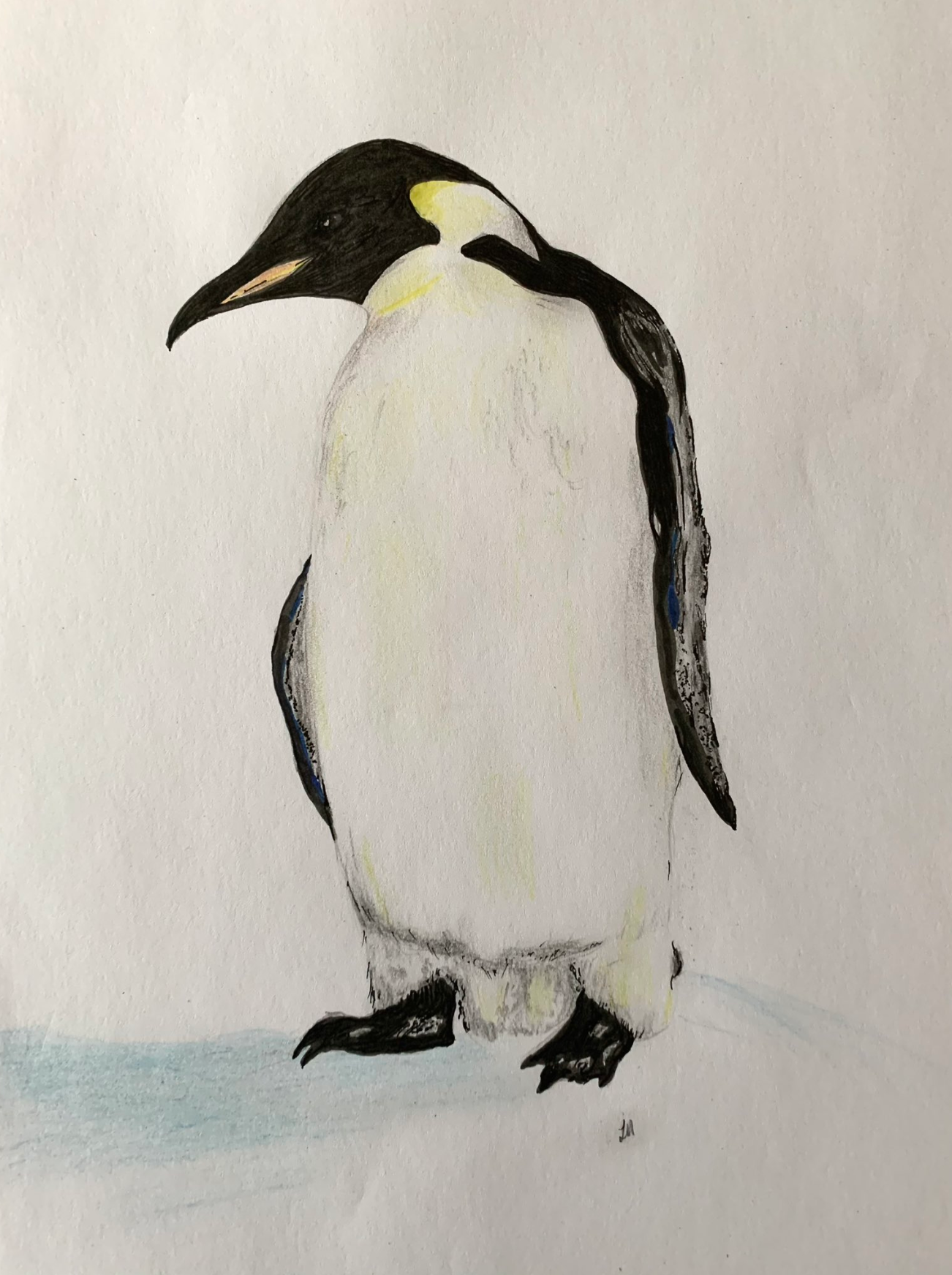
Celebrate #PenguinAwarenessDay. I will feature your draft, published/unpublished poetry/short prose/artworks about penquins. Please include a short third person bio.

no new clothes
the Emperor. penguin
disappearing

Artwork and poem by John Hawkhead

“Created Responses To This Day” Aaron Bn responds to Day 233 of my This Day images. I would love to feature your responses too.

morning pulls back
a blanket covered sky
quiet empty streets

Aaron
@VikingRaven78

Drop in by Paul Brookes

Nigel Kent's avatarNigel Kent - Poet and Reviewer

It’s a special pleasure to welcome a poet who does so much to promote other poets’ work and to be able to return the favour: Mr Paul Brookes.

Why dialect? This is the only sonnet in the collection written throughout in dialect. Others hint at the Northern way of speaking through their grammar. The tradition has been to write humorous verse when you write in dialect. I want to show that dialect can be used for weightier subjects, too. I use it for its immediacy, the sinews of its storytelling, and knack for conveying emotion. It gives a sense of belonging, of history. The alliteration at the beginning hints at the Norse origins of the language. It stands witness to the event. It gives the sonnet an authenticity and a sense of place.

I remember my late mam having words with my late sister about speaking on the house…

View original post 470 more words

Special Launch Feature – Beth Haslam

Patricia M Osborne's avatarPatricia M Osborne

Please join me in congratulating memoir author, Beth Haslam, on the publication of her brand new book Fat Dogs and WELSH ESTATES. Beth has come along to Patricia’s Pen to tell you all about this sequel. Without further ado, it’s over to Beth.

Fat Dogs and Welsh Estates – Series Prequel

Beth Haslam

Thanks so much for inviting me here to introduce my new book, Tricia. I’m honoured.

When my publisher suggested I write about my upbringing in Wales, I hesitated. Why would anyone have the slightest interest in reading about my childhood? My publisher thought otherwise, so I reflected. Finally, the solution came to me.

Instead of focusing solely on myself, which, ironically for a memoir writer, makes my toes curl, I decided to tackle the project differently. I would produce a light-hearted account centring on the rich tapestry of my homeland.

My research journey began with…

View original post 486 more words

It Felt Like Everything by K.S. Dyal (Ad Hoc Fiction)

tearsinthefence's avatarTears in the Fence

K.S. Dyal’sIt Felt Like Everythingis a novella-in-flash that does so many things that I love about the form. Writing about pain is difficult but writing about joy is sometimes nearly impossible. In his new craft book,Unlocking the Novella-in-Flash, Michael Loveday makes the point that the novella-in-flash writer can stop focusing on the narrative arc and instead explore the moments that contain so much of our lives much as Gwendolyn Brooks does inMaud Martha.Dyal is able to find joy and pain in these moments as she explores the lives of two young women who are coming of age in Buffalo, New York. Both are adolescents and having a hard time fitting in and understanding themselves. Both are exploring their understanding of sexuality, of course, and both feel awkward and out of place. That’s to be expected. They are teenagers, after all. There is nothing spectacular…

View original post 522 more words

Created Responses To This Day” Su Zi responds This Day 233 of my This Day images. I would love to feature your responses too.

Oh, the ache of memory
Mnemonic scallops
The night you came to me as an orphan the clouds were the also,
Except moonlit
so you were that and thus with us
a decade and more

Su Zi


Iris Ann Lewis: The Bells of Lübeck

The High Window Review's avatarThe High Window

lubeckSt Mary’s Church, Lübeck

*****

Iris Ann Lewis: Poem

iris ann

THE BELLS OF LÜBECK

Plango

I ring.

Incantation

I
scatter the winds,
disperse the clouds,
break the thunder,
shatter lightening,
warn of fire,
drive out plague.

My voice is the slayer of demons

Marienkirche
Vivos voco, mortuos plango

High up in the belfry
they swung free,
called the living,
mourned the dead.

A moonlit night,
the bells were still,
the town slept.

Out of darkness
bombers flew.
Fire blazed.

The bells rang out a warning
as they were falling,
falling.

They lie broken on the floor.

But though these iron tongues are mute,
still they hum a muffled tolling.

Plango mortuos plango mortuos plango mortuos plango…

Weight

What is the weight of peace?
This bell is freighted with it.
Three tons of bronze
to balance out war’s hate.
So heavy it can barely swing.

Its slow momentum gathers pace.
Its…

View original post 223 more words

#TheWombwellRainbow #PoeticFormsChallenge. It is weekly. Week Eighteen form is a #Trimeric. I will post the challenge to create a first draft of a poetic form by the following late Sunday. Please email your first draft to me, including an updated short, third person bio and a short prose piece about the challenges you faced and how you overcame them. Except when I’m working at the supermarket I am always ready to help those that get stuck. I will blog my progress throughout the week. Hopefully it may help the stumped. Also below please find links to helpful websites.

invented by Charles A. Stone: The rules are

1. Trimeric has 4 stanzas

2. The first stanza has 4 lines

3. The other three stanzas have 3 lines each

4. The first line of each stanza is a refrain of the corresponding line in the first stanza (so 2nd stanza starts with the second line, third stanza starts with the third line, etc.)

USEFUL LINKS

https://dversepoets.com/2021/06/17/poetry-form-trimeric/

https://www.writersdigest.com/write-better-poetry/trimeric-poetic-form

Trimeric Poem Type