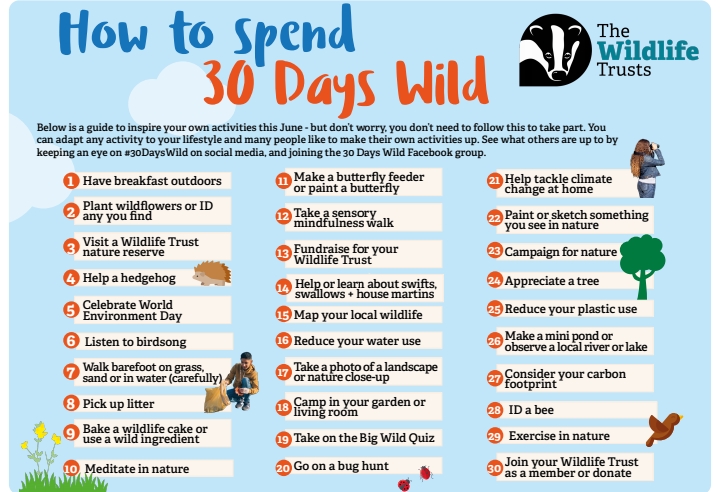
#30DaysWild. Day Ten. Meditate in the Wild. I will feature your photos, writing and artworks about, or including meditating in the wild. Can you make a piece of art, photo or poem/short prose based on the themes below every day in June? First drafts perfectly acceptable. Haikus, Tanka. Preliminary sketches, photos. I will feature all on the day, and add after, too.

screenshot_2022-06-01-11-53-32-60_a27b88515698e5a58d06d430da63049d

HAIBUN – A PILGRIMAGE TO MY FAVOURITE TREE

Intermittent rain and sun today. I need to adjust my focus, so I set off along the narrow road connecting my village to the next.. In the distance I can see you, my tree, the faithful one I have communed with in lockdown and beyond. You are patiently waiting for me, waving leafy fronds in the breeze.

I cherish our unspoken
Friendship. We do not need words,
you are a good friend

Your sturdy trunk has
multiple offshoots, swathed in
trailing ivy braid

Solid branches reach up
skywards, towards pure light,
sense of place so strong

I am content to stand in your presence and observe the birds coming and going with their easy sense of routine. There are sparrows and blackbirds, the occasional crow settling nearby and frightening away the smaller ones. Here with you I find calm and peace, a place to reflect and meditate.

As I run my hands
across your rough, tough gnarled bark
I hear sweet birdsong

Friend, you have stood here
for many a year, and will
be here when I’m gone

Generations will
Pass you by, yet sadly not
love you as I do.

We must say farewell now, you and I, each according to his tradition. I return home through the churchyard, pausing there again to admire the ancient yew trees by the lichgate. My heart sings.

-Margaret Royall

Screenshot 2022-06-10 at 17.05.06

-Jane Dougherty

Wombwell Rainbow Interviews: Stephen Paul Wren

Stephen Paul Wren

studied at Cambridge (Corpus Christi College) and worked in industry for many years. He transitioned back into academia at Oxford (St Hilda’s College) before joining Kingston University in 2018 where he works as a Senior lecturer in pharmaceutical chemistry. 


Stephen’s poetry can be read at www.stephenpaulwren.wixsite.com/luke12poetry and you can find me on Twitter @Stephen34343631. His book ‘Formulations’ (co-written with Dr Miranda Lynn Barnes) was published by Small Press in 2022. His book ‘A celestial crown of Sonnets’ (co-written with Dr Sam Illingworth) was published by Penteract Press in 2021. Also, Stephen’s poetry has appeared in places such as 14 magazine, Marble Broadsheet, Consilience, Tears in the Fence and Dreich magazine.

Stephen’s facebook group Molecules Unlimited is growing quickly and its first online poetry event is scheduled for Summer 2022.

The Interview

1. When and why did you start writing poetry?

I started writing poetry in my teens. I found it to be a very useful and interesting vehicle to express myself. I was able to devote much more time to the crafting of poems during the lockdowns which resulted in getting published more widely.

2. Who introduced you to poetry?

Several of my school English teachers inspired me to read A. E. Housman and others. More recently, my mentor Sarah Watkinson, encouraged me to explore poetry as an art form.

3. How aware are and were you of the dominating presence of older poets traditional and contemporary?

Yes, I had some awareness and plenty of respect for all poets out there.

4. What is your daily  routine?

I tend to wake very early so often write some lines then each day. I also set apart Wednesday evenings for some writing (when I have some ‘alone time’ and as a break from my academic work).

5. What motivates you to write?

I like to write about science, faith, people, the world around me and combinations of all these.

6. What is your work ethic?

I have a strong work ethic and always have multiple projects on the go.

7. How do the writers you read when you were young influence your work today?

At school, I was a fan of A.E.Housman and his cerebral style. I often reflect on his writing when crafting my own words. Ted Hughes and his imagery were other positive influences.

7.1. Why are you drawn to the “cerebral” writing of A.E.Housman?

A.E. Housman intrigued me because I found the idea of poetry being an intellectual exercise quite stimulating. Of course, writing poems involves many other layers, such as ‘the heart’, and I began to explore this through the works of others (Shakespeare sonnets for example). 

7.2. What inspires you in the imagery used by Hughes?

Crow (Hughes) had a significant impact on me in terms of imagery. The use of a creature to illustrate certain characteristics made me realise that there are countless countries to explore as a writer (there is no limit to space).

7.3. Reacting to your being published by Penteract Press how important is form to you in poetry?

Form has its uses but my view is that, first, I think of the story to tell and, second, I think about what form (if any) is best employed to tell the story. 

7.4. What forms are your favourites?

The sonnet and the villanelle.

7.5 Why those?

Villanelles attract me because they can assist with storytelling, e.g ‘across the sea to hastings’ on my blog

I favour sonnets because they enable the blend of ‘romance’/narratives around emotion and the challenge of writing within defined structures.

7.6. Any particular kind of sonnets?

All sonnets, really.

7.7. How did you decide on the order of poems in each of your books?

The order in ‘celestial crown of sonnets’ spoke to my co-author and I as we moved through the chronology of astronomical discoveries and making the crown ‘work’ ie. the final sonnet needed to make sense based on the earlier ones.

In ‘formulations’, my co-author and I wrote poems and forms around pairs of molecules that identified. There was no pre-determined order in the sequence. We hoped that the stories in the poems would take the reader on their own journeys.

7.8. What do you enjoy most about collaboration?

Working together to make a new, combined voice.  I also have two of my own collections in preparation.

8. Who of today’s writers do you admire the most and why?

I admire Katie Griffiths and she encourages me to think in new ways about poetry. I enjoy Matthew Caley’s originality, Philip Gross (for the way he makes you feel about topics that impinge on science) and Pascale Petit (for her ability to transport the reader into new places).

9. Why do you write, as opposed to doing anything else?

I write as a means to express myself. This is tricky to do on an emotional level in the scientific arena in which I operate on a daily basis. I am enthralled by the beauty and design in the world and so often feel compelled to write at the intersection of faith, science and literature. I enjoy making the reader think differently.

9.1. What does your faith bring to your poetry?

That I believe in the Lord’s love for us and the world. I marvel at his design all around us. I try to capture small snippets of these themes in my poems

10. What would you say to someone who asked you “How do you become a writer?”

I would say ‘I became a writer as a natural way of writing down my thoughts and experiences. Learning about form options etc. is an ongoing process.’

11. Tell me about the writing projects you have on at the moment.

I have a number of current projects. I am writing two new collections of my own poems and am beginning to think about words for a planned second collection in collaboration with Dr Miranda Lynn Barnes.

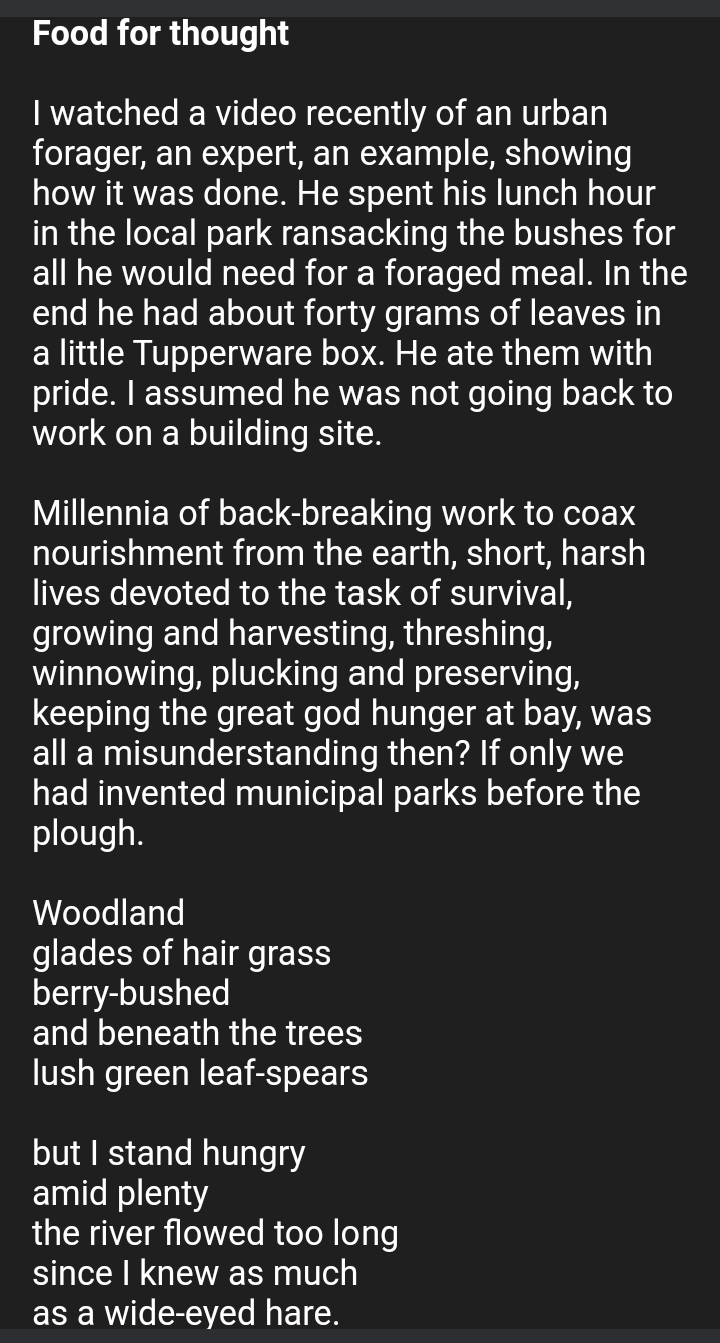
Food for thought

Jane Dougherty's avatarJane Dougherty Writes

For Day 9 of Paul Brookes’ 30DaysWild challenge.

Food for thought

I watched a video recently of an urban forager, an expert, an example, showing how it was done. He spent his lunch hour in the local park ransacking the bushes for all he would need for a foraged meal. In the end he had about forty grammes of leaves in a little Tupperware box. He ate them with pride. I assumed he was not going back to work on a building site.

Millennia of back-breaking work to coax nourishment from the earth, short, harsh lives devoted to the task of survival, growing and harvesting, threshing, winnowing, plucking and preserving, keeping the great god hunger at bay, was all a misunderstanding then? If only we had invented municipal parks before the plough.

Woodland
glades of hair grass
berry-bushed
and beneath the trees
lush green leaf-spears

but I stand hungry

View original post 16 more words

#30DaysWild. Day Nine. Making a wildlife cake, or using a wild ingredient. I will feature your photos, writing and artworks about, or including foraging, making a wildlife cake or using a wild ingredient. Can you make a piece of art, photo or poem/short prose based on the themes below every day in June? First drafts perfectly acceptable. Haikus, Tanka. Preliminary sketches, photos. I will feature all on the day, and add after, too.

screenshot_2022-06-01-11-53-32-60_a27b88515698e5a58d06d430da63049d

-Jane Dougherty

Thankyou to Sunil for featuring me as Author of the Month in Setu Review . I am delighted and honoured. It also includes an interview. Setu 🌉 सेतु: Our Walks Into Wombwell: Paul Brookes:

Paul Brookes: https://www.setumag.com/2022/05/Poetry-Paul-Brookes.html

Thankyou to Sunil for honouring me with this interview in Setu Review Setu 🌉 सेतु: Conversations: Decoding the Poet: Paul Brookes:

https://www.setumag.com/2022/05/conversations-decoding-poet-paul-brookes.html

The High Window, Summer 2022: First instalment

The High Window Review's avatarThe High Window

Logo revised

*****

Here is the first instalment of the Summer 2022 issue of The High Window. The following new material can be accessed via the top menu:

1. A selection of homegrown and international Poetry from 39 poets.

2. Poetry by Tom Laichas, the Featured American Poet.

3. An Essay by Edmund Prestwich on translating Dante.

4. An art feature from Rowena Sommerville, who is The High Window’s Resident Artist for 2022.

The second instalment will be published in another two weeks.

Enjoy!

David

View original post

#30DaysWild. Day Eight. Picking up litter . I will feature your photos, writing and artworks about, or including picking up rubbish, litter, garbage as you explore the wilds. Can you make a piece of art, photo or poem/short prose based on the themes below every day in June? First drafts perfectly acceptable. Haikus, Tanka. Preliminary sketches, photos. I will feature all on the day, and add after, too.

screenshot_2022-06-01-11-31-40-81_40deb401b9ffe8e1df2f1cc5ba480b12

screenshot_2022-06-01-11-53-32-60_a27b88515698e5a58d06d430da63049d

There are things we never forget

Jane Dougherty's avatarJane Dougherty Writes

For Paul Brookes’ challenge, 30DaysWild.

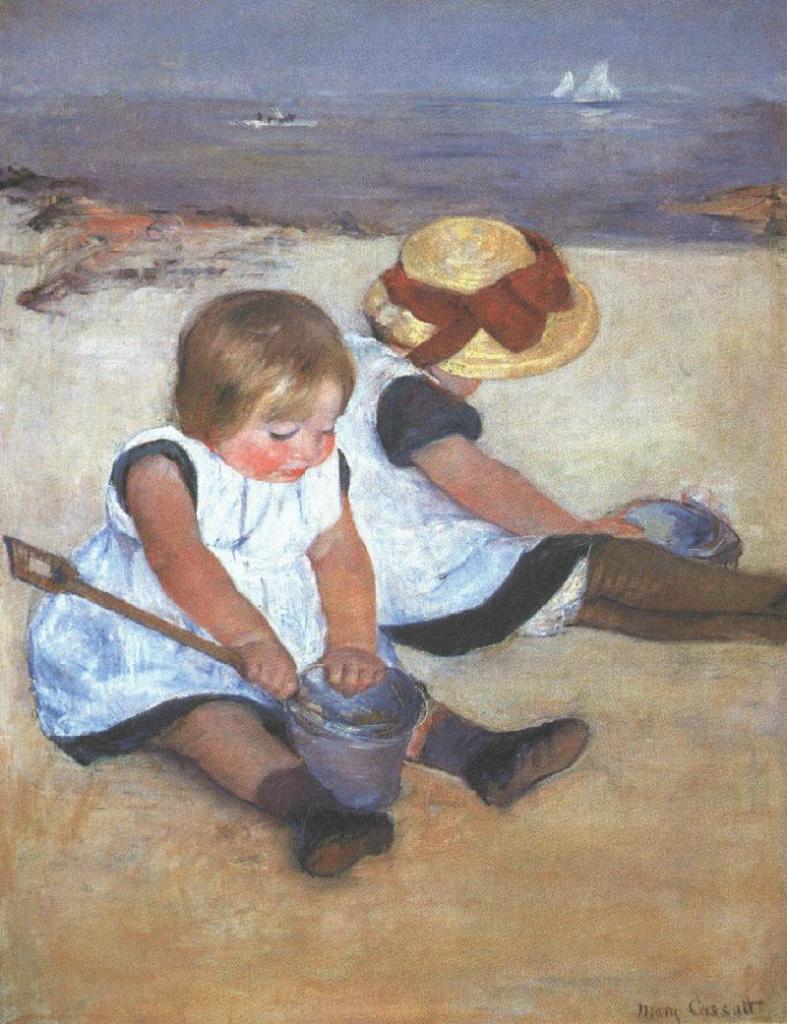
Painting by Mary Cassat

There are things we never forget

like skies, windy,
with the cutting edge of spring,
scudding clouds
and the song, drifting earthwards,
of the skylark,

still light, throbbing with heat
and only half-cool shade,
limp leaves,
sunlight sliding like melted butter,
butterflies and bee-buzz,
first blackberries,

and the heavy air, salt-sticky,
loud with gulls and the crash of the waves,
foam-hiss,
the running rippling of outgoing rills,
rolling grains of sifted sand
between bare toes.

View original post

#30DaysWild. Day Seven. Carefully going barefoot on sand, grass or in water . I will feature your photos, writing and artworks about, or including going barefoot (carefully), on sand, grass or in water. Can you make a piece of art, photo or poem/short prose based on the themes below every day in June? First drafts perfectly acceptable. Haikus, Tanka. Preliminary sketches, photos. I will feature all on the day, and add after, too.

screenshot_2022-06-01-11-53-32-60_a27b88515698e5a58d06d430da63049d

There are things we never forget

like skies, windy,
with the cutting edge of spring,
scudding clouds
and the song, drifting earthwards,
of the skylark,

still light, throbbing with heat
and only half-cool shade,
limp leaves,
sunlight sliding like melted butter,
butterflies and bee-buzz,
first blackberries,

and the heavy air, salt-sticky,
loud with gulls and the crash of the waves,
foam-hiss,
the running rippling of outgoing rills,
rolling grains of sifted sand
between bare toes.

-Jane Dougherty

The Featured American The Featured American Poet: Tom Laichas

The High Window Review's avatarThe High Window

tom laichasPhoto: Nathan Kosta

*****

I began writing regularly forty years ago, in a workshop with Peter Levitt, a Canadian poet, Buddhist teacher, and translator (see his exceptional rendering, with Kazuaki Tanahashi, of The Complete Cold Mountain, from Shambala). I lived alone, taught high school history, and wrote over weekends and summers

In the early 90s, I went to grad school (history again), and started a family. For the next twenty years, that’s where I devoted my time and attention. Then, ten years ago, forced out of my routines by a cluster of losses, I quit full time work and developed a daily writing practice. I wrote Empire of Eden between 2013 and 2018, and, in The High Window’s David Cooke, found a sympathetic, supportive, and energetic publisher.

 *****

About these poems:

Police Photograph of Robert Walser, Dead’ — My dad’s grandparents were small-town portrait photographers, and my…

View original post 1,804 more words