Sally Michaelson: Leeds to Bournemouth

The High Window Review's avatarThe High Window

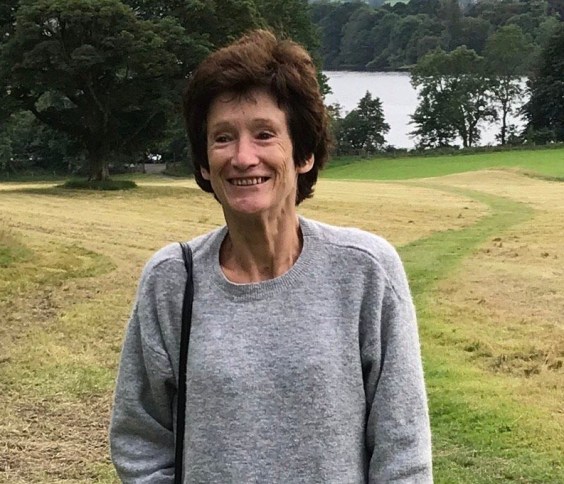
sally michaelson cropped

*****

Sally Michaelson is a retired conference interpreter in Brussels. Her poems have been published in Ink,Sweat and Tears, Lighthouse, The High Window,The Banghor Literary Journal, The Lake, London Grip, The Jewish Literary Journal, The Seventh Quarry, Idler, Hevria, Lilith, Algebra of Owls, Squawk Back and Dreich. Her debut collection The Boycott was published by The High Window in April 2021

boycott cropped

*****

Sally Writes:

‘I didn’t realize how much I wanted to write about Jewish hotels in Bournemouth in the 1960’s and my family’s ‘pilgrimage’ every summer. When I wrote the first poem ‘Leeds to Bournemouth’ memories of lavish food, stuffy lounges,colourful characters and my own discomfort came flooding back.I hope you’ll enjoy reading.’

*****

LEEDS TO BOURNEMOUTH

Dad fits a jigsaw
of suitcases and bags
into the bursting boot

of our Vauxhall Viva
wedging all four sisters
onto the backseat

perched on the pull-down
smoke from Dad’s Havana

View original post 1,118 more words

#ItsNotOk Sexual Abuse And Sexual Violence week 7th-13th February. Day Three. I will feature your published/unpublished poetry/short prose/artworks. Please include a short third person bio.

#Itsnotok2022 abuse

Frame by Helen Laycock front cover

Frame power by Helen Laycock

Windblown front cover by Helen Laycock

The above image is the front cover to Helen’s first volume of microfiction. “Windblown”. Her next volume will be called “Ink Spills”. I will be featuring microfictions from this over the week. Here is the second. Helen says of these:

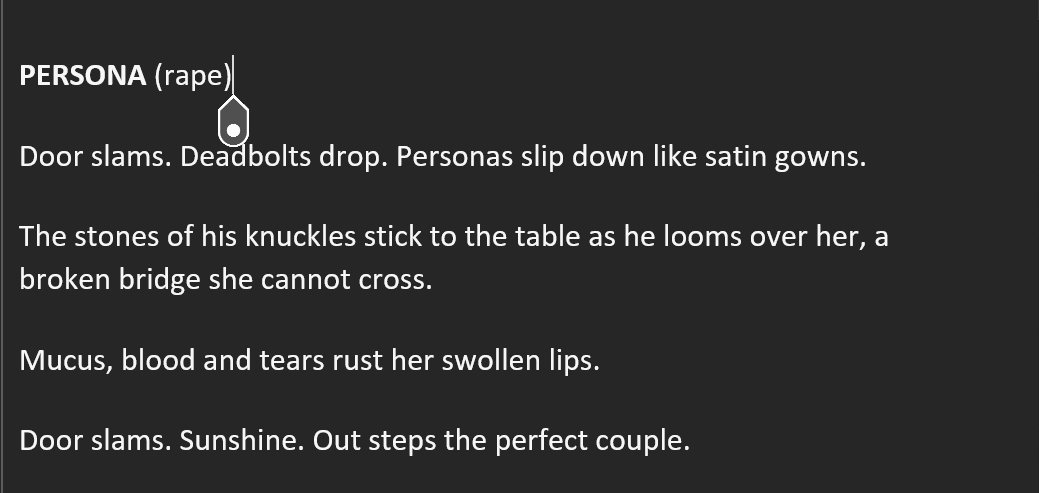
The words in capitals are not titles as such; they are the prompts given in vss writing challenges. In brackets I have indicated the general theme of each piece.

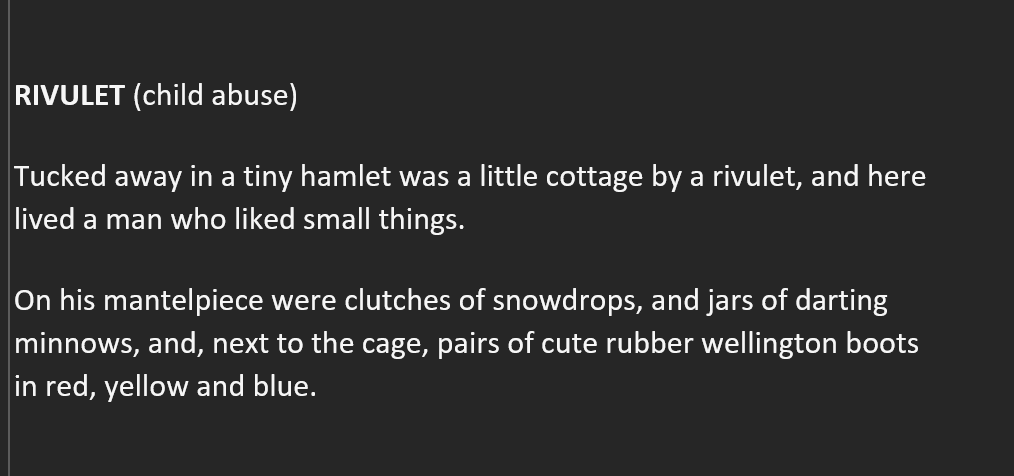
Rivulet by Helen Laycock

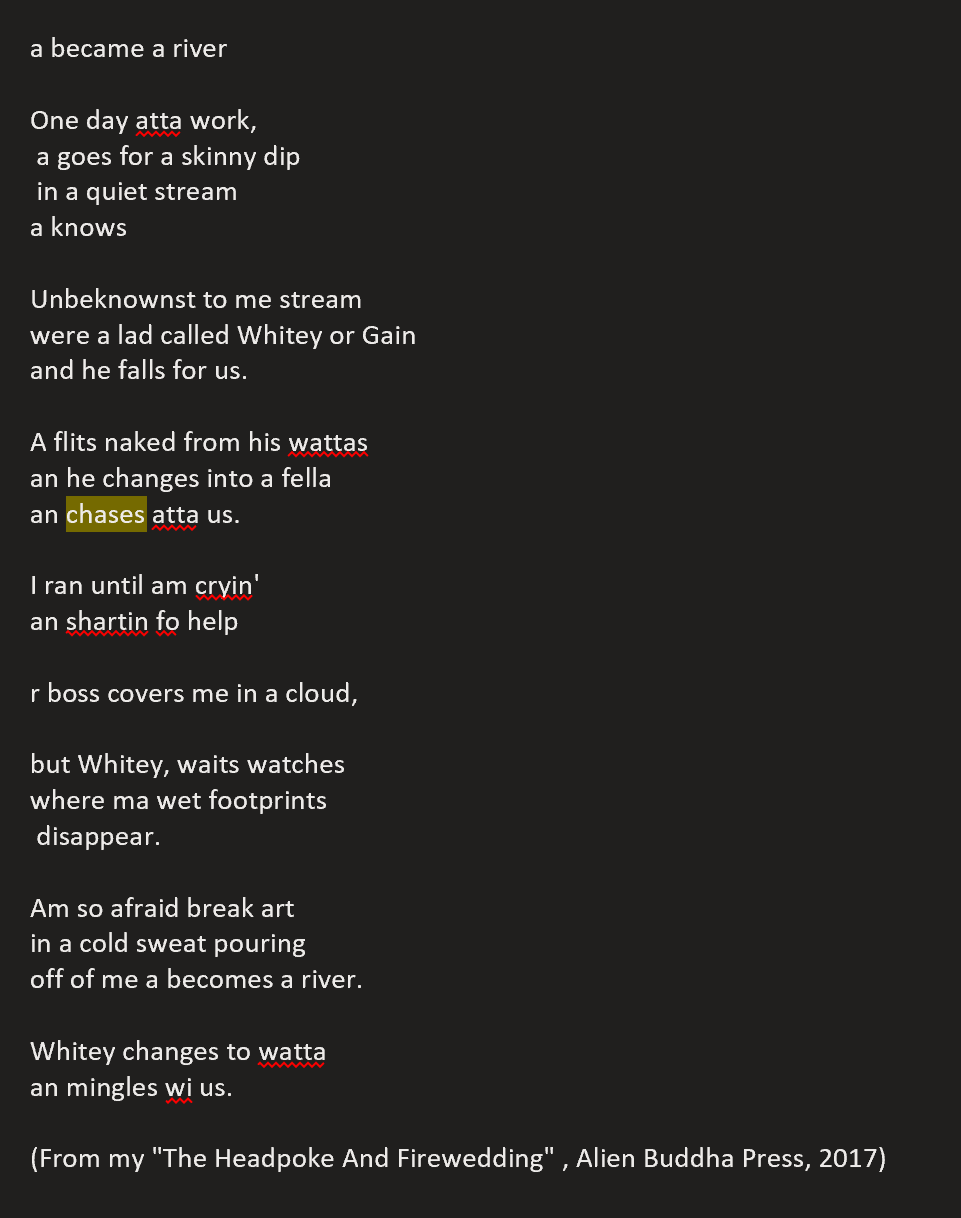
a becomes a river

-Paul Brookes

Bios And Links

bio revised Helen Laycock

Amazon Author Page

Facebook Author Page

https://www.facebook.com/helenlaycockauthor

Pillar Box Poetry

https://www.facebook.com/pillarboxpoetry

Twitter

@helen_laycock

WEBSITES

Poetry

https://helenlaycock.wixsite.com/marbleintocloud

Short Stories/Flash

https://helenlaycock.wixsite.com/fiction-in-a-flash

Children’s Books

https://helenlaycock.wixsite.com/helen-laycock

#ItsNotOk Sexual Abuse And Sexual Violence week 7th-13th February. Day Two. I will feature your published/unpublished poetry/short prose/artworks. Please include a short third person bio.

#Itsnotok2022 abuse TRIGGER WARNING Frame by Helen Laycock front cover Frame Nightlife Helen Laycock -Helen Laycock Windblown front cover by Helen Laycock The above image is the front cover to Helen’s first volume of microfiction. “Windblown”. Her next volume will be called “Ink Spills”. I will be featuring microfictions from this over the week. Here is the second. Helen says of these: The words in capitals are not titles as such; they are the prompts given in vss writing challenges. In brackets I have indicated the general theme of each piece. persona microfiction by Helan Laycock

-Helen Laycock. A Tongue Once a lass craved by a lad. He lusts after her. She is cold. He forces himself on her, He cuts out her tongue, to stop her gab. Sliced by his blade, he holds it with pincers. Her tongue’s root quivers, the rest lies on dark soil, writhes and trembles, searches for some sign of her. She weaves the fact in purple design on a white background, so her boss sees what her mutilater has done and moved by her rape molds her into a feathered thing, warm brown back, pale front, speckled with lines of dark arrows that point to her head, a tinge of golden brown on her breast, belly almost white with a few small dark spots, a bird who embroiders the fact of her pain in the cup of her nest, twigs, grass and moss, cemented thickly lined with mud, dung, rotten wood, mixed with leaves. At the start she can only call his name, nothing else in short bursts twice, clear and flute-like. She is a dirsh, thrusher, thirstle, throggle. Come icy ground she smashes the shells of snails against a favourite stone, picks at the foot, as at a swollen tongue, swallows the meat. -Paul Brookes Bios And Links bio revised Helen Laycock Amazon Author Page
Facebook Author Page https://www.facebook.com/helenlaycockauthor Pillar Box Poetry https://www.facebook.com/pillarboxpoetry Twitter @helen_laycock WEBSITES Poetry https://helenlaycock.wixsite.com/marbleintocloud Short Stories/Flash https://helenlaycock.wixsite.com/fiction-in-a-flash Children’s Books https://helenlaycock.wixsite.com/helen-laycock

The Wombwell Rainbow Interviews: Andrew Ray Williams

Andrew Williams reading his poetry

Andrew Ray Williams reading his poetry

-Andrew Ray Williams

is a poet living in Pennsylvania, USA. His work has been featured at Ink, Swear & TearsRed Eft ReviewThe BeZine Quarterly, among others.

Poetry Website: andrewraywill.wordpress.com 

General: andrewraywilliams.com

The Interview

When and why did you start writing poetry? 

I began reading and writing poetry a few years ago as I was nearing the completion of my PhD at Bangor University (Wales). Prior to this, I would enjoy reading fiction and non-fiction, but I had never seriously engaged in poetry. In high school, I was introduced to the likes of Wordsworth, Dickinson, Frost, among others. However, at the time, I mistakenly assumed that poetry was nothing more than a hunt for meaning. In my mind, poetry seemed like a reader’s Rubik’s cube. It was not until I was an adult that I discovered my initial impressions were crudely mistaken.  

In addition to teaching Christian theology, I also serve as a pastor of a church in Pennsylvania, USA. Oddly enough, my perspective on poetry began to change as I started to do more preaching on the Psalms in my local church. Reading and reflecting on these ancient poems drew me in, not only spiritually but literarily. How was I to expound on the Psalms with such little knowledge of poetics? This led me to read poetry.  

Who introduced you to poetry? 

As my story reveals, I really fumbled my way into poetry. But as soon as I became interested in it, I began reading voraciously. I soon realized that poetry was a gift I had been missing out on for far too long. I read William Shakespeare to William Blake to Walt Whitman. If I remember correctly, I believe it was Billy Collins’ popular anthology Poetry 180 that introduced me to contemporary poetry.  

How aware are and were you of the dominating presence of older poets traditional and contemporary? 

Poetry, like any other kind of literature, allows you to converse with the dead. One is not doing their due diligence if they are not becoming acquainted with at least some of the towering figures throughout history. Though I write almost exclusively in free verse, I very much enjoy reading older poets who utilize meter and rhyme. Writing poetry, I think, puts you in the company of many people who have come before you and will inevitably come after you.  

What is your daily routine? 

I wish I had a daily routine. Amid work and family life, I often must carve out time within a week to sit down, quiet myself, and write. I am not good at writing “on the go”. I need quiet and focused time. However, at the beginning of each week, between my personal and work schedules, I will always pencil in time to write. But, since I am currently contracted to write a non-fiction book, my poetry writing has slowed. However, next week I have already put a block of time in my week to focus on poetry.  

What motivates you to write? 

A few things. Many of my poems are birthed out of ordinary times with my wife and daughters. Even if they do not find their way into a poem, I am often inspired to write when I am with my family. Also, since I preach in a church setting and teach in a university setting, I find poetry helps relieve me of didactic communication. I find the form is not only beautiful but useful in expressing things I fail to know how to express otherwise. Finally, I write because I love the challenge. Poetic writing can be a great challenge. I enjoy wrestling with words, ideas, emotion, and ink.       

What is your work ethic? 

I am a self-starter and easily motivated, especially when it comes to writing. I write every week, with the only exceptions being when I am on vacation (and sometimes I will still write a poem). Even if I only have an hour in the week to write, I make sure I do it.  

How do the writers you read when you were young influence your work today? 

I grew up in “the south”—Texas, USA. However, now I live in Pennsylvania, USA, which is much farther north. People here tell me I have somewhat of a “southern-accent”, though I would never know it. I think writing works in a similar way. I know that my writing voice has been shaped by early influences, but I have little perception of how and to what degree.  

Who of today’s writers do you admire the most and why? 

Jane Kenyon was the first poet that I really adored. She often wrote brief lyrical poems that centered around place and ordinary life. I appreciate that her poems seem to always have perfect line breaks and I get the impression that no single word could be eliminated. Her husband, Donald Hall, who was also a poet has influenced me, though in other ways. His preoccupation with nature, countryside, loss, and death are themes I find compelling. Early on, he taught me that poetry need not be overly sentimental, though it certainly can be on occasion. Billy Collins taught me the art of being whimsical and talking directly to the reader. Lucille Clifton challenged me to say more with fewer words. Lately, I have been enjoying Philip Larkin (especially his whit) and have also delighted in reading R.S. Thomas’ work. Finally, I must also give credit to my mentor, Matthew M.C. Smith. He has and continues to help me become a better poet. 

Why do you write, as opposed to doing anything else? 

I love words like I used to love Legos. I enjoy building things out of them.  

What would you say to someone who asked you “How do you become a writer?” 

Read … A lot (2) Start writing (3) Seek out honest feedback (4) Keep reading 


Tell me about the writing projects you have on at the moment. 

At the moment I am publishing individual poems in an effort to build a bigger body of work. Once I can accomplish that, I aim to publish a small collection of poems. As I mentioned earlier, I am also currently I am writing a non-fiction book tentatively entitled, Reconstructing Prayer: Navigating the Complexity of Faith Through the Simplicity of Prayer. It should be released in early 2023 with Cascade Books.  

Thank you for this opportunity to talk, Paul.  

#ItsNotOk Sexual Abuse And Sexual Violence week 7th-13th February. Day One. I will feature your published/unpublished poetry/short prose/artworks. Please include a short third person bio.

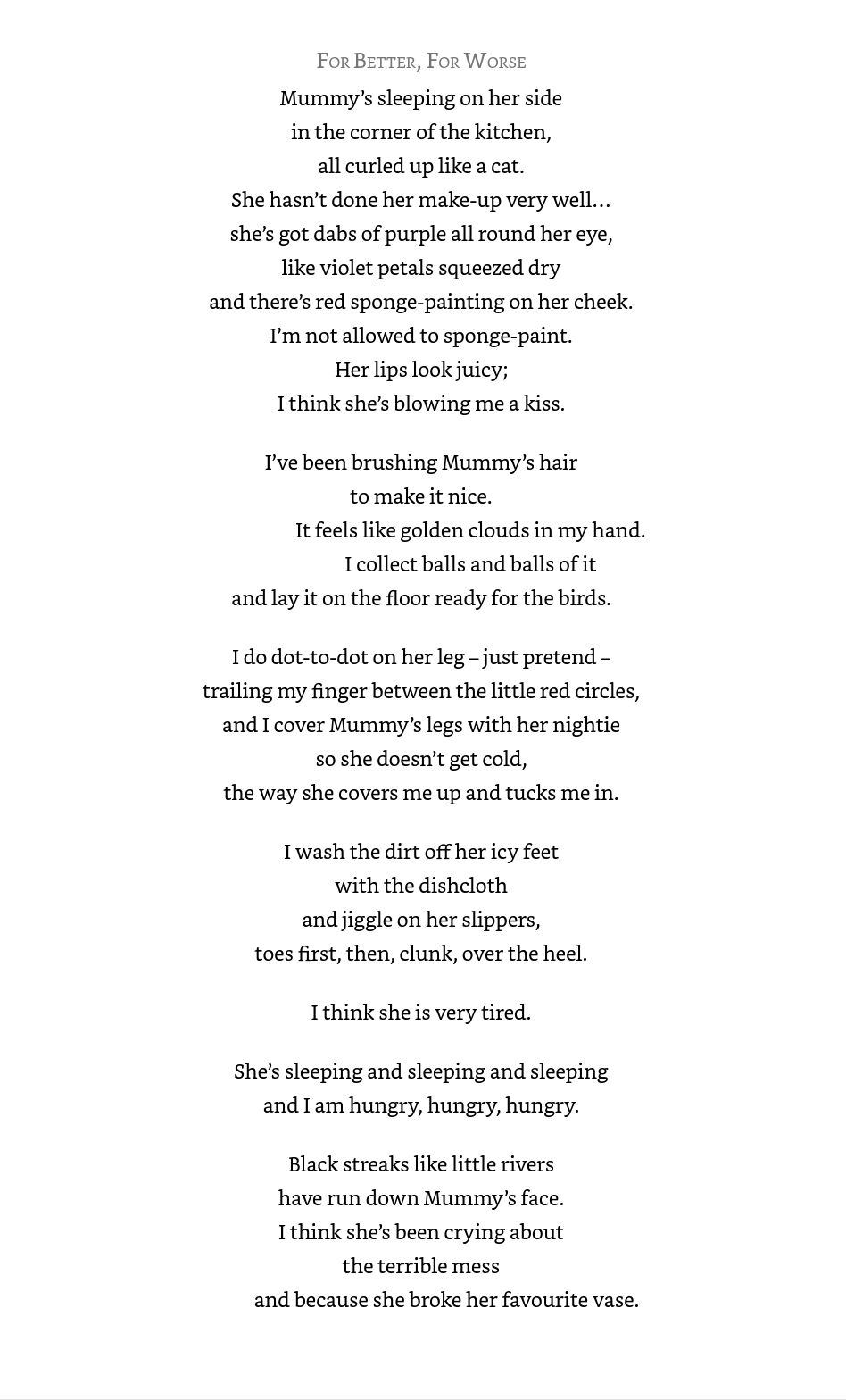
#Itsnotok2022 abuse Frame by Helen Laycock front cover Seven Question Interview: Q1 Frame Helen Laycock Frame For Better Windblown front cover by Helen Laycock The above image is the front cover to Helen’s first volume of microfiction. “Windblown”. Her next volume will be called “Ink Spills”. I will be featuring microfictions from this over the week. Here is the second. Helen says of these: The words in capitals are not titles as such; they are the prompts given in vss writing challenges. In brackets I have indicated the general theme of each piece.

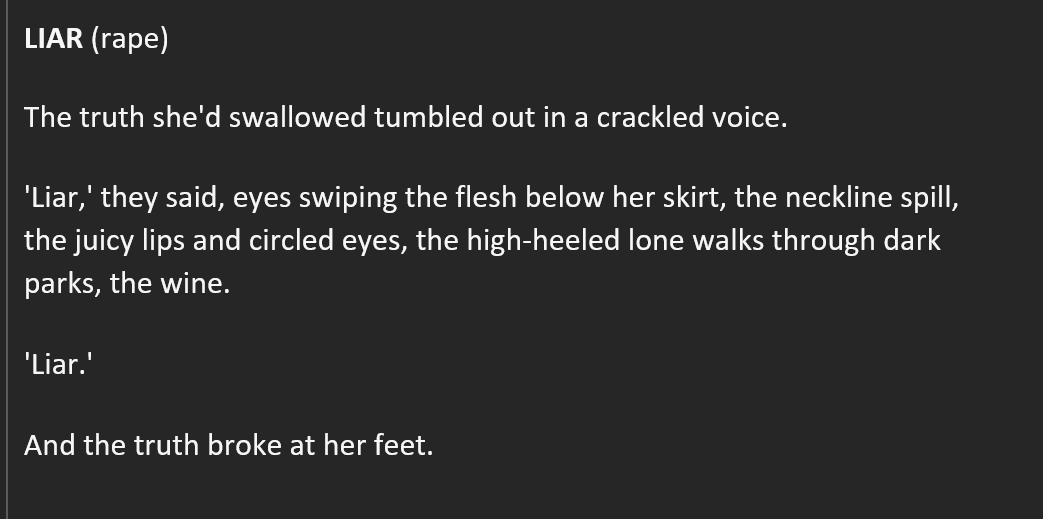
Liar by Helen Laycock

-Helen Laycock consent -Paul Brookes Bios And Links bio revised Helen Laycock Amazon Author Page
Facebook Author Page https://www.facebook.com/helenlaycockauthor Pillar Box Poetry https://www.facebook.com/pillarboxpoetry Twitter @helen_laycock WEBSITES Poetry https://helenlaycock.wixsite.com/marbleintocloud Short Stories/Flash https://helenlaycock.wixsite.com/fiction-in-a-flash Children’s Books https://helenlaycock.wixsite.com/helen-laycock

#NationalYorkshirePuddingDay. I will feature your published/unpublished poetry/short prose/artworks. Please include a short third person bio.

Yorkshire Pudding on Baking Tray with wood and decorative festive background

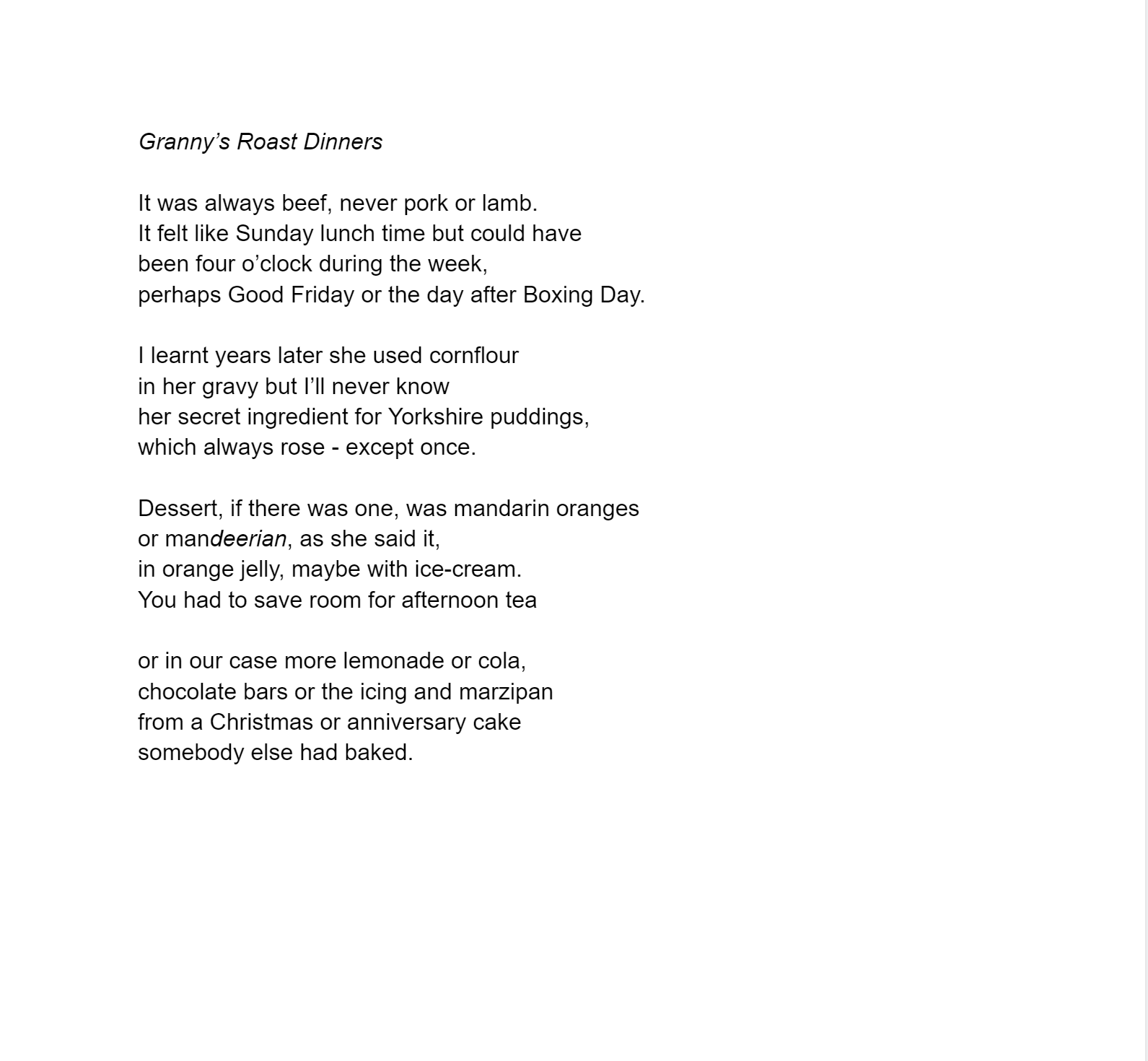
Granny's Roast Dinners by Peter Donnelly

-Peter J Donnelly

In this house they rise
Like doubloons
Or better still
Shaped something like
A sperm whales eardrum
They all are eaten
With gravy or syrup
With awe
And occasionally with stew

-Julie Corbett

The Buzz

“Where are the Yorkshire Puddings?”
a customer enquires, and to show
them where is the gravy to my brain.

“Have you got any custard?”
I point to the correct aisle
and get the jam roly poly in my stomach.

That shot of serotonin to the head,
lifts the day. I know where to find
what they want or need feels worthwhile.

-Paul Brookes

Bios And Links

-Julie Corbett

is a writer from East Yorkshire and writes about place and how it is remembered.

-Peter J Donnelly

lives in York where he works as a hospital secretary. He has been published in various magazines and anthologies including Dreich and Writer’s Egg. He has degrees in English Literature and creative writing from the University of Wales Lampeter. He recently won second prize in the Ripon Poetry Festival competition.

Poem, “The Wobbling Moon,” up in Roi Fainéant

merrildsmith's avatarYesterday and today: Merril's historical musings

“The world courses on

arhythmic heartbeats, now too fast, now too slow–“

Thank you to the lovely, lively editors at Roi Fainéant for publishing my poem, “The Wobbling Moon,” in this most recent issue. I’m eager to read the entire issue.

View original post

#ItsNotOk Ahead of Sexual Abuse And Sexual Violence week 7th-13th February I will feature your published/unpublished poetry/short prose/artworks about this issue. Please include a short third person bio.

#Itsnotok2022 abuse

Afterword by David Miller (Shearsman Books), Circle Square Triangle by David Miller (Spuyten Duyvil)

tearsinthefence's avatarTears in the Fence

David Miller’s writing has always crossed boundaries: between poetry and fiction, between the confessional and poetically distant, the heartfelt and philosophical. His work has consistently used short texts – often containing quotes or intertextual allusions – in juxtaposition to other short texts to build up a patchwork effect within a text. In the ‘Notes’ toAfterword, he refers to ‘independent texts. Yet related.’ and ‘Ruins, edifices, fragmented architectures.’ Adopting a phrase fromCircle Square Trianglea reader might think of reading Miller more as ‘through & past & back’.

But it is never a puzzle to be solved, or a jigsaw that makes a picture with straight edges and is complete. Miller’s work is often more like an archaeological tesserae, the remains of a mosaic that has slowly been revealed by digging and then patient brush work. The quotations and allusions, be they from neglected authors, obscure religious texts…

View original post 515 more words

#WorldCancerDay2022 #WorldCancerDay I will feature your published/unpublished poetry/short prose/artworks. Please include a short third person bio.

Invincibility
Your eyes confirm my heart’s free fall. My ears
heard right. Cancer. Enemy feared since childhood
Two classmates dead before their fifth birthday
Sister of my adulthood struck down at 35
Now you sit across the room from me
stoic on the mattress where we make love
I see the tsunami breaching your shore
pooling ‘round sandbags positioned for my benefit
My guts coil, jellyfish drying in sun’s glare
This light an X-ray aimed at the offending lymph node
swelling in your belly, taking on water like a sinking ship
Your blood, sacred as Eucharist, white with leukocytes
I bleed for you, marrow of my marrow, bone of my bone
We are in this together

-Gayle J Greenlea

Star Scan by John Hawkhead for World Cancer Day


-John Hawkhead


Inside These Bones

know this December light
know this December cold
And Angus pulls on his lead.

A white Highland terrier.
Your bedside companion
until that December
I take him for a walk.

Inside these bones
know this December gust.
The surface of my eyes
gather so much gritstone.

My December vigil
your bedside, Mam. Your breath
irregular as gust.
Go to Dad about it.

I tell Dad about it.
Take Angus for a walk
And gust blows grit.
And Angus pulls his lead.

Home half hour later ask
where you were. Ambulance
has taken you away.
I’ve never seen you since.

Gust is ghost breath and still
brings water to these eyes.
Inside these bones
Know this December cold.

-Paul Brookes


Bios And Links

-Gayle J. Greenlea

is an American-Australian writer and poet and counselor for survivors of
sexual and gender-related violence. Her poem, “Wonderland”, received the Australian Poetry
Prod Award in 2011. She shortlisted and longlisted for the Fish Poetry Prize in 2013, and
debuted her novel, Zero Gravity, at the KGB Literary Bar in Manhattan in 2016. Her work has
been published in St. Julian Press, Rebelle Society, A Time to Speak, Headline Poetry and Press,
The Wombwell Rainbow, Stanford University Life in Quarantine, Fevers of the Mind,
Kalonopia, Australian Health Review, and (soon) San Antonio Review.

-John Hawkhead

has been composing haiku, senryu, haibun, and haiga for over 20 years and he recently won the Grand Prix 2021 Setouchi Matsuyama Haiku Contest. His book, Small Shadows, was released in 2016. With more than a thousand published poems, he has been listed on “The European Top 100 most creative haiku authors” for the past ten years .Since then I’ve also won this year’s Porad contest (this haiku) and I was a finalist in the Trailblazer contest.