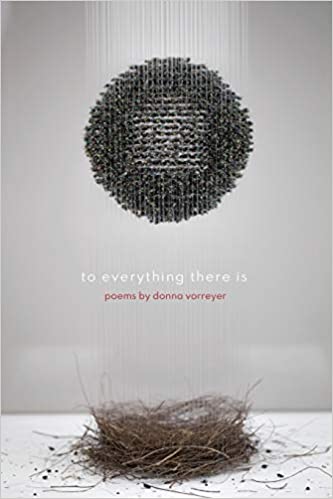
-Donna Vorreyer
is the author of To Everything There Is (2020), Every Love Story is an Apocalypse Story (2016) and A House of Many Windows (2013), all from Sundress Publications. Her work has appeared in Penn Review, Tinderbox Poetry, HAD, Poet Lore, Sugar House Review, Waxwing, and other journals, and she serves as an associate editor for Rhino Poetry. Recently retired from 36 years in public education, she can’t wait to see what happens next.
The Interview
- When and why did you start writing poetry?
I suppose there are three answers to that question. I wrote poems as a kid in elementary school because I had an ear for rhyme, and I was a teacher-pleaser. My poems got praised, so I wrote more poems. As a teen, I received a guitar for my 13th birthday and started writing songs, so that was my second introduction to being a poet, this time for the intrinsic motivation of expressing all of my teen angst about unrequited love and the attention it got me at parties.
But I started writing poetry again as an adult in my early thirties. I had always kept journals and had written some poems for children that had been published, but when I adopted my son, I found that I had more that I wanted to say. Being a public school teacher, I was far removed from the world of poetry, so in order to learn how to enter it, I started reading all of the contemporary poets I could find in the library (not many, it turned out) and found summer workshops to take during my breaks from teaching. As I began to find my voice, poetry became a way for me to filter and understand the world and my place in it.
2. How aware are and were you of the dominating presence of older poets traditional and contemporary?
When I starting writing, my dominating experience with poetry was through Shakespeare (both from my father and my 6th grade teacher) and then in high school, some canon poets like Frost, cummings, and Millay from my AP English teacher, who was a nun with a very specific sense of what it meant to be well-read. I try now to not only read current contemporary writers, but writers I may have “missed.” I have never studied poetry formally and do not have an MFA, so very often a poet that is considered influential has escaped my radar. For instance, although I had read the often-shared Lana Turner poem by Frank O’Hara, I hadn’t read anything else by him until a few years ago when I picked up a Selected anthology in a used bookstore.
I find it comforting that there are always new poets from which to learn, poets who vary so widely in concerns, in style, and in form. I like to believe that I learn “moves” from other poets that are then used in my own work organically rather than trying to mimic another writer’s tendencies.
3. What is your daily routine?
My daily writing routine is not a routine at all. I am not one of those people who writes every day or does morning pages. Although I am recently retired and have as much time as I’d like to write, I find that I still write the way I did when I was working, which is writing in fits and starts. I take a lot of notes, either in a journal or on my phone if I’m out or walking. When I have time to write, I see if those notes can spark a phrase or sentence. I often free write into an idea for a while and then leave it alone. Those freewrites are almost always longhand because, when I draft on a computer, I start to edit myself too quickly. I don’t allow the same type of messy wandering as I do on the physical page, and that wandering is usually where the strongest images come. Revision is my favorite part of writing, and that is where I spend the bulk of any time that I designate as writing time.
4. What motivates you to write?
Observations. Juxtapositions. Guilt. Fear. Memory. Love. Seeking to understand. Seeking to make connections. Writing is my way of understanding myself and the world I live in. Being able to explore the past, reach into the future, and question the unaswerable on the page is both challenging and soothing to me. If that writing ever finds an audience outside of me, then that connection is a delightful bonus.
5. What is your work ethic?
It depends on how excited I am about what I am writing or how immediate my need If I’m generating material that surprises or interests me, or I’m using my writing to work through something, I can dive into it for hours or days at a time without a break. If I’m in a fallow period where I’m not generating anything that interests me, then my work ethic becomes more of a gathering and thinking time where I read a lot and focus on those notes that may come here and there. When I have a specific task to complete (editorial work or proofing or prepping to teach a workshop), my work ethic is very strong. When others are depending on me, I tend to take care of those responsibilities first.
6. How do the writers you read when you were young influence your work today?
I read mostly classics and popular fiction as a young reader (young to me meaning high school and college) and the only poetry I encountered was whatever poets in the canon were in the literature anthologies we were using as textbooks – Norton’s, mainly – but I was personally drawn to both Shakespeare and Frost. I admire Shakespeare’s scope, his appeal to both “high” language and common emotion, a mix that is hard to pull off successfully. And Frost’s use of form and his ability to tell stories also held great appeal. I don’t know if I can honestly say I’m influenced by either of those writers, but when I find myself playing with meter, or trying to find the language to make something ordinary seem magical, I think of Shakespeare’s sonnets and Frost’s Birches, the girls with their hair thrown over their heads to dry in the sun.
7. Who of today’s writers do you admire the most and why?
This is a difficult question, as there are so many writers creating admirable work. I admire any writer who finds a way to make me feel something new that also somehow resonates with my own experience, writers who bring me into a world where I am both visitor and native. One writer I admire is Patricia Smith, as she is never satisfied with what she has already accomplished. She is always moving forward to something new, learning something new. And she is generous with her time and her attention in the literary community in a way that someone who has earned her level of recognition does not have to be. There are so many others for different reasons: Traci Brimhall for her language and gift of dreaming; Amorak Huey for his brilliant turns toward surprising and often poignant endings; Mary Ruefle for her humor and gift for seeing the world. I could go on for days…
8. Why do you write, as opposed to doing anything else?
m a competent cook, but not a creative one. I like sports and fitness, but I’m not a great athlete. I sing, play the piano and the guitar, but not well enough to share those skills with anyone else. Writing for me is the best way for me to be creative as I have the strongest kinship with language. Although I love visual art,and enjoy the process of creating it, I have a mental block about sharing it, a judgmental part of my brain that tells me I’m not good at it. With writing, although I have my inner critics, I have learned to tame them through being willing to acknowledge my strengths and weaknesses and work through them. When I write, I can choose easily to share that work or keep it to myself, to privately work through the world with language or cast the words out to others to see if they catch.
9. What would you say to someone who asked you “How do you become a writer?”
The easy answer is “write,” of course. But nothing is that easy.
If the question emphasizes “become,” then the answer would be to first be a reader. Fall in love with language, with stories, with descriptions. A person can’t do any of that without being a reader. Be an observer of the world. Notice the things that others walk right by. Also try to retain your child-like delight in creating – hush the inner critics that come with age and school and grades. Write poems and tell stories to please yourself, as a child does.
If the question is meant as how to become a published writer, that requires a set of skills that you must learn along the way. Accepting criticism and rejection. Understanding that there is always more to learn. Reading a wide selection of publications to see where your work might fit. But most importantly, having a willingness to take risks, as risk is inherent in any stage of making your work public. It’s a risk to put your thoughts onto a page. It’s a risk to send that work out. It’s also a risk to have it published and available for anyone to read and pass judgment.








 The Wombwell Rainbow