#GreatBigGreenWeek 18th – 26th September. Day Eight. I am looking for your words/artworks/photos/videos on Climate Change. Please join and add to the works of Samantha Terrell, Ian Badcoe, Neal Zetter and I. I would love to feature your #ecopoetry, #geopoetry your #ecoartworks, your #ecophotos your short #ecoarticles, here. Your #ClimateChangepoetry, #ClimateChangeArtworks. I will feature your work in my blog posts during this period.

The Great Big Green Week – Day Eight

the great big green week logo

Thoughts On Rising Sea Levels and Sinking Expectations

On the coastlines, sodium-saturated
Wood, swells as systemic
Denial of knowledge
And actively propagandized policies
Override reasonable
Solutions.

We know
Of unreasonable
Numbers of plastic water bottles, saturating
Our waterways and systems
Without any long-term pollution policy
Solutions,

As reasonable-
Minded policy-
Makers are saturated
By systemic
Conflict and mandates, knowing
It’s not enough to propose simple solutions.

Policies
Providing lasting environmental solutions
Must be backed by a reasonably
Large number of knowledgeable
Lawmakers who aren’t already saturated
With other issues in the system.

Yet, offering no solutions
To climate change, is to ignore reason –
Allowing a corrupt system
To saturate
Public airways with, more than smog but also, ignorance and lies instead of knowledge,
Further delaying solvent policies.

Take on the system!
Saturate
The world with knowledge
And reason.
Demand solutions.
Propose new policies.

Promote honesty and knowledge.
Earth deserves solutions
Based in science, and reason.
-SamanthaTerrell.com

A soap bubble…

…was blown
so long ago,
the wide-eyed, Wonderland-oblivious,
toddler of humanity blew
clumsily through the loop gripped
in one chubby fist

—billions of people will die—

and the soap film hesitantly bulged out
powered by bronze,
steel, the horse collar, crop rotation.
Sailing ships and steam engines
smoothed into the fragile sphere,
as were pickaxes, dynamite, production-lines…
industrial farming, the Haber Process,
internal combustion engines and the fractional distillation
of crude oil… Fast-breeder reactors…
embedded in the almost imaginary skin
of this bubble we blew,
this quintessentially breakable world
we knew through all our lives,
and implicitly assumed was real

—and billions will start to die—

when it turns out it is not. We built
a civilization on stuff we borrowed. We assumed
that fossil fuel in the ground
was a permanent state:
a natural condition forever. We thought
fertile topsoil was a given,
and clean water another gift, temperate climate,
fish-filled oceans, the very air…

—billions of people are starting to die—

as our assumptions start to crack along fine lines
and this is a bubble in the purest economic sense
because it actually worked through all the time
during which it seemed to work,
until one day, suddenly, boom!
It’s always been a lie.

If this island earth were a spaceship:
power failing, the food limited,
life support pumping dodgy air;
we’d get all of engineering there
and have a meeting to decide
who can be stuffed in lifeboats,
who can be stuffed in freezers, and who
—because engineers are nothing if not completely realistic—
won’t reach their destination.
You can try to get that one
before the United Nations, good luck with that!
And not to be a bore, but…

—billions of people will die—

and I don’t trust that lot to do much about it.
Although, also, I, with my slightly less than human head on,
—because I have one of those—I say: OK,
billions will die, it is hard to overestimate the size
of disaster facing us, but it’s not the end of the world,
it’s just the end of the world as we know it
and as long as we don’t completely blow it…
and as long as we weather the change
ride the tsunami
take what life remains us, as and where we find it
and not go end-of-days-fucking-crazy
with a Mad Max style weapons stash
and supercharger
on everybody’s Christmas list, then…

—for the billions who by chance do not die—

there will be some loss of privileges.
We won’t be eating meat;
we won’t be mining bitcoin; may not be driving personal cars
but we can hope still to be here
in some form.
We haven’t been attempting the impossible
it’s not that a planet cannot support an apical species
with a silly headcount.
It’s just that we didn’t do our homework.
We don’t have all the required tech,
have not closed the carbon curve,
balanced the energy budget, or worked out
what happens when ageing plastics want to retire…

…not produced a society that can keep its calm
on pressure-cooker starship Earth…

…but it can be done. Still, not a comfortable thought,
and it’s going to take some time

—during which billions of people will die.

It’s not the end of the world,
it’s just a soap bubble,
it’s the end of the world as we know it:
pop.

-Ian Badcoe

Carbon Footprint
MAY 06, 2019
I’m your deadly carbon footprint

Lurking spectre grim and grey

Growing larger, never smaller

I will never fade away

Stalking stealthily behind you

While you live your life on Earth

I’m your stain, your deep impression

I’m your legacy, your curse

I’m your dirty carbon footprint

Don’t ignore my warning sign

I’m your carelessness, your cancer

Soon consuming humankind

As you use your power electric

Coal and petrol, oil and gas

Killing nature with pollution

While you’re counting up your cash

I’m your lethal carbon footprint

Leaving you a bitter taste

Eating up all of our planet

Thriving on your piles of waste

I’m your rubbish not recycled

I’m the sting that’s in your tail

If you want to see tomorrow

Then you need to shrink me…now

-Neal Zetter

The Red Place by Lars Amund Vaage translated by Anna Reckin & Hanne Bramness (Shearsman Books)

tearsinthefence's avatarTears in the Fence

This melancholy book-length poem, first published in Norway in 2014, begins with a motionless drama:

THERE IS A YOUNG MAN inside me

I see him standing

by a dark wall

somewhere in the forest

which sets the timbre straight off. ‘Inside’, in a way, means ‘outside’. We’re not going to be able to trust even the simplest language. Adjectives will cancel each other out: ‘the beautiful, ugly buildings/ the rich, poor rooms’.Line-breaks are deployed to leave you rudderless:

Quietly I passed into that area of darkness

which does not exist.

[…]

Mother fell and moved around in a circle

which was impossible

and expected emotional reactions are denied: ‘I am not happy to see him/ nor do I mourn him’. Soon sets of spiralling metaphors are in play: the red place is the heart, which is the piano, which is the lover and the coffin, which is the forest which…

View original post 415 more words

#GreatBigGreenWeek 18th – 26th September. Day Seven. I am looking for your words/artworks/photos/videos on Climate Change. Please join and add to the works of Sam Donaldson and I. I would love to feature your #ecopoetry, #geopoetry your #ecoartworks, your #ecophotos your short #ecoarticles, here. Your #ClimateChangepoetry, #ClimateChangeArtworks. I will feature your work in my blog posts during this period.

Great Big Green Week -Day Seven

the great big green week logo

these days, the end-times


Sam Donaldson


For us in these times, to even have hope is too abstract, too detached, too spectatorial. Instead we must be a hope, a participant and a force for good as we face this catastrophe.

(Cornel West)

Hopeless Hope

These days weigh heavy, a burden upon the shoulders of my subconscious.

I am aware of a strong sense of hopelessness emerging within me. A deep despair and violent rage grow, despair and rage linked to what we are doing to our one and only planet, mother earth. I know that to be alive on this earth is a wonderful, bitter-sweet gift, but the more deeply I feel this connection the more deeply my despair and rage become, for dark, dark clouds are gathering overhead.

We live in a time when nuclear destruction is a probability but ecological destruction is a certainty, a time when the rich get richer and the poor get poorer, when the dark clouds of neo-fascism gather overhead.

Hull, my home, is due to be one of the first cities in the UK to be lost to rising sea levels.

Is hope possible in this time of ours?

These days I have lost all interest in abstract ideas of hope, all interest in optimistic illusions which deny how hopeless our situation really is. These days I am interested only in that mysterious spiritual quality embodied by many people actively resisting the forces of death across the world, a paradoxical quality I like to call “hopeless hope”.

laughing while weeping

teach us how to sit in the sound of raw lament
guttural cries buried deep underground
under mountains of rock
under layers and layers and layers
of silence

teach us how to pray, how to sit
in the sound of mothers crying
“for aren’t we perhaps born
from another’s pain?”

isn’t it true that the Gods within
can only be woken by the wailing
of a people whipped and starved and chained?

teach us how to sit in the sound of bruised dark night
to hear its hidden message, the gospel
for these days of stillborn futures
no joy to birth

teach us how to pray
how to let salty water
tend to open sores, turning tears
into the smiles of children
emptying us of the years
and years
and years
of unwept weeping

fill us with the music of life
fill us with the pleasure of dance
fill us with the warm embrace of love

teach us how to laugh
while we weep

I Lost My Laughter

Humanity has always lived under the shadow of death. But death, in and of itself, is not the problem. As Martin Beck Matustik puts it, “Finitude and mortality motivate tears or inspire works of tragedy, but they do not yield the bitter fruit of hopelessness. That graver condition arises from a type of action that affects meaningful human flourishing at its heart.”

The problem is greed, ignorance, hatred. The problem is cruel death. The problem is evil.

Embracing our mortality enriches our lives, but the shadow of cruel death undermines it. Evil does something to us, in our depths, shaking any sense we may have that being alive is a gift. It causes us to wonder whether it would have been better that we had never existed at all, sapping the future of any vitality or possibility other than the possibility of worse yet to come.

A friend of mine, an environmental activist, told me of how from 2006-2008 he had immersed himself in researching and communicating climate science and politics, as well as taking action. He told me of how, in retrospect, this changed his personality fundamentally. He said, “I used to be very extrovert and fun and am now basically introvert and terribly earnest, amongst other impacts. I learned that facts do not change minds – at least certainly not in any predictable way. I learned that people do not want to talk to me about our world and future. I learned that more than adequate technological solutions already existed, but they were not going to be implemented. The Powers that Be would rather risk Armageddon. I lost my laughter.”

If it was in our power to dispense with this shadow of cruel death, then we might be able to cultivate some sense of optimistic hope. However, the great beast of imperialistic, white-supremacist, capitalist hetero-patriarchy, incessantly spewing out cruel death, is immense. This “filthy, rotten system”, as Dorothy Day put it, is seemingly all-powerful, its roots go deep into the very soil and soul of our society.

This beast far out-numbers and out-guns the tiny communities of loving-resistance that exist like little oases in a barren wasteland.

We know we cannot win.

But maybe, just maybe, we may not lose. Maybe, just maybe, we will be given the grace not to lose our humanity, not to lose our laughter!

the signs of the end-times

prophesy to the wind
the signs of the end-times

waters rise and rise and slowly warm
while we march on down to worship
at our shopping-mall cathedrals
like frogs, unaware, our curtains drawn
in cold midwinter
while we march on down to high street stores
heaters blasting through open doors
while we march on down to their mantra
buy buy buy
our call to prayer
sung from minarets and TV screens
to own our souls and fill
our empty dreams

prophesy to the wind

the engine chugs, pumping clouds of steam
faster faster faster
bellowing thick dark smoke from the machine
demanding
commanding us to
drill drill drill
for we have more people with more cars to fill
(it’s OK, our grandchildren can foot the bill)
no need to change
no need to struggle
sacrifice – that relic of a history now ended
of a by-gone age
buried now
replaced by the ascent of man
Babel’s rubble, reassembled brick by brick
by our bloodied hands
up beyond heaven
up beyond god
up beyond the earth into the cold dead stratosphere of steel
and rubbish dumps
our great plastic mounds
the inheritance we pass on
the very ground we leave
to our children
the soiled soil from which they’ll feed

prophesy to the wind

that our blind eyes cannot weep
that our deaf ears dull our minds to sleep
that our souls now quiet as stone
leave our hearts unkind, unknown

prophesy to the wind

the textbooks teach, the homework set
the message:
that life is elsewhere
better elsewhere
and that we must be beautiful, now
and strong, now
and happy, now
needing that and that and that
now
bombarded, in every place, in every moment
by pictures
thin happy bodies, faultless faces
so thin, so happy
images of perfect bliss
covered in gold, dancing in ecstasy
never alone, never old
unlike here, unlike this
unlike me
drilling, without anaesthetic, through our skulls
boring down into our very souls
to fill us with that emptiness untold
that place where
every piece of crap imaginable
can be sold

prophesy to the wind
that we are already dead

these are the signs of the end-times

The Gift of Lament

When asked how to save our planet, Thich Nhat Hanh responded, “What we most need to do is to hear within us the sound of the earth crying.” In a similar vein, the theologian Walter Bruggemann writes that “anguish is the door to historical existence” and that the “embrace of ending permits beginnings”.

However, let’s not kid ourselves – the embrace of endings is not easy. In fact, it is a terrible thing, a death of sorts.

But the seed must die!

In their book Active Hope, Joanna Macy and Chris Johnstone talk about our need to undergo a virtuous spiral that moves from gratitude, to honouring our pain for the world, to seeing with new eyes, to going forth. Unless we allow ourselves to really feel and honour our pain for the world, we cannot move forward.

By plunging into the darkness of hopelessness and embracing our end, we allow ourselves to fully feel and honour our pain, and this in turn can transform us, enabling us to begin to see with new eyes, to go forth transformed to work for peace, justice and life.

As Carl Jung wrote, “It’s not by looking into the light that we become luminous but by plunging into the darkness.”

within this dying womb

within this dying womb
nine months of body bled dry around me
nine months of speaking to brick wall
inert

within this silenced body of hurt

I have spent my days pleading
but to no avail
finally cursing, striking out staff against cold, hard rock
against dry dry stone
striking out in anger
before sitting down in the dust
frustrated
exhausted
alone

still no water came

no word returned, these days of crying
now become decision
every heartbeat, every breath now a choice
for us
to compose a Requiem for this earth
to empty out our purse for the hospice nurse
now for comfort, no hope to mend
to sing out a haunting Lacrimosa
for our mother
for our lover
for our friend

We Can’t Just Weep

For a long while I have been drawn to Jeremiah, the weeping prophet, the prophet of doom who is called by God to try and wake his people up to their oncoming destruction, to speak, knowing no-one will listen.

There is a prophet in me too who weeps in despair, who wants to rant and rave, accusing all those who are sleeping-walking our species off the edge of a cliff (myself included). The prophet in me wants to silence every laugh and to wipe off every smile from every face, to close down every party and to grieve at every birth.

And yet, the more I reflect, the more I realise that while darkness is true, it is not the whole truth, and that weeping alone will not help us navigate our way through all this darkness. I have come to see that we need to laugh while weeping.

I am learning that our weeping needs to be balanced by, and grounded in laughter, rest, self-care, gratitude, and play. Otherwise it can spiral down into desperation or frustrated fury.

Deeply playful, joyful celebration is not a betrayal of those suffering and dying under our filthy rotten system, if it emerges from our day to day struggles of compassionate care and prophetic witness. In fact, it is a form of solidarity, a way of enacting a little bit of the world we desire for all. We celebrate deeply because the struggle is so tough. We laugh outrageously because we cry so painfully, and so often. The two go hand in hand.

deadly silence

drifting through this land
of no conversation
of deadly silence
of neon lights, car-exhausts
smartphones and reality TV

drifting through this land
now become a living cemetery
of indifference
now become an orphanage
devoid of touch
built of saddened walls
stained by unheard cries
no longer cried
cries of gentle bodies chained to beds
cries buried deep into bone marrow
as cancer, biting from the inside
like the cold of lonely winter

drifting through this land
where nothing happens to no-one

I ask myself
can anyone remember
why we killed God?
why we tore down temples?
why we poured concrete over sacred places?

beneath this silence
another silence whispers
that it was the men of philosophy
of science
of money and power
who chained the last poet down
to the cold hard vivisection table
while she cried
“Holy is the world! Holy is the soul! Holy is the skin!”
and they cut out her tongue

and now the trees no longer speak
and now the birds have forgotten their names
and now the rivers are muddied with oil

for it was cement and aluminium
that banished the spirits
that ate brains and imaginations
leaving only the dead silence
of pure machinery
of demonic industry
flourishing in the hushed shadows
of blind capitals, shrouded in fog

Moloch! Moloch!
this is your turf

so these days I see it as foolish
to sit like King Cnut
enthroned at the ocean’s edge
forbidding this world to be this world
forbidding plastic and oil
machine and tower-block
forbidding it all to be

for that is not poetry

poetry is to sing like a bird
in the dark, waiting for the morning light
or to bend down and write in the sand
words that will be forgotten forever
or to curate ordinary time
tending to kitchen table and fire-place
to create an exhibition
of such warmth, laughter and beauty
that Holy Trinity longing to be born
like an idea
like a field of white roses
like the never-ending hymn

Holy! Holy! Holy!

Holy is the world!
Holy is the soul!
Holy is the skin!

Holy!

Acceptance is Not the Same as Apathy!

One day, a couple of years ago, I remember feeling extremes both of desperation and frustrated fury as I struggled to wake up the world around me, but to absolutely no avail. That afternoon, I met with a good friend of mine in a coffee shop. As we chatted and I told him how I felt, he said to me, “let’s face it, we’ve lost.”

Mysteriously, these words, rather than becoming a millstone around my neck, became a liberation. As they sank in, I felt myself able to breathe deeply and relax, to let go.

Later I came across a video about despair in which Thich Nhat Hanh talks about the importance of accepting reality as it is, of the liberation that can come through embracing the worst:

We have to accept that this civilisation can be destroyed, not by something outside, but by ourselves. In fact, many civilisations have been destroyed in the past. So, our mental formation, our minds, are very important. If we allow despair to take over, we have no strength left in order to do anything at all. And that is why we should do anything that can prevent despair to happen, including meditation. So, when we meditate on civilizations that have been destroyed in the past, and if we can accept, then we can have peace, and become a better worker for the environment … We have to accept reality as it is and acceptance like that can bring us peace, and with that kind of peace, we have force … And meditation plays a role. Meditation means to look deeply, and when you look deeply you get insight and with that insight you are free from despair and anger, and you are a better worker for the environment.”

Acceptance is not the same as apathy!

liberation

the old nun sits at her window
coffee in hand, staring out
upon bulbs now bathed in sunshine
bulbs breaking through, soaking in the light
famished babes gulping down their mother’s milk
stretching up for the sun
after winter’s night

the old nun sits at her window
coffee in hand, staring out
out beyond bulbs
out beyond her church now crumbling
out onto these days of ours
empty and old
eroding away into the dust

the die is cast
the axe already fallen

she smiles, remembering that God
made plenty of time
enough time for everything
enough time to be born
to plant
to laugh
to dance
enough time to weep
to cry
to mourn
to die

in no hurry, she finishes her coffee
her gaze gracing those bulbs
remaining resolute in their appointed task
to flower
come what may
whatever the future ask

putting down her coffee cup, she accepts her charge
to become compost, good food
for the next thing
to fertilize an image, a vision
vague, unclear
of bulbs that have grown again
in some far-distant spring
grown in the garden of her church, now crumbled
flowering in a future
not her own

Keep On Keeping On

Matt Carmichael writes, “Hope does not depend on circumstances; when we speak of hoping for this, or hoping that the other, we are confusing hope with optimism. Whereas optimism makes the present more palatable by projecting today’s desires onto the future, hope makes the future bearable by perceiving the eternal pregnancy of the present moment. Hope is a state of mind that arises naturally from a disciplined openness to the vast potential of the moment.”

‘Hopeless hope’ seems to me to be a mystery that paradoxically emerges out from the darkness of hopelessness, holding itself in tension between the closedness of the future and the openness of the present, between the certainty of future defeat and the vast potential of the present moment. It is neither optimistic nor pessimistic, but “post-pessimistic”, as my friend Jill Mann put it. Rather than giving in to despair, ‘hopeless hope’ faithfully and defiantly refuses to give up, instead throwing itself more intensely into life in all its fullness.

As Karen Baker-Fletcher writes “Hope emerges most deeply and powerfully from struggle. That is its most powerful form. Hope is when you wake up in the morning, set both feet firmly on the ground, and keep on keeping on. Hope is a decision to keep on living and struggling for life.”

becoming body

these days I discover myself
more and more displaced
within these warped contours
of the machine, pulling
me out of place, pulling
me out of time, time
now with no seasons
no rhythms
no day or night
to guide me

all replaced
with one rhythm
one beat
relentlessly reworking my DNA
reforming my flesh and bone
around restless mind
frantic
unimaginably empty
angry
violent
seeping into the deepest pores
of my being

but I do not consent

pacing up and down, captive
tiger wrenched from the forest floor
sorrowed
knowing in my limbs that this is not right
not how things were made to be

and so
these days
I wander city streets differently
softer
slowly becoming body
made of skin that hurts
and bleeds
and longs for touch, fragile canvas
alive with memory, marked
with absence and presence
alien in a foreign land
made not of mud
nor wood, nor streams
but cold hard glass and concrete
tombstone for the ancient rhythms of the earth

my response:

each day to become softer
to become gut
to become heart
to kneel down now to worship
only at the temples of warmth and kindness
to beg for tenderness
vowing defiantly to fill each day
with tears
with laughter
with dance
and to hug my father
before the day is done

To Save Life, We Must Love and Celebrate It Too!

Laughing while weeping is impossibly difficult.

That’s why we need one another, communities where we support one another to do more together than we can do alone. Together we need to rediscover and recreate new rituals which will enable us to process what we are living and to channel it in positive ways. We need to rediscover and recreate times and spaces where lament and celebration go hand in hand, where rage and gratitude are intertwined, where we laugh and weep together.

This is the challenge ahead of us: To not be afraid of the darkness, but to face into it courageously, allowing ourselves to weep together for all that has been lost, is being lost and will be lost, and yet, to laugh together as we do. Our laughter must be as deep as, or deeper, than our weeping. We must celebrate and enjoy life, savouring every breath, tasting every mouthful. We must build the kinds of communities that know how to creatively inter-twine paradoxical dimensions of life in ways that are redemptive, bringing some small ray of light into the darkness of our world.

As Diana Francis puts it, “Of one thing I am certain: that laughter is essential to our spiritual energy. The road ahead may be daunting and at times sad and frustrating, yet there must be joy in the mix or we will never stay the course. To save life we must love and celebrate it too.”

the last days

if these days are the last days
I will prepare my hours
a will and testimony
each breath a gift
each smile a legacy
to pass on to the soil
for the next great ascendency

if these days are the last days
I will let go of each inhibition
lighting a fire
that will rage with its mission
to burn down to ash
every regret and omission

if these days are the last days
each word that I speak
will be my last stanza
that points at the moon
with a finger of wonder
that denounces injustice
with the claws of the lion

roaring out its reminder

that with each breath we are dying
that it takes work to be kinder
and love is all
that we can ever leave behind us

-Sam Donaldson


Bios And Links

Sam Donaldson,

is a coach, a mindfulness mentor, poet, and community activist with years of experience of living and working in intentional communities committed to care and constructive social change. After leaving Oxford University with a first in Philosophy, Politics and Economics, and studying for an MA in Post-War Recovery Studies at York, he began what he calls “my adventure of living life off the beaten track,” choosing to live and work in a L’Arche community, managing a house providing care for six adults with learning disabilities. It was during this experience of leadership that ” I began my love affair with personal and organisational growth, as well as beginning my meditation practice and setting out on a creative journey with poetry.” Since then he has  gained experience in a variety of grassroots community settings, including helping found and run the Mad Pride Hull project and helping found and run Quaker Roots, a grassroots peacebuilding group. He practices both Zen and Quakerism, and is currently training for a Post-Graduate Certificate in Psychosynthesis Leadership Coaching, and is in the process of publishing a collection of illustrated poems called ‘This Place’ with artist and poet Mike Sprout. Alongside all this, he loves sport, listening to music, walking in nature and spending quality time with friends and family.

https://makefriendswithyourmind.webnode.co.uk/poetry/

#GreatBigGreenWeek 18th – 26th September. Day Six. I am looking for your words/artworks/photos/videos on Climate Change. Please join and add to the works of Jane Lovell, Connie Bacchus, Sarah Connor, Samantha Terrell and I. I would love to feature your #ecopoetry, #geopoetry your #ecoartworks, your #ecophotos your short #ecoarticles, here. Your #ClimateChangepoetry, #ClimateChangeArtworks. I will feature your work in my blog posts during this period.

Great Big Green Week – Day Six

the great big green week logo

Fugitive in the Date Palm

It is hard to ignore the red-billed toucan.
Solomon says his bill is chipped like an old teacup
but we see the translucence of the deglet noor,
its caramelised sunlight.

After the stripping of thorn and billowing
of pollen across the plantation,
he blew in on a salt wind through the canyons,
beak bright as paintpots,

took shelter in the branches,
peeped at us with his blue eye from the canopy
while donkeys grazed determinedly below
oblivious to his dipping and tilting.

Solomon says he’s an escapee from a sultan’s
menagerie; we feed him pomegranate, mango,
leaving them in quiet acts of worship
at the foot of his favourite palm.

We know he is lonely, thousands of miles
of desert and ocean from home.
We call to him while we hang on ladders
wrapping the khlal in muslin.

Evenings, he hops about chuntering
at shadows, then curls into a feathered ball
secured by his great beak,
to sleep.

We think he dreams deep jungle:
Costa Rican mists, the whirring of moths
and pop of frogs, another red-billed toucan
hidden, waiting, in the forest gloom.

Solomon says one day, maybe he’ll set off
like a beacon, winging over Egypt, Libya,
Nigeria, the South Atlantic.
He prays for the fruits to ripen,

sweet rutab to delay his leaving,
checks on him each morning, peering
up into the leaves, his crippled toes sinking
in the warm sand.

-Jane Lovell

Ming

We ease you open.

Hinged to each valve,
a pale tongue rooted in silence
tears from its mantle.

You slacken and still.
A clear liquid oozes lustre
gleaned from ocean salt.

Muscle and foot, we scrape you
out, put you to one side,
globby and unfortunate.

Such is fate.

Carved into your shell
we find trade routes, the wake
of explorers, contours of underwater
mountains, the migratory patterns
of whales.

We measure the scrawled ridges,
scribbled centuries of silt and swell,
share tales – the ancients
of the deep:

ghost barnacles
on a fairground tail-slap swirl;
turritopsis dohrnii, aspic thimbles,
their eternal cycle of drifting light;

horseshoe crabs caught by the tide
in halls of porous rock,
tails and spines shattered
by the blast.

We call you Ming.
You are older than this world
we created.

We wrap your gummy form
in polythene, keep it on ice.

Ming, the bivalve mollusc was ‘born’ in 1499, meaning it was swimming in the oceans before Henry VIII took the English throne. It was unfortunately killed by researchers when they opened its shell to find out how old it was.

-Jane Lovell (she says: Ming won this year’s Ginkgo Prize).

Portraits, Samoa 1853

I use pens whittled from pointed bones,
quills and picks of tortoiseshell,
to draw their innocence:

angels appearing in a white sky,
black angels ground from bullets,
smoke of charred wood and candlenut,

their features, sepia drawn from ink sacs
of cuttlefish, the thin brown
of old blood scratched on cotton.

They come, warm skin strung with beads
and feathers, meandering tidelines of salt,
kneel in the sand, teach me the old tales:

that birds carry a piece of the land you miss
as a song, notes held in their mouths
on their sharp-leaf tongues.

I listen to their stories,
surround them with charcoal waves,
channels swimming with turtles,
coral blown through tiny bones.

They know I must leave soon.
We have gathered nutmeg, papaya, guava
seedlings rooted in packets of sand.

I scribe their names, put away my books.

High above the beach, great nets blow
with the day’s catch: lupe, knots of finch,
the last few still fluttering.

-Jane Lovell

Swimming Reindeer, British Museum

The figure in front is a female, with her smaller frame
and antlers. Watch her.
She is swimming the Aveyron with her head back, ears flat,
taking in the dizzy autumn air along her stippled length.
Eyes on the far bank and a skyline of chestnuts,
she kicks away the eels and navigates the current.
The male, chin resting on her haunch,
breathes heavily, catches his hooves
on unexpected rocks.

-Jane Lovell

gris, amarillo filters
on the field next door

the one trying to grow back invasive weeds
the one threatening to build a house so it is

no longer a beautiful field changing seasons for quail
running deer

& us

It is about the wildfire smoke we have in August.

-Connie Bacchus

Polar bear as the ice is melting:
So, maybe I’m the bear,
and the fear I see is my fear,
and the bewilderment is mine.,

as if I’m swimming hard
in a dissolving world, where all
those age-old certainties are melting –

that the world is ours,
that I am good,
that this place is bountiful,
and beautiful, and bottomless.

Maybe we’re all the bear,
realising that our home is shrinking
to a small space that can’t support
our weight, can’t feed us,
but we can’t step on
without disaster,

and the world is screaming.

The truth is that
the bear is the bear.
She swims on. I don’t know
if she feels hope, or fear,
and I can’t claim her
as a metaphor. She’s flesh and blood
and bones protruding,
she’s hungry
and the ice is melting.

-Sarah Connor

The Malnourished
(Previously published in the Poets’ Choice Global Warming Issue)

Drought
Can drive anyone
To desperation, and

Sweat
And toil are
Known thieves of time.

Then, while greed
Eats the garden you grew
For your family,

Little
Is left
For nourishment.

But don’t we
All have plenty of
Plastic silverware?
-Samantha Terrell

Bios And Links

-Jane Lovell

is an award-winning poet whose work focuses on our relationship with the planet and its wildlife. Her latest collection This Tilting Earth is published by Seren. She is Writer-in-Residence at Rye Harbour Nature Reserve. Her new collection ‘God of Lost Ways’ is forthcoming from Indigo Dreams Press later this year.

Jane has won the Flambard Prize (2015), the Wigtown Poetry Prize (2018), the Geoff Stevens Memorial Prize (2020) and the Ginkgo Prize (2020). She has been shortlisted for several other literary awards including the Basil Bunting Prize, the Robert Graves Prize and Periplum Book Award and has recently been nominated for the Pushcart Prize.

Publications include ‘Metastatic’ (Against the Grain), ‘One Tree’ (Night River Wood), ‘Forbidden’ (Coast to Coast to Coast), ‘This Tilting Earth’ (Seren Books) and ‘The God of Lost Ways’ (Indigo Dreams Press).

Jane also writes for Dark Mountain, Elementum Journal and Photographers Against Wildlife Crime.

She lives in Kent and is Writer-in-Residence at Rye Harbour Nature Reserve.

You can contact Jane at  janelovell128@hotmail.com

https://janelovellpoetry.co.uk

#GreatBigGreenWeek 18th – 26th September. Day Five. I am looking for your words/artworks/photos/videos on Climate Change. Please join and add to the works of Chris Murray, Michael McKimm, Patrick Corbett, Norman Bissell, Philip Ringrose, Sarah Tremlett, Cynthia Gallaher and I while we explore ecopoetry and geopoetry. What is the difference between them? I would love to feature your #ecopoetry, #geopoetry your #ecoartworks, your #ecophotos your short #ecoarticles, here. Your #ClimateChangepoetry, #ClimateChangeArtworks. I will feature your work in my blog posts during this period.

The Great Big Green Week – Day Five
the great big green week logo

“Seed”

Willow cut to its hidden houses
something secret furls,
unfurls its stem-self –

seed
slopes slews
under crystal
skin
(its)
flesh
blooms
to tone –
coralling a milky alumben
in water’s distress,
floats,

|stays|
alive
winds its silver
thread in brine –
fleshed frond
&
secret,

still –

a
silver thread
pulls-up
willow’s
Ochre
curtain.

Truncated
Cut, yet
I saw it —
willowGrove

willowGrief —

winter/flower/blossoms

lie on wet ground

bereft of their generations,

seed will lie

| seed will lie |

-Chris Murray

WHAT IS GEOPOETRY?

While putting together the programme for Poetry and Geology: A Celebration, a one-day event held at the Geological Society in October 2011, the question of what exactly we were celebrating was the most frequent aesthetic (as well as practical) concern for myself and my co-convenors.  Was the day just about those poets who had an interest in geology? Was it about famous geological poems?  Were we looking for geologists who wrote poetry or poets who wrote about geology (or both)?  What links where to be made between the act of writing poetry and the act of geological research (and vice versa?). Was the day limited to the study of ‘rock poetry’ or could broader avenues be explored such as our relationship with space and the aesthetics of place? In the end, as I hope the online resources reveal, the day was able to encompass all of these areas and more.

Something that caused most concern, however, was the use of the word ‘geopoetry’.  At first I shied away from it. I knew that the most well-known use of the phrase was originated by the Scottish poet Kenneth White and the International Institute of Geopoetics which he founded in 1989. Geopoetics, White writes, ‘is concerned, fundamentally, with a relationship to the earth and with the opening of a world’. This would indeed make a fitting banner for our day, but I felt that overuse of the word may narrow rather than widen our field, that we would be mis-using it, and also that the slightly more shamanistic elements of the geopoetics movement were perhaps not appropriate for an event at the Geological Society.

But I had seen Kenneth White in an incredible Q&A with Drew Clegg at St. Andrews in 2008 and deep down I knew that geopoetics had to be an element of the day (one simple sentence of White’s has since been firmly in my mind: that when writing poetry, you should ‘start with the local knowledge, with whatever is under your feet’). So I was thrilled to have Gordon Peters from the Scottish Centre for Geopoetics attend to provide an enlightening keynote lecture on geopoetics and the work of the centre.

Harry Hammond Hess – pioneering geologist who called his theories of plate tectonics ‘an essay in geopoetry’

It was only after the event, however, that I was informed that the term has at least one earlier origin, and it was in fact a geologist who coined it.  Harry Hess (May 24, 1906 – August 25, 1969) is considered a revolutionary figure in earth sciences and a ‘founding father’ of the unifying theory of plate tectonics. When he first published his theories and findings in the article ‘History of Ocean Basins’ (1962), he called it ‘an essay in geopoetry’. As the Canadian poet Don McKay explains:

[Hess] described his speculations as geopoetry in order to induce his readers (mostly other geologists) to suspend their disbelief long enough for his observations about seafloor spreading, driven by magma rising continuously from the mantle, to catch on. He needed his audience, in the absence of much hard data, to speculate imaginatively, as if reading poetry.
 

McKay goes on to explain, in his important and eloquent lecture  ‘Ediacaran and the Anthropocene: poetry as a read of deep time’, how Hess’s reasons for using the word geopoetry are as important today as they were back in 1962:

 
Now that so much evidence is in, and no one disbelieves in plate tectonics any more (at least no one who does not also disbelieve in evolution), the term might be allowed to lapse, a marriage of convenience whose raison d’être has evaporated. But, as you can see, I don’t think it ought to be. I think that Harry Hess, like Charles Darwin, Albert Einstein, or any other creative scientist, enters a mental space beyond ordinary analysis, where conjecture and imaginative play are needed and legitimate, and that this is a mental space shared with poets. But even more than this poetic license, I would say, the practice of geopoetry promotes astonishment as part of the acceptable perceptual frame. Geopoetry makes it legitimate for the natural historian or scientist to speculate and gawk, and equally legitimate for the poet to benefit from close observation, and from some of the amazing facts that science turns up. It provides a crossing point, a bridge over the infamous gulf separating scientific from poetic frames of mind, a gulf which has not served us well, nor the planet we inhabit with so little reverence or grace. Geopoetry, I am tempted to say, is the place where materialism and mysticism, those ancient enemies, finally come together, have a conversation in which each hearkens to the other, then go out for a drink.
 

Both Kenneth White and Harry Hess – men working in different fields, with different practical and aesthetic concerns – used the word in different contexts. But their intentions were the same – to create that crossing point, to open up the world; to improve as well as challenge, through imagination and astonishment, our relationship with the earth.

https://writtenintherocks.wordpress.com/2012/03/13/hello-world/

-Michael McKimm (http://michaelmckimm.co.uk/)

Earth Lines: Geopoetry and Geopoetics

Patrick Corbett, Norman Bissell, Philip Ringrose, Sarah Tremlett, Brian Whalley

Earth Lines is a compilation of poetry and essays on the broadest theme of geoscience. It combines geopoetry and geopoetics and an essay on the subtle differences. The historical appearance of geoscience in poetry is reviewed. Over forty poems on themes of stratigraphy, geological process, geologists at work, geoidentity and geopoetics can be found, as can essays recording a geopoetry walk and the poetics of climate change. A geological perspective on Auden’s In Praise of Limestone concludes the volume.

The Earth is heart and centre of this book; what it means to people, how it influences people and how we have influenced it. Deeper appreciation of the planet-people interaction may come from reading these earth lines.

Earth Lines is a delightful outcrop of poetry and prose. This collection looks back to deep time for inspiration, and forward to the environmental challenges we urgently face. Wandering through landscapes, exploring identity, Earth Lines seeks out the many stories told in stone, and how they move us to express ourselves through art and science.

-Dr Elsa Panciroli, scientist and author of ‘Beasts Before Us: The Untold Story of Mammal Origins and Evolution

Earth Lines book launch – 1 October 2021, 6.00pm

The Earth Lines book launch is part of the Scottish Geology Festival. The programme will include:

  • Patrick Corbett on the background to Earth Lines: Geopoetry and Geopoetics
  • Readings from poets: Elizabeth Wong, John Hegley, Alice Major, Alina Hayder, Stuart Graham, Mark Cooper, Neil Hodgson, Sila Pla-Pueyo, Jack Cooper
  • Round Table discussion with Norman Bissell, Yvonne Reddick, John Bolland, Brian Whalley, Rob Francis
  • Sarah Tremlett will introduce Earth Lines Online, with a reading from Ken Cockburn
  • Q&A from audience

Free, booking essential: book here

Audio and video recordings of some of the poems and poets featured in Earth Lines, including some additional poems

-Sarah Acton is a landscape poet, artist and creative facilitator. Sarah works with local Dorset and Devon museums, schools and organisations to develop arts and writing projects for social engagement and community. She works closely with the Jurassic Coast World Heritage Site (UNESCO) as poet-in-residence, and receives frequent commissions from Stepping into Nature, AONBs, and Alzheimer’s memory cafes. Sarah is currently playwright and project lead for the Heart of Stone project on the Isle of Portland, supported by Arts Council England National Lottery project grant funding. She is also co-lead artist for both the Museum at Home lockdown project for Lyme Regis Museum and Talking Tent for Dorset AONB.

https://vimeo.com/567010331

Earth Shapers

2020, UK

Poet: Sarah Acton
Film-maker: Sarah Acton

-Andrew Abraham From a kid collecting fossils in Lyme Regis, through the realms of academia and a geological career exploring for metals in remote regions of the world, Andy has lived, breathed, and felt Earth’s dynamic processes. Geology and geosciences are his passion, but his observation of fabrics and textures go beyond rock- and ore-forming processes to their beauty and connectivity to those defining our psyche and cultural diversity. His art and writing holistically incorporate his deep interest in life and the natural world around us. He retired from geology to focus on his artwork and fell into poetry as a way to convey his thoughts on geology, global challenges, and the absurdity of life, politics and more. He is known for his humorous geological rewrites of famous Christmas carols and songs, lives in Toronto Canada, and yearns to travel the post-COVID world.His images and some of his writing can be found on www.instagram.com/artisticrocktextures/

“When I briefly told attendees about my years conducting geochronological research, John Lane challenged me to consider writing something on Deep Time.

“Geochronology was an important part of my Ph.D. research. I realized back then that the ages of the rocks I was studying were incomprehensible to many outside of geology, yet I spoke of the errors of each rock’s age in +/- one or two million years. Not one year, not a century or millennia. Sometimes, even I catch myself and find it hard to believe that a tiny crystal can tell us how old parts of our Earth are. The recorded recital was included as part of a Geopoetry Slam at this year’s European Geosciences Union General Assembly.”

Zircon

2020, UK

https://vimeo.com/551412950

David Banks

Vigo Lane

2020, UK

being a song about mine water performed by Poke O’Swedgers

https://pokeoswedgers.bandcamp.com/track/vigo-lane

-John Bolland

John Bolland is a writer, artist and musician. He lives the North East of Scotland. His short fiction and poetry have been widely published in magazines and anthologies. His first full poetry collection – Fallen Stock – was published by Red Squirrel in 2019. He has been a prize winner in the Fish International Short Story Competition and runner-up in the Royal Society for Literature’s V.S. Pritchett Prize.A member of the STEM Poets group and a graduate of Glasgow University’s M.Litt., he has collaborated in residencies ranging from an Aberdeen PR agency to St. Andrew’s Universities Theology department.

Originally trained as a chemist, John has focussed exclusively on his writing and other creative projects since 2014 after a long, parallel career in the oil & gas industry. His work explores the experience of working in the extractive industries and the issues of inter-generational responsibilities that arise from this experience. He is currently finalising a new poetry collection and performance piece – Pibroch – which explores parallels between the Climate Emergency and the Piper Alpha disaster (1988) and has recently completed a novel, Threads, set in Angola, Scotland and the USA which explores themes of extractivism and neo-colonialism.

www.aviewfromthelonggrass.com

Blur Times

2020, UK

Blur Times combines film-poems created as part of my spoken-word project – Pibroch – with a series of geocouplets reflecting on the nature and experience of time.

Pibroch is a poetry collection and spoken word performance which explores parallels between the (current) Climate Emergency and the Piper Alpha disaster which occurred in the North Sea in 1988.

As a former oil & gas worker and activist with Extinction Rebellion, I was struck by the parallels and empathic disconnect between these two narratives. I perceived a mutual failure in compassion as oil and gas interests continued to pursue catastrophic projects whilst some climate activists did not seem to empathise with the experience of workers in these industries who were, in the case of Piper Alpha literally, trapped on a burning platform. We are all, currently, trapped on this burning platform – and, as in 1988, we are continuing to pump hydrocarbons into the flames.

In the course of awareness raising and activism during 2019, however, I was also aware of a parallel ‘fatalistic’ strand of responses to the Climate Emergency: a scientifically correct view that, in the long durée of geological time, this fluctuation in global atmospheric composition and, thereby, temperature was neither unprecedented nor extreme. As an oil & gas colleague once assured me (repeatedly): ‘At the end of the day, we’re all just a thin black line in a cliff.’ In responding to the Geological Society’s call for submissions, I was aware (as a trained physical scientist with a lifelong interest in geology) of these parallel truths: the urgency and vitality of life and the resilience and continuity of biophysical processes.

This seems to me to demand a critical exploration of the experience and significance of time itself – questions of both its granularity – in moments, seasons, lifetimes, generations, kalpas – and its direction. The geocouplets in Blur Times attempt to challenge the vital urgency of the film-poems with an objective relativity. Elements of contemporary quantum gravitational theory suggest that time is not a variable in the fundamental equations which describe being and theoretical physicists, such as Carlo Rovelli, have suggested, tentatively, that it is the sensitivity of ‘life’ to entropy – the driver of ‘times arrow’ – which creates the delusion of time. This physical challenge to both the anthropocentric and the geological narrative prompts, I believe, serious ethical questions about the ‘discounting’ of the value of ‘future’ experience in personal and political decision-making: for example, my life and my great-great grandchild’s life are, in a sense, co-present. Perhaps time, for us, exists because of entropic blurring. This theme, the bedrock of physical reality and the fluidity of experience remains a continuing inspiration in my work.

Publication of Pibroch by Red Squirrel Press is expected in 2021.

Ken Cockburn is a poet, translator, editor and writing tutor based in Edinburgh. After several years working at the Scottish Poetry Library in Edinburgh, since 2004 he has freelanced, working in schools, colleges, care and community settings, and collaborating with visual artists on book, exhibition and public art projects. He also runs Edinburgh Poetry Tours, guided walks with readings of poems in the city’s Old Town. 2021 sees The Caseroom Press publish his pamphlet, Edinburgh: poems and translations.kencockburn.co.uk  edinburghpoetrytours.co.uk

Close

2020, UK

Poet: Ken Cockburn

Close was written in 1996, when The Scotsman newspaper offices were still in the impressive building which fronts onto North Bridge, and whose lower walls form part of Fleshmarket Close; when buses still ran up and down the High Street (it is now largely pedestrianised); and when my daughter was four years old.

Patrick is a geologist and poet. Born in Surrey he moved to Purbeck (Dorset) at a young age and grew up there. He developed a love of geology and worked as a professional and academic geologist for 35 years before retiring, when he took up poetry and returned to his roots. He is on the Board of the Scottish Poetry Library and is involved with the Scottish Centre for Geopoetics and the School of Poets in Edinburgh.Patrick has degrees in geology, statistics and petroleum engineering from Exeter, University College London, Kingston and Heriot-Watt Universities. He is Professor Emeritus at Heriot-Watt University and has a strong interest in the University’s heritage and alumni (the latter as Vice President of the Watt Club). He is a Fellow of the Geological Society and the Royal Society of Edinburgh. He has a strong interest in using poetry to improve the communication of geoscience and science in general (particularly with respect to Energy, Climate Change and the Anthropocene).
www.geopoetrick.co.uk

Bare Bones

2020, UK
Poet: Patrick Corbett
The topography of the Isle of Purbeck is captured in this poetic traverse from the fields and quarries down to the coast.  Inland stone quarries have exploited, over centuries, the folded limestone as the sea erodes it through the endless drive from the westerly storms – storms which cause everyone to take shelter in the pub where their stories and memories will perhaps remain.

-Yvonne Reddick is a poet, researcher and editor. Her latest book is Ted Hughes: Environmentalist and Ecopoet. She is an AHRC Leadership Fellow, researching poets’ responses to debates about the Anthropocene. Her interest in geopoetry springs from hearing tales of life offshore from her father, who was a petroleum engineer. Her recent creative work is based on the tension between her wish to remember his life and work, and her concerns about fossil fuels as a cause of climate change. Her poetry has appeared in The Guardian Review and her critical work in the Times Literary Supplement.

Reading Dorothy Wordsworth’s Journal

2020, UK

Read by Yvonne Reddick

‘I’m interested in finding adventurous women writers from the past whose footsteps I can follow in. Dorothy Wordsworth’s journals give us her perspective on everything from hillwalking to travels through Europe. I admire the vivid way she conjures up place – you feel as though you’re there in 1803, making your way up Arthur’s Seat with her! When I think about the ‘deep time’ of the volcano’s formation, I’m also reminded of the layers and lines of literary history that inspire me and many others.’

-Phil Ringrose has followed his interest in poetry in parallel to his professional career in geoscience, mainly by publishing poetry as a hobby through his online web site. Having lived in India, Scotland and Norway, and drawing on his career as an Earth scientist, including field work in the Sahara and Greenland, his poetry takes a highly global perspective asking questions about humanity, sustainability and our common future. Philip is currently a geoscientist with Equinor in Norway and Adjunct Professor at the Norwegian University of Science and Technology. Some time back he graduated with a BSc in Geology at the University of Edinburgh and a PhD from the University of Strathclyde in Glasgow on the topic of post-glacial tectonics and seismicity.
www.poetpip.org

The Bubble

Poet: Philip Ringrose
Film-maker: Miriam Ringrose

The Bubble is part of the ‘Earth from Outer space’ collection of poems and was inspired by the story of the collapse of Greek civilization in the setting of the rocks of the Acropolis in Athens and the magnificent Parthenon. The bubble analogy draws from the science of thin fluid membranes to capture the fragile yet inspirational nature of our modern human society. The filming was done on the shores of Trondheim Fjord in Norway.

-Brian Rosen

I am a research geologist and marine biologist. I live in Dulwich in South London. For most of my career, I have worked as a research scientist at the Natural History Museum in London, and have contributed to several major long-term exhibitions there. I am now retired, but continue with my research as a Scientific Associate in the Department of Earth Sciences. For my research I have concentrated on the geology and biology of living and fossil corals and reefs with subsidiary interests in biogeography and the history of science, with field work and other travel to numerous locations around the world including many tropical islands in Atlantic and Indopacific. Current projects include contributing to a guide to the geology of the Peak District, and the evolutionary and ecological history of living and fossil scleractinian corals and its implications for climate change. Other interests include architecture, choral singing, football, hill-walking, industrial history, landscape history, languages, natural history, photography, and railways ancient and modern. Favourite British landscapes include North Wales, Pennines and North Devon. My parents inspired my interest in poetry and writing, and the wider world of politics, education, countryside, sport and travel.
Ballads of Middleton Moor

2021, UK

Poet: Brian Rosen
Film-makers: Brian Rosen and George Darrell

-Rachel Tennant is a landscape architect, poet and photographer. Her profession has provided her with an experienced eye for the elements of landscape and design as well as an understanding of our interaction with the world whether natural or man-made world.

Rachel’s writing, art and photography is heavily influenced by the external environment. She aims to distil a physical and emotional response to a location that captures and renders the ‘spirit of a place’. For her it is hard to separate the words and the image from the place and more increasingly her work has combined all these art forms together.

Rachel’s work has been included in the Scottish Writers Centre 10 year anthologyBrushes with War pamphlet; Glasgow Review of Books; the Voluntary Arts Council publication My Time; part of a touring exhibition in the Screen Machine; The Quilter; the Glasgow Anthology Tip Tap Flat, Glasgow Women’s Poets anthology; Prole Magazine; Glasgow University’s Glasgow to Saturn; Evelyn Glennie’s website; and the Gladrag.

Orkney Stories 1-3

2020, UK

Poet: Rachel Tennant

I revisited the Orkney mainland in October 2020 after more than a ten-year absence. I was once again struck by the power and beauty of the landscape which is imbued with an incredible sense of history and time. It is palpable – from the ragged coastal cliffs pounded by a daily onslaught of the sea to soft rounded patchwork fields edged with neat, rounded Orkney stone walls and always the brooding shape of the high hills on Hoys as a backdrop – all washed by such a magical and clear light. Interwoven and intricately layered within the land is the story of its ancient self, its very creation and the waves of people who lived and interacted with the landscape leaving their own patina.

The Orkney Series is a set of 9 video poetry pieces based on my reflections and the impact that island made on me following that visit.
Brough of Birsay is a dramatic and beautiful island off Brough Head on the North West coast of the Mainland continually pummelled by the Atlantic. It has been inhabited since before the Picts and is only reached by a causeway at low tide. It is easy to imagine the sanctuary, for all its meanings and reasons, that the island bought to the waves of different settlers. Its Norse name, Byrgisey, means Fort Island. All that remains active is the lighthouse and the colonies of sea birds. Yet the layers of the lives of its previous inhabitants remain a strong presence which is essentially what this piece is about along with the drama of the island’s location.

Sarah Tremlett MPhil, FRSA, SWIP, Bristol Poetry Institute Partnerships Board Member is a poetry filmmaker, poet, artist, curator, theorist and author of The Poetics of Poetry Film (Intellect Books and The University of Chicago Press). Presenting her work worldwide, she is co-director of Liberated Words Poetry Film Events, and editor of Liberated Words online. Her project Tree is a geopoetic family history, poetry and poetry film journal across different periods and locations.www.sarahtremlett.com  www.liberatedwords.com

Firewash

2020, UK

Poet: Sarah Tremlett
Film-maker: Sarah Tremlett

Firewash as both a poem and poetry film is a poetic apostrophe, centering on an intuitive response to an ancestor who mined at a site where there was manganese, in Cornwall in the 12th century. The poem first evolved whilst staying at the same location during a gale; and is taken from Tree a geopoetic family history and poetry film project, across different periods and locations.

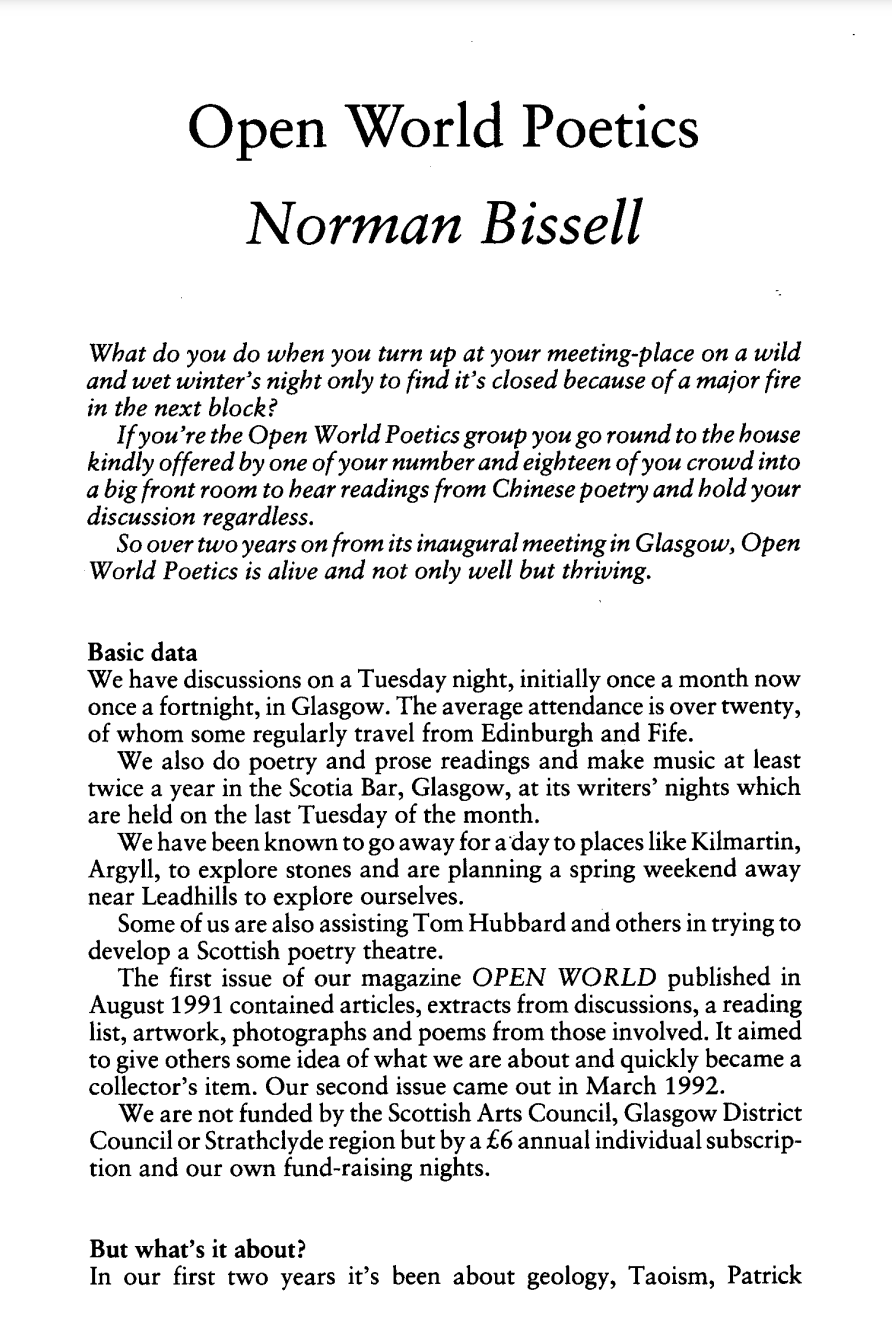
open world poetics 1open world poetics 2 norman bissell

Na H’In Ban

Long hours he would sit in his cell
with the wind howling around him
enclosed by the walls he had built
tapering into the centre
the only light from two slatted holes
beamed into his blank space
his calloused hands told him
how thick those walls were
but he preferred it here
to the company of the other monks.

He had left the old land and the fishing
to get away from the distractions of others
and here on this rocky outpost
of the white martyrdom
he would not be changing his ways now
he still fished and farmed in order to live
and he would pray and sing with the rest of them
but most of his time was spent here in solitude
contemplating life and death
or up there on the ridge
with the gulls wheeling and crying above him
peering over that sheer drop
at the big surf
that came crashing in from the west.

This is what he had come for
just to be here
alone on a rugged isle
to live under that wide open sky
to watch the stars at night
and wonder at their wanderings
to be with all of this
and of all of this
is what he had come for
to this spare isle of the sea.

-Norman Bissell
Slate, Sea And Sky

An island on the rim of the world
in that space between slate, sea and sky
where air and ocean currents
are plays of wild energy
and the light changes everything.

-Norman Bissell (https://www.normanbissell.com/poetry-2/)

The Elephant

If Africa is God’s garden,
then you, elephant,
are keeper of the garden,
with huge breath and vibrato voice,
you carve and detail
landscape’s highs and lows,
while Hong Kong artisans
carve your brothers’ poached tusks
into village scenes,
curving terraces crowded with people
arching silent into colorless heavens.

Keeper, your tusks, smoker’s white
and smooth as bannisters,
dig deep in savannah,
poking and uprooting trees
with an appetite that travels
to the horizon,
giving plain to where
lesser kudu can run,
and cheetah mark their prey.

Over your lifetime,
massive teeth rise six times
and never seem to tire
of chewing bark,
so seven generations of
wildebeest and giraffe
can graze and browse for tender shoots
instead of riffle through dust
to find your bones,
as the rich do through shop tables
to find your trinkets.

But to get them they have to
get you first,
so with those tusks
you tunnel through jungle
like a railroad company
does a stone mountain,
you charge through rain forest
like a bulldozer with a conscience,
leaving openings for forest buffalo
and gorilla to follow.

Your form, like a lighthouse,
adds brilliance
to the darkest of Africa,
letting in sun,
reflecting your ivory,
urging smaller plants
to thrive and open lushness
to those who can’t climb trees,
for without you,
just high branches could
push skyward,
reached only by monkeys, birds,
and the fair weather trade
of man’s scattered ambitions.

The clap of billiard balls
is no longer as deep
and full a sound as before,
but I’ve heard no one’s missed it.
And to tickle the ivories
was a fetish of piano players
when films were black and white.
Still, they’ve found ways to kill you
in greater numbers.

With the grandest of ringside seats
to spectacles of photographs,
books and zoos,
how is it we still
destroy you?

We carve dead idols
that neither see, nor hear,
nor speak, nor love,
nor keep,
for the circus of the self.
##

-Cynthia Gallaher

Ducks

Like “water off a duck’s back,”
farmers shrug natural ponds
and fill them with
more profitable holdings,
black rows and
two seasons of pesticide greenings.

Swamps, those notorious
hiding places of shackled fugitives,
and favored haunts of Cajun UFOs,
can’t seem to exorcize
builders who buy cheap
to clear reeds and cattails,
drain standing water
like a straw to the bottom
of dark cherry soda,
the good boy-scout work
of portfolio developers.

And ducks hover over one suspect watering hole
and to another urban swimming pool,
same as hummingbirds travel flower to flower,
while these journeys offer no nectar,
relief or room.

With the anxious return to ponds
they knew at mating time
a year before,
mallards make a descent
into scenes as crowded as
any city intersection,
hundreds of iridescent profiles
bob in the water,
the shoreline flutters in
wall-to-wall feathery bodies,
and seeing nowhere to land,
canvasbacks cut air
in crazy patterns
like distressed helicopters,
descending, hovering
and lifting up again confused,
from marsh to marsh,
from what was a swamp
to what never will be a swamp again.

And the pintail finds
hardly a place to lay her eggs
but in broad daylight,
where enemies crack shells,
breach generations.

Hunters relentlessly
search skies
once black with their wings,
and ducks relentlessly
search earth
once blue with their homes.
##

-Cynthia Gallaher

Apes

They are not people,
but they are not animals either.”
~ Adriaan Kortlundt, Dutch biologist

Orangutan

Orangutan stubbornly refuses
to come down from his tree,
his arms crossed,
he won’t share exotic fruits
he plucks so easily,
only by force did he crawl
into the tightest corners of the earth,
Borneo, Sumatra,
where pouting and reclusive
mama o. makes her children
find their own trees.

Gorilla

Gorilla leads us to count
on fingers and toes all the ways
he’s closer to us
than to odd cousin orangutan,
how gorilla gave up tree houses,
to stand rooted on his own fuzzy-palm legs,
now plays with frogs, pets baby antelopes,
eats vegetarian,
sheds tears at injustice,
and while little ones continue games
of “tag” or “king of the hill,”
civilization closes in on
his misty jungles,
and in between shadows that shift
with foreigners and fallen trees
we hear gorillas’ heavy and emotional bodies
hitting ground like falling boulders.

Chimpanzee

Chimp points a stick at us,
narrowing in on the single chromosome
that prevents us from
embracing like brothers,
he, more distant
to gorilla and orangutan,
than to us.
Chimp, most likely candidate
for future conversations,
able to share,
or barter and trade
like a businessman,
sharpen and curve sticks into tools
to better dig out termites
for lunch,
study starry skies
like a fifteen-minute Galileo
before disappearing again
in the bush,
where he works out the strategy
of when ground is better,
and tree-bound’s best.

Us

Gorilla and chimp,
like us, too, carry that underside
to kill their own,
but their rapes and murders
are soft cracks of fragile twigs
compared with our loud chain-saw wails
wrecking toothed havoc
on whole forests.
Nearly five billion of us
crowding out the fraction of our cousins left,
old echoes of who we were
or might have been;
Nearly five billion
crawling into all corners of the earth,
claiming “this is mine,”
crossing our arms,
shrugging our shoulders,
stubborn as orangutans.
##

-Cynthia Gallaher

Northern Spotted Owl

The folks in Forks*
can’t figure out why one lousy bird
needs 2000 acres to stretch its wings,
when all they want
is a half-acre homestead,
steady logging work,
one stop light,
and a cup of hot coffee
from the Pay ‘n Serve Cafe
to fire their engines like
a hot chain saw every morning.

Fish and Wildlife
say the “owls vs. jobs” controversy
will be over
in a few years anyway,
won’t be any more trees
to fight over;
but to the youngest loggers,
a few years are an eternity,
enough time to get a car,
charm a good woman,
and gather lots of wooly layers
before shipping out to Alaska
for new riches underground.

Meanwhile in minutes,
500-year Douglas Firs fall and break
the pristine silence of sky
like glass shattering.
and in the time it takes you
to count growth rings
that date back before Columbus,
the spotted owl has flown
from one end of his night turf
to the other, surrounded by
clear-cut stubble,
perhaps a feather or two
falls on top
of his ancestors’ bones,
while white mans’ bones,
still alive in anxious flesh,
shakes inside the White House,
the closet of environmental presidents
who carry chain saws,
and more than one crooked finger
from the cabinet
points to Forks as evidence
that conservation exacts
too high a price on commerce.

And while board feet continue
to sail around the world
like crazy toothpicks,
the spotted owl sleeps on
in a standing dead tree hollow
he calls home,
hoping man makes himself
as scarce as Sasquatch.

*Forks, Washington: the self-proclaimed
“Logging Capital of the World.” Population: 2500.
##

-Cynthia Gallaher

Dolphins Among Tuna

It’s like digging through your handbag,
and tossing out dollars to find pennies,
how they draw purse-seine nets
to fishing boats,
heave-ho breathless dolphins
to sharks by thousands,
or let them slip
through the grinder
along with tuna.

Cetacean magnificence,
along with other highly-evolved mysteries,
don’t generate money
for the fishing industry,
the curved, firm, echolocating bodies
are necessary nuisances,
as not-so-bright tuna
follow beneath to new feeding grounds,
taking more than a team of potential sashimi
to ever find,
while man follows doggedly above,
dolphin leading by the nose
to new payloads of yellowfin.

Reluctant guides of a double hunt,
spotted dolphin can’t shake their shadows
closing in with silvery horror,
with macabre macramé
of transparent motive,
these who slice through man’s
grammar and syntax
as easily as their lithe fins
cut waves,
their social smiles
ever permanent, sincere,
they don’t discriminate
when saving the overboard sailor,
pushing her to the surface.

Caught between the devil
and demand for chunk light,
dolphins are down
for the microfilament count,
drowned by intellect before profit,
and perhaps, if we bite
into the right lettuce-ruffled sandwich,
we might finally wise up,
as some of our
best thinkers on earth
remain
conveniently packed
in spring water.
##

-Cynthia Gallaher (All poems above from her collection: Earth Elegance. The book was published by March Abrazo Press in Chicago.)

Bios and Links

-Chris Murray
Chris Murray is a poet and essayist. Her most recent book Gold Friend was published in 2020 by Turas Press, Dublin. Chris is working on her sixth book and loves the work that goes into making books. Chris founded ‘Poethead’ a site dedicated to platforming work by women poets, their translators, and editors. A member of Fired! Irish Women Poets and the Canon, she archives objects related to the canonical neglect of women poets at RASCAL, Queen’s University, Belfast.

Chris Murray

https://timberjournal.org/archive/seed

Cynthia Gallaher,

a Chicago USA-based poet, is author of four poetry collections, including Epicurean Ecstasy: More Poems About Food, Drink, Herbs and Spices, three chapbooks, including Drenched, and the nonfiction Frugal Poets’ Guide to Life: How to Live a Poetic Life, Even If You Aren’t a Poet.

#GreatBigGreenWeek 18th – 26th September. Day Four. I am looking for your words/artworks/photos on Climate Change. Please join and add to the works of Caleb Parkin and Billy Mills and I while we explore ecopoetry. I would love to feature your #ecopoetry, your #ecoartworks, your #ecophotos your short #ecoarticles, here. Your #ClimateChangepoetry, #ClimateChangeArtworks. I will feature your work in my blog posts during this period.

The Great Big Green Week – Day Four

the great big green week logo

-Caleb Parkin (https://poetryfilmlive.com/the-zone/)

from imaginary gardens 1.1 Billy Mills

from imaginary gardens 1 Billy Millsfrom imaginary gardens 2 Billy Millsfrom imaginary gardens 3 Billy Millsfrom imaginary gardens 4 Billy Millsfrom imaginary gardens 5 Billy Mills

-Billy Mills

Sustainable Poetry

Everything is connected to everything else.

A bald statement to begin: most contemporary poetry is predicated on a set of unsustainable anthropocentric views of the nature of the world. That the world exists to serve as a stage set for the enactment of human dramas. That it reflects the moods of, or evoked by, the poet. That it exists only when observed. That it exists only when written.

These attitudes are, in English-language verse, at least as old as Spenser, but have enjoyed a massive resurgence thanks to postmodernist views of language as game. Interestingly both ‘mainstream’ and ‘avant-garde’ poetries tend to find common ground in this drive to subjugate the world as written to human needs and ends. The pathetic fallacy meets literary theory and nobody wins.

Other current cultural trends, ranging from hippy-dippy animism to the pursuit of the technological fix for everything, reinforce this view of the world as being understandable only in purely human terms. We make nature in our own image, one way or another.

The physical sciences take a different view: that the world is essentially physical, and that languages, including mathematics, are tools we can use to create increasingly accurate maps of it. Unfortunately, in populist attempts to explain their theories and concepts, even scientists can slip into animistic and/or idealistic confusion when they present objects and forces as if they were possessed of wishes, desires, needs and other human motivations, or speak of them as if they were created, rather than described, by mathematics or verbal language.

One form of this mistaken ‘scientific’ idealism that is regularly cited by modern supporters of the esse est percipi principle is the whole field of quantum physics. Idealists assume that the principle of indeterminacy supports the idea that the world is produced by the process of observation, and this is frequently compared to strands of oriental philosophy that hold to similar ideas. In fact, however, it would appear that quantum physicists themselves believe that the particles they study are real things with real existence. They just do not fully understand the ways in which these particles behave, and it may well be that new sets of scientific laws that describe nano-objects may yet evolve, quite different from those that describe the macro-level world. In any case, even if observation influences behaviour on the nano-scale, is anyone seriously arguing that telescopes influence the behaviour of the stars?

As poetry becomes increasingly professionalised, the pressure is on the qualified poet (MA in Creative Writing, PhD in Colonial Studies) to be able to draw on, and contribute to, a body of theory that lends academic respectability to their work. It is understandable that these professionals of language will be drawn towards those theories that foreground the importance of their chosen medium. By so doing, they contribute in some small way to the elevation of the human over the rest of the world. This, in turn, serves to aggravate, again in small ways, the ongoing environmental crisis that threatens to hasten the extinction of the species they elevate. In small ways, but even small actions have results. The person who writes poems also drinks increasingly impure water from the tap and selects over-packaged food from the supermarket shelf. Everything is connected to everything else: the first law of ecology.

Nothing ever goes away

Esse non est percipi. We live on a planet that is a small ball turning round a reasonably ordinary star, itself located in the outer reaches of a galaxy that is, in turn, just one of billions or possibly hundreds of billions. We share this world with about 1,000,000 named species, of which about 800,000 are animals. Of the animals, around 600,000 species are insects, and among these there are approximately 350,000 species of beetle. In the face of these numbers, a little humility is in order. While it may be consoling to believe that humans are the crown of creation and generate reality by means of consciousness and perception, the evidence tends not to support this position.

Ironically, the space in which postmodernist idealism has developed is created by the application to wealth-production of those very scientific advances that render idealism untenable in the first place. To quote Joseph Schwartz, from his book The Creative Moment (New York: Harper Collins Publishers, 1992): ‘One of the things that the physics of the nineteenth century makes inescapable is that the physical universe has structures that exist whether we are here to see them or not. We are too far down the road of industrial development to return to the dinner party idealism of Bishop Berkeley and his descendants and their fabulous theories of the world as mind and mind alone. Indeed this view has not been treated with the ridicule it deserves.’

Sustainable poetry finds its ground in the imperfect charting of these structures. It also illuminates the deep ecology view that we need to adopt an ecocentric mode of living in the world if we are to survive. If the role of philosophy is to inspire action, the role of poetry is to be in the world. Like the laws of physics, like mathematics, this poetry is descriptive, not proscriptive. It also accepts the sceptical view that full knowledge of the world cannot be attained through the medium of the senses. However, it sees this as a failure of the senses, not as an argument for the idealist position, and works towards the clearest possible approximation. Rather than saying that nothing is unless it is held in the mind of a human observer, it asserts that many things are that have never been perceived, and that for most things that are perceived, the perception is imperfect. This is a necessary part of the humility called for earlier. We are part of the weave of things, and our view inevitably depends on where we sit in that weave. That’s all. Everything goes somewhere.

There is no such thing as a free lunch

Cothu, the business council for the arts in Ireland, used to run courses in management, marketing and communications. It then changed its name to Business2Arts, and sent round a letter stating that its new aim was to convince business that an investment in the arts was sound, particularly because the arts could help improve corporate communications.
Small press poetry publishers applying to the Arts Council of Ireland are sent a form in which they are required to give details of their mission statement and actual or potential job creation status. This reflects the council’s role as a government-financed development agency, whose primary function is to fund and oversee the professionalisation of arts administration. Under this regime, the arts become part of the states economic development strategy. Music and literature are used in tourist promotion; arts in the community schemes help reduce the long-term unemployed numbers. The saleable is valued above all else.

However, there is no such thing as sustainable growth. We live on a finite planet, with finite resources available, and at some point growth will tip us over the edge. The arts are not immune to this fact.

Sustainable poetry is not a career move. As already noted, it is difficult for those poets who live and work within the confines of the literary and/or teaching professions, who have to some extent been colonised by the machine, to do work that questions the status quo. Consequently, it is likely that any attempt at a sustainable poetry will come from apparently marginal writers.

Another, perhaps more self-evident, aspect of sustainability has to do with the means of production and dissemination of the work. Sustainable poetry does not compete with more mainstream publishing houses for a slice of some illusory ‘market’. Why publish 500 copies if you know you’ll only sell 50? Why not barter? Keep the environmental impact to a minimum. Beware the technological ‘fix’ of e-publishing.

Even small actions have results. There is no such thing as a free lunch.

Nature knows best

So what might a sustainable poetry look like? I would like to present here a brief glimpse of some contemporary writing that represents a beginning.

For instance, the phenomenological poetry that Geoffrey Squires has been producing in recent years illustrates one way of writing about how we perceive the world. Here’s a short extract from his Untitled II as printed in Shearsman 50:

Slope of sound down where it comes from
last small effect

has no need of is not part of unaffected by
the mind is full of assertion and denial

and no impediment or obstacle nothing it seems in the way
but to listen for hear the right thing
that we so that we

quick it is quick rapid extraordinarily so

and overlapping not separate or distinct
laid down one upon another one after another
how they appear to us how they are remembered

Squires’ work manages to explore the relationship between mind and world without overvaluing the one or undervaluing the other. It is a poetry of experience and consequence, the experience of being in the world in which ‘there is not one moment but that something happens’ and the consequence of mind’s attempts at processing that experience in light of the perception that ‘recognition is not knowledge’. The experience is of a world that:

maintains maintains itself
has no need of is not part of
and overlapping not separate or distinct

Richard Caddel’s Fantasia in the English Choral Tradition, recently reprinted in Magpie Words (West House Books, 2002) opens with the following lines:

signals:
pact or parts
corresponding
in January
bonfires smoke
down the river bank
a way off —

moving (lunchtime)
out of the realm of
false, muddled argument
into that contact
with the world in which
(for which)
I live —
to point towards —
because there is no ‘away’
to sling things to
and to live here
is not to escape

you feel the heat
centres of learning
everything
tumbling
and still
that ‘human record’
how many million years
complete.

in which the movement of verse and mind reflect exactly that being in the world to which sustainable poetry must aspire. In fact, the best of Caddel’s work reaches this place as a matter of course, and then sings. Which is not to say that it discounts the human. Such primal experiences as love and death and the other ‘great themes’ are here, but always set in the context of ‘the world in which / (for which)’ we all live. This adds depth to the handling of the personal, resulting in poems that are both deeply moving and deeply grounded in the actual world.

flag-
stone rocking on unstable
base, the rain

gone under it,
sunken puddle. A speech
at odds with itself, as

likely to
soak you as save you.
Ann’s voice

clear out of the kitchen I must
be going no
longer staying — shapes

that delight
and try us.

(from Rigmarole: Uncertain time)

Caddel’s work is full of people, but they do not dominate the world, they inhabit it: placed in the weave of things. Shorn of the (pseudo) religiosity of a Snyder or a Hughes, this is ecocentric poetry in action.

Maurice Scully’s deep understanding of Irish poetry informs his own practice as a writer. Unlike the English pastoral tradition, which, as I have argued elsewhere, is essentially a poetry of empire, of the land as owned object, this tradition is one of the land as living world. From the 8th century haiku-like lyrics of intense perception to the onomastics of the Metrical Dindshenchus, medieval Irish nature poetry concerned itself with the stubborn actuality of things and of the odd relationship between those things and the words used to name them. These lines from Scully’s 5 Freedoms of Movement (Etruscan Books, 2002, originally Galloping Dog 1987) illustrate the point I am trying to make:

persistent undersound of a river. hardness.
table facing a square window inset in a deep white wall.
the four places. & more. the head of a narrow angular stairs.
sometimes an animal passes. brown white black.
a fly sometimes in the sunlight.
sometimes a man.

When Scully writes like this, the most fruitful comparison available is with the earliest Irish lyrics. The sheer concreteness of the writing mirrors the desire to present what is with minimal interference from the vanity of the writing ego. The world is not presented as a stage set for the acting out of some human drama but as a complex system of which the human domain is just one part. Or, to quote again

a large brain & a long childhood
leaves branches water (where was I?)
with all the ornate figurations in meta- this & that
(branches) climbing while the truth dwindling in proportion
to the glare of the accentuated frill will. well.
many mouths moving. no wonder nobody with any sense.

Wary of theory, this is a poetry of learning to live with and in the world, not of explaining and improving on it.

*

What these three very different poets have in common is a respect for the world in which they live and a balanced view of the role of perception, and of poetry, as mapper rather than maker. It is this that marks out their poetry as sustainable in the sense I have been using the term. Small actions can lead to big results. If poets fail to look to the possible consequences of the way they present the world, they run the risk of being complicit in ecological meltdown. If we write as if the non-human exists to serve as a rich source of metaphor, we mirror the attitudes of those who exploit more tangible and financially rewarding resources. If we see poetry as a career opportunity, or as part of ‘the market’, we enter into the world of unsustainable growth. If we insist that our limited understanding forms a basis for improving on billions of years of evolution, we are likely to destroy the infinitely complex systems that sustain life. Nature knows best.

If, on the other hand, poetic practice (given that poetic theory is pretty well irrelevant to the creation of good writing) comes to terms with the laws of ecology that serve as section headers in this essay, there is some small hope that our tiny input may help move the intellectual climate toward a position of respect for the world on which our survival depends. Everything is connected to everything else. Nothing ever goes away. There is no such thing as a free lunch. Nature knows best.

-Billy Mills

Bios And Links

-Billy Mills

Born Dublin 1954. Has lived and worked in Spain and the UK.  Now living in Limerick. Founder and co-editor (with Catherine Walsh) of hardPressed Poetry and the Journal.

Books include Lares/Manes: Collected Poems (Shearsman, 2009), Imaginary Gardens (hardPressed poetry 2012), Loop Walks (with David Bremner, hardPressed poetry 2013), from Pensato (Smithereens Press e-book, 2013) and The City Itself (Hesterglock, 2017).

Caleb Parkin 

is a day-glo queero techno eco poet, tutor & facilitator – and Bristol City Poet, 2020 – 22. He’s published widely in journals including The Rialto, The Poetry Review and Magma – and won or shortlisted in major competitions, including second prize in the National Poetry Competition 2016. He tutors for Poetry Society, Poetry School and Cheltenham Festivals, and holds an MSc in Creative Writing for Therapeutic Purposes (CWTP). He previously worked in BBC TV and Radio production and as a Senior Inclusion Worker. His debut pamphlet, Wasted Rainbow, was published with tall-lighthouse in February and This Fruiting Body is his debut collection out in October.

This poem is from Caleb’s upcoming collection ‘This Fruiting Body’ with Nine Arches Press, published October 14th 2021.

Marius Grose 

began his career in television post-production in 1983. He worked as a tape operator and assistant editor in Bristol and London for the BBC and ITV networks. Marius has cut programmes for all the major broadcasters in the UK as well USA companies such as National Geographic and Discovery. He has worked on programmes that range from wildlife documentaries, factual entertainment shows, current affairs such as Channel 4’s Dispatches, and feature films. In 2002 Marius was nominated for the Royal Television Society’s feature picture editor of the year award in recognition of his creative storytelling.

The High Window 23. Autumn 2021: Final Instalment

The High Window Review's avatarThe High Window

Logo revised

Here is the final instalment of the Autumn 2021 issue of The High Window.  The following new material can be accessed via the top menu:

1. A selection of homegrown and international Poetry from 35 poets.

2. Poetry from Sharon Kunde, the Featured American Poet.

3.  Translations of  Italian Poetry  edited by Caroline Maldonado.

4.  An Essay and a sequence of poems by Franca Mancinelli translated by John Taylor.

5. A bumper selection of Reviews.

6. Poetry from Tom Phillips, the UK  Featured Poet.

7. Artwork by Stella Wulf, The High Window’s Resident Artist, based on  poetry by Stella herself and Graham Mort.

There are also four new poems  in the Editor’s Spot which have been taken from his fortchcoming collection Sicilian Elephants(Two Rivers Press).

Finally, The High Window Press has  published three new collections: Mollusc by Mark Totterdell, The Silver Samovar by Jenny McRobert and…

View original post 20 more words

#GreatBigGreenWeek 18th – 26th September. Day Three. I am looking for your words/artworks/photos on Climate Change. I would love to feature your #ecopoetry, your #ecoartworks, your #ecophotos your short #ecoarticles, here. Your #ClimateChangepoetry, #ClimateChangeArtworks. I will feature your work in my blog posts during this period.

Great Big Green Week Day Three

the great big green week logo

Kids’ Climate March

The kids didn’t go to school on Friday.
They all skived off in their thousands,
played Tory truant with Andrea Leadsom’s inbox,
swaggered, like silly socialist sausages,
past Katie Hopkins’ newsstand.

When we heard what they were doing,
we peered out of our office windows,
hands full of plastic packaging
and toxic toner cartridges.

The kids failed to listen to our elected representatives,
who warned of wasting precious time,
and the danger of disrupting schedules,
as they kept busy with their efficient,
swift and productive Brexit negotiations.

Instead, the kids persisted with their silly snowflake dreams,
went AWOL during English Lit and Art
to paint pithy, poignant, political placards,
bunked off Maths, Geography, Geology, Biology
to read educated articles on climate science,
biodiversity, extinction and statistics.

They ghosted Sociology, RE and languages
to meet together in socially conscious,
multi-faith, bilingual community groups,
missing out on Media Studies
to take part in panel discussion shows on the BBC
and launch powerful social media campaigns.

Then, by mid-afternoon, when they should have been
running in slow motion round the tennis court,
they could be seen marching miles through city streets,
with rosy cheeks and blazing eyes.

Simon Abbot, aged 15,
missed Chemistry and Human Reproduction
to hold Isla Finch’s hand
outside the Bristol council offices.
When she told him she was scared
about all the forest fires and insects dying,
he drew a ladybird on her hand and kissed it.

Yes, we will all remember the day the kids went on strike,
while our leaders scoffed and sneered at them
from inside their Twitter feeds,
trying to squash their heads between their fingers,

all those ignorant, naïve,
selfish, planet-obsessed children,
playing hooky in History lessons
to save their own future.

-Liv Torc www.livtorc.co.uk from her new book, The Human Emergency (2021)

Caleb Parkin

 link to some of his poems published online, then here are a selection:

 – ‘Ecco the Dolphin’ on Ink, Sweat and Tears:

Ecco the dolphin by caleb

https://www.google.com/url?q=https://inksweatandtears.co.uk/caleb-parkin

He says “Interested in the construction of ‘Nature’ in culture here, in a computer game in this instance.”

 – ‘Please Do Not Touch the Walrus or Sit on the Iceberg’, on And Other Poems:

Walrus by Caleb


https://andotherpoems.com/2021/01/16/please-do-not-touch-the-walrus-or-sit-on-the-iceberg-by-caleb-parkin/


He says “I’m evolving the genre of ‘Ecophrastic’ poetry, inspired by natural history collections…Another such poem inspired by the Horniman opens the collection, but there are other museum poems dotted through.”

 – ‘Ode on a Black Plastic Compost Bin’ on Atrium:

ode by caleb


https://atriumpoetry.com/2021/02/09/ode-on-a-black-plastic-compost-bin-caleb-parkin/amp/?__twitter_impression=true

He says “Can ecopoetry be ecstatic, as well as mournful?”

 – ‘If the Earth is My Mother’ – a video, sample poem promo:

https://youtu.be/VbvSM5hjNNQ

He says of this : “Interested here in unpacking the gendered idea of ‘Mother Earth’ and making it very personal for me – and, I hope, the reader/listener.”

His book’s pre-order site :

https://ninearchespress.com/publications/poetry-collections/this-fruiting-body.html


The Malnourished

Drought
Can drive anyone
To desperation, and

Sweat
And toil are
Known thieves of time.

Then, while greed
Eats the garden you grew
For your family,

Little
Is left
For nourishment.

But don’t we
All have plenty of
Plastic silverware?
-Samantha Terrell (Previously published in the Poets’ Choice Global Warming Issue)

Bios And Links

-Liv Torc

is a poet, artist and ideas weaver who plunders the vast caverns and dormant volcanoes of the human and planetary condition. A Radio 4 Slam winner, a former Bard of Exeter, host of The Rainbow Fish Speakeasy and of The Hip Yak Poetry Shack. Liv runs the poetry stage at WOMAD, the Hip Yak Poetry School and the lockdown haiku and photography project, Haiflu – as featured on the BBC’s Radio 4 Today Programme. 

In 2019 her climate change in the face of motherhood poem The Human Emergency went viral and she performed at Glastonbury Festival and represented Somerset for the BBC’s National Poetry Day celebrations. In 2020 she was chosen as one of four Siren Poets by Cape Farewell for a commission on climate change in the time of COVID and for the BBC’s Make a Difference campaign.

Her books include Show Me Life (2015) and The Human Emergency (2021)

Find out more www.livtorc.co.uk

-Caleb Parkin

is a day-glo queero techno eco poet & facilitator, based in Bristol. His debut pamphlet, Wasted Rainbow, is published by tall-lighthouse in February 2021 (launching on Saturday 13th). His debut collection, This Fruiting Body, will be published by Nine Arches in October 2021. From 2020 – 22, he’s Bristol City Poet.

Tweet: @CalebParkin | Insta: @couldbethemoon | Websitewww.couldbethemoon.co.uk

On Sabbatical: Week Two

wendycatpratt's avatarWendy Pratt

Photo by Pixabay on Pexels.com

This week was, again, a week of surprises as far as the process of writing the novel is going. After a good break away from it over the weekend, I swung back into the novel on the Monday only to find myself blocked. My book is historical fiction featuring some very well known actual people and places, so needs to have a basis of fact onto which I can build the story. A lot of what I have been doing is finding anchor points for the fictionalised stuff, in the factual stuff. And on Monday I was searching for a place to fit a particular scene that would link two big chunks of plot together smoothly. But because there are several people, many animals, several places that are all part of the story at different time points, it becomes quite complicated. I became quite frustrated…

View original post 1,099 more words