GladToCare Awareness Week poetry challenge 6th-12th July. Join Eileen Carney Hulme, sonja benskin mesher, and myself. Let’s celebrate, notice the often unappreciated work of carers, both at home and in carehomes. Please email your poems to me. Monday: Home Carers, Tuesday: Care Homes Wednesday: How Do I Want To Be Cared For, Or Not Thursday: How I Care? Friday: Saturday: ‘A day in the life of a loved one in a care home’ Sunday: Why Do We Care? Here are today’s: Sunday: “Why Do We Care?”

Care Home

I want to scoop you
from the bed
your scent will leave
no impression here
and carry you back
more than two years
less than one mile
to your ground floor flat
your paintings
the garden
your cat
your summer
birthday bash
gathering of friends
food and wine
sun lettering the grass
with poetry and song
your purple-tipped hair
storming the lessening of days.

i.m. of Jean Millar Lawson 1929-2011

-Eileen Carney Hulme

The Carer 

He considers trains
the light and dark of journeying
the elements earth fire water air

he needs to oil the wheels
his shoulders ache
stooping pushing lifting

springtime, everything coming alive
today they’ll go to the park
maybe he’ll remove her scarf, gloves

shake off the strains of winter
the pressure points
transform the signs of pain

and the wheels turn, let out
a squeak, softly he speaks ‘not far now’
and in the distance a train purrs.

-Eileen Carney Hulme

After The Bones

Yesterday
I thought you were
tired lost blind
to the light that fluttered
through cotton curtains
troubled by silent faces
passing in and out of
your landscape, a darkness
of rivers a burning of hearts

Today
I think you are
waiting beyond sea-lines
beyond wind-drifts, reaching
into the sky multiplying stars
meditating with the moon
nothing frantic about your words
they are low soft whispers
graceful as bird song, sacred at dawn.

Published in Soul Feathers
An anthology in aid of Macmillan Cancer Support

-Eileen Carney Hulme

Why Care?

To prove to myself I can.
I can take the weight,

make the hard choices,
arrange visits to three care homes,

bringtheir literature home
for you to read and say

You choose, Paul.
I choose the rooms that look out

on greenery. Once an old hall,
Old nunnery for my dad,

An old Victorian house
for my Nanna. I visit once

every two weeks for her,
My dad once a week.

Read the care reports for each building
Arrange estate agents for their old homes.

stress to you it is your decision not mine,
foryou to say we trust you, Paul.

i have a lump in my throat.
I make a list and tick it off one by one.

-Paul Brookes

GladToCare Awareness Week poetry challenge 6th-12th July. Join Gaynor Kane, Ailsa Cawley, Samantha Terrell, Graham Bibby, Mary Druce, sonja benskin mesher, Yvonne Moura and myself. Let’s celebrate, notice the often unappreciated work of carers, both at home and in carehomes. Please email your poems to me. Monday: Home Carers, Tuesday: Care Homes Wednesday: How Do I Want To Be Cared For, Or Not Thursday: How I Care? Friday: Saturday: ‘A day in the life of a loved one in a care home’ Sunday: Why Do We Care? Here are today’s: Saturday ‘A day in the life of a loved one in a care home, or a carer’

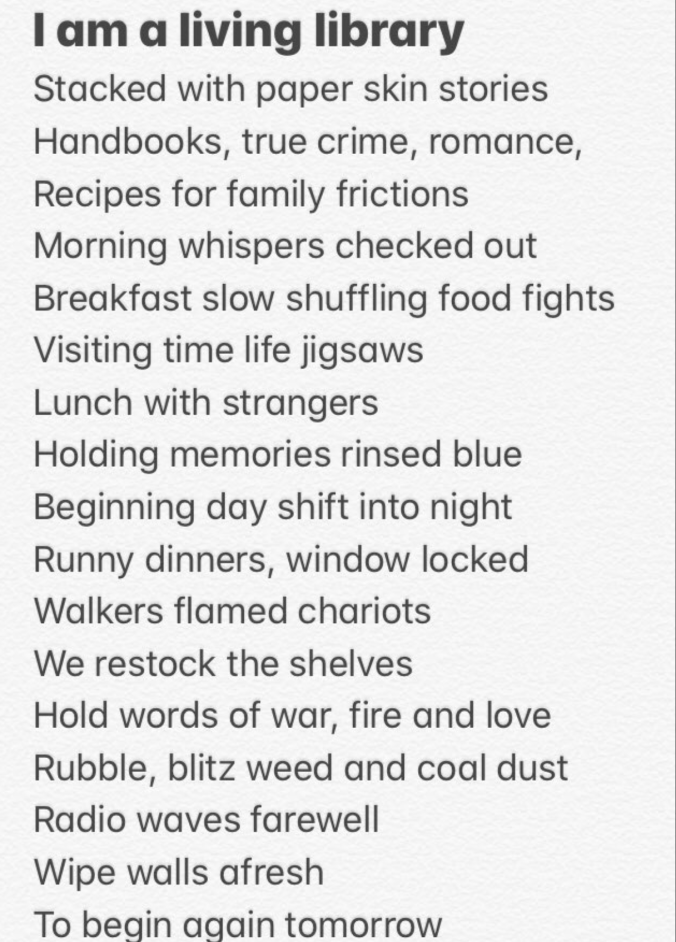
I Am A Living Library by Kate

-Kate

Waking the Dead 

Going up or down
left or right
there is only corridor,
in slippers
and dressing gown
she takes her daily stroll,
everyone a friend
everyone a stranger

doctors, nurses, social workers
discuss her life
while she is living it,
breakfast at seven
lunch at twelve
dinner at five
bed-pans, sheets changed,
television repeats

she prefers a slow walk –
through windows
she watches
trees empty their leaves
cars empty their visitors
word searching
like a flick of channels.
Perhaps she screams.

Now there are no screams.

-Eileen Carney Hulme

A day in the life of a carer.

I have my list of people today. I’ve got an hour or an hour and a half with everyone. I have buses to catch to every appointment and it’s always a rush between leaving and the next bus.
I love visiting these people. Everyone has different things they need, opinions, hopes and dreams. Sometimes, if I’ve got extra time, and no next person for a good while, I’ll stop over. It’s a chance to talk and for them to see they’re not just a number.

This day I stop. There’s been an accident. A lady is on the floor. No way I can lift her. Her husband is just home from hospital. I call an ambulance. Because she isn’t physically hurt, but can’t get up they’ll arrive as soon as possible as there’s been an emergency. I’m asked to wait. I don’t consider leaving an option. The company I worked for say to leave and let them deal with it. I refuse. They say that they won’t pay me for the shift if I stay. I stay. What sort of carer would I be to walk away? In the end my hour becomes three and a half. All unpaid. A paramedic car is there first, then we’re to wait for an ambulance. It’s been a crazy day.
But, if it were my parents would I want them left, frightened and uncared for? I’d like to hope that someone else would stay because it’s what carers do. They care. Beyond the money aspect. We just care.

AilsaCawleyPoetry2020

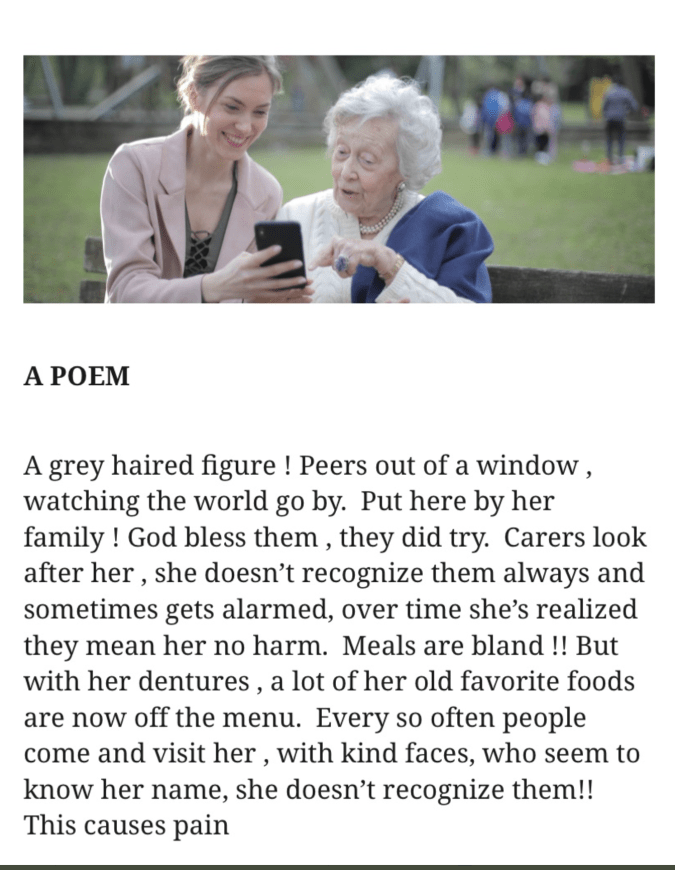
A Grey Haired Figure

-Jim

aide

a cigarette
won’t change
anything, lucy

it won’t dry your eyes
or bring back those
you can’t misunderstand
anymore
or pretend again they are
more than less

your break is done
so take one long drag
hold it under your skin
under the layer
of another goodbye

-Elizabeth Moura

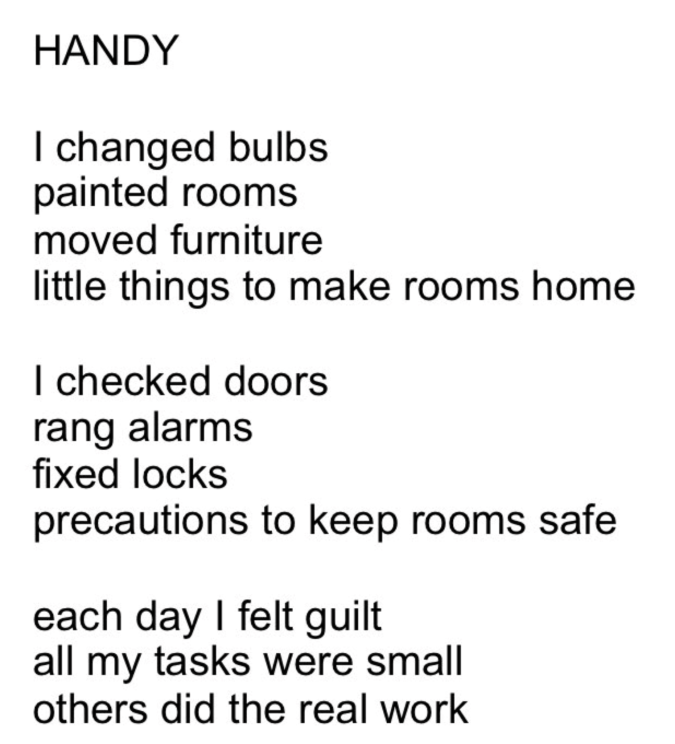
Handy by Richard Wari9ng

-Richard Waring

GladToCare Awareness Week poetry challenge 6th-12th July. Join Gaynor Kane, Ailsa Cawley, Samantha Terrell, Graham Bibby, Mary Druce, sonja benskin mesher, Yvonne Moura and myself. Let’s celebrate, notice the often unappreciated work of carers, both at home and in carehomes. Please email your poems to me. Monday: Home Carers, Tuesday: Care Homes Wednesday: How Do I Want To Be Cared For, Or Not Thursday: How I Care? Friday: Saturday: ‘A day in the life of a loved one in a care home’ Sunday: Why Do We Care? Here are today’s: Friday: Who Will Be Choosing My Carehome?

Put me in a place

Put me where I smell the air
Put me in a window
Rolling purple heather hills
To front or side

Let me smell the peaty richness
Let me see spring dance
Outside that window
I told you of

Please don’t let me face a wall
Or be trapped in an airless room
Give me my own few things
Where someone chats with me
Just talking of daily things
Without presuming I didn’t always
Live in the shell I’m now trapped

Once I walked the hills I see
Climbed the hills I watch
I’m still a part of them until
You force me to turn from them
They are my memories and life

-AilsaCawleyPoetry2020

.thank you for asking.

thank you for asking and the answer
would be quicker if I had cut my nails
to bounce the keyboard here

funny you should ask as i was thinking
over this yesterday while walking

how

it felt unfair that after all those years
of housekeeping
keeping his house clean
tidy, fitting in with all his
timetables and breathing

not breathing

that

she had to go to the home quietly
where she remained quietly

her daughter also went later
and remain quiet

i lived in a home in milton road
milton house, place of nighmare
for us kids

wettened beds
stinking laundry

deleted

so I stayed quiet

so thank you so much for asking
and being so thoughtful yet I tell

you clearly
that I do not want a care situation ever
for all the good it will do, so i won’t stay

quiet now
forgive me

I hope your dad had green in his view

other colours too

-sbm

This is written about my Nana who was going into a home permanently, after a temporary home to recover from heart attacks and falls and she couldn’t manage at home anymore. This is her viewpoint to my Dad who felt bad for not having room to take her in

Don’t feel bad, laddie. I know it’s not that you don’t want me. Whatever I say won’t cut it, will it, son? You see I’m used to my own space, my way of doing things. I’m pretty sure I can have that here. The room is a big one. The bed faces the light and I can watch the sky. They wanted me to face the door. The door’s a bore. The sky has pictures and it’s like a moving picture house if I look. I’ve time to do it, now. I’ll miss popping to Liptons for tea, and Woolworths for lunch. But you know I have plenty to keep me busy. I talk to people. Some say I’m nosey and say too much. But these young ones, seem to come to me for guidance. So I don’t care what anyone thinks of me. They’re in a bad relationship, I’ll tell them and say if they’re being taken advantage of. How can they be strong when nobody teaches them when to say no? So I’ll stay here, and dole out the advice to them as want it. Sometimes them as don’t! My days are full. I don’t stay in the communal rooms much. The ones who are going in their mind scare me a bit. I’m scared it’s catching and I’m not being next. I do stay when they sing though. Or when they bring in the history people who ask about my life as a child. I wasn’t always old. I didn’t always have a dicky heart. I didn’t always fall for nowt. But that was then son. I’ve got a few new books. I love these spy stories. They sound exciting to us normal folk. It’s sunny out there and I want to go a walk. Leazes Park in the sun or something nice. I’ll close my eyes a moment and think of childhood, my children and grandchildren. That daughter of yours will be in later. I’ll tell her some stories. She likes my old days chatter. I have all her secrets. You go son, I’m tired. Don’t you worry about me.

Copyright signAilsaCawleyPoetry

Written in memory of my nana Mary Williamson (Cawley) from who I took many lessons and my writing name.

Wombwell Rainbow Interviews: Tessa B. Berring

Wombwell Rainbow Interviews

I am honoured and privileged that the following writers local, national and international have agreed to be interviewed by me. I gave the writers three options: an emailed list of questions or a more fluid interview via messenger, or an interview about their latest book, or a combination of these.
The usual ground is covered about motivation, daily routines and work ethic, but some surprises too. Some of these poets you may know, others may be new to you. I hope you enjoy the experience as much as I do.
Tessa B Berring

Tessa B, Berring

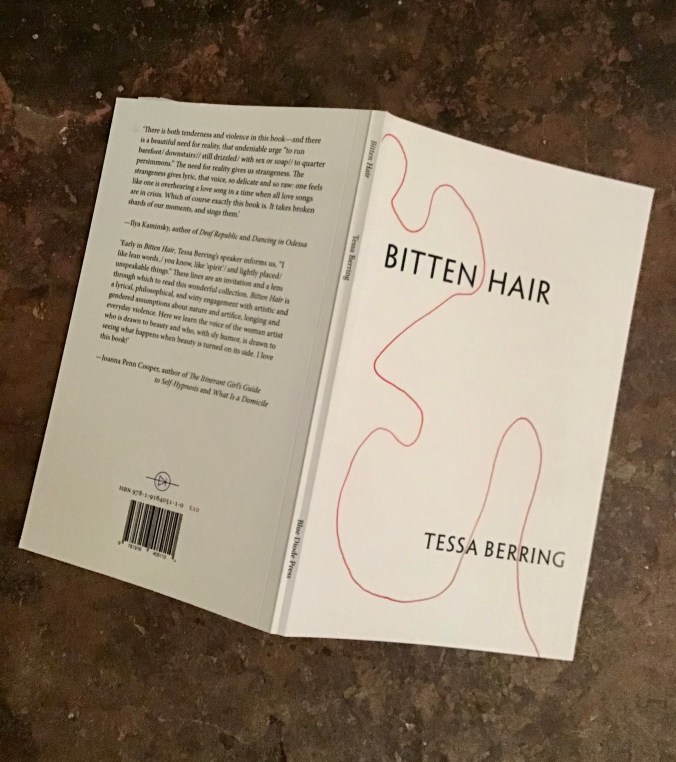
‘I like lean words,/ you know, like ‘spirit’/ and lightly placed / unspeakable things’.

Tessa Berring’s collection Bitten Hair was published in 2019 by Blue Diode Press. Further work can be found via Dancing Girl Press, Algia Magazine, Pamenar Press, Rabbit Catastrophe, and Datableedzine.


The Interview

1. When and why did you start writing poetry?

Well poetry is stunning. It stuns – I wanted to join in. I love the way you can read a poem and feel ‘yes, yes, oh my god, aaagh, that’s it!’ It answers. It enquires.

And poetry is a form of longing. Longing has always been an inspiration to me. The inherent uncertainty of it, the urge to reach, to open up, to lean

2. Who introduced you to poetry?

My parents were the first people to read and show me poetry – nursery rhymes, story books, prayers, songs. And just talking introduces one to poetry doesn’t it? I’ve always been in awe of speech – how an idea, or a feeling becomes heard, becomes language.

3. How aware are and were you of the dominating presence of older poets traditional and contemporary?

Aware of the dominating presence of older poets?.. Yes. Always….Well, some poets are simply always there taking up space. In mainstream UK bookshops you will always find Philip Larkin! But it isn’t his fault he’s got stuck forever on the high street – it is the cloying nature of capitalism and its stale (dead white male) imagination.

Poetry I love is poetry that lives aware of but in resistance to ‘dominating presences’ or ideas of ‘authority’. Poetry that guides and inspires through ever shifting writing communities, that spits and breathes through small presses, intimate collaborations, generous readings, no limp and docile magazine.

If poetry has a power, it is its sensuality, its sharp insanity, and the multiple ways that it can veer.

4. What is your daily writing routine?

I don’t have a writing routine. I write when I want to, or when I can . Usually at night and at home.

5. What motivates you to write?

I love listening to conversations. Often it is an overheard phrase, a couple of lines in a book, or online that will start me writing…. Or it could be a disagreement I want to untangle/be rid of, or the love of an image I want to look at for longer. Sometimes it is an emotion I want to channel somewhere. Words are good for that; transformative, tender, blunt, and bony things.

I rarely write with a sense of wanting to write ‘about’ something. It is always something more immediate, sudden. And often I’m left with nothing except the feeling of ‘having written’.

Perhaps that is the motivation – to write so as to have that feeling? I find it hard to know my own motivations. I am not politically motivated to write, but at the same time I believe that all good poetry is political. It challenges. It agitates. It finds (and obscures) meaning.

6. What is your work ethic?

My work ethic? I try not to have a work ethic around poetry.
Poems are survivors not products. Writing a poem never feels like ‘work’ – it feels free and visceral. The best poems are bloody – something like muscle or a heartbeat. Though sometimes the best poems are like birds and outrageous laughter.

7. How do the writers you read when you were young influence your work today?

All writers influence me. Or all writing influences me. Even writing I hate influences me. It shows me the edges and the stinking troughs! As a young girl I loved Paul Gallico and Muriel Spark: Love of Seven Dolls and The Prime of Miss Jean Brodie contain everything – Darkness, naivety, humour, sex, betrayal, sadness, warmth, insight…

8. Who of today’s writers do you admire the most and why?

Who do I admire now? I find that question harder and harder the more I read. It becomes hard to separate ones reading into individual writers. Is that a cop out? It probably is. I love reading what friends are writing and reading. I like to pick up books in shops for their covers. I like finding obscure texts on mind theory online, etc.

9. Why do you write, as opposed to doing anything else?

I’m never opposed to doing anything else, but I write when I know that it is only words that will get me close enough to what I am looking for, to what feels imperative in that moment.

10. What would you say to someone who asked you “How do you become a writer?”

I would say I can’t answer that. Or I would ask ‘What do you mean?

11. Tell me about the writing projects you have on at the moment.

I always have a little heap/smatter of words sitting in my laptop and which I tune into most days, not every day, but sometimes everyday. It is easy to get bored/disillusioned too. To feel ‘oh yes, here’s another unnecessary poem’. I’d like to work away from that – to make everything feel valuable.
GladToCare Awareness Week poetry challenge 6th-12th July. Join Gaynor Kane, Ailsa Cawley, Samantha Terrell, Graham Bibby, Mary Druce, sonja benskin mesher, Yvonne Moura and myself. Let’s celebrate, notice the often unappreciated work of carers, both at home and in carehomes. Please email your poems to me. Monday: Home Carers, Tuesday: Care Homes Wednesday: How Do I Want To Be Cared For, Or Not Thursday: How I Care? Friday: Who Will Be Choosing My Carehome? Saturday: ‘A day in the life of a loved one in a care home’ Sunday: Why Do We Care? Here are today’s: Thursday: How I Care.

Foot Reading – Haibun

this is not a kindness
a duty, or a religious metaphor
it is inherent

I fill two basins, rising steam dampens my face, add a few squirts of green, stray bubbles pop against the kitchen window. I ask you to dip a toe, you nod approval, lift the lead weight of your feet, they drop like lumps of land breaking free of the cliffs and falling into sea, sink beneath the surface. Your face relaxes.

blackbirds drop from tree
searching for breakfast leftovers
find nothing but bugs

Every Sunday night (whether I needed it or not, we laugh) you ran my bath, poured in Matey for bubble mohawks, tossed in multi-coloured Tupperware. After being swaddled in cotton, I’d run downstairs and would sit on your knee, in the fireside chair, while you dried my hair and between each individual toe, tickled my feet. Compare the single freckle we both have on our right little piggy.

sky turns from orange to red
pink and purple as dusk descends
swifts swoop in circles

Now, your toes sufficiently wrinkled, callouses waxy white, I ease each foot out, wrap them in the towel. Deformed feet, big toes bunioned, corns on phalanges; the result of too many dances in stiletto heeled winkle pickers. The scissors can cut anything, according to your QVC god, and I have tested this by gliding through a tin of ham.

baby mice, transparent
pink wrinkles, jump from nest
into jack russell’s teeth

In turn, I take these to both parents’ feet. You have shared fifty-three years and your fungal infections, with each other. Twenty toenails in shades of banana mousse, cream cake and custard, ribbed like palm trees or the shells on the beach.

found in pocket
one heart-shaped stone, polished
smooth by your thumb

I remember going to the Mournes each Easter Monday, to skim for smicks in the Shimna, then later after a picnic of egg and onion sandwiches, tea and biscuits, I would paddle in the Irish Sea, look for razor shells, driftwood, mermaids’ purses. Sitting in the boot of the Austin Allegro while you would dry my feet. Carefully pulling the towel between my toes to remove every grain of sand.

-Gaynor Kane ( poem first appeared in The North)

..old blanket..

I watch the blanket breathe,
hope it will never stop.
white, cellular, keeping warm,
the one I love, so vehemently.
scares me, this intensity of feeling,
that never stops,
and continues when the blanket lays quiet……

-sbm.

Spinning Plates

People looked on in wonder, impatiently said
I really don’t know what goes on in that head!
Sometimes so patronising, what can you say?
How on earth do you guess where he is today
Open your eyes you ignorant jerk
Sit quiet a while, it’s hardly work
To still your mind, quell your tongue
He can hear your comments, they stung.
Your back to him, he’s shaking his head
Heard every damned word that you said
Yes, he wanders, him it frustrates
In his head thoughts like spinning plates
Not a juggler, a circus clown sometimes they crash
Fall to the ground, to many shards smash
Don’t you think he’d say if he could?
Doesn’t want this, he ISN’T a fool
So sitting quietly, happy by your side
We talk of things you’d always hide
Subjects varied that you have to share
Your loves, passions, compelled to air
Instead of feeling like you’ve nothing to say
I try to savour your words each day
Knowing soon that this chance will end
When your man in black returns, on you to tend
You know what’s happening you aren’t dense
Can’t they just apply some common sense?
Shaking your head you roll your eyes
Patience lost, listening to sighs
You know they are tired, but you are too
You’ve fought so long, they have no clue
Tenacity making you fight till you’ve won
That’s when you’re ready for the setting sun
Time to leave the world mortals see
Through the door you’re going to be
Talking, laughing and chatting a while
In your voice I hear your sparkling smile
Tell me ‘she’s here ‘ and ‘is it okay to go?’
I have to say yes because I know
You’re happy to see it’s your beloved mother
The fight, battle given up for no other
Knew she was coming for you long before
Take her hand, go through the open door
Gently you lie there closing your eyes
All worries gone, said the goodbyes
I know should I need you where to look
Said you’d be down by the babbling brook
I’d only to call if I didn’t manage to see
And like always and forever you’d appear to me.

=AilsaCawleyPoetry2015

Generation Gap

You said, “This isn’t my world,” and then
You shook your head.
That look, deep
In your distant eyes, said
Everything that needed
To be said. And, your modesty,
In that moment of clarity,
Commanded
More respect than my
Inclination might have granted,
Because you said, “I really don’t
Know what I’m talking about. This isn’t my world…No,
It’s not my time.”
But I am moved to want to somehow
Merge your world with mine.

-st

Only One Heart

We are symmetrical
Beings – those of us who can call
Ourselves fortunate
Enough
To live in a body
Without injury
Or disease.
We have these
Two beautiful ears
With which to hear
Our creator’s call, and eyes to see,
And arms and legs and feet.
Though we have but one
Metronome-
Heart with which to live
And spend it how we choose: to take, or give.

-st

.after bright.

Sonja Benskin Mesher's avatarsonja benskin mesher

i wonder where I went that day
after being sacked

i would have gone back home
if I had of had such a thing

i may have looked in the posh shoe
shop window for comfort

that store figured a lot in my early days
losing myself in the display, styles 
and colours

I bought a pair once
they let me pay the four pounds
weekly
as I did not earn much more than
that weekly

only on tuesday did we discuss our
lack of money then
now with lockdown
we spend little
though we have

more

coming in back home with those
shoes she laughed then scolded me

who do you think will look at you
notice you

at work the upholstery assistants
laughed

I still like shoes james
and boots

and my home

#russell&bromley

View original post

Carlos Fuentes and Gabriel García Márquez (two contrasting forewords)

Tony Messenger's avatarMessenger's Booker (and more)

Reading literature about, or associated with, the Mexican Revolution (1910-20) I was struck by the contrasting styles in two of the forewords I read in two back-to-back titles. Whilst this is a post that doesn’t directly address the literature of the revolution, the different approaches by Carlos Fuentes in his “Foreword” to ‘The Underdogs’ by Mariano Azuela (tr. by Sergio Waisman) and Gabriel García Márquez,  ‘Pedro Páramo’ by Juan Rulfo (tr. by Margaret Sayers Peden) piqued my interest and I thought it may also interest other readers.

Underdogs

Carlos Fuentes opens his short piece with a precis of the events of 1910-20:

The Mexican Revolution (1910-20 in its armed phase) began as a united movement against the three decades of authoritarian rule of General Porfirio Diaz. Its democratic leader, Fransisco Madero, came to power in 1911 and was overthrown and murdered in 1913 by the ruthless general Victoriano Huerta, who promptly…

View original post 732 more words

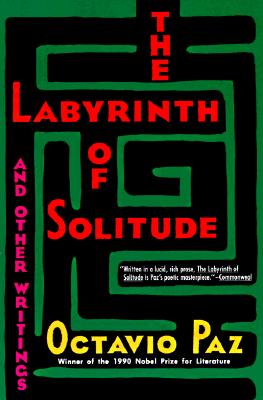
The Labyrinth of Solitude – Ocatvio Paz (various translators)

Tony Messenger's avatarMessenger's Booker (and more)

9780802150424

Octavio Paz, Nobel laureate in 1990, winner of the Miguel de Cervantes Prize in 1981 and the Neustadt International Prize for Literature in 1982, a writer and diplomat and my first stop in a journey I intend to take through Mexican literature.

‘The Labyrinth of Solitude’ is not a book you “review”, just like you don’t review an encyclopedia, it is a monumental work, revered for almost sixty years.

I need hardly warn readers that my opinions are a series of reflection, not a consistent theory. (P 381)

 My edition, published in 1985 by Grove Press, contains a translation of the original 1961 book length essay ‘The Labyrinth of Solitude’ (translated by Lysander Kemp), an essay “Critique of the Pyramid” written after the student uprisings in October 1968, which forms part of an extended section titled ‘The New Mexico’ (translated by Lysander Kemp) that “develop and amplify the Hackett…

View original post 757 more words

Mexican Masks – Carlos Fuentes & Octavio Paz

Tony Messenger's avatarMessenger's Booker (and more)

clipart960509

More Mexican literature from the 1960’s, today something a little different again. Carlos Fuentes’ novel ‘The Death of Artemio Cruz’, translated by Alfred MacAdam, covers, in non-linear fashion, the period 1889 to 1960, by joining Artemio Cruz on his deathbed, where various prompts that cause him to recall his past are presented to the reader.

At some later stage I will present my thoughts on the novel as a whole, however early in the book there is a passage that aligns wonderfully with Octavio Paz’s ‘The Labyrinth of Solitude’, more specifically the Spanish and Aztec history. Artemio Cruz, on his death bed, is thinking and addressing himself in the second person:

Because you will have created the night with your closed eyes, and from the depth of that ocean of ink, a stone boat – which the hot and sleepy midday sun will cheer in vain – will sail toward…

View original post 772 more words