Exhilarated to have “Her Knickers” featured on the front page of Open Arts Forum
“Invisible Me” A photo series by Rachael Ikins


Rachael comments “I have always been fascinated with eyes and faces in all media of my artwork.”
Lulled
the giants are here
they mollycoddle me cuddle me feed me a jugful of uncurdled milk
they spoon pureed peaches into my gurgling mouth then sing lullabies to soothe me to sleep
they promise me the world and everything that’s not extinct by the time I’m old enough to know the difference between a rhinoceros and a hippopotamus
then while I dream they go and start a revolution to save the oceans the earth the skies
they leave Argus Panoptes to watch over me
and I am safe
protected
unaware a hundred cataracts haunt his dauntless eyes
-Spangle McQueen
See in the Dark
“When what you write about is what you see,
what do you write about when it’s dark?”
—Charles Wright
Faces of lost loves
and my sons when
they were small,
heat shimmer off
a Texas highway
when I was a boy,
the woman gesturing
to no one on the bus
this morning.
Even with the light off
it’s never completely dark:
I can see the pale green
numbers on a digital clock
and streetlight filtered
by the blinds and
ambient light from
who knows where.
-Gregory Luce
Tantalum Lenses
‘I did nothing wrong’—Dominic Cummings
I crossed the polished marble floor
and found the politician’s optician at home.
His door was always open
for eye tests and fittings.
He looked long and hard into my eyes.
He’d damaged his own eyesight
writing illuminated text
by candle light.
He said there was no need to change my prescription—
exposure to his line of sight
had scratched my tantalum* lenses
with his vision.
*Tantalum is a conflict resource used in mobile phones, DVD players, video game systems and computers.
-Kit + CY
Twenty Twenty Vision
Masked and long division
Nature human fission
The World or us…
Decision?
-Mivvy Tekchandani
early while driving. omen repeating
sometimes the sun comes lower after the crest
one moment
imagine them marching, slow & white.
will you name them?
in the wake all things come clear.
slow & white.
later below the peaks i tell him. he said it is
the dark crystal.
sbm.

https://sonjabenskinmesher.wordpress.com/2017/11/09/a-vision-request/
sun hit the sea,
i was blinded,
by my own
shortcomings.
sbm.

Picasso
Out of blank space
gouge out shapes
of apples and light,
as instrument digs
a blister into palm
He cannot afford mistakes,
steady handed controls
citrus bite of wives
and mistresses.
Strong stink of oxidized linseed oil,
resins, ground cork, wood flour
and pigment all pressed together
and flattened. In later life
after bull sunned atrocities.
If mistakes made
disguise, or begin again.
A head on challenge.
Black eyes carve the shapes,
Print bold red, yellow and green.
A still life, unstilled creation.
-Paul Brookes
Wombwell Rainbow Book Interviews
I always give authors the opportunity to add, delete or change the questions that I ask, as the interview is as much about how they wish to be portrayed.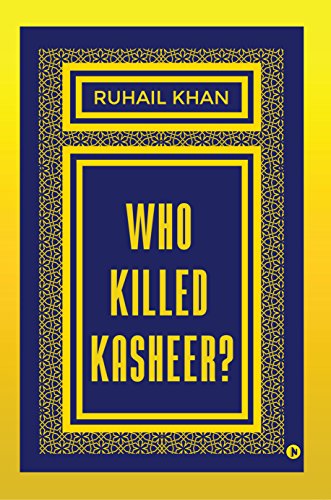
RUHAIL KHAN
Ruhail Khan is a Corporate Business Leader, a Top Management professional, an Industry thought leader, a much sought out keynote speaker and a published author. He was born in Srinagar to a technocrat father, a scion of a venerable family of professionals and an educationist mother who hails from a leading business house in the valley established about three centuries ago.
The prevalent ethos in the valley at the time stifled his efflorescence and he migrated out of the state as part of an exercise to “sniff, scour, scout and scalp” various career tracks, most of them being at diametrically opposite ends of the spectrum and finally he decided to opt for a Management career in the Global Corporate ethos. Armed with MBA degrees in Finance and Marketing as well as in International Business and Operations and coupled with a varied assortment of certifications / trainings / specializations inclusive of Advanced Management Courses, he has continued to straddle the Corporate world like a colossus and along the way becoming one of the youngest Corporate Vice Presidents ever in a Fortune 1000 company.
For almost two decades now, he has worked with an impressive quorum of class – leading companies across the globe, manning Top Management positions, while notching some commendable business milestones for each which has seen him getting bestowed with an impressive array of awards and felicitations…He currently works as the CEO at TransformationWorks Lab, which is an agile business transformation company…
Ruhail is a respected Industry thought leader and has been at the forefront as a speaker as well as an influential writer having featured regularly across the Big “F”, FT, ET, LinkedIn and a host of prestigious business publications as well as social media platforms besides running a couple of blogs and moderating some online business fora. He regularly conducts and participates in seminars, webinars and workshops to deliberate and disseminate path-breaking advances in the Customised Research and Advanced Analytics, IOT, Big Data, Artificial Intelligence, Automation and Machine Learning space as well as doling out information about various corporate functions as well as the latest advances in the Management and business biospheres…
Besides being a voracious reader he is passionate about outdoor activities too. Whenever he is able to find time in his hectic schedule, he spends that time trekking, swimming, travelling, and fulfilling his diverse socio-cultural obligations. His other personal interests include music, cooking, comparative theology, fiqh, technology, philosophy, psychology, world history, anthropology, warfare and defense systems, international relations and global polity but not necessarily in that order, though nothing pleases him more than spending time with his family…
Ruhail is a prolific and accomplished writer which can be comprehended from his recently published book, Who Killed Kasheer? He is currently involved in four different projects. One is a revised edition of his already published book of poems, “Who Killed Kasheer?”. The second is a step-by-step guide on Corporate Sales Transformation. The remaining two include a romantic thriller set against the backdrop of a trans-continental historical canvass and a tome on the contributions of Islamic civilizations to the development, dissemination and usage of Science and Technology across the ages. Although he considers himself as “work in progress”, his writing style is undeniably superlative and his delectable expertize in understanding and crafting the smorgasbord of human experiences makes this exposition a cathartic and emphatic experience for the reader. Who Killed Kasheer? is an epic of beauty, loss, suffering, sacrifice, courage, stoicism and hope…
The Interview
1. What inspired you to write poetry?
My passion for writing, which was ignited pretty early in my childhood, was an exposition of a discreet precocious consciousness, eager to explore disparate ethoses, engage discordant ideologies, evolve dichotomies of expression and excel at deliberating denouements so as to craft transformational works of art…
Other than that, being born and initially brought up in Kashmir, which by itself is an altaltissimic showcase of the Almighty’s creativity with its attendant historical upheavals in tandem with its rich socio-cultural ethos, really doesn’t spare anyone from the kindling of creativity which inspire different individuals in myriad manifestations, and I being no exception to the rule, succumbed to the calling, which in my case happened to be in the form of writing of all sorts and genres…
2. Who introduced you to poetry?
However much I want to do the honours, I cannot credit any particular individual for the introduction, but I can definitely attribute it to my academic and professional pedigree, starting off with my public school education from Tyndale Biscoe School, one of the finest educational institutions in the country; where the curriculum would by default introduce you to an impressive assortment of European and American poets, writers, thinkers and philosopher’s et.al with William Wordsworth, P.B. Shelley, John Keats, Thomas Wyatt, Sylvia Plath, Robert Frost, Robert Browning, Thomas Hardy, John Claire, Seamus Heaney, Louis Macneice, W.B. Yeats, Walt Whitman, Christina Rossetti, William Shakespeare, John Milton, Alfred Tennyson, Oscar Wilde, Dante Alighieri on one end and Friedrich Nietzsche, Arthur Schopenhauer, Georg Wilhelm Friedrich, Homer, Euclides, Erasthenes, Socrates, Pluto, Aristotle, Immanuel Kant, Soren Kierkegaard, Baruch Spinoza, Karl Marx, Jean-Paul Sartre, Martin Heidegger, Sigmund, Freud, Carl Jung, Leo Tolstoy, Franz Kafka, Albert Camus, Fyodor Dostoevsky, Michel Foucault, Johanne Wolfgang von Goethe, Jean-Jacques Rosseau, Voltaire, Niccolo Machiavelli, Ludwig Wittgenstein, David Hume and many others on the other end…
The literary expositions of these geniuses, irrespective of the fact whether they are poetic musings, intellectual enigmas, philosophical treatises or ideological enunciations, light a fire in your heart, mind and soul. You are never really the same person again, once you’ve read and understood them. You may or may not agree with what they ponder, pontificate or practice but they definitely make you think and in many cases, question your existentialist ethos and your subscription to a particular line of thinking…
And thinking is THE indispensable and core complement of any writing endeavour…
3. How aware were you of the dominating presence of older poets?
I consider it to be well-nigh impossible to be unaware of the presence of older poets, who according to my understanding are the ones who’ve been there before I hit the scene. However, I do not consider any of them to be dominating or intimidating in any way…
There is a very simple answer for that. We all are blessed with our individual corpora of intellect, free-will, priorities and talent, and some of these attributes may be common, complementary, conflicting or conflating across the board but that does not in any way undermine the creativity on an individual basis. We are all entities of an omni-potent reality…
4. What is your daily writing routine?
I abhor a regimented daily writing routine and instead scribble at will, an exercise made possible by leisure, fuelled by a desire to express, and engaged in time spared by my corporate and personal commitments. Notwithstanding this unregimented melange, I do occasionally find myself engrossed in lengthy and laborious stints of intellectual efflorescence and literary creativity which sometimes extend for weeks and even months on end…
For me, writing, in any form or genre, is not a daily, structured rigmarole but an exercise in contemplation and creativity, bereft of any enshacklement and boundaries…
5. What motivates you to write?
My writing is driven by different moods, motives, motivations and very rarely some manipulations too as dictated by the subject being written about. The basic idea is to channelize one’s awareness through an intellectual conduit that facilitates uncluttered, unfettered, and unprejudiced expression…
The underlying precipitant that primes my expressions is a deep – seated desire to showcase my interpretation and perceptions about a topic/subject, without any partisanship, concurrence or abnegation of its realism…
6. What is your work ethic?
I cherish the work ethic that I’ve chosen for myself that is basically free, fair, factual and fastidious. These attributes empower me to scuttle any semblance of lies, distortions, falsehoods, episodes of alternate truth as well as accentuate the clarity, finesse, reach and impact of my endeavours. I hopelessly strive for “upping the ante” when it comes to living up to my work ethic…
7. How do the writers you read when you were young influence you today?
It is only fair to say that all the writers that I read when I was young did initially influence my style as well as substance, though in a very limited and fleeting manner, more like spatterings of mud on fabric than impressions of indelible ink. But more interestingly, right from my first forays in writing, I fiercely and successfully strived to develop and showcase my originality, with an incorruptible DNA….
8. Who of today’s writers do you admire the most and why?
Pablo Neruda, Paulo Coelho and Gabriel Garcia Marquez rank right at the top of my most admired list, which incidentally is a pretty long one. What impresses me about them is a common thread of realism of narratives, candour in expression and the originality of character portrayal which has probably helped them script and craft a cavalcade of masterpieces.
Incidentally, my most admired list is populated by a huge concatenation of literary legends currently out there and across the ages. However, the constraints of time and space do inhibit any attempts on my part to explain the raison de ’etre of my admiration for them. Maybe, some other time in the near future…
9. Why do you write, as opposed to doing anything else?
The question is presumptive as it’s not acquainted with the bandwidth of my interests. However, writing is one of my favourite platforms of expression that I utilize effectively. Other than that I am involved in a wide spectrum of activities as a thought provocateur, keynote speaker, social volunteer, diversity, gender – equality and inclusivity champion, nature conservationist et.al while attending to wide envelope of other interests besides being a corporate business leader.
10. What would you say to someone who asked you “How do you become a writer?”
In all honesty and humility, I’d be initially challenged and constrained to respond to such a query. But then sanity and clarity would probably prevail and I’d simply say, “Break free and let your thoughts flow”…Nothing less and nothing more…
11. Tell me about the writing projects you have on at the moment.
Well, right now, I am simultaneously juggling with four different projects. One is a revised edition of my already published book of poems, “Who Killed Kasheer?”. The second is a step-by-step guide on Corporate Sales Transformation.
The remaining two include a romantic thriller set against the backdrop of a trans-continental historical canvass and a tome on the contributions of Islamic civilizations to the development, dissemination and usage of Science and Technology across the ages. So as you can guess, I’m a veritable black hole right now, what with the constant interplay between facts and fiction, imagination and incidence, clarity and confusion, patience and perfection; all getting pulled in and gobbled up…
12. How did you decide the order of the poems?
The real-life transitions that Kasheer [Kashmir] has witnessed over the ages dictated the order of poems and fortunately, I was able to start with a poem, which was largely reminiscent of the good times that I had as a kid in that ethos and pretty soon, you have poems meandering through history, politics and myriad episodes of human suffering, loss and pain and finally an ode to the indomitable Kashmiri spirit…
13. How important is the use of form in your poetry?
I do believe that form is important in poetry though at the same time I do tend to experiment with multifarious forms in various poems as is evidenced in the book. I am not a great fan of uniform form across multiple pieces in a titled compendium as I believe that such uniformity limits creative expositions and curbs the attendant risk affability…
14. Why did you decide to use ellipsis and lists in the book “Who Killed Kasheer”?
Talking about ellipses. Well, using ellipses is a dominant complement of my writing style as I find them to be complementarily conclusive and consciously continual too. This attribute accords a space for speculation as well as an entrapment of expectation…
And when it comes to lists, I believe that they become indispensable in some specific cases, like my book, wherein you have to cover a comprehensive canvass of people and personalities alongwith the past, present and potential possibilities…
15. What inspired you to write about Kashmir?
I believe that the Kashmir conundrum has spawned a diverse, disparate, and often contradictory and conflating pot-pourri of attitudes, perceptions, commentaries, denunciations, and justifications largely fuelled by individual or collective cognizance of and fidelity to concepts of nationalism, freedom, equality, liberty, justice, free-will, and dignity of life…
Accordingly, the representation of the genesis and progression of the turmoil has vacillated between an Orwellian Dystopia and a Morean Utopia. Subscriptions to either of the diametrically opposite world views coupled with a historical myopia aided by political obfuscation have ensured commensurate responses from the purported stake holders and created a fatal cocktail of death, destruction, and despondency for the peace-loving, hardworking, intelligent, and hospitable populace…
I’ve never been immune to the trials, travails, and tribulations of Kashmir. I’ve personally witnessed the loss, pain, and suffering of the masses; the epochal cultural transformation and the institutionalization of barbarity aided by draconian laws. I’ve been privy to episodes of degradation, denigration, and denial of human rights and the attendant nonchalant dismissal of the dignity of human life…
Over the years, I’ve seen young lives snatched, honor ravaged, dreams scuttled, futures obscured, livelihoods threatened, justice denied, accountability ignored, experiences tainted, psyches traumatized, communities uprooted, and media-driven stereotypes, especially the bogey of Islamism and Islamic Jihad; reinforced and entrenched across the gullible and information-starved masses countrywide…
The world’s most militarized tinderbox, with an active deployment of approximately 1,000,000 armed forces; and mismanaged by a concatenation of self-perpetuating, corrupt, and inefficient local polity and a mélange of local and central bureaucracy, has been held hostage by history, imperialism, geo-strategic posturing, religio-political affiliations, economic compulsions, and popular sentiment…
A smorgasbord of resistance and militant entities has compounded the working dynamic of the imbroglio. The decades gone by have been spectators to the various transformations of this narrative which have impacted the nature and course of these entities and the cavalcade of events triggered till date. The latest accoutrement to the canvass has been an almost unending spate of street protests…
The preponderance of global conflicts has largely obscured this ongoing turmoil which has so far claimed more than 100,000 dead and thousands more missing, maimed, blinded, tortured, and incarcerated while some being “discovered” in mass graves with a disturbing consistency. In this jeremiad of loss, it’s immaterial to pinpoint either accountability or complicity of the various stakeholders involved…
I took it upon myself as a moral and social obligation to showcase the real Kashmir; beautiful, battered, brutal; as opposed to political PR ops, TRP-driven media machinations and stereotypical Bollywood fantasies loaded with falsehoods, misrepresentations, and alternate truth. Every Kashmiri is a protagonist, every event a representation and every experience an illustration in this “all-inclusive” and “true-to-life” poetic exposition…
Hence the book…
The journey of writing this volume has been one of painful catharsis and self-realization…
16. How would you describe “Who killed Kasheer?”
“Who Killed Kasheer?” is a labour of love and pain. It encapsulates and vividly describes the existentialist dilemma of Kashmir as a realm and Kashmiris as an ethno-socio-political entity. It is a concerted and honest endeavour to comprehend, imbibe, and reflect upon the genesis, beauty, history, politics, culture, syncretic traditions, and the turmoil that the realm has had to contend with till date…
It encompasses a comprehensive exposition of the loss, pain, torture, misery, apprehensions, helplessness, cravings, aspirations, hopes, and dreams etc of common Kashmiri folks cutting across religious denominations, ethnicity, social stratification, political affiliations, sex, age, or historical chronology…
Every individual poem tackles aspects of a multitude of life-changing events and experiences that Kashmir and Kashmiris have been a witness to and have had over the millennia and portrays their responses that have been forged in the crucible of history, political machinations, dichotomies of fidelity and whenever possible, individual and collective expressions of free will and choices exhibited by or usually imposed upon them. Some rekindle previous, almost idyllic experiences in relatively peaceful times while others attempt to envision and script a peaceful, “all-inclusive” futuristic denouement…
A specific set of poems details the genesis, progression, efflorescence, zenith, and exploitation of Kashmiri civilization, polity, and culture while others narrate the resurrection, rejuvenation, and resurgence of the Kashmiri conscience. A few are dedicated to the struggles and sufferings of womanhood while others extol their virtues and aim to inspire them to soar high…
The predicaments and dilemmas of the common man on the street find their way into the poetic narrative along with the allegorical representation of seasons and the prevalent ethos. The divine beauty of this paradise finds expression in some emblematic dedications while the suffering of its denizens makes some quartets and octaves choke with pain and humiliation. Pragmatic stoicism walks tall with an ode dedicated singularly to it…
This poetic corpus is a microcosm of all that Kashmir, Kashmiris, and the Kashmir imbroglio are about and is a correspondence between their intimate experiences and their manifest illustrations. It aims to serve as a perceptible and palpable conduit between stifled apprehensions and aspirations on one hand and succinct awareness and acknowledgement on the other. It does not lay any claim to political correctness or espousal of any ideology. Every poem in the collection is either a saga of courage, a ballad of sacrifice, an epic of stoicism, or an anthem of hope…
17. Once they have read it what do you want the reader to leave with?
I have reasons to believe and am hopeful too that it will hold their hearts, minds and souls in rapture, as they embark on an unprecedented journey of discovery. It will accord them an opportunity to stand face-to-face with the real Kashmir; beautiful, battered, brutal, as opposed to political PR ops, TRP-driven media machinations and stereotypical Bollywood fantasies loaded with falsehoods, misrepresentations, and alternate truth. And yes, they are all going to fall in love with Kashmir, once again…
This book shall surely test the emotional bandwidth of its readers and etch every word on their hearts, minds and souls…indelibly. What makes this book special is that it aims for the readers’ intellect and conscience and shall surprise them with its disdain for political correctness and lack of espousal of ideologies. I hope that they shall find it as encompassing, engrossing, and enlightening as I have…
18. What role do you envisage, ”Who killed Kasheer?” playing when it comes to alleviating the endemic disconnect that the various complements of the global Kashmiri diaspora have to contend with as of today?
Other than being an eye-opener to the world, “Who killed Kasheer?” is a bridge-builder. The book consciously and conscientiously steers clear of ideological deification, political hagiography or religious affiliations. It is a treatise of truth. Given the highly controversial subject that it deals with, which almost always sees people subscribing to one ideology or the other, the book does not serve vested interests, spare those at fault, support wrong doers or satiate prejudice…
Instead it amplifies reconciliation and reapproachment, extols camaraderie and communion, highlights shared history and habits, accentuates commonality and consensus, glorifies the achievements and accomplishments and eulogizes the spirit and substance of Kashmir and Kashmiris…
It allows the diaspora a common ground to explore and engage reality, be it the glorious past or the grotesque present and develop the wherewithal to accept them while at the same time get introduced to the magnificent land of their roots, a veritable melting pot of cultures, creeds, communities, couture, cuisine, communication, confluences and congregations…
I personally recommend, “Who killed Kasheer?” to people across the board, globally, for an unbiased, unprejudiced, and unadulterated introduction to Kasheer [Kashmir]…
19. What is it that you wish for Kashmir?
I’m not going to wax lyrical about this proposition. But all that I wish for Kashmir and Kashmiris is peace, dignity and justice…And I think that they absolutely deserve the same…
Is this an aspiration that can be dubbed as an unwarranted, unrealistic and unviable proposition?
Thank you!
Ruhail Khan.
P.S:
The link to one of the book reviews in India’s leading journal, Frontline
http://www.frontline.in/books/bold-and-beautiful/article10031635.ece?homepage=true
Wombwell Rainbow Interviews
I am honoured and privileged that the following writers local, national and international have agreed to be interviewed by me. I gave the writers three options: an emailed list of questions or a more fluid interview via messenger, or an interview about their latest book, or a combination of these.
The usual ground is covered about motivation, daily routines and work ethic, but some surprises too. Some of these poets you may know, others may be new to you. I hope you enjoy the experience as much as I do.
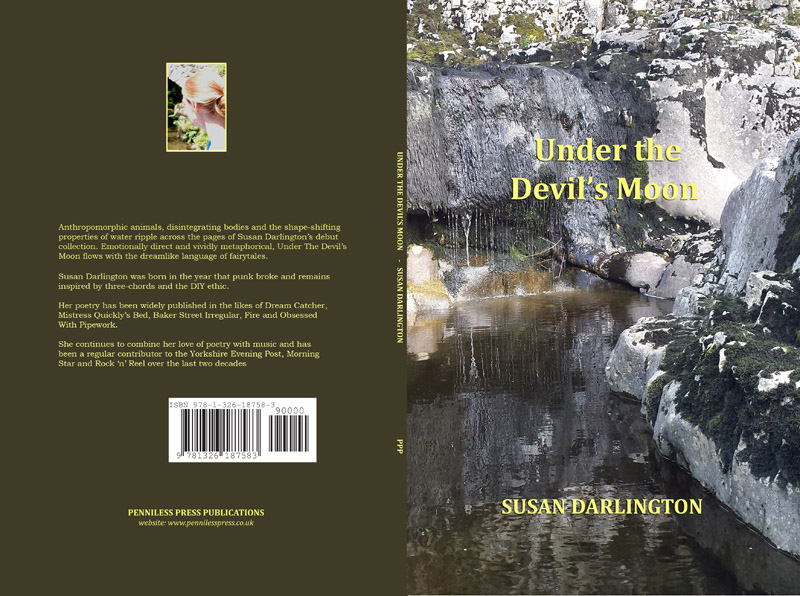
Susan Darlington
is a freelance arts journalist and poet. Her debut collection, Under The Devil’s Moon, is available now through Penniless Press Publications.
The Interview
Wombwell Rainbow Interview – Susan Darlington
1. What inspired you to write poetry?
I grew up in a household where writing was normal so it was never something I questioned or consciously made a decision to start. From an early age I played around with short stories and rhyme as a way to keep myself entertained. At some point it morphed from being a pastime to a compulsion.
2. Who introduced you to poetry?
I remember reading Heinrich Hoffman’s ‘The Story Of Augustus Who Would Not Have Any Soup’ in a children’s annual at my grandmother’s house. The moral was lost on me but I found it hilarious: life and death in five stanzas. I loved the conciseness, the rhyme, the story, and the macabre illustrations although I doubt I even realised it was a poem at the time.
3. How aware were you of the dominating presence of older poets?
Outside of school I mainly discovered poetry through fanzines. These were largely produced and written by my teenage peers, many of whom were female. Through Riot Grrrl publications I was introduced to, or became more interested in reading, people like Sylvia Plath, Anne Sexton, Patti Smith and Stevie Smith. The scene was reacting to a male dominated society but rather than finding it oppressive I was excited by the opportunities it created for change.
4. What is your daily writing routine?
It’s hard to develop a routine when, in common with most writers, I have to juggle poetry with the fluctuating demands of full-time paid employment. There are times this can be incredibly frustrating, as creative pursuits have to take a back seat, but it can make the writing windows all the more valuable to seize, whether they’re grabbed over a lunchtime drink or commute on the bus.
5. What motivates you to write?
It probably started out as a way to express myself, especially as a shy teenager, but it’s now more about being part of an ongoing conversation with other artists, other art forms, and natural environments. I’m also driven by the desire to improve my writing; to get closer to expressing my vision; and the basic need to be creative.
6. What is your work ethic?
I think it’s important to always be receptive to new ideas, even when caught up in domestic routine. Ideas for a poem could come from a phrase in a book, a piece of art, a half-heard song lyric, or something I’ve seen when out walking. These ideas then percolate at the back of my mind until I find a way to shape them into a piece of writing. It’s very rare I start with a completely blank page as by the time I start to write I’ve usually got the rough shape of a poem in my head.
7. How do the writers you read when you were young influence you today?
I discovered the power of words in a large part through the lyrics of Brett Anderson (Suede), Morrissey (The Smiths), and Jarvis Cocker (Pulp). I loved the way their words connected with me, made me feel understood, and transported me to different places. They all share a certain kitchen-sink romanticism, of finding beauty in urban landscapes. My writing tends to be much more influenced by nature but in essence I’m still trying to make that connection with other people through my words.
8. Who of today’s writers do you admire the most and why?
We’re fortunate to have access to so many talented writers from all stages of their career through e-journals. I used to produce a fanzine so I know how much commitment that involves from editors and how much it’s a labour of love. For that reason I have particular admiration for Colin Bancroft, who runs an exhaustive resource called Poets’ Directory as well as a beautifully produced online magazine called 192. I also respect Mark Davidson, editor at Hedgehog Press, who runs a novel supporter led model through the Cult of the Spiny Hog.
I recently discovered the work of Rebecca Goss. Her 2013 collection Her Birth is an incredibly moving narrative account of loss and moving on with life. I love the brevity of her writing, the striking imagery, and the way in which she represents female experience. The poems in it are broadly confessional but it feels like she’s looking outwards rather than the somewhat insular writing of some of those working in the style.
I also admire the work of Becky Cherriman, who I feel should get greater recognition, and Helen Mort. They deal with politics with a small ‘p’ and write from a female perspective about topics such as motherhood and pioneering mountaineers. They both use everyday language to create work that on face value appears simple yet they make deep connections with stunning turns of phrase.
9. Why do you write, as opposed to doing anything else?
It makes me feel complete. If there have been days when, for whatever reason, I haven’t been able to write then I start to feel unfulfilled and dissatisfied with life.
10. What would you say to someone who asked you “How do you become a writer?”
Write. Read. Edit. Don’t be afraid to follow your own voice, remember that all subject matters are valid, and know that imposter syndrome never goes away!
11. Tell me about the writing projects you have on at the moment.
I’m looking for publishers for two chapbooks. The first uses traumatropism – the ability of trees to continue growing after enduring trauma – as a loose metaphor for survival. The other is loosely constructed around phases of life, including creation myths and menopause. I’m also working on a micro-chapbook that considers what it means to be barren.
Tears in the Fence 72 is now available at http://tearsinthefence.com/pay-it-forward and features poetry, multilingual poetry, prose poetry, flash fiction, fiction and translations from Mandy Haggith, Andrew Duncan, Elzbieta Wojcik-Leese, Charlotte Baldwin, Jeremy Reed, Lynne Wycherley, Joanna Nissel, Mandy Pannett, Sam Wood, Genevieve Carver, Sarah Acton, Alexandra Corrin-Tachibana, Mike Duggan, Daragh Breen, Tracey Turley, Karen Downs-Burton, Barbara Ivusic, John Freeman, John Millbank, Olivia Tuck, Rowan Lyster, Sarah Watkinson, Greg Bright, Robert Vas Dias, Lucy Sheerman, Andrew Darlington, David Punter, Beth Davyson, Michael Henry, Judith Willson, John Gilmore, M.Vasalis translated by Arno Bohlmeijer, Paul Rossiter, Charles Wilkinson, Rupert M. Loydell, Reuben Woolley, Kareem Tayyar, Peter Hughes, Zoe Karathanasi, Lucy Hamilton, Lydia Harris, Lucy Ingrams, Mark Goodwin, Simon Collings, Aidan Semmens, Vasiliki Albedo and Ian Seed.
The critical section consists of David Caddy’s Editorial, Jennifer K. Dick’s Of Tradition & Experiment XIV, Andrew Duncan Apocalypse: An Anthology edited by James Keery, Lily-Robert-Foley on…
View original post 55 more words
Good poetry often creates a sense of release, of being returned to a point of wonder and attention. Alan Baker’s latest chapbook, A Journal of Enlightened Panic, has that quality. There’s an integrity about the writing which is enlivening.
The metaphor of life as voyage, journey, or walk dominates the volume. The longest poem, ‘Voyager,’ has perhaps the most complex use of these tropes. The poem is dedicated to Baker’s mother, who died in 2015. The text mixes information concerning the Voyager space probe, and material about life on a container ship, with the night-time wanderings of ‘Alan’, a cleverly objectified version of the poet himself.
The probe in outer space, the ship often travelling for days without seeing another vessel, have a resonance with Alan’s nocturnal perambulations, walks which have ‘the quality of dream’ but are also punctured by the unwelcome intrusions of time and unease.
Alan would…
View original post 500 more words
Slow Down! Red Squirrels! by Cheryl Camm
SCIURUS VULGARIS
Pinecone clutched adeptly between his paws, he hesitates, Ears quivering, alert for a predatory fox or a swooping goshawk – Danger lurks unseen within this innocent sylvan landscape
Concealed by the dense tree canopy; a stealthy pine marten Waiting to pounce and crush the fragile bones, strip bare the russet coat. Reaction must be swift, his tail balancing him perfectly in flight
High overhead in the tree’s hollow his vulnerable kittens cower In the patchwork drey of woven twigs, leaves and moss. Instinctive parental behaviour kicks in. He is their survival….
Recognising a sudden chill in the wind, he scrabbles urgently Among the dying leaves, as autumn makes its last stand. ‘Chuck chuk’, he stamps his feet in bold defiance, eyes darting warily.
-Margaret Royall.
She says “His breed shows dwindling numbers year on year, disappearing from their British haunts. This is our watch, we cannot ignore the call – Sciurus Vulgaris looks to man for protection; Tomorrow may be too late!” Type a message…
The Elgin Sweeties
The Duke had loved them, originally. They had crossed seas, dodged bullets and traps to dominate this new land. The grey giant “Sweet” Caroline stamped her victory. She scooped the cracked bodies of the fallen to sate her oak-sized appetite, taking surplus as trophies for her many cellars.
Scarlet knew their territory was lost; stripped bark-naked and sapped of strength. The once Common folk were now packed refugees with pouches full of seeds. Her black eyes shone north, towards Elgin pines. She had one last acorn tucked in cheek, a teardrop held inside. A grey shadow followed, tailing them unseen.
-Wai-Mei Chan
Says of this flash fiction:
” A few years ago there was a story in the news about a displaced grey squirrel which inspired this story – locals were divided on saving or killing the squirrel in order to protect the beloved red squirrels. Who were the true “sweeties”? Inspired by the current piece (grey squirrel = Sciurus carolinensis)”
I am overwhelmed with so much gratitude to these authors who make it so worthwhile with their wondrous words and stories.
I am glad to be one of the channels that they can do this through. One who focusses on the book they have written and doesn’t just ask generic questions, but absorbs the book and returns with questions about it and their creative process. My enthusiasm for it all.
And I do not charge for something I enjoy doing.

 The Wombwell Rainbow