November Ekphrastic Challenge: Day 15

Jane Dougherty's avatarJane Dougherty Writes

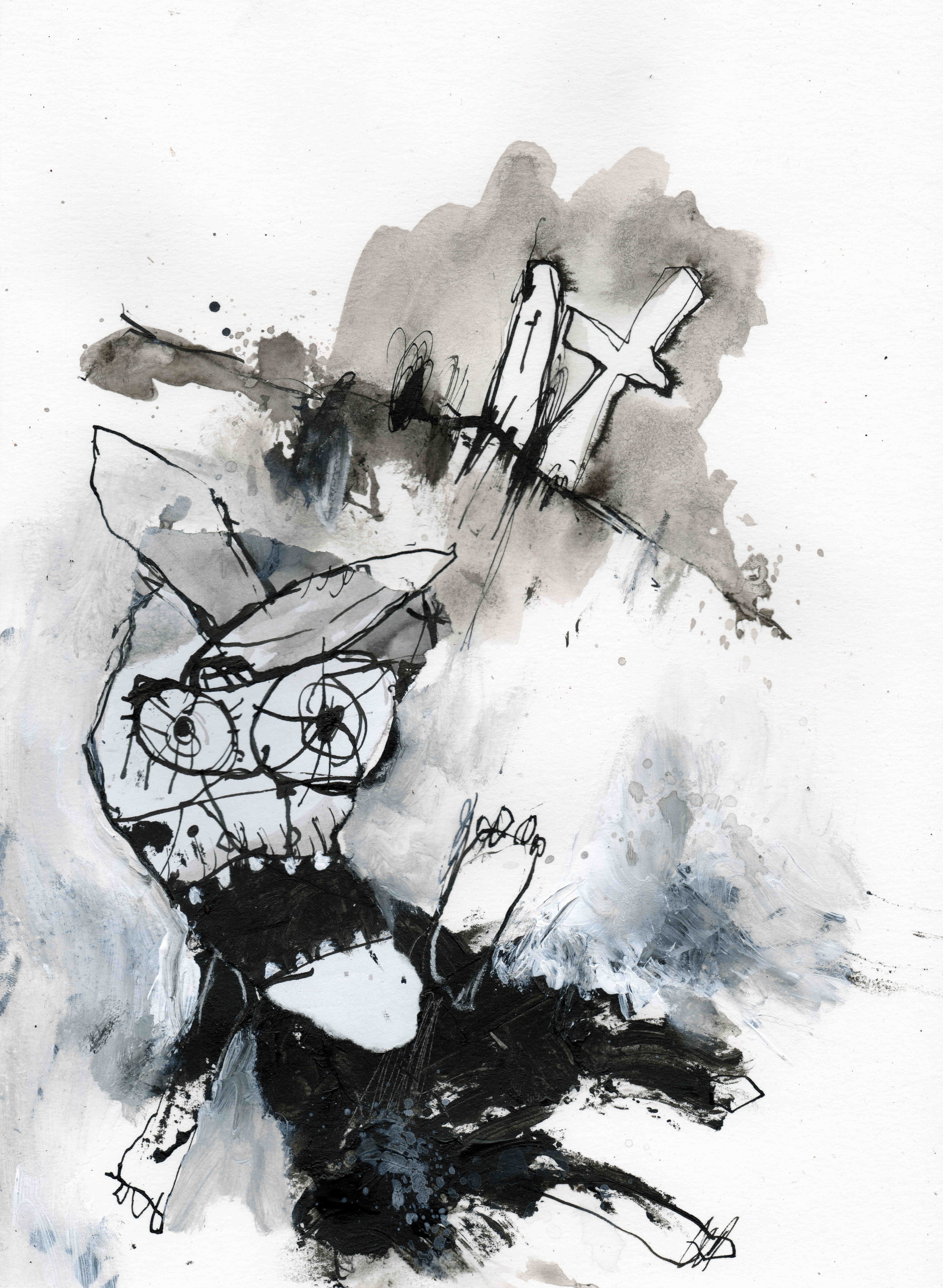
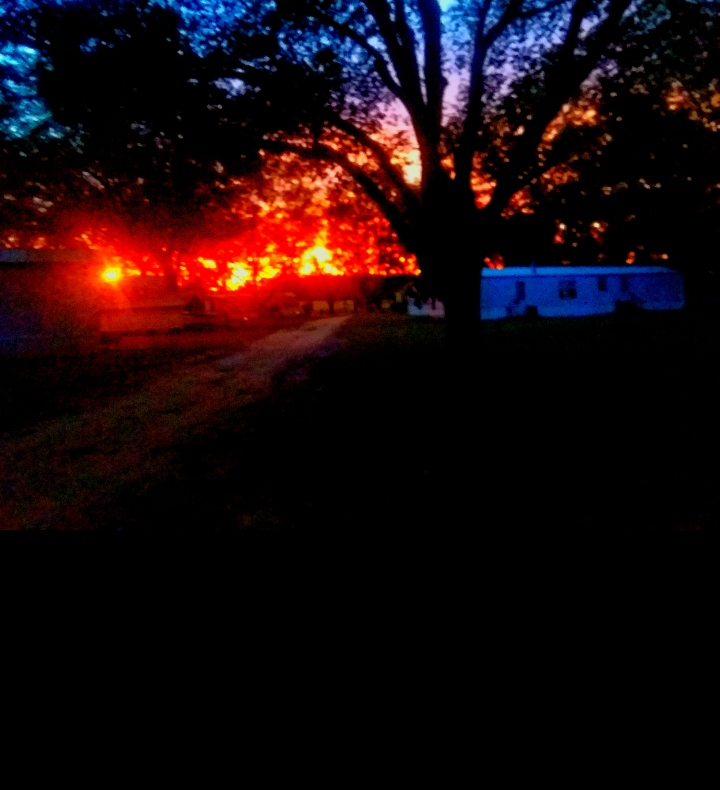
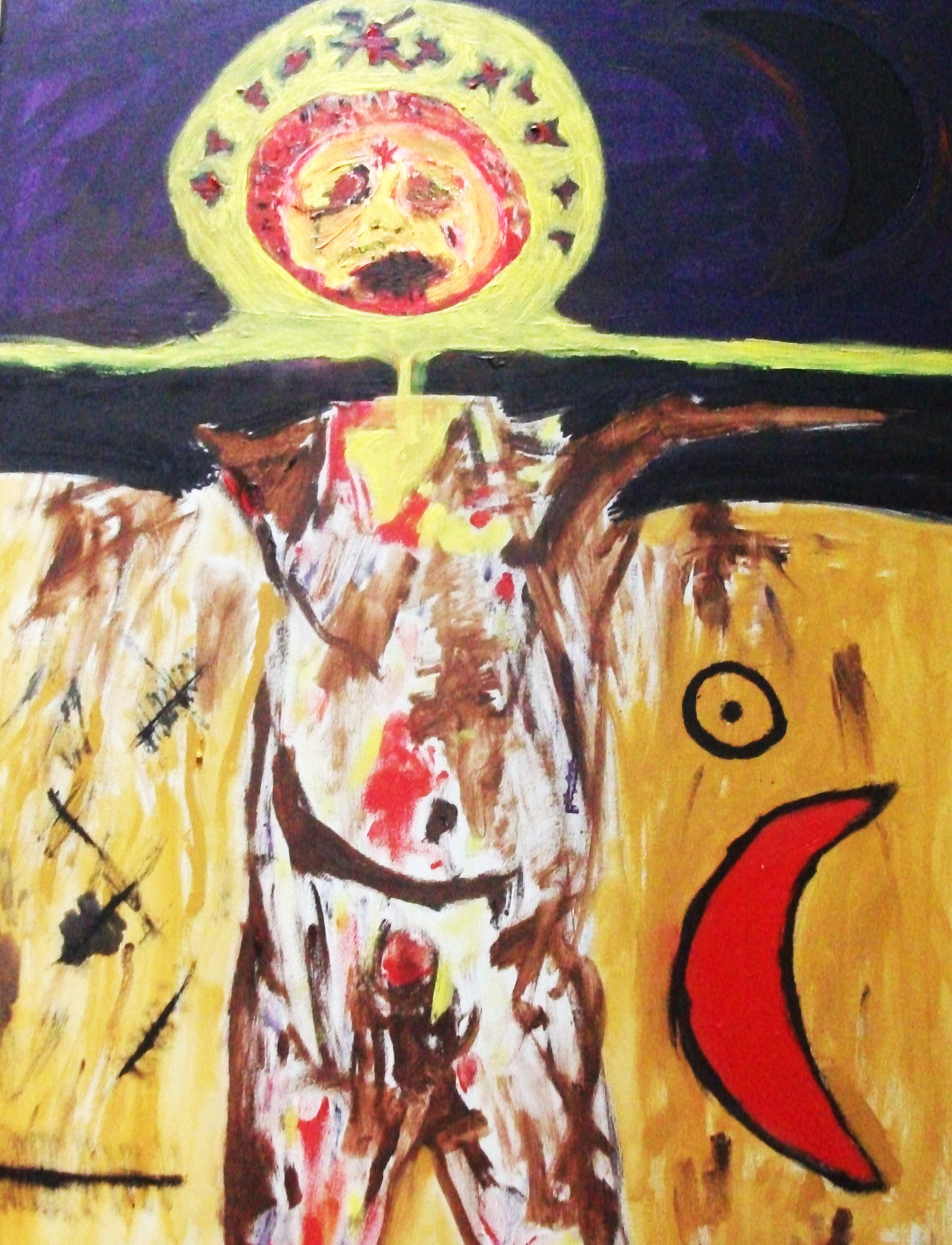
For Paul Brookes’ challenge, the poem is inspired by this painting, Background radiation by p a morbid.

Background Radiation by p a morbid

Background radiation

It’s coming like it or not,
the age of the three-legged pigs
and two-headed sheep,
the screaming chickens
and the calves with no mouths.

We watch the images on the screen,
pick up the groceries in their bright packages,
the meat neatly slabbed,
while the sun climbs higher and higher.

Ice melts,
forests burn,
we put on sunglasses.

View original post

Day Fifteen : Welcome to a special ekphrastic challenge for November. Artworks from Terry Chipp, Marcel Herms, MJ Saucer, P A Morbid, the inspiration for writers, Gaynor Kane, Peach Delphine, Sally O’Dowd, sonja benskin mesher, Anindita Sengupta, Liam Michael Stainsby, Helen Allison, Sarah Connor, Sarah Reeson, Holly York, Jane Dougherty, Gayle J Greenlea, Susan Darlington, Lydia Wist, Dai Fry, and myself. November 15th.

November 15th

Background Radiation by p a morbid
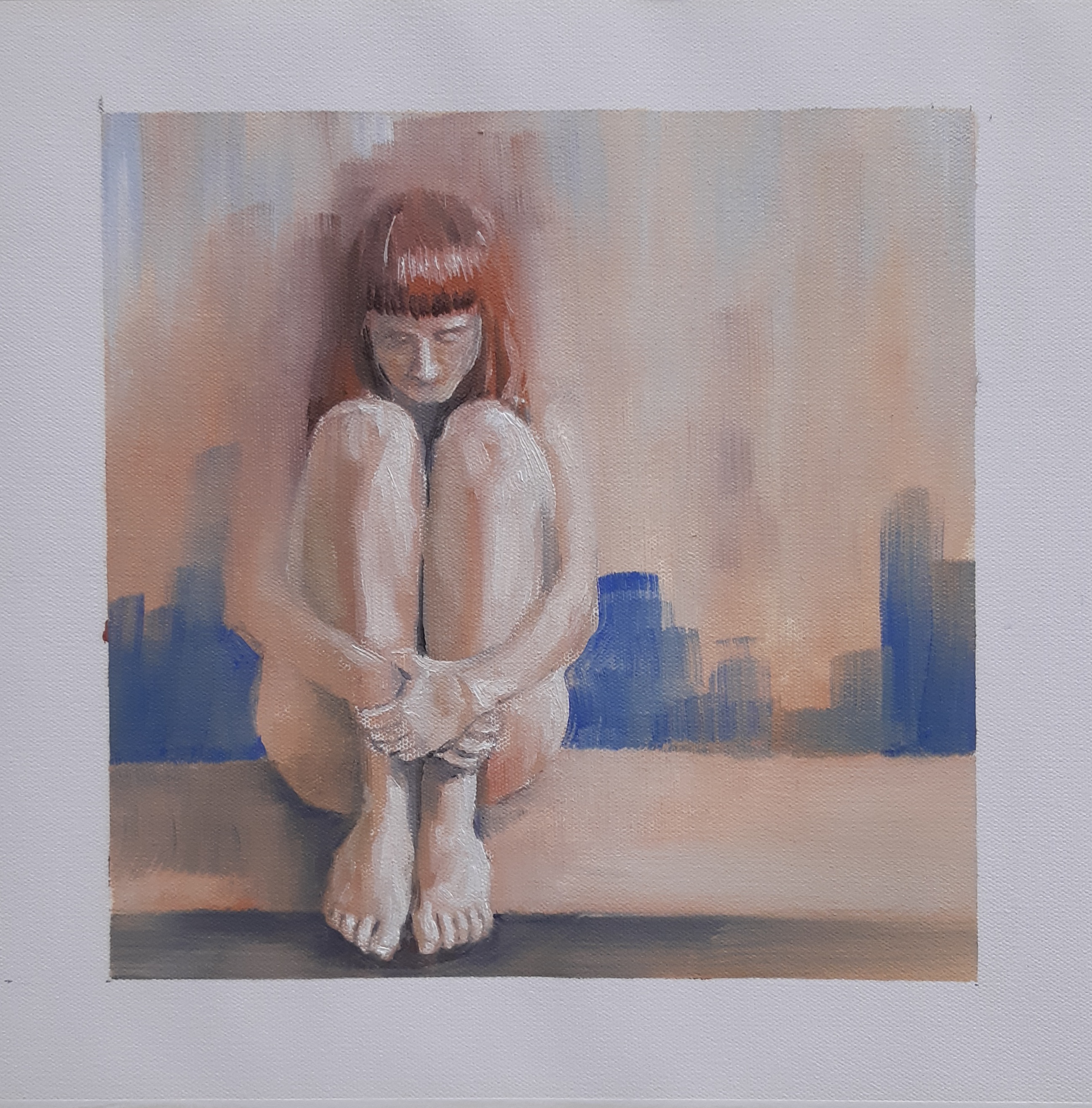
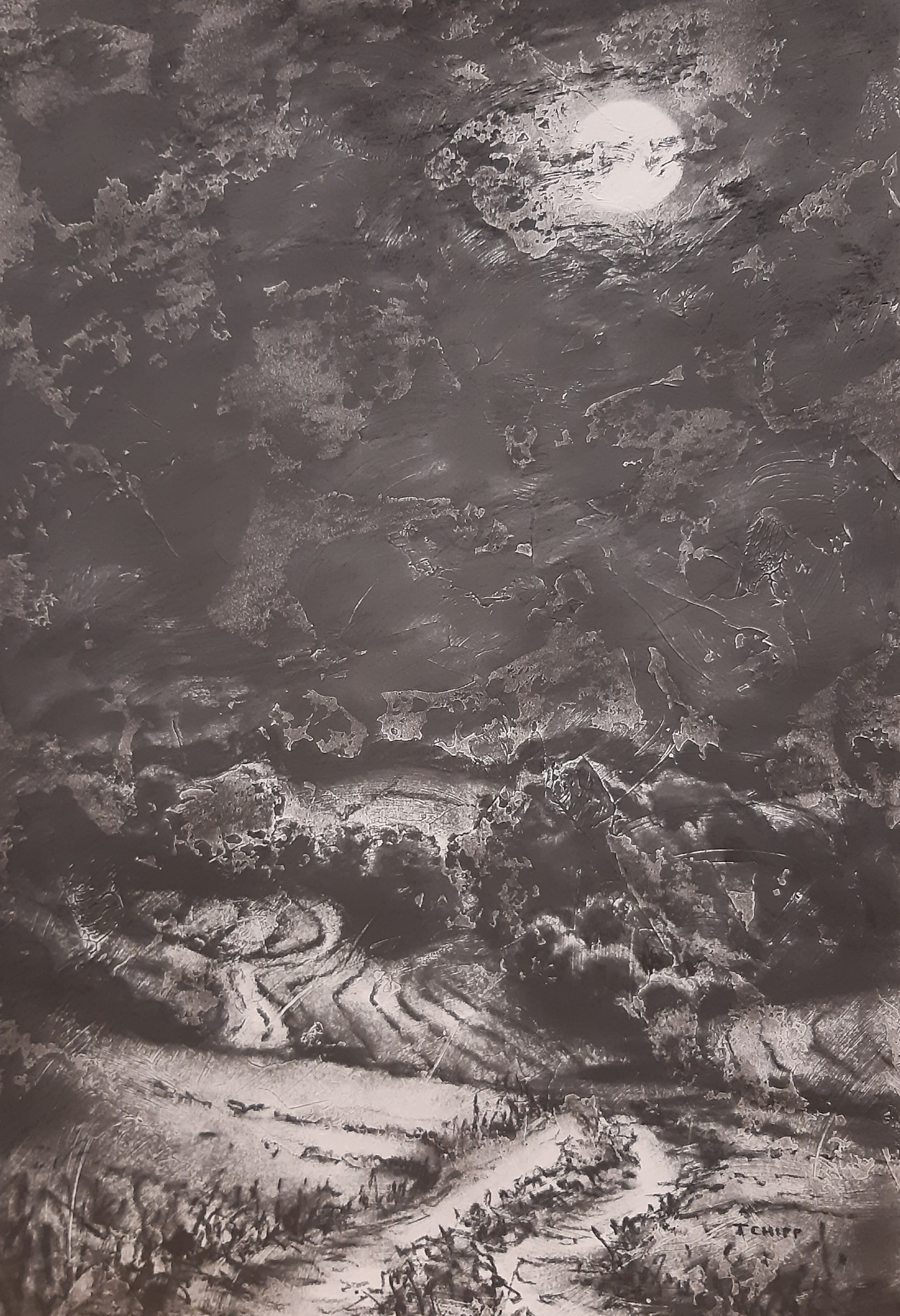
TC15 Just Thinking
Just Thinking by Terry Chipp
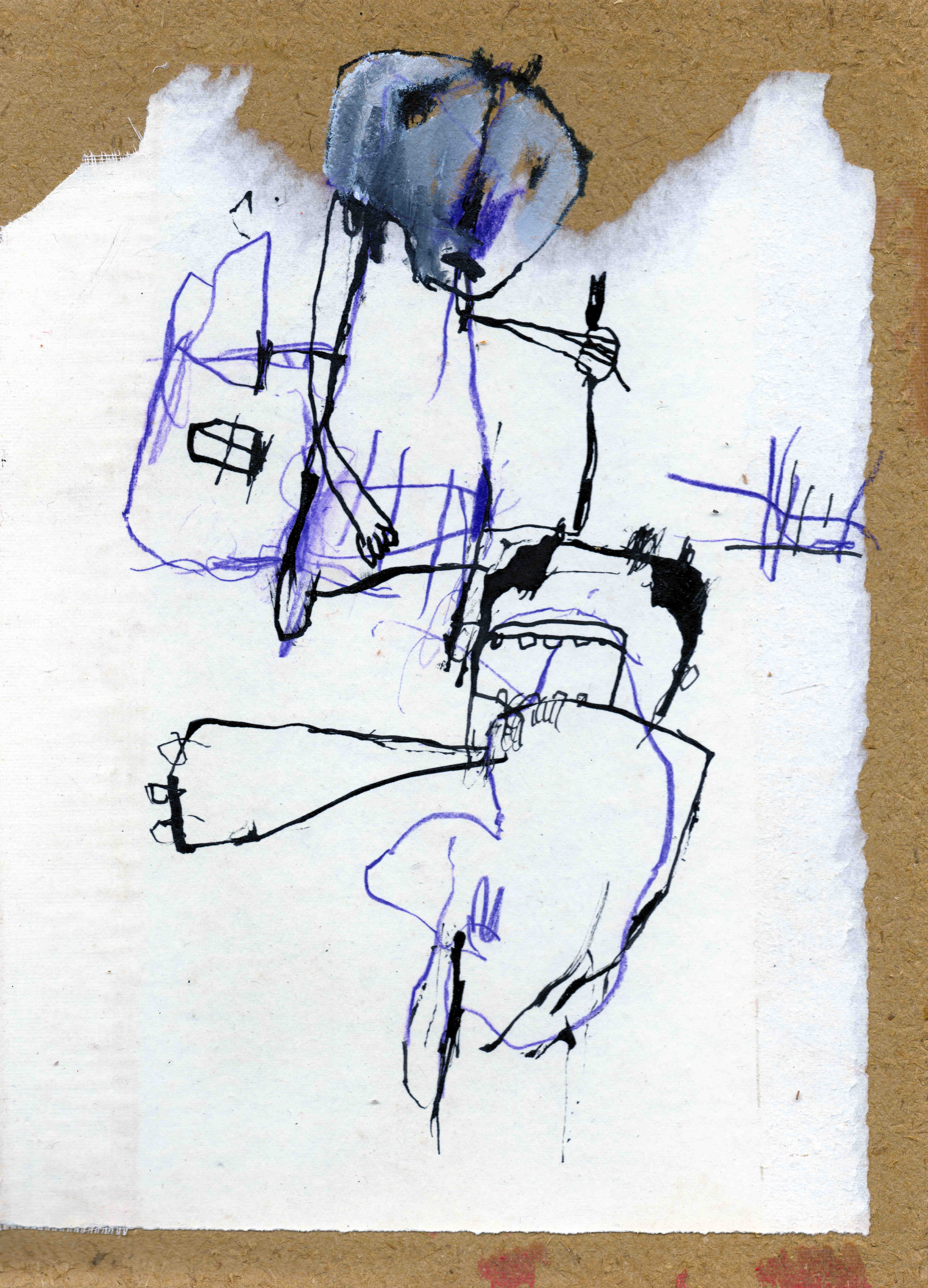
MH15 Dead poet, mixed media on paper, 21 x 29,7 cm, 2020
Dead Poet by Terry Chipp

DEAD POET

I’ve decided to stop
writing poetry,
due to my recent demise
and other mind to hand
coordination issues.

I now roam universal,
the eternal maverick,
shuffler of solar systems.

Great gravity storms,
I potshot their suns
into the nearest black hole.
It’s a quantum trick that
l learned on the trail.
I do this for money,
if you must know.

Now they call me
a street hustler,
as my likeness
waits in the next place
-carrying its own reward

As metaphorically
speaking,
I am now banned
from most galaxies
in this quadrant.

But they never said
it would be easy
being a poet.

-© Dai Fry 14th November 2020.

Just Thinking

Of anything but thinking.
Thinking of nothing and everything but that thing.
Thinking of the cold;
Cold floor, cold bones.
Count the goosebumps.
Listen to the drip
Of the tap
Like a metronome.
Hug your knees.
Think of comfort.
Think of touch.
Stop. Do not think.
Count the tiles.
Play imaginary chess.
It’s a game of resistant.
Let darkness come,
Become the white queen.

-Gaynor Kane

HUSH NOW

Hush now, sister,
this hurt will pass.

One day you’ll realise
its black roots
have left your heart
without you noticing.

So take this green bud.
Hold it to your chest,
let it unfurl inside you
and trust in time’s change.

=Susan Darlington

Dead Poet Thinking

both of us sit
downward contemplation:
one a sinner
other raised to heaven;
what has passed –
a moment, drawn

-Sarah Reeson

(Dead Poet)

“HELLO MY NAME IS something forgettable”

I’m a dead poet but if you stood by my grave
You wouldn’t know it
Not featured in textbooks
Not four hundred and something years old
Not critically acclaimed
My words aren’t dissected, adopted
Rearranged, reenvisioned
Banned or reaccepted
Streets don’t bear my names
No statues of my likeness
Not a feature of streaming networks’ original adaptations of my life’s work

(Just Thinking)

“This One Time In The Club”

What you were thinking:
That I was sad with drawn down corners of the mouth

What I was thinking:
It’s not natural to constantly smile
I’m fine
Besides, wasn’t aware that my expression
Didn’t meet your predetermined view of
What it should’ve looked like in that particular setting
Why can’t you stop smiling?

(Background Radiation)

What You PlayinAt?

Toxic behaviours like radiation
Reverbing round valleys
Nowhere to escape like
Trav’ling miles ending only on
The same spot again upside
Down try to change planes
On our backs but there it is again
Spun round eating our own tails
Something else has to change

-Lydia Wist

Background radiation

It’s coming like it or not,
the age of the three-legged pigs
and two-headed sheep,
the screaming chickens
and the calves with no mouths.

We watch the images on the screen,
pick up the groceries in their bright packages,
the meat neatly slabbed,
while the sun climbs higher and higher.

Ice melts,
forests burn,
we put on sunglasses.

-Jane Dougherty

Dead Poet

I sit here thinking how tired I am
of thinking. I’m desiccated,
an empty husk like the shell a cicada

shucks at rebirth. Waking is exhausting.
I crave the tender spring of new grass
underfoot, the soothing susurrus

of leaves slinging shadowed
silhouettes into catchments of pale
sun, the petrichor of clay in light rain,

muted comfort of slow-moving cloud.
Some days I want to burrow
into the roots of trees and sleep

for 17 years. Then wake insouciant,
winged; tymbals tuned to Summer’s
hymn.
-Gayle J. Greenlea

Flight

Jagged, snaggletoothed, these dreams of land,
a charred country where the dead tremble
like jig-sawed muppets, rag dolls, a raging of some sort,
almost spluttering, almost forgotten, forgone.
Where can I take these hands, these eyes? Mid-fall,
they start to look like someone else’s, flesh peeling right
off, bones emerging, hard and calcified, coagulated
veins and congealed with story, with history. They say
bones carry memory, carry time inside each deepening
groove. They say tombs are never silenced.
Somewhere, a woman gathers sarees
& jewels, spare change, scarcity, a stuttering earth
Somewhere a man packs knives just in case, for good measure, for a map,
a distance, a train ride, a rain full of eyes,
a sighing, a sighting. He looks around his home
one last time
before leaving it to burn.

-Anindita Sengupta

Dead Poet

The only good poet, some say.
Couldn’t live in a black and white world,
colorless, religion askew,
eyes ablaze for taking in,
mouth agape for savoring words.
A poet because long ago
a professor had leapt up on his desk
and declaimed out of the cradle
endlessly rocking, rocking the poet
to be. In the film he was portrayed
by a sad clown who later hanged himself.
Society of dead poets.

-Holly York 2020

Just thinking

Coiled into breath
words sink without ripples
in lightless waters, holding
in abeyance the hard wheel
of wind, spinning up from below
sternum, grasping my knees
suppressing the crying out
as emptiness pours
from my eyes, all my thoughts
a burning, lightning
touching sand, glass
not yet shattered.

-Peach Delphine

Dead poet

Hygiene not a virtue,
he lived for word
not even love,
what he used
holy for a moment,
always my horizons
we’re limited, expand
yourself, he liked to fuck
his proteges on the back porch,
an audience of squirrels
mourning doves, blue jays,
as if in that moment
fruit had dropped, golden
from the tree, now
here we are gathered
in the unity of the living
to give rest to the word
and flame, poor candle
burnt away to nothing,
utterance of ash.

-Peach Delphine

.day 15.

:: snowdrops ::

hold her up, you need to hold her up
stand each side of her

it is a challenge each day
to look at the images
remember

a challenge to deal with these things
some of us manage
to be vulnerable as naked
in private

some need holding up in sight
from my window

-..sbm..

Bios and Links

-Terry Chipp

grew up in Thurnscoe and ia now living in Doncaster via Wath Grammar school, Doncaster Art College, Bede College in Durham and 30 years teaching.

He sold his first painting at the Goldthorpe Welfare Hall annual exhibition at the age of 17 and he haven’t stopped painting since.

He escaped the classroom 20 years ago to devote more time to his artwork.  Since then he has set up his own studio in Doncaster, exhibited across the north of England as a member of the Leeds Fine Artists group and had his painting demonstrations featured on the SAA’s Painting and drawing TV channel.  Further afield he has accepted invitations to work with international artists’ groups in Spain, Macedonia, Montenegro and USA where his paintings are held in public and private collections. In 2018 he had a solo exhibition in Warsaw, Poland and a joint exhibition in Germany.

His pictures cover a wide range of styles and subjects from abstract to photo-realism though he frequently returns to his main loves of landscape and people.

Visitors are welcome at his studio in the old Art College on Church View, Doncaster.

e-mail:  terry@terrychipp.co.uk

Facebook:  Terry Chipp Fine Art Painting

Instagram: @chippko.art

-Marcel Herms

is a Dutch visual artist. He is also one of the two men behind the publishing house Petrichor. Freedom is very important in the visual work of Marcel Herms. In his paintings he can express who he really is in complete freedom. Without the social barriers of everyday life.
There is a strong relationship with music. Like music, Herms’ art is about autonomy, freedom, passion, color and rhythm. You can hear the rhythm of the colors, the rhythm of the brushstrokes, the raging cry of the pencil, the subtle melody of a collage. The figures in his paintings rotate around you in shock, they are heavily abstracted, making it unclear what they are doing. Sometimes they look like people, monsters, children or animals, or something in between. Sometimes they disappear to be replaced immediately or to take on a different guise. The paintings invite the viewer to join this journey. Free-spirited.

He collaborates with many different authors, poets, visual artists and audio artists from around the world and his work is published by many different publishers.

www.marcelherms.nl

www.uitgeverijpetrichor.nl

-Jane Dougherty

writes novels, short stories and lots of poems. Among her publications is her first chapbook of poetry, thicker than water. She is also a regular contributor to Visual Verse and the Ekphrastic Review. You can find her on twitter @MJDougherty33 and on her blog https://janedougherty.wordpress.com/

-Peach Delphine

is a queer poet from Tampa, Florida. Infatuated with what remains of the undeveloped Gulf coast. Former cook. Has had poems in Cypress Press, Feral Poetry, IceFloe Press, Petrichor. Can be found on Twitter@Peach Delphine

-Dai Fry

is a poet living on the south coast of England. Originally from Swansea. Wales was and still is a huge influence on everything. My pen is my brush. Twitter:  

@thnargg

Web: http://seekingthedarklight.co.uk

-Susan Darlington

Susan Darlington’s poetry regularly explores the female experience through nature-based symbolism and stories of transformation. It has been published in Fragmented Voices, Algebra Of Owls, Dreams Walking, and Anti-Heroin Chic among others. Her debut collection, ‘Under The Devil’s Moon’, was published by Penniless Press Publications (2015). Follow her @S_sanDarlington    

-Holly York

lives in Atlanta, Georgia with her two large, frightening lapdogs. A PhD in French language and literature, she has retired from teaching French to university students, as well as from fierce competition in martial arts and distance running. She has produced the chapbooks Backwards Through the Rekroy Wen, Scapes, and Postcard Poetry 2020. When she isn’t hard at work writing poems in English, she might be found reading them in French to her long-suffering grandchildren, who don’t yet speak French.

-Gayle J. Greenlea

is an award-winning poet and counselor for survivors of sexual and gender-related violence. Her poem, “Wonderland”, received the Australian Poetry Prod Award in 2011. She shortlisted and longlisted for the Fish Poetry Prize in 2013, and debuted her first novel Zero Gravity at the KGB Literary Bar in Manhattan in 2016. Her work has been published in St. Julian Press, Rebelle Society, A Time to Speak, Astronomy Magazine, Headline Poetry and Press and The Australian Health Review.

-Helen Allison

lives in the North East of Scotland. Her first poetry collection ‘ Tree standing small’ was published in 2018 with Clochoderick Press. Her work has appeared in journals and magazines in print and online and she is working towards a second collection.

-Lydia Wist

Like someone who tries out hats or other samples before making a final decision, experimenting with different ideas and techniques is how Lydia spends some of her time. This allows for other portions of time to speak through the lens of fiction, creative nonfiction and art. You can find her work at Cargo Collective , Lydia Wist Creative and on Twitter @Lydiawist.

Website links:

https://cargocollective.com/lydiawist

https://www.facebook.com/lydiawistcreative/

-Sarah Connor

lives in the wild, wet, south-west of England, surrounded by mud and apple trees. She writes poems to make sense of the world, and would rather weed than wash up.

-sonja benskin mesher

-Liam Stainsby

holds a bachelor in English Literature and Creative Writing and is a secondary school teacher of English and Creative Writing. Liam is currently writing his first, professional collection of poetry entitled Borders that explores poetry from all around the world. Liam also Co-Hosts a movie discussion podcast entitled: The Pick and Mix Podcast. Liam writes under the pseudonym ‘Michael The Poet’ 

Links: WordPress: https://michael-the-poet.com/

Twitter: stainsby_liam

Instagram: Michael The Poet

-Sarah Reeson

is 54, married and a mother of two, who has been writing and telling stories since childhood. Over the last decade she has utilised writing not just as entertainment, but as a means to improve personal communication skills. That process unexpectedly uncovered increasingly difficult and unpleasant feelings, many forgotten for decades. Diagnosed as a historic trauma survivor in May 2019, Mental health issues had previously hindered the entirety of her adult life: the shift into writing as expression and part of a larger journey into self-awareness began to slowly unwind for her from the past, providing inspiration and focus for a late career change as a multidisciplined artist.

Website: http://internetofwords.com

-Gaynor Kane

is a Northern Irish poet from Belfast. She has two poetry pamphlets, and a full collection, from Hedgehog Poetry Press, they are Circling the Sun, Memory Forest and Venus in pink marble (2018, 2019 and Summer 2020 respectively). She is co-author, along with Karen Mooney, of Penned In a poetry pamphlet written in response to the pandemic and due for release 30th November 2020.  Follow her on Twitter @gaynorkane or read more at www.gaynorkane.com.

Anindita Sengupta

is the author of Walk Like Monsters (Paperwall, 2016) and City of Water (Sahitya Akademi, 2010). Her work has appeared in anthologies and journals such as Plume, 580 Split, One and Breakwater Review. She is Contributing Editor, Poetry, at Barren Magazine. She has received fellowships and awards from the Charles Wallace Trust India, the International Reporting Project, TFA India and Muse India. She currently lives in Los Angeles, California. Her website is http://aninditasengupta.com 

Wombwell Rainbow Interviews: Philip Dawson Hammond

Wombwell Rainbow Interviews

I am honoured and privileged that the following writers local, national and international have agreed to be interviewed by me. I gave the writers three options: an emailed list of questions or a more fluid interview via messenger, or an interview about their latest book, or a combination of these.

The usual ground is covered about motivation, daily routines and work ethic, but some surprises too. Some of these poets you may know, others may be new to you. I hope you enjoy the experience as much as I do.

Out Of Mind

Philip Dawson Hammond

Philip Dawson-Hammond was born in 1959, in the industrial mill-town of Dewsbury, West Yorkshire.
The son of a shopkeeper, Philip was educated at Highfield Grammar School in Wakefield, and later at Leeds College of Technology, where he qualified as a machine printer.
However, he has previously spent over thirty years in the local newspaper trade, both on production and in an editorial capacity as a regular columnist and feature writer for a series of provincial titles.
Since starting to write at the age of sixteen, Philip has developed a style of his own, covering a rich variation of subject matter, which he feels has resulted in the discovering of his own individual voice within the diversity of modern verse.
Philip is married with one grown-up son, and now lives with Cathy, his wife of five years, in Sprotbrough, South Yorkshire.

https://pegasuspublishers.com/books/philip-dawson-hammond/out-of-mind

The Interview

  1. What inspired you  to write poetry?

I think it was during that long hot summer of 1976 when I was studying at Wakefield College of Technology. I was hoping to get into some sort of publishing, though I didn’t yet know into which exact area I wanted to be. However, the college did have a very well stashed library, something I was quick to take advantage of. It was there I stumbled across the Merseybeat poets. Roger McGough, Brian Pattern and Adrian Henry wrote in styles I had never even imagined existed. It was quite an Epiphany for me. Admittedly I had already dabbled in the classics, and was very much aware of poetry as a means of expression, though it wasn’t until around this time that I had any inclination to write it myself. Interestingly, only one poem still exists from this period, and is about to be published in ‘ Out of Mind’, over forty-five years later.

2. Who introduced you to poetry?

It wasn’t a person – it was a place: Tennyson Down on the Isle of Wight during the August of 1972. Like I said, I had dabbled in the classics from an early age. I was twelve-year’s-old, and very impressionable. Tennyson appears to haunt this very atmospheric Western tip of the island, and I was on a mission to learn more about the place. And the poetry of Alfred Lord Tennyson seemed to be the quickest route to take.

3. How aware were you of the dominating presence of older poets?

Never really thought of it. I remember buying a copy of John Betjerman’s Collected Poem. I think, by this time, I must have been around eighteen, and Betjerman, to me then, was very much the ‘elder statesman of English poetry.

4. What is your daily writing routine?

Don’t have one. Having said this – I wish I had. It would be so convenient….!!

5. What motivates you to write?

The need to proverbially keep my head above water. I am constantly in fear of letting an idea slip me by. I don’t have a great memory, and I constantly feel the need to scribble things down before I forget them. These so called ‘things’ could simply be an opening line to a new poem, a rhyming couplet or an original idea (or, at least, original to me).

6. What is your work ethic?

Write as much as you can, when you can, and as often as you can. And then throw as much of it away – as you can.

7. How do the writers you read when you were young influence you today?

Not many, I don’t think – not now, though I’m sure they did before finding my own voice. If I had to mention any, I would point to the ones already mentioned above, plus Dylan Thomas and Leonard Cohen.

8. Who of today’s writers do you admire the most and why?

There are many. Keeping it confined to poets exclusively, though, I would say Bob Dylan, Ian Parks and Simon Armitage.

9. Why do you write?

Need.

10. What would you say to someone who asked you “How do you become a writer?”

Write.

11. Tell me about the writing projects you have on at the moment.

 Probably more now than any one time in my life. This interview is one of them, of course. My collected poems, ‘ Out of Mind’ is due for publication on the 26th. of this month. I don’t wish to announce details of other ongoing projects, as they are not guaranteed to be seen through to fruition at this moment in time.

Thank you for reading, Philip Dawson-Hammond.

Jamie

Uncollected Works's avataruncollectedworks

Eulogy for the Beautiful Soul and Literary Arts Activism Genius , G Jamie Dedes
G. Jamie Dedes

G. Jamie Dedes passed away last Friday, November 6, 2020.

Jamie

You came to us, a little girl,

An immigrant,

When immigrants were welcome.

From the East you came

Like the sun from the Atlantic,

You, who knew the cedars of Lebanon.

Your roots were deep in the moist earth

And your branches spread widely,

Blessing immigrants and natives alike

With the fruit of your gentle wisdom.

Gentleness was always your path,

Beauty and Truth your travelers.

Your path was always high above our heads

But you showed us how to walk

The razor’s edge with soft feet.

Go softly, Sweet Gentle,

And light the night

With our hearts.

                                    November 6, 2020

View original post

Drop in Brendon Booth-Jones

Nigel Kent's avatarNigel Kent - Poet and Reviewer

I’m more than delighted to welcome Brendon Booth-Jones to reflect on one of the poems from his prize-winning Vertigo to Go

First of all, thank you for having me on to your ‘drop in’ series, Nigel. It’s a real pleasure to be among such esteemed company.    

I decided to talk about my poem Sonnet from my debut collection Vertigo to Go, published, as you well know, by The Hedgehog Poetry Press earlier this year. Sonnet is probably the most difficult poem in the collection, so I figured a bit of context and a dip into my personal poetics might be of interest to readers.

Vertigo to Go is a series of poems that traces the highs and lows of a young protagonist named Ashley. Ash is a composite cobbled together out of parts of myself, people I have encountered in my life and my imagination. I wrote most of…

View original post 509 more words

November Ekphrastic Challenge: Day 14

Jane Dougherty's avatarJane Dougherty Writes

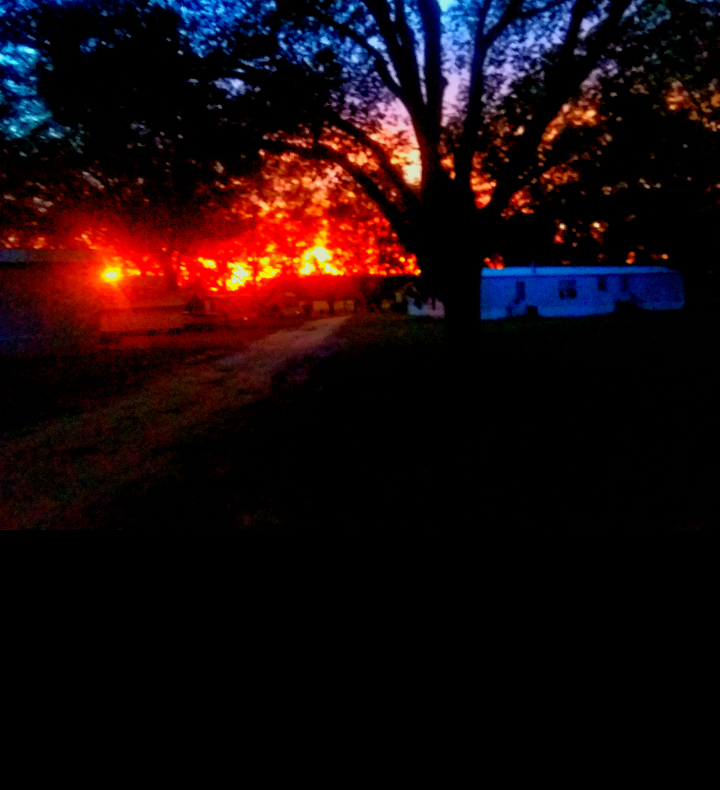
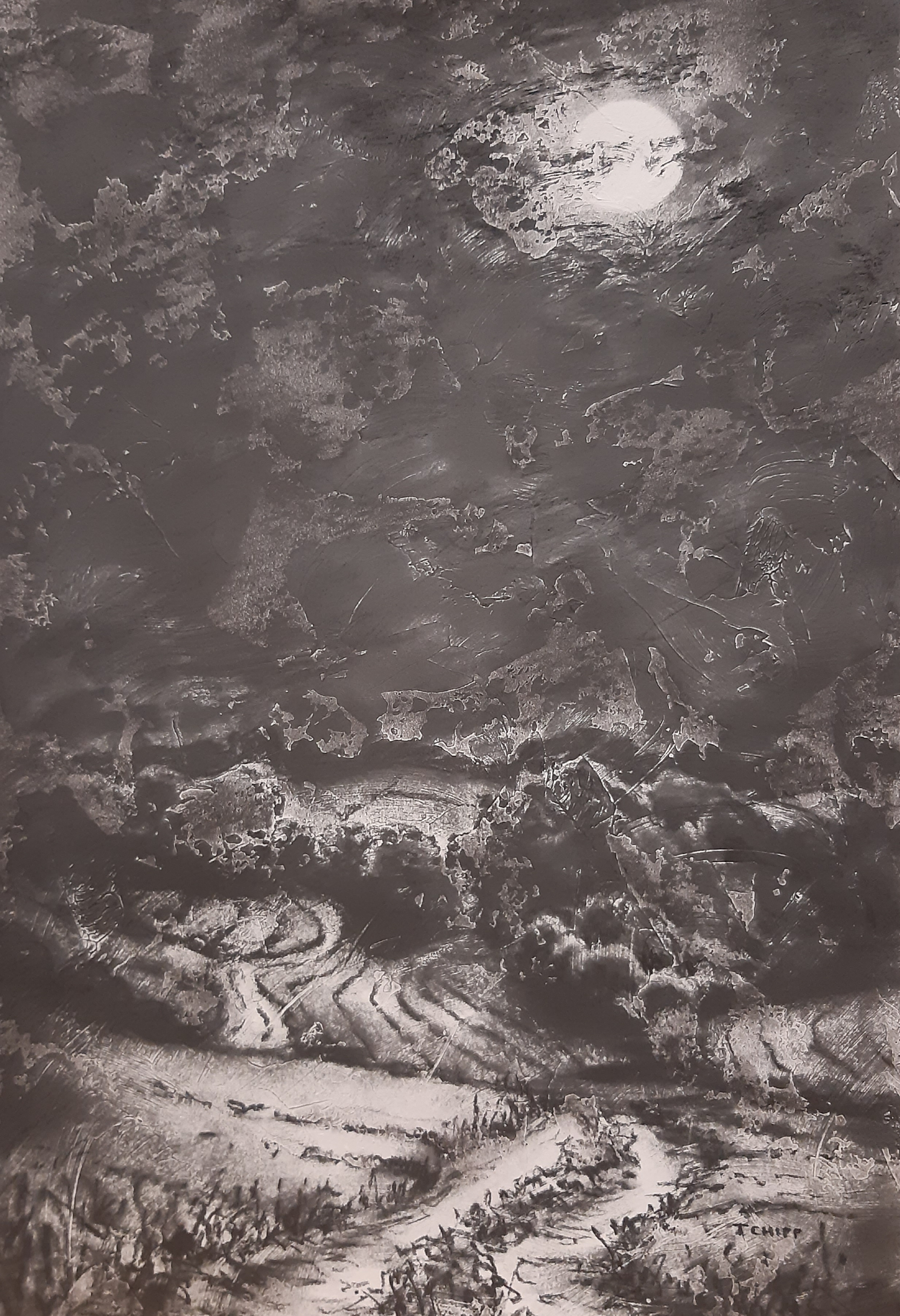
For Day 14 of Paul Brookes’ challenge, I have used this startling photo by MJ Saucer and Terry Chipp’s High moon.

MJS14

Mars

If the flames rise high enough,
the oceans full of coral bones
and starved tatters of walrus skin
roll high enough,
tempests and hurricanes blow hard enough,
the piles of dead in quicklime pits
belch corruption strong enough,
will the inferno
tossed from our flailing arms
burn up the moon?

TC14 High moon

View original post

Day Fourteen : Welcome to a special ekphrastic challenge for November. Artworks from Terry Chipp, Marcel Herms, MJ Saucer, P A Morbid, the inspiration for writers, Gaynor Kane, Peach Delphine, Sally O’Dowd, sonja benskin mesher, Anindita Sengupta, Liam Michael Stainsby, Helen Allison, Sarah Connor, Sarah Reeson, Holly York, Jane Dougherty, Gayle J Greenlea, Susan Darlington, Lydia Wist, Dai Fry, and myself. November 14th.

Day Fourteen
MJS14
-MJ Saucer
TC14 High moon
High Moon by Terry Chipp
MH14 De verlosser, mixed media on card board, 18,5 x 25,4 cm, 2019
Der Verlosser by Marcel Herms

Messiah Rising

Albion’s land
thru arable night,
a perennial winter’s tale.
Far as can, from edge,
fox-copse-shadow,
they forage as families.
Hedge bound,
fields their furrows
ice crimped.
Lepus europeaeus, feasting
foods of wintertide.
Their heavens shine
baleful orb light.
Frozen eight times under
silver black moon.
I wait patiently for
messiah’s rise.
A dawn blooded
weak winter’s sun,
was still-born to
freeze in short day’s
clench cold grip.
I sat here as
a solitary watcher,
at journey’s end.
Dark the dawn of light.
In new sun hanging
ragged and forlorn,
the brown hare will rise
ghostly from her form
taking a two leg stand.
A rival may appear
or morning will bring
its own salvation for
her leverets in
their nest of fur.

© Dai Fry 13th November 2020.

Mars

If the flames rise high enough,

the oceans full of coral bones
and starved tatters of walrus skin
roll high enough,

tempests and hurricanes blow hard enough,

the piles of dead in quicklime pits
belch corruption strong enough,

will the inferno
tossed from our flailing arms
burn up the moon?

-Jane Dougherty

Hunger

A field of paddy darkens, blisters
with rain. The blood and bone
of the world breathes in our ears.
The woman shines on, oblivious
to strands of hair across her face.

Tracks cut earth where wild grass
bends. Many have collapsed here
in obeisance. Aah, in Urdu, means
moan or sigh. The woman knows this
but does not reply. Her face ages.

-Anindita Sengupta

De verlosser

The Savior arrives, wearing a jetpack.
Seeing so many to save, she starts
to feel blue-faced and daunted at the task:
all the lost must be accounted for
and raised, even this gnash-toothed sobber
who bathes her gown in toxic tears.
She hopes he won’t begin to gnaw
her ankles as his tiny hands flail
chords on their invisible squeezebox
and the crowd chants “Lock her up!”

-Holly York 2020

.day 14.

:: line drawing ::

watched it twice those days when we could travel

see exhibitions

quiet slow and uneventful
it left lasting impressions
a simple drawing out
no fuss

and sometimes late in the evening
think of it
leave the house
and return to the simple line drawing

-..sbm..

High Moon Saviour

did you save me
from darkness, lit
by our belief
in landscapes, drawn
through circumstance;
as artistry

-Sarah Reeson

(Untitled photo)

“Burning (Material) Evidence”

Sick burns, burnout, embarrassment
Break downs, burn downs and third degree burns
Papers, shredding and crackling confetti
Celebrations, bonfires and burning stars
Denial, dancing and flaming hearts

(De Verlosser)

“Rewind”

It is a relief as pain is removed,
Absorbed from its source –
Poison from a wound
Veins relax after tensing
An exorcism of sorts has begun

(High Moon)

1
On the night before
It happened, Earth’s moon was
Strong and full and round
It pulled on tides, which pulled on sands –
Made ripples from broken down rocks and minerals –
I’d imagine these static waves as snakes standing by

2
On the night before It happened
Earth’s status remained unchanged

3
High over countryside less sway is seen but
Moon’s soft light touches everything
Makes shimmering soldiers of grassy fields
Protected by dense walls of trees, hedges, bracken
Landscapes wait, with or without incident, for
The changing of the guard – the return of Earth’s sun

-Lydia Wist

Verlosser (Messiah)

If I were you, I would rethink
positioning myself as messiah.
Disciples expect too much from the gods
Glory and adulation are short-lived,
humans fickle, addiction mistaken
for love. Sacrifice is the price
of immortality; arrow through
the heart, a self-inflicted wound,
castration, immolation. Ask Krishna,
Attis, Quetzalcóatl, Tammuz — saviours
dethroned, cast into the Underworld
to atone for sin. If you are the chosen
surrogate to mediate mercy from
heaven, prepare to save Dreamers,
free children from cages, bake cakes
for gay weddings, pay reparations,
hand women control of their wombs
There is no half-way in Goloka,
Omeyocan, Valhalla, Nirvana. God
is a servant who masquerades in flesh
Persephone in the garden, Radhika
milking cows, Kuutar spinning silver
yarn from the moon. The day comes
soon when you must leave Olympus,
wrest requisite redemption from dark
angels below. This time bone spurs
won’t spare you. Reveal yourself.
Are you demigod or simulacrum?

– Gayle J. Greenlea

Caravans and Petrol Bombs

We lived there. I bellydanced
for the neighbour, his hands
in rubber gloves washing dishes.
Our bed went through
the rotting floor. In winter
we had to bring the gas bottle
in. We ate drunken chips
made in the deep fryer
at 2am and didn’t set
the place on fire. When
we moved it became
a poshpad for the pups.
I’d left Christmas toffee
in the wardrobe. Opened
the door and a nest full
of baby mice smaller
than pink marshmallows
jumped out into my face.
We locked the terrier in
the room to sort it out.
When it no longer served
any purpose we made
molotov cocktails in Dale Farm
milk bottles. Threw them
through the windows
and watched it burn.

-Gaynor Kane

A NEW DAY

They tiptoed through the city of sleepers,
the night air swallowing the catcalling
that had followed them all their lives,
the hands that had snaked from dark alleys
to slap and grab at their bare legs.

They tiptoed with lightness in their hearts.
Dreamed of striking a match, throwing it
over their shoulders and walking away
without looking back, the streets burning
and the sun rising over a new day.

-Susan Darlington

Bios and Links

-Terry Chipp

grew up in Thurnscoe and ia now living in Doncaster via Wath Grammar school, Doncaster Art College, Bede College in Durham and 30 years teaching.

He sold his first painting at the Goldthorpe Welfare Hall annual exhibition at the age of 17 and he haven’t stopped painting since.

He escaped the classroom 20 years ago to devote more time to his artwork.  Since then he has set up his own studio in Doncaster, exhibited across the north of England as a member of the Leeds Fine Artists group and had his painting demonstrations featured on the SAA’s Painting and drawing TV channel.  Further afield he has accepted invitations to work with international artists’ groups in Spain, Macedonia, Montenegro and USA where his paintings are held in public and private collections. In 2018 he had a solo exhibition in Warsaw, Poland and a joint exhibition in Germany.

His pictures cover a wide range of styles and subjects from abstract to photo-realism though he frequently returns to his main loves of landscape and people.

Visitors are welcome at his studio in the old Art College on Church View, Doncaster.

e-mail:  terry@terrychipp.co.uk

Facebook:  Terry Chipp Fine Art Painting

Instagram: @chippko.art

-Marcel Herms

is a Dutch visual artist. He is also one of the two men behind the publishing house Petrichor. Freedom is very important in the visual work of Marcel Herms. In his paintings he can express who he really is in complete freedom. Without the social barriers of everyday life.
There is a strong relationship with music. Like music, Herms’ art is about autonomy, freedom, passion, color and rhythm. You can hear the rhythm of the colors, the rhythm of the brushstrokes, the raging cry of the pencil, the subtle melody of a collage. The figures in his paintings rotate around you in shock, they are heavily abstracted, making it unclear what they are doing. Sometimes they look like people, monsters, children or animals, or something in between. Sometimes they disappear to be replaced immediately or to take on a different guise. The paintings invite the viewer to join this journey. Free-spirited.

He collaborates with many different authors, poets, visual artists and audio artists from around the world and his work is published by many different publishers.

www.marcelherms.nl

www.uitgeverijpetrichor.nl

-Jane Dougherty

writes novels, short stories and lots of poems. Among her publications is her first chapbook of poetry, thicker than water. She is also a regular contributor to Visual Verse and the Ekphrastic Review. You can find her on twitter @MJDougherty33 and on her blog https://janedougherty.wordpress.com/

-Peach Delphine

is a queer poet from Tampa, Florida. Infatuated with what remains of the undeveloped Gulf coast. Former cook. Has had poems in Cypress Press, Feral Poetry, IceFloe Press, Petrichor. Can be found on Twitter@Peach Delphine

-Dai Fry

is a poet living on the south coast of England. Originally from Swansea. Wales was and still is a huge influence on everything. My pen is my brush. Twitter:  

@thnargg

Web: http://seekingthedarklight.co.uk

-Susan Darlington

Susan Darlington’s poetry regularly explores the female experience through nature-based symbolism and stories of transformation. It has been published in Fragmented Voices, Algebra Of Owls, Dreams Walking, and Anti-Heroin Chic among others. Her debut collection, ‘Under The Devil’s Moon’, was published by Penniless Press Publications (2015). Follow her @S_sanDarlington    

-Holly York

lives in Atlanta, Georgia with her two large, frightening lapdogs. A PhD in French language and literature, she has retired from teaching French to university students, as well as from fierce competition in martial arts and distance running. She has produced the chapbooks Backwards Through the Rekroy Wen, Scapes, and Postcard Poetry 2020. When she isn’t hard at work writing poems in English, she might be found reading them in French to her long-suffering grandchildren, who don’t yet speak French.

-Gayle J. Greenlea

is an award-winning poet and counselor for survivors of sexual and gender-related violence. Her poem, “Wonderland”, received the Australian Poetry Prod Award in 2011. She shortlisted and longlisted for the Fish Poetry Prize in 2013, and debuted her first novel Zero Gravity at the KGB Literary Bar in Manhattan in 2016. Her work has been published in St. Julian Press, Rebelle Society, A Time to Speak, Astronomy Magazine, Headline Poetry and Press and The Australian Health Review.

-Helen Allison

lives in the North East of Scotland. Her first poetry collection ‘ Tree standing small’ was published in 2018 with Clochoderick Press. Her work has appeared in journals and magazines in print and online and she is working towards a second collection.

-Lydia Wist

Like someone who tries out hats or other samples before making a final decision, experimenting with different ideas and techniques is how Lydia spends some of her time. This allows for other portions of time to speak through the lens of fiction, creative nonfiction and art. You can find her work at Cargo Collective , Lydia Wist Creative and on Twitter @Lydiawist.

Website links:

https://cargocollective.com/lydiawist

https://www.facebook.com/lydiawistcreative/

-Sarah Connor

lives in the wild, wet, south-west of England, surrounded by mud and apple trees. She writes poems to make sense of the world, and would rather weed than wash up.

-sonja benskin mesher

-Liam Stainsby

holds a bachelor in English Literature and Creative Writing and is a secondary school teacher of English and Creative Writing. Liam is currently writing his first, professional collection of poetry entitled Borders that explores poetry from all around the world. Liam also Co-Hosts a movie discussion podcast entitled: The Pick and Mix Podcast. Liam writes under the pseudonym ‘Michael The Poet’ 

Links: WordPress: https://michael-the-poet.com/

Twitter: stainsby_liam

Instagram: Michael The Poet

-Sarah Reeson

is 54, married and a mother of two, who has been writing and telling stories since childhood. Over the last decade she has utilised writing not just as entertainment, but as a means to improve personal communication skills. That process unexpectedly uncovered increasingly difficult and unpleasant feelings, many forgotten for decades. Diagnosed as a historic trauma survivor in May 2019, Mental health issues had previously hindered the entirety of her adult life: the shift into writing as expression and part of a larger journey into self-awareness began to slowly unwind for her from the past, providing inspiration and focus for a late career change as a multidisciplined artist.

Website: http://internetofwords.com

-Gaynor Kane

is a Northern Irish poet from Belfast. She has two poetry pamphlets, and a full collection, from Hedgehog Poetry Press, they are Circling the Sun, Memory Forest and Venus in pink marble (2018, 2019 and Summer 2020 respectively). She is co-author, along with Karen Mooney, of Penned In a poetry pamphlet written in response to the pandemic and due for release 30th November 2020.  Follow her on Twitter @gaynorkane or read more at www.gaynorkane.com.

Anindita Sengupta

is the author of Walk Like Monsters (Paperwall, 2016) and City of Water (Sahitya Akademi, 2010). Her work has appeared in anthologies and journals such as Plume, 580 Split, One and Breakwater Review. She is Contributing Editor, Poetry, at Barren Magazine. She has received fellowships and awards from the Charles Wallace Trust India, the International Reporting Project, TFA India and Muse India. She currently lives in Los Angeles, California. Her website is http://aninditasengupta.com 
Wombwell Rainbow Interviews: Antony Dunn

Wombwell Rainbow Interviews

Antony Dunn

Anthony Dunn

was born in London in 1973, and now lives in Leeds. He won the Newdigate Prize in 1995 and received an Eric Gregory Award in 2000. He has published three collections of poems, Pilots and Navigators (Oxford University Press, 1998), Flying Fish (Carcanet OxfordPoets, 2002) and Bugs (Carcanet OxfordPoets, 2009).

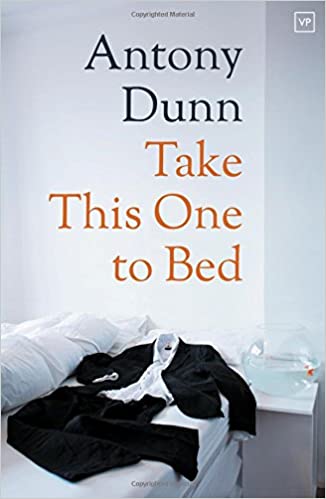
In 2015, he was the editor of Ex Libris, a volume of selected poems by David Hughes. His own fourth collection, Take This One to Bed, was published by Valley Press in October 2016.

The Interview

Antony Dunn

  1. What inspired you  to write poetry?

I’m not honestly sure I remember. I have vague memories of a book my parents gave me when I was very, very young – a treasury of poetry with lots of illustrations. I remember something about the fairies in the fireplace… By the time I was ten or so, I was writing poems a lot, at school, anyway. I wrote one about fox cubs in winter and my English teacher made me write it out nicely and he stuck it on the wall. I thought that was really something at the time. And I loved the game of making the rhyme and rhythm work properly.

Later, it was girls – or, specifically, my first proper girlfriend – that inspired me. She had to endure a number of overwrought sonnets, poor thing.

2. Who introduced you to poetry?

My parents, of course, but when I was teenager there was an English teacher at my school called David Hughes. He never taught me formally, but he became a real mentor for me. He was aware that I wrote lyrics for a pop band (me and my friend Simon), and somehow he got hold of scores and scores of the lyrics. I really can’t think how, now. But he went to the trouble of writing a paragraph or two of criticism on each of those lyrics, which must have taken him hours. Then he gave me the notes, and the gist was really, “Take out the oos and aas and the I love you babys, and apply some more rigorous rules, and you’ll be writing actual poetry.” That really struck me, and it felt as if he’d identified something right in the very essence of me that I hadn’t noticed before. Then I was off… And Dave and I would hang out and talk about poetry, and he introduced me to Edward Thomas and Ted Hughes and Wilfred Owen and took my poetry seriously.

And at almost the same time, I met my first proper girlfriend, and it turned out her father was Nigel Forde – a wonderful poet himself and, at the time, presenter of Bookshelf on Radio 4. He had a massive collection of poetry books, and when I moved in with the family for my gap year before university, we’d often stay up late, talking about poetry and swapping drafts and criticisms. It was wonderful.

So I was very lucky indeed to have those two pushing me on and seeing the potential in what I was writing when I was flailing about trying to work out what on earth I was doing. I owe them a lot.

3. How aware were you of the dominating presence of older poets?

Well, very, in the sense that I held a number of poets in high esteem to the point at which I was in awe of them. Edward Thomas and Ted Hughes, later Philip Larkin and Seamus Heaney, and later still Simon Armitage (who’s only ten years older than me). I wanted to be them, in a way, and I measured my poems against theirs frantically. And of course I always found my poems wanting in that way, which maybe made me work harder? I’ve relaxed a lot in that regard over the years, but I do still have jealous pangs when I read something brilliant that I know I’ll never match.

4. What is your daily writing routine?

Ha ha. Um… Wake up with low-level anxiety about writing, then don’t do any writing. That’s it. I’ve never had a routine, ever. I used to write a lot, and I’ve slowed down incrementally over the years.

Having said that, if I remove myself from real life for a bit something odd happens. A few times I’ve gone away for a week or so to a cottage somewhere with my lovely friend, the poet Matthew Hollis, and we’ve imposed a regime on ourselves. Get up early, drink coffee, write until lunchtime, then long walks, the pub or an afternoon writing if we’re really in the swing. And I’ve always come away from those with new poems, sometimes one from every day of the stay.

I also teach residential courses for the Arvon Foundation at Lumb Bank in Yorkshire and at Totleigh Barton in Devon. There I get up really early, often 5am, write until morning classes start, and then go for late afternoon walks with a notebook. And there again, I come home with new poems every time. Unfortunately, I seem to have trained myself only to write in those environments, and those moments don’t come round that often.

5. What motivates you to write?

That’s different from poem to poem. I don’t ever sit down to do some poetry-writing. I start writing because something very precise and specific has popped into my head and I urgently need to wrangle it before it disappears. Those ideas are like dreams – they’re vivid for a bit, but before you know it all you can remember is the vividness, not the idea itself, and that’s incredibly frustrating.

6. What is your work ethic?

Broken. Next! I look at all those people on Facebook doing NaPoWriMo in absolute disbelief.

7. How do the writers you read when you were young influence you today?

All sorts of ways, I’m sure, noticed and unnoticed. Matthew Sweeney presides still over some of my more surreal, imaginary story-poems. I reckon some of Thomas Hardy’s lyricism has rubbed off on me. And Eward Thomas’s. Simon Armitage’s precision-tooled clarity and cleverness definitely still make me want to write the way he does.

8. Who of today’s writers do you admire the most and why?

Ah, where to start? I love Daljit Nagra for his ability to be both jester and statesman. Kathleen Jamie’s poems break my heart every time. Danez Smith’s Don’t Call Us Dead was a remarkable recent read which I can’t stop thinking about. Jo Shapcott’s wild invention is breathtaking. I’m impatiently waiting for James Giddings to publish another book because his first pamphlet, Everything is Scripted, was brilliant. Julia Copus’s poems seem to be both experimental and, at the same time, absolutely familiar, and I love them. Did I mention Simon Armitage at all yet?

9.  Why do you write, as opposed to doing anything else?

I don’t. I pair socks. I make packed lunches. I load the dishwasher. I unload the dishwasher.

10. What would you say to someone who asked you “How do you become a writer?”

Read books. Loads of books. Go to poetry readings and performances. Find what you love and what inspires you. Read more books and go to more gigs. Start scribbling as you go along. You’re a writer.

11. Tell me about the writing projects you have on at the moment.

Honestly, just ‘writing a poem’ counts as a project for me. But there’s one thing I’ve started thinking about recently. When my son was born in 2010 I was talking to Matthew Hollis about how new-parent-poets must feel the need to write new-parent-poems, and I vowed I wouldn’t do that. Obviously, I did do that, and there are a few of them in Take This One to Bed. I’ve written a few more since then, too. I’m plotting to write a couple more, then publish them as a very limited-edition pamphlet, beautifully made and hand-printed in letterpress, with illustrations by a brilliant artist. I know who she is, but I haven’t asked her yet. And I’m going to call it The Poems I Promised I Wouldn’t Write.

‘She Wouldn’t Be Able To Come To You So Often If She Were Alive’ – A Poem and Two Images by clare e. potter

robertfredekenter's avatarIceFloe Press

‘She Wouldn’t Be Able To Come To You So Often If She Were Alive’*

from Kim Hyesoon

It’s when I’m washing, usually, the dishes,
it’s when I’m lost in a heat of suds
and I’m looking out the window, not staring
mind you, not fixed on anything but not really
seeing, it’s then, it’s then I feel her. I feel her
hand on my shoulder, and now I think of it
the first time was when the kids were babies
when I was delirious and brushing bottles
and teats, decontaminating and weeping into the sink
standing in my piss, and there, her hand on my shoulder;

this first touch was a light touch
not on account of her being dead of course,
she is no longer a wisp of a thing, but
on account of her not wanting to shock
me, on account of her bringing me back
into myself…

View original post 117 more words