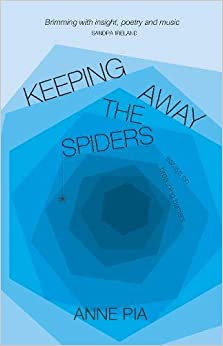
Anne Pia
 1. When and why did you start writing poetry and essays?
I have written for most of my life, from the five year diaries when I was a child, to adolescent poetry, to curriculum papers, government and inspection reports, articles on education for the Times Literary Supplement; my doctoral thesis over ten years ago.
But there was a singular event in my life in 2011 when my personal life crashed. I went travelling to the Hebrides with a tent and met a woman who was writing sonnets. She too was grieving. We talked about writing and I sent her some stuff to comment on. Shortly after when I was working as a volunteer on Holy Isle, the Buddhist Centre, I got up early one day and started to write …two poems. After that, it seemed as if they poured out of me. I was prolific …couldn’t stop.
At the end of 2014, a good friend challenged me to write a book in 2015 and Language of My Choosing came about. “I wont ever write a book” had been my reaction but the book just evolved…no plan… one thing led to another. It was almost as if, once I started, that the book was already inside me.
I write in order to start a conversation; in order to connect with people. I think that in order to do that, you need to be authentic and in that, being vulnerable.
2. Who introduced you to poetry and essays?
My whole focus as I grew up was on music, words and the arts generally. Music as well as words… almost all music has been so important to me. I learned the piano in my teens and since then have learned to play other instruments including the mandolin and now the fiddle. I have recently been delving into contemporary classical women composers. For me, poetry and prose have a music; they sound as well as speak on the page.
My first awakening to poetry and imagery was at school when I was blown away by DH Lawrence, Masefield, Keats, Wordsworth and Milton. There was one teacher that really brought poetry alive. She passed on her love of the poems by her emotion and her energy and you couldn’t help but respond…totally inspiring. My first degree at Edinburgh University was in the Arts and Humanities. I studied French and Italian literature and language, Philosophy and English Literature. My close reading of the poetry of Dante in The Divine Comedy trilogy especially; of Petrarch’s beautifully tender love poems to Laura and of the imagery of Charles Baudelaire, Impressionist and Modernist, where a feeling could be evoked through a blend of colour and sound gave me a strong sense of the power of words. I learned the craft of sparseness in Prévert’s work and the words of songs also made a big impression. Especially Georges Moustaki and Georges Brassens with his pithy, rustic and acerbic commentaries on French life and the bourgeoisie.
I think it was through my study particularly of French that I somehow saw words and word combinations as entry points to something deeper or universal and I think there are certain words which by their very nature, the sound they make, immediately convey what they represent. For instance..papillon in French, “farfalla” in Italian or Spanish “mariposa” all words for butterfly. You can almost hear the wings and see the flight in the sound of the words.
The essay form is one I am totally familiar with through my Arts Degree background though I hadn’t planned to return to it when I started writing Spiders. That form however, somehow seemed to fit what I was doing with the book, with the structure. It isn’t a far cry either from writing for academic purposes or writing an article for a journal.
2.1. Why did “DH Lawrence, Masefield, Keats, Wordsworth and Milton” blow you away?
Rich imagery, beauty, a great dignity, worthiness and and an underpinning philosophy.
2.2. How did the essay form “seem to fit what you were doing with the book, with the structure.” in writing Spiders?
The book grew from the notion of a series of collages which I carefully crafted or worked and reworked into essay form; a mix of imagery, honest retrospective and reflection and where I felt useful, the addition of evidence from current research or examples from other writing.
Each piece is illuminated with the irrepressible energy, the upsurge of a lust for life, with excitement at possibility and of discovery. In every essay there is a sense of travel forward, of self making and an assertion that self reliance is ultimately where our innate creative power resides.
The central unifying message… what ties all the essays together… but there is a basic framework from where that unifying message comes: a philosophy of impermanence …nothing is solid and everything passes; the transformative power of learning and openness; the existential precept of taking responsibility for one’s own life.
3. How aware are and were you of the dominating presence of older poets and essayists traditional and contemporary?
I want to honour what has gone before but at the same time, to stand firmly in the time I live in and to through current thinking and trends, look to a future in terms of writing style and what I write about. I have learned my craft from other writers past and present and gathered inspiration through encounters and conversation. There’s a strong European dimension in my writing. That comes from from my own hybridity (I am rooted in Italian and Scottish culture and have a strong leaning towards French culture too) as well as my background as a linguist. I have also been influenced by contemporary feminist writing…Gay, Beard, Solnit and so on, by current biographers and Nordic and Middle Eastern literature.
I want to bring the concept of the aesthetic back into conversations about writing. That is what I take from older literature… the beauty and eloquence of the image; and I particularly appreciate the undressed directness and honesty of a lot of writing today.
Ultimately, I am not aware of any dominating presence but I am affected by what I like, appreciate or am in awe of in writing old and new.
4. How did you decide on the order of the essays in “Spiders”?
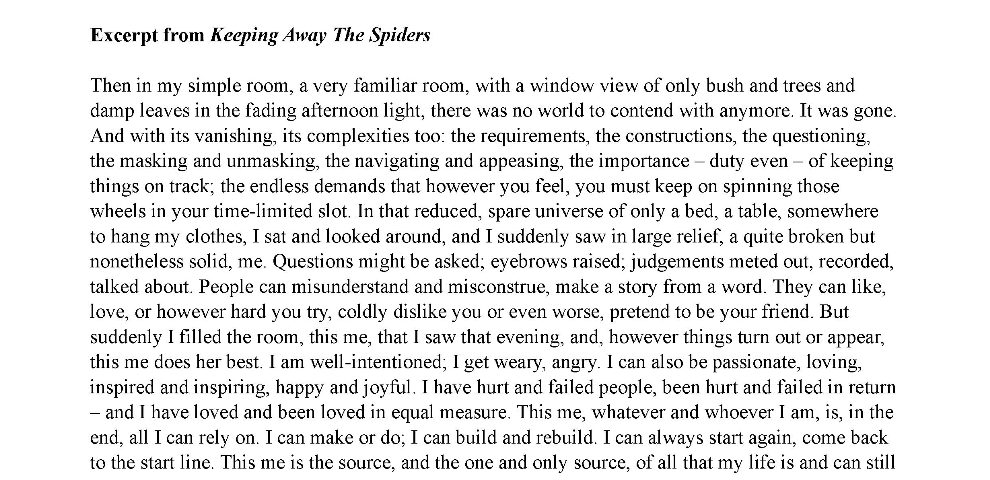
We felt that the essay On Miracles in Keeping Away The Spiders was the rawest and the “beating heart of the book” to quote my editors. That dictated how the other collages appeared. I also felt that the essay “and final notes” should round off the entire collection. “Variations”.. theme and different articulations of a melody line… is a metaphor and an appropriate place to end. I added “Then along came a spider” after my grief for the book written before the pandemic eased and I discovered hope and belief again.
5. What is your daily writing routine?
I am not a routine person in any way and that applies to writing too. There are many days, weeks when I don’t write. I find that my need to make music often competes. When I am fully into music, I get blocked as a writer and the opposite happens too. My current living pattern is dictated by the need to finish translating. The Sweetness of Demons my new poetry collection to be published next spring by Vagabond Voices, is my response to fourteen of Baudelaire’s poems in Les Fleurs du Mal. We decided only a few months ago that a translation into English of the poems should appear together with the original French and my own poem. I am really enjoying the challenge of working in two languages…excavating the original French word to find its true sense and then seeking the best match in English. But as one commentator said… it was Pichois I think, Baudelaire is untranslatable!
So, I write in blocks of time that’s to say, once I start, usually a first line of a poem, then I can’t stop or leave it alone until I feel it’s the best it can be for now.
6. Why are the essay titles in “Spiders” in lowercase?
Because I wanted the book to be intimate… open and fluid…to start a conversation and I wanted to remove any sense of formality.
7. How do the writers you read when you were young influence your work today?
Not really at all. As I said, I have a great admiration for the aesthetic be it in writing, artwork or music and I think its place is maybe a conversation that writers might have. What is it? How do I recognise it? Is it relevant to today? Can rawness, directness and the aesthetic co-exist? But I am far more interested in young people, and in the language and currency of young creatives; what they work on, where they work, what inspires them and how they work. I very much want to know and understand how young people experience and connect with the world.
8. Who of today’s writers do you admire the most and why?
I have very much enjoyed Italian crime writing, Giuttari, Camilleri, Donna Leone and Umberto Eco. I have been chilled literally by Nordic Noir Larsson, Jo Nesbo, Mankell, I have been captivated and single minded in my reading of Kate Mosse’s amazing French trilogy… so well researched and native. And I am very drawn always to magical realism…to Murakami, Zafon, Allende. One of the best books I have ever read was Love in a Time of Cholera, by Gabriel Garcia Marquez… sheer lyricism and immense dignity, like a Mozart Adagio or a Lera Auerbach Prelude.
I enjoy literature from the Middle East, Khaled Hosseini and I have read several of Elif Shafak’s books and some feminist literature including Women Who Blow on Knots. A writer very well worth reading is Abukabar Adam Ibraim’s Season of Crimson Blossoms. I find Amor Towles’ books fascinating and as a hybrid myself, Kassabova’s Border.
As an educationist, I found Darren McGarvey’s Poverty Safari trenchant, challenging and right on … for the middle class education establishment and for politicians it was a head blow… a directive to get real and start to legislate and free up resources for the deprived and “hidden under the covers” majority in Scotland.
Elena Ferrante gave me permission to write about Italy and an upbringing in an Italian home with raw honesty, a first in Scotland. And so, I admire her for that, for her convincing portrayal of Italian life in the South. Some of that I can relate to very well, having seen some of it. And an author whose work apart from Murakami whose writing has such strength and dignity, I would place at the top of my list is Karl Ove Knausgaard whose six volume autobiography I have read from cover to cover. From the smallest detail, he takes us on a journey of memories and layer by layer, reveals intimate aspects of who he is… his vulnerabilities, his fears and his aspirations. His writing is clear, accessible…relatable to as a human being and fascinating. His writing is like a French film where the sound of putting down a coffee cup hangs significantly in the air and leaves you in suspense.
The essayists who have inspired me have been among others, Caitlin Moran, almost all of whose books I have read; Roxane Gay and Mary Beard. I found Samantha Irby’s book Wow No Thank You interesting though it was launched after my own book of essays was finished. But generally, I found all of these essayists hugely funny, challenging, impressively honest and political. I have to mention Rebecca Solnit’s epic Men Explain Things to Me, a book which gave me the language to express what I had been feeling for many years.
I am a huge fan of bell hooks an academic who writes about gender and race issues…she was a huge influence when I was writing my own thesis “Teaching To Transgress: Education as the Practice of Freedom.
My poetry idols range from among many, Seamus Heaney, Yevtushenko (both of whom I have heard reading in person), Andrew Greig, Sharon Olds and Kathleen Jamie. Jay Whitakker’s poetry is economic, precise, exquisitely crafted and so eloquent and I love Janette Ayachi’s work, a creative avalanche of words which rock, make you laugh, make magic. Maybe like a Philip Glass sonata with pace!! I love rupee kaur’s milk and honey,,,,,real, direct and very moving. Some of these really make me shiver.
9. What would you say to someone who asked you “How do you become a writer?”
If you want to be a writer, just sit down and write. I am trying to decide as I answer this question, whether or not I wanted to be a writer. I certainly wanted to write! Various things come to mind to help the writing process … working out the best space to write in
and that may be a tent or a coffee shop; that space may vary from day to day; the best time… your most creative time; keeping all your notebooks and revisiting them from time to time and so on. Trying not to panic when no words come and other people you know are writing every day… getting events and getting published.
It is ultimately quite a solitary life and despite all the smiles and blandishments, you will find who your true friends are… those around you who are genuinely pleased for you when things go well. It is your journey. You need to stay steady, keep believing in yourself at the same time being realistic; the world isn’t waiting with bated breath to read what you have to say! There are always disappointments… and if one or several publishers don’t want your stuff, there may still be one who does!!
I think one question is an important one to consider… why do you want to write? Is it self expression, a catharsis? Is it to bring to light a human experience and explore it? For me, ever the educator, I see my writing as a space for conversation… I write to start that conversation; and my books are only one part of communication between me and others, the other part is when the book becomes live through events that bring people together to share. If you like, the book creates a little community of practice and commonality which makes us all feel better, understood, valued… not alone in our life experience.
Lastly, it is never too late… there is no best time or best age and every voice brings something important… the trick in being heard, is to continually craft, mould and sculpt so that we can be best heard. That is always the challenge when you write. And we constantly seek but never find perfection but you can’t stop trying.
10. Tell me about the writing projects you have on at the moment.
I have only this week, completed a two year project on Baudelaire. I sent the manuscript The Sweetness of Demons off to my publisher yesterday. It’s been a wonderful journey involving my 14 poems in response to the poems that touched me most in his Les Fleurs Du Mal. But as well as that creative process which really consumed me, I also set about translating the original French … also I believe a creative process! It was so satisfying getting to the heart of Baudelaire’s language and images and summoning all my linguistic and writing ability to render his wonderful, impressionist verses. He is known, despite all the translations, to be untranslatable! What is elusive, is combining the image and the sound.
I am about to start putting a poetry pamphlet together but haven’t worked out what final direction that will take. Maybe a book on food which is one of my passions as a hybrid… an Italian Scot. I have a wonderful connection with the University of Catania where Language of My Choosing, my first book, is on the set curriculum; and they have invited me to go over in May hopefully, to work with colleagues and students currently researching ‘hybridity’..how that changes your life view as you live on borders.
I am honoured to announce my recent elevation to the Scottish Poetry Library’s digital catalogue of Scottish poets and this month I am the Featured Writer in the Federation of Writers Scotland. I have several online “events”/conversations, interviews, arranged, to showcase my new book Keeping Away The Spiders and I hope to expand that outreach. While the loss of live events is a drastic loss… the wonderful get-togethers and readings… zoom gives a much broader, international opportunity and I am hopeful that we can use that tool, even in better times, to great advantage.
11. Once the have read “Spiders” what do you hope the reader will leave with?
Once they have read the essays I want the reader to leave with a sense of empowerment, optimism and a lust for life and adventure; to greet each day afresh. I want her to feel that she can be whoever she wants and that whatever she wants, what ever makes her happy, lies within her. We can almost always find freedoms, sometimes very small ones, and always space for some manoeuvre. During the pandemic, like all of us, I have felt terrible despair; I weep at loss of all that was; I give myself a hard time over all that I took for granted. I hate myself for that. But I know too that I found lovely experiences too. Small nuggets of unexpected joy and different ways to go.
I want the reader to believe that identity is flexible, malleable and a matter of choice and response to whatever is around.
Paul Freire sees education as the attainment of a powerful democracy. As an educator I know that transformation is always possible; it changes lives; profoundly changes who you are. And as a not very good Buddhist, I know that all things will pass.
Lastly, I do want the reader to open up these conversations with those of us around, for the good of us all.


![WP_20190717_15_25_00_Pro[42311] (2)](https://thewombwellrainbow.com/wp-content/uploads/2020/12/wp_20190717_15_25_00_pro42311-2.jpg)


 The Wombwell Rainbow