Wombwell Rainbow Interviews: John Huey

Wombwell Rainbow Interviews

I am honoured and privileged that the following writers local, national and international have agreed to be interviewed by me. I gave the writers two options: an emailed list of questions or a more fluid interview via messenger.

The usual ground is covered about motivation, daily routines and work ethic, but some surprises too. Some of these poets you may know, others may be new to you. I hope you enjoy the experience as much as I do.

John Huey’s

student work of the 60’s-70’s was influenced by teachers in Vermont such as John Irving at Windham College and William Meredith at Bread Loaf.
After many years he returned to writing poetry in 2011. He has had poems presented in ‘Poetry Quarterly’ and in the ‘Temptation’ anthology published in London by Lost Tower Publications. Work has also appeared in ‘Leannan Magazine’, ‘Sein und Werden’, at ‘In Between Hangovers’, ‘Bourgeon’, ‘The Lost River Review’, ‘Red Wolf Journal’, ‘Perfume River Poetry Review’, ‘What Rough Beast’, ‘Poydras Review’, ‘Flatbush Review’ and ‘Memoir Mixtapes’. In 2018 he appeared in two further Anthologies, ‘Unbelief’, published by Local Gems Press, and ‘Addiction/Recovery Anthology’, published by Madness Muse Press. His full-length book, ‘The Moscow Poetry File’, was published by Finishing Line Press in November 2017. Full information and Amazon links can be found at www.john-huey.com .

The Interview

1. When and why did you start writing poetry?

I started writing poetry in late 1964 or there about as a very young American High School student in Suburban Washington, DC, who had, quite fortunately, received some great guidance form an inspired teacher and his wife who pointed me in the direction of Ginsburg and Ferlinghetti who, though not available in the school library or formal course of study, I did find in a local chain bookstore and devoured immediately. Whitman, of course, was more readily available, and he was also an early major  influence. Bob Dylan also had a great deal to do with this awakening in another realm and history has shown that I was right in picking him out as a primary and early source of inspiration.

As a kid who “didn’t quit fit” I noticed, that despite a stable home and family environment in 1950’s – early 1960’s “White Bread America”,  that something was “off” and missing in that long gone world and I started to wonder why.

As I had already noticed poets who had come before questioning their place in society I felt that writing something on my own might help with my own questions. To both my delight and relief it did and sorting things out on the page through poetry quickly became a regular, then daily, habit of mind.

2. So would you say it was the inspired teacher and his wife who introduced you to poetry?

It was in the air. The teachers lit the flame but I would have picked it up within a year of that one way or the other. There was only one other real poet kid in my High School and I met him in 1965 and he was into all the beats that you could find in our environment there. Right place, right time.

3. How aware are and were you of the dominating presence of older poets traditional and contemporary?

Context is everything, a bit later, in college, I came under the influence of visionaries such as Hart Crane who, for a while, totally dominated my writing as the beats and Bob Dylan had done a bit earlier on. The British kicked in with Blake (psychedelic  visions thereof) and a college professor friend introduced me to Donne and the other 17th Century influences like Herbert. The Earl of Rochester fascinated me for other reasons but somehow I did manage to stand my own ground with, for better or worse, my own voice though the 19th century romantics such as Keats had their way with me as did Coleridge (more drug influences included there)..

This is a difficult question of course and there are dozens of important influences on me such as Edward Thomas, Dylan Thomas, Yeats, Auden, Plath and later, lesser known voices such as Weldon Keys who played a major role. While still alive, Berryman was looming at the time as was Lowell in their obsessions and brilliant downward spirals.

Every worthwhile poet is, to some degree, responsive to the sum-total of his or her influences but stands up for their own vision in the end.

4. What is your daily writing routine?

It varies greatly and I wish I had the discipline of some my great old poet friends like Gary Lemons (‘Snake’ series of books that are a must read) who can write every morning.

Much of what I like best takes place past midnight and is written, not without irony, on this handheld device with rough cuts emailed to myself to work on later.

For major projects like my recently completed 60’s-early 70’s book I have have a full vision and a deadline in mind and write to that.

I was stuck on the final section of this book, called ‘The Sunset Fires’, and exiled myself for a week to Putney, VT where a large chunk of the book takes place to “workshop” the final ten poems in a week. That tactic worked in that case but most of the time I write late at night only when so moved and revise in the mornings on the big screen.

5. What motivates you to write?

Another variable open ended question!

Initially, as a young person, it was a quest for identity combined with a desire to communicate in a unique and visionary way. All high mountaintops and idealization mixed with the ever present emotional upheaval of the young.

By the late 70’s I had burned through this vein and when some personally acquired bad habits, along with an unwise marriage, really kicked in I had an all purpose reason to stop and that’s exactly what I did.

The “bad habits” continued into the 80’s where, after leaving the idealizations surrounding a  yet to be fully kindled academic career behind, I somehow figured out how to make money in a totally unrelated career that eventually took me to every corner of the earth.

After taking my last drink in early 1987 I embarked on a second marriage and a family and was just too crazy busy to think of anything else. At least that’s what I told myself at the time when I saw my friends still writing oand publishing.

By 2004 the second marriage was effectively over and an opportunity presented itself to take my then thriving consulting business to Russia where I became a distributor of security screening equipment.

In early 2006 I met, in Moscow, the woman who is my current wife and the intensity and excitement of our life in Russia together became something that literally few people in the West could believe much less understand.

After the inevitable end of my Russian businessi in 2009 we came back to the US where I knew, in my bones, that the Russia “adventure” needed to be chronicled somehow. Though I didn’t fully extract myself from that place until 2013 in 2011 I began writing what became ‘The Moscow Poetry File’ which was my attempt to somehow transfer some of that undefinable and amazing experience into verse. I think I at least partially succeeded on that score.

After the Moscow book I completed two further collections that are still seeking publishers while being fortunate enough to appear in three anthologies as well as numerous magazines both on line and in print.

These books proved to be “event driven” as well and I find that the observable world provides more than enough incentive and stimulus to be both the subject and motivator for poetry.

I’m looking for the essence of both the times and the situations that unfold at this later stage of life and time itself, at age 70, gives me more than enough motivation to “get it down” while and where I can.

5.1. What does “event-driven” and “observable world” mean to you?

In addition to how I address this indirectly in my introduction to ‘The Sunset Fires’ (PDF attached) I am, at root, a determined lifelong atheist and dialectical materialist who only believes what is perceived by the senses in the observable universe. What moves people is both internal and external but all of human history and motivation can be explained by physical/chemical/biological properties as they interact with human populations over time. My favorite Englishman, by many a mile, is Charles Darwin, and I view the world through the lenses developed by Darwin and his fellow geniuses’ of Science and Nature.

But “where is the mystery” you might say? To me there is more than enough “mystery” to go around…. For example, “Where the hell did Trump come from and why is he the embodiment of pure human evil?”, “Why do some people recover from alcoholism and addiction and others die horribly and alone? “, “Why do some find love and lifelong happiness while others, just as capable, end up bereft?”, “Why does randomness determine so many final outcomes in life and are there any external reasons for these effects?”…The list goes on and on, is endless, and would provide countless subjects for Poetry over countless lifetimes.

6. What is your work ethic?

My “work ethic” goes back to the days of my late mother who, along with many other old time, Protestant American verities, instilled in us the proposition that “when you start something you finish it” which, these days, leads to very few incomplete fragments in the work I attempt now.

The exception to this is when I’m outside my wheelhouse as when I try to write fiction where an idea for a long incomplete novel has been kicking around in fragments for nearly a decade.

Poems however, when started, are always completed as are books.

I wasted enough time when I was on my “hiatus” from writing between 1978 and 2011 to waste any time now.

7. How do the writers you read when you were young influence you today?

All of the  writers who influenced me in my youth still resonate of course but there are several who are still a never ending presence.

Ginsburg, despite the overdone hippie trappings and embellishments, still remains central in his revolution of style and strength of spirit that propelled him forward as the indisputably essential beat poet. His shadow is long and his diction and unrelenting cadence still occupy the background in everything I write.

As a lifelong resident of Washington, DC the ghost of Walt Whitman, in his Civil War years, has been present in the city and in my writing as a beacon of goodness in the midst of the death and dismemberment  of the hospitals he visited daily during those times. A visionary artist can live a visionary life and while I have never been able to achieve such goodness that great, generous spirit shows me the way to a better way always despite the small chance of fully achieving anything approaching that.

Hart Crane was another gay man who suffered terribly when alive without Whitman’s vast resources of compassion and self love.

Through the alcoholic suffering Crane always showed great courage as a writer and his transcendent lyrical beauty is something  I have always reached for but have never, of course, been able to fully grasp.

The writers I most admire are better than I can ever hope to be and triumph over history and adversity to get to the palace of the “gods” with the only form of immortality available to us. The transmission of exactly where they wanted to be over time and the truth of the message, sometimes at the peril of the messenger, is all that any poet, as he or she ages, could aspire to.

There are many others other than these three of course but it is these voices I hear most clearly down to these days.

8. Whom of today’s writers do you admire the most and why?

There are people I really respect writing now like John Robinson and Charles Wright but most of what I see in the major journals passes me right by. I’m either too old to “get it” or not “tuned in” to most of what’s out there these days. I guess you will never find me in the audience at a “poetry slam”… Enough said on that. Dylan said, when I was young, “Don’t criticize what you can’t understand.” I really should leave it there before I start a riot or burn someone else’s house down.

My good friends who I know personally and who I have watched develop are a whole other matter and I get a world of good from the work of Gregory Luce who I have known for over 20 years and Gary Lemons who I have known for 50. These poets really encouraged and nurtured me when I returned to writing and their ability to hang in there for the “long haul” is really inspiring as are their books.

A great regret was the premature death, in 2006, of my wonderful friend from my college days in Vermont, and fine poet, Gregory Jerozal. He was never properly published in book form during his life and I’m on a mission, with his wife’s permission, to try to pull a proper book together from his many existing journal publications and old manuscripts I have. I’m being remiss for not completing this project and I hope I’m done before life is finished with me. He was a really fine poet and I miss him greatly. He would be a shining light if alive today.

8.1. Why do you admire these writers?

The writers I admire say what they mean and mean what they say without fashionably correct subjects and points of emphasis. A poet who gets to the heart of the matter and gets the reader to feel that it’s true, with a strong voice, and not written in a poetry workshop somewhere, is a poet I want to read. Allot of what I see out there is in a pale thin voice and the poets I admire most are the opposite of that.

9. What would you say to someone who asked you “How do you become a writer?”

I don’t think that you “become” a writer at all. It’s something you are. When I was 15 I was a writer and have no recollection of how that happened. It’s just something I had to do after having read some things that moved me. Artists in that sense are born, not made. at least that’s the way I look at it. The idea of writers “schools” has always amused me though I was, myself, greatly encouraged by my undergraduate creative writing teacher, John Irving, who, in terms of poetry, was more of a friend, coach and cheerleader than teacher. Likewise, when I went to Bread Loaf the one on one sessions I had with the fine poet William Meredith were also more of the same coaching and encouragement I had experienced with John. Those fine writers didn’t teach me, they inspired.

I was a writer even in those many years that I wasn’t involved at all and I know that because of the fact that things I have written since my “return” in 2011 have a tenor and a voice that I know was in gestation while I was dormant.

Back in the 90’s one of my friends I met in Secular AA was the late Washington DC cultural luminary and black arts movement poet Gaston Neal. I spent a great deal of time with him the year before his death in 1999 and he looked at me one day and told me “You are a poet, always have been and always will be and I know you will write again.” 12 years later I did.

10. Tell me about the writing projects you have on at the moment.

In addition to trying to get two further volumes of poetry published and continuing to write individual poems to send around to the journals I have had, as I mentioned earlier in response to one of the questions, a long delayed novel in the works that may prove too daunting to complete any time in the near term. The project in question takes place in a timeline from the late 60’s to the early 90’s and involves hippie thieves based in Vermont, the scene around a long defunct artists bar on Lower Broadway in Manhattan called St Adrian’s, a Washington Post journalist and some unique and disturbing circumstances involving parties known and now departed as well as a purely fictional cast of characters who propel the narrative forward despite their early and premature demise.

I’m not at all happy defining my own limitations but I may have met them here. I’m spending a week with an old poet friend in Vermont this coming May to get close to some primary sources with a person who was there

“When” who may be able to help me in moving this difficult (for me) manuscript off the proverbial dime at last.  We shall see.
Wombwell Rainbow Interviews: Adrienne Silcock

Wombwell Rainbow Interviews

I am honoured and privileged that the following writers local, national and international have agreed to be interviewed by me. I gave the writers two options: an emailed list of questions or a more fluid interview via messenger.

The usual ground is covered about motivation, daily routines and work ethic, but some surprises too. Some of these poets you may know, others may be new to you. I hope you enjoy the experience as much as I do.

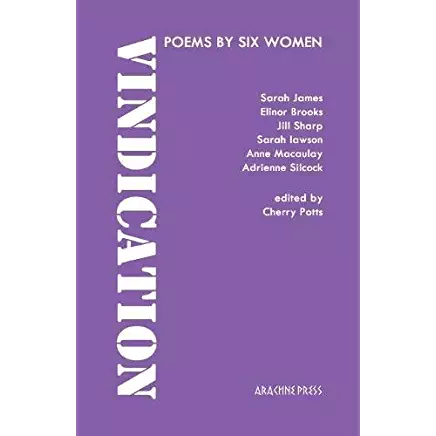
vindication

Adrienne Silcock’s

poetry has appeared in various magazines and anthologies, performing her poetry widely. In 2014 she published her first pamphlet Taking Responsibility for the Moon with Mudfog Press. Her first novel Vermin was published by Flambard in 2000. Her second novel Controlling Aphrodite was shortlisted for the Virginia Prize 2009. Her third novel The Kiss is published on kindle. She has previously produced two poetic sequences, Flight Path and The Fibonacci Sequence. She is a featured poet in 2018 collection by six women poets Vindication (Arachne Press). She has worked in mental health and community education, including teaching creative writing.

Links:

http://www.adriennesilcock.co.uk/

https://arachnepress.com/books/poetry/vindication-poems-from-six-women-poets/

https://www.amazon.co.uk/Vermin-Adrienne-Silcock/dp/1873226411

http://www.mudfog.co.uk/portfolio-item/taking-responsbility-for-the-moon/

https://www.amazon.co.uk/The-Kiss-ebook/dp/B008T4TEQU

The Interview

  1. What inspired you to write poetry?

Something in my DNA, I think! I’ve been writing almost as long as I can remember. I wanted to express myself as a teenager and I loved words. My brother inspired me to write my first full poem when I was stuck on a homework exercise. It was about a river. I discovered I liked the process.

  1. Who introduced you to poetry?

Teachers. Especially a funny little man (one of only two male teachers in an all-girls’ school) who was new and took some of the literature lessons when I was sixteen…I discovered a passion for the expressed word – Owen, Chaucer, Shakespeare, Auden, Eliot… Prior to that I’d been an avid novel-reader.

  1. How aware were you of the dominating presence of older poets?

I think I had a prejudicial yawn against pre-twentieth century poets…I wanted avant-garde, post-modern, crazy, rebellious voices…So, yes, I was aware of them, but I think I should have kept a more open mind before casting them to the wind. Unfortunately I associated Coleridge with dreary rows of wooden desks with ink wells and few windows (early grammar school). You can only grow your mind if you keep it open.

  1. What is your daily writing routine?

Ha! At one stage (luxury!) I was writing between 9 to 1pm most days of the week, then lunch and walking. But of course, like many people, I had to earn a living. So I fit my writing in on those special days available to me, and the rest of the time I do whatever I can to earn a crust.

  1. What motivates you to write?

My favourite question…because this is the spring barrel of what makes me tick! I have to write. Like breathing. It reminds me of who I am and of my humanity. I love the process. There is nothing more satisfying or peaceful than having passed a couple of hours in a creative zone. It is satisfying to stir around in all that dross inside yourself and arrange it into words, ideas and a poem or story in a way that you didn’t even know was there! Also, it’s a way of processing all that anger about the inequalities and wrongs in the world around us, with a hope that a poem might just touch someone else to want to do something positive about it. But maybe that’s too much to wish for…

  1. What is your work ethic?

To write about the world, but not to libel anyone. To tell the truth, but in creative ways. Never to write about real people without their knowledge (so, actually, never…) though that’s not to say I don’t write in composites. To write about the world in a literary way, so it’s Art and to be enjoyed as Art. Never to let my writing get in the way of caring about the people I love around me, i.e. if someone needs me, I’m there for them.

  1. How do the writers you read when you were young influence you today?

They influence me all the time, and I still go back to them. Wilfred Owen for speaking out against the horror of war, Eliot for challenging how poetry and ideas are expressed, Auden for his dogged philosophy. And many others, I absorbed via osmosis and I carry them in my heart.

  1. Who of today’s writers do you admire the most and why?

Difficult because there are so many. Alice Oswald and the late Mary Oliver. Graham Mort. Billy Collins has to be one of my favourites because of his casual style. I love the American poets from that point of view. The informality. The way something can be expressed in a personal, accessible way and yet refer to something in the classics, and have those layers. They’re warm and they touch you. So important in a poem, I think. And yet they turn things on their head.

  1. Why do you write, as opposed to doing anything else?

It gives me “Me time”. It’s almost a meditation, but you are creating something and you’re giving vent, even to something soft and non-aggressive like love. It’s a time to enjoy, to feel at peace, to remind yourself you’re human. It’s quality time. But I think it has to be done in balance with the rest of your life. People are important to me as well.

  1. What would you say to someone who asked you “How do you become a writer?”

That is so tricky! Because, when does someone become a writer? Many of us are writers at heart. For many of us the writing process is vital to who we are. I was born a writer. But I have not made a living out of writing. I haven’t paid the mortgage by it. I have published and still publish, but if someone wants to become a professional writer who wants to be able to pay for the beans on toast by it, I would say that you have to be prepared to do all those business things that creative people very often prefer to steer away from – social media, networking, pitching, developing a writing platform, readings, etc , etc. All those things which draw you away from that valuable writing time. On top, I think you have to be prepared to do those periphery jobs, too, which actually are very enjoyable in their own right, i.e. writing workshops, teaching, mentoring, copywriting, editing, proofreading (if you can get it – it’s competitive), apply for residencies, join NAWE. And keep your fingers crossed! Also, you need dedication and persistence – it ain’t going to happen overnight, No, Sir!

  1. Tell me about the writing projects you have on at the moment.

Well, I’m trying to bring herbs into the twenty-first century by writing poems about them! So it’s a pretty bonkers project. I love the way good writers layer centuries of history in with modern concepts, and this is what I’m trying to do with herbs. They have been used as cures, as salves, in folklore and in myth for as long as civilisation has existed, and yet they are almost forgotten, except for the odd bit of basil on the marguerita. So I’m writing a series of poems which combines today with old concepts of cure. I’d like to find a wacky illustrator to provide some herbal illustrations, rather in the mode of William Blake Songs of Innocence and Experience!!

Otherwise, I’m writing a few poems imbued which gentle woodland philosophy…who knows which forest path that will go along? Oh, and possibly a novel in the offing…

Looking forward to the March broadcast of my hour long interview with Mark Antony Rossi of Strength To Be Human. I talk about my interview series and my writing.

https://strengthtobehuman.podbean.com/p/contrib-bio-links/

TWO POEMS BY AND AN INTERVIEW WITH ANJUM WASIM DAR, PAKISTANI WRITER, ARTIST AND EDUCATOR

Fascinating

Jamie Dedes's avatarJamie Dedes' THE POET BY DAY Webzine

the poet by day, makes me a poet by night
how sweet is the sensation how smooth the flight
in  holy silence, words flow on, with delight
as the hours pass by, dawn breaks into light 
Anjum Wasim Dar


Over my life
I have drifted,
along, with the flow-

I came to know
I have to go, be slow
To move step by step
shed tears drop by drop,

Over my heart I found,
nothing was my own
It all had to be gifted,
to known and unknown,

Over my heart I saw,
as inside I bled
outside all was black ,

as the invisible was red,
love’s return, hard to find,
to complete a good age

we ourselves must be
loving caring and kind.

Spirit of Two Spheres

O My Spirit
someone has seen you
In sound and silence,
felt you in celestial
sphere,
O spirit where dost thy…

View original post 3,221 more words

Submissions: Great practical advice from Mark Antony Rossi on his Strength To Be Human series of podcasts.

Episode 13: Waking the Lion: Inside Writing — Submissions  https://lnns.co/RXB_Dal5woI via @ListenNotes

Wombwell Rainbow Interviews: Julia Webb

Wombwell Rainbow Interviews

I am honoured and privileged that the following writers local, national and international have agreed to be interviewed by me. I gave the writers two options: an emailed list of questions or a more fluid interview via messenger.

The usual ground is covered about motivation, daily routines and work ethic, but some surprises too. Some of these poets you may know, others may be new to you. I hope you enjoy the experience as much as I do.

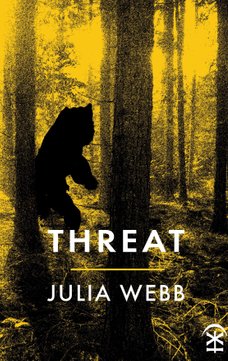
Threat Cover WEB

Julia Webb

graduated from UEA’s poetry MA in 2010. She lives in Norwich where she works for Gatehouse Press, is a poetry editor for Lighthouse and teaches creative writing. Her first collection, Bird Sisters, was published by Nine Arches Press in 2016.  Her second collection, Threat, will be published by Nine Arches in May 2019. Her poem ‘We is in the bank” won the 2018 Battered Moons poetry competition. To find out more: http://juliawebb.org/ She blogs at: http://visual-poetics.blogspot.co.uk/ and tweets: @Julwe1

Read more about her new collection: http://ninearchespress.com/publications/poetry-collections/threat.html

The Interview 

Thank you so much for asking me to complete your questionnaire – it is always good to be made to think about what I do and why .

  1. When and why did you begin to write poetry?

I began writing poetry in my teens – back then I wrote it for myself and it was (as you would expect) full of angst. I kept writing poetry on and off over the years – although for a while I concentrated on short stories – before coming to it more seriously when I was 40. I had started a degree in Creative Writing at Norwich School of Art and Design (now Norwich University of the Arts) thinking I would focus on prose but rediscovered my love for poetry – it’s conciseness, its ability to distil the essence of an idea and, more than anything its playfulness and the exciting things it can do with language.

  1. Who introduced you to poetry?

I had some poetry books as a child – mostly bought for me by my mum – The Oxford Book of Children’s Verse, The Golden Treasury of Poetry (edited by Louis Untermeyer) and Hilda Boswell’s Treasury of Poetry and her Treasury of Nursery Rhymes. I also had two books of poems by A.A. Milne and a lovely copy of The Quangle Wangle’s Hat by Edward Lear. All of these were books that I read and re-read countless times. I don’t remember much poetry at school – in fact I only remember studying Cargoes by John Masefield.

On the creative writing degree the poets George Szirtes, Andrea Holland and Helen Ivory were the tutors that re-awakened my love for both reading and writing poems.

  1. How aware were and are you of the dominating presence of older poets?

I am guessing by that you mean poets of the past. The books I read as a child were mostly full of older poems – in fact it was not until I left home and started looking for poetry on my own that I discovered that there were interesting contemporary poets. The male female balance in those books I read as a child was definitely mostly male heavy and I was delighted as an adult to discover so many great (and often overlooked) female writers. I still read older poetry now but tend to read more contemporary work. I think it is important to read and be aware of both. If you study art history you need to learn what came before the modern art movements to be able to understand how they came about – it is the same with poetry.

  1. What is your daily writing routine?

I don’t have a set routine. In fact I believe it is more important to set a reading routine than a writing one. Without reading poetry I don’t write much. I tend to write in flurries. There are times when I can’t stop writing and others (like now), which are a bit slower. For me writing is the easy bit – it is the typing up and editing that I have a resistance to.

  1. What motivates you to write?

I am driven to write – something sparks an idea and I am compelled to write it down – the spark could be a book, a poem, an article, something I have watched or a place I have visited.

I am interested in what makes us human (and therefore fallible) and how we relate to and act upon each other and the world around us – the nitty-gritty and the minutiae of the everyday. I am more interested in the grimy and dysfunctional side of life than the glitz.

I am also excited by the potential of language to challenge and excite us and to make us see the world in new ways. I love wordplay and breaking the rules – for example using verbs as nouns or messing up the punctuation.

Actually what I should have said earlier is reading that reading motivates me – reading other poets and reading widely is a huge motivator.

  1. What is your work ethic?

Keep writing. Stay true to the essence of the poem. If you are not scared of what the world will think then you are probably playing it too safe.

  1. How do the writers you read when you were young influence you today?

Alfred Noyes and Alfred Lord Tennyson taught me about sustained rhythms, I also love them for their tragedy, their romanticism and their ability to spin a tale. Lear, Beloc and nursery rhymes taught me to be fantastical – that things don’t always have to make sense. Milne I love for the pathos of the everyday, his humour and his ability to find a moment of joy amidst unhappiness (e.g. King John’s Christmas). Yeats and Thomas taught me to appreciate the beauty of language.

  1. Whom of today’s writers do you admire the most and why?

Gosh there are so many – where to begin?

I read very widely and am a huge fan of contemporary American poetry – some favourite Americans are C.D. Wright, Ross Gay, Claudia Rankine, Matthew Dickman, Michael Dickman, Lynn Emanuel, Joy Harjo, Dara Wier, Melissa Studdard, Rosemarie Waldrop, Natalie Diaz.

I love poetry that has a surreal twist – where people transform in some way or where the poet explores family or relationships between people in lots of different or unusual ways – people who do this really well are: Toon Tellegen, Anne Carson, Pascale Petit, Moniza Alvi, Helen Ivory, Hilda Sheehan, Stephen Daniels and Sarah Law.

Other poets whose work I love are: Carrie Etter, Andrew McMillan, Liz Berry, Alice Oswald, Denise Riley, Kei Miller, Jacqueline Saphra, Wayne Holloway Smith, Ágnes Lehóczky, Rebecca Tamas, Heidi Williamson, Esther Morgan, Angus Sinclair, Laura Elliott. These are all poets whose work excites and/or offers me new ways to view the world. There are lots of upcoming new poets whose work I admire too – too may to mention here.

  1. Why do you write?

Because I need to, to fulfil my creative needs and to help me make sense of the world.

  1. What would you say to someone who asked you “How do you become a writer?”

I would start by reading – read lots, read widely, read journals and books, read modern stuff as well as older works. Write a lot too – but don’t be in a rush to put everything you commit to paper out into the world. A famous poet once told me that it takes ten years to become a mediocre poet! When you have established a writing practice consider going on some workshops with writers you admire. I still go to workshops – you never stop learning, it gives you new ideas, insights, ways of working – it keeps things fresh.

  1. Tell me about the writing projects you have on at the moment.

I have a new poetry collection Threat coming out with Nine Arches Press in May this year and I will hopefully be doing some readings from that later in the year.

Currently I am working on a sequence of poems about my mother and mothers in general and another sequence about writing that features a character called The Bishop. I have also recently finished a pamphlet length sequence of experimental sonnets called Enteric, I am not sure what I am going to do with that yet.

I’M NOT DONE YET … AND OTHER RESPONSES TO THE LAST WEDNESDAY WRITING PROMPT

Very pleased to have four poems featured in the response to last Wednesday’s prompt in the company of great writing. Thankyou, Jamie.

Jamie Dedes's avatarJamie Dedes' THE POET BY DAY Webzine

“When I was young and miserable and pretty
And poor, I’d wish
What all girls wish: to have a husband,
A house and children. Now that I’m old, my wish
Is womanish:
That the boy putting groceries in my car

See me. ”
Randall Jarrell, Selected Poems


What a generous and engaging response to the last Wednesday Writing Prompt, I Am Beautiful Now, February 6, 2019. I guess we all have something to say about aging: poignant, wry, wise, well considered. You’ll find a lot to munch on here today.

Thanks to Julie Standig (and a warm welcome), Paul Brookes, Irma Do, Jen Goldie, Sonja Benskin Mesher, Marta Pombo Sallés (welcome back), Mike Stone, and Anjum Wasim Dar.  Well done, poets, and thank you!

Enjoy this stellar collection and do join us tomorrow for the next Wednesday Writing Prompt.


I’m Not Done Yet

I lost my ovaries a week…

View original post 3,738 more words

Wombwell Rainbow Interviews: Marc Woodward

Wombwell Rainbow Interviews

I am honoured and privileged that the following writers local, national and international have agreed to be interviewed by me. I gave the writers two options: an emailed list of questions or a more fluid interview via messenger.

The usual ground is covered about motivation, daily routines and work ethic, but some surprises too. Some of these poets you may know, others may be new to you. I hope you enjoy the experience as much as I do.

Marc Woodward

is a poet and musician born in New York but a long term resident of Devon. He has had work published in numerous magazines journals and online ‘zines (including Acumen, Atrium, Avis, Caught By The River, Clear Poetry, The Clearing, Ink Sweat & Tears, The High Window, Popshot, Prole, Reach; amongst many others) and featured on The Poetry Society website.
His chapbook A Fright Of Jays (Maquette Press 2015) was reviewed as “Beautifully crafted poems that sing in the dark of darkness” (Canto Reviews); and “Stories of moonlight and wildlife in the strange small wildernesses of the South West” (Ink Sweat and Tears).

A full collection

Hide Songs’ was published in August 2018 by Green Bottle Press and a further full collection ‘The Tin Lodes’ written collaboratively with well known poet (and Exeter University professor) Andy Brown is currently with publishers, hopefully for release later this year.

http://marcwoodwardpoetry.blogspot.com/

Marc is also a remarkable musician. His CD Bluemando is highly recommended.

The Interview

  1. What were the circumstances under which you began to write poetry?

I’ve been writing poetry on and off since I was a child. I recall writing a poem at primary school, aged maybe 7 or 8, which the teacher was very enthusiastic about, and thinking ‘this is it, this is my thing – I’m going to be a poet!’  It was the first thing I ever wanted to be. I didn’t know then that it wasn’t really a career option!

  1. Who introduced you to poetry?

Hard to say. My father wrote poetry although more satirical verse really, which he used to have published in She (the woman’s magazine) and other journals. I think I picked up on it at school and just ‘got it’.

  1. How aware were you of the dominating presence of older poets?

I was into Blake as a child (The Tyger of course, what kid doesn’t love that?), the whole Songs of Innocence and Experience. Then later A E Housman, Larkin, Betjeman, Edward Thomas, and the War Poets – all fairly straightforward poets that we got presented with at school I suppose. Milton and Shakespeare obviously.

  1. What is your daily writing routine?

I don’t really have a routine. However I do believe you have to have time alone, which for those who hold down day jobs or have family commitments can be hard. I’ve always found long solo car journeys – with the radio off of course – to be useful times to mull things over.

  1. What motivates you to write? 

Sometimes it’s seeing or hearing something I feel I should write about but mostly it’s just things that jump into my head – often as a response to a visual stimulus from the natural world and a creative process starts to occur.

  1. What is your work ethic?

I don’t have a structured one. I don’t really force myself to write although if I’m working on a specific project I’ll become quite obsessive about it. I’m certainly not a writer who diligently bangs out so many words a day. I’ll go for periods where I don’t write anything but hopefully the reservoir is gradually refilling during these times. Also I feel it’s important to get out and live – talk to people, do things, and if in the back of your mind there’s a little curator making notes then I believe that’s the truest way to find poetry.

  1. How do the writers you read when you were young influence you today?

I was taken with Larkin when I was in my teens – not so much his cynicism- although that always seemed so English and relatable – but his attention to structure and form, craft if you like. I still pay attention to that, too much perhaps and more so than many other contemporary writers. It’s a habit I’m working on breaking…

Edward Thomas looms large too.

  1. Who of today’s writers do you admire the most and why?

I read quite widely. Some poets I enjoy for exactly the opposite reason that I enjoy others. For example I admire structure and form but I enjoy reading free verse too.

But to answer the question, recent favourites have included Wendell Berry (he’s still alive so I think it counts!) because he speaks to me of issues I feel connected too; Billy Collins for his lovely light touch, Gillian Clarke for her rural themes and sense of craft, John Burnside for beauty and tautness.

I also enjoyed Sarah Howe’s Loop of Jade and thought the high profile debate about it unfair; and Kayo Chingonyi’s excellent collection Kumukanda for its musicality and voice.

Also my friend Andy Brown’s (professor of English and Creative Writing at Exeter Uni) various collections – most recently Blood Lines.  As well as being a truly excellent poet, Andy should also get a mention as a mentor – he’s been a generous, reliable (and occasionally brutal) second opinion and kindly edited/published my Fright of Jays pamphlet.

  1. Why do you write?

This is one of those questions where I should answer flippantly with ‘I just do’ or similar.  In truth I love the idea of creating something beautiful that goes beyond the self. I love it when I start out with an idea and the end result is something altogether different – when the poem takes on a life of its own.

  1. What would you say to someone who asked you “How do you become a writer?” 

Write. Then read and write some more. Then throw it away, read some more – from a range of places – then write again.  Repeat.

Think about who you are, what you want to say, how you’d like to say it. Then ask yourself why would anyone be interested? Ultimately I believe you need to be making a connection.

  1. Tell me about the writing projects you have on at the moment.

I went to California last October to take up a two week writing residency working on a project looking at the USA/UK relationship. I was born in New York, my English parents were living there in the 50s and 60s, and I’m exploring their relationship with the US as well. At least that’s the idea but it’s still a work in progress.

I’m also writing a little portfolio of poems dealing with Parkinson’s Disease. I was diagnosed as being in the early stages of this illness a couple of years ago – which came as a shock as well as a wake up call to make each day count.  I think perhaps the art with writing about such matters is to avoid self-pitying or mawkishness and find a way of stepping out of yourself.  Find a way of communicating so that it connects with the widest cross section of people.

But perhaps that’s true for all poetry?


Wombwell Rainbow Interviews: VVBT

Wombwell Rainbow Interviews

I am honoured and privileged that the following writers local, national and international have agreed to be interviewed by me. I gave the writers two options: an emailed list of questions or a more fluid interview via messenger.

The usual ground is covered about motivation, daily routines and work ethic, but some surprises too. Some of these poets you may know, others may be new to you. I hope you enjoy the experience as much as I do.

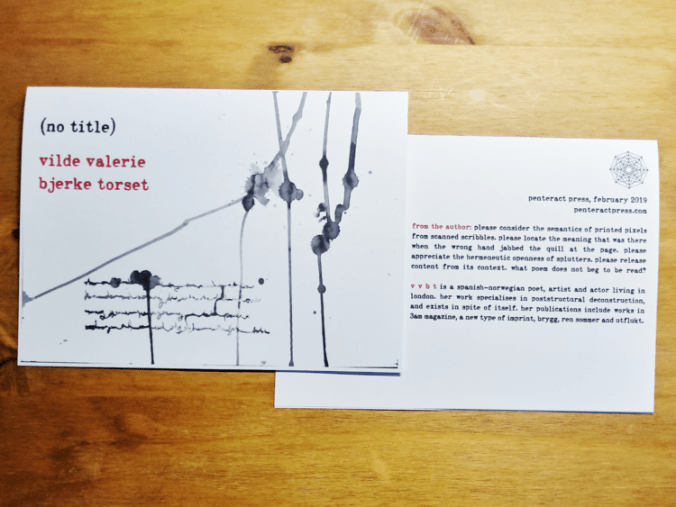
vvleaflet-pic

VVBT

is a Spanish Norwegian poet, artist and actor living in London. her publications include works in 3am magazine, a new type of imprint, brygg, penteract press, ren sommer and utflukt. she was a member of the experiments and innovations in poetry program at kingston university, where she won the 2018 writers graduation prize.

https://vildebjerketorset.com/books

The Interview

  1.  When and why did you begin to write poetry?

poetry – i don’t know. i’ve been writing since i was a kid, all kinds of stuff, stories for my brothers, word games, anything really. in college i was part of a poetry society (i know how it sounds – if it helps, its name was K.U.K., which is norwegian for dick – that doesn’t help, does it) which probably constituted my first attempts at poetic endeavours. i’ll take them with me to the grave.

  1. Who introduced you to poetry?

i grew up surrounded by books, prose and poetry and anything in between. i’ve been extraordinarily lucky, having always access to a plethora of authors, and being encouraged along the way. i’ve also had some magnificent teachers, like my spanish teacher reading lorca to a class of 11 year olds.’ t

  1. How aware were and are you of the dominating presence of older poets?

never been an issue. for one, i’m surrounded by fellow foals. moreover, i’ve only ever been met with welcome and support by the poetry community. it might be a case of echo chamber or naivety, but i remain grateful.

  1. What is your daily writing routine?

utterly, magnificently, perpetually non existent. i usually juggle loads of stuff, projects and meetings and collaborations and training and whatnot – none of which adhere to a set schedule. i don’t operate with weekends or holdidays, just endless to-do lists and post-it’s. i write on the bus, at intermissions, when reading, when trying to sleep.

  1. What motivates you to write?

anything and nothing. a deadline can be as efficient as an idea. generally speaking, i write because i write because i write. i’ve always been drawn to language, and am by nature hyperassociative. add to that a fair amount of curiosity and cheek, and you got yourself a poet.

  1. What is your work ethic?

i would say see question 4.-5., but in all honesty i take my work ethic very seriously. the idolised notion of an erratic and capricious creative genius possessed by divine inspiration is just BS. i’m obnoxiously lucky to do what i do, and i pride myself in calling it work. professionalism is a matter of self-respect as much as common decency.

  1. How do the writers you read when you were young influence you today?

probably in every way except directly.

  1. Who of today’s writers do you admire the most and why?

i am hopelessly guilty of not reading enough of my contemporaries as i’m forever trying to catch up with the past. it’s a deplorable habit. given this predicament it’s fortunate that i get to collaborate with living, talented creatures i would otherwise not have encountered. that being said… lyn hejinian, alice birch, sarah kane (i know, but come on), oh, and i discovered brenda shaughnessy just earlier today.

  1. Why do you write?

i don’t have a good answer to that. i’m not sure it matters why – whether it’s a compulsion, a passion, or a logical outcome of given circumstances. i know it’s a privilege, and i know it’s a struggle. on a grand scale the creation, manipulation and mutilation of language and culture is fascinating, but who cares why i do it?

  1. What would you say to someone who asked you “How do you become a writer?”

apart from things like ’write’ or ’read’, i mean, who’s asking? i’d probably say it is a case of the blind leading the blind.

  1. Tell me about the writing projects you have on at the moment.

i’m doing a series of things in relation to the european poetry festival, including a book launch and a few collaborative readings. then i’m filming a short film i’ve written, and developing a curatorial concept which is not ready for disclosure quite yet. other than that i just had a pamphlet out with penteract press, an extract from a collection of asemic writings that i’m still developing.