My National Poetry Month challenge to myself has become a collaboration between synaesthetic artist Sammy-John, myself, Anjum Wasim Dar and Jay Gandhi: Day Twenty-Eight: Wish You Were Here

Wish You were here

Wish you were here
Mixed media on wood

Blindfolded

the thunderous slap
awakens me
in the wee hours
even after 5 years.
the fingerprints
of that very slap
are punched
in the heart
of my mother.
All I told her was that
Dad is cheating.
Today again we start
our respective journeys—
one is in the guilt lanes
and other in the streets
of a denial.

By Jay Gandhi

Wish You Were Here
I thought writing would help
but it did not
I thought painting would comfort
but it did not
I thought coffee would be company
but it was not
I thought poetry would bring patience
but it did not
I thought the garden would bring joy
but it did not
I thought music would make me peaceful
but it did not
I thought moonlight would be serene
but it was not
I thought a book would talk to me
but it was silent

silence cuts sharply, my spirit struggles
to be free
eyes have let out every single tear
I just wish, just one little wish
I wish
I wish you were here.
2019 © CER    Anjum  Wasim Dar

When I Get It There

is a part of me
I wish was here.

leaps from rock to rock
with minimum effort,

Now being is not having
Not having becomes not

appearing
for appearances sake.

2019 Paul Brookes

Wombwell Rainbow Interviews: David Roe

Wombwell Rainbow Interviews

I am honoured and privileged that the following writers local, national and international have agreed to be interviewed by me. I gave the writers two options: an emailed list of questions or a more fluid interview via messenger.

The usual ground is covered about motivation, daily routines and work ethic, but some surprises too. Some of these poets you may know, others may be new to you. I hope you enjoy the experience as much as I do.


David Roe

Born in Derbyshire in the 60’s, David has lived in the North East since his early teens. An undiscovered dyslexic in his childhood, he became a secret writer for over 30 years. Conned into a poetry Slam in 2015, and not bound by the rules of literacy and education (he just never learned), David is a free and un-tethered writer and a refreshing new addition to the Spoken Word scene. David likes to think of himself as a “Northumbrian with a wonky accent”. With a mix of both comedy poems and more poignant pieces. Working as a Chimney Sweep, he gets to travel all of Northumberland, meeting a wide variety of people, both of which are a source of inspiration for his art. Sharing his work with audiences, David can be found gracing the stages throughout the North of England. Poet in residence for the wonderful Redefest held near Otterburn the first weekend in August every year, organising their poetry side of entertainment. His first short story Birth of a Legend was published in the collection of short stories “Grimmer Fairytales” published by Spectral Visions Press in October 2018 making him both an Author and a Poet.

https://www.amazon.co.uk/Grimmer-Fairytales-Spectral-Visions-Press/dp/1727746740

The Interview

1. When and why did you start writing poetry?

In my early 20’s, i had a bad day at the office and got sent home to ‘think about my future’. I lived in North Shields at that time, so took a walk out to the old Tynemouth Priory, found a quiet bench and sat with my thoughts. A woman, mid 50’s sat next to me and we started to talk.We talked about everything, life, love, family etc, we even ordered pizza to the bench and stayed there till the early hours of the next day.I don’t think there was a ‘click/switch’ moment, but on looking back at my early scribbles, it was around that time i started to write.

2. Who introduced you to poetry?

Defo Dr Seuss and Pam Ayres. Exposed to both, the lyrical nature of their writing gave a struggling boy a love of words. We didn’t have TV as children, dad said it would ruin us, so reading was a common pastime.

3. How aware are and were you of the dominating presence of older poets traditional and contemporary?

Not remotely. I left school with only a CSE 3 in English because of my dyslexia, it hadn’t been invented back then, so i was an ‘awkward little bugger who wont write anything down’. I never reached the level in English where poetry was read or studied. I am still yet to read any of the masters. Poets and writers are painters, but instead of paint, we use words. I love the freedom of a blank canvas, not limited by education or rules. My writing and poems are an expression of me and my thoughts, not history or guidelines.

4. What is your daily writing routine?

I carry pencil and paper with me at all times, but I don’t write everyday. I’m a self employed chimney sweep and jobbing builder. I’m also one of these nuts who jumps out of bed at 5am every morning, and land running. Writing gets sort of slotted into the gaps of busy days, or days off.

5. What motivates you to write?

Over the years, I’ve grown to love words and not fear them. Writing helps me understand words and express myself. Many current topics cause me to write, i work regularly with a few charities that are close to my heart. I’m a people watcher and through my job i get to meet a huge range of people from all walks of life.

6. What is your work ethic?

I’m a very practical and grounded person who doesn’t tolerate fools gladly, and I hate ‘ditherers’, if you don’t do something, nothing will change. So drive is never a problem. My dad taught me that if you want something, you have to work for it, then it will hold greater value to you. The journey is as important as the prize

7. How do the writers you read when you were young influence you today?

Bill Bryson and Terry Pratchett. Both love to play with words, like Lego Masters constructing huge artworks. I think the love of words and play on words learnt from them both can be found in my work.

8. Whom of today’s writers do you admire the most?

Tess Gerritsen. I love her attention to detail as she builds the excitement of a story, she is one of the few writers who grip me

9. Why do you write, as opposed to doing anything else?

I couldn’t spell very well, so I wrote in secret for 30 years,  I knew the words, just didn’t know how to spell them, so I wrote to express the inner artist within me. I truly didn’t think anybody would ever be interested in anything I wrote. So writing helps me see both my own soul, and other peoples.

10. What would you say to someone who asked you “How do you become a writer?”

I don’t think anybody ‘becomes’ a writer. We are all poets, writers, dancers, singers, painters, musicians and lovers, the secret is finding the ones your good at. A very dear friend told me “Just write, it doesn’t matter what its about or whether anyone will see it. Just write, it trains the brain” I find that a mantra to live by.

11. Tell me about the writing projects you have on at the moment.

Just had my first short story published in Grimmer Fairytales late 2018. available on Amazon. Ive wrote my first novel, 14000 words, but its only at 1st edit stage, so i think that wont appear till 2020. Im currently writing a one man show which will form the backbone of a book launch later this year. It will be my 1st book of poetry which is currently with the publishers. And as always, i write for fun and many local projects with poems tumbling from my mad brain.

Wombwell Rainbow Interviews: Susan Millar DuMars

Wombwell Rainbow Interview

I am honoured and privileged that the following writers local, national and international have agreed to be interviewed by me. I gave the writers two options: an emailed list of questions or a more fluid interview via messenger.

The usual ground is covered about motivation, daily routines and work ethic, but some surprises too. Some of these poets you may know, others may be new to you. I hope you enjoy the experience as much as I do.

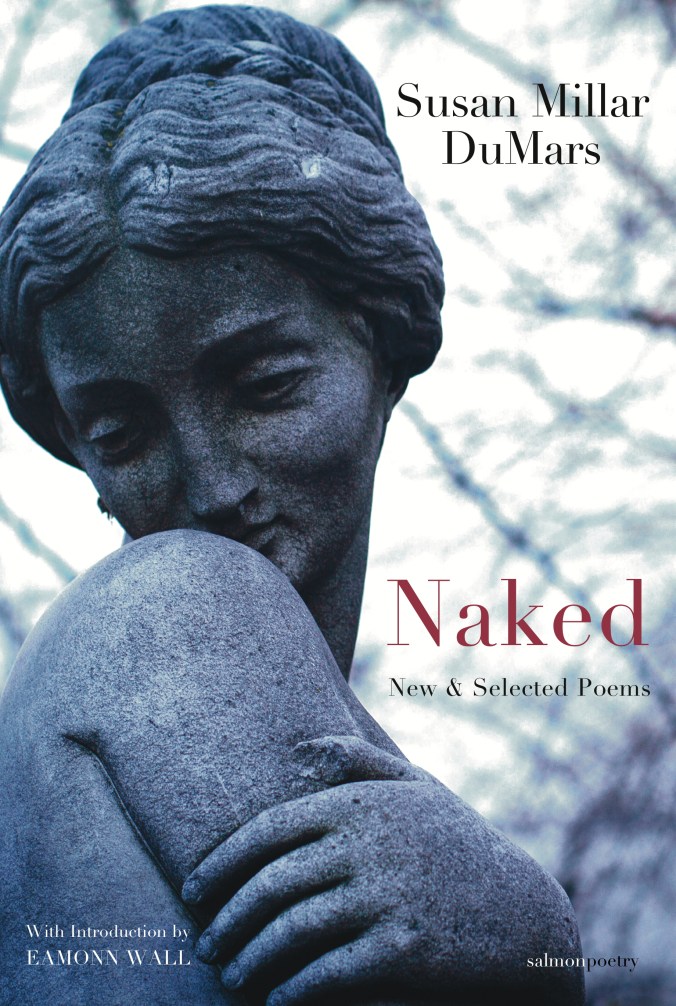
naked_frontcover

Susan Millar DuMars
has published five collections, the most recent of which, Naked, came out in March of 2019.Susan is also a short story writer, author of American Girls(2007, Lapwing Press) and Lights in the Distance (2010, Doire Press); she’s at work on a new collection, Cameos. Born in Philadelphia, Susan lives in Galway where she and her husband Kevin Higgins have coordinated the Over the Edge readings series since 2003. She is the editor of the 2013 anthology Over the Edge: The First Ten Years (Salmon Poetry).
The Interview

1. Who introduced you to poetry?

My father read to me, and encouraged me to read, when I was small.  Lots of poems for children – Robert Louis Stevenson’s A Child’s Garden of Verses.  And Dr. Seuss, I loved him.  When I was eight, a teacher told us to each write a poem about our favorite color.  I chose red, and had so much fun writing it I then wrote a second one about orange.  I liked thinking about rhyme and counting syllables, it made me feel clever; and I very much liked writing down what I thought.  Pictures in words.

As a teenager, I wanted to write songs.  I idolized all the rock star poets, from Pete Townshend to Laurie Anderson to Joni Mitchell to John Lennon and on and on.  Unfortunately I’m not at all musical.  But I could write.

2. How aware were you of the dominating presence of older poets?

Apart from my crushes on rock gods, I also fancied myself to be in love with Percy Shelley.  This was ages 11-13.  He was lyrical and rebellious with a strong belief in justice.  My type!  I have teenage journals filled with quotes from Shelley.

Then came the short sharp shocks of Emily Dickinson and William Carlos Williams; the spiritual embrace of Walt Whitman; the mad rush from Ferlinghetti, Ginsberg, Di Prima.  Then Sexton, Plath, Olds and Iriguaray broke my head open.  In a good way.  I’ve been lucky, I’ve had many wonderful teachers who have led me to great writing – starting with my dad.

3. What is your daily writing routine?

I do not write every day.  Certain days are designated writing days (two or three/week during term, three or four when I’m not teaching).  I get up early, meditate, journal and then cross over into whatever project I’m on.  Sometimes at my desk, often on the bed.  I hand write everything first.  I try hard not to edit while writing.  Writing is for the first half of the day, editing is late afternoon-evening.  I write for as long as I’ve got. It could be ninety minutes, could be five hours.  I’m quite stubborn once I get started and I have to remind myself to stop at some point and eat.

4. What motivates you to write?

In my life now: a meeting of my poetry group, or an email from my publisher asking when she can expect new work, motivates me to write poems.  Teaching fiction motivates me to write fiction (otherwise I feel a fraud).  My husband Kevin talking about his work motivates me to have work of my own to talk about.  These are not deep motivations, but I think all writers need to build in these simple situational motivators too.  A writing competition deadline, an assignment due for a class.  We all need these.

On a deeper level…I write poetry to make sense of something.  I write fiction because I’ve noticed a story no one is telling, because its main character is female or poor or dismissible for some other reason.  Mostly I write to answer the question is it just me?

5. What is your work ethic?

Only to do everything to the best of my ability.  Otherwise, why bother?  And not to imitate anyone, including any of my former selves.  To be brave and honest.

6. How do the writers you read when you were young influence you today?

I return to them often for inspiration.  I read them and remember that initial excitement I felt about the dizzying power of language.

7. Who of today’s writers do you admire the most and why?

You know, I work with writers every day (my husband and I have run the Over the Edge readings series, in Galway, Ireland, for sixteen years).  So I’d prefer not to single anyone out. I admire writers who are unafraid to be different, to create their own weird cool, follow their own obsessions.  I love an original voice; they aren’t all that common.  I also appreciate writers who help other, newer writers – by teaching, mentoring, organizing readings or editing magazines.

9. Why do you write, as opposed to doing anything else?

Because I can’t play the guitar!

10. What would you say to someone who asked you “How do you become a writer?”

Write.  You can only learn by doing it.  Read loads, all different kinds of stuff, and set yourself exercises of imitating the elements of style you like.  Keep a journal, so you become used to expressing thoughts in written words.  Look for some form of community support.  A writers’ group, or a class, or open mic sessions, or conferences…anything that brings you into contact with others interested in writing.  When you feel ready, start submitting work to magazines and websites.  Accept feedback gracefully, while at the same time remembering that a rejection is not the final word on anything.  Your secret weapon is your experiences, your voice; no other writer has these.  So be yourself.

11. Tell me about the writing projects you have on at the moment.

Fiction: Cameos, a book of short stories (my third).  Each story is written from the point of view of a peripheral female character from a well known Gothic novel.  For example, in Irina, I’ve given the young female vampire in Dracula her own backstory (https://atticusreview.org/irina/ ).  I love the idea of giving voiceless women characters a chance to speak.  And I love Gothic; love, love monsters.  Savoring work on this project.

Poetry: I’ve just published my fifth poetry collection, Naked: New and Selected Poems  (https://www.salmonpoetry.com/details.php?ID=483&a=39).  It contains eighty four poems, the highlights of twenty five years I’ve worked as a published poet.  I recently had the great pleasure of launching the book at a Poetry Flash event in Berkeley, California; I got my MA at the University of San Francisco, so this was, in a sense, bringing those early poems back home.  Now I’m setting up events for the book in Ireland (where I’ve lived for twenty one years) and elsewhere.  The title refers to my policy of being brave and honest in my writing.  I’m so proud of Naked.


My National Poetry Month challenge to myself has become a collaboration between synaesthetic artist Sammy-John, myself, Anjum Wasim Dar and Jay Gandhi: Day Twenty-Seven: My Monet

Monet

Monet

My Monet

He abandons her as I abandon you.
Day after day strives to better capture

what he must, this sensation too quick
becomes that sensation, this telling moment

of light, of consequence. He lives
in perpetual debt. Scratches what he can

while debt collectors hammer down his door.
Like him all I can give is the family I neglect

to catch this colour of breath, these times
I will not see again as life flits by. Grief

behind and in front and with each step
outside the door a debt, a loss, a given.

2019 Paul Brookes

Monet

She loved vanilla,
eggs & snow.

Every night she

tracked the cusps

of the moon—

she died today;

she was wrapped

in whites as she

traversed the clouds.

By Jay Gandhi

My Monet,
He said Is
Charming adorable shining bright
one but in a constellation ,distant
difficult to decide, I moved  to  Yi
Ching cleromancy, whom shall I fancy?
My monet needs space, no one is
perfect, maybe the typical blonde
the smartest with ‘The Look’ so
loyal smart and an amazing cook
I dream of one, of varied trichitic
impressions, like a painting visible,
unusual visual from distant scape
sparkling in form, a classy inscape,
My monet I found much to my joy
a painted expression, soon discovered
in dismay, colored over lines ‘n contours
was just another classic artistic  impression.

2019 © CER       Anjum Wasim Dar

My National Poetry Month challenge to myself has become a collaboration between synaesthetic artist Sammy-John, myself, Anjum Wasim Dar and Jay Gandhi: Day Twenty-Six: A B Minor

B Minor

B Minor

B minor
        Bee is
huMming,
buzzIng—
HoNey
yellOw
nectaR

By Jay Gandhi

A B Minor

I am the key
of patience,
A judgement comes

through that door.
I am the key
to that door.

I am the calm
awaits fate.
I submit

to your divine
dispensation.
You turn my key

to unlock your door
to my judgement.
You use me.

2019 Paul Brookes

B Minor

One by one, they fall, three
in all, more maybe,
silently they wave farewell
To the tree, descending to land on the ground-
over and over they go
round and round,
The tree is still, bravely the loss it will bear, without a sigh without a tear,
submitting to divine will,
ever ready for submission, think a while, what can happen –
surely after Winter Spring will come,
All emerging from hibernation, to begin afresh
A rejuvenation.

2019,©️CER. Anjum Wasim Dar

My National Poetry Month challenge to myself has become a collaboration between synaesthetic artist Sammy-John, myself, Anjum Wasim Dar and Jay Gandhi: Day Twenty-Five: The Jug Choir


The Jug Choir

The Jug Choir
Mixed media on calico

The Jug Choir

Sing into these Bellarmine jugs
daubed with faces of bearded men,
‘Witch Bottes’, the body of the male vessels filled with urine,
bent nails and votive cloth hearts,
to cause pain to any ‘witch’ that poses a threat.

What colours of song?
Ritual embedded in acts of violence.

2019 Paul Brookes


By Jay Gandhi

The Jug Choir

Bring me the washtub, the washboard, spoons
some bones a jug and a lyre
It is time to blow with the jug choir
A relic from Sirkap Valley
a precious pitcher from Taxila
a blue jar from old Jaulian
Adding  to all these, the Ozark Harp
would make all the A,G,C, minors, sharp
unique antiquarian rhythm with Indo-Pak alap

2019 © CER     Anjum Wasim Dar

Wombwell Rainbow Interviews: Emma Lee

Wombwell Rainbow Interviews

I am honoured and privileged that the following writers local, national and international have agreed to be interviewed by me. I gave the writers two options: an emailed list of questions or a more fluid interview via messenger.
The usual ground is covered about motivation, daily routines and work ethic, but some surprises too. Some of these poets you may know, others may be new to you. I hope you enjoy the experience as much as I do.

GITD 2 72

Emma Lee

was born in South Gloucestershire and lives in Leicestershire. Her poems, short stories and articles have appeared in many anthologies and magazines in the UK and Canada, Hong Kong, Mexico, New Zealand, South Africa, Turkey and USA. She has three poetry collections, “Ghosts in the Desert” (Indigo Dreams Publishing, 2015), “Mimicking a Snowdrop” (Thynks Press, 2014) and “Yellow Torchlight and the Blues” (Original Plus, 2004) with a fourth forthcoming from Arachne Press in 2020.

She has performed her work at The Poetry Cafe in London, all three Leicestershire universities, at LCFC, the Jam Factory in Oxford and Hatherley Manor in Cheltenham, amongst other venues. She’s also read poems for BBC Radio, EAVA FM and joined panels organised by the University of Leicester’s Sociology, Communications and Media department to talk about artistic responses to the refugee crisis arising from her co-editing of “Over Land, Over Sea: poems for those seeking refuge” and curation of Journeys in Translation. Her essay “Spoken Word as a way of Dismantling Barriers and Creating Space for Healing” was included in “Verbs that can Move Mountains” (Sabotage, 2017) and she presented a paper at the Jungle Factory Symposium organised by the Leicester Migration Network. Emma Lee’s poems have been translated into Chinese, Farsi, German, Greek, Italian, Polish, Portuguese and Romanian. Currently she is on the committee of Leicester Writers’ Club and the steering group for the Leicester Writers’ Showcase and has experience in organising poetry readings and live literature events. Emma Lee also reviews for five poetry magazines and blogs at http://emmalee1.wordpress.com

The Interview

  1. What inspired you to write poetry?

I’ve always told and read stories. Reading was a quiet activity and I was encouraged to read from an early age. As a child I used to build houses from plastic bricks and invent stories for the people who might have lived in them.  Those stories evolved into poems. I prefer the extra layer of musicality in poetry to prose. I write short stories, reviews and blog articles but prefer poems. In my late teens I decided I either had to take my poetry seriously or write it off as a hobby so started reading and then submitting to poetry magazines. I already wrote music reviews and expanded into book reviews too. Reviewing books is a great way of reading work you wouldn’t necessary chose to read and figuring out what works and what doesn’t and why.

  1. Who introduced you to poetry?

School did its best to put me off poetry. We read the War Poets and other poetry by men. I was left thinking that either women didn’t write poetry (unlikely) or women didn’t write poetry worth studying (incredible) so I went to the library. A friend sent me a copy of Ted Hughes’ “You Hated Spain” and I so identified with the subject, I had to read Sylvia Plath and her contemporaries.

  1. How aware were you of the dominating presence of older poets?

I started getting published as a teenager so was very aware that I was a young poet. I was also a woman in a male dominated environment, although that’s slowly changing, so had every expectation that I’d feel as if I was on the outside looking in for a long time. It didn’t bother me. By the time I started looking at joining local writers’ groups, I already had a few years of publishing credits behind me so didn’t feel dominated by older poets when workshopping new work.

  1. What is your daily writing routine?

Back in my teenage years I wrote secretly, scribbling in a notebook under a desk, writing fragments in margins or grabbing a spare half hour here and there so I can write anywhere: crowded cafes, a quiet desk, on public transport. I’m also in the habit of turning up early and utilise those spare moments waiting for everyone else to turn up. It doesn’t bother me if I write with a pen into a notebook, on my phone or on a computer. Now I write around a day-job (I’m a copywriter) and other commitments so I don’t have a routine as such. I do write most days and when I’m not writing I’m often thinking about writing.

  1. What motivates you to write?

I find that a story or image or song will haunt me until I write about it.

  1. What is your work ethic?

Workaholic. I have to schedule breaks.

  1. How do the writers you read when you were young influence you today?

They taught me it was OK to fail. You will always learn from what you write even if it results in a piece you wouldn’t seek to publish. Nothing is wasted. Writers need to continually learn and develop their craft otherwise you risk becoming stale.

  1. Who of today’s writers do you admire the most and why?

I don’t like to single out names, but those, often unsung, writers who support others by mentoring and giving feedback, organising live events, reviewing, organising groups and editing presses and magazines. Those who understand it’s not a competition and are genuinely supportive of others.

  1. Why do you write?

I could no more stop writing than I could stop breathing. In my “is it a hobby or serious?” phase, I did try to stop writing. It didn’t work.

  1. What would you say to someone who asked you “How do you become a writer?”

Read. Write. Read more. Seeing your name on the spine of a book in a bookshop is a huge ego boost and great target to aim for, but it’s writing that makes you a writer and you can’t be a writer unless you read. Find people who can give you constructive feedback on your work, whether that’s a trusted reader or joining a writers’ group (IRL or online), and who will encourage you to develop and grow as a writer.

  1. Tell me about the writing projects you have on at the moment.

My fourth collection, “The Significance of a Dress” is forthcoming from Arachne in 2020. I’m reviewing (I’m always reviewing something) and drafting some poems. 2018 is Leicester Writers’ Club’s 60th anniversary and I was challenged to see if I could get (at least) 60 poems accepted for publication. I’m pleased to say I did.


My National Poetry Month challenge to myself has become a collaboration between synaesthetic artist Sammy-John, myself, Anjum Wasim Dar and Jay Gandhi: Day Twenty-Four: The Bluebell Woods

The Bluebell Woods

The bluebell woods
Mixed media in calico

The Bluebell woods

These blue flowers love mutual company
and yet are free. They reflect sky
and on other days skies reflect them.
The petals spring in spring and leaves
die in summer — a life full of swag! And
I feel what Wordsworth would have felt
when he saw a bunch of golden daffodils.

By Jay Gandhi

Bluebell Woods

O may I go a wandering along
to find the deep bluebell woods
I long to see the fairies play,
I’m tired of Red Riding Hood
Unafraid of the bluebell ring
I’ll venture into Sherwood Forest
while I look for cousin hyacinth
I might see Robin Hood, at rest
I know the sap of English bluebells
has glue strong for binding books
for fastening feathers to arrows,
fired by medieval archers, on crooks,
In old dense woodlands I’ll go
forgetting in foliage all my cares, for
hours lie on bluebell woods ‘and pray
to fairies, to send my nightmares, away-

2019 © CER     Anjum Wasim Dar

The Bluebell Woods

toll the end of Winter’s bite,
with delicate cerulean leaves
gently pull out its sharp teeth,

2019 Paul Brookes

Wombwell Rainbow Interviews: Benjamin Guilefoyle: The Woolly Hat Poet

Wombwell Rainbow Interviews

I am honoured and privileged that the following writers local, national and international have agreed to be interviewed by me. I gave the writers two options: an emailed list of questions or a more fluid interview via messenger.

The usual ground is covered about motivation, daily routines and work ethic, but some surprises too. Some of these poets you may know, others may be new to you. I hope you enjoy the experience as much as I do.

Benjamin Guilfoyle: The Woolly Hat Poet

is a woolly hat wearing performance poet. His unique brand of wonderfully warm, woolly and often silly words has seen him headline poetry nights all across the North of England. His poetry covers all bases from ‘loud cinema eaters’ to the life teachings of his hero, Mr Brian Blessed. He has two poetry publications; ‘Level Up’ from 2015 and his first poetry collection ‘Please insert disk 2’ from 2019.
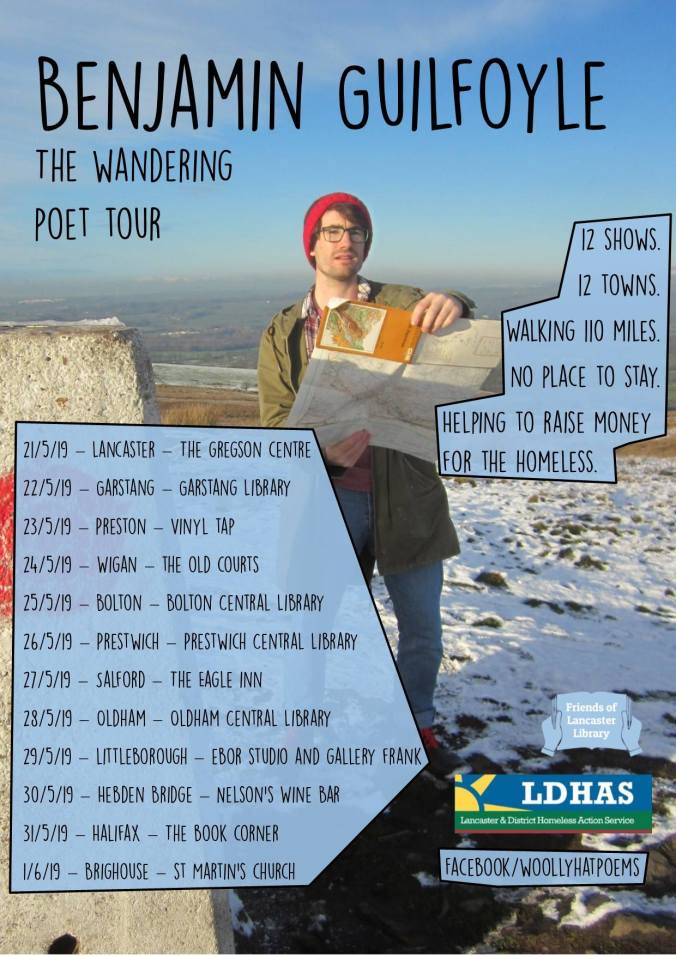
Benjamin loves nothing more than to perform his poetry to a live audience and in 2019 is taking his poetry on the road with ‘The Wandering Poet Tour’. The tour will be to raise money for the Lancaster Homeless Shelter and the Lancaster Children’s Library. Benjamin will walk from Lancaster to Brighouse performing poetry in twelve towns along the way with support from local poets and performers.
benjamin
As part of his other poetry projects in 2019 Benjamin is working with the Morecambe Exchange to make a short film from one of his poems all about ‘Pilates’. He is also animating some poetry with the help of Cumbrian animator Hannah Fox.
In 2018 Benjamin entered his first poetry slam and became the Morecambe Fringe Festival slam champion which was a lovely surprise as he doesn’t usually go in for poetry competitions.

He is also a primary school teacher specialising in the early years.

https://www.facebook.com/pg/woollyhatpoems/

The Interview

  1. When and why did you start writing poetry?

I have always loved words, rhythm and rhyme. My mum used to read me and my sister poetry and heavily rhythmic books when I was very young so I think I always had an ear for patterns, sounds and rhythm.

When I was in college, many moons ago when Eminem was big, me and my mate Steve made a pact to be the world’s next big rap superstars. That was obviously a terrible idea as we were, or at least I was, the nerdiest, goofy looking ‘wanna be’ type kid. Kind of like the kid in the ‘Pretty Fly for a White Guy’ video by The Offspring. Steve was way cooler than me. He had a rap name and everything. He was called ‘MC Heat’. I regret nothing. We had an insane amount of fun.

When I moved to Lancaster in 2014 to pursue a career in teaching I was taken to an open mic night in town and that’s where I saw proper performance poets for the first time and I kind of fell in love with what I saw and heard. Until then I’d never thought of poetry as something that could be so hip and funky. I remember thinking to myself “I can do that”. So I went home and wrote a poem. I took it along to the next open mic night and read it off of A4 paper. I was terrified. My hands wouldn’t stop shaking, but people clapped. I went home and wrote more.

I fell in love with poetry and since then it has gotten out of control.

2. How aware are and were you of the dominating presence of older poets traditional and contemporary?

I was very aware that there were other poets on the scene. I was also aware that nearly every other poet had a lot more experience than I had. It was pretty daunting at first to try and get up onstage with people who had been performing a lot longer than I had but I use every performance, whether I’m watching or performing, as an opportunity to learn from other performers. I always find things that I like in other performances and watching and talking to other poets has helped me to grow as a writer and a performer. I still have lots to learn.

I thinks that’s my favourite thing about poetry now, it’s that anything goes. If you want to perform it and you enjoy it then good for you. Poetry is a different beast for different people and no two poets are the same. The fact that performers will to take to the stage and read their own thoughts and feelings in front of strangers is one of the bravest things anyone can do.

So, as for a dominating presence, um, I wouldn’t say it was dominating, I just had to be brave and use every opportunity to learn how to shape my writing and performance.

3. What is your daily writing routine?

I don’t have one. I don’t have time fit a writing routine into my daily life. I’m a teacher. I’m too busy. I just write when I have something to write about. I often carry ideas and words in my head for ages and eventually I find the time and words to make something out of it. I try to write from a place of happiness. I look out for the small things in life that people might gloss over in their everyday life. My emotions occasionally play a part in my writing but I also want my poems to entertain so I try to think about things that people can relate to as well

4. What motivates you to write?

I am motivated by lots of things. I think the main themes I keep returning to are childhood, growing up and having courage. I like to write about nature as well. I quite often draw on my personal experiences from the past and use elements of those experiences to write poems that have a narrative. But on the other hand I have written a poem called ’12th Century Shower Scene’ which is all about that scene in 1991’s Robin Hood: Prince of Thieves where Kevin Costner is completely ‘starkers’ under a water fall so I’ll write about anything.

Songs. I’ll also take inspiration from songs. The words of Ben Folds have been a huge influence in my writing.

5. How do the writers you read when you were young influence you today?

I have inherited a love for rhythm and rhyme from the poems and books I read and was read as a child. The copy of ‘Noisy Poems’ – collected by Jill Bennett and Nick Sharratt – in our house had worn out pages. The first rhyme in the book rhymes Dorchester with orchestra and the book just gets better and better from there. There is also ‘Song of the train’ by David McCord in there and when read it has the rhythm of a train and you feel like you are the train. It’s superb. Repetitive, but for a young child it really is excellent writing.  We read lots of A.A. Milne poems and I think they have been a huge influence on me with regard to adding a narrative in to my poems. Books like Hairy MacLary and the Shirley Hughes poems and her ‘Alfie’ stories were also read a lot.

I have my mum to thank for all that.

6.  Who of today’s writers do you admire the most and why?

I feel as a poet I really should know more modern poets than I do. I’m pretty useless in that regard. There are poets that I have met and seen perform and they have really blown me away with the energy and passion that they bring to the stage. That’s what I love the most. Energy and passion and to see the performer believing in what they are saying. Of poets that I have either seen perform or have had the opportunity to know in some fashion I would say my favourite poets are Dominic Berry, Alex Slater, Rosie Fleeshman and ‘Th’Owd Chap’ George Melling. But really, I admire anyone who will get up on stage and perform their own work and for me that’s the beauty of poetry these days. There is so much great poetry out there. Some I will like and some I won’t but I admire anyone who will read their own work.

7. Why do you write, as opposed to doing anything else?

Poetry was, when I first started writing properly, really a place where I could empty my head and try and make some sort of sense of life at a time when I didn’t have anyone to talk to. I had just moved to Lancaster and left all my friends and the majority of my family back in Yorkshire. Poetry helped me to get my thoughts out and keep me sane. To a point I still use poetry in much the same way. I sometimes find in conversations I am stuck for the right words or I feel I should be able to talk about things much more eloquently than I actually do. Poetry gives me the chance to take my time and find the right words to get my point across. I wouldn’t say I do it as opposed to anything else. I’m never bored and always have little projects going on and poetry has just become one of my many hobbies that I am lucky enough to be able to share with people.

8. What would you say to someone who asked you “How do you become a writer?”

Just start writing and don’t care about if it’s good or not. Just write. Probably about something you’re interested in at first and eventually you will find a writing style and themes that suit you. Every writer is different and that’s what’s so exciting. Every writer will do work that is fantastic and every writer will write pieces that are absolutely rubbish. Don’t be afraid of feedback. If it’s negative then it’s constructive. Use it to learn and develop your writing. Don’t share writing that you aren’t happy sharing. Just write and write and write. And read. You’ve got to be a reader if you want to be a writer.

9. Tell me about the writing projects you have on at the moment.

I am currently preparing for my first poetry tour which will commence on 21/5/19. The tour is called ‘The Wandering Poet Tour’ and is in aid of two local charities; the Lancaster and District Homeless Action Service and the Lancaster Children’s Library. The tour will see me walking 110+ miles from Lancaster to my hometown of Brighouse in West Yorkshire. I will be passing through Garstang, Preston, Wigan, Bolton, Prestwich, Salford, Oldham, Littleborough, Hebden Bridge, Halifax and finally Brighouse. I will be performing each night with support from poets local to each area. Because the tour is in aid of the homeless shelter I will have no place to stay. I will just rely on the kindness of my audiences to put me up for the night or risk becoming homeless myself. More information on the tour can be found at the Woolly Hat Poems Facebook page -> facebook/woollyhatpoems
I am also working on my first poetry collection. ‘Please insert disk 2’ is comprised of 42 poems with themes of childhood, love, happiness and survival. It is very close to completion and I am having to be careful not to rush in the final stages. I will be posting more about my collection in the very near future on the Woolly Hat Poems Facebook page.

Press Release

Woolly Hat Poet set to walk 125 miles on an 12-date tour for charity – and he needs a member of the audience to put him up each night Lancaster-based Benjamin Guilfoyle will strap on his walking boots for an epic 125-mile hike from Lancaster to Brighouse in Yorkshire for his first big poetry tour.
But audiences on the 12-date tour are in for a shock – because he will make an on-stage appeal every performance for one of them to give him a bed for the night.
Benjamin is raining money for two charities – the Lancaster and District Homeless Action Service and the Lancaster Children’s Library – with every penny from ticket sales and donations while on the tour donated to the charities.
And to raise awareness of the issue of homelessness, the poet will have nowhere to stay each night of his tour – and will be sleeping rough unless someone in the audience steps forward and offers him a bed for the night.
Benjamin said: “The Wandering Poet tour is all about being kind and doing something for others to make their day a little bit brighter. I want to be able to use my poetry and this tour to make a difference, however small, and to support these two local charities because without support they might not be around that much longer.”
“My poetry comes from a place of happiness. I use my poems to tell stories and to focus on the smaller things in life that we might overlook and those small victories that get us through our everyday lives.”
“My poetry, I hope, will make my audiences laugh and there will be at least one poems in the show that they can relate to on a personal level.”
The performance poet – know as the Woolly Hat Poet  – heads out on the road in May for a gruelling 12-date tour, taking in Lancaster, Garstang, Preston, Wigan, Bolton, Prestwich, Salford, Oldham, Littleborough, Hebden Bridge, Halifax and finally his home-town of Brighouse on consecutive nights.
The Wandering Poet Tour is inspired by Yorkshire’s own Simon Armitage and his Coast to Coast walk in 2015.
Each show Benjamin will be joined by local poetic talent, musicians and artists to give each show a local voice.
The tour kicks off on May 21 in Lancaster and will run each day until June 1.
NOTES:
Full tour dates and venues:

Lancaster – The Gregson Community Arts Centre – 21/5/19 – 7PM
Garstang – Garstang Library – 22/5/19 – 7PM
Preston – Vinyl Tap – 23/5/19 – 7PM
Wigan – The Old Courts – 24/5/19 – 7PM
Bolton – Bolton Library – 25/5/19 – 2PM
Prestwich – Prestwich Library – 26/5/19 – 1PM
Salford – The Eagle Inn – 27/5/19 – 7PM
Oldham – Oldham Library – 28/5/19 – 7PM
Littleborough – Ebor Studio & Gallery Frank – 29/5/19 – 7PM
Hebden Bridge – Nelson’s Wine Bar – 30/5/19 – 9PM
Halifax – The Book Corner – 31/5/19 – 7PM
Brighouse – St Martin’s Church – 1/6/19 – 7PM
Woolly Hat Poet on Facebook: facebook/woollyhatpoems  
Benjamin Guilfoyle is a performance poet and a primary school teacher specialising in the early years. Benjamin authored his first poetry pamphlet ‘Level Up’ in 2015 and a full poetry collection ‘Please insert disk 2’ in 2019.
The poet is available for interview.
Photographs
Available on request OR Attached to this email

Contacts:
Email: woollyhatpoems@gmail.com // Phone: 07792660866 or 01524 752837 // Twitter: @woollyhatpoems