Wombwell Rainbow Interviews: Kari A. Flickinger

Wombwell Rainbow Interviews

I am honoured and privileged that the following writers local, national and international have agreed to be interviewed by me. I gave the writers two options: an emailed list of questions or a more fluid interview via messenger.

The usual ground is covered about motivation, daily routines and work ethic, but some surprises too. Some of these fiction writers you may know, others may be new to you. I hope you enjoy the experience as much as I do.

Annotation 2019-07-20 222817

Kari A. Flickinger

was a 2019 nominee for the Rhysling Award, and a finalist in the Iron Horse Literary Review’s 2018 Photo Finish. Her poetry has appeared in Written Here: The Community of Writers Poetry Review, Riddled with Arrows, Door-Is-A-Jar, Dark Marrow, Rhythm and Bones, Moonchild Magazine, Nine Muses, Burning House Press, and Ghost City Review, among others. She is an alumna of UC Berkeley. When not writing, she plays guitar to her unreasonably large Highlander cat.

Find her:    kariflickinger.com   @kariflickinger   legendcitycollective.wordpress.com

The Interview

1. What inspired you  to write poetry?

Love and trees, maybe. I spent my childhood wandering aimlessly through the mountains of Northern California. Poetry is love. Lovers inspire me to write. And I don’t mean between the sheets, necessarily. I mean the way we show love in our world. The way I have been cared for, and have been shown how to care. The way I can extend care.

At the same time, my infinitely shit grasp on communicating with others also inspires me to write. Poetry makes all of my worst personality traits beautiful. I’m obsessive, destructive, at times unkind due to my scrutiny of my environment—a bit oblivious. I’m bipolar—I flip a lot, and process slowly. But all of these traits help me build like an ocean on the page. I unfold, align, take up space, and it all swells into a crescendo. Learning to read from all directions has helped me write from all directions.

2. Who introduced you to poetry?

As a kid, I stumbled into poetry. I picked up these big fat books that were impossible for a little Kari to understand, and I consumed them. I was a weird kid. I told people I was going to be a poet and write the “Great American novel”. I was like eight years old. I was exposed to poetry at Renaissance festivals as a kid, too. My mom was a seamstress for years, and we would hawk for various shops, or join parades, and it was all very over-the-top Shakespearean. I like to think those years taught me how to read nuance.
But, the first time I was aware of loving poetry was when I read a book about unicorns from a local library. I checked that book out so many times. No other budding child-poets were going to gather inspiration from THAT copy! (I just looked it up, it was The Unicorn Treasury edited by Bruce Coville. I can’t believe I’ve just shared this story. Just ordered a copy online. What a time to be alive.)

I knew poetry would become my life when I read E. E. Cummings’ “[buffalo bill’s]” in high school. The configuration and rhythm fascinated me. My schoolgirl crush: E. E. Cummings. I wrote this poem out in my notebooks the way most girls write their crush’s last name in hearts.

Later, I think I became poetry when I read Marianne Moore’s “The Paper Nautilus” in community college.

3. How aware were you of the dominating presence of older poets?

I wasn’t until I went to get my formal education after turning thirty. I went to Diablo Valley College and knocked those survey courses out, and every day was a new expansion. I mean, do you know what it’s like to fall in love every day? I started getting migraines from reading and loving. Suddenly, there was Donne, Yeats, T.S. Eliot, Coleridge, Keats and Milton. There was Beowulf, and Chaucer. And it was love everywhere.

And it’s absolutely a problem that these are all old white fellas from one region of the world (some of which were stealing their poetry from their sister’s journals—cough, cough, Wordsworth, cough.) But, how do you abate love when it appears? How do you deal with that?

When I got into UC Berkeley, the reverence for these fellas was almost too much, at times. The boys’ club is still very much alive, but I think that’s changing and being part of that change is brilliant.

4. What is your daily writing routine?

I write when I do. I’m very self-motivated, so I can walk away when something isn’t working, and come back to it later with fresh eyes, and it doesn’t hold me up for years. I write most days. Until recently, I had written almost every day for about two years. But it’s not a hard fast rule because I hate rules, and I immediately throw them out when I make them. Writing just happens. I’ve begun to trust my gathering phases or downtime. I’m unreasonably prolific. If I get manic, I clean the house and write into the night.

5. What motivates you to write?

Usually either piecing together observations—sewing together ideas that don’t necessarily belong together, or deconstructing. I love to build and destroy. Poetry is like a Lego set you can take with you everywhere, and work on anytime. Or an inexplicably meaningful blanket-fort. That’s a weird answer. I basically said writing motivates me to write.

6. What is your work ethic?

It’s absurdly strong. I put myself into anything I work on. I’ve held jobs since I was 15 years old. I often walked two miles back and forth between my first job and home, (not necessarily through the snow.) I had extremely strong, nearly obsessive follow-through all my life until recently when I worked through several diagnoses. It’s made me take a step back, and examine what I have time for. Should I write and research for hours, and not eat or go outside? No. No, I should not do that. I’m squishy and I’m 35, and the body can’t take that madness, anymore. But, I admit I love to work on writing. I love to edit. I never stop. When I’m not writing, I’m thinking of how I could be. It’s a compulsion. I have cancelled life obligations to stay home and write.

7. How do the writers you read when you were young influence you today?

Music shaped me, first. I was a musician, I played guitar and wrote songs. My family was very musical. I would walk to this old record store with this bearded wizard looking man, and buy records for 25 cents and listen. I listened very loudly, then.
Teens-Kari found: E.E. Cummings, the poemphone poets, the beats, the constellation of sixties rock—The Doors, The Byrds, Jefferson Airplane, Janis Joplin, Jimi Hendrix, The Beatles—it was all this absurdist spoken word kaleidoscopic thing really. Eventually, I found how to be brutal and honest by listening to Tori Amos.
Twenties-Kari found: Bukowski, because of-course-she-did. Those were hard years, love-wise.

Thirties-Kari has found: Robert Duncan and Czesław Miłosz. Sharon Olds. Lorine Niedecker. Roethke. Södergran. Rilke. Yeats. Merwin. Glück. Elizabeth Barrett Browning.

8. Who of today’s writers do you admire the most and why?

The why: I love writers who burst through language to annihilate the expected. It’s extremely difficult to balance complexity of construction with what is real. I love when a piece is a little bit instructive, part knife-to-the-gut with a dash of the order of humanity’s place in the universe, and a sprinkle of science.

The who: I’ll start with my brothers-of-the-word, Nicholas Yingling, and Dylan Heier-Ross—two of the most brilliant beautiful human beings, and most stunning writers a person could possibly hope to encounter. My writing friends Sterling Farrance, Bree Cassells, Tessa Rissacher, Ian Sheerin, and Kim Harvey.
Then my Writing Collective, they are all amazing writers cultivated by the wonderfully talented C. Aloysius Mariotti: legendcitycollective.wordpress.com.
I admire Jessica Barksdale, Brenda Hillman, Bob Hass, Lyn Hejinian, Tess Taylor, Brenda Shaughnessy, Sharon Olds, Jorie Graham, Morgan Parker, Rosebud Ben-Oni, Joy Harjo, Rae Armentrout, Matthew Zapruder, Aaron Poochigian, and K. Weber.

At Berkeley and the Community of Writers, I was so incredibly privileged to work with a few of the above-named folks, and I genuinely felt like an imposter. It’s an insane time to be writing. There are so many working amazing living breathing reading loving poets—it would be impossible to name who inspires me. Chances are, if I’ve encountered you, and your poetry, I admire what you’re doing. I seem smug, but that’s just my face. I secretly love you all.

9. Why do you write, as opposed to doing anything else?

I would never say anything if I didn’t write it down first.

And I do other things, I walk in botanical gardens, play guitar, work for a financial institution, eat tacos and watch bad television. But, something in me is always forming the next piece. I keep a notepad next to me when I’m driving. I sit at this long stoplight after work everyday, and write.

10. What would you say to someone who asked you “How do you become a writer?”

Write something down—you’re a writer. Labels are a huge myth created by this square little system. Claim your label. Practice. Observe. Love. And, this is especially for young women, you don’t owe anyone your “humbleness”. Buy into yourself. Promote yourself. Time to yourself is self-love. Believe in what you can do because you are capable.

11. Tell me about the writing projects you have on at the moment.

I have a handful of poems I really love coming out in the next few months, one is inspired by Molly Bloom’s monologue at the end of Ulysses, and songs by Cake, and Concrete Blonde. Also, a couple poems about my struggles with my mental health; one about Ceres (celestial and myth.) Some about Taco Bell and Sappho. One about sound-bathing at the UC Berkeley Botanical Garden for the Summer Solstice last year.

I have several larger projects in some level of construction. A chapbook on liminality that is inspired by Ovid’s Metamorphoses; I’ve started writing shorts in dialogue with various folktales, and a dialogue with Italo Calvino’s Complete Cosmicomics. I also have a chapbook on myth and limerence that explores the ramifications of the idealized poetic object (features poems to an avalanche of exes.) And I’ve been doing a lot of pieces based in sound—partitioned by the movements in specific pieces of music, or samplings of pop-culture.

I think sometimes people read my work and think there’s too much going on. But this is my brain. I have been accused of not showing enough heart in my work before; there is heart there—a lot of it—but like me, you might have to dig to get there.

My latest project (this is an on-going project):

Ten Things I Learned as a First Time Literary Magazine Editor

wendycatpratt's avatarWendy Pratt


I’m just about to write the editorial for Dream Catcher Magazine issue 39, the first issue to go to print with me in my official role as editor. It’s been a rollercoaster and a real learning curve as myself and the fantastic Dream Catcher team navigate the hand over between two editors with with different styles and ideas. Whilst trying to keep on top of the day to day stuff – the ever growing submissions reading, liaising with colleagues, making decisions and accepting (yay!) and declining (sorry!) work from writers all around the world – I have been working out new systems for tracking submissions, in order to speed up the process and allow us to easily and precisely see exactly what the status of any submission is at any point in the process. And lo, the hard work is paying off and we are about to see Issue…

View original post 851 more words

Wombwell Rainbow Interviews: Mark Antony Owen

Wombwell Rainbow Interviews

I am honoured and privileged that the following writers local, national and international have agreed to be interviewed by me. I gave the writers two options: an emailed list of questions or a more fluid interview via messenger.

The usual ground is covered about motivation, daily routines and work ethic, but some surprises too. Some of these poets you may know, others may be new to you. I hope you enjoy the experience as much as I do.

Subruria

Mark Antony Owen

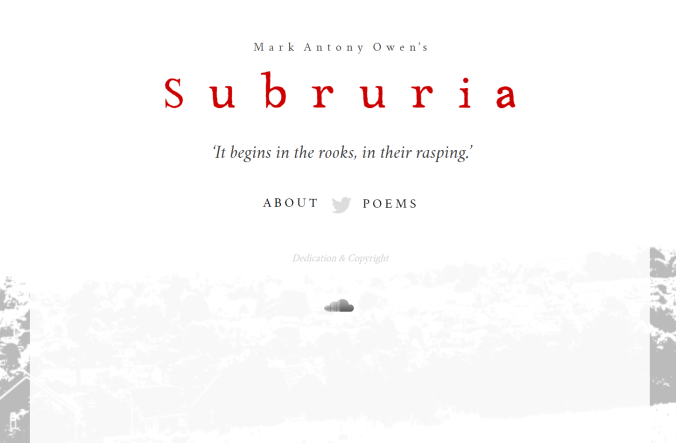
Syllabic poet Mark Antony Owen (https://www.markantonyowen.com/) writes exclusively in nine original forms – sometimes, with variations. His work centres on that world where the rural bleeds into the suburban: a world he calls ‘subrural’.
Mark’s economic, often bittersweet, poetry cycles through themes of love and loss and what we think we remember. His poems – some general, others intensely personal – shift unchronologically back and forth between things observed and things recalled.
Based in subrural East Hampshire, Mark is the author of digital-only poetry project Subruria.
Mark performs his poems at iambapoet.com

The Interview

1. What inspired you to write poetry?

Poetry and I have had an on/off love affair stretching back to when I was seven. I still recall the first poem I ever wrote at that age … though I’ll spare your readers that. Poetry has come and gone and come again into my life several times since then – and until I turned 37, I didn’t really know what to do with it. It took a troubled period of my life, a realisation that my career was insufficiently fulfilling, and a deep-seated desire to create something that might reflect at least some of who and what I am in the world before I admitted to myself, ‘You’re a poet.’

For this reason, there’s been no one moment I can point to and say, ‘That’s what first inspired me.’ I’m a writer, I’m certain, because of Jeanette Winterson’s novel, ‘Oranges Are Not The Only Fruit’. But I’m a poet, perhaps, because I think and feel poetically, rather than in a prose-like way. All I know is that I don’t want to tell my life straight. Where’s the art in that?

2. Who introduced you to poetry?

Here’s where I’d love to be able to heap praise on some long-forgotten secondary school English teacher, or a thoughtful relative who instilled in me a love of literature. Sadly, I can’t: I’m pretty much self schooled in poetry – and in art, generally. So I’ll tell you instead about two poems which, when I was coming back to poetry after a prolonged period of not thinking about it nor writing any, reinvigorated me and made me want to make it as a poet … whatever that means.

The first poem is ‘Shopper’ by Connie Bensley. It contains this one line that, when I read it first, felt like it showed me what was possible in poetry:

` … The road chokes
on delivery vans.’

It’s just those six words: the idea of a road as a throat. And it was utterly transformative. It made me realise I didn’t have to write about love or loss or nature in that florid, faux-Keatsian, juvenile way too many young people do.

The other poem that had a devastating impact – in a good way – was ‘A Bird in the House’ by Elizabeth Jennings. I feel I need to share a bigger slice of this poem, from its ending, to try to convey what I felt when I first encountered it:

`After my first true grief I wept, was sad, was dark, but today,
Clear of terror and agony,
The yellow bird sings in my mind and I say
That the child is callous but wise, knows the purpose of play.
And the grief of ten years ago
Now has an ancient rite,
A walk down the garden carrying death in an egg
And the sky singing, the trees still waving farewell
When dying was nothing to know.’

How powerful is that last line? Obviously, this extract is shorn of context. But you get a sense of the innocence and the tragedy that this poem deals with so brilliantly. You can read the poem in full and hear Elizabeth Jennings read ‘A Bird in the House’ over at The Poetry Archive. (https://www.poetryarchive.org/poem/bird-house)

3. How aware were you of the dominating presence of older poets?

Larkin and Hughes. Those were the only two names I can remember having imposed on us at school. Consequently, they were the two dominating presences I encountered as a young man. I don’t recall much about Hughes from that time, but I do remember thinking I wanted nothing to do with Larkin.

Fast-forward nearly twenty years, and there I was, reading Andrew Motion’s biography of the poet – and (horror of horrors) finding myself as inspired by the facts of his life as by his poetry. I worry at times that I’ve absorbed something of the Larkin spirit; I often talk about my own work as belonging to something I’ve termed New Pessimism, which I’m sure Larkin would’ve loved.

This is not to suggest I see myself as entitled to nor wearing the old curmudgeon’s crown – his poetry works in quite a different way to mine. But I do seem to see the world through Larkinesque eyes when I write, so it’s possible I’m treading in his footsteps even without consciously meaning to.

4. What is your daily writing routine?

Oh, to have one of these! My days are long and quite full-on. I rise early to drive to places of work that are considerable distances from home. Once I’m back, I help a lot around the house and with the raising of my children – so there’s no sloping off to a study for a couple of hours’ writing. But at some point, I fantasise, I’ll be in a position to enjoy at least one day a week when I can wake around 7am, take coffee, listen to some chamber music, shower, perhaps go for a walk in the countryside, then arrive at my desk for 10am to write or revise till about 4pm.

I greatly admire those who rise before the sun to write, or who scribble deep into the night. My brain’s not at its best at those times of day. So I tend to write in snatches: draft new poems quickly to preserve (as far as possible) the original idea, then take sometimes several years – and countless revisits – to perfect what I first jotted down. Not exactly what you’d call ‘routine’.

5. What motivates you to write?

I’ll let my vanity answer this one: I want to be remembered. Or rather, I want the art I create to be remembered. That’s not my sole motivator, of course – I write because I need to express how I think and see and feel about the world around me (as well as the world within me). But when I ask myself how, at the end of my life, I hope to appraise all I’ve written, I always come back to the idea of art conferring upon artists a kind of immortality. I’m not actually interested in living forever physically. I like to hope, however, that my work might go on living long after I’m gone.

6. What is your work ethic?

If, by ‘work ethic’, what’s meant here is, ‘Do you believe in working hard?’, then no – I don’t. I believe in working smart. There’s no inherent virtue nor value in hard work, no matter how much the world tries to convince you there is. There’s every virtue and value in working smarter. Do it right, and you can achieve just as much as you might by hard work alone but with a greatly reduced cost to your physical, mental and emotional health. Take it from someone who used to be a workaholic (and who got ill for a number of years because of this): it’s really not worth it.

What matters most is constancy. You need this to drive you – give you a reason to believe that what you’re doing matters, to motivate you to carry on. It also helps to keep you from deviating too far from (or diluting) your original vision. Do that, and things can and will get messy, sooner or later. Hard work doesn’t enter into it. Yes, you will face challenges. Look always for the smartest way to resolve these, not the way that’ll see you expend the most effort. Life is hard enough as it is. Don’t make it harder, especially not in the name of art. Don’t rob what you love of its joy.

7. How do the writers you read when you were young influence you today?

Without wishing to make it sound like I grew up in a house free from books – I didn’t; my father was a voracious, wide-ranging reader (and still is) – I wasn’t a reader as a child. I wanted to make and do and go outside to play: to have a visceral interaction with my environment. I sometimes wonder if this hands-on life experience in my early years has in some way shaped my approach to poetry. When you’re immersed in the world in a very physical way, you tend to notice a lot about it. Certainly, I can’t imagine anyone who knew me as a child ever suspecting I’d grow up to be a writer – and definitely, not a poet. So as much as I’d like to answer this question by citing a list of obscure or critically acclaimed authors, I really can’t.

8. Who of today’s writers do you admire the most and why?

There are so many incredible, inspiring writers around today that whoever I pick I’ll inevitably neglect to mention someone else equally worthy. I must confess to reading mainly female poets, so I’m going to name-check just three: Natalie Ann Holborow, an extraordinarily talented poet to whose work I was introduced only relatively recently; Rebecca Goss, whose writing goes from strength to strength with each new collection; and Ada Limón, who writes with such intensity and honesty it’s disarming. I could reel off a dozen more names, but I won’t.

9. Why do you write, as opposed to doing anything else?

Fun fact: I wanted to be a visual artist. A cartoonist, actually. I spent my entire childhood believing this was my creative destiny. I tell people the reason I quit was because my step-brother was much better than me at visual art. The truth is that I simply lost my love for it. Around the same time, I was discovering I had facility with words.

At first, much like Larkin I suppose, I was resolute in thinking I’d be a novelist. It took me most of my twenties to realise I wasn’t cut out for this – followed by a long, dry spell of no creative writing through the bulk of my thirties. I say ‘no creative writing’, but in fact I was working as an advertising copywriter, which gave me an outlet of sorts. What that job alone should’ve proved to me was that I enjoyed short-form writing the most.

To bring all this back to the question, I hit a point where I felt almost a physical ache from not creating something original – something that came from me, rather than in response to a commercial brief. When I’d wrestled with the reasons why and explored what might make my ‘pain’ go away (my options at that time included writing comedy, something I still wish I’d done), I realised my first literary love was poetry. Ever since that epiphany, I’ve made poetry a fundamental part of every day. I can’t imagine this ever changing now, after almost a decade.

10. What would you say to someone who asked you “How do you become a writer?”

If you can do anything else better, do that! Being a writer is rarely, if ever, as glamorous as one imagines. But if putting one word after another after another is the thing that gives you your power and freedom of expression (and you believe you have something to say, and a way to say it differently to how others might say it), then you need do only two things: write a lot, and read even more. Reading will fuel you, inspire you, educate you, entertain you, alarm you, enrich and enliven you. Writing will give you the means to take what reading – and living – gives you, and transform it into art. Because art is the goal. Why aim for anything less?

11. Tell me about the writing projects you have on at the moment.

I shall be frank here, and bold: the next 30 years are being dedicated to my digital-only poetry project, Subruria (https://www.subruria.com/). You can read what this is (and how it came about) in another interview I gave earlier (http://poetryminiinterviews.blogspot.com/2019/03/mark-antony-owen-part-one.html?m=0) in 2019 as part of Thomas Whyte’s Poetry Mini Interviews series.


Wombwell Rainbow Interviews: Prince Bush

Wombwell Rainbow Interviews

I am honoured and privileged that the following writers local, national and international have agreed to be interviewed by me. I gave the writers two options: an emailed list of questions or a more fluid interview via messenger.

The usual ground is covered about motivation, daily routines and work ethic, but some surprises too. Some of these poets you may know, others may be new to you. I hope you enjoy the experience as much as I do.

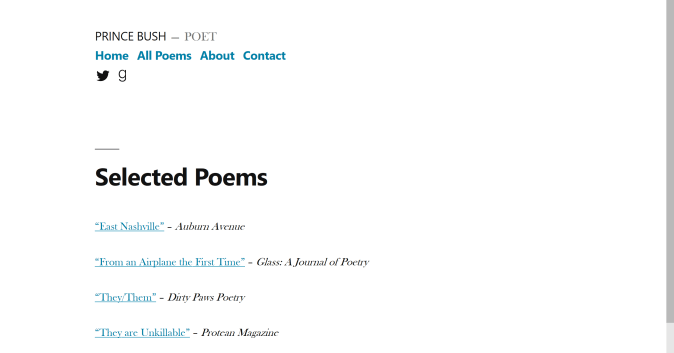
Prince Bush Website screenshot


Prince Bush

describes himself on the Fisk University site: I am a first generation student and poet at Fisk University. I am grateful to have worked with Arctic Tusk, Rhythm & Bones Lit, Fisk Political Review, and Soft Blow. My lifelong job is one I’m currently living: to write and read poetry. I am fortunate to want a dream job that also supports my favorite activity, conversing with a poem. I want to one day give poetry readings around the world from a book of my own and I would love to win the Pulitzer Prize. At Fisk I feel like I am in conversation with the great poet Nikki Giovanni, a graduate herself.

His website is: https://pbush.com/

The Interview

1. What inspired you  to write poetry?

I had many thoughts and emotions as a child that I didn’t want to tell anyone else. Thus, I wrote them down, and began to enjoy this activity, particularly for its freedom: I could write whatever I wanted, and no one could stop me. I discovered omnipotence, similarly to a superhero making it out of radioactivity.

2. Who introduced you to poetry?

Caroline Randall Williams, a poet and professor, introduced me to contemporary poetry. Before I knew poetry historically, but did not know that people were making poems today.

3. How aware were you of the dominating presence of older poets?

I was not aware at all. I was introduced, because Caroline is amazing, to poets young like me. Because of this, I have always felt like I am in good company. I also love that many older people are in poetry, as hopefully I will make it to their age and will be as well.

4. What is your daily writing routine?

My daily writing routine is reading. I want to at least read one poem a day, and oftentimes end up reading many more. I write whenever I feel moved to write, which is pretty often when I’m reading.

5. What motivates you to write?

Other poems motivate me, as well as being alive and feeling, mentally and physically. Any activity I take part in can end up in a poem, even watching Netflix. I am easily motivated to write a poem!

6. What is your work ethic?

My work ethic is the same as any poet who cares about their poem. I do always work towards the poem and not a collection, though, and that may be different from poets who are book-oriented.

7. How do the writers you read when you were young influence you today?

I am still reading those poets, as I am only 21! But the poets I’m reading have all helped me navigate everything from the form I like to write in to what I want to write about.

8. Who of today’s writers do you admire the most and why?

Jericho Brown—he takes form seriously and does a wonderful job with constructing a book. Every poem in his books serve a purpose.

Patricia Smith—she has rewritten her book four times. I strongly admire her commitment to excellent poetry.

Kendra DeColo—she taught me that I can publish poetry about anything, and should do it confidently.

9. Why do you write, as opposed to doing anything else?

Nothing else would satisfy me. I love poetry and decided to commit my life to it. I find every part of the process rewarding.

10. What would you say to someone who asked you “How do you become a writer?”

I would give them one of my favorite quotes: “To begin, begin.” – Wordsworth    1. Tell me about the writing projects you have on at the moment.

I am working on poems as they come. I’m a senior at Fisk University and will be getting my MFA in Poetry immediately after—that is sure to lead to many more poems!

Wombwell Rainbow Interviews: Amanda Earl

F WORD WARNING

Wombwell Rainbow Interviews

I am honoured and privileged that the following writers local, national and international have agreed to be interviewed by me. I gave the writers two options: an emailed list of questions or a more fluid interview via messenger.

The usual ground is covered about motivation, daily routines and work ethic, but some surprises too. Some of these poets you may know, others may be new to you. I hope you enjoy the experience as much as I do.

Amanda Earl

is a Canadian poet, publisher, prose-writer, visual poet and editor who lives in Ottawa, Ontario. Her first and only poetry book so far is Kiki (Chaudiere Books, 2014). Amanda is the managing editor of Bywords.ca and the fallen angel of AngelHousePress. Connect with Amanda on Twitter @KikiFolle or visit AmandaEarl.com for more information.

The Interview

1. What inspired you to write poetry?

I didn’t even realize I was writing poetry until my mid thirties. I scrawled on pads of paper from my parents’ workplaces, all kinds of confessional stuff and complaints and lists. I made notes on index cards about everyone I knew and filed them in a metal box. I just wrote. I didn’t label it. I heard nothing but poetry by men from early childhood and up, whether it was in school or recitations by my father: Shakespeare, Victorian morality poetry, Edward Leer. I liked the rhyming and the sound play, and the images, but I rarely related to it. I dismissed the thought of poetry from my head.

In my mid-thirties, I was going through a period of depression and searched the Internet for solace. I came across the poet Mary Oliver’s poem, Wild Geese, Lorna Crozier’s Carrots (https://jeveraspoetryanthology.weebly.com/carrots.html) poem and also Gwendolyn MacEwen’s fascinating and dark mythological poems. These excited me and made me realize that perhaps I was also writing what could be called poetry. I still wasn’t sure.

2. Who introduced you to poetry?

My father, I suppose, but it didn’t feel like an introduction. He was always reciting poetry to me as a child.

3. How aware were you of the dominating presence of older poets?

More like the domineering presence. Since school curricula for literature were dominated by dead white men, I knew nothing about women poets until I found them in my Internet search in the 90s.  I wish I’d known about Plath and Sexton in my teenage years; although what darkness I would have dredged up back then under their influences… When I first started to realize I was writing poetry, it took me some time to find out about poets like Anne Carson who is willing to step out of traditional form to make poetry out of the long lost fragments of Sappho, accordion books about grief, little chapbooks placed in a box so readers can rearrange at will. Or Caroline Bergvall and her mesmerizing engagements with Old Norse. There’s just so much possibility out there for poetry and yet quite often the same white men, dead or alive, have their work published again and again and win prizes and are taught as the poetry that matters.

4. What is your daily writing routine?

According to Mason Currey in his book, Daily Rituals: Women at Work, the photographer Diana Arbus ritual was sex. (https://www.artsy.net/article/artsy-editorial-daily-routines-10-women-artists-joan-mitchell-diane-arbus?fbclid=IwAR2fXdj7OUukk2c_-RUU8mxIhor8FRPaSWU3yJ0_f_W0t_DzUR8LQ3y3ej0) I usually start my day off with a good wank and at least an hour of pervy chat with a few random strangers. I shivered this morning after a particularly good orgasm. After that I drink Irish Breakfast tea, burn some incense and write or go outside, if it’s not too hot or cold, and wander about until I have no choice but to write. I carry a red journal with me for snippets of overheard conversation, some weird sound play that comes to me, or a doodle. My red journals are smeared in paint and tea stains.

5. What motivates you to write?

1. Lorca’s concept of the duende (https://www.poetryintranslation.com/PITBR/Spanish/LorcaDuende.php) Death is near. I don’t want to be immortal, I just want to continue the conversation. I’m influenced by ghosts, such as Oscar Wilde and Djuna Barnes, Leonora Carrington, Jean Cocteau and Beatrice Wood.

2. Alienation. In some ways I live the standard North American life, but in others I don’t. I write and publish others full-time. I don’t have a nine to five job. I don’t drive. I don’t own property. I live downtown. My husband and I are in a passionate and open marriage. I write to reach out to that one kindred misfit in hope that they feel less alone. The Tragically Hip song “It’s a good life if you don’t weaken,” (https://www.youtube.com/watch?v=gwNVxvczgCs&feature=youtu.be) comes to mind. “Let’s get friendship right.”

6. What is your work ethic?

I follow three principles: whimsy, exploration and connection. I want to play; I want to learn new stuff and I want to write things that connect with those alienated by convention and the lonely. I punched a timecard as a late teen and I saw my parents punching those same damn cards. I loathe systems and routines and any attempts by external authorities to dictate my time, so I rebel against any system. I write because I breathe. It’s just part of me. Writing isn’t as tough as plumbing or surgery.

I serve the work rather than dictating what the work will be. I once spent three months learning about the sonnet because the manuscript I was working on had to be made up of sonnets, not because I wanted to but because the content required it somehow.  I wrote three of the damn things and gave up. They were awful. That manuscript remains unpublished.

I try to remain grateful and humble to have the opportunity to write. Sometimes my work gets published, which is a huge honour. I try to be careful not to let my ego tell me how great I am, because I’m not. I’m just in the right place at the right time and have found the right publisher somehow. This happens rarely.

I try not to take up too much space and leave space for writers who do not have the benefits granted by white colonialist publishing policies and attitudes that continue to prevail. I try to promote and publish 2SLGBTQIA, BIPOC, and D/deaf and disabled writers and look for ways I can support them when I can. I don’t do this enough.

7. How do the writers you read when you were young influence you today?

I read the Exorcist, Mad Magazine, Archie Comics and Harlequin romance novels as a youngster. These works gave me a sense of irreverence that is important for my writing. In high school and university I studied French, German and Italian and finally got excited by literature. Dante made me fascinated with Heaven and Hell; Kafka made me fear insects; Baudelaire made me want to drink red wine. Rimbaud showed me that synaesthesisa, which I have, was not just something I experienced. Later I read Milton’s Paradise Lost. Early influencers of the long poem, I suppose, and the epic. I am writing an anti-epic these days. Red wine isn’t something I can stomach easily anymore. Now and then I’ll have a little Lagavulin in the tub.

8. Who of today’s writers do you admire the most and why?

Nathanaël for Je Nathanaël, for working in the spaces between genres and writing so beautifully of the body.
Sandra Ridley for her ability to write long, mesmerizing poems and read them as if they are incantations.
Christine McNair for syntactic daggers, sounds that are bitten off, and charm.
Anne Carson for her sense of play and versatility.
Canisa Lubrin for Voodoo Hypothesis, which is the only book she’s written so far, and it’s brilliant. I am awed by the skill in these poems, not just on a poetic level (diction, imagery, lineation, structure, balance) but also by the power of one writer’s willingness and ability to so effectively dismantle and bring to light the ongoing effects of racism while offering in-depth and tangible illustrations of the othered.
Alice Notley for the Descent of Alette, a most extraordinary long poem.
rob mclennan for his prolific writing and quiet poetry and bizarre wee stories.
Amber Dawn for brave femme truths and incorporating subjects that are traditionally taboo in mainstream CanLit, such as sex work.
Joshua Whitehead for the sheer invention and brilliance of Full Metal Indigiqueer which takes down the literary canon so skillfully.
The writers in the anthology Stairs and Whispers: D/deaf and Disabled Poets Write Back Edited by Sandra Alland, Khairani Barokka & Daniel Sluman (http://ninearchespress.com/publications/poetry-collections/stairs%20and%20whispers.html)
for the versatility and beauty of their writing. It’s good writing and more people should be aware of it.
Ian Martin for self-deprecating comedy.
Erín Moure for Elisa Sampedrin.
Lisa Robertson for the gift of the sentence.
Gary Barwin for his whimsy and willingness to play in numerous genres and media.

I wish Djuna Barnes was here. I’m always looking for a modern-day equivalent. Nightwood was an exquisite and poetic novel.

9. Why do you write, as opposed to doing anything else?

I don’t just write. I also play with paint, make visual poetry, which some might say is a form of writing, run two small presses, which do a bunch of things. I spend too much time on social media. I make countless lists. I watch a lot of films and tv. I listen to music. I wank. I fuck my husband. We cook glorious meals together. I go on long rambles and spend a lot of time in cafés. I cry and worry every day for the persecuted in this topsy turvy era where the Ogre in the House of White is making us all fear that the end of the world is close.

All these activities and emotions enter into my writing in some way.

10. What would you say to someone who asked you “How do you become a writer?”

I don’t know. I focus less on being a writer and more on writing. Writer sounds like a title and titles have a bunch of preconceived expectations I can’t satisfy. Same with poet. I just write.

But I guess, I’d tell them to be gentle on themselves, surround themselves with books, art, film and whatever inspires them. Ignore prescriptive rules, such as write what you know. Heather O’Neill, a fiction writer I admire, once said that for her to write, she has to be angry about something. At least that’s what I remember her saying at an Ottawa International Writers Festival event.

For me, I have to feel emotion of some sort, whether it is anger, sadness, love… I guess I would say to the person who wants to write that they are going to have to make sure that they don’t numb themselves. It’s easy in this era to want to numb ourselves against all the pain and suffering and power games going on, but when we numb ourselves, we don’t feel and if we don’t feel, it’s hard to respond. Writing, whether it’s directly political or not, is a response to what’s around us. I think it takes a great deal of empathy to write. It takes close listening and close watching.

Find a mentor. I’ve been fortunate in that rob mclennan has been extremely supportive of my work. He’s been honest when the stuff is shite. I still remember taking my first of his poetry workshops in 2006 and him telling me I was writing zombie poems.

He’s published many of my chapbooks through above/ground press and my book, Kiki through Chaudiere Books. He always encourages me to write and he has introduced me to many of the poets I mention in my list of influences and more. He does this not only for me, but for numerous others. It’s amazing!

11. Tell me about the writing projects you have on at the moment.

I was fortunate to have received a grant from the City of Ottawa for Beast Body Epic, a long poem that I began a few years after a major health crisis in 2009 and have been tinkering with ever since. So I’m going to finish tinkering and submit the manuscript for the fourth time toward the end of the year.

I have a smaller manuscript called The Milk Creature and Mother Poetry, inspired by Diana di Prima, one of the women active in the Beat poetry scene.

I’m working on The Vispo Bible, a life’s work to translate every chapter, every book, every verse of the Bible into visual poetry. I began in 2015 and have completed about 300 pages so far.

In 2018, I began work on a novel. Its working title is The Nightmare Dolls’ Imperfect Reunion. It’s about women, health, ageing, friendship, gender, and it has a helluva soundtrack. (https://open.spotify.com/playlist/5B1GAgN046EdtrBLXiNoni?si=NIbexI5mQqKnr54qfmJ7ZQ)

Wombwell Rainbow Interviews: Rachael Ikins

Wombwell Rainbow Interviews

I am honoured and privileged that the following writers local, national and international have agreed to be interviewed by me. I gave the writers two options: an emailed list of questions or a more fluid interview via messenger.

The usual ground is covered about motivation, daily routines and work ethic, but some surprises too. Some of these poets you may know, others may be new to you. I hope you enjoy the experience as much as I do.


Rachael Ikins

Rachael Ikins has been nominated for the Pushcart Prize & CNY Book Award multiple times and won the 2018 Independent Book Award for Just Two Girls. She featured at the Tyler Gallery 2016, Rivers End Bookstore 2017, ArtRage gallery 2018, Caffe Lena, Saratoga Springs, Aaduna fundraiser 2017 Auburn, NY, Syracuse Poster Project 2015, and Palace Poetry, Syracuse. Her work is included in the 2019 anthologies Gone Dogs and We Will Not Be Silenced the latter Book Authority’s #2 pick for the top 100 Best New Poetry Books for 2019. She has 7 chapbooks, a full length poetry collection and a novel. She is a graduate of Syracuse University and Associate Editor of Clare Songbirds Publishing House. She lives in a small house with her animal family surrounded by nature and is never without a book in hand.

Associate Editor Clare Songbirds Publishing House, Auburn NY

https://www.claresongbirdspub.com/shop/featured-authors/rachael-ikins/

2018 Independent Book Award winner (poetry)

2013, 2018, 2019 CNY Book Award nominee

2016, 2018 Pushcart nominee

Www.writerraebeth.wordpress.com

https://m.facebook.com/RachaelIkinsPoetryandBooks/

@poetreeinmoshun on Instagram

@writerraebeth on Tumblr

@nestl493 on Twitter

Above all, practice kindness

The Interview

1. What inspired you to write poetry?

I started writing poetry in second grade when I was 7. I still know that silly poem by heart that I’d written for Halloween. And it was about cats. Some things never change, although I write about more than cats now. As far as inspiration I suppose it was hearing it—I speak several languages— poetry is its own language. My first grade teacher had us copy poems to learn penmanship from the chalk board. My father used to have me read psalms from the Bible at bed time as I learned to read more. I think I was just born a poet. Only one period of my life was I unable to write and that was caused by serious adverse reaction to medications. It was a bleak time.

2. Who introduced you to poetry?

I have already mentioned my dad and my first grade teacher. The most significant person was my 8th grade English teacher. A poet and author herself, she presented the unit on poetry ( met with groans esp. from the boys) by having us go out into the community to find poems in magazines and periodicals and cut them out. To create a notebook of poems. She had us each get a copy of two seminal poetry books, Poetry USA and Reflections on a Gift of Watermelon Pickle and we were assigned poems and practiced. We performed for a small crowd one afternoon in the school library. It made a huge difference to be taught by someone who was passionate about poetry. No English teacher for the rest of my school years ever came close. We are still friends. She is in her 80s now and still writing in multiple genres, attending workshops and publishing.

3. How aware were you of the dominating presence of older poets?

I’m not sure what this question refers to. Older in history poets or older people I knew who liked or wrote  poetry. My father was given, as were all soldiers, The Pocket Book of Poetry.  Soldiers would carry it under their helmets. My dad still had his copy, and we used to read from that little book. So I was aware of the masters as a kid, but had not known an actual adult poet until I was 14.

4. What is your daily writing routine?

I tend to work in the mornings. I browse markets using social media a lot, too. If I find something interesting I will match up the pieces I want to submit and then revise and polish. As far as new work, again, it tends to be written mornings. I was riding my bike yesterday morning, and a poem started up in my head. This has always been a way I write.
Other days something will happen, something that has been subconsciously simmering will say “It’s time!” Whatever else I had planned that day will take back seat to the need to write, and I may write for 5 hours straight.

Walking or riding and letting my mind roam. Once the body is craving relief, all extraneous clutter- thought goes away and clears space for something new to appear. I just listen for it.

5. What motivates you to write?

A feeling of not having achieved some mysterious rubicon yet. I have won a lot of prizes and as well published quite a lot of books with three publishers in multiple genres, and yet I  am just driven. I also have to say, I think I can’t help it. Writing is like breathing to me. “Write or die.” I would also like to make a significant amount of money at my craft/passion to make a dent in my monthly budget. Would I like to support myself at it? For sure, but I don’t know if that will ever happen. I have intense focus and ability to pursue something no matter who detracts from it. That has done well for me, too. Because in spite of teacher support, my family never took my writing seriously until the past decade.

6. What is your work ethic?

My work ethic has always been work hard and  help one another. We are all in this together. Contests aside, we are not competitors though some act that way. Help someone else. Don’t trample someone with your ambition. Pay it forward. Honesty. Write honestly.

7. How do the writers you read when you were young influence you today?

Oh, that is an easy one. I first tried to read Tolkien to myself as an 8 year old. Was a tad daunting. Instead I read all of Milne’s Winnie the Pooh books. The classics. Read Tolkien again in my 20s and was hooked. Both these authors made a mark on me somehow, scarred my heart and brain because decades later after writing nothing but poetry since age 14, in my 40s I wrote a series of children’s stories and the initial chapters of what became the first book in the Tales from the Edge of the Woods series, Totems. My understanding of fantasy and my choice of magical characters and so on was sparked by those great authors. My children’s stories stayed in a box until about a year ago, through 7 moves. I showed them to a publisher last year and we worked on edits. A Piglet for David will be coming from Clare Songbirds Publishing House later this year, the first in a series of young reader chapter books.

8. Who of today’s writers do you admire and why?

I admire J. K. Rowling though I am not a Harry Potter fan. Like her, I have known horrible poverty. You just do the work, period. And if you become successful, you do good with it. I also have always admired poet Marge Piercy. Since her book The Moon is Always Female in the ‘80s with its erotic poems connected to the natural world and also cat poetry Marge has seemed to appear along the journey just when I  needed an example to follow. I have also been at work on straight fiction, a lesbian adventure/ romance for awhile. I have never been fond of reading explicit sexual descriptions. It bores me. Do it, don’t discuss it lol.

I had to write a love scene and had no idea how to do so. One thing about love scenes is it is easy for them to be unimaginative.

I was in a bookstore and found an anthology Best Lesbian Erotica, not sure of the year. Looking through the table of contents I saw Marge Piercy had a short story in it. So I bought it, read her story and the rest of them, then faced off one night, sweating, in front of my computer and wrote the scene. A few years later my story “The Horse Rescuer” was accepted for publication, and I was paid probably the most for one piece I’ve been so far.

In 2014 I noticed Marge on FaceBook so I private-messaged her, one of those “You don’t know me but…” expressions of gratitude for her presence in my literary life. She responded and suggested I submit to her June Poetry Intensive. She chooses 12 students for a week long workshop every year. I finally got to meet my hero.

I like Mary Oliver’s poetry, too, but Marge is the one who has always been there in some sort of magical way. There are really too many authors for me to list.

9. Why do you write as opposed to doing anything else?

I can’t not write. And when a poem in particular or a scene if we’re talking prose, starts coming together in my mind, I have to stop whatever else I’m doing. It’s like going into labor I guess. You can’t tell the baby you’ve changed your mind, stay in there.

10. What would you say to someone who asks “How do you become a writer.”

You write. The best way to become a writer is to read everything you can get your hands on. Then you write. Maybe you start out emulating a style of someone you like to read. Keep writing and eventually your own voice will be heard. Writing is the most labor-intensive, long-term gamble of a profession going. You can theoretically spend, for example, 5 years writing a novel, another several seeking an agent and publisher if you want to go the path of the big 5 publishers, and yet you can spend a whole decade of your life on that one project and it may never be accepted. Or sell. Know that up front. Study. Go to workshops. Find a writing group. Read at open mics. And if/ when you reach a point where you have something to submit, read the specs the publisher lists as to how to submit to their publication. It shows respect. Many a writer has been summarily rejected for not submitting the way the publisher requested. Be tough. Opinions are completely subjective. Being rejected by a publication is meaningless. Editors are human beings. We all have different tastes. Don’t take it to heart. If you are lucky enough to get a note of feedback along with the rejection, learn from that. Read books about writing.

It’s hard. Be aware. Being a writer is not for the faint of heart. If you are serious about it you will pursue it no matter what. We only pass this way one time. So if you really want to do this, do it.

11. Tell me about the writing projects you have on at the moment.

Right now I am in the midst of launching my mixed-genre memoir, Eating the Sun. It is the love story of my husband and me. Organized by seasons of the year, the garden is the vehicle that takes the reader on the journey. Each section starts with narrative and then has poetry related to it, and finally recipes created by us from garden ingredients we grew. I use my artwork often in my books when publishers allow it.

This book has pen and inks, photography and cover art by me. I have a second manuscript submitted to a publisher. It is all poetry titled Confessions of a Poetry Whore. Another poetry  manuscript  to be sent this fall is titled Riding in Cars with Dogs.  It will be the companion book to my previously published For Kate: a Love Story in Four Parts written after the death of my beloved cat, Katie.  Since grief is a universal experience and so is love, no matter what shape the beloveds, this book is accessible to anyone who has lost someone.
The second fantasy book of the Tales of the Woodland series,  Beach Wrack has been written and edited professionally and is in the queue with a mid-level publisher. Book 3, Through the Hedgerow  is half written.

All four or five of the young reader chapter books are written as well. A Piglet for David will be Book 1. These also have my artwork as illustrations.  My work is contained in 5 upcoming anthologies, and I am eagerly awaiting copies. All releasing this summer and fall. Both writing and artwork.

Last but not least, I am at work on a thriller/horror genre novel. Haven.

Wombwell Rainbow Interviews: Steve Denehan

Wombwell Rainbow Interviews

I am honoured and privileged that the following writers local, national and international have agreed to be interviewed by me. I gave the writers two options: an emailed list of questions or a more fluid interview via messenger.
The usual ground is covered about motivation, daily routines and work ethic, but some surprises too. Some of these poets you may know, others may be new to you. I hope you enjoy the experience as much as I do.

Denehan

Steve Denehan

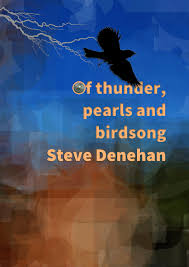
lives in Kildare, Ireland with his wife Eimear and daughter Robin. Publication credits include The Irish Times, Poetry Ireland Review, The Phoenix, Into the Void, The Opiate, The Hungry Chimera, Ink in Thirds, Crack The Spine and The Cape Rock.  He has been nominated for The Pushcart Prize and Best New Poet and his chapbook, “Of Thunder, Pearls and Birdsong” is available from Fowlpox Press.

Here are some relevant links:

Website – https://denehan.wixsite.com/website
Twitter – https://twitter.com/SteverinoD
Facebook – https://www.facebook.com/denehan

Steve performs his poetry at iambapoet.com

https://www.iambapoet.com/steve-denehan

The Interview

  1. When and why did you start writing poetry?

I started writing poetry when I was in primary school. I was lucky enough to win a small competition when I was around 9 years-old. My (very) short story was published in a national newspaper and I won a crisp £1 note. My father was a carpenter and worked so hard to provide for us and I remember being amazed at how he gave sweat and sometimes blood to turn wood into money whereas I had taken what was in my head and turned that into real, actual money. I thought, JACKPOT!

This would have been in the mid-1980s in Ireland and unemployment was very high. Times really were tough and my parents thought that writing wasn’t really going to give me much of a future. So I was discouraged from writing all the way along really. I can understand their thinking of course but I still wrote bits and pieces over the years.

I would have written with zero discipline and really with no objective. I just got a kick out of it. It’s still the same now really. I wrote short stories, poems and a few screenplays purely for the joy of it. My wife Eimear had tried for years to persuade me to submit the poems somewhere but I assumed that it would be just a waste of time. I would never have, and still don’t, consider myself a “writer”. I just like to write. Eventually Eimear wore me down and I put together a submission and sent it out. I absolutely expected it to be rejected so I put it out of my mind. If it had been rejected I doubt I would have ever tried again but, amazingly, a poem was accepted and published.

I was astonished and was sure that there had been some mistake. Until I saw the poem appear online I didn’t really believe it. This would have been just over two years ago. It seems strange to think back now but at the time I remember thinking that I had gotten further than I ever would have expected and I was happy to leave it at that. Sometimes when I think back to that time (and so many other times in my life) I want to give myself a shake.

Happily, I was persuaded to submit to a few other journals and got lucky again and I just kind of continued. Since then, and I still can’t believe this, I have had just under 200 poems published in print and online all over the world and a chapbook published which I still hold in my hands every once in a while, just to be sure it really happened.

The writing, like so many other things in my life, is something I just kind of fell into and I get an enormous amount of pleasure from it.

  1. Who introduced you to poetry?

An old teacher of mine, Mr. Shanahan. When my chapbook was published I got in touch with him after all these years to give him a copy as, if I had never met him there would have been no poetry and probably no writing full stop. Everyone seems to have a favourite teacher but Mr. Shanahan was more than that to those lucky enough to be in his class. He was, and still is, an amazing person who has an infectious enthusiasm for, well, everything.

He introduced, what he called, “Poetry Corner” every Friday where everyone was encouraged to write a poem and read it. In a classroom of boys only this was no mean feat but it didn’t take long before it was the highlight of our school week. We were taught how poetry could be anything, it could be personal or a complete fiction, it could rhyme, or not and it could be as long, or as short, as we wanted. It was fantastically freeing. I still remember the poem he read to us that he said was the shortest poem in the English language. It was called “Goldfish” and the whole poem was, simply, “wet pet”.

Besides having Mr. Shanahan we were also privileged to have a child prodigy and one of Ireland’s greatest poets in our class, Davoren Hanna. Like Christy Brown before him he had been born with a tremendous disability, quadriplegic cerebral palsy. He could not communicate verbally and could do nothing for himself yet within him was a burning intelligence that shone brightest through poetry. Sitting on his carer’s lap he would slowly lean toward oversized letters written on a large board, painstakingly creating some of the most wondrous poetry ever to come out of Ireland. Sadly he passed away in his late teens but his work lives on and is still absolutely transcendent. I wrote a short poem about Davoren actually if you would like to read it.

Davoren Hanna
A poem for one of Ireland’s greatest poets and, once, my friend

the wheels of his wheelchair squeak along my femur
he taught me
how words are an upturned collar against it all

he planted shame
behind my ear when I let him go
before he went

my body shared
my thoughts borrowed
and words, these little, late words
broken piano keys on the ocean floor

  1. How aware are and were you of the dominating presence of older poets traditional and contemporary?

I was not aware at all of the dominating presence of any other poets… But I guess I am now! Thanks for that Paul! Maybe it is because I write only for the love of it that I am oblivious to any shadows cast by anyone else. In the best possible way I really don’t care about what anyone else is doing or has done as it is not going to affect what I am doing. I am going to write regardless. I probably shouldn’t admit to this but I don’t really read a whole lot of poetry and never have. I listen to, and am often moved to tears, by song lyrics though. I find songs have a much greater impact on me than poetry.

  1. What is your daily writing routine?

My daily writing routine can be quite varied. It all depends on what, if anything, is going on in my head. I don’t seem to have a plan at all. Usually a line will come along based on something that has happened or that I have seen. I either take note of the line somewhere and come back to it later or, if time allows, write the poem on the spot springing off that one line. I often find that when I have written one poem another poem is ready and waiting so I tend to write several back to back. Once a poem comes along I find it is usually finished quickly. I don’t think I have ever spent longer than half an hour on an individual poem. I have met some really nice people through poetry and they can pour over a poem for days and weeks before it is just right. I have a huge amount of admiration for them and how they work. I have tried to spend more time honing a poem but they seem to lose whatever flow they might have had.

5. What motivates you to write?

I know a lot of people say that writing is a way of exorcising. I’m sure has been true for me occasionally but really it simply comes down to the joy of it. The idea of creating something that wasn’t there previously is weirdly intoxicating. It doesn’t even have to be good, luckily! There is an alchemy to it all. Taking thoughts and giving them some kind of life is incredible. They don’t even have to go anywhere. I have hundreds of poems that I have never submitted anywhere and probably never will but I am so happy that they exist. Though in saying that I never go back and read them again. At the risk of sounding ridiculously pretentious it is the act of creating them that is so addictive.

6. How do the writers you read when you were young influence you today?

I’m not sure really. I think I am probably more influenced by what and who I read now. The influence of the writers I read when I was younger has probably waned a little, or a lot, over time. Like my approach to writing I read only for pleasure and as a result I read (and probably write) a huge amount of nonsense.

7. Whom of today’s writers do you admire the most and why?

I absolutely love Glen Duncan and would encourage everyone to track down any of his books but particularly his startling debut, Hope, the devastating Death of an Ordinary Man and the darkly funny and dazzlingly inventive I, Lucifer. He has a way of putting the reader right in every moment and is so, sometimes frighteningly, relatable.
I also gobble up as much Joe R. Lansdale as I can though he is so prolific that he almost writes them faster than I can read them. In terms of variety there is nobody like Joe who can flit effortlessly between Elvis and JFK teaming up and fighting a re-animated ancient Egyptian mummy in Bubba Ho-Tep to the achingly beautiful and tender, The Bottoms, which could have been written by Mark Twain.
Paul Auster is another favourite but I feel he has faded a little over the last fifteen years or so. His earlier stuff was so beautiful and thought provoking and didn’t take itself as seriously.
They would be three contemporary writers who I would love hugely but there are many, many others.

9. What would you say to someone who asked you “How do you become a writer?”

I would say, “I’m not sure, ask a writer!” Really, the beginning of the answer is unbelievably simple I think. Just write. Beyond that I find that the two most important things for me when it comes to writing is to only write when I have something to say and to place more importance on content than style.

If you have written a few bits and pieces and feel that you would like to submit them I would recommend doing a little research beforehand. There are an almost infinite amount of journals and magazines but some might suit more than others. Also, feel free to reach out to me, or any other people out there who are writing, for advice. From my experience everyone is really warm, open and helpful and will gladly help steer you in the right direction while avoiding the pitfalls.

10. Tell me about the writing projects you have on at the moment.

I would love to dazzle you with a long list of interesting and impressive projects that I have going on at the minute but really I’m just writing away and seeing where it takes me. I have some poems coming up soon in a few amazing places like Into The Void and Poetry Ireland Review as well as a batch of poems that are coming out in the autumn in the amazing and artful language of Farsi. A couple of weeks ago I was shortlisted for the Anthony Cronin International Poetry Award at the Wexford Literary Festival but unfortunately didn’t win. It was a great experience though. I had been due to have a book published in September but I ended up withdrawing it as I found the publisher very, very difficult to deal with. That was a real shame and a painful thing to have to do as there is no guarantee that I might ever have the chance again. But I am glad I did as I want my poems to appear somewhere where they are wanted and that I, and the poems, are treated with respect.

I have since submitted the book to a few other presses and there has been tentative interest so maybe it might appear at some point.

Stoked to have five poems featured in the responses to last Wednesday’s writing prompt on the subject of reincarnation. Thankyou, Jamie.

“The Endless” . . . and other poems in response to the last Wednesday Writing Prompt