Wombwell Rainbow Interviews: Jess Thayil

Wombwell Rainbow Interviews

I am honoured and privileged that the following writers local, national and international have agreed to be interviewed by me. I gave the writers two options: an emailed list of questions or a more fluid interview via messenger.

The usual ground is covered about motivation, daily routines and work ethic, but some surprises too. Some of these poets you may know, others may be new to you. I hope you enjoy the experience as much as I do.
Jess Thayil

Jess Thayil

is working to complete a first collection of poetry. Her poems have appeared in Magma Poetry, The Stinging Fly, Ink Sweat And Tears, Black Bough Poetry, AbstractMagazineTV, Potomac Review and Whale Road Review.

The Interview

  1. When and why did you start writing poetry?

I started writing poems 8 years ago around the same time I started to train in long distance running. While I’ve been working on poetry actively since then, for the most part, I managed to write poems and edit them in tiny scraps of time outside work. For the last couple of years, after my health deteriorated, I’ve had to give up work and running. So I’ve been focused more avidly on writing poetry and on some abstract painting even as my health conditions continue to be challenging to manage.

As for why I started writing poetry, I don’t really know and that might sound odd considering many poets have a defining reason or two. But the truth is that it felt right to return to it after a long break. (I last wrote and won awards in poetry while in school and university). Of course, I didn’t write strong poems 8 years ago because I was very out of touch with contemporary poetry. It took me a while to get into the groove because poetry wasn’t the only thing on my plate. But it felt like a nice challenge at the time to begin reading contemporary poetry, hone my own craft and work towards a first book. I’m happy I stuck with it.

2. Who introduced you to poetry?

I was introduced to a little poetry in school and then more of it at university as part of English Literature study. As much as I enjoyed those classes, I don’t remember loving poetry as I do now. Contemporary international poetry is a diverse and vibrant space. You ask about my ‘introduction’ to poetry, and while I will rattle off some names for you, that ‘introduction’ is ongoing.

When I started to write poems 8 years ago, I invested in the Bloodaxe Book of Contemporary Indian Poets edited by Jeet Thayil. It’s still available from Bloodaxe Books and is a hugely vital anthology for anyone anywhere who wants to read English poetry from India. Back then I also read and continue to enjoy Eunice de Souza (passed away in 2017), Meena Alexander (passed away in 2018), Vijay Nambisan (passed away in 2017) and the late Dom Moraes. Contemporary Indian poets like Priya Sarukkai Chabria, Arundhathi Subramaniam, Tishani Doshi, Keki Daruwalla, Arvind Krishna Mehrotra, Jayanta Mahapatra, Ranjit Hoskote and Jeet Thayil continue to be my introduction to poetry. I’m only stopping with those names because the list of contemporary Indian poets everyone, ideally, should read is (wonderfully) long!

3. How aware are and were you of the dominating presence of older poets traditional and contemporary?

I don’t know if I have a perfect answer to this question. If you mean, was I aware of Yeats, Keats, Tennyson, Eliot… yes. But while I dip into their works from time to time, contemporary and international poetry is way more interesting to me. So, to answer your question in relation to contemporary poetry, both ‘dominance’ and ‘older’ has a mixed significance for me. People can be dominating voices with or without poetry today if they use social networks in a way that happens to click and then that continues to attract large numbers of followers. And today, we can start to write poems while ‘older’ or be younger with multiple books in our names — age is practically irrelevent in some ways, is it not? Technology and platforms are more relevant.

From what I can see, ‘dominance’ has a lot to do with network-led reach. We could say Rupi Kaur and Lang Leav are dominant. But so are Jericho Brown, Maggie Smith and many others. It seems to me that some contemporary poets who dominate social media use the services of digital marketing agencies. It’s perhaps advantageous, in some ways, for poetry as an art form that anyone can have a sizeable platform- and network-enabled reach if they want to work for it

4. What is your daily writing routine?

I read some poetry everyday whether or not I work on my poems everyday. I’m also developing a practice in abstract and mixed media art — another reason I don’t write everyday. But most days, I’m in negotiations with myself on what a poem or a set of poems needs to lose and what I will keep. I’m gearing up to have a full manuscript ready and that means I’m currently busier with editing old poems than writing new ones.

I did set a target for myself at the start of 2019 to write one new poem a month, and I’m on track with that so far. And because I also deal with the uncertainties of chronic illness, I don’t set a rigid daily routine. Instead, I target to finish a few different things related to writing/poetry in a week, and this seems to help me get enough done even with those personal challenges.

5, What motivates you to write?

On motivation for my writing:

I’m always interested in the agency and capacity of individuals to effect a revolution in their lives. And I think about how that speaks into the collective. I believe even an individual who finds herself without a ‘community’ is speaking into the collective as well as bolstering its arguments and affirmations. I’m drawn to how women navigate the world at this point in the history of time.

My first manuscript will have a lot of that. But everything motivates me — birds, buildings, bones, hands, humans coughing and sneezing, unwashed dishes, windows, wells, worms… everything.

6. How do the writers you read when you were young influence you today?

If you mean poets specifically, I wish I could say I was hugely influenced by the ones I had to read in school or in my undergraduate programme in India. But I recall we read white male poets and only a meagre number of women, white or coloured. Even the fiction I read as a hobby when I was growing up in India was written by white authors too. It feels more accurate to say that what I didn’t read then, and what no one guided me to read, has in one way or another, more of an influence on me now.

I read poetry by Sarojini Naidu and Kamala Das (aka Kamala Suraiyya) so many years after leaving school and university. Their work is representative of strong voices in Indian poetry and I’m now amazed they were not in our literature texts. I remember one of Nissim Ezekiel’s poems featured in a textbook and then we never heard of him again. And not a single poem by poets like K Satchidanandan or Arun Kolatkar in a literature textbook at university. We never had to write essays on India’s English language poets but we handed in a number of assignments on poets like John Milton and John Donne. This scenario likely prevails to this day. So all that underrepresentation has influenced me more than anything else — I now want to read more Indian poetry in English, even translations from our regional languages, or read in regional languages as I write more poetry in English myself.

7. Who of today’s writers do you admire the most and why?

I’m currently reading Glen Wilson’s An Experience On The Tongue. What I enjoy about Glen’s poems is that they contain distinct worlds in each of them and that bigness is expertly sustained by grounding images and local references. (I feel the same way about Seamus Heaney’s poems). I’ve also enjoyed Nathan McClain’s collection Scale for its buzzing units (poems) that somehow achieve the feat of heart-tuggery while simultanoeusly having a settling effect on me. Between a hawk and a young girl’s ‘entanglements’ with each other, they are (for me) not just leading images and metaphors in Maggie Smith’s collection Good Bones, but also the reason why Maggie’s poems feel tethered while also enabling me to feel all the swooping flight in them. I want to read a lot of Maggie’s work, past and future. Ricky Ray’s collection Fealty contains poems of reflection and meditations on pain, but some of them have an assured way of granting a reader like me the light of little unexpected jokes as they travel towards their finish lines. I enjoy what Kelli Russell Agodon does with the sea and love in Hourglass Museum, I enjoy her questions, and I’m keen to read more of her work.

I like to re-read Heidi Williamson. Her poems are confident neat arrangements and they have a way of fixing you in place without force. She’s another poet whose worlds I can get lost in and you may understand what I mean especially when you read The Print Museum. I also tend to re-read Louise Glück and John Glenday nearly every year now. Louise’s long poems in Averno and many of John’s compact poems in both Grain and The Golden Mean having a way of defining and redefining for me what a good reading day feels like. I read the work of many Indian poets over and over — I’ve mentioned their names earlier. In general, because I write poems, and I know what I want them to try and achieve, I enjoy reading poets whose language is clear and simple while their poems aren’t easy. To me, there’s huge value (and I’m learning more about this everyday) in poetry that can say things directly while also inviting the reader to contemplate how a single line or fragment can point to multiple meanings each time you read a poem — I enjoy poems that keep on giving.

8. Why do you write, as opposed to doing anything else?

To enjoy it. And if something makes me enjoy it less, I retreat and do more of the other things I enjoy, like painting or cooking, and then what feels like a natural pull of writing puts me back on course. I operate like the sea. More like a wave. I try to enjoy being a wave.

9. What would you say to someone who asked you “How do you become a writer?”

Write. As regularly as you can. And if you’re not writing just for yourself and you aim to be read, get used to revising and editing your work, show your work to other writers who can comment constructively on your writing and help you polish up your work.

10. Tell me about the writing projects you have on at the moment.

I’m working to complete a first collection of poems. I’m also working on a first novel, but I don’t expect this to progress in a hurry. I’m all right with a novel taking 5 or 10 years or longer. Because after 8 years of attempting poems, poetry takes up much head and heart space.
For me, the writing life includes reading poetry by other debuting and emerging poets. Reading helps me think about poetry and its function as well as place in the world. That could lead to some essays, or not. I hope to continue to write poems beyond a first manuscript, whether or not I have a first published book of poetry to my name, and whether or not I manage to write anything outside poetry.

Wombwell Rainbow Book Review: hall of several tortures By Reuben Woolley

Dean pasch the hall of several tortures

A photograph by Dean Pasch provides the front cover illustration to “hall of several tortures”

Wombwell Rainbow Book Review: hall of several tortures By Reuben Woolley (Knives, Forks and Spoons press, 2019)

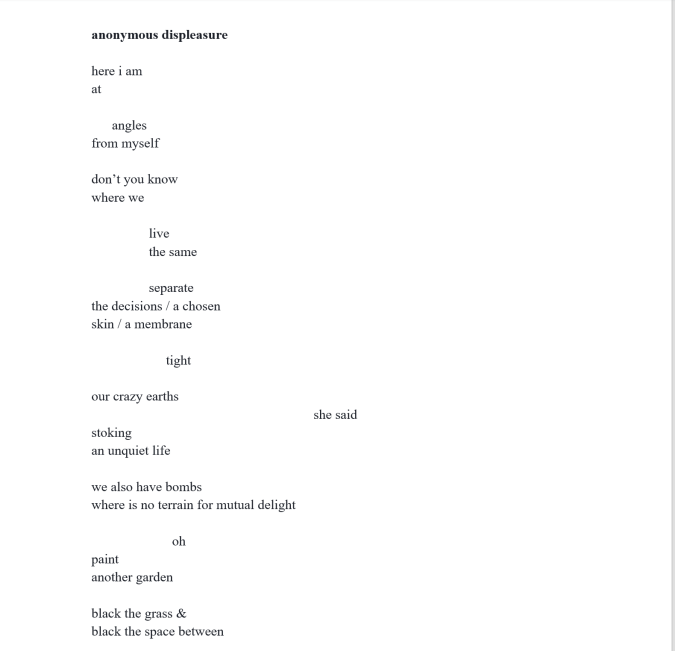
anonymous displeasure

I am increasingly impressed by the work produced by Reuben Woolley. His latest publication “hall of several tortures” he describes as “built up around the multiverse concept. A young woman lives on a parallel world from ours (through the membrane) she is somehow able to see and sometimes participate in events on this dystopian world of ours.” The contents lists the poems without page numbers, and there are no page numbers on the pages themselves. As with most poetry collections this leaves us with two options: read the book page by page from left to right, or to dip in as our fancy takes us. Either way the words are sparse on the page so the “white space” becomes as much a part of the work as the text. It acts as a active silence between one word and another,

Much as in the plays of Samuel Beckett, and Harold Pinter the white space (silence) holds emotional weight, as does the plain language. No Latinisms or Greekisms. Music is paramount. Direct reference is made to the blues, and the way music moves us from one emotional state to another. These poems demand to be read aloud. They become like the layers in Dean Pasch’s photography, one view laid over another, so we see glimpses of another scene as if through a “membrane”. A device I am reminded was often marked as a “bad” photo when I got mine back from “Boots” the chemist, and even then thought it a great device for another way of looking at the world.

I look forward to reading more work by Reuben, His work could easily be presented on stage with Dean’s photos as backdrop, as it is intensely dramatic.

hall of several tortures book interview

https://thewombwellrainbow.com/2019/08/06/wombwell-rainbow-book-interviews-hall-of-several-tortures-by-reuben-woolley/

Last years interview by The Wombwell Rainbow of Reuben Woolley’s creative process:

https://thewombwellrainbow.com/2018/09/08/wombwell-rainbow-interviews-reuben-woolley/

Wombwell Rainbow Interviews: Natalie Whittaker

Wombwell Rainbow Interviews

I am honoured and privileged that the following writers local, national and international have agreed to be interviewed by me. I gave the writers two options: an emailed list of questions or a more fluid interview via messenger.

The usual ground is covered about motivation, daily routines and work ethic, but some surprises too. Some of these poets you may know, others may be new to you. I hope you enjoy the experience as much as I do.

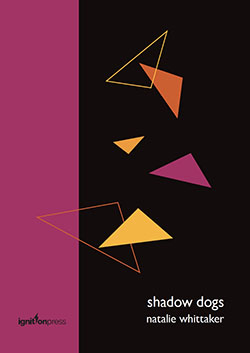
Natalie_front_cover

Natalie Whittaker

is from South East London, where she works as a secondary school teacher. She studied English at New College, Oxford.

Her poems have been published in Poetry News, Brittle Star, Aesthetica Creative Writing Annual, #MeToo: A Women’s Poetry Anthology and South Bank Poetry.

Natalie was awarded second place in the Poetry on the Lake short poem competition 2018 and the Oxford Brookes International Poetry Competition 2017.

Her pamphlet ‘Shadow Dogs‘, available from ignition: https://www.brookes.ac.uk/poetry-centre/ignition-press/pamphlets/

Her second pamphlet #Tree is due out March 2021.

and her twitter account is @natalie_poetry

The Interview

1. What inspired you  to write poetry?

I’ve always been the sort of person to write things down and try to narrativise my life – I used to keep a diary even in primary school. I can’t really explain why, it just seemed like the natural thing to do, like something hadn’t really happened until I’d written about it. In terms of ‘creative writing’, I started off with stories – I wrote a lot of bad short stories in sixth form – and the stories got shorter and shorter until I realised that I actually wrote poems. At the same time (around the age of 17) I was getting really into the poetry that we were reading for A-level English at school, and this continued the ‘inspiration’, I suppose.

2. Who introduced you to poetry?

English teachers at school. I was lucky enough to have some great English teachers, particularly in sixth form. I suppose that’s the reason why I’m now a secondary school English teacher myself, more than being the reason why I am a poet.  We studied pretty standard stuff – an anthology of Victorian poetry, some ‘unseen’ poems for the exam – but it always seemed to mean a bit more to me than just something to write about in an exam. Then in year 13 we studied Philip Larkin’s ‘The Whitsun Weddings’, and something just switched on in my brain – I was like yeah, this is the good shit! I know Larkin’s not a particularly fashionable person to like now for various reasons, but at the time I just got the sense that this was someone writing about ‘normal’ stuff – bleak towns, shopping centres, sitting on a train – and it struck a chord. I realised that poetry could be about quite everyday things, and still contain great emotion. And I loved how miserable he was. I found that really funny.

3. How aware were you of the dominating presence of older poets?

Most of the poets I read in school were dead. I didn’t really have much awareness of living poets, or a sense that it was something that people actually did as a job. So I suppose a ‘dominating presence’ wasn’t something that I worried about, I was too naïve to even be aware of it. The first poet I really got into independently of school was Sylvia Plath. She definitely became a ‘dominating presence’ for me when I was about 17.  I remember that I asked for her collected poems and journals for Christmas, and that it seemed a bit perverse at the time – to buy a poetry book that you weren’t obliged to read for school! It wasn’t the sort of thing that people around me did.

4. What is your daily writing routine?

I don’t really have one. I work as a secondary school teacher so I don’t write every day. I used to get my writing done in the school holidays. Or on the weekends, or if I attend a writing workshop or Arvon course, where you have no choice but to write! Or just on the bus or train. I don’t have set hours where I sit down to write. I can’t imagine that.

5. What motivates you to write?

A line or a sound or an image that I can’t get out of my head. The need to transform emotion (usually negative emotion) into something approaching comprehension.

6. What is your work ethic?

For years I was an incredibly slow and sporadic writer. Literally one or two poems a year. I just didn’t have the confidence in my writing to ‘allow’ myself to dedicate that much time to it. And in the first few years, at least, teaching is  a pretty full-on job. But in my late 20s I realised that I didn’t have all the time in the world, and that I had better start taking my writing seriously, because it was clearly sticking around as a a part of my life whether I wanted it to or not! So I signed up for a few weekend classes at The Poetry School, an Arvon course, and an evening class at City Lit… and it just went from there. When I was offered a pamphlet publication in 2018 that was a massive boost to my confidence – I think my work ethic quadrupled that year – I wrote more in one year than I had in the previous five years put together! I’m now doing an MA part time so that has kept the momentum going for now.

7. How do the writers you read when you were young influence you today?

Everything sticks in my head. I’ve got a bit of an obsessive mindset. So I’m sure everything I’ve read influences me hugely. Larkin and Plath are still there, probably. Elizabeth Bishop definitely is – she was my ‘special author’ choice when I did my undergraduate degree. Simon Armitage, Tomas Transtromer – they’re both in there from years ago too. I suppose the main ‘influence’ is just an awareness of what has come before, so that you can move into or against a tradition.

8. Who of today’s writers do you admire the most and why?

I admire / envy so many writers of my own age! Fran Lock, Liz Berry, Jack Underwood, Kayo Chingonyi, Wayne Holloway-Smith, Niall Campbell, Helen Mort, Jay Bernard… I could go on for a long time. Actually, a few of those guys are year or two younger than me. They got their poetry act together a lot sooner!

9. Why do you write, as opposed to doing anything else?

If you mean instead of another art form, I was rubbish at art at school! Bottom of the year in year 8, I remember that clearly! And I never had music lessons or anything like that. I just went to the library! It was something that I could do by myself, that didn’t involve being taken to some form of class or organised activity.

10. What would you say to someone who asked you “How do you become a writer?”

Read. Spend years just reading other poets. Try to imitate what you’re reading. The writing won’t be great at first, but you’ll learn a lot. Then read some more, and spend another ten years trying to get good at writing. It’s probably not the best advice, but it’s all I’ve got because it’s what worked for me.
Also – join a writing group! I left that way too long, due to crippling shyness and social anxiety about my writing, which probably didn’t do me any favours.

11. Tell me about the writing projects you have on at the moment.

Since ‘Shadow Dogs’ I’ve started going in a different direction formally. I’m working on a series of unpunctuated poems that use extended spaces instead of punctuation. The spaces are always six space bars, and the poems have to make rectangle shapes on the page. I can’t explain why – that’s just how things are coming out at the moment.

Wombwell Rainbow Interviews: Jennifer Wortman

Wombwell Rainbow Interviews

I am honoured and privileged that the following writers local, national and international have agreed to be interviewed by me. I gave the writers two options: an emailed list of questions or a more fluid interview via messenger.

The usual ground is covered about motivation, daily routines and work ethic, but some surprises too. Some of these poets you may know, others may be new to you. I hope you enjoy the experience as much as I do.

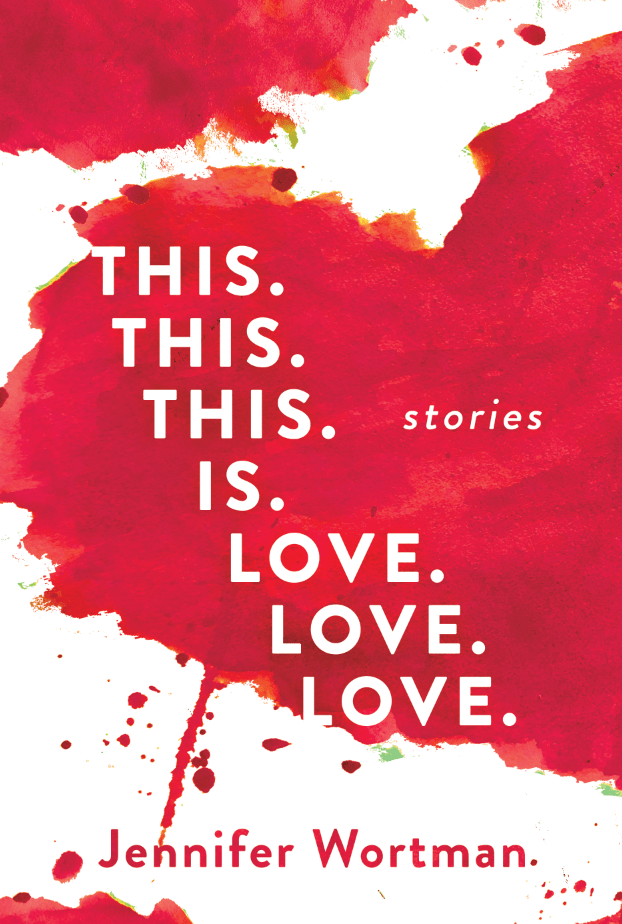
Jennifer Wortmann

Jennifer Wortman

is the author of the story collection This. This. This. Is. Love. Love. Love (Split Lip Press, 2019). Her fiction, essays, and poetry appear in TriQuarterly, Glimmer Train, Normal School, Brevity, DIAGRAM, Juked, and elsewhere. She lives with her family in Colorado, where she serves as associate fiction editor for Colorado Review and teaches at Lighthouse Writers Workshop.

website: jenniferwortman.com. Twitter: @wrefinnej.

The Interview

1. What inspired you to write poetry?

I write a little poetry, but I mostly write fiction. In both cases, what inspired me to write was reading so many books I loved. I wanted to make other people feel the way those books made me feel, and think the way they made me think.

2. Who introduced you to poetry?

My mom read to me a lot, including lots of Dr. Seuss, especially Hop on Pop, and my dad loved reading me Hands, Hands, Fingers, Thumb by Al Perkins, all books full of wonderful rhythms and rhymes. That was my first introduction to the joys of language.

3. How aware were you of the dominating presence of older poets?

When I was younger, I was very aware of the dominating presence of older writers. I idealized them and wanted to be like them. I’ve learned a ton from them but they have less mythic power over me now.

4. What is your daily writing routine?

It’s been extra busy, so my routine has fallen apart; I mainly write in little spurts when I can. During more stable times, I prefer to write in the morning before I start my other work. I will focus on my main project then, and later in the day, I might dip into other pieces or do something more left-brained like line-editing. Sometimes I play with poetry and weird prose or explore places I’m stuck before I go to sleep. If I’m lucky, my unconscious mind will work its magic and I’ll wake up with breakthroughs.

5. What motivates you to write?

When I don’t write, I feel useless and sad.

6. What is your work ethic?

My work ethic is to make my writing as good as I possibly can without losing sight of my well-being and other important things in life.

7. How do the writers you read when you were young influence you today?

That’s hard to say. Our influences, I think, are largely unconscious, whether we like it or not. But I’ve always been attracted to voice-driven narratives with a psychological or philosophical bent: writers like Fyodor Dostoevsky, Walker Percy, Alice Adams, Ford Madox Ford, and Iris Murdoch had a big appeal to me when I was younger, and their sensibilities may show up in my writing.

8. Who of today’s writers do you admire the most and why?

Too many to name but I’ll say a few: Megan Giddings writes daring, astonishing prose, and supports other writers through her work as an editor of The Offing and the Forward writers-of-color flash-fiction anthology. Her chapbook Arcade Seventeen is brilliant and I can’t wait for her novel that’s coming out next year, Lakewood. Heather/Heathen Derr-Smith combines poetry and activism in a beautiful and necessary way: I was deeply inspired by her project of reading poems of protest by multiple writers down at the Texas border through the nonprofit she founded, Čuvaj Se. Other writers I admire include Maggie Nelson, for her ingenious mix of high intellect and emotional rawness; Jericho Brown, for his precision and fire; and John Edgar Wideman, who has been combining the visceral and cerebral and lyrical to stunning effect for decades.

9. Why do you write, as opposed to doing anything else?

At times in my life I’ve dabbled in other art forms, especially music, but writing has the biggest appeal to me because it combines intellect and emotion so well: I get to use all of myself when I write. Being an introvert, I also appreciate the solitary aspects of writing.

10. What would you say to someone who asked you “How do you become a writer?”

Read a lot and write a lot, in that order. Find a community, big or small, and get trusted feedback on your work. Revise, revise, revise. If you decide to submit work for publication, expect rejection and don’t let it throw you: persistence is key.

11. Tell me about the writing projects you have on at the moment.

I’m working on a novel-in-stories about a middle-aged mother of two whose husband has died: she has ambiguously paranormal experiences and sleeps around a fair amount—that’s pretty much the plot! I’m also putting together a couple chapbooks: one of flash fiction and another I’m envisioning as a semi-evasive memoir in poetry and prose.

Wombwell Rainbow Interviews: Louise G. Cole

The Wombwell Rainbow Interviews:

I am honoured and privileged that the following writers local, national and international have agreed to be interviewed by me. I gave the writers two options: an emailed list of questions or a more fluid interview via messenger.

The usual ground is covered about motivation, daily routines and work ethic, but some surprises too. Some of these poets you may know, others may be new to you. I hope you enjoy the experience as much as I do.

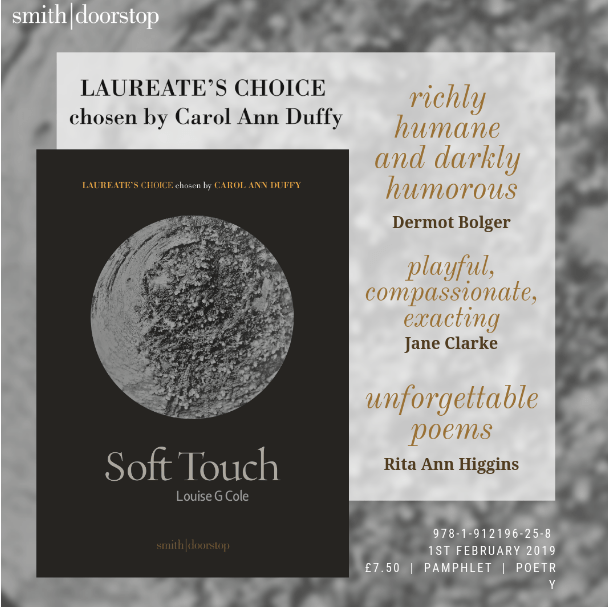
soft touch promo

Louise G Cole

Originally from Worcestershire, but now living in rural Ireland, Louise G Cole writes short stories and poems. She won the Hennessy Literary Award for Emerging Poetry in 2018 and was then selected by UK Poet Laureate Carol Ann Duffy for publication of a poetry pamphlet in February 2019. In 2015, she was shortlisted for a Hennessy award for a short story, and that year won the HE Bates Short Story Competition and the Hanna Greally Literary Award. In June 2019, one of her short stories won the New Roscommon Writing Award and a story was selected for publication in the Cork Libraries anthology, ‘From the Well’. Louise was one of 12 poets chosen for a Poetry Masterclass with former US Poet Laureate Billy Collins at the John Hewitt International Summer School in July 2019. She has been published in various anthologies, newspapers and literary magazines, including the Irish Independent, the Irish Times, Crannóg, From the Well, Stony Thursday, Skylight 47, Ropes, the Strokestown Poetry Festival Anthology, Poetry Ireland Review and the Ogham Stone. She blogs at https://louisegcolewriter.wordpress.com/ where she explains the ‘G’ in her name is there to avoid unnecessary confusion with an underwear model.

The Interview

1. What inspired you to write poetry?

I’ve always loved writing, but I only recently (five or six years ago) discovered writing poetry was a way I could put words together for someone else to appreciate. I’m inspired by family, the environment, nature, annoying people in the bank queue, charity shops, grief, flashers, knickers, heck, there’s no end to what has inspired me to write.

2. Who introduced you to poetry?

That would be a teacher at primary school, Mr Simance, who read us Charles Causley and Longfellow. And my mother, who could recite verses she learned as a child. She was still word perfect from memory well into her 90s.

3. How aware were you of the dominating presence of older poets?

It was difficult not to be aware of the older poets when my mother was reciting Keats, Kipling, Wordsworth and the like. And studying involved reading poetry by DH Lawrence, Dylan Thomas, Robert Frost. All men, of course. I didn’t get into older female poets like Emily Dickinson or Christina Rossetti until I’d finished studying.

4. What is your daily writing routine?

Sadly, I don’t have a daily routine, although I do snatch a few minutes at the end of every day to write in a journal, which is a way of unscrambling my thoughts. I always carry a notebook, so whenever I have the chance, I write. I am lucky to get away to a writer’s retreat several times a year, which is productive, non-stop writing for several days at a time – bliss, but not a sustainable pace, way too intense.

5. What motivates you to write?

Writing is a compulsion and after a while you need third party validation that what you are writing is worthy of an audience. The ‘success’ then becomes addictive too – I get a great buzz from hearing complete strangers tell me they’ve enjoyed something I’ve written. That thrill is a great motivation to keep going.

6. What is your work ethic?

In a nutshell, hard work usually pays off. I’m someone who slogs away at trying to get it right. I’m always attending workshops and masterclasses, following the lead of writers whose work I admire. And I’m a dedicated re-writer. My first drafts are only ever that – I can turn out 20 or 30 drafts of a poem or a story before I’m happy.

7. How do the writers you read when you were young influence you today?

Probably not a lot. I was weaned on Enid Blyton and Agatha Christie, but I became a voracious reader of all styles and genres. I believe only by reading widely can a writer experience style and form and thereby find their own voice. I think I’m getting there, writing with my own distinct voice, but it has taken a long time to get to this point.

8. Who of today’s writers do you admire the most and why?

Where to start? There hundreds – no thousands – of good writers out there. Some tell a good story, but the style is not to my taste, others write beautifully but haven’t got much to say. Rarely, the stars are in alignment and you get both, substance and form (and I’m talking everything, poetry, fiction, essays and memoir here). I’m always keen to read anything by Anthony Duerr, Jess Kidd and Kevin Barry. Then there’s Billy O’Callaghan, Claire Keegan and Danielle Mclaughlin who write short stories to take my breath away. My tastes in poetry veer to the accessible styles of well-established poets like Billy Collins, Carol Ann Duffy and Gillian Clarke, all of whom I’ve been fortunate to work with. Ireland has shedloads of wonderful modern poets I admire – I daren’t name one for fear of missing out others.

9. Why do you write, as opposed to doing anything else?

I write because I feel I have to (see above), but also because a looming deadline is a great excuse for getting out of other chores. I mean, I haven’t time to mop the kitchen floor if I’ve a writing project to finish by midnight, have I?

10. What would you say to someone who asked you “How do you become a writer?”

Pick up a pen, grab a notebook and off you go – write! Stop talking about it and get on with it. Join a writers’ group, but shop around until you get the right fit, a small group of like-minded folk who are supportive and encouraging. Start your own if you have to. And enter writing competitions and submit to magazines and journals to get public validation, there are plenty out there to try. Alongside all that though, develop a thick skin and don’t be discouraged by people trying to put you off. Having said that, if the process creates grief, give up and take up knitting or sky-diving, or something else to fill your time. Writing should be (mostly) fun.

11. Tell me about the writing projects you have on at the moment.
I am working on a new poetry collection and I have a book of short stories already out there looking for a publisher. I’m also 100,000 words into a novel I’m enjoying writing for pure escapism. I’ve completed seven novels, the first five being unpublishable drivel, but a satisfying exercise in how (not) to do it. The two others still need some work, but I’m not in a hurry. I’m also involved in leading two local writing groups and we’ve a words and art project under way where we’ve swapped words and images with an art group to give each other inspiration. That culminates in a public exhibition soon, which is very exciting. I’m always keen to do public readings of my work – that’s how you get to connect directly with readers and thankfully, is usually a great experience.

Wombwell Rainbow Book Interviews: “hall of several tortures” By Reuben Woolley

Dean pasch the hall of several tortures

The title poem of his new collection with Knives Forks and Spoons Press.’this hall of several tortures’ (with thanks to Fran Lock)

A link to Reuben’s earlier Wombwell Rainbow Interview:

Wombwell Rainbow Interviews: Reuben Woolley

1. What inspired your new book?

I’ve always been fascinated by Science Fantasy starting back in the late 60s with Michael Moorcock, which is where I had my first contact with the idea of the multiverse. This continues years later with Terry Pratchett and Neil Gaiman and later with China de Mïeville. I’ve been reading Stephen Hawking’s ‘A Brief History of Time’ as well. I’ve often wondered what kind of poetry, if any, would be found on these parallel worlds. I suppose I wanted to have a go at writing it. I’ve also been stimulated by Dean Pasch’s multi-layer photos and was delighted when he agreed to do the cover, one which sums up the idea of the collection so well.

1.1 In the poems you speak of approaching these worlds from an odd angle, an edge. Would this be what some fantasy writers call a “portal”?

Yes. A membrane between the universes. The collection is built up around the multiverse concept. A young woman lives on a parallel world from the (through the membrane) she is somehow able to see and sometimes participate in events on this dystopian world of ours.

1.2. A stranger in a strange world. An observer

Yes. It gives me several layers of separation between me, the poet and the ‘i’ that appears in the poems.

1.3. The fragmentation of syntax conveying the fragmented worlds she is observing.

Ha! That’s my most usual voice. My poetry is very much affected by music: in the topics and images by the Dylan of 1964-66, Roy Harper and Captain Beefheart(also musically); musically by minimalists such as Terry Riley, and Jazz such as Mikes Davis, Kind of Blue, John Coltrane, Blue Train. I followed Coltrane through ‘A Love Supreme’ and into his work in Free Jazz. This is what I try to do in poetry. I like to think I write Free Poetry. Any word or image can go anywhere but only the really good poet can recognise that place and allow the word or image to go there, just as only the very best jazz musicians can play Free Jazz. I want to be that good a poet and it’s what I’m working for. I hope I’ll get there some day.

2. You do have certain phrase such as “she said” that hint this experience is being reported to you.

That’s her on her planet. Reporting to me and I’ve no idea where I am. Lost somewhere in the aether or bouncing off the membrane and rather anonymous.

2.1. Ah. So the writer moves between worlds as well as the participant. Both are like refugees in the others world.

I think a poet lives in the world he or she writes about.

2.2. And that world must have like Free Jazz as many “possibles” to explore. You riff off the meaning and emotion of the phrases.

And the white spaces which are an essential part. Meaning may change from one side of the space to another.

2.3. Mercurial

At times. Slow like Pluto at others. And all mixed up with black holes, dark matter and singularity events (see Hawkings).

2.4.Time squashed, or elongated. You also use “un” as in “earths of undelight”. These remind me of ee cummings use of the term.

I was thinking of the painting by Hieronymus Bosch, ‘Garden of Earthly Delights’. ee cummings has been an influence on me for a long time.

2.5. Another example, as in Free Jazz of phrases that hint at other art outside of the poems, delightful surprises for the reader or listener that deepen the work as a whole.

Thank you. I am affected by many kinds of music and also painting and photography. I look for creative imagination in all art. Hockney leaves me cold, for example but Miro and the later abstract painters really get me going.

2.6. How must the reader out loud read the white space, as a pause or run straight on into the next word?

The white space is the same as for music: silence. The greater the space, the longer the silence. They also give the reader/listener time to think, rethink and participate creatively.

2.7.Profound messages about grief and loneliness are conveyed in plain language, no wondering off into Latinisms. It is all breath and bone, and all the more powerful to me because of this.

I’ve been accused of ‘being difficult’! This is certainly not because of the vocabulary. I don’t want readers to need a dictionary by their sides. I haven’t studied poetry since my A-Level days. My speciality is in Applied Linguistics: I play with grammar and I may use an adjective as a noun or an adverb, for example. A useful question would be the Wittgensteinian, ‘why this word here and now’. I play with the words and the grammar.

It gives me a new/different way of looking at things in our shared world.

3.

Reuben Woolley lost words
A good example- I’m going to read the first poem, dedicated to Fran Lock, the title poem for the collection and ‘time comes counting / one two zero’ which is dedicated to Antony Owen.

4. One final question: How did you know when this book was finished?

I submitted it to Alec Newman at Knives Forks and Spoons Press last year, a little before my current book, ‘some time we are heroes’ came out with The Corrupt Press. I was bowled over when he accepted it as the quality of the poets that KFS accepts is tremendous. I’ve just been further surprised that, along with other KFS poets, I’ll have a poem up as part of Blackpool Illuminations.

Wombwell Rainbow Interviews: Andres Rojas

Wombwell Rainbow Interviews

I am honoured and privileged that the following writers local, national and international have agreed to be interviewed by me. I gave the writers two options: an emailed list of questions or a more fluid interview via messenger.

The usual ground is covered about motivation, daily routines and work ethic, but some surprises too. Some of these poets you may know, others may be new to you. I hope you enjoy the experience as much as I do.

Andres Rojas

Andres Rojas
was born in Cuba and arrived in the United States at age 13. He is the author of the chapbook Looking For What Isn’t There (Paper Nautilus Debut Series winner) and of the audio chapbook The Season of the Dead (EAT Poems). His poetry has been featured in the Best New Poets series and has most recently appeared or is forthcoming in, among others, AGNI, Barrow Street, Colorado Review, Massachusetts Review, New England Review, and Poetry Northwest.
Website: Teoppoet Poetteop https://teoppoet.wordpress.com/
Free Audio Chapbook: The Season of the Dead  http://www.eatwords.net/eat-poems-13/
Chapbook, Looking For What Isn’t There, available from Paper Nautilus Press
https://readpapernautilus.blogspot.com/2019/04/andres-rojass-looking-for-what-isnt.html

The Interview

1. What inspired you to write poetry?

I loved reading as a child and wanted to create that magic myself, but I wasn’t really drawn to poetry.  When my mother, sister, and me came to the United States to join my father who was already living here, he shared the poems he was writing with me. I was 13, and I tried my hand at some poems too, which my father promptly shot down. I believe he told me to quit trying, that I wasn’t a real poet, or words to that effect. I believed him.  Much later, when I began to read poetry seriously in 11th and 12th grade, I was struck by the forcefulness of the art form and how quickly and poignantly it could get to the heart of an emotion or a moment. So I think what inspired me to write poetry was reading great poetry. I then wanted to try and duplicate the power and elegance of the poems I was discovering.

2. Who introduced you to poetry?

I grew up reading poetry (in Spanish) in Cuba, formally I think starting in 5th grade, but the first class that opened up poetry for me was my 11th grade English class in the U.S. There, I encountered T.S. Eliot’s “The Love Song of J. Alfred Prufrock.” I had never seen a poem do things like that before. I remember also being in awe of Chaucer’s “The Canterbury Tales” and of Shakespeare’s “Macbeth” and “Hamlet” when we covered them in 12th grade.  In college, I began to take creative writing classes, so the people who introduced me to writing poetry were Marilyn DeSimone and Kevin Bezner at Florida Community College in Jacksonville.

3. How aware were you of the dominating presence of older poets?

Once I started to write poetry in college, I was awestruck by the work of Adrianne Rich, Carolyn Forche, and Sharon Olds, particularly Rich; I remember wishing I could write anywhere near as well as she did. I was lucky to meet and have my poems workshopped by Stanley Plumly, Philip Levine, and Donald Justice while in community college. I then went on to work with Debora Greger, Michael Hofmann, Donald Justice, William Logan, and Joan New as an undergraduate at the University of Florida, in Gainesville. I was keenly aware of the quality of their work and of how far I had to go to write at their level, and that there was no guarantee I ever would. They were unfailingly generous in their support and encouragement, but I knew I was in the shadow of giants. I was also aware of the work being done by, among others, Amy Clampitt, Louise Gluck, Mark Strand and Seamus Heaney, so … talk about dominating presences.

4. What is your daily writing routine?

I am always on the lookout for interesting images and phrases, which I jot down in my journal, writing notebook, or iPhone. I try to sit down and write at least once per day, though I revise existing poems several times during the day, whenever I get a chance. Most of my starting drafts don’t go anywhere, but now and then the exercise takes on a life of its own (it seems), and I end up with a reasonable first draft. Generally speaking, it takes me about two or three days to get a few lines down that seem to work together, and then about a week to get a more-or-less complete first draft. Then I revise for months (literally), just chipping away at words, smoothing the lines out, trying to use every opportunity to make the images interesting for me and for future readers.

5. What motivates you to write?

The sheer joy of creating something new in the world that challenged me to the utmost to get it done. Writing poetry is the most difficult thing I do on a regular basis, and the satisfaction of trying to do it right is huge. Very seldomly, I do end up with a poem I really like, and those moments are incredible. Sometimes I recite those poems to myself as I go about the day and just revel in the experience.

6. What is your work ethic?

If I don’t become a better writer, it will not be for lack of trying. I’d like my tombstone to read “He Never Gave Up.”

7. How do the writers you read when you were young influence you today?

I think it was Elizabeth Bishop who said you learn more from the classics than from your contemporaries. However, poetry is evolving in so many exciting ways that the people changing poetry today are a greater influence on me than the canonized poets. It’s as if poets today are imagining new ways to do poetry with each poem they write, and it is fascinating to watch and learn from them.

8. Who of today’s writers do you admire the most and why?

There are so many! In more or less chronological order of my becoming aware of them, I continue to love Louise Gluck and Sharon Olds. I love the work being done by Ross Gay, Eduardo Corral, Ada Limon, D.A. Powell, Natlie Diaz, Rebecca Hazelton, Sandra Simonds, Maggie Smith, Jenny Xie, Terrence Hayes, and Ilya Kaminsky. I am also loving and keeping an eye on some emerging poets who are already doing interesting things and have great promise: Leila Chatti, Eloisa Amezcua, Roy Guzman, Paige Lewis … I could go on and on. What I love about these poets is how they make the art form theirs, how imaginative they are not just in writing poems but in expanding what a poem can be and what poetry can do.

9. Why do you write, as opposed to doing anything else?

Writing is something I do reasonably well, and I feel I have the potential to get better at it if I keep trying. I need to do creative things to feel satisfied, and writing poetry seems to be the creative thing I’m best at.  Writing poetry challenges me while not remaining frustratingly impossible. Almost impossible, yes, but sometimes I strike a little gold.

10. What would you say to someone who asked you “How do you become a writer?”

You become a writer by writing and by keeping on writing even when nothing you produce seems to have much merit. I would say, don’t worry about not being as “good” as some writer you admire, but rather work on being the best writer you can be right now. If you keep writing, you will get better. You become a writer the moment you commit to writing. The goal is to become the best writer you can be, and this is a slow, gradual process.

11. Tell me about the writing projects you have on at the moment.

I am working on my second chapbook, which I hope to merge with my first published chapbook and turn into a full-length book. I am also working on collecting all my finished poems since 1991, titled “Uncollected,” which I hope to publish eventually.

Wombwell Rainbow Interviews: Ngozi Olivia Osuoha

Wombwell Rainbow Interviews

I am honoured and privileged that the following writers local, national and international have agreed to be interviewed by me. I gave the writers two options: an emailed list of questions or a more fluid interview via messenger.

The usual ground is covered about motivation, daily routines and work ethic, but some surprises too. Some of these poets you may know, others may be new to you. I hope you enjoy the experience as much as I do.

Ngozi Olivia Osuoha

is a Nigerian poet/writer/thinker/hymnist. A graduate of Estate Management with experience in Banking and Broadcasting. She has featured in over sixty international anthologies, published over two hundred and fifty poems/articles in over twenty countries, some of her poems have also been translated into and published in Russian, Romania, Arabic, Farsi, Spanish, Khloe, amongst others.. She has published ten books of poetry.

Her Facebook site is https://www.facebook.com/ngoziolivia.osuoha.3
Her Twitter is @OsuohaNgozi
Her WordPress Is ngozioliviaosuoha.wordpress.com

The Amazon link to all of her books: https://www.amazon.com/Ngozi-Olivia-Osuoha-Books/s?k=Ngozi+Olivia+Osuoha&rh=n%3A283155&fbclid=IwAR2KYxeBU27XbOYcLxwVZ2Yh2U-H-XJjvuzDBbMOi9LwdQeI5xsmhjdD0TI

The Interview

1, When and why did you start writing poetry?

God is the primary inspiration, but He spreads it across the world at large, the society, environment, people,…

1.1. How did God inspire you to write poetry?

Every gift comes from above, I believe it was God that gave me the gift/talent.

2. Who introduced you to poetry?

Introduction?? It is natural. I don’t think anybody actually did

3. How aware are and were you of the dominating presence of older poets traditional and contemporary?

The older poets played their role, so are the young and younger playing theirs. Every man to their duty post.

3.1. What role did older poets play?

I answered accordingly.

4. What is your daily writing routine?

I don’t really have writing routine. I write anytime, anyhow, anywhere,.. Depending.

5. What motivates you to write?

Passion, legacy, quest for a better society.

6. What is your work ethic?

Work ethic?? In terms of writing, maybe none, apart from doing decent work.

7. How do the writers you read when you were young influence you today?

I can’t recall vividly because I offered geography in Senior secondary. The bit I did in junior secondary might not have shaped my writing.

7.1. What shaped your writing?

Education, society, happenings around the world

8. Who of today’s writers do you admire the most and why?

Chinua Achebe, THINGS FALL APART, because generally all over the world, things have fallen apart indeed.

8.1.  Who of today’s living writers do you admire the most, and why?
I admire my Facebook friends and publishers. My author-friends and poet-friends are wonderful.
I belong to different Facebook writing groups, they are wonderful
9. Why do you write, as opposed to doing anything else?

Writing is a burden, a divine mandate, you cannot run away from it.

10. What would you say to someone who asked you “How do you become a writer?”

If you were called to be one, you will definitely be one.

11. Tell me about the writing projects you have on at the moment.

Before the end of August, I hope to release my eleventh book. There are other anthologies I featured in, that would be out then.
There are so many works to be God, God willing.

Wombwell Rainbow Interviews: Jill Abram

Wombwell Rainbow Interviews

I am honoured and privileged that the following writers local, national and international have agreed to be interviewed by me. I gave the writers two options: an emailed list of questions or a more fluid interview via messenger.

The usual ground is covered about motivation, daily routines and work ethic, but some surprises too. Some of these poets you may know, others may be new to you. I hope you enjoy the experience as much as I do.

Jill Abram

Jill Abram

is Director of Malika’s Poetry Kitchen, a collective encouraging craft, community and development. She grew up in Manchester, travelled the world and now lives in Brixton. She regularly performs her poems in London and occasionally beyond, including Ledbury Poetry Festival, Paris and USA.  Publications include The Rialto, Magma, Under The Radar, The High Window and Ink Sweat &Tears. Jill produces and presents a variety of poetry events and she created and curates the Stablemates reading series.

jillabram.co.uk

The Interview

  1. When and why did you start writing poetry?

I’ve always put pen to paper but when I gathered my poems together to take on my first Arvon course, it was a very thin portfolio! That course in 2007 kicked things off and I came back wanting to do more. I’m not very good at self motivation so looked for some external discipline. Someone told me about Poetry School and I thought their monthly Saturday Sessions with Jane Draycott would suit me. They did and I attended those for 5 years (on and off) until Jane stopped leading them, when a group of us carried on meeting monthly to workshop poems and became Tideway Poets.

In 2008 I started performing my poems and took some performance workshops. One of these was led by Malika Booker and she subsequently invited me to join her collective, Malika’s Poetry Kitchen. This has been the greatest influence on my practice, learning to craft, to turn the inner editor off when writing and make editing a separate process, and to read read read!

I never took English Lit at school, though I did quite well in Lang, so wasn’t brought up with the canon. My early influences were Edward Lear, AA Milne and Lewis Carroll, ie so called nonsense verse, so I used to write mainly with rhyme and meter. I still haven’t read many “dead poets” but have immersed myself in contemporary poetry and love going to hear poets read their own work.

2. Who introduced you to poetry?

My earliest memories of poetry are from Infants/Junior school:
When I was 4/5, I took part in the top class’ end of term play – I was a child in bed as my “mum” narrated Hiawatha and the rest of her class acted out the story. (I had one line – when she mentioned the warriors, I had to say, “Gosh, I bet they were fierce!”)
A year or two later, I narrated The Jumblies while the rest of my class (in green balaclavas and blue gloves) performed the actions. I have a book of Edward Lear which my mum gave me wen I was very young – maybe it was around this time.
I also remember my whole class learning “You Are Old, Father William” together with Mr Gee in Junior 2 (year 5).

I don’t remember who introduced me to adult poetry, but some of the books I bought before the time I was writing seriously are by Lemn Sissay, Henry Normal, Maya Angelou and Edna St Vincent Millay.

3.  How aware are and were you of the dominating presence of older poets traditional and contemporary?

It depends where you go – my first performances were at slams and they were youth dominated, the classes and courses I did were attended by an older demographic (and more women than men).

I heard a statistic a few years ago that 90% of published poetry books were by dead people and 9 of the other 10% were by Ted Hughes and Seamus Heaney, so how has that changed now..? The recent surge in poetry book sales has, to a large extent, been down to a few poets – eg Rupi Kaur accounts for at least 1m of the £12m increase.

In terms of the “establishment” where experience counts, naturally you are right, but I see a lot of talented and successful young poets – and think of all the schemes and prizes for young poets. The poetry underdogs are those who came late to writing so of course are older.

4. What is your daily writing routine?

Hahahahahahaha!

Sorry for laughing in your face- I don’t have one. In fact I have no routines in my life (a long career of unpredictable/irregular hours working)!

5. What motivates you to write?

Usually external stimuli – a workshop, a deadline. A successful workshop (for me) is when one of two things happens: either I come up with something I would never have come to on my own, or I find a way to express something that has been stuck in there for a while. I don’t give myself the headspace often enough to allow inspiration in, but sometimes I see something that really clicks and triggers something off.

For example:
A couple of years ago, I saw news footage of refugees walking through Hungary and it reminded me of a scene from a film when Jews were being exiled from their village about a century earlier – which is the history of my forebears. I wanted to write a poem connecting them and the result was Like A Fiddler On The Roof, published in Tears in the Fence Issue 67
Home

I want to write more about migrants and refugees, linking recent/current stories with those from the Jewish diaspora over centuries. Not just the Holocaust, which is still in living memory for some, and survivors bore witness so that we should “never forget” – but despite that, there are so many parallels in the way people are being mistreated now and the rise of the far right again.

6. How do the writers you read when you were young influence you today?

I’m not sure they do.

7. Who of today’s writers do you admire the most and why?

Top of the list has to be Malika Booker – I’m biased of course, because she founded Malika’s Poetry Kitchen (a collective focusing on craft, community and development since 2001) from which I have gained so much. She invited me to join in 2009 and I started running it a year later, so I’ve been its Director for half of its existence now! (We’re celebrating our 20th anniversary in 2021 with an anthology to be published by Corsair, which will include poems from alumni past and present, and a series of events so watch this space!) But MPK is exactly one of the reasons for her being my number 1 – not only is she a fine writer, dedicating herself to her craft, and great performer but she gives so much back. She’s mentored so many poets, often voluntarily, and has given so much help and encouragement to others – often, but not exclusively, to young poets of colour, no doubt remembering the difficulties she had when starting out as a black poet with few role models and rejected by the establishment. I can barely even start to list all that she has done to enable others and am delighted to see her recognised in the September edition of British Vogue in the “Leaders and Proteges” section (with one of her protégés, Theresa Lola).

8. Why do you write, as opposed to doing anything else?

I can’t draw – not even a straight line with a ruler – or sing/play an instrument. I guess I write because I can. I’m a big show off so writing poetry means I have something to perform and, with open mics/slams, you can do that without needing an invitation, passing an audition, or having to commit to fixed rehearsals, which can be tricky with my job. (Please note that I do now get asked to read so I hope that is some indicator of quality!) Outside of Poetry World, I often feel no one listens to me so at least I can express myself through my writing – and it turns out some people even read/listen to it!

9. What would you say to someone who asked you “How do you become a writer?”

Just do it!. Put pen to paper (or fingers to keyboard or whatever) – you can get a lot of joy and satisfaction from doing it even if you’re no good.

If you want to be a good writer, the first  – and only essential – other thing is to read read read! Read stuff you don’t like as well as stuff you do. You have to be aware of all the possibilities before you know what suits you.

You can do courses and classes, you will be exposed to loads of other poets as well as techniques and ways of writing, and (perhaps more importantly) make poetry friends. If you don’t have much money to spare, many organisations offer bursaries/grants etc. and there are MOOCs and other free online resources. But you can invite a few pals for nothing to share work – online makes so much possible even if you can’t get to meet face to face. And thanks to the Poetry Society there may be a local Stanza group you can just turn up to. If you’re lucky enough to live near one of the poetry libraries you can borrow books for free.

10. Tell me about the writing projects you’re involved in at the moment,

I’m working on my submission for the MPK anthology, a sequence about my chronic health condition and the refugee poems I mentioned earlier, although I have been far from prolific lately. I had mentoring with Mimi Khalvati last year which led to a manuscript for my debut collection and I’m waiting to hear from a publisher about that. I’m applying for ACE funding to continue my Stablemates event series (in which I interview three poets from one press, then they read) and want to do more of those in London and at Festivals further afield. I’m also trying to build my career as producer/presenter so if anyone needs a poetry event (reading/interview/panel/launch etc.) organising/hosting etc. – look no further!


“The Painter, The Poet And The Portrait” So honoured and privileged to have a poem and portrait featured among so many brilliantly talented writers, and Andrew’s art inspires and energises, much like his personality. Many thanks to the shining lights of Paul Dyson and Ian Parks for their hard graft with Andrew to get this through. I’m stoked.

Brochure https://www.yumpu.com/en/document/read/62766015/brochure via @yumpucom