Wombwell Rainbow Interviews: Eve Black

Wombwell Rainbow Interviews

I am honoured and privileged that the following writers local, national and international have agreed to be interviewed by me. I gave the writers two options: an emailed list of questions or a more fluid interview via messenger.

The usual ground is covered about motivation, daily routines and work ethic, but some surprises too. Some of these poets you may know, others may be new to you. I hope you enjoy the experience as much as I do.
eve black

lips by Eve Black

My Naming by Eve Black

Eve Black

writes poems. Twitter: @Ev3diary

The Interview

1. What inspired you  to write poetry?

I started writing poetry in my teens, as a revolt against the idiotic mechanisms of the patriarchal institutions (family, school, church) into which I had been inducted against my will. The voice of the poem is the voice of desire, anger, anguish. It is a different voice, a voice no one hears most of the time. A printed or spoken poem makes it public, briefly.

2. Who introduced you to poetry?

I was quite solitary at school (I still am), and would spend break and lunch times sitting on my own in the library. One day, when I was fourteen, I chanced upon The New Poetry, A Alvarez’s anthology of confessional poets. I read Anne Sexton, Robert Lowell and Sylvia Plath for the first time. And that was that. When I studied for my GCSE English I had to read a well-meaning anthology of mostly dull poems, but there was one by Carol Ann Duffy I liked called “Medusa”, and that confirmed me in my interest in poetry. But I didn’t talk about it to anyone. Talking about it would have neutralised its magic.

3. How aware were you of the dominating presence of older poets?

Sexton, Plath, Eliot, Hughes were monoliths. Even though I admired them, something in me wanted to smash them too. I didn’t know much about living poets until after I left school.

4. What is your daily writing routine?

I get up very early – usually 5am – and I sit patiently, with a pen and yesterday’s newspaper. Yesterday’s news is already the stuff of legend. I underline stories and phrases that interest me (often to do with crime). Then I write lines of poetry on the newspaper, wherever there is a tiny space. WIth time, the lines grow into a poem.

5. What motivates you to write?

Public discourse is cowardly; we all say what our audience want to hear. Poetry is the opposite. That’s why I write it.

6. What is your work ethic?

If I can write, I write. If I am too exhausted or depressed, I don’t.

7. How do the writers you read when you were young influence you today?

I still admire the hostile directness of writers like Plath and Sexton, the way they threaten to leap off the page and stab the reader to death. But stylistically, my work occupies a different world from theirs. I never write about myself, even when it looks as if that’s what I’m doing, so I never fall into the trap of self-idolatry you find in some of their poems. I’m not worthy of idolatry. No one is.

8. Who of today’s writers do you admire the most and why?

There aren’t many. Scherezade Siobhan is amazing, her words are like life forms, germinating and pollinating, riotously. Joanna Walsh is constantly expanding the possibilities of narrative prose. I also admire poets who write without consideration for what is conventional or tasteful. I enjoyed Void Voices by James Knight. But I keep going back to my favourite dead poets, Alejandra Pizarnik and Joyce Mansour. Their poems are knives, laughter, holes punched in partition walls.

9. Why do you write, as opposed to doing anything else?

I don’t know how to answer that.

10. What would you say to someone who asked you “How do you become a writer?”

By writing. A writer isn’t a special thing you become. Just write.

11. Tell me about the writing projects you have on at the moment.

I have written and had published some short, self-contained lyric poems. I’m trying to write a longer sequence now. It’s hard, but the newspapers are helping.


Wombwell Rainbow Interviews: Aziz Nazmi Shakir

Wombwell Rainbow Interviews

I am honoured and privileged that the following writers local, national and international have agreed to be interviewed by me. I gave the writers two options: an emailed list of questions or a more fluid interview via messenger.

The usual ground is covered about motivation, daily routines and work ethic, but some surprises too. Some of these poets you may know, others may be new to you. I hope you enjoy the experience as much as I do.

Aziz Nazmi Shakir

was born (1973) in Smolian, a Bulgarian town situated in the Rhodope Mountains associated with the legendary musician and poet Orpheus. There, as a student at the Language High School, he started writing and publishing poetry. Later, at the Arabic Philology and Turkish Language and Literature departments of Sofia University, besides his poetry collection ‘Grounds for a Sky’ (1993), he added to his literary activities a number of poetry and novel translations from Arabic and Turkish language. Subsequently Aziz continued his lyrical and academic career on a parallel basis. While dealing with a Ph.D. thesis at the History of Sciences Department of Istanbul University he published his second poetry book ‘At the Age of 22’ (2004). Later as a faculty member of Sabanci University in Istanbul he authored a third poetry collection called ‘A Sky at 33’ (2007) and a collection of short stories titled ‘Rain Apocrypha’ (2007). Thanks to the latter, he won a grant to join the 40th International Writing Program in USA, where he participated in a series of reading performances in: The Library of Congress (Washington), the Chicago Writers’ Guild Complex at Chopin Theater (Chicago); Northwestern University (Evanston), Prairie Lights Library in Iowa etc. Most recently Aziz published ‘A Circumnavigation of the Absence’ (2017), a volume including poems in Bulgarian, Turkish and English.

https://iwp.uiowa.edu/sites/iwp/files/IWP2007_Shakir-Tash_aziz_sample.pdf

“From One Sky to Another” by Aziz Tash – Pass By Here

“From One Sky to Another” by Aziz Tash – Pass By Here

BeLanguage| Best WordPress theme for language schools

https://openaccess.leidenuniv.nl/bitstream/handle/1887/16995/ISIM_16_A_Muslim_Voice_in_Bulgarian_Poetry.pdf?sequence=1

https://www.jenatadnes.com/poeziya/stihove-ot-azis-shakir-tash/

Азиз Таш – Открита литература

Азиз Таш – Открита литература

Споделено пространство за художествена литература, литературна критика, теория на културата и литературата. Мяс…

THE 9TH EDITION OF THE INTERNATIONAL FESTIVAL PULARA, IPOH, MALAYSIA | School of Languages

1. What inspired you to write poetry?

My first inspiration was a high school Mathematics teacher. As you can guess I used poetry to work through my frustration towards her. Later on I found out that looking or waiting for an inspiration results in a tremendous loss of time and hence, of verses, and started to produce my own grounds for writing.

2. Who introduced you to poetry?

I recall listening to poems at the age of four or five as part of my kindergarten curriculum in my birth town Smolian. When I was 14, I participated in a competition dedicated to my high school patron Ivan Vazov with an English translation of one of his classical poems. The jury was chaired by Hristo Stoyanov, a Bulgarian poet, notorious for his constant scandals with the local intellectual circles. Impressed by my first poetical steps, the latter invited me to a creative writing course headed by him. There I met a group of talented people, who learned from each other how to write and how not to write

3. How aware were you of the dominating presence of older poets?

Thanks to the above mentioned course I started regularly travelling to the capital city, Sofia and meeting there some well-known poets, not only in verse, but also in person. Little by little, I began realizing that some of the most celebrated poets in the country, were not as ideal as an unbiased reader would assume. The greatest benefit of this type of awareness was that very soon the old poets’ presence became less dominant. Simultaneously, the cults created by the textbooks and the literary media were disrupted too.

4. What is your daily writing routine?

I don’t write poetry on daily basis. It is not a sport after all. I guess regularity is important for some of my colleagues, but even if this is the case, such authors should not flood their readers with all of their production. Please, ask me the question again when I start writing a novel!

5. What motivates you to write?

Motivation changes in accordance with the age, the mentality and the present mood of the writer. Sometimes it is better to leave it anonymous. Some readers would maybe hate favorite authors, if they knew what motivated the latter to write certain masterpieces. Besides “classical” motivators like amour propre and common vanity, it is good to be incited by a certain cause, to know that your text will save (or at least will try to change for good) a life, a feeling or make someone smile. Motivation for reading is as important as motivation for writing, thus I as an author should use my “pre-position” to attract readers’ attention. This process itself functions as an additional motivation for writing.

6. What is your work ethic?

То restrain from all kinds of plagiarism; to be original, but not necessarily for the sake of selling your books or your soul. If I happen to be part of a team, team ethics should be applied.

7. How do the writers you read when you were young influence you today?

Back then the influence of the newly read writers was much greater and more direct. Being influenced in the right way is a blessing, nevertheless it turns into a curse when the writing reader falls short of transforming this influence into a mere ingredient used in the manufacturing of a brand new product. Once you get rid of the dominance of the authors you admire, you start finding the path to your own style, and all favorite books read from your earliest age onwards, start a constructive influence you are mostly unaware of.

8. Who of today’s writers do you admire the most and why?

Nowadays I strongly try to avoid all kinds of admiration. Admiration often is dangerous and blasphemous. Are the late Emily Dickinson (1830-1886), Nikos Kazantzakis (1883-1957), Emiliyan Stanev (1907-1979), Cemal Süreya (1931-1990) and Costas Montis (1914-2004) considered today’s authors? No matter if they are physically dead or alive, all authors whose texts are part of my day, are today’s for me. In this sense I can include in my list the names of Li Po (701-762), Abuʾl-Qasim Ferdowsy (c. 940–1020), Jalal ad-Din Rumi (1207-1273), Yunus Emre (1240-1321), Fuzuli (1483-1556), Muhibbi (1495-1556), Kahlil Gibran (1883-1931), İhsan Oktay Anar (b. 1960). If I give a satisfactory answer to the “why” part of your question, the size of the interview will triple, so very briefly: these men and women of letters hold keys to different rooms of my soul and body, which sometimes stay locked for years. There are even such that I become aware of only after they are being unlocked. This leads to the idea that all of us are sharing some cyphered codes and literature grants an abundance of universal passwords catalyzing specific functions of the brain related to our spiritual growth or decline.

9. Why do you write?

I guess from my earliest age I was “indoctrinated” by the primary school curriculum in Bulgaria that a writer is a very important person. The literature lessons usually would introduce him as a superman: Besides writing masterpieces worth entering our textbooks, he fought as a hero in some wars, acted as a journalist and propagandized progressive ideas, craved for all sorts of humanitarian causes etc. So when I started facing social injustices in my fragile youth, my first poems came as a natural reaction aimed at criticizing and mocking some of my teachers as sources of unfairness and biased prejudices. I might have subconsciously tried to copy the behavioral model of the hero-writers from the textbooks. Later writing became for me a way of running away from the transitory earthly matters. This coincided with my first publications in the central literary press and the feeling that “writing is my thing”. Now I had an additional reason to write: more and more people, who had read my texts contacted me and provided me encouraging feedbacks. My ego was on the rise. The next stage was finding the golden middle between the supposed expectations of the readers and the “writing for the sake of writing”. Now writing is part of my way to answer myself “why do I write”.

10. What would you say to someone who asked you “How do you become a writer?”

If I find this someone sympathetic enough, I will say: “It is a long story”, and on my turn, I will ask a full set of questions, and If his/her answers convince me that he or she deserves it, I will exert efforts not only to explain, but also (if this is the case) to practically support a future writer-to-be. Generally speaking, beside all other conditions as being talented and to know well how to read and write, to become an author one needs to know grammar.

11. Tell me about the writing projects you have on at the moment.

“Project” sounds to me as something tremendous involving a group of professionals driven by an original idea strong enough to suppress their egos and bring them together. If I receive an invitation to participate in such a venture, I shall definitely love to be part of it. Nevertheless, if by “projects” my personal writing intentions are meant, they include a novel dedicated to children with developmental problems and their parents, who yearn for less problematical successors by struggling with bureaucracy, institutions, and most of all with themselves and their own complexes and phobias. Actually in most of the cases such parents tend to be more problematical than their children. Since translating involves plenty of writing and the translations have a copyright, I also have a couple of novel translations from the Turkish into Bulgarian language to finish and publish in the months to come.


Wombwell Rainbow Interviews: Glynn Young

Wombwell Rainbow Interviews

I am honoured and privileged that the following writers local, national and international have agreed to be interviewed by me. I gave the writers two options: an emailed list of questions or a more fluid interview via messenger.

The usual ground is covered about motivation, daily routines and work ethic, but some surprises too. Some of these poets you may know, others may be new to you. I hope you enjoy the experience as much as I do.

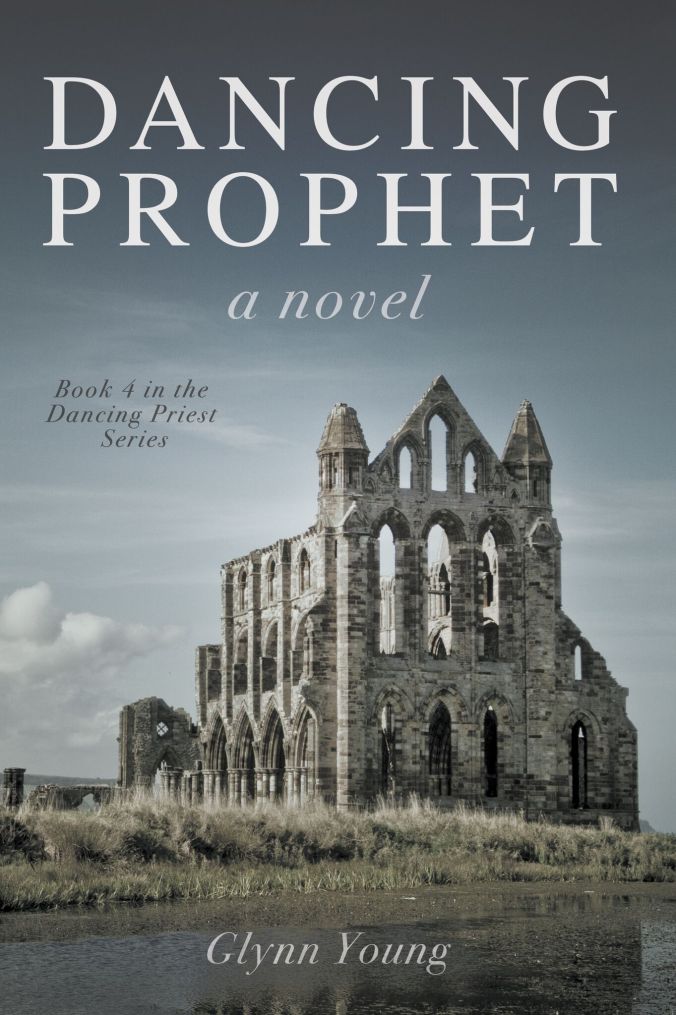
Dancing Prophet cover

Glynn Young

worked in Corporate Public Relations for two Fortune 500 companies, for whom he earned several national speechwriting and public relations awards. He is the author of four novels, Dancing Priest, A Light Shining, Dancing King, and Dancing Prophet, and the non-fiction book Poetry at Work. He is also an editor at Tweetspeak Poetry and Literary Life. He and his family live in St. Louis.
Blog: http://faithfictionfriends.blogspot.com Web site: http://dancingpriest.com
Facebook: https://www.facebook.com/glynn.young
Twitter: http://twitter.com/gyoung9751
Instagram: http://instagram.com/gyoung9751
Pinterest: https://www.pinterest.com/glynnyoung/
LinkedIn: https://www.linkedin.com/in/glynnyoung/

The Interview

1. What inspired you to write poetry?

Like most people in their teens, I wrote a lot of really bad poetry. And then I didn’t write any at all for the next 40 years. Or I thought I didn’t. What happened was that I became a corporate speechwriter. That led inevitably to poetry – poetry began as the spoken word. I began to writer poetry seriously about 10 years ago, when, as part of a conversation on Twitter, I wrote and posted a short poem.

2. Who introduced you to poetry?

A good friend told me that if I was serious about being a speechwriter, I had to read poetry, and specifically three of the great moderns – T.S. Eliot, Dylan Thomas, and Wallace Stevens. He gave me a “collected books” of each – and it changed my career. Quite a few corporate executives don’t know that some of their best speeches were inspired by those poets.

3. How aware were you of the dominating presence of older poets?

I don’t think I ever thought in terms of “dominating” older poets. In grade school, we learned poems like “The Midnight Ride of Paul Revere.” In high school, we studied Eliot, Frost, Emily Dickinson, Edna St. Vincent Millay, Sara Teasdale, Edgar Lee Masters, Edwin Arlington Robinson, and Walt Whitman. In college, I studied British literature, and got a healthy dose of the Romantic poets, Shakespeare’s sonnets, Chaucer, Thomas Hardy, and others.

4. What is your daily writing routine?

My routine is to find time to write whenever I can find time to write. It’s usually the early morning and late evening hours.

5. What motivates you to write?

My first attempt at writing (that I remember) was in fifth grade, when I tried to write a mystery story. I didn’t think of myself as a “writer” until I was in college, although I was one of the few (very few) people who enjoyed writing themes, essays, and reports for English Composition and English Lit. Writing has been an essential part of who I am for a very long time, including through my entire professional career.

6. What is your work ethic?

I was raised in a family that believed in working hard. It was likely the familiar “Protestant work ethic,” but it wasn’t a “hard work gets to you to heaven” concept. Instead, it was more “hard work is its own reward.”

7. How do the writers you read when you were young influence you today?

I started out with mysteries – the first book I bought for myself when I was seven was “Trixie Belden and the Secret of the Mansion.” I loved the Hardy Boys, and then graduated to Sherlock Holmes and Agatha Christie. I still enjoy reading the mysteries of the Golden Age – the period from the 1920s through the 1940s when some of the greatest mysteries of all time were written.

As for literary and more serious fiction, I still read Charles Dickens. I read “A Tale of Two Cities” and “Great Expectations” when I was 13 and 14, respectively. I recently reread both, along with “Oliver Twist” and “David Copperfield.” I love the sweep of Dickens’ stories. And he drew incredibly vivid and memorable characters.

I also just reread “The Scarlet Letter” by Nathaniel Hawthorne, and it was nothing like the book I remembered from high school. It’s not a book about how mean the old Puritans were, but a story about the internal conflicts people experience, what they sacrifice for appearances sake, and how revenge destroys both victim and avenger.

8. Who of today’s writers do you admire the most and why?

For fiction, I like the British writer Mark Haddon, best known for “The Curious Incident of the Dog in the Night-time” but with several novels and a short story collection that are excellent. I also like Anthony Doerr; his “All the Light We Cannot See” is a marvel. Two historical fiction authors who are outstanding storytellers are Hilary Mantel (“Wolf Hall”) and Annie Whitehead (“To Be a Queen”). In poetry, I like James Matthew Wilson, who writes beautiful formalist poetry, and Benjamin Myers, whose recent “Black Sunday” makes you believe you’re living in the Dust Bowl of the 1930s. And Robin Robertson’s “The Long Take” is a noir novel of Los Angeles written in poetic form; I love how he uses poetry to tell the kind of story told by Dashiell Hammett, Raymond Chandler, and James M. Cain. My favorite contemporary mystery writers, Louise Penny, Ann Cleeves, and William Brodrick, write mystery stories that read like novels.

9. Why do you write, as opposed to doing anything else?

Writing is like breathing and eating for me. There’s something else besides writing?

10. What would you say to someone who asked you “How do you become a writer?”

Writers, before they are writers, are readers. I became a writer because I read widely, broadly, and deeply. I became a writer because I trained as a journalist. I became a writer because I was working on a public issue for a company, and someone needed a speech on the topic. I suppose all of those things together say I became a writer by inclination, training, and opportunity.

11. Tell me about the writing projects you have on at the moment.

I’m working on my fifth novel; it’s part of my Dancing Priest series and will likely be the last in that line of stories. The draft is done and I’m going through my own editing process before I send it to the publisher. I’m also researching the Civil War; my great-grandfather enlisted when he was underage and was turned into a messenger boy. What happened to him at the end of the war is fascinating and something of a family legend.

I also review poetry weekly for Tweetspeak Poetry (http://www.tweetspeakpoetry.com) and write on various topics for an online journal called Literary Life (http://literarylife.org).

On Plays/Short Stories Wombwell Rainbow Interviews: Soji Cole

On Plays/Short Stories Wombwell Rainbow Interviews

I am honoured and privileged that the following writers local, national and international have agreed to be interviewed by me. I gave the writers two options: an emailed list of questions or a more fluid interview via messenger.
The usual ground is covered about motivation, daily routines and work ethic, but some surprises too. Some of these poets you may know, others may be new to you. I hope you enjoy the experience as much as I do.

Embers


Soji Cole. PhD

Performance/Theatre Studies and Research, Performance as Research, Drama Therapy, Trauma Studies, Cultural Memory in Post-Colonial Dramas and Films, Diversity Studies, Creative Writing.

• Winner of the NLNG NIGERIA PRIZE FOR LITERATURE (2018)
• Visiting Research Scholar (Centre for Arts Research and Creative Exchange), University of Roehampton, London, UK. (2018)
• Diversity Studies International Teaching and Scholarship Network Fellow (2013 & 2017)
• Fulbright Research Scholar (2014-15)
• Winner of the Association of Nigerian Authors (ANA) Playwriting Prize (2014)
• Winner of the International Federation for Theatre Research (IFTR) ‘New Scholars’ Prize’ (2013)
• Winner of the African Theatre Association (AfTA) ‘Emerging Scholars’ Prize (2011)

The Interview

1. What inspired you to write plays/short stories?

ANS: Old stories, comics and cartoons that I read when I was in elementary school were my foetal inspirations. I grew in them. I tool fancy flights in them through my imaginations whenever I read them. I could remember ‘Chike and the River’ by Chinua Achebe, a lot of Enid Blyton stories, ‘Tintin’ cartoons, ‘Austerix and Obelix’ and a whole lot of others. I gulped them down voraciously and they became the inspiration which triggered my writing sense. And moreso, I had a difficult time growing as an orphan so those books provided me with some sort of escape.

2. Who introduced you to plays/short stories?

ANS: In my lower secondary school I had my seat beside a small-sized girl who could make beautiful character drawings and cartoons. I thought I could do the same too but when I tried I found that my drawing could only be compared with scratches of a chicken feet scrambled on pure sand. I decided to just write my story without drawing. That was the introduction to my writing plays and stories.

3. How aware were you of the dominating presence of older playwrights/fiction writers?

ANS: Oh I was quite aware of their presence. We were nurtured on these prominent older figures, and their prominence overwhelms us whenever we study them. At some points I got angry that I was being fed the same cuisine all over. I began to have introspection. This writing thing is like doing business. You can’t ask an older wealthy business man to retire because you want to be wealthy too. The ground is too large and will accommodate all of us. I felt we need to engage them in some sort of healthy generational competition. And I think that is what the younger generation of writers across Africa are doing now.

4. What is your daily writing routine?

ANS: I don’t write daily. It is unfortunate. In Nigeria – and almost in the entire African continent, it is hard to cast yourself as a full-time writer. We don’t have the type of literary set-up that some other countries have. So what we do is to pick up a job, at least for subsistence (or survival), and then write as pastime. I would have a daily writing routine only if I were a core full-time writer. Here, we deal more with the burden of living than of writing. And I think that makes us fantastic – because we are resilient!

5. What motivates you to write?

ANS: My environment mainly. And when I say my environment I mean from the minutest immediate surroundings to the whole world. Issues of humanity propels me to want to write. There are many good things to write about the world – good things that people willingly bypass or are ignorant to see. There are many bad things to write about the world – bad things that are not being redressed because they suffer attention and pretensions. Those things are materials that motivate me to write.

6. What is your work ethic?

ANS: My work ethic is not static. But in every work I do I try to be as honest as I can and then I attempt to justify my conscience. I have been in a few trouble with some authorities because of my work. And I believe I will still continue to be.

7. How do the writers you read when you were young influence you today?

ANS: Oh I read a lot of fantastic stories while growing up. So I guess the biggest influence when I was way younger was the story. Great stories transport me. As I attain some level of adulthood I came to believe that how language is manipulated to tell the story is more important than the story itself. Fortunately I was already weaned on the storytelling. So these days I try to manage a great story with beautiful language when I write.

8. Who of today’s writers do you admire the most and why?

ANS: Well, if you were to ask who is the writer that I admire most I would say Henrik Ibsen. But you have put a clause in the question which means you are referring to more contemporary writers. I think I love Chigozie Obioma and Arundhati Roy. On the same level. They have this sublime use of language to convey their beautiful stories.

9. Why do you write, as opposed to doing anything else?

ANS: I enjoyed it. If I were given an opportunity that’s the only thing I’ll do. It gives me joy to see that I have the power to create a world by myself. To create some sort of unrestrained happiness and justified sorrow. To create characters and kill them off as I wish. To toy with the emotion of potential readers just in a bid to gauge the humanity in all of us.

10. What would you say to someone who asked you “How do you become a writer?”

ANS: I’ll probably ask the person; ‘how do you cook’? As humans we all probably have the instinct to know how to cook. Some took strong fancy for it while some feel it’s not part of what they wish to know. Those who took likings for it have different aspirations for doing so. While some just want to learn to be able to cook for themselves and probably their family, some others aspire to be professional chefs. In the end when we ask who the real cook is we know who we are referring. That is the way I am still learning to be a writer, and that is how I’ll answer such question.

11. Tell me about the writing projects you have on at the moment.

ANS: None. I have some ideas I am flirting with but they have not developed into anything worth writing on. Like I said earlier, we keep other jobs here as writers and the jobs take their toll on us. But then, I am hoping that by the end of the year one of the ideas would have fully ferment and then I can go ahead with the processing.

Wombwell Rainbow Interviews: Kiley Lee

Wombwell Rainbow Interviews

I am honoured and privileged that the following writers local, national and international have agreed to be interviewed by me. I gave the writers two options: an emailed list of questions or a more fluid interview via messenger.

The usual ground is covered about motivation, daily routines and work ethic, but some surprises too. Some of these poets you may know, others may be new to you. I hope you enjoy the experience as much as I do.

Kiley Lee

Kiley Lee

is an artist and writer from Almost Heaven, West Virginia. Her poems have appeared in Anti-Heroin Chic, Ghost City Review, Marias at Sampaguitas, Mojave Heart Review, Animal Heart Press, and Dancing Girl Press among others, and she is currently working on her first chapbook. Her drawings and paintings have been showcased on various online platforms and shown in multiple exhibitions at the Monongalia Arts Center in Morgantown, WV. She lives with her husband, Toby, and her cat and dogs, Charlie, Jupiter, and Sadie, near the majestic Ohio River.

Website:

https://legendcitycollective.wordpress.com/

Social Media:

Twitter – @KBogart10

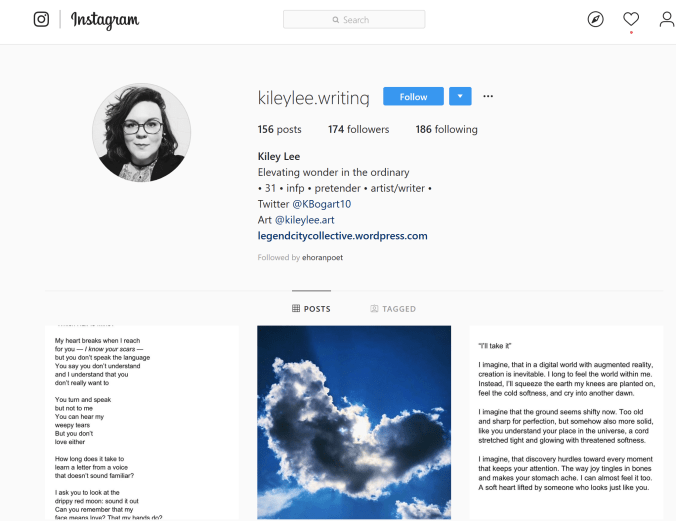
Instagram – @kileylee.writing & @kileylee.art

The Interview

1. What inspired you to write poetry?

I first started writing poetry as a child. My mother had a library in her bedroom that I used to look through, and when she read me “The Lady of Shalott” by Tennyson for the first time, I was completely enamored. I enjoyed reading, but this new form of writing was fantastical to my young mind. Now, I write poetry because it’s my favorite form of writing. I use it to process the world around me.

1.1 What “enamoured” you in Tennyson?

I guess the musical quality of the words was what captured me initially. The precise images, the rhyming. It was so fun to read aloud. The story is lovely in its own right as well, but realizing that words could sing without music was what really attracted me to poetry. It’s something I’m still conscious of to this day.

2. How aware are and were you of the dominating presence of older poets traditional and contemporary?

Vaguely. I know parts of the Western canon, but I don’t consider them a standard. I’m a college drop-out, so I never had to experience any particular era or school of thought being forced on me. I follow wherever my curiosity leads. As far as contemporary poetry is concerned, I rarely know the names or faces of academically prestigious poets, but the exclusivity of class is something I’m VERY aware of. And unfortunately, I think that’s something that is, even if ignorantly, perpetuated by some dominating literary circles.

3. What is your daily writing routine?

I’m always absorbing. Feelings. Light. Sound. Not everyday is a day of output for me. Sometimes my entire day is just observing and reacting. So even if I’m not actively creating every day, some part of me is engaging and remembering for later access. Routine is not something I’m very familiar with unfortunately.

4. What motivates you to write?

Hmm, I think I just want to see more beautiful things in the world. I guess that sounds kind of vain, but I do hope that someone finds comfort or solace from something I’ve created. I also think art is just another means of communication, and like Donald Winnicott wrote, “Artists are people driven by the tension between the desire to communicate and the desire to hide.”
5.  How do the writers/artists you read and saw when you were young influence you today?

I think the artists around me as a kid really ingrained the idea of story in me, in whatever capacity they could, and I think I take that idea now and just try to translate something out of it. I try to be specific about my experiences in a way that’s not totally revealing, or controlling. I would rather leave the conversation between the art and the viewer.

6.  Who of today’s writers/artists do you admire the most and why?

I admire the writers who give. Generosity seems so rare now, and those writers who give their time and resources to lift others up, those are the ones who shine in my eyes. I appreciate and cherish the support I’ve found in the Legend City Collective specifically. They are a group of passionate people who are speaking beautiful things into this world. And if I must actually name a single writer, then I’d have to choose Marie Howe. I found her poetry during a very important period of my life, and I would absolutely fan girl if I saw her in real life.

7. What would you say to someone who asked you “How do you become a writer/artist?”

Write this down and hang it up where you’ll see it often:

Talent is a pursued interest. Anything that you’re willing to practice, you can do.” – Bob Ross

And also, to pay attention. It’s very easy to be lulled to sleep and miss the magnificent.

8. Tell me about the writing/art projects you have on at the moment.

No specific projects at the moment. I’ve been putting together a chapbook for a while now, so hopefully I’ll have that completed soon.

“Awakening! Sweet or Rude” . . . and other poetic responses to the last Wednesday Writing Prompt

Thankyou Jamie for featuring seven of my poems in electrifying company in The Poet By Day responses to last Wednesday’s Prompt.

Jamie Dedes's avatarJamie Dedes' THE POET BY DAY Webzine

“I’d love to wake up to complete silence, white sheets, and the smell of crisp air and roses.” Maria Elena,Eternal Youth


And it being Tuesday, here are the responses to the last Wednesday Writing Prompt, Awakening, August 7. Today our poets explore the ins, outs, pleasures and occasional weirdness of one of the most pivotal points of the day.

Brown-eared Bulbul shared under CC BY-SA 2.0 license

This collection is courtesy of bogpan (Bozhidar Pangelov), mm brazfield, Gary W. Bowers, Paul Brookes, Anjum Wasim Dar, Irma Do, Sheila Jacobs, Sonja Benskin Mesher, Tamam Tracy Moncur, Pali Raj, and Clarissa Simmens.

Today we also warmly welcome Urmila Mahajan in her first appearance on this site. Urmila mentions a bulbul bird in her poem.  I’d never heard of it. I had to look it up. The bulbul – pretty bird – doesn’t live in the Americas or in Europe.

View original post 3,036 more words

Wombwell Rainbow Interviews: Jess Thayil

Wombwell Rainbow Interviews

I am honoured and privileged that the following writers local, national and international have agreed to be interviewed by me. I gave the writers two options: an emailed list of questions or a more fluid interview via messenger.

The usual ground is covered about motivation, daily routines and work ethic, but some surprises too. Some of these poets you may know, others may be new to you. I hope you enjoy the experience as much as I do.

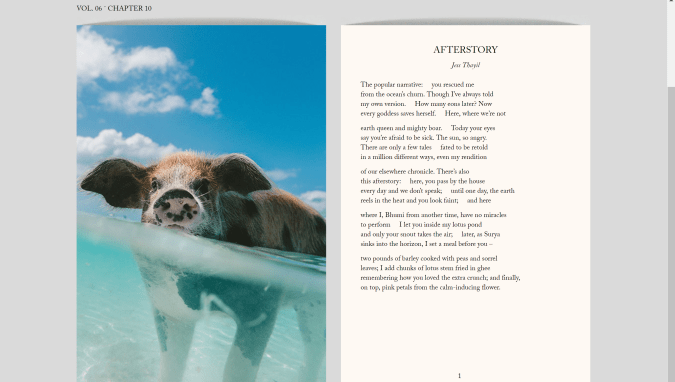
Jess Thayil

Jess Thayil

is working to complete a first collection of poetry. Her poems have appeared in Magma Poetry, The Stinging Fly, Ink Sweat And Tears, Black Bough Poetry, AbstractMagazineTV, Potomac Review and Whale Road Review.

The Interview

  1. When and why did you start writing poetry?

I started writing poems 8 years ago around the same time I started to train in long distance running. While I’ve been working on poetry actively since then, for the most part, I managed to write poems and edit them in tiny scraps of time outside work. For the last couple of years, after my health deteriorated, I’ve had to give up work and running. So I’ve been focused more avidly on writing poetry and on some abstract painting even as my health conditions continue to be challenging to manage.

As for why I started writing poetry, I don’t really know and that might sound odd considering many poets have a defining reason or two. But the truth is that it felt right to return to it after a long break. (I last wrote and won awards in poetry while in school and university). Of course, I didn’t write strong poems 8 years ago because I was very out of touch with contemporary poetry. It took me a while to get into the groove because poetry wasn’t the only thing on my plate. But it felt like a nice challenge at the time to begin reading contemporary poetry, hone my own craft and work towards a first book. I’m happy I stuck with it.

2. Who introduced you to poetry?

I was introduced to a little poetry in school and then more of it at university as part of English Literature study. As much as I enjoyed those classes, I don’t remember loving poetry as I do now. Contemporary international poetry is a diverse and vibrant space. You ask about my ‘introduction’ to poetry, and while I will rattle off some names for you, that ‘introduction’ is ongoing.

When I started to write poems 8 years ago, I invested in the Bloodaxe Book of Contemporary Indian Poets edited by Jeet Thayil. It’s still available from Bloodaxe Books and is a hugely vital anthology for anyone anywhere who wants to read English poetry from India. Back then I also read and continue to enjoy Eunice de Souza (passed away in 2017), Meena Alexander (passed away in 2018), Vijay Nambisan (passed away in 2017) and the late Dom Moraes. Contemporary Indian poets like Priya Sarukkai Chabria, Arundhathi Subramaniam, Tishani Doshi, Keki Daruwalla, Arvind Krishna Mehrotra, Jayanta Mahapatra, Ranjit Hoskote and Jeet Thayil continue to be my introduction to poetry. I’m only stopping with those names because the list of contemporary Indian poets everyone, ideally, should read is (wonderfully) long!

3. How aware are and were you of the dominating presence of older poets traditional and contemporary?

I don’t know if I have a perfect answer to this question. If you mean, was I aware of Yeats, Keats, Tennyson, Eliot… yes. But while I dip into their works from time to time, contemporary and international poetry is way more interesting to me. So, to answer your question in relation to contemporary poetry, both ‘dominance’ and ‘older’ has a mixed significance for me. People can be dominating voices with or without poetry today if they use social networks in a way that happens to click and then that continues to attract large numbers of followers. And today, we can start to write poems while ‘older’ or be younger with multiple books in our names — age is practically irrelevent in some ways, is it not? Technology and platforms are more relevant.

From what I can see, ‘dominance’ has a lot to do with network-led reach. We could say Rupi Kaur and Lang Leav are dominant. But so are Jericho Brown, Maggie Smith and many others. It seems to me that some contemporary poets who dominate social media use the services of digital marketing agencies. It’s perhaps advantageous, in some ways, for poetry as an art form that anyone can have a sizeable platform- and network-enabled reach if they want to work for it

4. What is your daily writing routine?

I read some poetry everyday whether or not I work on my poems everyday. I’m also developing a practice in abstract and mixed media art — another reason I don’t write everyday. But most days, I’m in negotiations with myself on what a poem or a set of poems needs to lose and what I will keep. I’m gearing up to have a full manuscript ready and that means I’m currently busier with editing old poems than writing new ones.

I did set a target for myself at the start of 2019 to write one new poem a month, and I’m on track with that so far. And because I also deal with the uncertainties of chronic illness, I don’t set a rigid daily routine. Instead, I target to finish a few different things related to writing/poetry in a week, and this seems to help me get enough done even with those personal challenges.

5, What motivates you to write?

On motivation for my writing:

I’m always interested in the agency and capacity of individuals to effect a revolution in their lives. And I think about how that speaks into the collective. I believe even an individual who finds herself without a ‘community’ is speaking into the collective as well as bolstering its arguments and affirmations. I’m drawn to how women navigate the world at this point in the history of time.

My first manuscript will have a lot of that. But everything motivates me — birds, buildings, bones, hands, humans coughing and sneezing, unwashed dishes, windows, wells, worms… everything.

6. How do the writers you read when you were young influence you today?

If you mean poets specifically, I wish I could say I was hugely influenced by the ones I had to read in school or in my undergraduate programme in India. But I recall we read white male poets and only a meagre number of women, white or coloured. Even the fiction I read as a hobby when I was growing up in India was written by white authors too. It feels more accurate to say that what I didn’t read then, and what no one guided me to read, has in one way or another, more of an influence on me now.

I read poetry by Sarojini Naidu and Kamala Das (aka Kamala Suraiyya) so many years after leaving school and university. Their work is representative of strong voices in Indian poetry and I’m now amazed they were not in our literature texts. I remember one of Nissim Ezekiel’s poems featured in a textbook and then we never heard of him again. And not a single poem by poets like K Satchidanandan or Arun Kolatkar in a literature textbook at university. We never had to write essays on India’s English language poets but we handed in a number of assignments on poets like John Milton and John Donne. This scenario likely prevails to this day. So all that underrepresentation has influenced me more than anything else — I now want to read more Indian poetry in English, even translations from our regional languages, or read in regional languages as I write more poetry in English myself.

7. Who of today’s writers do you admire the most and why?

I’m currently reading Glen Wilson’s An Experience On The Tongue. What I enjoy about Glen’s poems is that they contain distinct worlds in each of them and that bigness is expertly sustained by grounding images and local references. (I feel the same way about Seamus Heaney’s poems). I’ve also enjoyed Nathan McClain’s collection Scale for its buzzing units (poems) that somehow achieve the feat of heart-tuggery while simultanoeusly having a settling effect on me. Between a hawk and a young girl’s ‘entanglements’ with each other, they are (for me) not just leading images and metaphors in Maggie Smith’s collection Good Bones, but also the reason why Maggie’s poems feel tethered while also enabling me to feel all the swooping flight in them. I want to read a lot of Maggie’s work, past and future. Ricky Ray’s collection Fealty contains poems of reflection and meditations on pain, but some of them have an assured way of granting a reader like me the light of little unexpected jokes as they travel towards their finish lines. I enjoy what Kelli Russell Agodon does with the sea and love in Hourglass Museum, I enjoy her questions, and I’m keen to read more of her work.

I like to re-read Heidi Williamson. Her poems are confident neat arrangements and they have a way of fixing you in place without force. She’s another poet whose worlds I can get lost in and you may understand what I mean especially when you read The Print Museum. I also tend to re-read Louise Glück and John Glenday nearly every year now. Louise’s long poems in Averno and many of John’s compact poems in both Grain and The Golden Mean having a way of defining and redefining for me what a good reading day feels like. I read the work of many Indian poets over and over — I’ve mentioned their names earlier. In general, because I write poems, and I know what I want them to try and achieve, I enjoy reading poets whose language is clear and simple while their poems aren’t easy. To me, there’s huge value (and I’m learning more about this everyday) in poetry that can say things directly while also inviting the reader to contemplate how a single line or fragment can point to multiple meanings each time you read a poem — I enjoy poems that keep on giving.

8. Why do you write, as opposed to doing anything else?

To enjoy it. And if something makes me enjoy it less, I retreat and do more of the other things I enjoy, like painting or cooking, and then what feels like a natural pull of writing puts me back on course. I operate like the sea. More like a wave. I try to enjoy being a wave.

9. What would you say to someone who asked you “How do you become a writer?”

Write. As regularly as you can. And if you’re not writing just for yourself and you aim to be read, get used to revising and editing your work, show your work to other writers who can comment constructively on your writing and help you polish up your work.

10. Tell me about the writing projects you have on at the moment.

I’m working to complete a first collection of poems. I’m also working on a first novel, but I don’t expect this to progress in a hurry. I’m all right with a novel taking 5 or 10 years or longer. Because after 8 years of attempting poems, poetry takes up much head and heart space.
For me, the writing life includes reading poetry by other debuting and emerging poets. Reading helps me think about poetry and its function as well as place in the world. That could lead to some essays, or not. I hope to continue to write poems beyond a first manuscript, whether or not I have a first published book of poetry to my name, and whether or not I manage to write anything outside poetry.
Wombwell Rainbow Book Review: hall of several tortures By Reuben Woolley

Dean pasch the hall of several tortures

A photograph by Dean Pasch provides the front cover illustration to “hall of several tortures”

Wombwell Rainbow Book Review: hall of several tortures By Reuben Woolley (Knives, Forks and Spoons press, 2019)

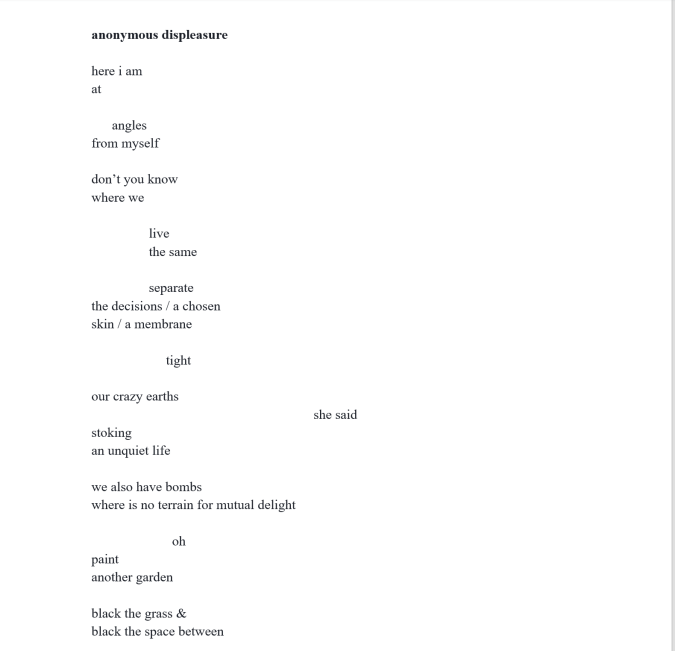
anonymous displeasure

I am increasingly impressed by the work produced by Reuben Woolley. His latest publication “hall of several tortures” he describes as “built up around the multiverse concept. A young woman lives on a parallel world from ours (through the membrane) she is somehow able to see and sometimes participate in events on this dystopian world of ours.” The contents lists the poems without page numbers, and there are no page numbers on the pages themselves. As with most poetry collections this leaves us with two options: read the book page by page from left to right, or to dip in as our fancy takes us. Either way the words are sparse on the page so the “white space” becomes as much a part of the work as the text. It acts as a active silence between one word and another,

Much as in the plays of Samuel Beckett, and Harold Pinter the white space (silence) holds emotional weight, as does the plain language. No Latinisms or Greekisms. Music is paramount. Direct reference is made to the blues, and the way music moves us from one emotional state to another. These poems demand to be read aloud. They become like the layers in Dean Pasch’s photography, one view laid over another, so we see glimpses of another scene as if through a “membrane”. A device I am reminded was often marked as a “bad” photo when I got mine back from “Boots” the chemist, and even then thought it a great device for another way of looking at the world.

I look forward to reading more work by Reuben, His work could easily be presented on stage with Dean’s photos as backdrop, as it is intensely dramatic.

hall of several tortures book interview

https://thewombwellrainbow.com/2019/08/06/wombwell-rainbow-book-interviews-hall-of-several-tortures-by-reuben-woolley/

Last years interview by The Wombwell Rainbow of Reuben Woolley’s creative process:

https://thewombwellrainbow.com/2018/09/08/wombwell-rainbow-interviews-reuben-woolley/

Wombwell Rainbow Interviews: Natalie Whittaker

Wombwell Rainbow Interviews

I am honoured and privileged that the following writers local, national and international have agreed to be interviewed by me. I gave the writers two options: an emailed list of questions or a more fluid interview via messenger.

The usual ground is covered about motivation, daily routines and work ethic, but some surprises too. Some of these poets you may know, others may be new to you. I hope you enjoy the experience as much as I do.

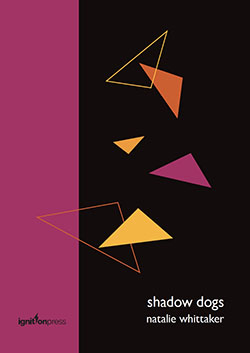
Natalie_front_cover

Natalie Whittaker

is from South East London, where she works as a secondary school teacher. She studied English at New College, Oxford.

Her poems have been published in Poetry News, Brittle Star, Aesthetica Creative Writing Annual, #MeToo: A Women’s Poetry Anthology and South Bank Poetry.

Natalie was awarded second place in the Poetry on the Lake short poem competition 2018 and the Oxford Brookes International Poetry Competition 2017.

Her pamphlet ‘Shadow Dogs‘, available from ignition: https://www.brookes.ac.uk/poetry-centre/ignition-press/pamphlets/

Her second pamphlet #Tree is due out March 2021.

and her twitter account is @natalie_poetry

The Interview

1. What inspired you  to write poetry?

I’ve always been the sort of person to write things down and try to narrativise my life – I used to keep a diary even in primary school. I can’t really explain why, it just seemed like the natural thing to do, like something hadn’t really happened until I’d written about it. In terms of ‘creative writing’, I started off with stories – I wrote a lot of bad short stories in sixth form – and the stories got shorter and shorter until I realised that I actually wrote poems. At the same time (around the age of 17) I was getting really into the poetry that we were reading for A-level English at school, and this continued the ‘inspiration’, I suppose.

2. Who introduced you to poetry?

English teachers at school. I was lucky enough to have some great English teachers, particularly in sixth form. I suppose that’s the reason why I’m now a secondary school English teacher myself, more than being the reason why I am a poet.  We studied pretty standard stuff – an anthology of Victorian poetry, some ‘unseen’ poems for the exam – but it always seemed to mean a bit more to me than just something to write about in an exam. Then in year 13 we studied Philip Larkin’s ‘The Whitsun Weddings’, and something just switched on in my brain – I was like yeah, this is the good shit! I know Larkin’s not a particularly fashionable person to like now for various reasons, but at the time I just got the sense that this was someone writing about ‘normal’ stuff – bleak towns, shopping centres, sitting on a train – and it struck a chord. I realised that poetry could be about quite everyday things, and still contain great emotion. And I loved how miserable he was. I found that really funny.

3. How aware were you of the dominating presence of older poets?

Most of the poets I read in school were dead. I didn’t really have much awareness of living poets, or a sense that it was something that people actually did as a job. So I suppose a ‘dominating presence’ wasn’t something that I worried about, I was too naïve to even be aware of it. The first poet I really got into independently of school was Sylvia Plath. She definitely became a ‘dominating presence’ for me when I was about 17.  I remember that I asked for her collected poems and journals for Christmas, and that it seemed a bit perverse at the time – to buy a poetry book that you weren’t obliged to read for school! It wasn’t the sort of thing that people around me did.

4. What is your daily writing routine?

I don’t really have one. I work as a secondary school teacher so I don’t write every day. I used to get my writing done in the school holidays. Or on the weekends, or if I attend a writing workshop or Arvon course, where you have no choice but to write! Or just on the bus or train. I don’t have set hours where I sit down to write. I can’t imagine that.

5. What motivates you to write?

A line or a sound or an image that I can’t get out of my head. The need to transform emotion (usually negative emotion) into something approaching comprehension.

6. What is your work ethic?

For years I was an incredibly slow and sporadic writer. Literally one or two poems a year. I just didn’t have the confidence in my writing to ‘allow’ myself to dedicate that much time to it. And in the first few years, at least, teaching is  a pretty full-on job. But in my late 20s I realised that I didn’t have all the time in the world, and that I had better start taking my writing seriously, because it was clearly sticking around as a a part of my life whether I wanted it to or not! So I signed up for a few weekend classes at The Poetry School, an Arvon course, and an evening class at City Lit… and it just went from there. When I was offered a pamphlet publication in 2018 that was a massive boost to my confidence – I think my work ethic quadrupled that year – I wrote more in one year than I had in the previous five years put together! I’m now doing an MA part time so that has kept the momentum going for now.

7. How do the writers you read when you were young influence you today?

Everything sticks in my head. I’ve got a bit of an obsessive mindset. So I’m sure everything I’ve read influences me hugely. Larkin and Plath are still there, probably. Elizabeth Bishop definitely is – she was my ‘special author’ choice when I did my undergraduate degree. Simon Armitage, Tomas Transtromer – they’re both in there from years ago too. I suppose the main ‘influence’ is just an awareness of what has come before, so that you can move into or against a tradition.

8. Who of today’s writers do you admire the most and why?

I admire / envy so many writers of my own age! Fran Lock, Liz Berry, Jack Underwood, Kayo Chingonyi, Wayne Holloway-Smith, Niall Campbell, Helen Mort, Jay Bernard… I could go on for a long time. Actually, a few of those guys are year or two younger than me. They got their poetry act together a lot sooner!

9. Why do you write, as opposed to doing anything else?

If you mean instead of another art form, I was rubbish at art at school! Bottom of the year in year 8, I remember that clearly! And I never had music lessons or anything like that. I just went to the library! It was something that I could do by myself, that didn’t involve being taken to some form of class or organised activity.

10. What would you say to someone who asked you “How do you become a writer?”

Read. Spend years just reading other poets. Try to imitate what you’re reading. The writing won’t be great at first, but you’ll learn a lot. Then read some more, and spend another ten years trying to get good at writing. It’s probably not the best advice, but it’s all I’ve got because it’s what worked for me.
Also – join a writing group! I left that way too long, due to crippling shyness and social anxiety about my writing, which probably didn’t do me any favours.

11. Tell me about the writing projects you have on at the moment.

Since ‘Shadow Dogs’ I’ve started going in a different direction formally. I’m working on a series of unpunctuated poems that use extended spaces instead of punctuation. The spaces are always six space bars, and the poems have to make rectangle shapes on the page. I can’t explain why – that’s just how things are coming out at the moment.

Wombwell Rainbow Interviews: Jennifer Wortman

Wombwell Rainbow Interviews

I am honoured and privileged that the following writers local, national and international have agreed to be interviewed by me. I gave the writers two options: an emailed list of questions or a more fluid interview via messenger.

The usual ground is covered about motivation, daily routines and work ethic, but some surprises too. Some of these poets you may know, others may be new to you. I hope you enjoy the experience as much as I do.

Jennifer Wortmann

Jennifer Wortman

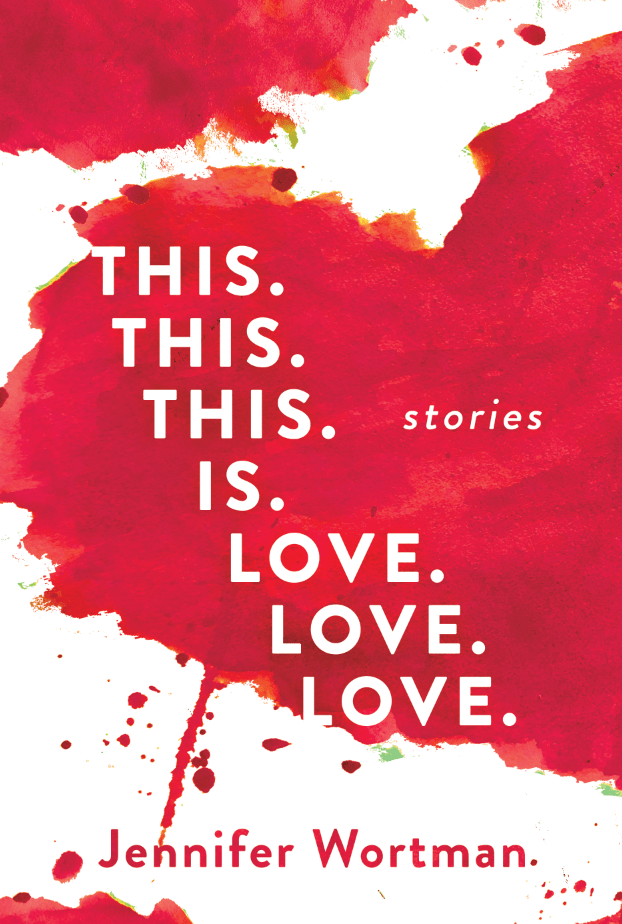
is the author of the story collection This. This. This. Is. Love. Love. Love (Split Lip Press, 2019). Her fiction, essays, and poetry appear in TriQuarterly, Glimmer Train, Normal School, Brevity, DIAGRAM, Juked, and elsewhere. She lives with her family in Colorado, where she serves as associate fiction editor for Colorado Review and teaches at Lighthouse Writers Workshop.

website: jenniferwortman.com. Twitter: @wrefinnej.

The Interview

1. What inspired you to write poetry?

I write a little poetry, but I mostly write fiction. In both cases, what inspired me to write was reading so many books I loved. I wanted to make other people feel the way those books made me feel, and think the way they made me think.

2. Who introduced you to poetry?

My mom read to me a lot, including lots of Dr. Seuss, especially Hop on Pop, and my dad loved reading me Hands, Hands, Fingers, Thumb by Al Perkins, all books full of wonderful rhythms and rhymes. That was my first introduction to the joys of language.

3. How aware were you of the dominating presence of older poets?

When I was younger, I was very aware of the dominating presence of older writers. I idealized them and wanted to be like them. I’ve learned a ton from them but they have less mythic power over me now.

4. What is your daily writing routine?

It’s been extra busy, so my routine has fallen apart; I mainly write in little spurts when I can. During more stable times, I prefer to write in the morning before I start my other work. I will focus on my main project then, and later in the day, I might dip into other pieces or do something more left-brained like line-editing. Sometimes I play with poetry and weird prose or explore places I’m stuck before I go to sleep. If I’m lucky, my unconscious mind will work its magic and I’ll wake up with breakthroughs.

5. What motivates you to write?

When I don’t write, I feel useless and sad.

6. What is your work ethic?

My work ethic is to make my writing as good as I possibly can without losing sight of my well-being and other important things in life.

7. How do the writers you read when you were young influence you today?

That’s hard to say. Our influences, I think, are largely unconscious, whether we like it or not. But I’ve always been attracted to voice-driven narratives with a psychological or philosophical bent: writers like Fyodor Dostoevsky, Walker Percy, Alice Adams, Ford Madox Ford, and Iris Murdoch had a big appeal to me when I was younger, and their sensibilities may show up in my writing.

8. Who of today’s writers do you admire the most and why?

Too many to name but I’ll say a few: Megan Giddings writes daring, astonishing prose, and supports other writers through her work as an editor of The Offing and the Forward writers-of-color flash-fiction anthology. Her chapbook Arcade Seventeen is brilliant and I can’t wait for her novel that’s coming out next year, Lakewood. Heather/Heathen Derr-Smith combines poetry and activism in a beautiful and necessary way: I was deeply inspired by her project of reading poems of protest by multiple writers down at the Texas border through the nonprofit she founded, Čuvaj Se. Other writers I admire include Maggie Nelson, for her ingenious mix of high intellect and emotional rawness; Jericho Brown, for his precision and fire; and John Edgar Wideman, who has been combining the visceral and cerebral and lyrical to stunning effect for decades.

9. Why do you write, as opposed to doing anything else?

At times in my life I’ve dabbled in other art forms, especially music, but writing has the biggest appeal to me because it combines intellect and emotion so well: I get to use all of myself when I write. Being an introvert, I also appreciate the solitary aspects of writing.

10. What would you say to someone who asked you “How do you become a writer?”

Read a lot and write a lot, in that order. Find a community, big or small, and get trusted feedback on your work. Revise, revise, revise. If you decide to submit work for publication, expect rejection and don’t let it throw you: persistence is key.

11. Tell me about the writing projects you have on at the moment.

I’m working on a novel-in-stories about a middle-aged mother of two whose husband has died: she has ambiguously paranormal experiences and sleeps around a fair amount—that’s pretty much the plot! I’m also putting together a couple chapbooks: one of flash fiction and another I’m envisioning as a semi-evasive memoir in poetry and prose.