I am honoured and privileged that the following writers local, national and international have agreed to be interviewed by me. I gave the writers two options: an emailed list of questions or a more fluid interview via messenger.
The usual ground is covered about motivation, daily routines and work ethic, but some surprises too. Some of these poets you may know, others may be new to you. I hope you enjoy the experience as much as I do.
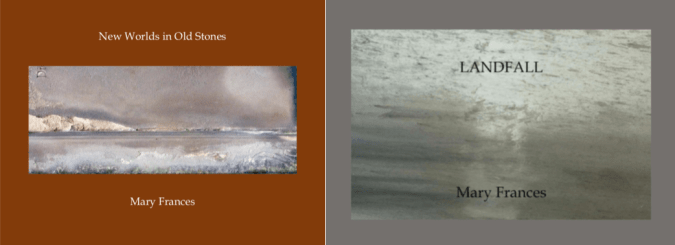
Mary Frances
In the last year Mary’s words and images have been published by Metambesen, Luvina Rivista Literaria, Burning House Press, and Lone Women in Flashes of Wilderness. She has new work coming soon from Penteract Press.
The Interview
1. Who/what introduced you to art and poetry?
On my first day at school, I stole a book. I had become enchanted by words – ‘birds of paradise’ and ‘ukelele’ – and by images of huge colourful flowers and a full moon glittering on water. As I remember, it wasn’t that I wanted to possess the book exactly, more that I just couldn’t let go of it, I couldn’t stop looking.
I think I was taken to the national gallery as a child but I remember it from that time only as a dark place of war horses and suffering saints. My introduction to art came when I was perhaps 8 or 9 wandering alone into the gallery of a museum and finding Whistler’s nocturnes. I still remember the feeling of being inside these paintings – I knew these waters, this light. I don’t know how much time passed before the attendant gently tapped my shoulder and told me that the gallery was closing. When I went back a few weeks later the Whistlers were gone, replaced by sports photographs, and the attendant explained about travelling exhibitions while I stood there and cried. I still get that stunned everything-else-has-disappeared feeling sometimes in exhibitions – it is a falling in love.
2. How aware were you of the dominating presence of older poets/artists?
I have always been aware of them, but not as a weight if that’s what you mean. Growing up we read comics and discovered pop music. Through older family members we knew Victorian melodrama and music hall songs. Classic books were just a different kind of language and other kinds of story – they were enjoyed without reverence. The same with artists. But it’s not my day job, I had no need to break free of anything.
3. What is your daily routine for creative work?
I don’t have a routine but I make something most days. Or rather, most nights – I have my best ideas late in the day and I don’t sleep easily.
4. What motivates you to write, to make art?
Walking, the feel of language, wide-open eyes.
5. What is your work ethic?
I tend to get lost in it, endless variations and re-workings, not too bothered about how much of it will ever be seen or read.
I used to have a website for my art and cut-ups but I took it down a few years ago. It felt like a showroom and I wasn’t comfortable with it. Now I just leave things lying around on twitter which feels less like a display case and more like inviting people to rummage through whatever is on the table. I like the transience – so many people pinning fine things to the lamppost every day and then it’s blown away overnight and so we start again. Absence of weight keeps me moving. I’m happy to start over, not look back.
The commonality in all my work is that I enjoy finding, remixing, and reframing things that are already there. Meanings tighten very quickly and cut-up and found work disrupts that. Everything can be otherwise, and much is hidden or ignored. I’m looking for other ways of seeing and altered perspectives. I’m also interested in dreams.
6. How do the writers/artists you found when you were young influence you today?
I wouldn’t be able to say much about direct influence, but I’m very aware of those writers I’ve carried with me in the most worn books and marked pages, the ones who got into my bloodstream, Virginia Woolf and Angela Carter.
I think my art work has been influenced by illustration and hand-drawn animation. I often have the sense that I’m creating stage sets. I barely knew the characters in those old films of childhood – my focus was on the backdrops, their real-not-real-ness.
7. Who of today’s writers/artists do you admire most and why?
I enjoy many poets, far too many to list, but If I had to choose just one it would be John Burnside. I am incredibly moved by his work, by his capturing the essence of small-huge things. I feel I know those places, that weather, those absences.
I read and re-read a lot. I try to find new and different voices and keep an eye on small presses and online magazines. I don’t like the idea of poetry or any writing as comfort, I am looking to be unsettled. I blame the fairy tales. John Trefry’s two novels, ‘Plats’ and ‘Apparitions of the Living’, have changed the way I read, and what I choose to read – that’s a rare extraordinary thing. I love those books, and I am still afraid of them.
I see as much contemporary art as I can, and whether or not I like the work I find it interesting, both in itself and as a mirror of the times. I think about and begin to understand many other things as I look at art. People cluster and fidget behind me with their frustrated i-phones, and attendants still comment sometimes on how long I’ve been there – I’m not a great person to go to galleries with. I could probably list favourite exhibitions more easily than favourite artists. Some collections haunt me for years: Jo Whaley’s ‘Theater of Insects’, Tracey Moffat’s ‘Laudanum’, Peter Greenaway’s ‘Luper’, Cathy Wilkes’ show at Tate Liverpool. But I would travel a long way to see new work by Anselm Kiefer or Sarah Sze. They notice everything, use everything, weave multiple webs of connection – one so heavily, necessarily, weighted, the other so delicately balanced, luminous, seeming light as air.
It will be no surprise to anyone that I also spend a lot of time looking at walls. And gallery floors.
8. Why do you write or make art, as opposed to doing anything else?
Oh, I do a lot of other things and I’m glad for that. There are other kinds of necessity. So many more things than we might have imagined can become acts of love.
9. What would you say to someone who asked you how to become a writer or artist?
If the question is whether art and writing are worthwhile things to spend time on, then I would give every encouragement. In terms of a career or recognition, I wouldn’t know anything about that.
I would just add that thoughtful readers are, in my view, writers, that keen appreciators of art are indeed artists, and that risk-taking editors, dedicated librarians, and imaginative curators are the very best.
10. Tell me about the creative projects you have on at the moment
I’m working now on several projects and I don’t know yet which ones will work. I like this state of variousness with many possible directions to take. The process of messing around and changing my mind is important. I’m happy with things unfinished.
 The Wombwell Rainbow
Pingback: Celebrate Wombwell Rainbow Interviews with me over 26 Days. Today is Letter F. One letter a day displaying all the links to those interviews. We dig into those surnames. Discover their inspirations, how they write, how did they begin. Would you love to ha
Pingback: Celebrate Wombwell Rainbow Interviews with me over 26 Days. Today is Letter F. One letter a day displaying all the links to those interviews. We dig into those surnames. Discover their inspirations, how they write, how did they begin. Would you love to ha