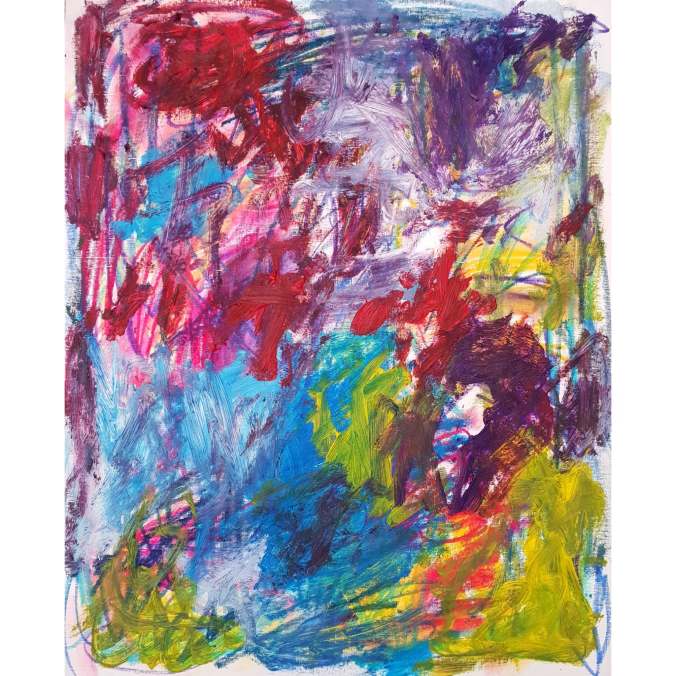
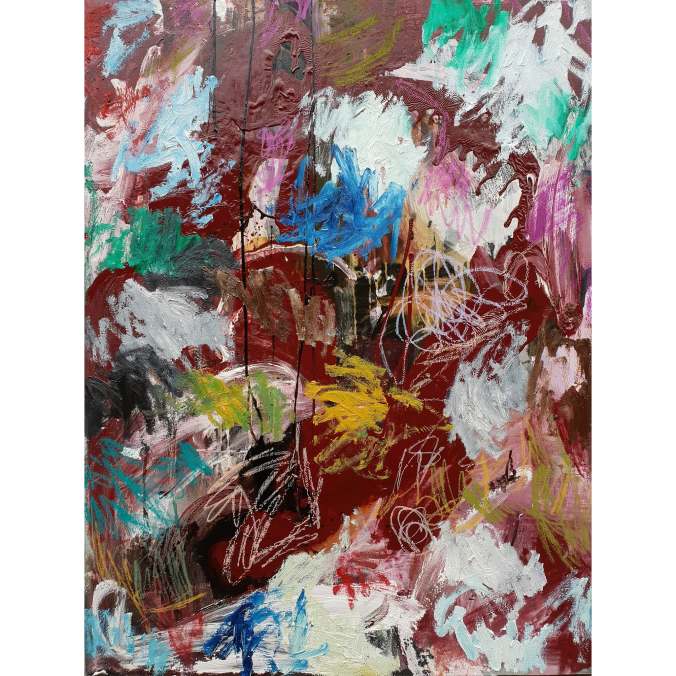
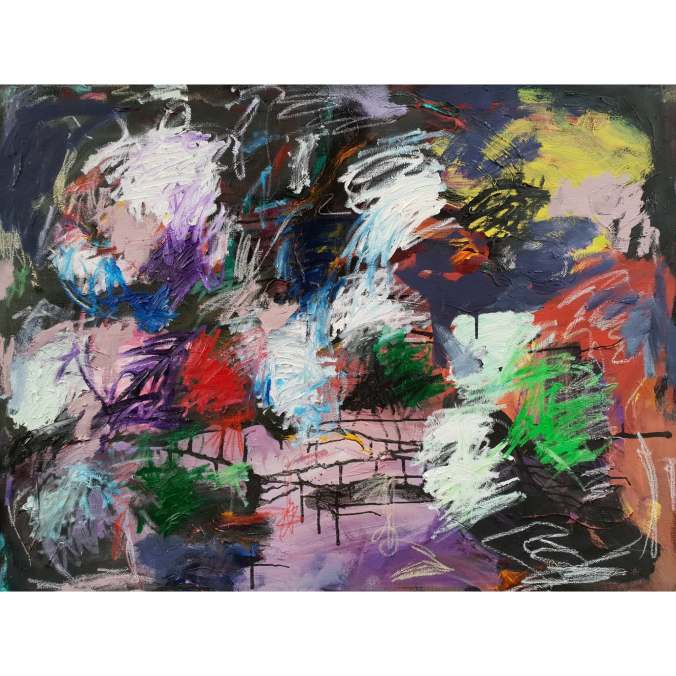
My National Poetry Month challenge to myself has become a collaboration between synaesthetic artist Sammy-John, myself, Anjum Wasim Dar and Jay Gandhi: Day Six: D Major Fur Mo

D Major Fur Mo

D Major Fur Mo

The Cage

The parrot starts to sing Paani Da
as I play the E minor Chord.
He tries to be in tune but the heat
is getting to him. A.C. is not working,
roof is leaking, maid has not turned up,
Zomato guys are taking ages to deliver
a Cheese Frankie. Nick is still in coma.
I shift the chord to D. It’s ungainly
but the parrot does finish his song

By Jay Gandhi

These Are Victories

fresh green shoots, leaves and flowers,
woodlands heady scent of wild garlic ,
bird song and bleating lambs
wild daffodils appear alongside the river
smaller and more delicate,
trumpet shaped flower a paler yellow.

kittiwakes, guillemots,
razorbills, gannets,
fulmar, shag and puffin
return to seacliffs

blackthorn blossom a froth
of clustered white flowers
on thorny branches
before the leaves burst bud.

curlew’s soft, bubbling call,
Ring Ouzel’s a blackbird
with white bib blasting
out of the heather

emperor’s, orange and yellow
day-flying moths, eyespot patterns
on their four wings, struggle
from cocoons on the moors.

Mo sits and downs a sacrifice of golden ale
sunglint on pint glass, a fine sup,
thankful another winter’s
deaths and distress worked through.

By Paul Brookes

No glory, nor pride in fires of violence ever exists;
Transformed into myriads of granule dust,
Innocent lives to eternal slumber sent
With brave last words they went–
Not to their Earthly abode, but to the celestial
Spheres to twinkle and shine and guide
The world to a higher call from a higher ground.
Once that stood tall was forever destined to fall,
Unnoticed, autumnal traces become visible,
Harbingers of the changing fall, remember ye all
The blaze metamorphosed to flowers?
Darkness white, casting a gloomy pal,
But the crashing of the wall
Was a higher call from a higher ground
To the heavens bound,
Where there are glorious towers.
There will be, there are unforgettable flowers.
Myself in race, color, creed, and freedom fetters–
Could I have served God better?

By Anjum Wasim Dar

Wombwell Rainbow Interviews: Andrena Zawinski

Wombwell Rainbow Interviews

I am honoured and privileged that the following writers local, national and international have agreed to be interviewed by me. I gave the writers two options: an emailed list of questions or a more fluid interview via messenger.
The usual ground is covered about motivation, daily routines and work ethic, but some surprises too. Some of these poets you may know, others may be new to you. I hope you enjoy the experience as much as I do.
A

Andrena Zawinski

is an award winning poet and educator. Landings is her latest poetry collection (Kelsay Books, Hemet, CA, 2017). Her previous book, Something About (Blue Light Press, San Francisco), is a 2010 PEN Oakland Josephine Miles Award recipient for excellence in literature. Her first collection, Traveling in Reflected Light (Pig Iron Press, Youngstown, OH, 1995), was a Kenneth Patchen competition winner. She has additionally authored five chapbooks. Zawinski compiled and edited Turning a Train of Thought Upside Down: An Anthology of Women’s Poetry (Scarlet Tanager Books, Oakland, CA, 2012).

Her poems have won awards for free verse, lyricism, form, poetry of social concern and have appeared in numerous literary journals and magazines including Quarterly West, Gulf Coast, Nimrod, Rattle, Blue Collar Review, Progressive Magazine, Pacific Review, and others. Her poetry has been widely anthologized in American Society: What Poets See, Borderlands and Crossroads: Writing the Motherland, So Luminous the Wildflowers Anthology of California Poets, Veils Halos and Shackles, Women Write Resistance: Poets Resist Gender Violence, Raising Lily Ledbetter: Women Poets Occupy the Workplace, and in many more.

Zawinski has contributed as Features Editor to PoetryMagazine.com since 2000, showcasing emerging and celebrated poets with equal attention. She is on the Poetry Board for The Literary Nest. She also founded the San Francisco Bay Area Women’s Poetry Salon in 2007, a social group that continues to bring together a diversity of talented and accomplished poets.

Zawinski has a long legacy of feminist organizing, consciousness raising, and direct action in the Women Against Violence Against Women Movement. She co-founded Women Against Sexist Violence in Pornography and Media along with the National Radical Feminist Organizing Committee. She was a founding collective member of the Gertrude Stein Memorial Bookshop and worked as manager of the cultural feminist collective, Wildsisters, Inc. restaurant and entertainment space. Zawinski remains committed to poetry and the condition of women and the working class worldwide.

Zawinski is a veteran teacher of English writing of early childhood through college students. She taught at Allegheny Community College, in the Pittsburgh Public Schools, for the Western Pennsylvania Writing Project and International Poetry Forum, for the Pennsylvania Council on the Arts, and at the University of Pittsburgh. She recently retired as a popular English composition and creative writing instructor at Laney College in Oakland, CA.

Some of her honors include Allen Ginsberg Awards, Emily Stauffer Poetry Prize, Ina Coolbrith Award, Milton Acorn Prize, Mulberry Press Award, Pushcart Prize nominations, Triton Salute to the Arts and those that came from Akron Art Museum, Artists Embassy Dancing Poetry, Alameda Arts Council, Bay Area Poetry Coalition, Black Bear Review, Black Hills League of American Pen Women, Sacramento Poetry Center, Sacramento Public Library, Sarasota Poetry Theatre, Soul Making Literary Competition, Taproot Literary Review, Tiferet Journal.

Of her work, Len Roberts described her poetry as “strongly imagistic and tightly rhythmical” while Lynn Emanuel characterizes her writing as “an articulate, urbane, sophisticated voice …[that] seethes with savvy…packed with a bristling ironic intelligence.” Grace Cavalieri calls Zawinski “the poet we find when we’re in luck.” Of her latest collection, Landings, Poet Laureate Rebecca Foust has deemed the collection as “…Part paean and elegy to what was, part lyric and dirge to what is, Landings asks the question of what remains—where we land—after great loss, then answers the question in poem after glowing poem…a book that offers wisdom and solace and one you will take comfort in reading again and again.” Author and Editor Carolyne Wright has said that “Zawinski knows that the missing are never wholly gone, and despite the frequent harshness of human interaction, in these Landings, she embraces the richness of human experience, and praises the courage of those who go on living as if they could do anything. Jan Beatty, Creative Writing Program Director at Carlow University, has said: “…Zawinski’s is the necessary voice of the truth teller, speaking trouble among the beauty. These poems breathe compassion with no borders… In these brave poems, the blood moon blazes red-orange/sunbeams at its edges—as we feel the fire of brutality, the heat of desire and great loss, and the colors spreading out onto our fragile, beautiful lives.”

amazon.com/author/andrenazawinski
https://andrenazawinski.wordpress.com
http://www.poetrymagazine.com/zawinski

The Interview

1. When and why did you first decide to write poetry?

This question makes my head turn two ways: first to “When did I first write poetry?” and then to “When did I consider myself a writer of poetry, a poet?” I was first inspired by poetry after being hungry for mail as a girl landlocked by sweltering summers and frigid winters in Pittsburgh, Pennsylvania. My boredom and curiosity took me to scanning ads in the back of my mother’s magazines, tape quarters she gave me to file cards and send them off in the world of mail order. Some of the earliest arrivals were, of course, the autographed star photos and stamps for a collection; but I actually requested “A Coney Island of the Mind” (Lawrence Ferlinghetti!) and

Howl,” (Allen Ginsberg!), which became both my introduction to poetry and my license to speak my mind in that genre.

It wasn’t really until my twenties, however, that I actually came across the musicality of poetry through Dylan Thomas and the powerful force of poetry through Sylvia Plath. And that’s when I started writing and never stopped, but then also never more than stuff for-the-drawer that I shared with friends but never saved. (I did get a couple of publications under a pen name, and those went into the drawer as well.)

Around 1990, once I started collecting the work and reading in public, I considered myself a poet. I was fortunate to receive encouragement through an audience of both peers and established writers. I participated in workshops with poets I admired who were available to me through the University of Pittsburgh’s Writing Project (Jim Daniels, Lynne Emanuel, Len Roberts), but I never pursued an MFA degree. As a single parent with a BS and M.ED already under my belt along with a short stint into a PHD program, I was delighted instead to be surrounded with people hungry to write and to read poetry, to revel in the passion of poetry.

My first full collection went to print in 1995, having won Pig Iron Press’ Kenneth Patchen Prize in 1993 selected by Joel Climenhaga (who had actually palled around with Patchen). Right after that, honored to be on stage as an “Up and Coming Writer” with two of my mentors, Daniels and Emanuel, at an AWP Conference, I was for the first time paid for my work and went before a really large audience instead of those of small cafes and bookstores. Having had returned from a Prague Summer Writing Program, I was surprised by Pittsburgh Magazine’s Harry Schwalb Excellence in the Arts Award in Literature with honors as “One to Watch in Literature.” There was no turning back to wearing the mask of a pen name or to muffling my poetry in a drawer.

1.1. Why did you request Ferlinghetti and Ginsberg?

City Lights happened to have ads in one of the magazines…I remember Look and Life and Screen. But not which the ads were in which magazines. The city lights books cost fifty cents then in the mid-60’s, if I recall correctly. I was young enough to trick or treat, which I did as a beatnick after reading them and putting it all together.

I actually have anew poem about that. It was called “Girl, waiting to be filled” but I changed it to “mailbox.” I met Ferlinghetti at a party for his paintings. Joyce Jenkins introduced me to him as a real fan. I told him the story, and he said he wished more people would share that sort of thing with him. Later I won through Paterson Literary Review two ALlen Ginsburg honors prizes.

2. How aware are and were you of the dominating presence of older poets traditional and contemporary?

Then? Not at all. I lived and was schooled in a working poor community where the most literary experience I got was being punished to recite Shakespeare in class for the crime of passing a note. My option taking a letter grade drop. I chose the latter. Of course, I became widely aware and moved by contemporary older poets legacy of verse through time.

3. What is your daily writing routine?

Wishing. Wishing I were a fast writer, wishing I were a disciplined writer with a schedule and projects, wishing for an inspiration so strong that I can’t stop writing. The reality is that I am a slow writer, lack a schedule, and am a writer who never embarks upon projects that publishers love to pitch. I enjoy the act of discovery in writing because, as E. M. Forester asserts, and I believe: “How do I know what I think until I see what I say?”

Delays inevitably appear along the way as I revise. This can be polishing phrases and descriptions, tightening lines and stanzas, or finding on the stage of the page what form a piece should take—one unpunctuated sentence, sonnet, haibun, pantoum, villanelle, poetic prose, narrative free verse? I revise more than I generate text.

My writing happens largely at the computer and has since I got one in the late 80s, a Macintosh that whistled like a teapot. On my screen are always one or two poems I am working on that I visit and revisit. And there are files: Works-in-Progress that contains things near completion along with a Seeds file that holds the typing up of scribbles from napkins, receipts, note book pages or descriptions and ideas that might germinate one day. I dip into these files whenever inspiration doesn’t grab me by the throat and demand I find my voice to speak. And then hoping. Hoping the poem is ready to move into my Submissions file, hoping the poem deserves an audience through publication, hoping it fits into the scheme of things of a current manuscript, hoping it will touch someone in some way whether in tenderness or with ferocity.

4. What motivates you to write?

What motivates me to write can be anything in the present moment or distant past from newscasts to poetic tomes that spark imagination to fly into the blank of the page: singing birds and beached whales, roller skates and coal mines, porch swings and fireflies, suitcases and moonbeams, all of it (in the words of Marianne Moore) “the art of creating imaginary gardens with read toads,” revealing the extraordinary in the ordinary.

5. How do the writers you read when you were young influence you today?

Writers I read when young were mostly doled out as high school assignments dictated by teacher preferences, so most of that fell on my deaf ear of a rebellious student. Perhaps if someone would have drawn a line between Romeo and Juliet and West Side Story, I may have cocked that ear. Remember, I did not attend an MFA program in my college years—I was actually and ironically in “teacher training.” Often having characterized myself as a self-taught poet to students in my creative writing classes, this I felt encouraged them to take risks beyond the sanctions of academia to become their own best teachers.

Contemporary writers I have read by choice are the ones who have most influenced me: Adrienne Rich’s consummate truth telling, Marge Piercy’s poignant narratives, Dana Gioia’s beautiful use of tradition, C. K. Williams’ depth of emotion, Sharon Olds’ candor and accessibility, Carolyn Forché’s passion for the personal as political, Yusef Komunyakaa’s musicality and truth telling, Martin Espada’s social consciousness of common folk, Wislawa Szymborska’s plain speak. These I return to again and again for both solace and inspiration.

6. Why do you write?

That’s not an easy question, but I have an easy answer. I suppose it’s the same reason a painter paints, a sculptor sculpts, a musician makes music. It’s a drive combined with a self-perceived talent. For me, as a poet, everything is my canvas, my clay, my notes. I am the consummate eaves dropper—whether on how the humpback hills green in spring or an animated conversation unfolds between a parent and child on a train. I am always watching, always listening—ears, eyes, mind, heart always open, open to it all.

7. What would you say to someone who asked you “How do you become a writer?

Don’t imitate, but do be informed by writers that have come before you and writers you admire who are writing right now. Be part of a community of writers: take a class, join a workshop, attend conferences, go to readings, participate in open mic opportunities. Read a lot of writers. Re-read the ones that tug at your heart over and over again. Start local and go global—let your voice be heard in hometown publications and venues, and as you steady your feet on that ship, sail out to other places you dream to be. It’s limitless.

8. Tell me about the writing projects you have on at the moment.

Earlier I said that I don’t embark upon projects, and what I meant by that is that I am not one to sit down and write a book of, for example, all nature poems or all poems of work or only family poems. I am completing a new manuscript now that contains, of all things, those nature poems, poetry of work, family poems, plus political poems and even a couple of quirky ones that might bring an aha and ha-ha. I also continue (since 2000) to be Features Editor for PoetryMagazine.com, an online only magazine since 1996, that has gone biannual: I invite six poets twice a year to showcase their work there. There is a popular Women’s Poetry Salon that I founded in 2007, for which I organize gatherings about every six weeks that one to two dozen women attend at a time, an informal social group that feeds us with a potluck of poetry and food outside our regular work writing and publishing. Finally, I am honored to have been recently invited to be a guest editor for the Poetry Sunday column for Women’s Voices for Change, something in the offing. There is, of course, the ongoing process—when I am not writing or revising I am submitting poetry for publication and giving public readings.

Wombwell Rainbow Interviews: Sven Kretzschmar

Wombwell Rainbow Interviews

I am honoured and privileged that the following writers local, national and international have agreed to be interviewed by me. I gave the writers two options: an emailed list of questions or a more fluid interview via messenger.

The usual ground is covered about motivation, daily routines and work ethic, but some surprises too. Some of these poets you may know, others may be new to you. I hope you enjoy the experience as much as I do.

Landscape 1

Image for the cover of a future publication

Sven Kretzschmar

was born in the southwest of Germany in 1987. A trained analytic philosopher and literary scholar, he is the former coordinator of the European Federation of Associations and Centres of Irish Studies. He has published poems in Skylight 47, Ropes, Coast to Coast to Coast, The Wild Word, and with the Poetry Jukebox project in Belfast among others. He won the 2018 Creating a Buzz in Strokestown prize for his poem ‘Listen closely’. He is the illustrator of Grimwig and Bert Borrone’s Perpetual Motion, and the chairman of the German-Irish Society Saarland. Sven holds degrees from Saarland University, Germany (BA), the University of Luxembourg (MA), and University College Dublin (MLitt). Academic publications have appeared in Think Pieces. Food for Thought (a festschrift) and are forthcoming in Theoria and Praxis and in the Hungarian Journal for English and American Studies. Sven has worked abroad at the UCD School of Philosophy in Dublin, Ireland, and in the Leuven Centre for Irish Studies in Belgium, engaging in teaching and research about medical ethics as well as Irish literature and early modern London drama. Current academic endeavours focus on Irish poetry and its intersections with philosophy, as well as on the topics of responsibility in medical ethics, and on the philosophy of autobiography.

Sven’s blog, where all his journal and zine publications appear after publication:
https://trackking.wordpress.com/

The Interview

Many thanks for the invitation to this interview, Paul. It was quite a bit of a challenge to not only think about my work, but to consider possible concepts behind it – a challenge indeed, but nevertheless a very welcome and intellectually rewarding one.

1. What inspired you to write poetry?

I do not actually recall what might have been the initial inspiration for me to start writing poetry, but I do remember the reason: it would have been in the 10th grade, I think, when our English teacher gave us the homework task of writing a poem. I was writing rap lyrics at the time, both in English and in German, and about all sorts of topics. I had already developed an interest in American songwriters and German rock bands too, but decided to stick with a UK singer, Ms. Dynamite, for a kind of poetry template. I ended up writing two poems and, as far as I remember, was the only one in class finishing the task.
I took it from there and kept writing. A start into creating poetry had been made, even though it was not yet poetry as literature. Looking at in hindsight, what drove me to write was probably less of a general inspiration, something that would have been there, but probably what was not there. My peers were not writing creatively, were not listening to the music I fancied, and very often did not take an interest in what I was interested in art-wise, so I suppose I wrote out of a feeling of me without the rest of the world (as opposed to the famous ‘me against the rest of the world’ stance). For a while then, I also wrote from a place of worldlessness while I studied analytic philosophy, which is a great thing to do, but it simply did not give me the insights I was expecting from philosophy.

2. Who introduced you to poetry?

Prof. Bert Hornback, whom I met in Saarbrücken, Germany, the great Dickens scholar and friend of such well-known writers like Seamus Heaney and Galway Kinnell introduced me to poetry properly (Bert’s neighbours back in Ann Arbour had been Jane Kenyon and Don Hall, can you imagine!). I was illustrating his first novel, Grimwig, after an undergraduate semester abroad in Dublin. Bert, who, I think, was the first one to invite Heaney over to come and read in the United States, invited me and other students to his flat in Saarbrücken to form a weekly book club. We read modern classics and canonical authors, so that is how I got in touch with the work of established poets. Bert was also the first one to give me some feedback on my own creative writing, which proved indefinitely valuable.

3. How aware were you of the dominating presence of older poets?

I certainly was well aware of Heaney’s presence (although I never conceived of him as ‘dominant’ in whatever way), but other living ‘big shots’ were not so much on my map, not out of ignorance but simply because I had not yet encountered their work. Where I am from, literature is mostly taught with regards to novels and stage plays, due to the fields of expertise of the respective university teachers. (Other reasonable restrictions might play a role too.) In addition, English literature was only part of my minor subject during my undergraduate years, so I learned about the likes of Vona Groarke or Pat Boran only by and by. This was good insofar as I am not ‘starstruck’ – I do not bother about big names or about following in the footsteps of anybody else, nor do I think something a ‘big’ poet does well and successfully must necessarily be the way for me to go. It might well prove a useful orientation though, because they didn’t earn their spurs for nothing, right? What I am interested in is good poetry, and of course some older poets are well-established, because they do just that: they write good poetry. If, however, I come across a non-mainstream poet or a no-name, pretty much somebody like myself, and they have a good poem, I enjoy it as much as I enjoy a good poem from a Nobel laureate or from an Aosdána member.

4. What is your daily writing routine?

To be very frank, I do not have any routine I would be aware of, or at least nothing that would deserve the name. Half of my actual writing of first drafts happens in writing fits, the other half is really sitting down trying to write something with a topic in mind and notes that have been accumulated with regards to said topic. I try to write every evening, sometimes also during the day if I feel like it, but it very much depends on if there are other things I have to give priority to. There is work to be done, there is a social life to keep up with, voluntary work, reading, drinking tea, letting my mind roam, doing some academic research (For fun! Yes, that’s the point where you may finally call me crazy if you wish…) and such important matters like eating and sleeping. It can be tough to squeeze in some writing. Since I do not have a major research project at the moment, I spend most evenings writing and editing drafts (cf. question 11).

5. What motivates you to write?

Expressing my self creatively in ways that I could not do with painting or drawing is certainly one reason. The other very important reason, I suppose, would be to investigate the world that surrounds me, and to make sense of it, particularly because not everything I am interested in could be expressed in a reasonable academic fashion, so in that regard poetry and short prose are the things to do really.

6. What is your work ethic?

This question presupposes that I have something like that…
All jokes aside, I think it is important to continue writing in one way or another, even if you are not satisfied with a particular draft and think working on it any further would lead nowhere anyway. Stripping off the layers, adding words and phrases here and there, rearranging the structure, and basically fiddling around with the whole piece is key to explore what a poem could be, or become, what your preferred form for the poem could be, and how that might contrast to what a new reader would or should encounter when reading that poem first. This can be tedious at times, because you might feel like going nowhere with whatever you are working on, but it is always worth returning to a poem with a fresh look to decide if there is something you can do to make it a good poem or if it might really be a stillborn piece of text. Or if it might work better in a different form (say, as flash fiction). In the meantime, to keep on writing, I tend to other poems if I encounter one where I really cannot move forward at a given time.

7. How do the writers you read when you were young influence you today?

I am still young!!! [fakes offended facial expression and makes exclamatory theatre gestures] Well, at least sort of…
So, there are writers from way back that influence me now and there are influences that I might have encountered just yesterday. Most of the writers from the past happen to be men. I am not sure why that is so. Also, most of them are German, as that is my native language and so, naturally, the language I first started reading in. Ralf Isau, whom I read a lot during adolescence, is probably the first to mention here, as he created fantastic worlds I still like to remember nowadays. Then comes Ian Levinson (whom I read in translation), who fascinated me with his dry and dark humour he uses to deliver social commentary. Max Goldt and Marcus Hammerschmidt are also worth mentioning because I very much drew on their absurd short prose when I started to write prose texts myself. With regards to poetry, Edgar Allan Poe is certainly the first influence I had (I deliberately count out the above-mentioned artist Ms. Dynamite as she’s a singer, although that’s a very technical approach and thus certainly up for grabs and for discussion). A few years after that came Seamus Heaney, and then Louis MacNeice, whose works made me take my own poetry more seriously and made me aware of the fact that it can be something other than just the stuff you jot down for yourself, that it can be actual readable and enjoyable and thought-provoking literature. Other, non-literary, writers worth mentioning are Epicurus and Odo Marquard. Both are philosophers outside the analytic tradition, which makes it strange that I took a fancy to their texts, but then again, you can always approach something through the analytic lens. The analytic approach is by no means the absolutely perfect method, so one should remain open-minded regarding other schools of thought.

8. Who of today’s writers do you admire the most and why?

Geez! How long a list am I allowed to provide here?

I will do it in alphabetical order to not unfairly prioritise anybody, as I think the below writers are all fantastic.

Annemarie Ní Churreáin: She provides comprehensible social and cultural commentaries on what it means to be a woman in 21st century Ireland, and on the developments leading there. In addition, her writing skills are really excellent. If you have not yet read Bloodroot, I recommend you get your hands on the book immediately. A pleasure to read, and one that gets your mind going, exploring the subjects further beyond poetry and into real life.

Dave Lordan: Dave made performance poetry accessible for me. Before that, I didn’t really have an understanding of what it is, also because respective events in Germany often feature performers who clearly work with prose texts, so naturally the term ‘poetry’ was difficult for me to apply here. He pointed out to me there are different approaches to the matter in question. Dave is also a passionate and brilliant creative writing teacher, very approachable and always with some good advice for his students. I have not read one of his full-length collections yet, but have read some very good, well-crafted poetry online, and have him on my reading list for later this year.

Doireann Ní Ghríofa: Isn’t she just great?! Naturally, I wouldn’t be able to read her work in Irish, but her English poetry really gets to me. Like Annemarie, she discusses lots of social and cultural matters in her work, but contrary to the former, her lyrical I seems to speak from a more subjective angel, which, I think, can be particularly well observed in her poems about motherhood. Plus: she wrote the second of the two best inscriptions into my copy of Clasp when I was in Dublin for a book launch. I also enjoy comparing how some of her poems develop over different publications and how she manages to find yet another twist to make the next version of a poem even better.

Elaine Cosgrove: She had me off to a flying start reading her Transmissions. Although many of her subjects seem to have little to do with the things going on in my own life, I feel I can relate a lot to what she is writing. Even when creating images and sceneries I know I have not lived through, she manages to make me think I’ve been there, in that exact spot, had that exact thought etc. That is something I find utterly fascinating. What is more, her poetry is sometimes on the brink to prose, sometimes presented in non-standard, experimental forms – but the wonderful thing is it does not matter, even for my rather traditional reading habits. Her poetry works regardless of all that, readjustment to the next form or typeset happens in the turning of a page.

Francis Harvey: Okay, he is dead, but not for so long, so I take the liberty to count him in. Marvellous landscape and nature poetry delivered with a down-to-earth approach and always the awareness for social contexts that come with living in a certain place (in this case: Connemara). I find his descriptions and images are very often at once subtly moving and very intense. (To that effect, Mark Roper seems to be similar. I have not read enough from him yet, but plan to make good for that in the future.)

Jessica Traynor: Since her first collection, she manages to write very fine lyricism informed by a sharp sense of history and a great social and cultural awareness – but never with a wagging finger. Often enough, you’d also find a fine sense of humour in between the lines and pages, and she is not afraid of approaching themes like witchcraft in a playful and imaginative, yet reasonable and straightforward way, so as a reader I do not shy back thinking this is an odd topic, but recognize it as just the right to do in the case of the respective poems. Jessica seems to have an excellent feeling and understanding of what her poetry needs and how to craft her verses in ways that make sure there is always something interesting and new that makes you want to read on.

Marcus Hammerschmidt: A German author of absurd short prose (in addition to journalism and novels I haven’t read yet). His Waschaktive Substanzen (roughly translates with detergent substances) has been the first book I read after a long while of reading academic philosophy only – and it was pure literary illumination! The book is like a short fiction collection with stories of parents who test-die, or a skeleton child swimming in a lake with no water, of stars above a sports hall – they get stolen over night, dinosaurs and horsetails that decide to become fuel for future cars – which is what the cretaceous age wanted when it prostrated itself. And much more. All of it written in fine and well-accessible prose. How could you not love this kind of literature?!

Max Goldt: Probably one of Germany’s best writers. Intellectually challenging at times, but always in a pleasant way. Writing with a distinct and subtle sense of humour, Goldt is an outstanding narrator who can serve every form from the classic short story to playlets with the kind of ease and perfection that absorbs me from the first sentence. His use of the German language is stunningly perfect, an example for young Bill Shakespeare to follow! We owe to him terms like “Klofußumpuschelung”, a word so beautiful and strange I could not even translate it (K. means the kind of fluffy rug people put halfway around the foot of their toilet bowl in the 80’s and early 90’s). Examples of his stories include a women who gets drunk on the radio once a week and talks about anything and everything then, or a guy who despises summer and thus puts on his winter coat, walks out into the evening heat and almost faints – people are so impressed that they form clubs and societies of summer despisers (to be honest, that would really be the thing for me…). Goldt also writes about absurdities of language use, e.g., ‘exclusive’ offers usually offering nothing near exclusivity, or texts about the pluperfect tense used in Berlin dialect, and all kinds of further enjoyable meditations. He is a precise stylist as well as a lover of free literary forms – a combination you don’t find that often among well-known authors.

Pat Boran: Here’s one who has a way with words for sure. He writes poetry with such lyricism and ease! Pat is a great storyteller with a keen eye on details and message, and a precise measure for where to put which word. Maybe that is due to him being an experienced haiku writer in addition to the more ‘classic’ western tradition he seems to master on the side while editing another fabulous collection of one of the wonderful authors he works with. There is wit and humour and emotional understanding and a sense for science and academic and rational insights all over his poetry, and always in the right place.

Seamus Heaney: Dead, like Harvey, but I still count him among our contemporary poets. Always a difficult read, but certainly very rewarding once one has managed to lay bare the manifold of meanings he hides in his poems. There is a lot I can relate to, not least in his nature poetry. I find it particularly interesting how he overlaps with Odo Marquard regarding some topics. I have written about that in the past and there’s a good chance I will go on to research thematic intersections in their works. With regards to Heaney’s political poetry about the Troubles, I find it very interesting how he deals with questions of moral responsibility – something the moral philosopher in me is keen on researching too at some point.

Vona Groarke: Vona really has a way of surprising her readers. At least she surprises me. Her poetry is full of little twists one wouldn’t expect, but which help to perfect the message. Her images and wordplay come out brilliantly, regardless of the topic. Really a champion of the craft, and a bright and humorous and approachable human.

9. Why do you write, as opposed to doing anything else?

Why do you do anything at all, as opposed to doing nothing? Or: “anything” else, really? Human lives are finite, we are thus not in the position to do anything. Instead, we have to limit ourselves to doing some things. One of my things is writing. I could also kill people, sure, but washing off the blood is a dirty business, and being a killer is also complicated, illegal, and immoral. Writing is only complicated (at least in those parts of the world where I have made a home so far), so in that regard, it is certainly preferable. I could also be a football player, but since I don’t have a fancy in football (not a cliché German in that regard, I admit…), writing, again, is the preferable option – and so on, and so forth.
To give you a serious answer to the above question: I really don’t know. My musical skills are pretty moderate, euphemistically put, but creative as well as intellectual expression has always been of interest. Although I enjoy and engage in drawing and painting too to a certain extent, writing is probably the one thing for me which combines mind, emotions, and aesthetic expression. Not that this description couldn’t be applied to music as well, but as I have said, that’s not my kettle of fish. Using words seems to be the more natural thing for me to do. That is probably as good an answer as I can give here.

10. What would you say to someone who asked you “How do you become a writer?”

It really seems to depend on what one means when using the term ‘writer’. In a very technical sense, I am a writer when I write a shopping list. Am I still a writer when I am not currently engaged in the process of writing? If it’s only about shopping lists, the answer is probably: no. But I would think of people as writers who engage in the practice of writing regularly and with the ambition to showcase at least part of their work and make it available to a broader public. (How broad that public will be regarding a given sort of text is a different matter.) So, to become a writer you need to start writing. You should also develop ideas about what you want to write about, your medium/sort of text, what your style should be (serious, humorous, absurd, to name but a few). However, some of these are very theoretical thoughts and should not be set as absolute goals. A certain level of flexibility and open-mindedness seems unavoidable, I’d say. It might so happen that you are absolutely set on writing flash fiction but are not really capable of doing it. Instead, you might turn out to be really good at writing classic short stories. Enforcing the flash fiction way could then be detrimental to the quality of the overall outcome, so it seems advisable to maintain an open mind to be able to come up with the best possible text. If you want to become not just a writer, but a good writer, it is advisable to listen to honest and constructive criticism. This will certainly be hard at times but will turn out to be very profitable for the quality of your writing. Also, there are a range of established authors from all strands of life and with a vast range of expertise who offer creative writing courses, online as well as in the real world – the likes of Dave Lordan, Kevin Higgins, or Adam Wyeth are those I am aware of spontaneously. Furthermore, the Irish Writers Centre provides a list of writers who are available for support regarding all sorts of literary genres. For those who shy away from social interactions (because they might think: “ugh, humans – how very disgusting!” [poshly taking a nip of sherry]), there are plenty of how-to-write books out there. My recommendation would be Pat Boran’s The Portable Creative Writing Workshop, because it’s hands-on, informative, and comprehensible, but there are plenty of other options there too. And since you have to read a lot to get an idea of all the good writing that is out there, you might as well put a how-to book on your syllabus.
Last but not least – in fact, most essential: keep writing! Practice as often and regularly as possible, otherwise there’s hardly a chance of getting better at it, or as the famous New York poet James Todd Smith put it: “Doin’ it and doin’ it and doin’ it well.” (Okay, calling LL Cool J a poet is a bit over the top, but he has a way with words still. Call it poetic license if you will.)

11. Tell me about the writing projects you have on at the moment.

There are quite a few recent and current projects on my list, some with looming deadlines, some without, and I can work rather freely regarding the latter ones. Aside from the ever-ongoing submissions game involving editorial work on existing material, I am currently preparing a suite of poems to submit to the Writing Home anthology of Dedalus Press. Although I do not currently live in Ireland, I have strong ties with the island, particularly with Dublin, because I have lived there for a couple of years a few years back, and I still hope that someday I can return for good.
The second project is an anthology about the conflict between Palestine and Israel. At this point, I cannot yet tell much about it though, because it is all very much in its early stages.
Thirdly, I have just finished writing a paper about ageing in Seamus Heaney’s last collection, Human Chain, which is to appear in the Hungarian Journal of English and American Studies.
A chap book and a pamphlet are also in the making. Not commissioned though, but for to submit to respective competitions.
Last but not least, and, at this point, quite a fair bit into the future, I intend to brush up my MLitt thesis for potential publication, and to write a PhD thesis dealing with intersections of philosophy and literature.
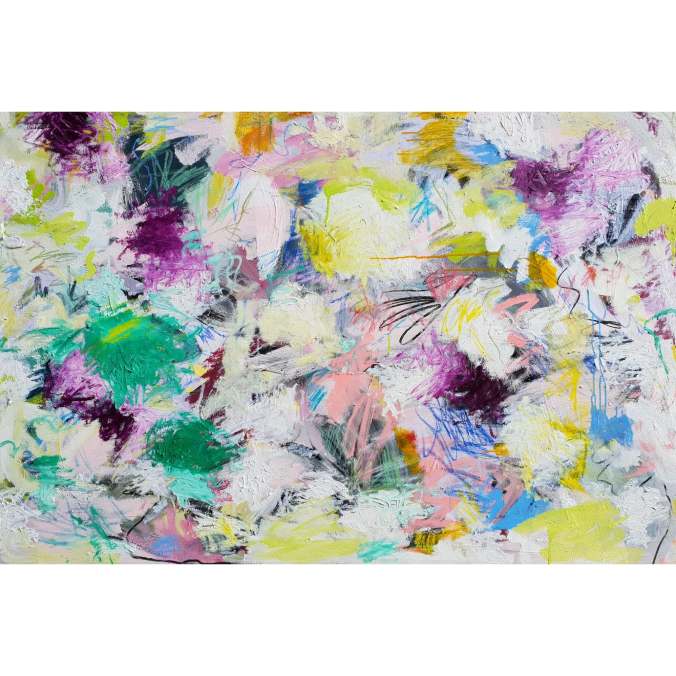
My National Poetry Month challenge to myself has become a collaboration between synaesthetic artist Sammy-John, myself, Anjum Wasim Dar and Jay Gandhi: Day Five: An Impromptu

Impromptu

An Impromptu

Wooden bird table made of logs
darkened by April showers

is a gust fall into daffodil blooms
scatters their fresh yellow petals.

I lift the table with blotchy cold hands
and stand it again on the white pebbles,

aware any further blow will topple it
once more into the new growth.

A constant restoration as nature moves on.
A conservation of my late dad’s garden.

Impromptu

The other day on stage
I created a cushion where
you could have cracked
our standard one-liner:
You blanked out

I had gelled green with red
and all you had to do
was dip your fingers in violet
and paint; your hands froze

We have done this from school!
speak on any topic,
draw from any abstract,
write songs for any tune
and dance on the same song

They cut as and
we bleed spontaneity
yellow is mellow, lakes are shallow
red is anger, Big D is a banger
Trump is cocky, Stallone is rocky
blue is with hue and all that’s impromptu

Today you sculpted a man with the
head of a horse and feet
like that of an elephant—
Normalcy is returning

By Jay Gandhi

Impromptu

Neolithic  hunters,
found power of life in red
Romans loved war Ares

Anemone turned red
as Adonis died, lost the white
to grace, sacred blood.

War weapons painted
Erik the red, found Greenland
penguins bears captured

Rebellion is red
rosy red  is for love and beauty
making red, evil doing.

Be a bride, wear red
gift red eggs to first born child
avoid red affairs wild.

By Anjum Wasim Dar

My National Poetry Month challenge to myself has become a collaboration between synaesthetic artist Sammy-John, myself, Anjum Wasim Dar and Jay Gandhi: Day Four: In Grandpa’s Garage

Grandpa's Garage

In Grandpa’s Garage

newly built an inch wider to regain
the stolen boundary taken by the neighbour’s new fence.

Everything placed around the edges is a space
for grandad’s Ford Popular I let rot on my dad’s driveway,

so it had to be taken away.  Turpentine and dripped paint, swarfega
and rotted grass cuttings, small Golden Syrup tins, strawberry jam

glass bottles full of nails, light grey concrete flags lean against each other
dominoes caught in mid fall. Old bicycle clips to hold back the flap

of his uniform trousers as he rode up and down Harrogate hills
on his official black Post Office bike.

Memories must be binned, charity shopped or auctioned.

by Paul Brookes

A sacred temple it seems to be, or perhaps Plato’s cave
illumined by the good sun, enlightenment streams upon
Precious relics, contraptions to some, laid in order, nuts
bolts tools nails and pails, brushes brooms and  sticks
Collected  in time, oleaginous ? No, polished  defying
destructive distortion, ask the one who perceives them
As priceless  treasures.

What tins and cans  magically dark
what pieces white in artistic grandeur
Wires draping coiled or swinging low ,
like lace, and on  golden black patched
Carpet rests the sharp tailed  royal Chevy
so loved valued , a vintage,  a passionate
Revelation, engulfed in oil scented aura
tranced in multifarious colors-  transformed-
Ah to another  garage in another time where
a jute woven charpoy, an Indian hookah placed
As serving guard, a pair of rubber slippers
on the floor, packing crates stacked  with some
old used leather suitcases , a small wooden table
a jug and glass and some books, was all the label
doorless  space but with a roof, illumined by
the good sun, smoke rising from the mud stove
The aura of freshly cooked wheat filled the air.

By Anjum Wasim Dar

Stars

Stars are already dead
or are dead people stars…
Every person becomes a star
after leaving earth and
he becomes one because
he doesn’t wish to leave!
Myth has it that he passes
out in the mornings. That’s
codswallop. Fact is that
he  sleeps underneath
the blanket of the clouds.
Delhi often misses seeing
its forefathers and it has
only itself to blame:
Smog is such that stars
f
a
d
e
away
Stars are the ghosts
that we can see with
our naked eyes
After death, one becomes
a Big-Boss. One can see
everything. Just can’t
speak up. Sometimes his
sound manifests into our inner
voice. It refrains us from
doing wrong.
And that is the wavelength
between us and our ancestors.
By Jay Gandhi

My National Poetry Month challenge to myself has become a collaboration between synaesthetic artist Sammy-John, myself, Anjum Wasim Dar and Jay Gandhi: Day Three: In F Minor Key

F Minor

In F Minor Key

When she flags down the bus of forgiveness,
steps on and pays the price to go

the distance, and sits down next to
trepidation who smells like a street

full of crocodiles and iguana skins,
while she sees grief and sadness holding

placards on street corners advertising
communication at no cost for a limited

time. This is her stop where she gets off
and finds herself in the recrimination market,

where temporary stalls of remembrance shout
discounted sweet deals with hidden sour spices.

She decides not to buy as her aim is off
centre and orders a meal of fear and anger

cold when it arrives she complains to
the wrong people who feed her to the animals.

2019 ©  Paul Brookes

In F Minor Key
Sounds of teargas shots are heard, a regular feature
come, it’s on again, everyone together, in unison
We are strong now’, she knew, many long years,
of bearing riots attacks and facing uniformed men

where are our boys and men, blinded  and tortured
missing or hiding in the surrounding hills, O Kashmir
Thy sacred freedom  is a sad song , tuneless chanting
it is now, a freedom chant in harmony , in F Minor key

we sing in closed doors , beating the tin trays, ‘we want
freedom’ we will win freedom one day, we sill sing free
Our lakes shine in the sun a sparkle of hope, they give
our kids smile , shiver , hunger , run hope to live on
Pellets may rain, in blind pain Kashmir you bleed still
how much blood will freedom need how many notes
In F Minor Key to complete the song of liberty
Hope till eternity  as many fight for rights, to be free
2019 © CER  Anjum Wasim Dar

Flames


the flames are like the stars
in a constellation: together
yet alone. They ignite a fire
in the heart, bake feelings
at 180 degrees. 45 minutes
do not satiate. A lifetime
wouldn’t do so either. The
most gifted swan cannot
discern between the milky
flame of friendship and
watery glow of unrequited
love. Times which we shared
looking at the sea near Marine
Drive and  places we went
to— Can you recollect the
restaurant Pizza By the Bay.
Our wit was sharp and our
our instincts were keen.
And now we sit in different
living rooms wondering
if we both would together
could create a constellation.

By Jay Gandhi

A collaboration between poet Jay Gandhi and myself for National Poetry Writing Month challenge: Day Three: A Fire In This Heart

the flames are like the stars
in a constellation: together
yet alone. They ignite a fire
in the heart, bake feelings
at 180 degrees. 45 minutes
do not satiate. A lifetime
wouldn’t do so either. The
most gifted swan cannot
discern between the milky
flame of friendship and
watery glow of unrequited
love. Times which we shared
looking at the sea near Marine
Drive and places we went
to— Can you recollect the
restaurant Pizza By the Bay.
Our wit was sharp and our
our instincts were keen.
And now we sit in different
living rooms wondering
if we both would together
could create a constellation

JG

Stars are cold pinpoints.
We are different flames.

You are the ghost of a flame.
You in your place, I in mine.

I don’t want to be reminded of good times.
It makes this grief even sharper.

That swans bond for life is codswallop.
Stars are already dead when their light reaches us.

Wombwell Rainbow Interviews: Iris Colomb

Wombwell Rainbow Interviews

I am honoured and privileged that the following writers local, national and international have agreed to be interviewed by me. I gave the writers two options: an emailed list of questions or a more fluid interview via messenger.
The usual ground is covered about motivation, daily routines and work ethic, but some surprises too. Some of these poets you may know, others may be new to you. I hope you enjoy the experience as much as I do.

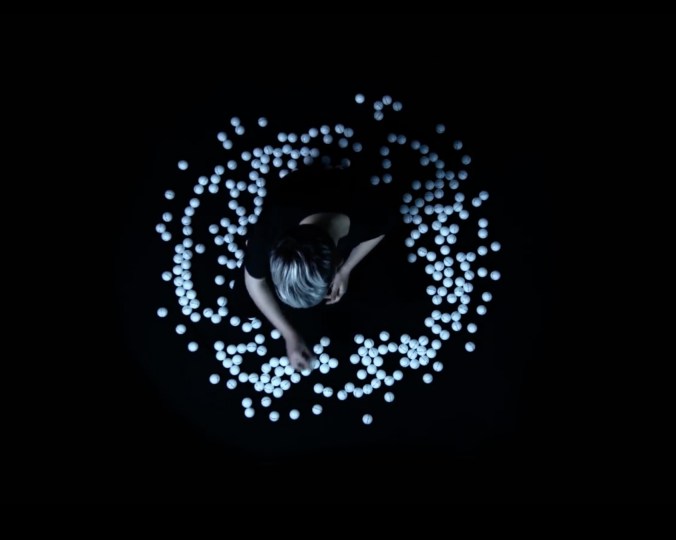
Iris Colomb Spill Still

From Iris Colomb’s performance ‘Spill’, filmed by Eta Dahlia

Iris Colomb

is an artist, poet, curator, editor, and translator based in London. Throughout her practice she strives to create relationships between form and content, applying a design approach to poetic projects.

Her pamphlet I’m Shocked came out with Bad Betty Press in 2018; her chapbook ‘just promise you won’t write’ was published by Gang Press in 2019; and her co-translation (with Elliot Koubis) of The Stories and Adventures of the Baron d’Ormesan, a series of short stories by Apollinaire, came out in 2017. Iris’ poems have also appeared in magazines including 3:AM, Erotoplasty, Tentacular, Zarf, Splinter, and Datableed, and in a number of UK anthologies.

Iris has been resident artist and poet at the Centre For Recent Drawing, she is now the Co-Editor of HVTN Press, and a founding member of the interdisciplinary collective ‘No Such Thing’. Her visual work has been showcased in the collective exhibition ‘We Fiddle While Rome Burns’ (Donetsk, 2014), featured in several exhibitions in the UK, and was sold at auction in Versailles in 2015. Her artist books have also been exhibited and collected by the National Poetry Library and Chelsea College of Arts’ Special Collection.

Iris has given individual, collaborative and interactive performances at a range of events in the UK, Austria and France. These performances have involved artist books, collaboration, experimental translation, metal tubes, hand-held shredders, red bins, shouting over hairdryers, spitting in books, and turning audiences into poetry machines.

Her website is https://iriscolomb.com/

Instagram at @iriscolomb.

The Interview

1. When and why did you begin to write poetry?

I started performing and writing poetry regularly in October 2014. Before this I had started writing what I thought would become a play, a disparate set of texts to be spoken out loud which I hoped to combine when they started to cohere. In June 2014 I met Zorro Maplestone in my hometown, Paris. We were both going to see the same play and when it began twenty minutes late, we started chatting. The next day I was already back in London, but when I came back to Paris he was the first person I wanted to see. I called to see what he was up to and it turned out he was going to a weekly spoken word open mic event. I had never heard of spoken word before but was happy to join. During the next two months I spent in Paris, Zorro and I attended that same event every week and I gradually plucked up the courage to read out some of my writing. When I eventually returned to London, I continued attending open mic nights and started performing every week, leading me to write new pieces regularly.

2. Who introduced you to poetry?

The book ‘Word Score Utterance Choreography’, which was edited by Bob Cobbing and Laurence Upton in 1998 was a major discovery for me — it really influenced my way of thinking about poetry. It was recommended to me by Laurence Upton at a Writers Forum workshop, back when I was still studying graphic design at Camberwell College of Arts. The book’s contributors, by offering generous insights into their visual and performative practices, introduced me to the kind of poetry I am now interested in reading, hearing, and making. It was an incredibly frustrating book to read as a graphic design student as its layout was completely inconsistent, with constantly changing typefaces and no page numbers — of course I eventually found out that this was all part of the Writers Forum aesthetic. Nevertheless, as I delved into it, it completely fascinated me. I think it was exactly the kind of book I needed to meet at the time in order to start grasping the shear range of approaches to visual and sounded text which could coexist, beyond the rather more restrictive and linear graphic design approach I was being taught to adopt.

3. How aware were and are you of the dominating presence of older poets?

I think one of the most exciting aspects of London’s poetry scene is its intergenerational fluidity. In my experience, poets seem to connect because they share core interests, values and tastes, regardless of their age or level of experience. When I first started attending readings this really struck me. While I was most often younger and less experienced than everyone else in the room, I always felt welcome. When I was just starting to write and had very little knowledge of poetry, I felt comfortable enough to be upfront about it and ended up learning a lot from my conversations with older poets. I still find it so wonderful to be able to talk to poets who were already active in the 70s, and to see them perform their work now. I have found my interactions with poets of all ages very enriching and have always felt accepted, regardless of my own age.

4. What is your daily writing routine?

My processes always vary according to the projects I am currently working on and their different stages. These processes often involve activities which are very far removed from writing itself. Indeed, my ‘writing’ processes have involved walking in the same circle for an hour, listening to four conversations at the same time, asking questions to people on the street, going through old text messages, taking sight-specific notes or transcribing YouTube videos about science and craft. Some of my projects engage with material constraints, so things like measuring the circumference of different brands of ping-pong balls, shredding texts of different type sizes or finding out what amount of paper can fit into an aluminium tube often become crucial stages of writing projects too.

5. What motivates you to write?

Generally, what motivates me to write is the challenge of trying something new or something that looks like it’s not going to work — the stubborn impulse to find ways to make it work anyway. My writing projects often start with a visual, structural or formal element and other parts of the project are then built to fit. For example, my project ‘Spill’, which involves 280 ping-pong balls started with a desire to create spherical stanzas. This led me to imagine the kinds of stanzas which would best fit a sphere, the possibilities this form could open up and the ways in which the spherical form could become vital. Sometimes conceptualising a new piece feels a bit like solving a subjective equation, using a kind of intuitive logic. With every project my goal is to produce possible textual experiences for audience members and/or readers. I generally have an idea of the kind of experience I want to create and I then have to find ways to get there. Once those choices are made, I’m ready to do the writing.

6. What is your work ethic?

Although my projects are often the result of relatively strict systems and structures, my goal is to use these constraints as a way of producing a kind of inner coherence, which can be felt by an audience without them knowing where it comes from, allowing them to make their own connections and to experience the work on their own terms. I prefer not to introduce my work when I perform, but if people ask me for an explanation afterwards I’m usually happy to discuss the ideas and processes behind it. Again, I aim to create experiences through language . This experiential emphasis is very important to me, so I try to put together conditions which enable audiences to curate their own experience of the piece, without the imperative to understand.

7. How do the writers you read when you were young influence you today?

I started to come across Jackson Mac Low’s work several years ago. I kept noticing his poems in anthologies, but it took me a while to realise I was always connecting with the same poet’s work. So, when it came to writing my master’s thesis, Mac Low was the obvious choice in terms of focus. The more I immersed myself in his work, the more fascinated I was with his incredible flexibility and breadth of approaches, often combining several contrasting forms of process. I found the discovery of his practice incredibly freeing. It allowed me to become more comfortable with the unstable boundaries between intentional and non-intentional ways of working. Beyond this, exploring the extensive variety of works Mac Low produced over more than fifty years led me to realise the incredible range of approaches one can be led to adopt throughout one’s time as a writer. These realisations have given me both the confidence to take my experiments further than I expected to and to put less pressure on individual projects.

8. Who of today’s writers do you admire the most and why?

I admire work which engages with the performative potential of poetry, opening up interdisciplinary spaces; writers we only call writers because we have to call them something. I want language to be contemplative, surprising and exasperating.

9. Why do you write?

I love words and I want to find out what they can do.

10. What would you say to someone who asked you “How do you become a writer?”

I would tell them to write. There are a lot of preconceptions about what being a ‘writer’, a ‘poet’ or an ‘artist’ should mean… If you just focus on making work you don’t have to think about them and you’re already there.

11. Tell me about the writing projects you have on at the moment.

At the moment, I’m working on a range of collaborative projects, several of which involve artists who work in different disciplines. One I’m really excited about is a collaboration with the artist Nik Nightingale, mixing shibari and poetry. It involves writing a text responding to my experience of shibari while building a shibari performance that will allow me to continue reading the text while being tied and suspended. Nik and I have worked together for years but we have never mixed these two disciplines until now, so while we are already comfortable working together, this project is particularly exciting for us. So far, I have found it both very physically challenging and creatively stimulating.

A collaboration between poet Jay Gandhi and myself for National Poetry Writing Month challenge: Day Two: Coexist

The outer cold and inner coldness
coexist. The chimney is charring
wood while it emits the smoke
of my misery.
I have bleed. My mind has been
twisted & knocked and all the
memories have been erased.
Memories of all the people
who once hugged me is lost
Though I write this note,

there is no reason.

JG

I could murder a good meal,
but meat and two veg remind
me of shared times, shared places,
before you were forced to leave
by a sharper edge, a keener need.
Buffeted by your absence, cuffed
round the head by your disappearance.
Life looks askance at this cold grate
where once flames met one another.

PB