Wombwell Rainbow Interviews: Andy Jackson

Wombwell Rainbow Interviews

I am honoured and privileged that the following writers local, national and international have agreed to be interviewed by me. I gave the writers two options: an emailed list of questions or a more fluid interview via messenger.
The usual ground is covered about motivation, daily routines and work ethic, but some surprises too. Some of these poets you may know, others may be new to you. I hope you enjoy the experience as much as I do.

51Vz652ZjKL._AC_US500_QL65_

Andy Jackson

The Scottish Poetry Library states

“His first collection The Assassination Museum was published by Red Squirrel Press in 2010, and a second collection A Beginner’s Guide To Cheating followed in 2015. He was editor of Split Screen: poetry inspired by film & television (2012) and its sequel Double Bill (2014), also by Red Squirrel. Whaleback City: the poetry of Dundee and its hinterland was co-edited with W.N. Herbert in 2013 (Dundee University Press). He edited a cycling-themed anthology Tour de Vers (Red Squirrel 2013) and Seagate III, an anthology of contemporary poetry from the Dundee area (Discovery Press 2016).

Since 2015 he has co-edited (again with W.N. Herbert) the political poetry blog New Boots and Pantisocracies which was anthologised in print by Smokestack Books in 2016. He also co-edited the online Scotia Extremis project with Brian Johnstone. He regularly chases ambulances via his Otwituaries blog. He was appointed as Makar to the Federation of Writers Scotland for 2017.”

The Interview

1. When and why did you start writing poetry?

I suppose like many writers, they started to experiment at School – poetry was quite rewarding and, unlike most of my classmates, I actually enjoyed it for what it was, and, unlike most things at school, I could actually do it. Thankfully nothing I wrote of that era survives to shame me. I did occasionally write doggerel and light verse in my student days, but after moving to Dundee in 1992 I joined a creative writing group led by Colette Bryce, the then poet-in-residence at the University. She was (and remains) incredibly gifted and rightly dismissive of the rubbish I was writing, and basically said if I was interested in pursuing poetry as an art form I’d have to read more (and better) and learn some craft. I certainly read more these days, though I’m not sure the craft has improved that much. I think I started writing more seriously because it was an intellectual and artistic challenge – I certainly wasn’t motivated by a desire to be heard or to say something. I don’t feel I’ve got that much to say from my own experience – I’m far too conventional to be a proper poet.
2. How aware are and were you of the dominating presence of older poets traditional and contemporary?

I was aware from early in my ‘serious’ writing career that there was a group of poets, scholars and critics who occupied the highest ranks of the pantheon, both contemporary and from recent generations. Like most competitive disciplines, it’s not easy to break into the top ranks, even if that’s your aim (which in my case it most certainly was not – I’m not deluded!). I was also acutely aware that these poets dominated because, in the main, they were extremely good.

I feel you can regard your peers in several ways – you can be inspired by them to write better, you can reject them and continue working in your own way, you can be intimidated by them and give up. The latter is easy – there are some poems where you just have to step back and say ‘that’s just too good’ – but if you don’t learn something about how to write better when you encounter brilliance, I feel you’re missing an opportunity to grow and improve.
3. What is your daily writing routine?

Haha! It’s not quite a routine and it’s certainly not daily! I am very unprolific and it takes a long time for any poetry to get done in my house. And I certainly don’t write every day – not even every week, sadly. Like many poets, I have a stack of images, fragments of lines, photographs, quotes or other triggers which I carry round with me, although mine are on a note-taking app on my phone/iPad rather than written down. I haven’t written a poem longhand since…well, this century.

My process tends to involve drawing up a sketch of a poem setting out the structure, and then painting colours on top – images, vocabulary (I like to use a broad vocabulary and go for precision rather than abstraction or vagueness). Then, into the freezer with it for days, weeks – years in some cases – before taking a fresh look and embarking on numerous edits and re-edits. I’ve never finished a poem at one sitting – Colette Bryce’s advice on editing was priceless – a poem’s not finished until there’s nothing left to take out. Some poems are barely recognisable from the first draft.
4. What motivates you to write?

I’m not really an introspective poet, reflecting and ruminating…nor am I a pastoral or nature poet. I am interested in modern life or observations of others, so I’m motivated by something interesting but fairly minor – quirks of behaviour, odd situations, people or juxtapositions. I tend to think the great themes have been done pretty well by the pantheon of poetic legends, and I prefer to spend my time looking under their writing desks for the sweepings and the screwed-up papers. I’m partly motivated, therefore, by the idea of writing about things no-one else appears that interested in. I’ve no pretensions to posterity – my poetry will probably date quickly and I don’t write for a place in history. Nothing if not realistic!

Another thing that motivates me is the poetry ‘project’ – organising interesting poetic initiatives (the Split Screen/Double Bill anthologies and subsequent roadshows, the New Boots and Pantisocracies and Scotia Extremis web projects) and involving new and established poets, spinning them off into reading events and occasionally into printed form. I enjoy that and I have had more pleasure out of the presentation of anthologies as live events than I’ve ever had out of my own work.

5. How do the writers you read when you were young influence you today?
When I was at School we studied only a little poetry – some war poets, a little Shakespeare, but there were a few random poems we did in English that have stuck with me – John Stallworthy’s ‘A Poem About Poems About Vietnam’, Peter Porter’s ‘Your Attention Please’, R.S.Thomas’s ‘A Peasant’. I think the voice Peter Porter used in his poem has been an influence – I hadn’t realised until answering this question how much I had absorbed of the way this poem worked. I do feel a poem can adopt any number of personae, speak with any voice it cares to – all is valid if the poem is good. My poetry seems rarely to speak in my own voice. I am also drawn to formalism, which is a feature of the Stallworthy and the Thomas. We didn’t ‘ave free verse when I were a lad!
At 6th Form College I studied Seamus Heaney. Boy, did that open up a few doors to writing. I couldn’t write like him – who can? – but he certainly changed the game for me in terms of use of language and imagery.
5.1 How did Heaney influence your imagery and language?
I think firstly the viscerality and earthiness of his images – these were poems of the mud and the ploughed field and rotting bodies rather than of the skies and the trees and the birds. Lakes didn’t conceal shimmering shoals of fish but weighted-down bodies of dead babies. There was a persistent darkness about the images he used – something rotten in the heart of the land, its people, its history and its politics, and he captured it beautifully with the vocabulary of several languages. I think he also looked across the broad sweep of history – epic poetry of a different kind.
I’m not sure his writing influenced me per se, except to show what was possible with language and image, how people, place and politics are all interrelated.
6. Who of today’s writers do you admire the most and why?

I am a fan of Paul Farley, U.A. Fanthorpe, Sean O’Brien, Jackie Kay, Don Paterson, Simon Barraclough and others. Mostly poets with a strong narrative sense and a storyteller’s eye. I am drawn to poets who use rich and varied language, who paint from a broad palette of words.

7. Why do you write, as opposed to doing anything else?

I have no talents in any other areas, sadly. I think I have a reasonable facility with words and therefore it’s the only artistic option available to me! It gives me pleasure, particularly the sharing of it.
8. What would you say to someone who asked you “How do you become a writer?”

I’m not sure you can ‘become’ a writer – there’s obviously no entrance exam or proficiency test – you just write, or you don’t. If you do write, you should read first – lots of reading, across all styles and backgrounds. And once you’ve written something, be prepared to share your work with others. And once you share it, be prepared to accept comments – positive and negative. And once you’ve had comments, be prepared to edit, rewrite or even go back to the drawing board with the poem. But, more than anything else, I would say you should read.

9. Tell me about the writing projects you have on at the moment.

Thank you for asking, Paul – and thanks for such a stimulating set of questions. I have been involved in editing two projects which are about to turn into books; Scotia Extremis was a web-based project which looked at extremes of the Scottish psyche through contrasting cultural icons…co-edited with the venerable Brian Johnstone and due to be published by Luath in early 2019, and The Call of the Clerihew, a collection of several hundred short, scathing poems about historical and contemporary figures in the clerihew form…very entertaining and witty, and due out on Smokestack, also in early 2019. Of my own work – well, slow but steady progress on a collection based around patron saints of unusual things – jockeys, lottery winners, haemorrhoid sufferers, disappointing children. Still seeking a publisher for that, but hopefully it will see the light of day before too long. A few other web-based projects about to start, but I guess I’m looking for the next big poetry thing to get my teeth into.

The above paragraph should act as a warning, Paul – never ask a poet to tell you what they’re doing, because they will tell you!

Wombwell Rainbow Interviews: Ross Wilson

Wombwell Rainbow Interviews

I am honoured and privileged that the following writers local, national and international have agreed to be interviewed by me. I gave the writers two options: an emailed list of questions or a more fluid interview via messenger.
The usual ground is covered about motivation, daily routines and work ethic, but some surprises too. Some of these poets you may know, others may be new to you. I hope you enjoy the experience as much as I do.

line-drawing(1)

Ross Wilson

was raised in Kelty, a former mining village in West Fife. His first pamphlet collection, The Heavy Bag, was published by Calder Wood Press in 2011. He lives in North Lanarkshire with his partner and daughter, and works full time as an Auxiliary Nurse in Glasgow

The Interview

1. What inspired you to write poetry?

I’ve always been a compulsive writer, writing stories since childhood, though I didn’t really get going as a poet until I was 27 when I was moved to write an elegy for my old boxing trainer.

2. Who introduced you to poetry?

Most of us have nursery rhymes and fairy tales read to us as children and I suppose that’s where I would have been introduced to poetry and stories. But as a serious reader and writer of poetry, I had to come to it myself, in my late teens. The analytical approach to poetry in High School didn’t engage me at all. But I was compelled to find my way back to it on my own.

I remember sitting beside someone in High School who was obsessed with Jim Morrison. He once rattled off a list of drugs Morrison was reputed to have taken. I got a shopping list from Morrison as well: Rimbaud, Baudelaire, Nietzsche, Artaud, Kerouac, Blake, Joseph Campbell . . . all new names to me at the time. From there I started ordering books at the local library and buying what I could to build up my own personal library.

3. How aware were you of the dominating presence of older poets?

Rupi Kaur is a lot younger than I am yet her books dominate poetry sections so much Waterstones could employ a forklift truck driver to move her bookstacks when browsers request to see what else is on offer.

If you mean older poets who have a high profile, I don’t particularly care, to be honest. Some of them will have earned their position, others less so perhaps, but I just get on with my own writing and read what I like. If I don’t like them I just ignore them on the shelf. Or swerve around the piles, in the case of Kaur.

If by older you mean dead poets whose reputations haunt the shelf space, I don’t feel dominated; intimidated by their skills sometimes, though at the same time the presence of their poetry and influence is as much an inspiration as anything else. And if we are talking about the dead, I’d say poems only die when people stop reading them. The poetry of someone who has been dead for hundreds of years could have more life in it than the poems of someone alive today.

4. What is your daily writing routine?

I work full time as an auxiliary nurse, 12 hour days and night shifts, and have a 15 month old baby daughter to look after with my partner, so I don’t have a daily writing routine as such. Naturally, writing will always come third place to family and earning a living. That’s true of almost every poet, of course. Even Famous Seamus Heaney had to fit poems in around his work schedule well after he was established.

In my twenties, when I was mostly working on novels and short stories, my life revolved around reading and writing rather than the other way around and that was great for progressing as a writer but was never going to be sustainable.
Basically, I write when I can, where I can. There are lines of dialogue that made the final cut of a feature film I was involved in that were originally scribbled on a paper towel while working as a dishwasher in an old folks home.
These days I have a wee lap-table with a lamp that slides under the couch in our living room (a few inches out of reach of chubby hands) with poems or essays in progress clipped to its surface.

A lot of writing, for me at least, involves tinkering and tweaking drafts through various stages. I think it was Auden who described writing as scraping away on a dusty stone to see what the inscription is. And then there’s Derek Mahon, in his poem, The Mayo Tao:

I have been working for years
on a four-line poem
about the life of a leaf;
I think it might come out right this winter.

5. What motivates you to write?

Well, the compulsion to write is always there, as mentioned earlier. There’s a child-like (as opposed to childish) need to play and toy around with language, word-sounds, shapes and forms, and then there’s the adult concerns that affect us all that go into the content and subject matter.

6. What is your work ethic?

There’s a good poem called Graft in Ben Wilkinson’s new collection, Way More than Luck. It’s about running (though as with any good poem it’s about much more.) “It must get easier over time,” someone says to the runner who climbs a hill that’s also “the old hill/of weakness versus the will.”

But anything worthwhile
is pure heart and courage.
I’m not talking the rich
and their inheritance.

Fuck that shit. Graft hard,
and hold true to this –
no one got anywhere fast
without striving for it.

Of course, by “anywhere” Wilkinson isn’t necessarily talking about winning Olympic Gold but taking what you’ve been born with as far as it will go.
I see writing as more of a competition with myself than with other poets. Your natural ability will only ever take you so far but you’ll always go further with a strong work ethic. To stick to a sports analogy, there was a talented Scottish middleweight boxer in the late 1950s, early 1960s, called John McCormack. McCormack was an underachiever, which is to say he never fulfilled his potential or went as far as his talent suggested he would. In his last fight he ended up losing a points decision to a man with the same name, so in the record books it reads: John McCormack lost on points to John McCormack.

I’m the opposite of McCormack: there are far more talented and smarter poets than me around, but I’ve gone further than many would have expected by grafting hard.

7. How do the writers you read when you were young influence you today?

I guess it depends on how far back we go and how young you mean. I rarely if ever return to the writers I mentioned earlier (the Morrison list of my late teens) but they were a start, or a transition from reading more commercial mainstream genre based books to what, for better or worse, is regarded as literature. Having said that, influence can be a hard thing to pin down; sometimes an influence might be obvious, other times it might be more subtle, like something you’ve absorbed without being entirely conscious of taking it in.

8. Who of today’s writers do you admire the most and why?

I admire the sharp satire of Hugh McMillan’s poems and how moving he can be when he wants to be. McMillan has a strong imagination but always brings it back down to earth.

I enjoyed Liz Berry’s Black Country for her distinctive imagination and her use of dialect.

I like Richie McCaffery, not only for his poetry but for his services to poetry. You sense it’s vocational with Richie. He does a lot of work keeping the names and reputations of poets alive, particularly those neglected and in danger of being forgotten. In addition to that, he is a fine poet himself.

Good writers, of course, are always for today even if they died yesterday or 2,000 years ago!

9. Why do you write?

The need to express myself; the urge to create; the enjoyment of making something; to think things through (or feel things out;) to challenge myself and others; to catch some memory or emotion or idea; to make some shape out of the chaos of living; to celebrate the life of people I respected or loved and, hopefully, to share and connect with others, whether they are standing a few feet from me in a room I happen to be reading in or are reading my poems in America or Australia (where I’ve recently sold some books too.) I could probably go on and on and on and . . .

10. What would you say to someone who asked you “How do you become a writer?”

Read widely and re-read the books and writers who matter to you. Be patient. Don’t take rejection personally. Listen to those who have worked hard at their craft, but remember: their way isn’t your way; you’ll have to find that yourself.

Writing is a solitary activity that requires some introspection but it’s not all about you. Remember you’re also part of a community of other poets (as well as the actual community you happen to live in) and part of a tradition (or traditions) of poetry that go back almost as far as you can trace humanity in all cultures through time. In other words, don’t neglect to read and support your contemporary writers but don’t corner yourself in a cul-de-sac of the new. Have a wee walk down the multiple roads that lead us to where we are and breathe new life into the classics (and the neglected voices we might find like ruins among the monuments.)

Be suspicious of auld farts like myself writing do’s and don’t lists!
As Bruce Springsteen once said, “Don’t take yourself too seriously, and take yourself as seriously as death itself.”

11. Tell me about the writing projects you have on at the moment.

My first full collection, Line Drawing, has just been published by Smokestack Books, so I’m organizing book launches for that. Meanwhile I’m busy working on poems I hope will make up a second collection while also tinkering with a sequence of poems for my baby daughter that I hope to release next year. That will be a wee pamphlet of some 15 poems or so. I have also just completed a 6,000 word essay on poetry and ideology.

Wombwell Rainbow Interviews: Matthew Haigh

Wombwell Rainbow Interviews

I am honoured and privileged that the following writers local, national and international have agreed to be interviewed by me. I gave the writers two options: an emailed list of questions or a more fluid interview via messenger.
The usual ground is covered about motivation, daily routines and work ethic, but some surprises too. Some of these poets you may know, others may be new to you. I hope you enjoy the experience as much as I do.

Matthew Haigh

is a poet, artist and designer from Cardiff. He is a regular contributor to anthologies by Sidekick Books – most recently collaborating with friend and artist Alex Stevens on Battalion and No, Robot, No! They also collaborated on the Tumblr series This Was No Suicide – a reimagining of Murder, She Wrote episodes produced using cut-up poetry and collage. He published a pamphlet, Black Jam, with Broken Sleep Books in 2019.

Matthew performs his poetry at iambapoet.com

https://www.iambapoet.com/matthew-haigh

The Interview

1. When and why did you start writing poetry?

I started writing poetry around 10 years ago, after I’d graduated from university and found myself unemployed for quite a while. I can’t really pinpoint why I started writing poetry – I just found myself scribbling down little lines as they came into my head one day and it grew from there. Unemployment was difficult, but I do believe that having that time allowed me to discover something that is now a huge part of my life.

2. Who introduced you to poetry?

Nobody introduced me to it, as such. One of the first poetry books I bought was a collection of Dorothy Parker poems. I enjoyed her sharp, acidic style and it got me writing my own versions.

3. How aware are and were you of the dominating presence of older poets traditional and contemporary?

When I started out I was completely new to poetry so I wasn’t forming those kinds of ideas about gatekeepers and traditions and things like that. These days I’m very aware of dominating trends in the poetry world, but for me it’s not so much an issue of “older” poets forming the zeitgeist, it’s more a case of London-centrism. And when we have the internet, and Skype, and social media – it really doesn’t need to be the case.
There’s also a strong sense of what is allowed. You see certain poets being attacked on Twitter by people who’ve decided they are the arbiters of what writers can and cannot do. Or somebody writes a negative review of a poet’s work and all hell breaks loose. I don’t believe in this ivory tower poetry community. We’re more than happy to discuss films, music and games – literally any other media – with honesty and humour, and not always with eggshell-delicacy, so why not with poetry?
I think the way poets show each other support is really beautiful, and I’m not advocating being a dick to people. But some poets have this viewpoint of If you don’t have anything nice to say, don’t say anything at all – and that is some kind of Orwellian nightmare in my eyes.

4. What is your daily writing routine?

I’m so disorganised. I work full time and care for my mother, who has a disability – and her wellbeing is always going to be my priority. It can be tricky finding the time needed to write but somehow I just get it done, because not writing isn’t acceptable to me.

5. What motivates you to write?

It feels quite powerful, I think. With any kind of creative project, you are bringing something into existence, you’re utilising the power of your imagination and employing all the skills required to shape that thing and make it real. I know for a fact that when I’m not writing, I tend to feel quite low and my mood suffers for it. If I’m working on a project I feel really commanding and in charge.

6. What is your work ethic?

My work ethic is to keep experimenting and trying new things. I went through a period of not writing anything at all for about 2 years, because I’d grown so bored with my usual style – it felt like I always knew what the poem was going to be before I started it. So I began making collage poems and it brought the whole thing to life for me again.
Also because I have a background in art, I love visuals and want to incorporate that more into my work. I’ve collaborated a lot recently with my friend and artist, Alex Stevens. We’ve contributed some visual poetry – including a poetry comic – to a few Sidekick Books anthologies. I’d like to expand on things so my poetry snakes its way into different forms.
So for example I had this idea where I would make little scale models or dioramas of video games that don’t exist, like point and click games, and the text would be little poems… or I wanted to make a book of miniatures where the poems were typed in tiny font and you needed a magnifying glass to read them, kind of a language version of those artists who carve things into grains of rice. I wanted to make a video poem soap opera, too; think Eastenders, but with cockroaches.

7. How do the writers you read when you were young influence you today?

The writers who’ve come to influence my subject matter would be people like Harlan Ellison, William Gibson, JG Ballard… I remember reading Crash in my mid 20s and being so intoxicated by Ballard’s writing, in particular. And I mean intoxicated in the sense that his writing felt so drunkenly rich. That melding of erotica with technology, futurism and Hollywood dreaminess really influences me.

8. Who of today’s writers do you admire the most and why?

In terms of poets, I’m really taken with Astra Papachristodoulou and her futurist aesthetic. I recently read Baby, I Don’t Care by Chelsey Minnis, and I enjoyed that concept of writing a whole book in character, those fragments of old 50s Hollywood glamour. I need to mention the musician Scott Walker, who basically writes poetry set to theatrical soundscapes. Each song is like a dark play. And he’s really funny. I like it when incredibly talented people can do humour as well as the serious stuff, so for instance in his song Corps De Blah there’s a segment with an orchestra of farts.

9. Why do you write, as opposed to doing anything else?

Writing poetry is one outlet for the ideas I get, but not the only one. I get a similar thrill when I design or paint something I’m happy with. I enjoy dancing as an art form, and makeup and fashion, but in a bastardised, futuristic way – bodily adornments made monstrous. It’s that connection between poetry, music and the visceral – it’s all movement isn’t it. It’s the flowing of the brain into the limbs and muscles and fingers.

10. What would you say to someone who asked you “How do you become a writer?”

Going on my own experience – as somebody who doesn’t have an MA in creative writing, and as a Welsh writer who isn’t part of that London scene but has been able to cross over into London-based publications and beyond – do the thing that gets you excited. You might feel really unsure about the thing you’re doing – I certainly do, most of the time – but it’s a thrilling kind of uncertainty. The worst thing is to keep it safe, I would say.
Also, try to find the people who “get” you. I discovered Sidekick Books way back when I was just starting out, and it was beautiful to find a publisher who approached poetry with an imaginative, experimental ethos. I’ve submitted work to them countless times over the years and appeared in a number of their anthologies – Kirsten and Jon are such supportive people. I can’t overestimate how vital it is to find those individuals who believe in your work, because it helps you believe in your work too.

11. Tell me about the writing projects you have on at the moment.

In February 2019 my first pamphlet, Black Jam, will be published with Broken Sleep Books. And then in June my debut full length poetry collection will be published with Salt. It’s called Death Magazine and it’s a contemporary-futuristic pastiche of body horror, fashion and lifestyle blogs. So there’ll be editing work to do on those, but I’m also planning on expanding Death Magazine to include a number of visual art pieces and maybe more. Again, I’m working with Alex – he designed the cover image for the book and created this cover model who’s a sort of flirty, bio-organic faceless hunk-tart. We’re hitting ideas back and forth about what we can do and I’m really excited to get cracking on those.

The Wombwell Rainbow: Chad Norman

The Wombwell Rainbow

I am honoured and privileged that the following writers local, national and international have agreed to be interviewed by me. I gave the writers two options: an emailed list of questions or a more fluid interview via messenger.
The usual ground is covered about motivation, daily routines and work ethic, but some surprises too. Some of these poets you may know, others may be new to you. I hope you enjoy the experience as much as I do.

selectedpoems-cover

Chad Norman, Truro, NS, Canada

His poems have appeared for the past 35 years in literary publications across Canada, as well as a number of other countries around the world.
He hosts and organizes RiverWords: Poetry & Music Festival each year in Truro, NS., held at Riverfront Park, the 2nd Saturday of each July.
In October 2016 he was invited by the Nordic Assn. for Canadian Studies to give talks on Canadian Poetry and read from his books at Borupgaard Gym in Copenhagen, and Risskov Gym in Aarhus, as well as other readings in both cities and Malmo, Sweden. Because of that tour Norman has started the manuscript, Counting Coins In Denmark And Sweden.
His most recent books are Selected & New Poems, from Mosaic Press, and Waking Up On The Wrong Side of The Sky, from Grant Block Press, and a new book, Squall: Poems In The Voice Of Mary Shelley, is due out Spring 2020, from Guernica Editions. Recently, he completed the manuscript, The Black Rum Poems, and presently works on a new manuscript, A Small Matter of Inclusion.
In October of 2017 he read at various Eastern Canada venues in Kingston, Ottawa, and Montreal. And in the Fall of 2018 Norman will undertake a speaking/reading tour of Scotland, Ireland, and Wales, as a celebration of literacy and Canadian Poetry.
His love of walks is endless.

The Interview

1. When and why did you start writing poetry?

In my mid-teens I had a very troubled relationship with my father, and at that point we had moved across Canada several times due to my parents unsettled marriage. You see my mother is from Nova Scotia, and my father from British Columbia, so I was dealing with the two coasts of Canada. To get back to that relationship really does mean a beginning of sorts, you see my father was a very consistent workaholic, so that meant he always had jobs for me to do, and they were posted on the fridge each day I came home from school, and they were jobs in addition to what I had to do in order to keep our orchard and ground-crops watered and free of weeds.
But it was because of this situation I began to leave post-it notes for my father, and with those I quickly understood the power of words, and how we could communicate. But it wasn’t until a number of years into the future I began to write what I actually believed to be poems.

2. Who introduced you to poetry?

I had always known about poetry through song lyrics, but it wasn’t until I started to listen to the Caedmon recordings, mainly Dylan Thomas, that I really heard words by themselves so to speak, no instruments other than the voice. So as to who introduced me to poetry I’d have to say myself for one, and Murdock Burnett, a Canadian poet who used to work at a bookstore in Calgary, Alberta, who was responsible for ordering my Caedmon choices. He also encouraged me to attend some open mic evenings, and shared a title of his own with me.

3. How aware are and were you of the dominating presence of older poets traditional and contemporary?

I became aware of them quickly because I knew the importance of being led by what I eventually called “my elders”. But I never felt they were any type of dominating presence, just that I could begin my own path by being led, paying attention to their paths, and that, now nearly 40 years later, continues to be my way to honour and follow. Both extremely important for the path I look down and see I am on.

4. What is your daily writing routine?

. As for a daily writing routine I don’t really have one, due to having to chase the almighty paycheque, so I have 12-hour days and nights when I am working at a manufacturing plant. However, and thankfully, those days are only 16 each month. So that gives me the other days to either be tinkering on poems in early stages, or right into preparing submissions for magazines, or preparing manuscripts for presses. But I always keep a small notepad and trusty pen in my pocket no matter where I am, especially when out on my walks. I feel the writing process for me is on-going even though I may not be actually physically writing or typing…there always seems to be poems working within me to find their way to the page and stage.

5. What motivates you to write?

I am motivated to write mainly as a way to stay sane, to stay active in my life as poet, husband, father, and employee. But to say what causes poems, well, over the years human behaviour, nature, poverty, war, love, sex, I could go on, but it can be summed by saying, simply, I am alive, and I want to say I am, I am living on our tolerant planet. Too many have lived and died and not left us their proof, their stories of enduring life.

6. What is your work ethic?

As for my work ethic, I had a time when younger I worked on the family dairy farm, it was there I discovered what would become my life-long work ethic, and fortunately I have been able to apply it to the writing of poems throughout my writing life. As for what it is I keep things open to the mystery, open to not knowing where the poems come from, why they come, but be the “reliable vessel” as Whitman advised poets to be. When it comes time be part of the poem’s longing, or that “irresistible disturbance” as I call it, I am then with my notebook and pen, or at the keyboard to settle in for capturing the poem, and having a very sharp eye and ear for editing.

7. How do the writers you read when you were young influence you today?

The writers I read when I was young seem to come back to me more as I grow older. As for their influences, mainly, all of them end up saying pretty much what they said in the beginning, “Believe in your need to speak and capture, go on and move deeper into your love of words, and keep developing a way to have your poems say something to someone.” I am always appreciative when one of them calls to me again.

8. Who of today’s writers do you admire the most and why?

I have so many poets around the world I admire, but if I must single any out for the moment it is some of the poets from the UK I recently read with during my Fall speaking/reading tour, Live The Reading Life, 2018, poets from Ireland like Kevin Higgins and Maria McManus, from Wales like Rhys Owain Williams and Emily Blewitt, and from Scotland like Ray Evans and Kathryn Metcalfe. I admire them because they all have the courage and need to live as poets today. Not an easy life.

9. Why do you write, as opposed to doing anything else?

I write to stay sane. To say I was here, like Kunitz, the American poet once titled one his collections, “Passing Through”, I want to say I too have passed through, saying it with my poetry.

10. What would you say to someone who asked you “How do you become a writer?”

You become a writer by dealing with the mysterious feeling in your gut, that endless almost painful thing, that will travel throughout your body until the need to speak by writing down the voices the poems send. And never again not hearing or honouring them.

11. Tell me about the writing projects you have on at the moment.

At the moment I am writing a manuscript called, A Small Matter Of Inclusion, where, through poems, I am exploring how I feel and what I think of peoples who have to uproot themselves from their homelands, and make a decision to move to my homeland, Canada, all the time knowing this is happening around the world as well. The other manuscript I am working on is called, A Small Parental Forest, poems which deal mainly with some kind of connection to the natural world. You see, I have a small forested lot in a local suburb I use as a short-cut, to the plant where I earn the pay-cheque, a lot where I contiue to receive poems, and the other wonderful types of disturbances that are sent to me from my own yard surrounding my home here in Truro, Nova Scotia. I also have a second children’s book on hold, as well as two chapbook types of collections also patiently waiting for my return. I am blessed, but I have earned it. To know this keeps me writing.

Wombwell Rainbow Interviews: Alan Toltzis

Wombwell Rainbow Interviews

I am honoured and privileged that the following writers local, national and international have agreed to be interviewed by me. I gave the writers two options: an emailed list of questions or a more fluid interview via messenger.
The usual ground is covered about motivation, daily routines and work ethic, but some surprises too. Some of these poets you may know, others may be new to you. I hope you enjoy the experience as much as I do.

49 Aspects Cover

Alan Toltzis

is the author of two books of poetry, 49 Aspects of Human Emotion and The Last Commandment. He has published in numerous print and online journals including, The Wax Paper, Hummingbird, IthacaLit, North of Oxford, and Right Hand Pointing. Find him online at alantoltzis.com and follow him on Twitter @ToltzisAlan.

The Interview

1. What inspired you to write poetry?

In college, I took a course on modern poetry that was taught by the Irish poet, Thomas Kinsella, and I was hooked. I’m a learn by doing kind of guy and once he taught me how to read and understand a poem, I wanted to try my hand at writing and took two creative writing courses from him.

2. Who introduced you to poetry?

When I was a kid, my grandmother loved poetry. Old fashioned, rhyming kind of stuff that was in a black leather-bound volume that looked more like a bible than a book of poems. That was probably my first association with poetry. But as I mentioned above, I got my start with Thomas Kinsella. I had no idea how lucky I was. He really taught me that poetry was very specific and precise and that the best poems stand up under in-depth analysis, providing the reader with more and more with each close reading.

3. How aware were you of the dominating presence of older poets?

The first poets defined a society’s culture, its norms, its ethos. The poems themselves were part history and part theology. As for the “dominating presence”—just think about sections of the bible that are written in verse that people still read and use in their lives today. The psalms are ancient poems that are read/recited by many people even today. We don’t always think of this as poetry but that’s exactly what it is.

4. What is your daily writing routine?

I don’t separate reading from writing in my routine. For me, it’s always part of the same process. My reading is a combination of poetry and religious texts that I use as a way to think conceptually about the world and my place in it. It becomes a lens through which I experience the world. It’s a meditative process for me that allows me a way into my writing. The connection between my finished poems and how it started isn’t always easy to discern, and it is not at all necessary for the reader to know it to fully understand the poem. The beginning and having enough of an idea or image or words to work with is the hardest part for me. From there, it’s an intense writing and editing process (which I think of as more of the mechanics of writing the poem) and many drafts until I’m satisfied.

5. What motivates you to write?

Writing seems like a natural outgrowth of observing the world, how it relates to me, and how I relate to it. I also try to write in books and themes so I have a set plan for extended sequences of poems, which give me an incentive to move forward through the process.

6. What is your work ethic?

I try to be very disciplined about my work. Spending anywhere from 3 to 6 hours reading/writing daily. And I always make sure I finish the poem I’m working on before moving on to another. It’s a way for me to get the poem done and not be left with fragments.

7. How do the writers you read when you were young influence you today?

I have my favorites who I have learned from and always go back to. The two that I depend on are John Donne and Theodore Roethke. I loved the precision and pacing of Donne’s work. His willingness to lay out the logic of his thinking for the reader. You see it very clearly in the metaphysical conceits in his work. He won’t rush. As for Roethke, I am very at home with his imagery and how he connects his inner self with nature.

8. Who of today’s writers do you admire the most and why?

I love reading Christian Wiman for the intensity of the language and how he uses faith in his work. As soon as I started reading his poetry, I realized how much it felt like a modern-day Gerard Manley Hopkins. The language is always intense and precise and the emotion gut wrenching. Wiman also has the ability to use rhyme so deftly that it can go unnoticed while adding to the complexity, meaning, and beauty of the poem. His language pushes his poetry to its extreme so that he can wrest as much meaning and emotion out his work as possible.

9. Why do you write?

The desire or need to write flows naturally. I am able to lose myself in my writing/reading providing me with the most intense, meditative, and focused experiences of my day.

10. What would you say to someone who asked you “How do you become a writer?”

One word: Read. Once you’ve read enough and deeply enough, you’ll know what to do when you have something to say.

11. Tell me about the writing projects you have on at the moment.

My second book, 49 Aspects of Human Emotion, was published in August and I’m working on a book of poems loosely inspired by blessings—not as a way of showing thanks in the traditional way, but as a way for me to understand the many blessings we all have in the world and their meaning. I’ve written about 40 in the series so far and 15 have been published in literary journals.

Wombwell Rainbow Interviews: Antony Mair

Wombwell Rainbow Interviews

I am honoured and privileged that the following writers local, national and international have agreed to be interviewed by me. I gave the writers two options: an emailed list of questions or a more fluid interview via messenger.
The usual ground is covered about motivation, daily routines and work ethic, but some surprises too. Some of these poets you may know, others may be new to you. I hope you enjoy the experience as much as I do.

41n9OzJ3yKL._AC_US500_QL65_

Antony Mair

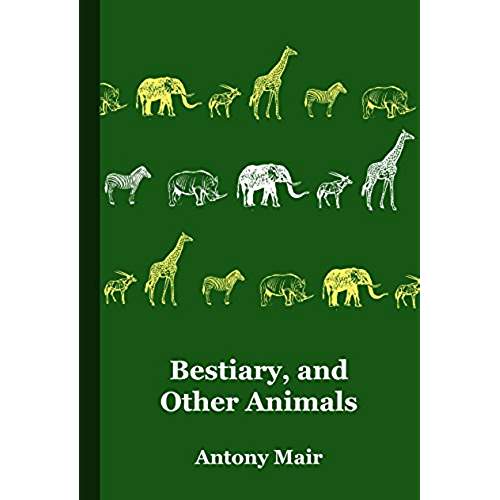
After a degree in English from Magdalen College, Oxford in the 1960s, Antony spent a year in Germany teaching in Heidelberg before entering a Benedictine monastery for three years. This was followed by a job as manager of a shop in New Bond Street in London’s West End, and then training as a solicitor, which led to a career in the City as a commercial lawyer, specialising in international transactions and European Community law. He left the City in 2005 and moved to the Dordogne, where he ran an estate agency with his partner Paul McQuillan for seven years, returning to England in 2012 to live in Hastings. Having completed five unpublished novels over several decades, Antony turned to poetry, his other love, and completed an MA in Creative Writing at Lancaster University. After being published in a number of poetry magazines, he had two collections published in 2018 – the first, Bestiary and Other Animals, by Live Canon, after it had been shortlisted in the Live Canon First Collection Competition 2017, and the second, Let the Wounded Speak, by Oversteps Books.

The Interview

  1. When and why did you start writing poetry?

It’s only recently that I have regarded poetry as something to specialise in, rather than as something that I wrote in addition to anything else. My first writing was as a child, when my father gave me a model theatre: I wrote small plays which I acted out on the tiny stage with characters on rods, in front of my family, who must have been bored stiff. Our house was full of books – my grandmother was an avid Dickens reader, and introduced me to him at a young age. I was reading War and Peace at the age of eleven, I recall – probably without understanding much of it.

I came to poetry in my teens. I still have books given to me or bought in my schooldays – the Penguin Modern Poets series, Charles Causley, Ezra Pound – a miscellaneous grouping. I remember wallowing in Tennyson’s In Memoriam as a teenager. That was the time I first started writing my own poetry. I used to have it published in the local paper, the Reading Mercury. I suspect that, for reasons too complex to go into here, poetry was a way of discovering my identity as an outsider. At the 2018 Torbay Poetry Festival I won the Festival Challenge with a poem that gives a bit of a clue to my thinking at the time:

MATERIALS FOR A POETRY QUIZ

A traveller knocked at my childhood’s door
and a mirror cracked from side to side.
Hiawatha wooed an Indian squaw
and a knight-at-arms loitered before he died.

Then Prufrock, Prytherch and Ezra Pound
appeared in my dreams, arm in arm with John Donne,
later joined by some wilder friends I found,
like Swinburne and Ginsberg, and then Thom Gunn.

“Come join us,” their voices seemed to say,
“in Tara’s halls and in caves of ice,
in a Wicklow shed or in old Cathay,
and you’ll taste the nectar of Paradise.”

“For we’re the skylarks whose blithe spirits sing,
the nightingales perched in enchanted trees.
Come and drink from the well of Mount Helicon’s spring
and we’ll teach you to warble with full-throated ease.”

So under my old friends’ watchful eyes
I took my pen, like Seamus, and dug –
not yet, perhaps, for a Nobel prize
but some kindly words and a Festival mug.

2. Who bought or gifted you the books?

I bought them out of pocket money – I was given a fixed sum each week that included bus fares to school, but I used to walk to school, so saving money for books. Some I got as school prizes, some as Christmas or birthday presents from family.

3. How aware are and were you of the dominating presence of older poets traditional and contemporary?

The quick answer to that question is: very much. A number of the poems in my two books are intertextual – for example, “N” in Bestiary, which stands for Nightingale, refers to Keats and adopts the stanza and rhyme structure of his “Ode to a Nightingale”, as well as incorporating some of Keats’ wording. My hesitation, though, in answering your question, arises from your word “dominating”. I don’t feel dominated by the great poets – it goes without saying that I shall never rise to their stature, but at the same time we have a lot in common in the creative process. They are faced with the same challenges as the rest of us – it’s just that they meet them better! We swim in the same pond, even if I’m a minnow and they’re a magnificent trout.

4. What is your daily writing routine?

I wish I could say I have a daily writing routine. But I don’t find it works like that. Poems depend on an idea rising, and then gestating. I am currently working on a book-length sequence of poems that will cover the life of Mary Queen of Scots. This requires a series of preparatory steps: doing the basic historical research; deciding on the event to cover in a poem; deciding on the “voice” to be used in the poem – e.g. some are done in Mary’s voice, others in the voices of courtiers or attendants – all before pen is put to paper. Quite a lot of this development happens in the background of the mind, I find.
I try to do something involving poetry each day – it may be simply reading other poets, or it may be writing, or submitting to magazines etc. Probably at least an hour or so, sometimes more – often in the evening.

5. What motivates you to write?

It seems such a simple one, doesn’t it? But the quick answer is: I don’t know. What happens is that an idea comes into my head – it could be because of something I’ve experienced, something in the news, something in a book I’m reading – and it starts nagging at me until I have to put pen to paper. I don’t write to achieve recognition or status, nice though these are when they come. It’s just a reflex that is part of my nature. Not a very satisfactory answer, I know, but that’s the way it is.

6. How do the writers you read when you were young influence you today?

I’m not sure that they do. To take Keats as an example: I recall wallowing in his lushness as an adolescent, without really analysing the craft. When I did a poem called “Nightingale” in my Bestiary I followed the stanza and rhyme structure of his Ode for all of two stanzas, which was an interesting exercise, and made me appreciate how skilled he is. Equally, if I now try to translate something by Baudelaire, for example, I appreciate his talent in quite a different way from the comparatively superficial enjoyment I had as young. Exercises like this don’t so much give rise to them influencing me, but are very illuminating in showing the shared challenge of strict forms. There is much in the creative process that is common to all poets, and binds us all together even if we are on very different levels. When it comes to influence, I was probably quite strongly influenced at the outset by Thom Gunn, whom, again, I first read when I was quite young. However, I only discovered Seamus Heaney about ten years ago, and the poets I most admire and am arguably most influenced by are people I have read in the past decade.

7. Who of today’s writers do you admire the most and why?

Where do I start. By “today’s writers” I assume you mean people alive – otherwise I’d have put Seamus Heaney at the top of the list. But, staying with Ireland, I have to put Derek Mahon just behind Seamus. A very different poet, but a master of form. I like his culture and his cosmopolitanism. I like the early Muldoon very much – less so with his clever-clever later stuff.
John Burnside for his extraordinary atmospherics. Robin Robertson – his Man Booker shortlisted verse volume The Long Take is extraordinarily powerful. I admire Liz Berry for the power of her writing, and its mix of folklore and modern. Alice Oswald for her ability to create a magical atmosphere. I didn’t care for Simon Armitage a lot, but his last collection – The Unaccompanied – has made me revise my view completely, and I am a convert.
I like poets who create an emotional resonance – I’m not particularly interested in those who are obsessed with language or who write poems that, on closer examination, have little emotional content.
8. Why do you write, as opposed to doing anything else?

The quick answer is: because I have to. That, however, only takes the matter one step on. Let me say, rather, that it’s an inner compulsion. When I look back over my life, it has always been there. An idea will come into my mind, like a shape pressing against a curtain: indistinct, but insistent. It has to find a shape, literally a definition. That shape may be prose or poetry.

I have a vivid recollection of doing an essay for my English teacher at the age of eleven or twelve. I can’t remember the subject, precisely, but I invented some fictional scenario with invented characters. What I remember most clearly is the teacher saying “Where do these people come from?” The answer is now as it was then: I don’t know. They are part of me, and I carry them like children waiting to be brought into the world. Nor is it just characters of this kind – it may also be an experience, a moment caught like a photograph, needing to be developed and shared.

9. What would you say to someone who asked you “How do you become a writer?”

I’m not sure I can answer this. I would start by taking refuge in definitions – what do you mean by “a writer”? is it someone who earns their living from writing? Or is it someone who simply has writing as the predominant activity in their day to day life? Or is it something else altogether?
The answer to the original question will depend on the answer to these subordinate ones. I suppose the quick answer is:
– Take your pen or your laptop and write something (if this is too hard, there are prompts and techniques that can be found on the net)
– Learn techniques – read some of the increasing number of books written for students of creative writing, attend classes, courses and workshops
– Get feedback – from your peers, teachers and editors
– Be very patient and don’t be discouraged
– Start again at the beginning of the list – I.e. take your pen or your laptop etc.

10. Tell me about the writing projects you have on at the moment.

I have been working for a year, now, on a sequence of poems that cover the life of Mary, Queen of Scots. They are written in a variety of forms and in different voices – sometimes Mary herself, sometimes a servant or bystander, sometimes an omniscient narrator. The intention is to do between fifty and sixty poems in all. I think it will take me another year to complete. The process is quite laborious: I do the research as I go, then decide on which moment to cover, then the voice and the form, trying to preserve the reader’s interest by maintaining variety. I have reached the stage where I am going to have to submit what I have done so far to one or two people to make sure that I’m on the right track. Having said that, it may all turn out to be unpublishable.
I have also been intending to have another look at some of my unpublished novels, to see whether they could possibly be revamped or revived.

Wombwell Rainbow Interviews: Janet Sutherland

Wombwell Rainbow Interviews

I am honoured and privileged that the following writers local, national and international have agreed to be interviewed by me. I gave the writers two options: an emailed list of questions or a more fluid interview via messenger.
The usual ground is covered about motivation, daily routines and work ethic, but some surprises too. Some of these poets you may know, others may be new to you. I hope you enjoy the experience as much as I do.

Janet Sutherland Home Farm jpeg

Janet Sutherland

was born in Wiltshire and grew up on a dairy farm. She has an MA in American Poetry from the University of Essex. Her poems are widely anthologised and have appeared in magazines such as Poetry Ireland Review, The New Humanist, The London Magazine, The New Statesman and The Spectator. In 2018 she received a Hawthornden Fellowship during which some of the poems in her new collection, Home Farm, were written.

The Interview

1. What inspired you to write poetry?

I’d seen that in the finest poetry poets can go beyond what is ordinarily sayable.

2. Who introduced you to poetry?

I went to a catholic school for a couple of years between the ages of 9 and 11, in those days we had handwriting lessons, taught by copying. You could choose a sheet each day to copy and most of them were poems. I remember copying The Way Through the Woods by Rudyard Kipling when I was 9 and memorising The Snowflake by Walter de la Mare, because I liked it. We were also taught songs, heard tracts of the poetry of the old testament, spent months studying The Journey to Samarkand by James Elroy Flecker with a student teacher, and we performed The Song of Hiawatha by Longfellow as our end of year performance having sung and it and read it and talked about it for much of the year. We wrote poems too, my first was about the blue flower Scilla when I was nine.

3. How aware were you of the dominating presence of older poets?

I wasn’t aware of that when I was very young but gradually became more aware through school and into University. Rather than a dominating presence of older poets I’d say for me it was and still is a process of discovery, of delight in finding the voices that speak to me through time from Chaucer to Donne to Yeats and Pound and Bishop and so to poets writing now.

4. What is your daily writing routine?

I sit at my desk pretty much every day and go for walks in between stints at the desk. My routine varies according to what my current projects are. Now there’s a lot of admin around my new book, Home Farm, and the initial research stages of my next project about a journey my great great grandfather took in 1846/7, which I’ve been working on for the last few years, in between other projects. When I start writing more creative pieces towards the new work I’ll also be thinking about structure and how the thing might fit together. The general process is to write then edit and keep editing through many versions. To try out the new work on writing friends. At the writing stage of the project it’s in my head most of the time whether I’m at the desk or not.

5. What motivates you to write?

It’s like a thought itch— for instance I saw a blue boat on the river near where I live, it was half submerged and as the river is tidal it was keeping up with me as I walked. That image stayed with me and became a poem in which the blue boat was like a soul drowning:
https://www.maryevans.com/poetryblog.php?post_id=4482

6. What is your work ethic?

To keep at it even when it’s hard. To keep at it even when it doesn’t work. To go for a walk or just away from the desk when I’m stuck. To keep editing until it’s finished and when it is to send it out.

7. How do the writers you read when you were young influence you today?

They form the bedrock to everything. In my 20’s I loved Reznikoff, Pound, William Carlos Williams, Oppen, Eliot, Robinson Jeffers, Wallace Stevens.

8. Who of today’s writers do you admire the most and why?

I admire Anne Carson hugely. She is a tremendous writer and very innovative, very clever, playful, learned, joyous with language, deep. Reading her is a complicated adventure. My favourites of hers are Autobiography of Red and Nox. I have also recently enjoyed Ocean Vuong’s Night Sky with Exit Wounds, an extraordinary first collection. I love the work of Lee Harwood who died in 2015. I could name so many others…

9. Why do you write?

There are things I want to say that I can’t say in any other way. The process of writing is helpful in sidling up to it.

10. What would you say to someone who asked you “How do you become a writer?”

Read as much as you can and find out whose writing excites you then read to challenge yourself and find out why other people like the work of writers you don’t like. Keep reading as widely as you can and develop your critical eye. Then write, if it helps start with some free writing for flow, and edit, edit, edit. Be critical of your own work. It’s helpful to find support from other writers through groups or by exchanging writing with writing friends, or by going on courses if you can afford it or using books on writing practice. But the most important thing is to think (and dream) and write and edit and to do this regularly.

11. Tell me about the writing projects you have on at the moment.

I’ve just finished a collection of poems which comes out in January which is called Home Farm. These poems explore the farm where I grew up. You can read a sample of it here:
https://www.shearsman.com/store/Janet-Sutherland-Home-Farm-p123552365?forcescroll=true
I’m currently working on my next book which will be about a journey my great great grandfather took from London to Serbia in 1846 and 1847. His name was George Davies and he travelled with a Mr Gutch who was a Queens Messenger delivering government documents. I have his journals which document each day of his travels by steam boat, train, carriage and on horseback. I travelled part of the same journey last autumn and made my own journal.

my website is here: https://www.janetsutherland.co.uk/


On Fiction Wombwell Rainbow Interviews: Kristina M. Serrano

On Fiction Wombwell Rainbow Interviews

I am honoured and privileged that the following writers local, national and international have agreed to be interviewed by me. I gave the writers two options: an emailed list of questions or a more fluid interview via messenger.
The usual ground is covered about motivation, daily routines and work ethic, but some surprises too. Some of these fiction writers you may know, others may be new to you. I hope you enjoy the experience as much as I do.

41f0SvbXwnL._AC_US500_QL65_ (2)

Kristina M. Serrano

After starting college at 16, Kristina M. Serrano earned an Associates Degree in Arts, BFA in Fiction, and a Certificate in Publishing by the time she was 20, which she regretted because she loved college and wanted to stay there longer. She rode horses for 10 years, sang the national anthem at four large events, and gave up her title as Executive Editor of a literary magazine for more time to pursue her writing career. When not writing, you can find her reading novels and manga, watching anime, tending to her pet fish, or snuggling her fluffy bichon frisé. More about Kristina and links to her books and social media can be found on her website:

http://kristinamserrano.wixsite.com/author

The Interview

1. What inspired you to write fiction?

Mostly, I love writing to escape, like so many others. I guess you could say my inspiration stemmed from a desire to find both wonder and realization, to take a break from mundanity while learning about the real world through fantasy, kind of like astronauts observe Earth from space to study it.

2. Who introduced you to fiction?

Well, I’ve always loved reading and writing ever since I was a little girl. I don’t even remember learning how to read; I just always could. So I guess I kind of introduced myself to fiction, haha.

3. How aware were you of the dominating presence of older writers?

Oh, it’s always intimidating to think of just how many writers there are out there who are better and more experienced than me, but I’m grateful for them because their success stories offer valuable encouragement and advice.

4. What is your daily writing routine?

I used to write just about every day. Not really a routine; I just had to write because I loved it so much, and I still do. But over the past year or so, I haven’t written nearly as much as I would have liked because of battling mental health issues: severe depression, OCD, anxiety, and insomnia, comorbids of my autism, which I was diagnosed with only this year. I’m slowly working on reviving my past write-as-often-as-I-can habit as I continue therapy.

5. What motivates you to write?

Lots of things. I get an idea for a story, and I want to see what happens. Or maybe I have something as small as a specific scene in mind that I’d like to jot down to see how it develops. Or maybe I have another world or worlds spinning in my mind, and I want to explore them, so I design them and creatures and such; these are usually alternate dimensions. Or maybe (because I love romance), I get an idea for two characters and I want to see how they meet and/or interact, and how their relationship develops through facing obstacles. There are so many wonderful things about writing and stories that I could probably list things that motivate me all day!

6. What is your work ethic?

When it comes to publisher deadlines, I try to finish edits and revisions as quickly but efficiently as possible. I actually enjoy this process because it reminds me of homework, which I miss dearly!

7. How do the writers you read when you were young influence you today?

When I was a child, I read pretty much nothing but horse books. My two favourite series were Pony Pals by Jeanne Betancourt and Heartland by Lauren Brooke. I’m sure the former first taught me about adventure in fiction, and the latter introduced me to light romance in books. I remember reading them over and over again, so I’d also say they taught me how to recognize my favourite themes and elements in stories.

8. Who of today’s writers do you admire the most and why?

Wow, this is a hard one because I’m looking right now at so many good books and authors I’ve read on my shelves trying to choose. J. K. Rowling is obvious. I actually first read the Harry Potter series as an adult because I was so obsessed with horse books as a child that I didn’t read much else. I remember admiring her when I first learned her story because she clung to her love of writing despite so many challenges, and, well, everyone knows how awesome the Harry Potter books are, so I don’t need to elaborate on those. I also admire Tite Kubo, the mangaka of Bleach, for his expert blending of plot and subplots, settings, characters, and backstories.

9. Why do you write?

I don’t know where I’d be without writing. It’s my special interest, my life. I write because I love it, because it’s therapeutic, because it gives me a sense of accomplishment, and just for fun.

10. What would you say to someone who asked you “How do you become a writer?”

Think of all the things you could write, then narrow those down to the things you would want to write, then write those. Sure, you could write anything whether you like the topic or genre/et cetera or not, but I believe it’s important to write what you love, because a writer is someone who writes, and it’s hard to keep doing something you don’t enjoy.

11. Tell me about the writing projects you have on at the moment.

Dozens, haha. Pretty much all YA paranormal and fantasy romance. I definitely need to finish the last book in my published series, Post Worlds, about an Egyptian-goddess descendant who finds love with a boxer despite supernatural challenges prying them apart. I would also like to complete a science-fiction book one day, but mostly I’ve just been working on those scattered YA ideas.

Collected Poems Volume 1 by Peter Riley (Shearsman Books)

Excellent review of an excellent poet.

tearsinthefence's avatarTears in the Fence

Peter Riley’s two volumes of Collected Poems weighs in at about 1200 pages and they need to be reviewed. There is no way that a short piece here can do justice to the wealth of this work and so I shall write three or four reviews covering the chronological development of a poet whose voice is a labour of “calm close attention” (‘All Saints’, a short prose piece from the opening section of Volume 1, pieces written in London between 1962 and 1965). When I gave a Paper at a Conference in Birkbeck devoted to Riley’s work I focused on his editing of the magazine Collection. The Paper was written up for PN Review 207, some six years ago and it began rather mischievously. Now that we can see more fully the quality of Riley’s early work from the Sixties I wish to repeat that mischief by…

View original post 763 more words

Stoked to have my commission for photos featured throughout this brilliant magazine to background, accompany wondrous contributions by talented others.

WP_20181209_15_25_02_Pro