Wombwell Rainbow Interviews: Chris Hardy

Wombwell Rainbow Interviews

I am honoured and privileged that the following writers local, national and international haveagreed to be interviewed by me. I gave the writers two options: an emailed list of questions or a more fluid interview via messenger.

The usual ground is covered about motivation, daily routines and work ethic, but some surprises too. Some of these poets you may know, others may be new to you. I hope you enjoy the experience as much as I do


Chris Hardy

Tell me about your latest collection, and about definite recent and upcoming publications in magazines and online.

My fourth collection, ‘Sunshine at the end of the world ’ *, was published in 2017 by Indigo Dreams. http://www.indigodreams.co.uk/chris-hardy/4593968553 http://www.poetrypf.co.uk/chrishardypage.shtml

The title is also the title of a poem in the collection, not the best poem, in my view, but the title is the sort of phrase I like: it makes you wonder what it might mean, and prompts images of many things, but it also stops you thinking – like a koan. And without thinking you know, sense, what it means.

“The acute poems of this wonderfully named fourth collection are always clear, sometimes rueful. They cherish their ghosts. Past and present are summoned by memorable lines with strength and tenderness.” Alison Brackenbury

“Bird nesting in mailbox. Rat scrabbling in cavity wall. Spring uncoiling and a welcoming harbour. A guitarist as well as a poet Chris Hardy consistently hits the right note, never hits a false note.” Roger McGough

“These poems explore Time, from the tender appreciation of new life, through all its vicissitudes, to death: Time alters, enhances, destroys. They deserve to be read slowly, to appreciate the many and varied nuances which lead to the comprehension of the Now.” Patricia Oxley, Editor: Acumen Literary Journal

“Staggeringly beautiful, poetry as art form. Sam Smith, The Journal 53, January 2018. There is a breadth to this collection that crosses oceans. It reinforces his reputation as a poet in his own right.” Greg Freeman, Write Out Loud

“Chris writes vivid, expository poetry having the heft of short stories, often heavy with portent and mystery. Each of these poems is a story as beautifully muscular and slippery as an eel.” Peter Kennedy, London Grip, December 2017.

“Sunshine at the end of the world’ is tender and affecting and feels like an elegy, a beautiful and accepting celebration of what was, what is and what is to be – a poet writing at the peak of his powers. It is a collection of humanity, compassion and wisdom.” Dino O’Mahoney, Ink Sweat & Tears, January 2018.

I have won prizes in several competitions including the National Poetry Prize and been published over the years in many magazines, anthologies and poetry websites – Acumen, Agenda, Algebra of Owls, Atrium, Brittle Star, Corbelstone Press, The Dark Horse, Dreamcatcher, Frogmore Papers, Fenland Reed, High Window, Huffington Post, Ink Sweat and Tears, the Compass, the Interpreter’s House, London Grip, the Moth, the North, Obsessed With Pipework, Orbis, Picaroon, Planet, Poetry Review, the Rialto, South, South Bank Poetry, Stand, Tears in the Fence, Under the Radar and others.Within the last few years poems have appeared at the Blue Nib, Confingo *, Confluence *, Lampeter Review *, Poetry Salzburg Review *, Riggwelter, Soft Cartel, Presence *, South * and Stand*. Poems are due out soon in Blue Nib, South Bank Poetry, Picarooon and Orbis – maybe elsewhere, I’m waiting to hear back from editors and also the judges of various competitions.

The Interview 

(Some of these questions and consequently my answers overlap)

  1. What inspired you to write poetry and who introduced you to poetry?

I started writing at school, influenced and inspired by Keats, Coleridge, Owen, Shakespeare and Blake. We did these and other authors for our ‘O’ and ‘A’ levels so I suppose the exam curriculum introduced me to poetry – we also had a couple of good English teachers one of whom, Mr Coltman, was a 2nd world war veteran and a poet. Publishing started when I came across poetry magazines in London, where I was living. I submitted poems to them and began to get published: Stand, Poetry Review and Slow Dancer were amongst the first to take my poems.

  1. How aware were you of the dominating presence of older poets?

I’ve never felt overawed or dominated by poets from the past. I respect and admire their work, their efforts, if not always their characters and lives. ‘Older poets’ and their works don’t dominate, they encourage. Here are some books, authors, tales, I admire and which have affected me and my writing at various times:The King James Bible and Cranmer’s Book of Common Prayer; Greek, Egyptian, Middle Eastern and Indian myth; the Greek Anthology; some, not all, Shakespeare (eg Hamlet, Othello); Coleridge (eg Frost At Midnight); Keats (especially the sonnets); Shelley; Fitzgerald’s ‘Omar Khayyam’; Thomas Hardy; Owen; Rosenberg; Sassoon; Edward Thomas; Frost; Snyder; Ginsberg; Ferlinghetti; Corso; Robert Duncan; eecummings; William Carlos Williams; Lowell; TS Eliot; Pound, (mainly ‘Cathay’); Berryman; Larkin; Plath; Hughes; Bishop; Carol Ann Duffy and recently, Charlotte Mew, Jack Gilbert, Billy Collins, Philip Levine, the Bloodaxe anthologies, Cavafy, DH Lawrence, Raymond Carver ..I have also been influenced, in their attitude to life, subject matter and style, by novelists such as Tolstoy, Emily Bronte, Faulkner, Hemingway, Conrad: they write from their own experience, which connects their work directly to reality. They firstly create a physical world from imagery and through and from this arises any underlying meaning: fact is far stranger than fiction and, once fiction is made from fact, fiction cannot lie.Another important thing is that I am a musician, a guitar player. I write songs but have never found this comes easily, nor can I easily set my own poems to music, though in my work with LiTTLe MACHiNe I, with the other two members of the group, have set many famous poems by well known authors to music. I have been greatly affected and guided by many great song writers, who I regard as poets – I don’t think there is any point or value in distinguishing between songs and poems, they both use words, and many poems accepted in the canon are also songs eg ballads. And of course Homer, Sappho etc chanted, sang, performed their work, to music. The blues musicians of the 20th C and the songwriters who learned from them and invented Rock & Roll, Rhythm & Blues, Rock etc are great artists and I am definitely influenced by them in my writing: Son House, Blind Boy Fuller, Robert Johnson, Howling Wolf, Muddy Waters, Big Bill Broonzy, Bert Jansch, Bob Dylan, Leonard Cohen, Chuck Berry, Jim Morrison, Lowell George and many others.

  1. What is your daily writing routine?

George Herbert: ‘I once more smell the dew and rain and relish versing’:I wait for a signal that switches on my attention so I know there’s a poem there. Sometimes I’m working on a few poems at a time, or there’s nothing new but I’ll be revising, or there’s nothing. I have learned not to worry – though I do. When I am undistracted and in the right mood I can allow words to surface without examining, or deleting. Heaney wrote about writing, ‘In the corner of a lecture’ – when your mind is focused, on something or nothing, the imagination sends messages to the surface. I like discovering what the poem reveals, seeing what I didn’t know I knew. I feel cheerful when there’s a poem in a drawer, waiting to be attended to.Michael Longley said, ‘Better silence than forgeries .. I wait for poems’, which sums up my attitude to all this. So no, I do not write every day, but I am ready to write – I try to remember to have a notebook on me at all times. I have written poems on beaches, in front of the TV, on ferries and buses .. all I need is some paper and a pencil or pen. I do not type until I have re-written by hand several times. I use a manuscript book for drafting, sometimes I compose straight into it. I have kept quite a few of these as they are a sort of mine or quarry – there is stuff in there that I might be able to use – fragments, abandoned poems and also many notes, quotes, pictures. I stop writing when I have nothing else to write down.One important rule, that I have to remind myself of, is that, once I start I must not stop to correct, re-consider, censor .. that is fatal as if there is anything there it might find its way out buried in a load of verbiage and imagery that can be pared away later. Another helpful way of finding what a poem is about is getting someone else to read it – they may see what the poem is trying to reveal, or is really about, and suggest ways of bringing this out, making the poem in fact. On the whole I do not agree with the often expressed notion that a poem is ‘never finished’: I read poems written years ago and, while noticing that I might not have phrased or structured it like that now I do not wish to re-write it .. it is better to start afresh. I have written many poems that took hours to get right, then found that what I have left is not worth doing anything with. I will leave it, and possibly make use of any images, phrases, lines in a future poem.

  1. What motivates you to write?

I write lyric poetry, by which I mean pieces of writing in a verse form that do not extend much beyond 4 or 5 pages, most of my poems are less than 40 lines long. I write like this because that is what my imagination creates – I sometimes intend to put together something longer but this rarely happens, mainly because it is ‘put together’ – is artificial. Over many years I have come to rely on my imagination finding the material it needs in my experiences and making something new from that. What is produced is then shaped by me into a verse form – stanzas, lines, punctuation etc – that seems to emerge from the poem. Often the first few lines set the form. I do not sit down thinking I must write a poem and this is the topic, nor do I attend writing classes where topics are set. Again, to me, all this produces is artificial, manufactured, poetry. I trust my imagination to make something, using words, from my knowledge and life: the poem, if it is a poem, will reveal what I was aware of but did not ‘see’ or ‘know’ before. Of course this leads to periods of anxiety when nothing appears, sometimes for months, but I have to remind myself then that this does not matter. What does matter is that whatever is written is necessary (to me) and ‘authentic’. 

  1. What is your work ethic?

When poets write they resemble improvising musicians and footballers – making it up without thinking. But musicians and footballers practise intensely so that, when they have to, they can perform freely. They practise physically and try to master the practical elements of their art. They operate within constraints (eg in music – the instrument, the notes available and their skill). Is there an equivalent for poets? How do poets practise using words so they are there when needed, without (too much) thought? By reading, listening, talking and discussing. Then, diligently wait, and do all you can to be ready: ‘Intensity of mood is the one necessary condition in the poet’ (Edward Thomas).As Coleridge said there is, ‘A well of the unconscious into which everything drops and the act of creation is lowering the bucket and pulling up images and words that have hopefully undergone metamorphosis’. This indicates that you must allow, trust, the imagination to make from its material – what you have stored from memory, thought, feeling, reading, experience etc – the phrasing and imagery of the poem: metaphor, yoking images together to reveal ideas, truths, feelings, understandings, knowledge that you did not know were there.I do not ‘practise’ writing poems as I practise guitar, every day for at least 1 – 2 hours. I have to be patient and calm and wait for the moment, which is also a mood – when I become aware that anything and everything in the ordinary world is of interest and has a mystery: it is inexplicably strange that we are here, like this. Then it takes a prompt: a word, an image, a memory, a line of verse, a phrase.
Nick Laird: ‘Since the poet more often than not sits down to write about nothing, the content, subject matter, of the poem, rises to meet the words from below volition .. It is not a wholly intended process and requires trust’. What this all means is – you need to try to somehow get into the right place physically but especially mentally and emotionally, and then wait. My work ethic is to watch out, try to make space and time for when poems might arise – be alert, awake, wherever you are. This is what Buddhists call mindfulness – (I did an MA in Buddhism and Hinduism). ‘Anything, however small, may make a poem. Nothing, however great, is certain to’ (Edward Thomas).I practice guitar if possible every day. This is because an instrument is a physical device that you need to keep physically acquainted with: your hands need to be kept strong, relaxed, with hard finger tips. I don’t have a ‘writing’ work ethic – I do not sit down and make myself write. That would be against what I feel and believe about my poetry. However I do read poetry, looking for new names and going back through earlier favourites – I have just read two Cavafy collections.   

  1. How do the writers you read when you were young influence you today?

The appeal of poems I respond to is their unveiling of truth and mystery. Poetry that is clear and intense, that seems necessary to the poet. I’m not interested in poems that are puzzles, that don’t deliver. ‘The Waste Land’s’ linked images and apparently disconnected sections are constructed to make you experience the concerns that drove Eliot to write, without having to pause and think. The meaning in the poem is in the emotion it creates in the reader, who must simply read the carefully chosen and arranged words and ‘see’ what they describe and suggest. I prefer ‘Ode to the West Wind’ to many of Shakespeare’s sonnets, much of Donne, and all of Prynne.I have noticed I have evolved a style I tend to begin with that, after editing, becomes the style I end with. I fight this at times, try to use words differently, to change and break up what has become a habitual tone – for example the use of half rhyme, regular stanzas, a ‘smooth’ clear feel etc. But in the end I don’t like what these attempts produce. The same goes for subject matter: I want to write about everyday actual things, (Seeing the world anew. The wonder and strangeness of ordinary life .. Newton said something like, ‘All I have done is stand on the pebbles and look out over the ocean’ to which Yeats remonstrated, ‘Never mind the ocean, what about the pebbles!?’) but these have to have significance of some sort to prompt the writing and then always turn out to relate to underlying, broader meanings and issues that I constantly return to – life, death, the planet and Universe, memory, family .. the perennial mysteries that prompt all religions and much art. 

  1. Who of today’s writers do you admire the most and why?

Sharon Olds, Carol Ann Duffy, Roger McGough, Brian Patten, Gillian Clarke, Katrina Naomi, Hannah Lowe, Jo Bell, David Constantine, Gary Snyder, Arun Kolatkar .. Why I like them is explained in the other answers: they are interesting and have something to say – content is as, if not more, important than form and style, don’t try to make the reader think they’re stupid because they cannot understand the poem, don’t try to be obscure, cheerfully address important everyday things like work, sex, birth, death , purpose, meaning, us and our fellow creatures on this tiny blue speck, use words elegantly and beautifully, are not afraid or scornful of expressing feeling ..

  1. Why do you write?

I began decades ago as I thought poets seemed to live interesting, dramatic lives and I was greatly affected by some of what they wrote, especially Shakespeare, some of the Elizabethans like Wyatt, and the Romantics. I had friends with similar inclinations and we used to write together. This continued at Kent University where I read English and American Literature. There were several undergraduate poets there, we knew each other and established a short-lived magazine called, ‘The Lost Works Of Neville Chamberlain’. Some of the staff, like Michael Grant, were poets who encouraged and supported us, commenting positively on our poems which was very charitable of them considering how dreadful they were. They invited impressive, powerful personalities such as Auden and Graves to give lectures, judge poetry competitions, and attend seminars. Eventually I discovered the satisfaction of managing to write and finish poems that expressed things that were important to me and also seemed well shaped, elegant, self-sufficient.

10. What would you say to someone who asked you “How do you become a writer?”>

Keeping going when inspiration is absent, there is nothing to say and no one wants to publish poems you think are interesting and well constructed enough to find an audience. Even if you win a prize in the National Poetry Competition, or get a poem in the Forward Anthology or into a ‘prestigious’ magazine nothing will probably change in your life – it takes luck, contacts and of course the right poem to make money and a name .. most poets in any case do not want to earn a living as poets. This would mean writing to order like a journalist or forcing the pace as novelists do – poetry should be written in the corners of your life and you need to live, not write, to write it. Far too many poets work in Universities and especially on ‘creative writing’ courses: this means that their only experiences, from which the poems must come, are of writing and talking about writing, (and the poetry that is about poetry is the most pointless, self-regarding and unenlightening of all).To me the ideal poet’s life would be that lived by Gary Snyder, who worked in the forests of North America, or William Carlos Williams’s life as a GP, or Byron and Shelley living on debt, family, friends and fame. Arnold, Wallace Stevens, Yeats, TS Eliot, Ted Hughes, Larkin, all worked in the world and wrote – as if life, work and poetry were connected rooms.I have had the privilege in LiTTLe MACHiNe of working with, and observing, Carol Ann Duffy and Roger McGough over several years. Both of them have spent much of their lives making a living from writing poetry. They have diligently promoted poetry by going into schools, and encouraging the aspiring poets who constantly approach them. They work hard all the time, travelling about the world, meeting the demands of agents, publishers, and deadlines, go on stage on their own and for an hour or more make a large audience really listen, and move and amuse them, just with words. And they always carry a pen and notebook ..        

11. Tell me about the writing projects you’re involved in at the moment.

There used to be far more print outlets, and, it seemed, far fewer poets too. Online publications are able to accept large numbers of poems and they have multiplied. But who actually sits down and scrolls through a free, online magazine? Poetry seems popular and available but this maybe an illusion create by self-promotion on social media. As far as its impact on national culture, on TV, in the press etc, it is barely visible: very little Arts Council funding compared to theatre and opera, publishing concentrates on novels, non-fiction and biography, and poetry has nothing like the power, presence or impact of the music industry. I have a theory that most poets over the past 50 years would prefer to have been in rock bands – creative, known, busy, earning. But once you have accepted you are a poet then nothing beats finding a poem, finishing it and seeing it leave and go off into the world on its own. There’s no money or fame in it, but when something really needs saying, commemorating or celebrating, the public, and the State, turn to poetry – funerals, weddings, remembering Wars, standing up to violence. It is understood as being, like music, uniquely able to express profound feelings and ideas, and measure up to such moments.  In my customary fashion I have been working on several poems after a quiet period. I do not find the UK, especially London, in the Summer, conducive to writing. Winter is much better, though travelling between May and September in Greece or Italy helps. The mirror in our sitting room has been there for years. Mirrors have strange qualities. One of these new poems began with a question and a memory: why did we buy this ‘Overmantle’, as it is called? The familiar sensation of a still, attentive mood, prompted by realising this glass had stared back at us staring at it, made me grab a pencil. After a few days and several drafts there was a sort of sonnet. The last verse came from realising suddenly that the back of the box was hidden to me but not to the mirror, which had been observing the carvings there for decades, just as we had been looking into this suspended eye, this lake in the room. And writing the last lines about Shakti, the goddess who protects and is also a partner, I saw how my imagination was linking the deity on the box to my wife and her purchase many years ago. The poem taught me something I had not known I already knew. 

THIRD EYE

We bought a mirror to fill the space
above the mantelpiece, from where it has
remarked on our appearance ever since.


A pool of light protects the wall
by holding and returning light,
expands the room as if we’d moved next door
and at night doubles its portion of the dark.

On the shelf stands a teak box
with a cracked lid, all you could afford
for my birthday when we’d just met.

The mirror knows the carving on its back
better than us.
Shakti, her panthers and peacocks dance
hidden in the glass.

FIN


Chris Hardy
London, October 2018.
www.littlemachine.com


Wombwell Rainbow Interviews: Kerry Priest

Wombwell Rainbow Interviews 

I am honoured and privileged that the following writers local, national and international have agreed to be interviewed by me. I gave the writers two options: an emailed list of questions or a more fluid interview via messenger.
The usual ground is covered about motivation, daily routines and work ethic, but some surprises too. Some of these poets you may know, others may be new to you. I hope you enjoy the experience as much as I do.

Kerry’s poetry features in this anthology 

Kerry Priest

Kerry’s work has been anthologized in The Best New British and Irish Poets 2018 (Eyewear), Future Poems (Emma Press, forthcoming) and has appeared in journals such as French Literary Review, Acumen and The Broadsheet.
She grew up in Sheffield and studied Anthropology and Linguistics at Edinburgh University.
She has lectured at the Universities of Humboldt, Berlin and ULCO, Boulogne-Sur-Mer.
Kerry also used to be a professional DJ.  http://www.kerrypriest.com

The Interview


1. What inspired you  to write poetry?

I left the city and moved to the countryside round about the same time as both my parents died. Contact with nature’s cycles of life and death seems to have led to an outpouring of poetry. The first poem I wrote in 20 years came from seeing a red kite in a Derbyshire churchyard and it all spiralled from there, really.

2. Who introduced you to poetry?


My mother taught me how to write poems when I was seven years old. We used to read John Betjeman together.
I also had a fantastic English teacher, Rosie Ford, who took us to Lumb Bank on Arvon courses. The guest poets included Carol Ann Duffy and Don Paterson. We had no idea who they were, obviously, because we were fourteen.
The third lot of inspiration came years later, when I saw Jackie Juno perform and she introduced me to the idea of spoken word poetry.

3. How aware were you of the dominating presence of older poets?


I’m very drawn to the 60s, as that was the point where existentialism and metaphysics loomed large, so Norman MacCaig, Peter Porter, Ted Hughes, Wallace Stevens, Wislawa Szymborska.
The history of poetry and the bardic, shamanic side of things is truly fascinating. On a good day, I like to feel myself part of an ancient tradition. Perhaps predictably, therefore, I read the more cosmic people like Blake, Donne, Vaughan, Whitman, Yeats, Rilke, Rimbaud…

4. What is your daily writing routine?


I keep a notebook for walking on the moors and otherwise I try to write or edit something every day. If I’m not in the mood, I’ll usually read instead.

5. What motivates you to write?


At the moment, I’m sort of embedded in a couple of projects, so I have the impetus to see them through.
The process of reading widely is very inspiring for me. I’ll often be busy borrowing ideas from other poets, or just be inspired by something I’ve read about Mary Queen of Scots or breakdancing or something.
Mostly, though, I’ll just be haunted by an image and I have to keep writing about it until it leaves me. Like at the moment, I’m obsessed with a particular conch shell that I can never quite see right inside and I‘ll never know what monster lurks inside that pearly spiral corridor, but I couldn’t bring myself to smash it open because the mystery of nature is what attracted me to this particular conch in the first place.

6. What is your work ethic?


Pretty good. I seek out like-minded communities to make it more fun if it gets stale.

7. How do the writers you read when you were young influence you today?


One of the first poems I fell in love with was Louis MacNiece’s Snow. That feeling, the giddiness at hidden layers of reality, is a recurring theme for me.
Liz Lochhead, John Keats and Ted Hughes are three poets who’ve never left my reading pile.

8. Who of today’s writers do you admire the most and why?


Some that spring to mind are Matthew Francis for his variety, Liz Berry for her musicality, Jo Bell for the killer phrase, Alice Oswald for her controlled yet wild use of metaphors.
Also John Burnside, Selima Hill, Paul Farley. I’m just listing names now…
I recently discovered Abigail Parry and adore the creepy world she conjures up in her poems.

9. Why do you write?

Probably because I have finally found something I can do quite well. I’m very competitive with myself.

10. What would you say to someone who asked you “How do you become a writer?”


I guess anyone can write, in fact everybody should write. But a good writer will care more about the art than about self-expression.
 
11. Tell me about the writing projects you have on at the moment.


I’m writing The Ice Baby, which works as a pamphlet and as a performance. It’s about Prehistory, ritual, origins, medicine and magic. I do a live soundtrack using bones and sticks I’ve found on Dartmoor and amping them up with a guitar pickup to make a kind of minimal techno-drone backing track.
Polyphony has been around in music for a thousand years, but is yet to reach the spoken word, so that’s something I’m working on with Jennie Osborne. Inspired by attending Alice Oswald and Stevie Wishart’s summer school, we have put together a multi-voiced choir which does poetry instead of singing.
I am also writing radio plays which feature dramatic verse and radiophonic sound experimentation.
http://www.kerrypriest.com


Wombwell Rainbow Interviews: Mysti S. Milwee


Wombwell Rainbow Interviews 

I am honoured and privileged that the following writers local, national and international have agreed to be interviewed by me. I gave the writers two options: an emailed list of questions or a more fluid interview via messenger. The usual ground is covered about motivation, daily routines and work ethic, but some surprises too. Some of these poets you may know, others may be new to you. I hope you enjoy the experience as much as I do. 

Mysti S. Milwee

 is an International published Synesthesia artist (whom paints to music), and poetess from Southside, AL. Her art and poetry has widely appeared in numerous magazines, e-zines, anthologies, and tours and has been used in academic studies and ministries across the US and abroad. Her collaborative works have been published in New Delhi, India with International Famous Singer/Songwriter Debasish Parashar to his Borgeet debut song “Pamaru Mana” which has received global recognition and numerous publications in India, Italy, & the US, huge thanks to Dipankar Jyoti Bora who did amazing work in PR/Exposure in India; In collaboration with International acclaimed British Composer Keith Barnard in London, United Kingdom, to his organ music “The Universal Harmony of Light”; In collaboration with Nationally acclaimed singer/songwriter Jonathan Joel Pop Artist from (Nashville, Tennessee) to his debut song “Mascara”. She is a former musician with the gift of musical knowledge, and a former vocalist singer. She is a member of several well known music and art societies, music and writing collaborative teams, and groups including: ASCAP (American Society of Composers, Authors, and Publishers); Art & Music International Group; Songwriting and Music Production Group; The Stellar Society: Writers, Poets, Filmmakers, and Artists; MADE-The Society of Music, Art, and Drama Education; Arts, Music, Literature & Humanities Group; Music of Other Dimensions Group; Native Music Blessing and Prayer Group; ASPS (Alabama State Poetry Society); Writers Anonymous; Alabama Writers Conclave; and many other groups, societies, and organizations across the US and abroad. More of my awards, publications, interviews, etc. can be found at:
http://www.mystismilwee.wordpress.com

Follow me on facebook for current links to my most recent publications in poetry.Instagram @ Twitter @mystiartpro
MSM-ART: http://www.facebook.com/pages/MSM-ART/178157392288070 

The Interview


1. What inspired you to write poetry?

 I was inspired to start writing poetry since the age of thirteen, when a tragic event affected our nation. My emotional response to this event left me in a state of mind of wanting to write to help effect change in our nation and our world as a whole to give my heart and soul to the people who are hurting and suffering. I wanted to be that messenger to convey an emotion left so deep in someone’s heart and soul that they would remember me and my words, and for them to remember what they felt and somehow be there for them spiritually and soulfully, instilling words of hope and healing to a broken and dark world that needs so much love, light, and healing. It is my heart to give and be there for “the people” through the most powerful tool, my words. I write what I feel, to convey a message through my voice and my vision that breathes life back into the broken world through poetry, painting, and photography. Everything that attaches to my mind inspires me to write freely and expressively.

2. Who introduced you to poetry?    

I was first introduced to poetry at a very young age, reading poetry and books. My librarian first introduced me to the world of rhythm and rhyme, which is where I first fell in love with reading poetry. It was instilled in my veins from that point forward, reading everything I could get my hands on. I fell in love with reading poetry and books, never toys. 

3. How aware were you of the dominating presence of older poets?   

I was very aware of the older poets, I started studying Maya Angelou, The Beat Poets, William Wadsworth, Walt Whitman and many others when I was around age 10 at my local library, I was a curious type of person and always wanting to learn and study everything on my own, I have always been a self-disciplined, self-motivated and determined person since a young age. I would research the great minds on the computer, in magazines, etc. and went with what I felt was closest to my heart, because I knew somewhere in their poetry I could either relate, or it was an experience to learn and shape my character with a voice and vision from the depth of my soul. 

4. What is your daily writing routine?  

As a rule, I generally write at night when it is very quiet and I can focus more, although I tend to have a writers’ burst here and there during the day depending on my mindset, what is going on, my mood, and where I’m at, between the busy daily work schedules. I usually commit to 2 to 3 hours a night that fluctuates. I keep a log to track submissions, publishing’s, etc.
It is sometimes a challenging task to keep up with as I write poetry, articles, essays, etc. and my sheet is usually very long and with my background as an internationally published synesthesia artist as well, sending in my paintings to magazines and journals, and also the aesthetics of art and the creative process relating to my synesthesia method of interpretation. The writing process is a very detailed process in which I love to write about my art and in ekphrastic form.I read my poetry friends posts on various social network platforms here and there that often inspire the next poem. Seeing their posts also keeps me motivated to keep writing 

5. What motivates you to write? 

Music motivates my writing the most, I would be on break from work or at night during quiet time and put my ear buds in and listen to give myself a boost or just to relax and often the music would spark a poem or a song because of its emotion and feeling, it conveys a message of understanding and depth that is usually related to everyday life. Music is a poetic movement in lyrical voice, it is a wonderful aid and tool that really keeps me writing and producing poetry and songs. I write because I am passionate about words, I love it and love to feel and express both in writing and visual art form.

 6. What is your work ethic? 

My work ethic is to just be me and do my best to achieve good results by setting reasonable goals that I can meet, maintaining a balance of communication, effort in a positive way, and dedication.Evolution and the world of change is the only way to embrace an “open mind”, the world is an open gate towards success. We must first not be our own enemy, but to spare ourselves to live in a world that is always changing at a fast pace, as the millennials become our future. Not just writers have to embrace it but all creatives and we seek that acceptance and learn from harsh criticism.
If we don’t keep an “open mind” we set ourselves up for frequent disappointments and we give up our dreams. Being a visual artist since age three has been a course of change and challenge, in the beginning it frequented some failures but I learned from them, won some lost some it is what it is, and learned to accept and learn from it. Those failures were the bumps I climbed upon, it made me more determined and dedicated to never give up, learning from my experiences and criticism.  

7. How do the writers you read when you were young influence you today? 

The writers I have read have influenced me to have courage, be optimistic and never give up hope trying, they have encouraged me to find myself and my self-worth. The journey a lot of writers have embraced either a lonely life or had spent half their life in depression trying to find themselves, their identity and being a “people watcher” in society. How they influenced me to find myself, but I wanted to take that insight of what I read and turn it into something beautiful between the light and darkness and convey an emotion. It gave me the ability to learn, to experience the depth of understanding emotions and what people were actually writing, and what they were thinking. Learning from writers at an early age was a measure of wisdom, courage, adversity, strength, and perseverance and it helped me deal with the challenges and things that I was dealing with at an early age, they encouraged me to “think perspective” and be a transparent writer with my feelings in order to help the people and creatives who may be going through the same thing the older writers dealt with in their lifetime.

 8. Who of today’s writers do you admire the most and why? 

The writers who I admire the most right now are the contemporary poets such as Scott Thomas Outlar, Debasish Parashar, Danijela Trajkovic, Keith Barnard,Vatsala Radhakeesoon, Don Beukes, Linda Imbler, Christine Tabaka, Mike Griffith, Michael Lee Johnson, Ken Dronsfield, Urainah Glidewell, Sue Brannan Walker, and several others.. I admire them because I can relate well to their poetry, and they have been of great influence in who I am today as a writer. Their writings, and the emotion felt that touches my heart in a way that is also healing. I say this because we all have been there at some point of our life, needing healing in certain areas of our life. What doesn’t kill us makes us stronger, and the longer we keep it in and don’t write what we feel, the longer it stays bottled up inside.  I admire them because they make me a stronger writer, to improve to be better. There is always room for improvement and they have been a huge influence not only in my life, but also as a writer.


9. Why do you write? 

I write because it is my passion to give back to the world with words. Directly, giving the people hope, healing, encouragement, spiritual enlightenment, and love. Writing is my way of giving my heart and soul to others because its who I am, and what this world needs for writing is my calling, I will never give up who I am, and the words will never stop when my heart has so much to give. Writing has also been my sense of healing, curiosity for words, and finding out who I am and having the ability to see the imagery in my mind to convey thought of words and pictures to paint in my mind. As an grapheme-color-imagery synesthesia writer/poet, in which I write to and refer to poetic and artistic devices in my memory which aid to express a linkage between the senses. Writing from multi-sensory experiences has driven my mind, seeing a phenomenal height of illusion projected through words envisioned from interpretation of dreams; emotions; sensations and vibes; and spiritual depth of dimension and aura ( a three dimensional feeling and effect). This technique is a useful way to heighten and highlight a specific image or description that can be used to demonstrate confusion and excitement, adding an extra layer of meaning and can make imagery more complex and detailed, while also using mnemonic devices to write which is a memory device that also aids in my writing.


10. What would you say to someone who asked you “How do you become a writer”?

I would tell them to first write what you feel and get use to writing for others. See how it feels, start by joining poetry groups, or posting on social media and retain feedback, see how the people react and  learn from it, and learn from the positive and negative comments  (Yes there are critics, but let it shape you not break you. Learn from it). Learn from all perspectives they are your stepping stones. Set reasonable goals and keep a log of your submissions to journals, magazines, etc.. Set deadlines and stick to them. Be dedicated with discipline and focus, but learn to pace yourself and don’t put more on yourself that you can’t handle. Be consistent and choosy, learn your market before you submit to journals, mags, etc. Write something that has meaning to you, that is of importance, something that people can relate to. You have to ask yourself, “Why do I want to be a writer, and what do I want to accomplish as a writer”? That is your identity, your starting point in an outreach from your heart from your POV (Point of View) but in relation to writing for the people. Write through the mess, the rough drafts, revise and edit, edit, edit those imperfections but don’t forget to put “Your heart into it”.

 11. Tell me about the writing projects you have on at the moment. 

At the moment I am working with the team in writing and marketing with Advaitam Media & Entertainment- New Delhi, India on our ongoing Project Shillong. We are all collaborating together as a team whether in the making the music video and or writing various articles, essays, etc. for international acclaimed singer/songwriter Debasish Parashar on his debut song “Shillong” which is an “emotion”. His lyrics is a lyrical poetic romantic song. We are a team of powerful creators and collaborators. (Follow us on Facebook for updates; links; links to articles, magazines, etc.; YouTube link to Debasish’s music video “Shillong” https://www.youtube.com/watch?v=6P9clKk-TC0 )Besides that I have been writing poetry for several ministries across the US and abroad this year, so far this year to date I have written over 40 poems for ministry teams to be used as part of their sermons, biblical studies, and for various other projects and children’s programs. I am currently working on my first book of poetry, which I plan to have out next year along with works in translation (Cherokee/Tsalagi/Sequoyah language) and working on writing and illustrating my first children’s book. I am a writer and illustrator listed on the SCBWI (Society of Children’s Books Writer’s & Illustrators) website that I am affiliated with. Other recent writing projects and publishing’s include (Short List Version):*The Kolkata Review -Kolkata/Bengal, India (November 2018-Inaugural Issue-Issue 1)
*Hidden Constellation -USA (TBA- December 2018)
*SETU Magazine (October 2018 Edition Issue)
*International Poetry Anthology: Love as Universal Religion-TBA November 2018
*International Multidisciplinary Journal – (India)-Article: “The Creative Process: Interpretation
  of the Mind from Divine Inspiration”
*Asian Literary Society’s -World Peace Anthology-Contributor-November-2018 (New Delhi, India)
*Moonchild Magazine (USA)– Shillong (Project Shillong)- Essay by Rajarshee Chakraborty (and in collaborative efforts with the Shillong team)-November 2018
*GloMag Magazine (Chennai, India)-In ekphrastic collaboration with Don Beukes (October 2018)
  -Don wrote a poem “Song of the Sunali Wagalvladiya” in response to my painting, in which we
   both collaborated in the poem as well with presenting my cultural heritage in the Cherokee
   Tsalagi language.
*News Folder (New Delhi, India)- My English poem “The Path of Life” was translated in Hindi
  and published in News Folder-newspaper -(October-2018); “Waiting for a Lovely Soul”-August 2018
*Campionatul Modial de Poesia World Championship of Poetry- my English poem was translated into
   Romanian and published in the Romanian Anthology of World Poetry. (Romania-October-2018)
*The 13 Alphabet Magazine -Bangladesh-October 2018-Issue #4-Short Story-contributor-
  “The Shillong Song.”
*Northeast Feed (Rajarshee Chakraborty)- “The Shillong Song” -Collaborative Team efforts
  September 2018
*Siege Now (Ashrujit Basu) Kolkata, India – “The Making of the Song Shillong”,
  penned by Mysti S. Milwee (and in collaboration with the team).- September 2018
*Asian Literary Society’s-Petals of Love Anthology-Contributor-August 2018
*Siege Now (Ashrujit Basu) Kolkata, India – Article- “Art & Poetry from the Heart”-August 2018
*Cover Art for GloMag Magazine (Chennai, India)-July 2018
*Warriors With Wings-The Best of Contemporary Poetry- (Editor: Michael Lee Johnson & Co-editor:
  Ken Dronsfield- “Finding Faith & Freedom” & “Pushing through the Pain” poems published.
 *Interview with editor Vatsala Radhakeesoon- Creativity from the Heart- Mauritus – July 2018……….and many other publications leading back to January 2018

Wombwell Rainbow Interviews: Ben Armstrong

Wombwell Rainbow Interviews

I am honoured and privileged that the following writers local, national and international have agreed to be interviewed by me. I gave the writers two options: an emailed list of questions or a more fluid interview via messenger.
The usual ground is covered about motivation, daily routines and work ethic, but some surprises too. Some of these poets you may know, others may be new to you. I hope you enjoy the experience as much as I do.

Ben Armstrong

is a poet, musician and technical writer from the Black Country, UK. Known for his love of surreal and hyperreal imagery, he often eschews other, more sensible aims to hurtle blindly toward this end. Often times, this has led to a complete lack of interest in his work though he occasionally writes ‘the hits’. He is a student of David Morley’s Warwick Writing Programme and his poems have featured in a number of online journals and zines, the editors of which have superb taste. His first collection of poetry, Perennial, is out early 2019 (Knives, Forks and Spoons Press, 2018). He is currently working on a sequel.Website: adlibion.wordpress.com Twitter: @BenArmstro_
http://www.knivesforksandspoonspress.co.uk

The Interview

Wombwell Rainbow Interviews
 
1. What inspired you to write poetry?

My circumstances, more than anything I’d say. It’s difficult to pinpoint one factor but I remember that I was at University and I used poetry as a way to distance myself from the world I found myself in. It allowed me to build a new place to inhabit, mentally, and provided me the space seldom granted by my situation. Mostly it was a form of escapism and I’ve always been a writer, so it made sense. I enjoy colourful language and clever wordplay, but I like to dip in and out of things. Poetry just made a lot of sense – I fell into it.

2. Who introduced you to poetry?

My first real exposure to modern poetry was through my flatmate, Alistair. He’d recently taken a course at University, taught by Jane Commane (Editor, Nine Arches Press) and George Ttoouli (Editor, Gists & Piths) and his enthusiasm for the subject rubbed off on me. We spent many hours reading poetry in our kitchen and after a while, I decided to see if I could write something to a fair standard. He was my spirit level in those early days – I wrote mainly to improve upon the previous work I gave him. After that, I started performing at open mic nights in Leamington Spa and had a wider audience to practice with.

3. How aware were you of the dominating presence of older poets?

I’ve always been aware of poetry. It was a key part of my school syllabus so I read all the classics when I was younger. Wordsworth, Coleridge, Blake, etc. I always gravitated more toward the experiment style of T.S. Eliot than the lyrical verse of the romantics though. I like that harsh, descriptive American style. I could never relate much to older poets, even though I do admire their work.

4. What is your daily writing routine?

I don’t really have one. Some days I actively experience or recall things which could turn into poems. Other days I write them down. In my more editorial moments, I’ll dive in and restructure a poem or a collection of poems. I like to think of my poetry as an extension of myself, and in the same way that whole days of my life are lost with no clear point, I don’t tend to write something everyday either.

5. What motivates you to write?

I need to get things out. I’m not really sure why. It’s like any other urge. You do it, you feel better. I also like having an impact on someone in some way. You know, when someone reads one of my poems and really takes something away from it, I feel like it was worth writing. It was worth writing once for me, and then it achieves another, second life with them.

6. What is your work ethic?

I usually work in short bursts, writing each poem in one session. I find that the idea remains purer that way. I wrestle with the language until I’m happy. If I don’t end up liking it, I’ll break it down into a few lines which I think have potential and save them for another day. I will write diligently and with focus if I have an idea which I think merits a voice.

7. How do the writers you read when you were young influence you today?

In countless ways, many of which are probably too subconscious to properly discuss. I’m the sum-total of my influences, configured in a way that makes my writing mine, I think.

8. Who of today’s writers do you admire the most and why?

I always find having met someone and spent time with them, that it’s much easier to get inside and appreciate their work. David Morley was my tutor during my time at Warwick University and he is a truly fantastic poet, mentor and human being. I carry things he taught me everywhere. Luke Kennard is my favourite modern poet, for sure. His writing is hilarious, moving, intellectually sharp. I highly recommend reading The Migraine Hotel.

9. Why do you write?


I touched on this in a previous question, but it’s mostly for my own enjoyment – with a secondary benefit of creating something for others to enjoy. I’ve always just loved writing. A poem feels like home. I usually carry a book of poetry with me in my rucksack – like you would a phone charger or your keys. I think poetry is very important.


10. What would you say to someone who asked you “How do you become a writer?”

To become a writer, all you need to do is write. Unless you’re looking at it as a profession, I think you become a writer precisely at the moment you decide you are one. My biggest piece of advice is to network, socialise with writers, and share ideas. Doors open that way.
 
11. Tell me about the writing projects you have on at the moment.

Currently, my first collection, Perennial, is in its final stages and is scheduled for release by Knives, Forks and Spoons Press in January/February 2019. I couldn’t be happier with how it turned out and it’s a real honour to be in such great company. I wrote the majority of the collection between 2010 and 2016 whilst out travelling. Specifically, I drew a lot of influence from North Berwick, a small coastal town near Dunbar in Scotland, and Scheveningen, in The Hague, Netherlands. There’s a bizarre sci-fi/romance story underpinning all the poems – it’s not overt, but it is there. I’ll be going into more detail on it when I perform live in support of the book.I’m also looking into co-authoring a book with a friend, James. His work is excellent and I feel like our styles complement each other’s well. Apart from that, I’m busy writing more poems which will form the basis for my next collection.Thanks for the questions, Paul!

Wombwell Rainbow Interviews: Jemma Borg

Wombwell Rainbow Interviews

I am honoured and privileged that the following writers local, national and international have agreed to be interviewed by me. I gave the writers two options: an emailed list of questions or a more fluid interview via messenger.
The usual ground is covered about motivation, daily routines and work ethic, but some surprises too. Some of these poets you may know, others may be new to you. I hope you enjoy the experience as much as I do.

The Illuminated World by Jemma Borg

Jemma Borg

Jemma Borg’s first collection, The illuminated world (Eyewear, 2014), won the inaugural Fledgling Award and included a poem highly commended in the Forward Prize. Recent publications include The Poetry Review, Oxford Poetry and Magma. She won the Ginkgo Prize for Ecopoetry in 2018, and the RSPB/Rialto Nature and Place Competition in 2017.
http://www.jemmaborg.co.ukwww.lyrikline

The Interview 
 
1. What inspired you  to write poetry?

My first encounter with Shakespeare at school. I’d not had much exposure to poetry as I was growing up, but I loved the language of Shakespeare immediately – the sound of it (even if I didn’t know about iambic pentameter then) and the complexity but also the ability to present that complex thought in surprisingly lucid and spare ways. We also had a very progressive teacher that year at school who used to bring in song lyrics to our lessons – stuff we were listening to, like the Eurythmics – so I was also being presented with a very permissive atmosphere in terms of what poetry could be.

2. Who introduced you to poetry?

Well, that teacher has some responsibility. But really it took off from that point at school for me – I sought out poetry myself in the local library. I’d always been writing stories as a child, but it became very much poetry that I focussed on from then on – I have a couple of collections from my teenage years (unpublished of course). I like the idea that poetry is a natural rhythm in our bodies – iambic pentameter fits with the breath, for example – so I also think there’s something instinctive about it, which suggests you don’t need to be introduced to it so much as encouraged to find it in yourself.

3. How aware were you of the dominating presence of older poets?

Initially, I’d say I was more aware of the tradition – the long history of poetry and although that seemed largely male, it didn’t bother me. As I became a more experienced writer, I realised that it mattered I was a woman – in terms of ‘the tradition’, but also just as an issue I had to think about. But I didn’t feel that older poets – I assume you mean contemporary poets – were dominating as such. I ‘ve been determined to learn what I could from them. Most poets I’ve worked with have been generous, encouraging and inspiring. And, ultimately, your mentors become the poets you read and return to again and again – and they can be from any time, any place.

 4. What is your daily writing routine?

In school term time (i.e. when I don’t need childcare), I write every day of the working week. Before I had my son, I wrote every day – which I felt was an important part of my apprenticeship to poetry. Now, it’s less crucial if I don’t work at my desk every day – that’s also a necessity with a child, you never know if you’re going to need to drop everything and attend to their needs. I’ve found I can work in my head, editing poems, and I appreciate the role of things like walking and exercise in freeing up my work. I’m very interested in the writing process – and it isn’t all about what you do at your desk. Fortunately. A sense of continuity matters though and I do try to get away on a retreat once a year – and then I often write into the evening – by nature, I’m a night owl, but parenthood usually forces me to be the opposite of that.

5. What motivates you to write?

Reading is a huge motivator – coming across something you admire or are excited by or reading a poem which you can feel doing its thing, strengthening that ‘obstinate centre’ in you that Elaine Feinstein wrote of. Ted Hughes said that a ‘heightened awareness draws language to itself’ so some of working has to be getting into that state of heightened awareness – music helps for me. So there are also these ‘peripheral things’ that help – coffee, a lack of distractions… Often the job is about getting yourself to engage with difficult topics and to challenge procrastination – which is usually about learning to be gentle with yourself.

6. What is your work ethic?

No pain, no gain? Poetry is a vocation and a journey – and poets should aim to become a channel rather than just express their own opinions or experience. Writing is as much about the work you do on yourself and your life. Writers have responsibility – but you have to find out what that responsibility is for the way your write. Also, writing does not depend on ‘being in the mood’ – you can sit down to it and just do it like anything else. But see above – sometimes procrastination means you’re finding something tricky, perhaps psychologically, and then you might want to go and do something else, like take a walk.

7. How do the writers you read when you were young influence you today?

When I was young, I read a lot of science fiction (Asimov, JG Ballard…). I think that’s a good basis for writing what we have come to call ‘ecopoetry’ – an eye on the apocalypse while at the same time imagining alternative futures. Also, I trained as a scientist at university and as such science often influences my syntactic choices – scientific literature is written in a particular kind of way, with lots of parentheses and with a strong rhetorical basis. Of course, everything you read influences you in some way – and that’s all good. We just have to read as widely as possible in order to ‘educate the intuition’.

8. Who of today’s writers do you admire the most and why?

Having just returned from the Aldeburgh poetry festival, and seeing her perform, I have to say that the Penned in the Margins poet Elizabeth-Jane Burnett was amazing. The poetry works wonderfully – musically – on the page but then, live, the poet spontaneously breaks out into song, as though the poetry has to lift off the page, the words taking flight. It really was a very memorable moment – it was not because the poet wished to be ‘performative’, but she was following the musicality of her words to their full conclusion. Fascinating. I like language that is alive – and to me that’s what poetry should be doing. One of the books I’ve enjoyed most over the past few years for that very reason is Christopher Logue’s translations of the Iliad – War Music. I love poetry in translation generally for the stretching it forces English to perform. I also admire the musicality of poets like Alice Oswald, and I like poets who are engaged in a ‘project’ – hers she states as being about giving voice to natural things, hearing them as they are in themselves not from the biases we humans have (this is a tricky task). A lot of poets who impress are from America – and while Jorie Graham’s project has become more specialised, her work along with that of Louise Gluck, has an attractive ‘meatiness’. American poets do not apologise for having a poetics of ideas.


9. Why do you write?

Because I have to. It’s always been a part of my life and I go slightly crazy if I don’t. It’s probably to do with keeping my inner sense of the world in some kind of order. The joy of it is the sense of discovery you can get as you work through a poem and that’s a kind of addictive joy. I also just enjoy language, the music of it, the almost physical properties of it (I like working with collage in the early drafting process). Also, I believe that writing – all art – matters. It matters that we struggle to express, represent and transform.

10. What would you say to someone who asked you “How do you become a writer?”

Ah, that’s an interesting question. I think you both choose it and it also kind of happens to you too. But you have to give yourself a lot of time, and you have to write a LOT to begin with. Read a lot too, obviously. If you’re not massively interested in reading, you’re probably not a writer. You have to think about, and discover, what kind of writer you are – there are many different ways to be a writer and sometimes people get caught up thinking they want to be a poet or a novelist, for example, when their skills may lie elsewhere. And don’t do it unless you absolutely can’t bear not to – it’s going to demand so much from you and rewards are thin on the ground.

11. Tell me about the writing projects you have on at the moment.At the moment,

I’m working on my second collection, so a lot of what I’m doing is editing, with the occasional new poem being written to fit the trajectory of what will ultimately be the book. I’m also researching ecopoetics and how women have combined motherhood with writing. I’m interested in challenging myself with different ways to write from this point onwards – and want to think about innovative approaches.

Wombwell Rainbow Interviews: Karen Alkalay-Gut

Wombwell Rainbow Interviews 

I am honoured and privileged that the following writers local, national and international have agreed to be interviewed by me. I gave the writers two options: an emailed list of questions or a more fluid interview via messenger.
The usual ground is covered about motivation, daily routines and work ethic, but some surprises too. Some of these poets you may know, others may be new to you. I hope you enjoy the experience as much as I do.

Hanging Around The House

Karen Alkalay-Gut

has retired from teaching poetry at Tel Aviv University but not from poetry itself. She writes about poetry in numerous forms, cultures and historical contexts, and has written a biography of Adelaide Crapsey.  Her current project is entitled “Here Lie: Poets and Their Graves.”  The third disk of “Panic Ensemble” with her lyrics will be released in 2019 in Berlin.  She’s lost track of the number of books published in English, Hebrew Spanish and Italian translation.  Her latest publications include the Hebrew, “Ways to Love,” in 2017, “Yerusha” in Yiddish and Hebrew, and Hanging Around the House, 2018.
Alkalay-Gut was born in London, England, near the end of World War II.  She moved with her family to Rochester, New York, in 1948, and completed her Phd at the University of Rochester.  In 1972 she moved to Israel and has been living there since.  She is married to Ezra Gut and has children, step-children, grandchildren, and sometimes a pet or two.
Much more information can be found on her website: http://www.karenalkalay-gut.com.

The Interview 

1. What inspired you to write poetry?

The need to figure myself out.  In fifth grade I started writing because a tired teacher told the class to spend the next hour expressing ourselves in words.  I stayed after class and wound up taking the adventure story – that was suddenly filling up my mind – home for the night to finish.  From that moment on I loved writing stories. I wrote plays for the class to perform.  As long as someone asked me to write, I could write.   But it was only a few years later when I began to write poems.   And that was because I didn’t have an audience and I wanted to understand what was going on with me.

2. Who introduced you to poetry? 

The first time I really heard poetry was when a teacher in sixth grade read out “The Highwayman” to us, and I went home and learned it by heart because of the music.  And I got a radio for my birthday and began hearing wonderful lyrical songs.  But it was only when I began studying in  advanced courses that concentrated on great poets, like Chaucer, Pope, Williams, that I really began to feel the power of poetry.     

3. How aware were you of the dominating presence of older poets? 

They were never dominating for me because I never thought of my own poetry as part of the poetry world.  It was my world from the beginning.  The only rule I followed was when a poet told me that I should never write if I could sleep without writing poetry.  It had to be an intense drive. 

4. What is your daily writing routine?

I don’t write poetry if the words don’t come into my head.  Usually while in the middle of something else, something monotonous and often rhythmic.  Because prose demands a daily and regular schedule, and I worked and raised kids and did volunteer work, I only write prose occasionally.  I often go back to that excuse that Thoreau gave, “My life is the poem I would have writ but I could not both live and utter it.”  Sometimes you have to leave writing alone and get some experiences and then you have something to write about.

5. What motivates you to write?

Freedom.  Time to write.   I also really like it when I know I will be reading or publishing to a welcome audience.  It makes me think about what I want to say to them.  I’m not interested in figuring myself out any more.

6. What is your work ethic?

Do you mean do I believe in hard work?  Or do I believe that hard work should be rewarded?  Do I have a moral basis for my work? 
Let me answer my third interpretation of the question.  I believe that poetry helps people understand and develop their humanity and that it is therefore necessary to society.  I believe that reading poetry opens me up to others and I hope my poetry does that to other people.  So I believe there is a moral responsibility to communicate poetry to others.  But it is also a very pleasurable activity.

7. How do the writers you read when you were young influence you today?

Of course I don’t remember the writers who didn’t influence me.  And my reading was incredibly eclectic.  I loved the historical novels of Noel Gerson, whose romantization of the past stimulated my mind when I was ten and too young to understand them.  But I loved Gulliver’s Travels too – especially the third book that mocks intellectuals.  The big poetry revolution came when I read Jack Kerouac and then found a record of him reading his poetry.  The music of it drove me wild and I listened to it again and again for years.

8. Who of today’s writers do you admire the most and why?

I’m stumped.  There are so many and it’s so complicated. I don’t like poetry that begins with an agenda although I love poetry that embodies an agenda.   So Lucille Clifton always resonates for me.  But I recently became engrossed in some novels of the Egyptian writer, Ali Alaswani, that are deeply political, and wondered why there is such a difference between my reaction to poetry and fiction.9. Why do you write? Because I can’t sleep unless I do.10. What would you say to someone who asked you “How do you become a writer?”You write.  You write and put it away for a while.  Then you show it to someone.  Then you show it to someone else.  Then you revise and then you show it to someone again.  Then, when you think it says what you want it to say,  you try to publish it.  


11. Tell me about the writing projects you have on at the moment.

I’ve been writing short pieces about poets and their graves.  I call it, “Here Lie.”  I’ve been going around to graves of poets around the world, taking pictures, and writing the stories around them.  I’ve written more than a dozen so far, and they are all fascinating and very different.  I’ve also been writing lots of poetry – some about my family in the holocaust, some about little things in life – like cell phones and kids.  I haven’t been doing too much with these because I just put my energies into writing a book of poems in Yiddish that came out this March and got some good reviews.  I studied Yiddish as a child and my parents spoke it and the stories they told me were more accessible when I returned to their language.  Now I’m back in English and reorganizing my head.  I think that will ultimately be good for my poetry and my prose to reorganize my head.  Last year I did a little book called “Hanging Around the House,” that consisted of poems that the reader is supposed to hang around the house so that they get the feeling that the walls and the furniture are talking to him/her.  My favourites are the ones you hang up in the bathroom because there they have a captive audience.


Wombwell Rainbow Interviews: Patrick Osada

Wombwell Rainbow Interviews

I am honoured and privileged that the following writers local, national and international have agreed to be interviewed by me. I gave the writers two options: an emailed list of questions or a more fluid interview via messenger.
The usual ground is covered about motivation, daily routines and work ethic, but some surprises too. Some of these poets you may know, others may be new to you. I hope you enjoy the experience as much as I do.


Patrick Osada

is a retired Headteacher, now working as an editor & reviewer of poetry for magazines. He helps to run SOUTH Poetry Magazine, one of the longest running poetry magazines in England.                 ( http://www.southpoetry.org )
 
Patrick has been writing poetry all of his adult life. His first success came with a prize-winning poem in a national poetry competition. This gave him the confidence to submit his work more widely, leading to regular publication of his poetry in many of the leading poetry magazines. 
 
Patrick’s first collection, CLOSE TO THE EDGE was published in 1996. It won the prestigious ROSEMARY ARTHUR AWARD and was submitted for The Forward Prize.
 
His second collection, SHORT STORIES : SUBURBAN LIVES was published in 2004 followed by ROUGH MUSIC in 2006 and CHOOSING THE ROUTE in 2010.
CHANGES, Patrick’s fifth collection, was published in January 2017, his current collection,
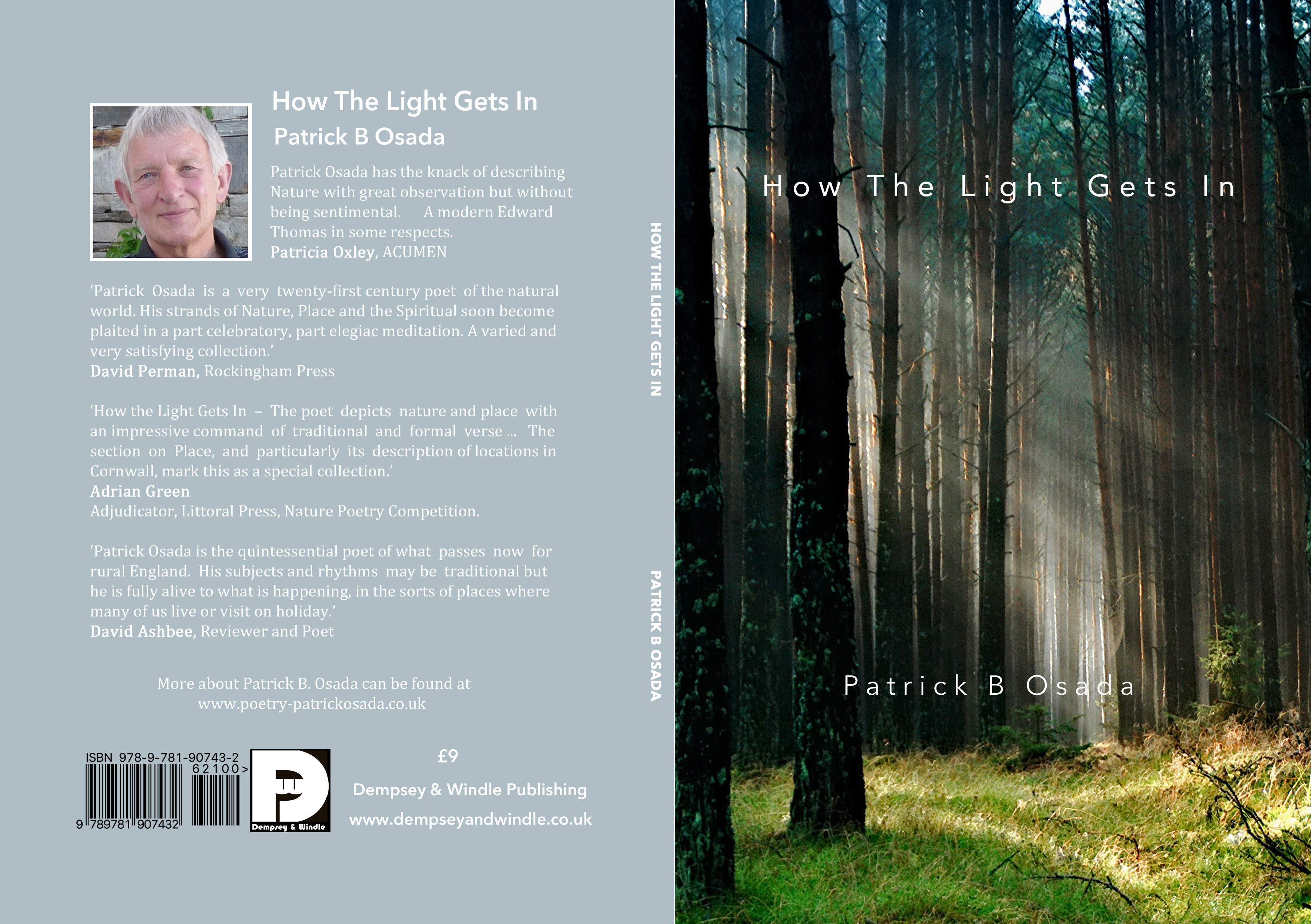
HOW THE LIGHT GETS IN, was published in 2018.
 
Patrick’s work has been included in many anthologies, on internet sites and broadcast on national and local radio in the UK. His poetry has been translated into several European languages and has appeared in anthologies published in a number of different countries. For more about Patrick’s work, visit :  http://www.poetry-patrickosada.co.uk

The Interview
 
1. What inspired you to write poetry?

                                                                                                      I suppose poetry has always been with me. As a small child my mother taught me nursery rhymes and read poetry. Looking back, I realise how wide a choice of children’s poetry I enjoyed, ranging from Stevenson’s “A Child’s Garden of Verses” and De La Mare’s “Peacock Pie,” to Edward Lear’s  “nonsense” poems, Milne’s “Winnie the Pooh” and “Now we are Six” and, later, Belloc’s “Cautionary Tales.”

2. Who introduced you to poetry?

                                                                                                          As I have already explained, I was introduced to poetry as a very young child. However, as a teenager, I was only interested in sport, any kind of reading – let alone poetry – was viewed as a chore and imposition. My saviour was a teacher called C.A.Broome who introduced me to the poets of the First World War as part of my “O” level English course. Suddenly the poems of Rosenburg, Thomas, Blunden and, particularly, Owen, Sassoon, and Henry Reed totally captured my interest and imagination. I realised that poetry could move me in a special way…and I was hooked.

                                                                                                                                           3. How aware were you of the dominating presence of older poets?                                                   

From my introduction to the poets of the First World War, I discovered that two famous war poets, F.W.Harvey and Ivor Gurney, were both linked to my home county, Gloucestershire. Later I discovered their association with The Dymock Poets, including Robert Frost and Edward Thomas.                                                                                                                                                At college, my studies introduced me to poets varying from Chaucer, Dryden, Milton and Shakespeare to Keats, Coleridge, Byron, Shelley and Clare. One of my tutors, the famous Welsh poet Leslie Norris, introduced his students to a rising star, the Sussex poet, Ted Walker. I discovered Dylan Thomas, Betjeman, Larkin and Hughes and went to the Royal Albert Hall to see the “Beat Poets”, including Ginsberg, Ferlinghetti and Corso with the British poets Adrian Mitchell and Michael Horovitz…So, as you can see, “the dominating presence of older poets” has always been with me, ‘though I always have regarded them as inspirational rather than dominating.

4. What is your daily writing routine?

                                                                                                                     I don’t have one!! I don’t write poetry on a daily basis…I write when I have to. I am not one of those writers who works to a timetable, I only write when inspiration and compulsion demand. For me, poetry is a bit like a major illness – stopping normal life and demanding my full attention when it strikes…

5. What motivates you to write?

                                                                                                            Anything can act as a prompt to write. Usually a thought, idea or experience will work away in my mind (like grit in an oyster) and start to form the basis for a poem. When this happens I need to quickly jot down words, phrases or lines that come to mind, together with notes (a “storyboard”) of what I want to say. Once this is done I can usually translate this material into a poem… but if I fail to undertake this process the poem evaporates! Consequently I have been known to get up in the middle of the night to write…

                                                                               I  agree with Philip Larkin’s excellent description of what motivates the writing of a poem, it is …”to construct a verbal device that would preserve an experience indefinitely by reproducing it in whoever read the poem.”

6. What is your work ethic?

                                                                                                                               I’m not sure how to apply this question to writing poetry! In most other things hard work equals reward, but in poetry I suppose a successful poem brings personal satisfaction.

7. How do the writers you read when you were young influence you today?

I’m still reading many of the same poets that I have discovered during a lifetime of reading poetry. I presume that I have absorbed influences along the way, something, perhaps, my readers may be able to identify…

8. Who of today’s writers do you admire the most and why?

                                                                       Sadly, most of the poets I admire are now dead. I don’t think there are any poets writing today able to match, for instance, Larkin, Hughes, Gunn and Heaney  or the three Thomases – Edward, Dylan & R.S. Of living poets I would mention Motion, Duffy Michael Longley and Americans, Sharon Olds and Thomas Lynch.

                                                                                                                                                              I probably own more collections by Gillian Clarke than books by any other living poet. I admire the way she blends traditional writing skills with her ability to capture the Welsh countryside and its people.

                                                                                                                                                                            Two poets I know personally and would recommend are Ian Caws (an Eric Gregory Award winner) for the wonderful way he records life on the Sussex Downs and coast – his technique is sure-footed and his rhyme unobtrusive; Andrew Geary, a newcomer whose first collection, “A Shoal of Powan,” promises great things to come.

9. Why do you write?

I write because I have to… As I said earlier, writing poetry is a compulsion, something I will continue to do until inspiration and “my muse” desert me.

10. What would you say to someone who asked you “How do you become a writer?”               

In the first instance, I write for myself – to satisfy this strange compulsion to express myself in a written form. A lot of my early poems were not shared with anyone. Eventually, I mustered the courage to show my work to family and friends, then to seek publication.
My real interest in poetry started as a teenager, leading me to read a lot of poetry throughout my life. I would recommend becoming a reader of poetry as an important a step for any aspiring poet. A lot about style, form and poetic technique can be learnt in this way…

11. Tell me about the writing projects you have on at the momen

I am currently promoting my 6th. And latest collection, “How The Light Gets In”… As this is my latest “project” it is receiving a lot of attention – however, I am glad to say, my poems are still being written!


Wombwell Rainbow Interviews: Rebecca Gethin

 Wombwell Rainbow Interviews 

I am honoured and privileged that the following writers local, national and international have agreed to be interviewed by me. I gave the writers two options: an emailed list of questions or a more fluid interview via messenger.
The usual ground is covered about motivation, daily routines and work ethic, but some surprises too. Some of these poets you may know, others may be new to you. I hope you enjoy the experience as much as I do.

All The Time In The World by Rebecca Gethin

A Sprig of Rowan

Rebecca Gethin

Rebecca Gethin’s first novel, Liar Dice, which was published in 2011. Her frst poetry collection, River is the Plural of Rain, was published by Oversteps Books in 2009. Her second novel was What the Horses Heard and her second poetry collection, A Handful of Water. She has worked as a creative writing tutor in a prison and currently works as a freelance creative writing tutor and writer.

The Interview 

1. What inspired you to write poetry?
 
I wrote stories night and day as a child and when anyone asked me what I was going to be when I grew up, I’d answer “a writer”.  They always laughed.  I then forgot about it in the race to make a living, bring up children, weather life.   Later, I remembered my original aim and found I still wanted to write a novel but, for some reason, started writing poetry and this somehow served as an apprenticeship for the two novels I wrote. I think I won’t write another novel now as I prefer writing poetry. It carries less expectation of success and it’s a friendlier, less isolating world.  Also I can bin a day’s work more easily: binning 40k words is not so easy!   
 
2. Who introduced you to poetry?
 
We read quite a bit at primary school and my early years were full of Stevenson, Masefield, Walter de la Mare. I remember the rhythms and rhymes even now though I don’t always remember the words.  Nobody at home read any at all.
 
3. How aware were you of the dominating presence of older poets?
 
Very and felt very intimidated!   I loved Yeats and Keats but funnily enough when I went to university to study English I could never write essays about either.  But these inspired me to try and try again:  Seamus Heaney, Ted Hughes, Sylvia Plath, George Mackay Brown, Edward Thomas.  I loved a not-so-well- known Donegal poet called Francis Harvey.    
 
4. What is your daily writing routine?
 
I spend each morning writing at my desk if I can. Then in the afternoon I think about it. I may go back and adjust a comma or some words later or re-write the whole thing. 
If I don’t spend the morning fiddling with writing I need to catch up somewhere in the day so I might do that or else it’s just one of those days that gets away.  An accumulation of such days may make me feel  slightly unwell but I am aware that sometimes I am absorbing experience that I will use later and that’s ok.
I use a camera a lot to capture memories, images, experiences.   This is how I try to operate …I don’t wait for inspiration. I write or edit or organise.   I  find the best poems and the most enjoyable to write are the ones where I don’t know  where it’s going and my brain suddenly furnishes me with the direction….  as if the poem is writing itself.  Of course, I think a poet can also know where a poem is going and it might still be perfectly ok ( crafted and neat) but the ones that surprise the writer will probably surprise the reader!   Of course you will lose the surprise to yourself while you edit it or fiddle about with it…. but even fiddling and editing can also bring out the surprise.  Editing to me can be as creative as the initial write. 
 I was the same when I wrote my novels: I had no idea what was coming on the next page and wrote the two books sentence by sentence.  I edited a lot later on and enjoyed this but I had  no plans or maps for the plot to start with. 
 
5. What motivates you to write?
 
Lots of things give me what I call ‘a poem feeling ‘. 
Reading others. Making notes on what I see or hear.  Observing whatever and whenever I can.  Making small discoveries.
 My two monthly poetry groups, reading and supporting their work while their critiquing of my own is immensely supportive to me. 
 
6. What is your work ethic?

Work ethic?  Not sure I have such a thing.  Ethic seems a big word!   I am not writing for a living or to deadlines except my own.  My family comes first and, in the spring, my garden is next.  I love being outside and, on a sunny day, at any  time of the year I would rather be outside than at my desk so there can be a conflict within me!  I am Aries and am used to this. So although I do need to spend time writing then I don’t necessarily work that hard at it unless something is pressing me.  
I am learning to cope with the downs of my self-confidence and not let it get me down when it comes over me.  Just something we all have to live with.

7. How do the writers you read when you were young influence you today?
 
In my teens I read some of the Penguin Modern Poets books and Peter Redgrove is the one that stands out in my mind.  Again it’s the rhythm and flow of his work that is what interested me, the entrancing, visionary quality.  I also read Ezra Pound and a lot of TS Eliot.  At that time I was lucky to go to a reading by Jorge Luis Borges in London which was amazing although I couldn’t make out much. I also went to one by Kathleen Raine. For some reason I was introduced to her and she kindly enquired what I was going to do, as you do. When I proudly told her I was going to university to study English she said “Poor you” which was disappointing. But she was right because, after my degree, I never read a printed word for pleasure for nearly eight years!  I wrote too many essays and had to stuff masses of writers into my head.  At university, however, I heard Yevgeny Yevtushenko read in Russian and I was blown away.
 
8. Who of today’s writers do you admire the most and why?
 
This changes all the time!   But these writers don’t change: Alice Oswald for her visionary perceptions on nature, her surprising voice and turns of phrase.
Tony Hoagland for his compassion and rage and his discursive style, the way he melds two things together to make a greater whole. 
Norman MacCaig for his astonishing imagery.
Penelope Shuttle for her making the ordinary so very extraordinary.
Susan Richardson for her distinctive voices and her great knowledge of nature.
Les Murray for his voices and for being astonishing.
George Szirtes for being so apparently effortless and so adroit. 
Michael Longley for making my heart beat faster. I could go on and on….


9. Why do you write?

Because I am besieged by sense impressions I don’t want to lose.
Because it has become part of who I am and I feel ratty and almost ill if I don’t.
Because I want to record things that may vanish otherwise.
Because I want to resurrect things that are being lost.  10. What would you say to someone who asked you “How do you become a writer?”I’d say give yourself permission to write and above all let yourself write rubbish. Set yourself a target time and write for that length every day even if only 15 mins until it becomes engrained in you, a habit.
Put it away and come back to it a week (or a month or a year) later and see what bits you are surprised by.  Write them out again and see what connections you can make or what you now think is finished. If it surprises you now,  it will surprise others.  Keep going even if life gets on top of you!  


11. Tell me about the writing projects you have on at the moment.

I am about to go on a writing residency in a remote seaside cottage in SW Cornwall in Dec. This is a wee bit daunting to be honest.
I am putting together a pamphlet called Vanishings (working title) on endangered creatures but this has a way to go.  I have time though because Palewell Press is going to publish it at the end of 2019. (I could happily have studied Ecology.) 
And I have another up my sleeve on excavated stories because I love archaeology and finding things out , working title is Signs of Life.   (I should probably have studied History. )
I was reading at Aldeburgh Poetry Festival on climate change and want to work on this.

 
 Thank you Paul Brookes for making me think about these questions.

Wombwell Rainbow Interviews: Bina Sakar

Wombwell Rainbow Interviews

I am honoured and privileged that the following writers local, national and international have agreed to be interviewed by me. I gave the writers two options: an emailed list of questions or a more fluid interview via messenger.
The usual ground is covered about motivation, daily routines and work ethic, but some surprises too. Some of these poets you may know, others may be new to you. I hope you enjoy the experience as much as I do.


Bina Sakar

Bina Sarkar Ellias wears multiple hats, as a poet, fiction writer, curator, graphic designer,  editor and publisher. She recently curated the Migration Project for the Pune Biennale 2017, integrating works of artists, poets, filmmakers and photographers. She is founder, editor  and publisher of International Gallerie, an award-winning arts and ideas publication since 21 years.  Gallerie encourages critical understanding and appreciation of cultural diversity through the arts. Her book of poems “FUSE” has been taught at Towson University, Maryland, USA and selected poems have been translated into Urdu, Chinese, Arabic and French. Her forthcoming book “WHEN SEEING IS BELIEVING” has just been launched. She has given talks at various global venues and has received a Fellowship from the Asia Leadership Fellow Program 2007,  Japan, towards the project Unity in Diversity, the Times Group Yami Women Achievers’ Award, 2008, India, and the FICCI/FLO Award, 2013, India, for excellence in her work.
OTHER DETAILS
She has edited, Fifty Years of Contemporary Indian Art, 1997, for the Mohile Parikh Centre for Visual Arts, Mumbai, 1997. She has designed artist Jehangir Sabavala’s catalogue for  the 2002 show in Mumbai, Delhi and New  York, artist Rekha Rodwittiya’s catalogue, 2003, and recently her book in 2007, for shows in New York, Crossing Generations: diverge, the fortieth anniversary catalogue for Gallery Chemould, Mumbai, 2004, and a book on  artist Tyeb Mehta, Svaraj  by Ramchandra Gandhi. She has designed, edited and published an art  book, Chinthala Jagdish: Unmasked, 2004,  and The Curious World of Chinthala Jagdish, 2008; a book of poems, Rain, for Indian poet Sudeep Sen, 2005, Ayesha Taleyarkhan’s book of photographs, Bombay Mumbai, 2005, American photographer, edited and designed Leena Kejriwal’s book of photography, Calcutta: Repossessing the City, Waswo X. Waswo’s book, India Poems: The Photographs, and his recent catalogue, A Studio in Rajasthan, 2008, and artist Surendran Nair’s book, Itinerant Mythologies, 2008.

The Interview

1. What inspired you to write poetry?

Imagination; the magic of words in poetry and story books, lured me into scribbling my thoughts on random scraps of paper when I was perhaps nine or ten. And from teenage on, the novels of Gorky and Dostoevsky, the genius of Shakespeare, the philosophies of thinkers like Marx and Russell, and later Orwell, Thoreau, James Joyce , Sartre and Kafka, Camus, and Edward Said.  But the limerick and sonnet, the haiku and tangka, the ghazal, the acrostic and elegy, all have their inimitable characteristics that continue to delight.

2. Who introduced you to poetry?

As a child at school, books of poetry with simple rhymes enchanted me and later, poets like Tagore, Kipling, Wordsworth, Keats, Byron, Shelley, Tennyson and Whitman. It soon evolved to the irreplaceable Ginsberg, Kerouac, Sylvia Plath, Wisława Szymborska, Ramanujan, Walcott, and others.

3. How aware were you of the dominating presence of older poets?

I’ve been in admiration and appreciation of them since a long time. The deftness of thought, language and cadence lingered in all the quiet moments one had in-between preoccupations. The older poets have a distinct vocabulary but contemporary poets are marching forward with their own charged style, in hundreds. Perhaps today, one is more aware of the numbers because of the net and social media.
4. What is your daily writing routine?

One becomes a slave of routine as there are multiple practices I am immersed in. That of editor-designer-publisher of the bi-annual arts and ideas journal International Gallerie; a fiction writer and art curator interspersed with travels that entice me to varied regions, people and cultures. However, my poetry writings emerge mostly in the punctuations of these activities; in transit at airports, during a tea break, between destinations, often in the middle of the night…

5. What motivates you to write?

Life. People I encounter, places I visit, socio-political issues, nature; everything that speaks to me.

6. What is your work ethic?

Work is Worship… beneath its didactic surface, this proverb really connotes energy for me. Work is my life, work is love and passion, work for me, means a constant delight in learning, sharing the learning, disseminating unity in diversity, condemning wars, violence and injustice, speaking peace through the voice of words. Work is an instrument of healing.

7. How do the writers you read when you were young influence you today?

Many of the writers still resonate; like Shakespeare’s universally enduring characters, Orwell’s 1984 which is an all-time classic, increasingly relevant today.

8. Why do you write?

Writing is a compulsion. It happens without announcing itself.

9. What would you say to someone who asked you “How do you become a writer?”

I would say you do not “become” a writer. A writer has words flowing in his or her veins. The words get honed and chiselled through experience, and love for words.

10. Tell me about the writing projects you have on at the moment.

I have just launched “When Seeing Is Believing”, a book of poems that respond to the beauty and power of art and images. My poems are an ongoing process. As new poems emerge they will find themselves in books. A book of short stories is also unfolding. As is a novel and my ongoing preoccupation with “International Gallerie”, the global arts and ideas print journal that I’ve been editing and publishing since 21 years. Every project is unlimited joy! Do visit: http://www.gallerie.net

Wombwell Rainbow Interviews:  Julian Stannard 

Wombwell Rainbow Interviews

I am honoured and privileged that the following writers local, national and international have agreed to be interviewed by me. I gave the writers two options: an emailed list of questions or a more fluid interview via messenger.
The usual ground is covered about motivation, daily routines and work ethic, but some surprises too. Some of these poets you may know, others may be new to you. I hope you enjoy the experience as much as I do.

Julian Stannard

is a poet and a university teacher. He obtained his PhD. from UEA and is now a Reader in English and Creative writing at the University of Winchester, where for five years he was the programme leader for the MA in Creative and Critical writing. He writes critical studies – his most recent book was about the work of Basil Bunting   (http://writersandtheirwork.co.uk/index.php/author/authors-s-u/201-stannard-julian) – as well as reviews, essays, and poetry. His most recent collection is What were you thinking? (http://www.cbeditions.com/stannard.html)(CB Editions, 2016). His work appears variously in TLS, Poetry, Manhattan Review, Poetry Review, Poetry London, Spectator, Guardian, Telegraph, The Honest Ulsterman, The Forward Book of Poetry (2017) and Nuova Corrente (Italy). An essay on the poetry of Leonard Cohen appears in Spirituality and Desire in Leonard Cohen’s Songs and Poems (Cambridge Scholars, 2017.) He is at present writing a study of British and American poetry entitled Anglo-American Conversations in Poetry: 1910-2015 (Peter Lang).
He has read at various literary festivals, including the Aldeburgh Poetry Festival, as well as literary venues in the UK, mainland Europe and the USA – including London, Amsterdam, Utrecht, Paris, Rome, Prague, Genoa, Munich, New York and Boston. He teaches for the Poetry School (London) and is often invited to organise and lead workshops in a freelance capacity. He is both a Hawthornden and Bogliasco Fellow and has been a visiting Erasmus scholar at Charles University Prague and the University of Warsaw. Presently he is an External Examiner for the MA in Creative Writing at Birmingham City University and has been nominated for both Forward and Pushcart Prizes for his poetry. From 1984 to 2005 he lived for long periods in Italy, where he taught English and American Literature at the University of Genoa. He has written poetry about that mysterious port city and is now working on a bilingual publication of his Genoese poems for Il Canneto Publishers ( Genoa).

http://www.julianstannard.com/about/

The Interview

1. What inspired you  to write poetry?

As a young kid I was sent to a boarding school near Sheffield. I had been living in Malaysia  up until that moment  so boarding school  felt like an unexpected  and unwanted incarceration; it could be  nightmarish at times, and it was always  extremely cold! Reading –  as is so often the case, I think,   was  a way of coping generally  and English  was more or less the only thing I was  reasonably good at .
At ‘A level’  we studied  the poetry of Gerard Manley Hopkins  who, it turned out, had actually taught at the school in the  19th century,  and  we also studied The Waste Land  which seemed to resonate across the years. Something in my head said   ‘Holy shit, I think I like this!’

2. Who introduced you to poetry?

Our A level English Lit teacher was an irascible drunken left-wing Scotsman who was nevertheless on occasion  quite brilliant. He didn’t discourage drinking; in fact, he probably saw it as part of our wider education (an extra-curriculum activity), so we would trek across the damp hills looking for accommodating Public Houses.  In the 1970s no one seemed to bother that much about the legal dimension.  A barmaid would say ‘I suppose you’re going to say you’re eighteen?’ and we would say ‘Yes’ in the deepest voices  we could muster.  The beer flowed and in  our state of  inebriation  we would sometimes   talk about  poetry, and  even begin  to write it, in  our heads at least.  At the ages of sixteen, seventeen, eighteen, drinking and writing poetry  and  smoking hash were somehow inter-related and it felt better than most of the other things you were expected to do.
The English teacher had a record of Eliot reading The Waste Land which, as it most  likely seemed the easiest option, he   would  play quite often, invariably nodding off before  we got to What the Thunder Said. We knew much of it off by heart.
At University, in 1983,  I met Fleur Adcock , who came to give a reading and I realised in an instant that  poetry could be conversational,  colloquial and utterly contemporary. For me this was a real breakthrough!

3. How aware were you of the dominating presence of older poets?

In those days it  was still mostly all about older poets, but less so after meeting Fleur.  At University I read  a lot of medieval poets, including Chaucer, who were in turn  indebted to classical poets.   Later when I moved to Italy in the 1980s I learnt that every school child  could cite something  from Dante’s Divine Comedy. And I learnt that Liguria and Genoa, the city  which for a decade or so  became my home , had a rich literary history.   Which included the presence of Byron, Shelley, Dickens, Lawrence, Charles Tomlinson,  Hemingway, WB Yeats, Ezra Pound, Max Beerbohm, Basil Bunting , Camillo Sbarbaro, Eugenio Montale, Giorgio Caproni, Dino Campana.
This year, much to my delight,  the Italian publishers Canneto has published my book Sottoripa (2018), which is  a bilingual  publication of my poems about Genoa, translated by Massimo Bacigalupo.
http://www.cannetoeditore.it/libri/arte-e-grafica/sottoripa-poesie-genovesi-di-julian-stannard/
In 2013 the title poem had been  made into a short film by Guglielmo Trupia  which was nominated  at the Rain Dance Film Festival

But it was also in that period –  the 1980s – I got hold of a copy of Michael Hofmann’s Acrimony  –  an outstanding  collection by such a youthful poet  – Again  it  was a case of reading old and new voices  – and then finding  one’s own voice.

4. What is your daily writing routine?

I begin new poems with a mixture of hope and fear and excitement.  Because  I spend a lot of time teaching in  a university which also means  marking, and all that other bureaucratic stuff and then, when possible,  enjoying some recovery time,  I don’t always have a consistent writing routine but I take the opportunities when they arise  – on the train maybe, or weekends or during holiday  time. I spend a lot of time working on drafts or reading new poetry. I like listening to music, especially Thelonious Monk, Miles Davis,  Charlie Parker et al. This helps me write or re-write or just relax.
When  my younger son was living  with me I would  listen to  a lot of  Rap – whether I wanted to or not – and when it comes to   the Notorious B.I.G , I have acquired a coating of  expertise!
And  sometimes I send poems to friends to see what they think.

5. What motivates you to write?

A response of a kind.  The general weirdness of stuff I think – overheard conversations, things I‘ve read, billboards, train announcements (endless!), anger, desolation, joy, memories. I think we’re living in particularly challenging times; the political climate is worrying, more food banks, more homelessness, more poverty, fear of losing one’s job. The wider international situation too.  I have always been a loyal supporter of the Labour Party so that in itself brings  highs  and lows, rather like watching  your football team play brilliantly for much of the game yet somehow  throw it away  right at the end. Brexit fills me with immense sadness.
6. What is your work ethic?
Teaching  often  consumes swathes of my life, it’s  draining , but because I also teach creative writing  I can, from time to time, get inspired by student  work which is wonderful too. It’s a delight to come across real talent and help nurture it.  I like to read  a lot of contemporary poetry and new fiction  generally. I am asked to review quite frequently which is a discipline in itself, a kind of homework, and a way of keeping up to date. Travelling often produces new poetry. Notwithstanding work pressures I manage to write a fair amount; and if a poem demands  to be written I  usually find the time to answer those demands! It’s a lot more enjoyable than writing some anodyne document or funding bid.
7. How do the writers you read when you were young influence you today?
Their influence never really goes away, even if you spend a lot of time with newer or different  voices. I think  those ‘early’ poets helped fashion a way of thinking  about poetry  – and it’s  always a great pleasure to return to their  writing, whether it be those earlier generation such as the modernists  –  Eliot ,Pound, William Carlos Williams, DH Lawrence  – or  poets such as Frank O’Hara or Robert Creeley,  and/ or Lowell, Berryman  and co. Not to mention those older contemporary poets, especially if they are still producing new work: poets such as Fleur Adcock, Christopher  Reid, Hugo Williams, Maurice Riordan , Selima Hill, Michael Hofmann-  to name a few.

8. Who of today’s writers do you admire the most and why?

There are so many! There’ s a kind of resurgence in the world of  poetry I feel. I could roll out  a list off the top of my head but I am surely  leaving people  out; but the list would surely include Caroline Bird, George Szirtes, Kathryn Maris, Andrew Macmillan, Declan Ryan, Emily Berry, Tim Cumming,  André Naffis-Sahely,  Claudia Rankine, Sharon  Olds, Annie Freud, Ishion Hutchinson, Luke Kennard, Richard Skinner,  and some pieces  from  Bobby Parker  and Ocean Vuong too. I would also want  to acknowledge the dark genius  of Frederick Seidel, the intimations of mortality still coming from the pen of Clive James. And I take my hat off to my former student and colleague Antosh Wojcik who’s making   quite a name for himself as a performance poet.
And why? Variously and varyingly  there is so much  energy  here, a lot of drive, and risk- taking,  and moments of candour (Lowell said ‘ why not say what happened’?)  and plenty of ludic mischief  too and experiment  with form;  in effect some lively conversations between poetry and prose, including  prose poetry, and other media too, including social media.  Some of the poets above work across genres: variously novelists, translators, essayists,  reviewers,  editors, teachers, events’ organisers  and  publishers . Difficult not to mention Charles Boyle, ex-poet, and now writer of prose under various names and the founder of CB Editions. The blogging of Katy Evans-Bush  –  fine poet – has been  significant and the gregarious Bethany Pope, poet and novelist, is now writing more or less daily reports from China.   I look forward to reading her next book.

9. Why do you write?

After forty years or so of doing it  –  oh  my God ! – it’s become a habit, a way of thinking and even a way of  living. Sometimes reportage, sometimes invention, I guess it’s a way of dealing  with some deep, not always unpleasant,  itch  – which in turn probably answers to  all  sorts of Freudian-like  neuroses…
Writing, at times, is totally satisfying and, in a practical sense, quite easy to do. I don’t need a studio or a theatre or complicated props.  Just the page itself, I guess, which  is a kind of stage.
10. What would you say to someone who asked you “How do you become a writer?”
I’d say Read, read and read yet more  and try thing out. Experiment, take risks, be thick-skinned,  and try and get  plenty of sleep!

11. Tell me about the writing projects you have on at the moment.

My last  English collection came out in 2016 –  What were  you thinking? (CB Editions http://www.cbeditions.com/stannard.html) ;
so  I’m grappling  with the creation of a new MS – several pieces of which  have been published in  magazines. Any new collection  has , at least for me , a rather  aleatory dynamic –  feeling  my way forwards, as it  were, letting  poems butt their way in, or conversely slide away …
I’m also writing a book called Transatlantic Conversations – which is about the relationships, harmonious or otherwise,  between British and American  poetry; this is for the publisher Peter Lang.
As well as the above ,I’m  also working with  the novelist and artist Roma Tearne on a collaborative  project  called  Heat Wave  – It’s s a sort of dialogue between  poems of mine and Roma’s  fantastic  paintings . Not an ekphrastic venture I hasten to add. More a dark night of the soul with some gleeful moments too! A kind of synaesthetic fugue….
It’s coming out next year thanks to Green Bottle Press. We’re planning  several readings /events so watch this space!