Wombwell Rainbow Interviews: Thasia Anne

Wombwell Rainbow Interviews

I am honoured and privileged that the following poets, local, national and international have agreed to be interviewed by me. I gave the writers two options: an emailed list of questions or a more fluid interview via messenger.
The usual ground is covered about motivation, daily routines and work ethic, but some surprises too. Some of these poets you may know, others may be new to you. I hope you enjoy the experience as much as I do.

515oxA+ObNL._SX398_BO1,204,203,200_

Thasia Anne

Thasia Anne is the producer, director, and participant in Women of Word featuring a few Man Made Words (WOW) on Edinboro University of Pennsylvania campus. WOW has as the troop of poets reading individual poetry woven into conversation, with 2018 being the eighth year. She has been published in “Our Favorites”; Poets’ Halls Press, “Spitmag; Art and Poetry Magazine Vol.2, & 3”, “Poetry of S.O.U.L. An anthology of selected works from Poets around the world”, “Word Stock” and “Delirious, A Poetic Celebration of Prince.”

Wombwell Rainbow Interviews

1. What were the circumstances under which you began to write poetry?

I was in 7th grade and a person from the City of Erie School District came into our English class. They said they were taking a SAMPLER of students across the district to create a small magazine. We were asked to write a poem. I knew what poetry was. I was also very familiar with beautiful language as my mother was a stunning reader and loved The Just So stories and Jungle Book by Rudyard Kipling. The week previous to this exercise was punctuated with the death in the Vietnam war of my friends brother.
My first poem was
WAR
The green grass covered hill
The wind blowing the still
Lavender flowers
That stood like towers
Straight and tall
For a world so small
The men in Vietnam
Are tired of the fighting, the dying, and the ever- lasting crying
So, we go to our hill
Where the wind blows the still lavender flowers
2. Who introduced you to poetry?

Well my mother to the beauty of language, and I guess the school district for asking me to write a poem, which I had never done.
3. How aware were you of the dominating presence of older poets?

Well I am just now really starting to dig into deceased poets. I had laid my writing down during a very tumultuous 17 year abusive marriage. I met a poet in 1999 who really changed a lot for me. He encouraged me to sit in coffee shops and nature. He encouraged writing workshops to hone what I do. Craig Czurry from the Wilkes Barre area really gave me the confidence to believe in my words. I had spent 17 years being told nothing I had to say had meaning, so this was huge for  me.

4. What is your daily writing routine?
I don’t write daily, But as often as I can. I have a brain injury that occurred in 2008 from a fall at work. So, I am extremely grateful for any writing. I easily could have died, been brain dead or a paraplegic. So, am thrilled that I still have it!
5. What motivates you to write?

Ultimately, either beauty or pure ugliness. The ugly usually comes from the behaviour of some abusive individual. I have a lot of poetry on domestic violence that I use to help other women realize they are not alone. Help is out there and many of us have walked in their shoes. I teach prevention and might I add, that I teach abusers are of all sexual orientations, colors  and bank accounts!

6. What is your work ethic?

I have always been a diligent and hard worker. Whether it be for a job or writing. I am old enough that I go back to packing up manuscripts into large manilla envelopes, paying postage, and waiting and waiting to never hear a thing! I have written ten romance novels, eight to ten poetry manuscripts, and numerous stories. I am now embracing electronic successes.

7.   How do the writers you read when you were young influence you today?

I sometimes see the sing song of Rudyard in what I write. I do not hunt it down and make it happen, it just appears like the leopard who got his spots. I work hard to not fall into all the rhyming, but enjoy the reward of one that is well placed.

8. Who of today’s writers do you admire the most and why?

I will always admire Craig Czurry and all his international interpretations.
Locally there are a few that I love to follow. Matt Borczon, and how he has taken terrible experiences and made them relatable to others, while healing himself. I think I relate because I was able to heal my own heart from the scars of domestic violence through writing it out. I use my first chapbook, “Love and Licorice Whips” to this day to help women who are escaping.
Cee Williams has always been a great writer. In the last two years he has lost his mother and beloved dog Rocky. He has transcended to great ness while exposing his soul in loss.
Marjorie Wonner, a grand elder lady who writes of the days gone by. She has attended many workshops and classes. She expertly writes of an era I admire.
I have recently become aware of Scott Thomas Outlar and his poetry that transcends to a time in my life where I thought we could all love our way out of wars and conflict. I just love hearing him read.

Sean Thomas Dougherty and his poem Why Bother has become like a mantra to me.

9. Why do you write?

I have to. It saved my life when I escaped domestic violence. Forgive me, but poetry was like squeezing the puss out of a boil for a long time. I have learned to write more objectively about those days, but I am not sure those poems are as effective.

10. What would you say to someone who asked you “How do you become a writer?”

Put your pen to paper, or nowadays fingers on keyboard. If you cant get something down? Maybe you just are not going to be a writer. Personally, for me, it had always flowed pretty effortlessly.

I was at a workshop about ekphrastic poetry. I was shown a pic of a local statue I had yet to see. Within seven minutes I had my poem, Fruits of Our Labor.

Fruits of Our Labor
Horse –powered shoes clamber and climb higher, dragging my world out of the mire of obscene politics
The jewel of the Great Lakes has slipped down from our crown
Tenuous up-cycled metal bulging and straining to bring
our town back from the precipice of extinction
Vacationers come to our Lakeshore
to watch our unemployed re-educate
Machinist nurses, paper makers making burgers Do you want fries with that?
Where are we at?
Oh equine of equity
How do we drag ourselves back to relevancy?
With the same hard work and hardened hands that
BUILT THIS CITY
When the first horse and wagon wandered to the edge of our great lake
11. Tell me about the writing projects you have on at the moment.
I just finished a project that I embarked on with my step-son and his son. They are phenomenal photographers. At Christmas they showed me some photos they had recently taken and I was immediately inspired to write a couple pieces of poetry. I showed them my poems and explained Ekphrastic poetry to them. We all got excited. Alien Buddha Press just released POETOGRAPHY last week. Ronald Tregaskis, Cullen Tregaskis, and Thasia Anne. It is available on Amazon, along with my books Broken Branches, and The Past is Calling.

If you have any follow up questions let me know. Hope I didn’t get too lengthy here.
A poet well worth a gander. “The house that does not exist”, a poem by Bulgarian poet Bozhidar Pangelov

via The house that does not exist, a poem by Bulgarian poet Bozhidar Pangelov

Wombwell Rainbow Interviews: Jason Baldinger

Wombwell Rainbow Interviews

I am honoured and privileged that the following poets, local, national and international have agreed to be interviewed by me. I gave the writers two options: an emailed list of questions or a more fluid interview via messenger.
The usual ground is covered about motivation, daily routines and work ethic, but some surprises too. Some of these poets you may know, others may be new to you. I hope you enjoy the experience as much as I do.

a2539649070_16


Jason Baldinger

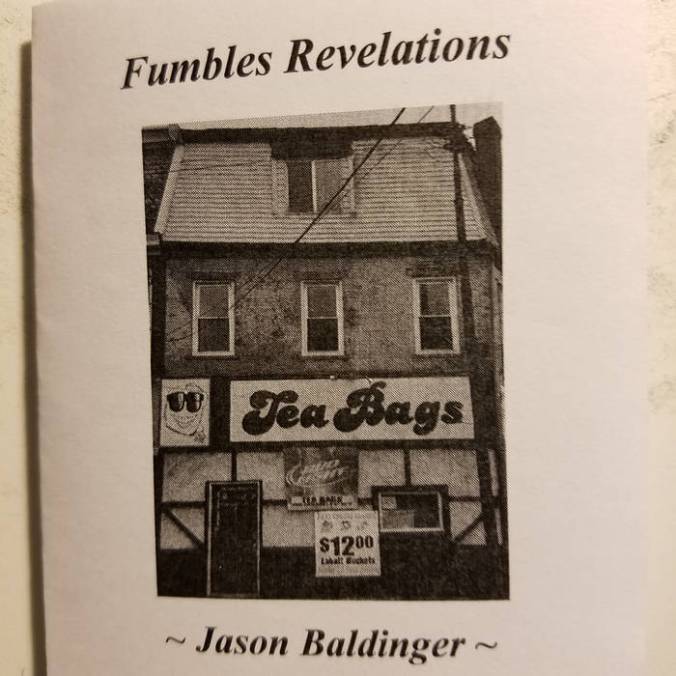
Jason Baldinger is a poet hailing from Pittsburgh and recently finished a stint as writer in residence at the Osage Arts Community. He is co-director of The Bridge Series reading series, the author of several books, the most recent are This Useless Beauty (Alien Buddha Press), The Ugly Side of the Lake (Night Ballet Press) written with John Dorsey and the chaplet Fumbles Revelations (Grackle and Crow) which are available now. The collection Fragments of a Rainy Season (Six Gallery Press) and the split book with James Benger Little Fires Hiding (Spartan Press) are forthcoming. Recent publications include the Low Ghost Anthology Unconditional Surrender, The Dope Fiend Daily, Outlaw Poetry, Uppagus, Lilliput Review, Rusty Truck, Dirtbag Review, In Between Hangovers, Your One Phone Call, Winedrunk Sidewalk, Anti-Heroin Chic, Nerve Cowboy Concrete Meat Press, Zombie Logic Press, Ramingo’s Porch, Rye Whiskey Review, Red Fez, Mad Swirl, Blue Hour Review and Heartland! Poetry of Love, Solidarity and Resistance. You can hear Jason read poems on recent and forthcoming releases by Theremonster and Sub Pop Recording artist The Gotobeds as well as at jasonbaldinger.bandcamp.com

The Interview
1. What were the circumstances under which you began to write poetry

It was high school for me. I believe sophomore year we had a very short couple week poetry module. I can’t remember what we read, but we were also assigned to write poems as well. I really liked writing, and writing poems came naturally, although at the time the poems I wrote were terrible.
2. Who introduced you to poetry?

I really don’t remember what we read in high school, except maybe Emily Dickinson and Bryant’s Thanatopsis and I didn’t follow up, even though I kept writing, with other poets until after high school. It was then that I found the Beats and Bukowski which was most of what I would read for years except for Whitman

3. How aware were you of the dominating presence of older poets?

Really very little, I stopped writing in my 20’s and when I got back to it I didn’t write poems. I started song writing in my later 20’s, which is what led a friend to force me to do my first reading. That was 10 years ago, I’ve been doing a lot of filling in the gaps since.

4. What is your daily writing routine?

I honestly don’t have one. If I’m un or underemployed I’ll take the day to do what needs to be done and around four pm I’ll get to work on editing or writing or whatever project I may have in mind. Most of the time, and with technology this is easy, if an idea starts I’ll use my voice recorder on my phone to start fleshing out the idea. Also, using notes or memorizing a line or a skeleton of the form until I can get somewhere where I can start to put the idea on paper.

5. What motivates you to write?

I write a lot of real life, a lot of road poems, a lot about what I see around me. I really can’t explain what it is that catches my brain but when something really tugs at my brain it feels like a tape recorder clicks on in my head.

6. What is your work ethic?

I’m not sure if there’s anyway to answer this than to say I work hard. Between writing, editing, submitting, working on manuscripts, reading and co directing a reading series you could say my schedule is nearly constantly full

7. How do the writers you read when you were young influence you today?

I’m still writing road poems but hate comparisons to Kerouac. I still write poems about alcohol and drugs but hate Bukowski comparisons. I’m cool with Brautigan and Whitman comparisons. realistically the style in which you write should be your own, I never wanted to emulate any writer particularly. As a reader though, what you read be it history, poetry, genre fiction et all will probably bubble up or get a nod in what and how you write

8. Who of today’s writers do you admire the most and why?

Over the last couple years of traveling I’ve gotten to meet so many great writers who are happy making their art and doing what that do because its what makes them happy. I think that’s the right idea, ain’t none of us getting the standard rich and famous contracts out of this. Of that crew of writers I can shout out locally its people like Dave Newman, Lori Jakiela, Scott Silsbe, Bob Pajich, Jason Irwin, Kris Collins who all have all of what Pittsburgh is coming out of them in droves. I love Don Wentworth’s beautiful Hiaku’s and now his expanded Ghazals. John Grochalski and Ally Malinenko are both writing killer poems about the state of America under trump and running the fantastic blog Winedrunk Sidewalk. Missouri and Kansas writer like John Dorsey (a pgh ex-pat) James Benger (who I co authored a forthcoming book called “Little Fires Hiding” with) Jason Ryberg, Victor Clevenger, Shawn Pavey and Jeanette Powers. I haven’t even shouted out Matt and Mark Borczon and Sean Doughtery who write killer real poetry out of Erie. Damian Rucci and I met in Kansas City and its been amazing to watch how his writing grows. John Patrick Robbins is another guy who killing it and running the great blog the Rye Whiskey Review There are so many beautiful writers out there and I could talk about, and sorry to the ones I haven’t mentioned. Safe to say, the state of underground poetry in America is in really good hands.

9. Why do you write?

I think of it as social history at this point. Not to say my life is that interesting or revelatory, but never has there been so many people without means writing, publishing and documenting what’s happening around them. If any of this survives into the future there will be a really good view of what people lives were like and maybe that helps humans (if they last) better rationalize their experience. Then again, maybe not and all I’m doing is trying to remember or satisfy my own damn ego. Dealers choice

10. What would you say to someone who asked you “How do you become a writer?”

Happy accidents, good drugs and penchant for self-destruction. I honestly don’t know. I’ll go with the Erie Poet Ron Androla’s advice “Live the Poem!”

11. Tell me about the writing projects you have on at the moment.

Currently working on the final edits of a split book with James Benger called “Little Fires Hiding” which will be released in the next couple months on Kung Fu Treachery Press. After that I should be getting started on formatting “Fragments of the Rainy Season” which will be coming out on 6 Gallery Press here in Pittsburgh. It’s been a crazy couple months of book publishing so who knows where it goes from there.


Wombwell Rainbow Interviews: Lesley Merrin

Wombwell Rainbow Interviews

I am honoured and privileged that the following poets, local, national and international have agreed to be interviewed by me. I gave the writers two options: an emailed list of questions or a more fluid interview via messenger.
The usual ground is covered about motivation, daily routines and work ethic, but some surprises too. Some of these poets you may know, others may be new to you. I hope you enjoy the experience as much as I do.

17191737_10212695323676647_7549777593441863746_o5-e1489602482481

An anthology in which Lesley’s poetry appears.

Lesley Merrin

Her poemhunter link: https://m.poemhunter.com/lesley-merrin/

The Interview

1. What were the circumstances under which you began to write poetry?
I have had this overwhelming desire to write since I was very young: letters, diaries, articles for magazines, life histories and the occasional poem.  I have always loved poetry and used to read poems to my children before they went to sleep.  I think the first poem I wrote was when I was about eighteen,
I was a Teacher of English for fifteen years and set poetry writing tasks for my pupils so would write examples for them to encourage them.
I also wrote a few of my own poems towards the end of my teaching career I started writing poetry more seriously when I met Ian Parks and was entranced by his knowledge and his ability to enthuse everyone. He made very difficult poetry accessible and interesting and I have him and other members of Read to Write who encouraged me to take poetry more seriously.

2. Who introduced you to poetry?
My passion for poetry came from my father.  He was a very social man and would have late night parties after leaving the pub.  His friends came along and some sang, and others performed poetry.  His repertoire was extensive, such as Rudyard Kipling, the monologues that were performed by Stanley Holloway, Keats, Hilaire Belloc, and many more.
Although my experience has been enriched by my involvement with Read to Write.
3. How aware were you of the dominating presence of older poets?
I suppose because of my background I have been introduced to many varied poets and feel the more that you read the more you learn.  If you are aware of the varied styles you are able to create your own style and make progress as a poet yourself.
4. What is your daily writing routine?
To be honest I don’t have a routine. I make a lot of notes in my writing book, often conversations in a café, on a bus, or the pub.  Or I see something happen which I think it is worth noting.  I have ideas circulating in my head, then when they come to fruition I begin to write a poem, I can’t write every day because I have to feel a passion for a poem or an idea for it to be successful in my own eyes. If not, I can’t make it work.   A few months ago, I was moved when some Asian men were holding their own service outside a Cathedral.  They were decrying the recent bombings and said although the men responsible called themselves Muslims they were not, because true Muslims were peaceful people.  I wrote a poem about it and believe this to be one of my best poems because I really felt the passion of the men’s message and a real need to write a poem about it.
5. What motivates you to write?

I think I’ve already answered that question with the previous answer. However, I have this need to write in some form or another. I always have, and I don’t honestly think that will change.

6. What is your work ethic?
I suppose because I have worked consistently for forty years and have now retired I just write when I feel the need.  When I am set a task by Ian at R2W I sometimes have something in my head that I have wanted to write for a long time and it fits the criteria, sometimes I struggle and must do some research beforehand, I always in the end really enjoy it whichever way I approach a poem.  It always takes several drafts before I can find it acceptable, but I find the whole process exciting and worthwhile even if it is quite hard.  Sometimes someone asks ‘how long did it take to write that poem?’ and I say probably a couple of hours.  But, later I think that poem has been going around in my head for a few weeks.  It/s the pulling together and writing the poem that take two hours,

7. How do the writers you read when you were young influence you today?
Any poet that you read, study and perform has an influence on you. You are not always aware of this and features of the poem may turn up in your own poetry.

8. Who of today’s writers do you admire the most and why?
I love Roger McGough because of his ability to play with words and make his poems amusing.
Carol Ann Duffy, because her poems are accessible to everyone, but they are also deep and meaningful with extra layers.
Benjamin Zachariah for his delivery and the rhythms of his poetry,
Ian Parks because of his ability to recreate the feelings you have experienced and  atmosphere of a place  you may have visited on paper and touch your heart.

9. Why do you write?
I write because I have to..   Sometimes it is experiences or stories that I need to write a poem about. Sometimes it’s a feeling I need to write about, sometimes we are given exercises to do.  I always must write in one form or another, or I don’t feel fulfilled.
10. What would you say to someone who asked you “How do you become a writer?”
I would say keep a note book with you.  Write down anything you find interesting.  Conversations, happenings anything.  Keep a poetry diary.  Sit somewhere and just write what comes into your head.  Write about what you are passionate about, what you feel.  Read, read, read.  Read the well-known good poets as well as lesser known poets.   Have as many tools in your toolbox as you can, (advice from Ian Parks) i.e. forms, rhymes, blank verse, syllabics, your don’t have to use them all just be aware.  ‘Know all the rules’ and then you can break them (Ian Parks)
Don’t be put off if your poems are not accepted by a magazine or publisher, keep trying and working hard and ask for feedback.  One of the most rewarding aspects of my writing is having my poemd workshopped.  Some of the other poets are very perceptive and see what does and doesn’t work.  You don\t have to change anything you don’t want to, sometimes your favourite words or lines might be suggested to be cut, if you decide to cut them you can always keep them for another poem that will be more fitting,

11. Tell me about the writing projects you have on at the moment.
I am writing poems for the Suffragette project at the Mansion House, a poem for the Doves of Doncaster.  I am following up the Carol Ann Duffy workshop I did at Balby with a group ‘You Have Mail’. Each member is writing letters in a persona.  I am hoping to produce a booklet publishing the poems and letters from this subject.
I am writing an article for the MAC magazine interviewing a man, Charlie, who is 94 years old.
I have a poem published in the next Eye Flash poetry magazine which is due out in October.
I have just recently had a sketch of mine aired on Write Radio on Write Funny. I am also rehearsing for a short play written by a friend who will eventually film it and put it on Youtube.  Watch this space!!!!!


Wombwell Rainbow Interviews: Frank Colley

Wombwell Rainbow Interviews

I am honoured and privileged that the following poets, local, national and international have agreed to be interviewed by me. I gave the writers two options: an emailed list of questions or a more fluid interview via messenger.
The usual ground is covered about motivation, daily routines and work ethic, but some surprises too. Some of these poets you may know, others may be new to you. I hope you enjoy the experience as much as I do

26166627_10155266591822993_7640067934263250491_n

The Interview

1. What were the circumstances under which you began to write poetry?

Trauma: There was no poetry in my life at school or at home apart from nursery rhymes. I left School (which I hated) at 15 and ½ and joined the Army as a Junior Soldier. The first poem I wrote was about leaving school, leaving home and finding that army life was far harder that anything I had experienced. It was in rhyming couplets, not that I knew that then. I guess I realised that I could write a poem or two. They were mainly autobiographical and only for me to get it out of my system as there was nobody to talk to about feelings at that time.
2. Who introduced you to poetry?

Years later I joined a poetry group where we shared our poems and did exercises. We became a group of friends and we all got better. Doors began to open and the lights started to go on. We had guest speakers notably Barry Hines and Ian McMillan and Martin Wiley, Martin sadly died then Ian McMillan started to lead the group and we became a workshop. Then other things got in the way and the writing stopped.

More recently I joined a group in Mexborough ran by Steve Ely. Steve introduced real poets and we discussed there writing methods and looked at the poem more deeply, analysing it.  Alongside this I also joined “Read to Write” Mexborough headed by Ian Parks. Ian introduced poets as people. His vast knowledge of the “great” poets is phenomenal and R2W took me to another level. I started reading my poems and performing “real” poet’s words in public. So as to who introduced me to poetry it has to be The two Ian`s and Steve and the other poets in the various groups that I have had the pleasure to be associated with.

3. How aware were you of the dominating presence of older poets?

Not at all if you mean established figures. I knew about Kipling, Wordsworth and the like but they had no significance to me until fairly recently.

4. What is your daily writing routine?

I don’t have one: even if I had the time to have a routine I would not keep to it. Technology is my saviour I always have my mobile or IPad to take notes as they come to me. A snippet of overheard conversation, a thought that pops in to my head, a witnessed incident, they all go down in a note
And looked at later sometimes used sometimes not. I do however find it best to write first thing in a morning or a thought will come on the edge of sleep and I reach for the phone.

5. What motivates you to write?

As above, things that I see, hear or witness.

6. What is your work ethic?

As above I don’t have one: I don’t have drafts I tend to edit as I go along. I find that it is best to let the poem write itself then all I do is edit it and claim it as my own.

7. How do the writers you read when you were young influence you today?

They didn’t as I didn’t I am not a good reader and am Dyslexic. I have to realy interested to read. (So long poems are of little interest) I’m getting better and I see the importance of reading others but I have to admit that I prefer to listen to Ian Parks tell a story.

8. Who of today’s writers do you admire the most and why?

That’s a difficult one, the writers of “Read 2 Write” who help, support and inspire.

9. Why do you write?

I guess it’s about leaving something behind, getting your point across uninterrupted and justifying it as “Poetic licence”.

10. What would you say to someone who asked you “How do you become a writer?”

Write about what you know, about what you feel. Practice exercises. pick a subject ant subject and just write whatever comes in to your head don’t bother about spilling or grammar or punctuation that will come in the editing.,;: Acrostic are good fun, write your name down the side of the page and add one word for each letter. Then expand it in to sentences that make sense`

11. Tell me about the writing projects you have on at the moment.

I am trying to put together a pamphlet of my poems, I have been doing to do it for a long time so I must get on with it.
I am working on a series of Sonnets, Something that even I would have not imagined me doing.
I have also been thinking of putting a Performance collection together.
I would also like to get some of my short stories and flash fiction finished and put in to some sort of order. If only time were elastic.


Wombwell Rainbow Interviews: Jamie Dedes

Wombwell Rainbow Interviews

I am honoured and privileged that the following poets, local, national and international have agreed to be interviewed by me. I gave the writers two options: an emailed list of questions or a more fluid interview via messenger.
The usual ground is covered about motivation, daily routines and work ethic, but some surprises too. Some of these poets you may know, others may be new to you. I hope you enjoy the experience as much as I do.

Capture001

Jamie Dedes

describes herself as “Poet and writer, I was once columnist and associate editor of a regional employment publication. Currently I run this site, The Poet by Day, an information hub for poets and writers. I am the managing editor of The BeZine published by The Bardo Group Beguines (originally The Bardo Group), a virtual arts collective I founded.  I am a weekly contributor to Beguine Again, a site showcasing spiritual writers.
My work is featured in a variety of publications and on sites, including: Levure littéraure, Ramingo’s Porch, Vita Brevis Literature,Compass Rose, Connotation Press, The Bar None Group, Salamander Cove, Second Light, I Am Not a Silent Poet, Meta / Phor(e) /Play, and California Woman.”

The Interview

THANK YOU, Paul, for your interest and the honor of this interview.

What were the circumstances under which you began to write poetry?

I began playing with poetry in elementary school. It was magical: the way a story could be told or a point made with such economy.

“One merit of poetry few persons will deny: It says more and in fewer words than prose.” Voltaire

I’m still fascinated with the way economy gives poetry a unique power. Witness Robert Lax, the hermit poet of Patmos, whose work has bone, muscle and sinew and yet became more and more minimalist as time passed coming finally to single words running down the page.

The only thing that comes close to such power is a good documentary photograph.

Who introduced you to poetry?

My Aunt Yvonne and Uncle Larry gave me The Little Golden Book of Poetry, which was published in 1947.  I kept it for years. Sometimes my aunt would read it to me. Absolute delight! (I can still hear her voice.) As I grew older I became aware that famous writers wrote the poems: Robert Louis Stevenson, Walter de la Mare and others. The poems were playful, relevant and stayed with me. There was one by Walter de la Mare, The Cupboard, in which a fat little grandmother rations out Banbury Cakes and lollipops.

Of course my own small plump grandmother – called Sidto by us – wouldn’t have known Banbury Cake. Our “cake” would be baklava and our “lollipops” would be semsemiyeh (sesame candy) but, like the grandma in the poem, my grandmother was indeed the keeper of the cupboard and she was in charge of dishing up sweet and savory.  So the poem was a joy and my first hint that poetry crosses borders.

How aware were you of the dominating presence of older poets?

What I was initially aware of was the dominating presence of what seemed to me mostly Anglo-Saxon male writers, which made it appear that being a poet wasn’t viable for a scrawny brownish hyphenated girl. Eventually, the shelves of the Brooklyn Public Library revealed a wealth of female poets: Emily Dickinson, Elizabeth Barrett Browning, Theresa de Avila, Mary Wadsworth Brewster, Emily Bronte, George Eliot, Lousia May Alcott, Amy Lowell, H.D., Djuna Barnes, Louise Brogan, Gwendolyn Brookes, Joy Davidman, Diane Di Prima, Louise Glock and others. I read about the 10 muses, the Tamil women poets, and women poets of other cultures. Hope!

My first poem was published when I was seventeen. As an adult, I would come to put poetry aside for years and write newspaper columns, feature articles, and other “practical” material that would bring in a paycheck. I came back to poetry and short stories as central efforts, something more than scribbles in my notebooks, when I retired from doing work for others in 2008.

What motivates you to write?

It feels good. Peaceful. In its essence, it’s meditation.

How do the writers you read when you were young influence you today?

First and foremost, I am grateful to Pearl Buck, my spiritual mother. She didn’t influence me stylistically, though I enjoyed her writing and was completely taken with her storytelling. I was influenced by the way she wrote about Chinese peasants with understanding and respect and because of her lived ethic, her sense of responsibility and commitment to those – especially children – in need. Pearl Buck was blacklisted for saying that the world would one day pay for the subjugation of the “colored” races. That wasn’t a threat. It was a warning about the losses and the inevitable fallout from moral turpitude.

Steinbeck was also an influence as was Betty Smith. They wrote about common things and common (not meant pejoratively) often poor people, the genuine people of our Earth. This remains my own value for writing and reading. Along that line, two fave poets are Walt Whitman and William Carlos Williams. I appreciate the way Williams captured the demotic.

Who of today’s writers do you admire the most and why?

Probably the same writers that engage your readers, often those writers coming out from small presses, on best selling lists, and some found on lists of required reading in schools. One thing I focus on through my sites though is the work of lesser known writers and poets who are worth reading. So let me give a few of them a shout-out:
• Paul Brookes is one!  
• My smart savvy talented daughter-in-law, Karen Fayeth.
• Many of the women in Second Light Network of Women Poets who may be fairly well know in the U.K. but not as much in the U.S.
• Michael Dickel whose chapbook War Surrounds Us is a fave of mine.
• Naomi Baltuck who puts together photographs with brief narratives to create stories that are charming and pointed.
• Former journalist, Joe Hesch, poet and writer, who brings us tales about America’s roots.
• Sylva Zanoyan Merjanian who donates the sales from her books to Armenian refugees.
• John Anstie, Corina Ravenscraft and Priscilla Galasso, who are so sharp and informed and whose ideals are so real my heart weeps.
• Michael Watson, who brings grace and perspective to everyday issues.
• James Cowles, an acute wit.
• Charles W. Martin, among other things, the king of folksy wisdom.
• Juli Juxtaposed is probably the most brilliant essayist in our circle. She takes my breath away.
• Russ Green has a sense of conscience that won’t stop.
• Bozhidar Pangelove is lyrically loveable.
• Julia Gherghei, Sharon Frye, Reuben Woolley, Liliana Negoi (actually quite notable in Romania), Debais Mukhopadhyay are conscious writers who share deep concerns for the human condition and for the beauties of nature.
• Sonja Benskin Mesher for the way she combines words and art.

What would you say to someone who asked you “How do you become a writer?”

It takes hard work, dedication, and lots of alone time, so first ask yourself  “do I want to be a writer or do I want to have written.”  If the later, find something else to do. If the former, then …

Read. Read. Read.
Write. Write. Write.

Wombwell Rainbow Interviews: Ken Allan Dronsfield

Wombwell Rainbow Interviews

I am honoured and privileged that the following poets, local, national and international have agreed to be interviewed by me. I gave the writers two options: an emailed list of questions or a more fluid interview via messenger.
The usual ground is covered about motivation, daily routines and work ethic, but some surprises too. Some of these poets you may know, others may be new to you. I hope you enjoy the experience as much as I do.
51musYVh-EL

Ken Allan Dronsfield

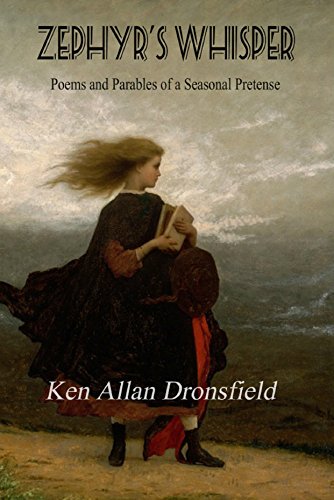
Ken Allan Dronsfield is a disabled veteran, Poet and Fabulist hailing from New Hampshire, he now resides on the southern plains of Oklahoma. Ken is a prize winning Poet who enjoys music, writing, walking in the woods at night during a full moon and spending time with his cats Willa and Yumpy. He has three poetry collections, “The Cellaring”, (Poems from a Darkling Side of a Shadowed Mind) is a book of 80 poems touching on the paranormal, haunts, weird and wonderfully odd work. His second book titled “A Taint of Pity”, (52 Life Poems Written with a Cracked Inflection) is a collection containing eclectic and ‘thinking’ poems. His third and recent release is titled, “Zephyr’s Whisper” (64 Poems and Parables of a Seasonal Pretense), a superb collection of both seasonal and nature poetry. Included is his poem, “With Charcoal Black, Version III” that was selected as the Prize Winning poem for Realistic Poetry Internationals Nature Poem Contest. All Ken’s books are available through Amazon. Ken is a three-time Pushcart Prize nominee and Best of the Net, 2016-2018.

Ken is also the Co-Editor and Cover Artist for three poetry anthologies, “Moonlight Dreamers of Yellow Haze”, “Dandelion in a Vase of Roses”, and just released, “Warriors with Wings”. Along with his friend, Michael Lee Johnson, Editor in Chief, both are certain this latest anthology is one of the best available in print.”

The Interview

First, I’d like to say ‘thank you’ for the opportunity to explain a little about myself in answering.
These questions.
What were the circumstances under which you began to write poetry?

-I began writing at about the age of 13. I got interested in playing the guitar and
decided to write my own songs. I started writing lyrics, I then wrote poetry much later in life. Of course, this was quite a challenge in the past few years as most song lyrics are rhyming works and poetry TODAY has gotten away from the rhyme scheme.

Who introduced you to poetry?

-I started reading poetry by Poe, Frost, Whitman and others in high school.

How aware were you of the dominating presence of older poets?

-I’ve never felt any domination from older more experienced poets. Perhaps a certain ‘egotistical flair’ but I attribute that to the belief in oneself and ability.

What is your daily writing routine?

-After I wake and have my coffee, I go on the computer and read my emails. If I get an inspirational spark then I write, if not, I spend time reading. Books from other poets, websites, etc…

What motivates you to write?

-Writing has always been a part of my life in some way, shape or form. I believe it’s embedded in my heart, my being.

How do the writers you read when you were young influence you today?

-I think their ‘style’, their inspirational voice, influences me every day.
Tell me about the writing projects you have on at the moment.

-Actually, right now I’m spending time reading the works of others. I’ve invested in some books through Amazon, etc., and I’m also doing some writing, a few poems a week, and reading a lot. I’m also submitting work to a host of different magazines, journals, reviews, etc. I just had a book published, “Zephyr’s Whisper”, Poems and Parables of a Seasonal Pretense, through Scarlet Leaf Publishing, and it’s available through Amazon or Barnes and Noble. I’ve also just completed the co-editor/cover art work on a poetry anthology, “Warriors with Wings” with my friend Michael Lee Johnson as Editor, now on Amazon.


Wombwell Rainbow Interviews: Pris Campbell

Wombwell Rainbow Interviews

I am honoured and privileged that the following poets, local, national and international have agreed to be interviewed by me. I gave the writers two options: an emailed list of questions or a more fluid interview via messenger.
The usual ground is covered about motivation, daily routines and work ethic, but some surprises too. Some of these poets you may know, others may be new to you. I hope you enjoy the experience as much as I do.
41W1kvuFpGL._SY346_
Pris Campbell

According to Amazon “The free verse poetry of Pris Campbell has appeared in numerous journals, such as PoetsArtists. Rusty Truck, Bicycle Review, Boxcar Poetry Review, and Outlaw Poetry Network. She has had three Pushcart nominations. Her haiku, tanka and haiga publications include Frogpond, cattails, Acorn, Haigaonline, One Hundred Gourds, and Failed Haiku. The Small Press has published six collections of her free verse poetry and Clemson University Press a seventh one, a collaboration. A former Clinical Psychologist, sailor and bicyclist until sidelined by ME/CFS in 1990, she makes her home in the Greater West Palm Beach, Florida”

The Interview
What were the circumstances under which you began to write poetry?

When I became ill with ME/CFS, an illness I’ve lived with for 28 years now,  I couldn’t write at all for nine years due to my inability to tolerate light, cognitive problems,  and heavy dizziness. When I was finally able, my initial dreams of writing novels had to be set aside. They took more cognitive effort than I could handle. I found a hokey little haiku site, wrote haiku incorrectly until someone invited me to join a poetry board. I moved over into mainly writing free verse which WAS manageable for me and found I loved it. I began honing my skills until finally publications in journals began coming, as well as seven chapbooks and books. Over the past ten years I returned more seriously to haiku and added tanka and haibun to my writing choices. I love writing those, too, and recently had a tanka book published by Nixes Mate Press.


Who introduced you to poetry?

My mother. She was a big reader. Our house was filled with books, among them, poetry books. I memorized The Highwayman as a preteen so I could recite it to myself without carrying the book around. Another favorite in my early teens was The Love Song of J Alfred Prufrock. Elizabeth Barrett Browning won my heart with her sonnets.

 
What is your daily writing routine?

I have no daily routine. It all depends on my health situation on a given day and if there’s something worth writing about.


What motivates you to write?

The muse who taps me on the shoulder and says ‘I have something to say now so please take it down’. I’ve written stories or plays since grammar school so my muse has aged with me.


What is your work ethic?

I used to be a type A. Now, with this illness, I’m a ‘do it as you can’. If I make a commitment to do something, however, I ask for leeway in time constraints and I do get it done.


How do the writers you read when you were young influence you today?

It was partly these poets but also my interest in story telling that drew me to poets with their own stories or slices of life embedded into their poems. My mother was a first grade teacher so I rode to school in her belly for eight months, kicking fiercely as time for my release into the world drew near. She told me that when she gathered her class around for story time I would stop kicking as soon as she said ‘once upon a time’ and resume immediately after. Later, when I had croup, those were the words that would soothe me. That experience led me to the early poets who were stepping stones into the now.


What would you say to someone who asked you “How do you become a writer?”

I would ask them first had they written anything. One can’t become a writer without setting something down on paper first, no matter how awful it may seem at first. For me, the route to improving writing is to read people who make you want to shred everything you’ve written, because they’re pointing you in a direction that appeals. Reread the poems carefully and see how they put them together. It’s important to read a good source on poetic devices and how to learn to use them, even if you only eventually use a few. Inner rhyme, half rhyme, alliteration and the song of a poem are very important in my own writing. Don’t fall in love with leaving things in a poem simply because they ‘really happened’. Does it really matter that a red bird flew by? If it’s essential to the poem, keep it. Otherwise, cut it. Understand that the close of a poem is what you leave the reader with. Don’t drag it out. Make an impact and exit stage left.

 
.Who of today’s writers do you admire the most
and why?
Sharon Olds, Rebecca McClanahan, Li Young-Lee, Sherman Alexie, Taylor Mali, Al Winans, among others. I won’t name younger, poets who are not as well known and risk leaving out someone whose writing I really like. These poets I chose all write with both honesty and grace. These are some of the ones I would want to shred my poems for.

Tell me about the writing projects you have on at the moment.

I think I’m finished with books. I’m very happy with the ones I have out and grateful to the publishers but they’re a lot of work. I want to settle into only submitting to journals or good anthologies when I’m moved to and writing new things.


Wombwell Rainbow Interviews: Mike O’Brien

Wombwell Rainbow Interviews

I am honoured and privileged that the following poets, local, national and international have agreed to be interviewed by me. I gave the writers two options: an emailed list of questions or a more fluid interview via messenger.
The usual ground is covered about motivation, daily routines and work ethic, but some surprises too. Some of these poets you may know, others may be new to you. I hope you enjoy the experience as much as I do.

WP_20180904_22_04_12_Pro (2)

Mike O’Brien

The Interview

1. What were the circumstances under which you began to write poetry?
I have written songs since I was about 16. I started with punk songs, and then moved into less angry stuff and eventually into stuff which wasn’t angry at all. Then, due to my reputation as a performer, I was asked to compere a monthly poetry night in Manchester, and present some stuff of my own at it. I began by speaking the lyrics to some of my songs, which worked reasonably well, before branching out into writing pieces that were intended to be spoken rather than sung.

2. Who introduced you to poetry?
If I take songwriting as my starting point, then I would have to answer John Lydon (formerly Johnny Rotten of the Sex Pistols, and Ron Mael, the moustachioed piano player and lyricist of the group Sparks. However I was aware of poetry as a distinct art form before I had even heard of either of these characters, due to the good work of Mr Johnson, who was my form tutor at Wilberforce junior High School back in the early 70s, who read us such works as “The Smugglers Song” by Rudyard Kipling, “Simon Legree” by Vachel Lindsay  and “Twa Corbies” which is an anonymous Scottish poem. Subsequent teachers at secondary school, including the excellent Mr Shearring, and the psychotic Mr Garry, added to my education with stuff from Shakespeare and “Tam O’Shanter” by Burns, before I started to dabble in Radio 4, and discovered the likes of Philip Larkin “the Old Fools”

3. How aware were you of the dominating presence of older poets?
I don’t know that I was aware of a dominating presence. I knew that there were writers, mainly pop and rock lyricists who could express thoughts and feelings that I shared and/or enjoyed, and I wanted to try and do what they did. As for non-musical poets,  I was aware of the likes of living figures such as Larkin and other stars of Radio 4 and the Sunday Times, but I didn’t consider them to be operating in the same field as me, and consequently had no sense of competing with or trying to emulate or follow them.

4. What is your daily writing routine?
To my shame, I don’t really have one at the moment, although I do carry a notebook around with me for ideas and jottings, and put at least a paragraph in it most days. Then every now and then, I get serious, and try and find an hour or two each day to put the best ideas into some sort of shape. Not necessarily always poems or songs either.  I also like to write little essays and stories to expand on my thoughts. But due to laziness, work commitments and the relative ease with which one can purchase alcohol, I do not do as much as perhaps I might. follow them.

5. What motivates you to write?
I think it is nice to get my thoughts and ideas down in some sort of formal language, rather than just having them whirling around in my head. It clears them up, and makes them more accessible both to myself and perhaps to others. Even if they are daft ideas, or just whims, I think it is nice to see them stated well. And if they are in the form of a song or a poem, performing them gives me a chance to show them off, and also for me to show off my performing ability.

6. What is your work ethic?
I really don’t think that I have one. To be honest I think that my ego is probably my master, constantly telling me that unless I actually write something it will have no other way to obtain the stroking that it desires. I could spend more time performing other people’s somgs and poetry, but that doesn’t tick the same boxes for me at all. I would only be getting half the pleasure and there would be a constant niggling voice telling me(rightly or wrongly) that I could write better stuff.

7. How do the writers you read when you were young influence you today?
I’m not entirely sure that they do in any other way other than that they are a part of what got me here. I feel as though I have my own voice which owes as much to my background, teachers, family and friends, as it does to Johnny Rotten, Ron Mael, Robert Burns and Philip Larkin. I would like to imagine that were any of those lyricists and poets to read my stuff, they would see their mark there, but that so would my Mam and Dad, Mr Shearring, and the lads that I went to pubs and pop concerts with in the 1980s.

8.  Who of today’s writers do you admire the most and why?
Ohh Crikey. I’m not particularly up to date with stuff at all. My niece took me to see a singer who calls himself “Beans on Toast” recently. I considered him to be an excellent lyricist and raconteur. He had just written a book “Drunk Folk Stories”  about his many years on the music scene (which had completely passed me by). I read it in a day and would thoroughly recommend it to anyone, whether they have heard of him or not. I liked his humour and his honesty. In fact I would go as far as to say that humour and honesty are the qualities that I admire most in other writers. So, although not poets, and probably no longer particularly modern, I enjoy reading stuff by Alan Bennett, Nick Hornby and Probably even more unfashionably, Garrison Keillor.

9. Why do you write?
I would refer the honourable reader to my response to “what motivates you to write?” adding that it is one of the few things that I am reasonably competent at that I would consider to have some value beyond idle entertainment.  Or maybe it doesn’t.

10. What would you say to someone who asked you “How do you become a writer?”
Just write. Do it as often as you can. Carry a notebook and pen and write in it. Have a decent writing program on your computer and on your smartphone if you are into that sort of thing. Simplenote is good because you can start on your phone and pick it up on your computer. Practice writing for periods of time. Train so you can do an hour with ease, train so that you can do 1000 words with ease. Then if you are able to expand on either target, do so. Also, learn to draft, by which I mean learn to produce a volume of writing without worrying about grammar, structure or even quality. All that can be edited later. Get your thoughts down first, so that you have something to edit. What you do with the produce of your labours is another story, whether it is just for you, for you and friends, for performance or publication is almost irrelevant. Because if you don’t do the work, you will have no produce to worry about anyway. So, as the training shoe copywriter said “Just do it!”

11. Tell me about the writing projects you have on at the moment.
I have just completed a set of poems called “A Voyage Around My Father Figures” which my good friend Ian Parks is about to publish as a pamphlet in his “Glass Head Press” . I will be performing it in its entirety in one or two venues in an attempt to shift some copies to repay his faith in me.
I have also gone in to publishing myself, helping Barry Griffiths to bring out a slim volume of his biographical Poetry “Life Histories” which we will be launching very soon.
These ventures completed, I am left with notebooks and a head full of nonsense which may or may not become written things. A piece of gothic fiction based on one of Ian Parks’ poems. A piece based on Charlie Chaplin’s experiences in Mexborough. Some half formed thoughts about the poetry and robots. A comedy detective thriller set on a train. There’s loads of stuff in there, and its only my indolence, the day job and alcohol preventing it getting out. Hey prospective writers, don’t be like me! Make sure that you walk the walk, as well as talking the talk.


Delighted to have four poems featured in The Poet By Day in creative company. Thankyou, Jamie for this and speaking of my ongoing interview project . “the gift 2 . ” … and other poems in response to the last Wednesday Writing Prompt

via ” . the gift 2 . ” … and other poems in response to the last Wednesday Writing Prompt