Wombwell Rainbow Interviews: Soodabeh Saeidnia

Wombwell Rainbow Interviews

I am honoured and privileged that the following poets, local, national and international have agreed to be interviewed by me. I gave the writers two options: an emailed list of questions or a more fluid interview via messenger.
The usual ground is covered about motivation, daily routines and work ethic, but some surprises too. Some of these poets you may know, others may be new to you. I hope you enjoy the experience as much as I do.

Soodabeh Saeidnia

According to Amazon “Soodabeh lives in Queens, NYC. She got her Pharm D and PhD of Pharmacognosy and has worked as a researcher, assistant and associate professor in the Kyoto University (Japan), TUMS (Iran) and University of Saskatchewan (Canada). She writes in English and Farsi. Her English poems have been published in different anthologies and literary magazines including Careless Embrace of the Boneshaker (GWFM) Squawk Back, Indiana Voice Journal, Sick Lit Magazine, Dying Dahlia Review, etc. She has authored and edited both scientific and poetry collections. Her… book, Where Are You From, is a bilingual anthology gathered from 61 poets.”

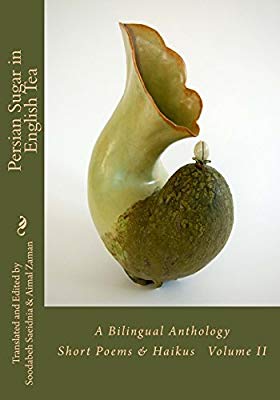
Her book “Persian Sugar In English Tea” now in its third volume features an international array of poets that she has translated into Farsi. Soundcloud features the Farsi versions read aloud to Persian music as background.

41iH0yGpGFL._AC_SY400_

The Interview
1. What were the circumstances under which you began to write poetry?

I was 12 years old and it was quite fun in the beginning but as soon as I found poetry a fascinating way of expressing my thoughts and feelings, I never put my pen away. I kept writing when the war was dreadful and my dear Tehran was under rocket attack by Saddam Hossein; when the school was closed for 40 days and my father moved us to the small town for safety; when adults were frightened to death and children played the role of happy angels; when there was blackout almost every night and the dark cardboards were glued to the windows; when the sugar and rice were in shortage and people stood patiently in line to get their own share; when hope was the only cure and the future … I also kept writing when the breeze of peace was blowing, the wounds were healing and the scars didn’t bother anymore …

2. Who introduced you to poetry?

The first mentor was my dad. He is a passionate and good poet and I remember he read for us every night from Hafiz and Rumi collections. I have to give a shout out to my high school teacher and best friend, Mrs Maryam Ghayekhloo who taught me how to criticize my own poems and introduced me to the modern poetry.

3. How aware were you of the dominating presence of older poets?

Well, I love to read of the pioneers’ and older generations’ accomplishments and do respect their life long endeavour but avoid living under their shades. They are inspiration but not my destination! About 700 years ago, Saadi said “فرزند خصال خویشتن باش”  which means “be your own character’s child”.

4. What is your daily writing routine?

There is no routine! I don’t write everyday but I keep thinking about it several days before I start developing an idea. When it comes to write, it doesn’t matter at work or at home, on the paper or on the web.

5. What motivates you to write?

It can be everything from a jar of spice on the cupboard to a bottle of medicine on the shelf, from the physical pain in the chest to the spiritual/mental injury. I think pains of any kind have been the greatest motives for poets.

6. What is your work ethic?

I love originality and so try my best to save my pen from plagiarism and to mention and appreciate the poets whose writing inspired me.

7. How do the writers you read when you were young influence you today?

Some poems are ageless and no matter in what age you read them, they inspire or hunt you in different ways. I believe Rumi’s are of such kind. Interestingly, I often find myself to enjoy reading children fairy tales/mythology again. They may not inspire me anymore but delight my heart and change the sight angle.

8. Who of today’s writers do you admire the most and why?

David Shapiro and Joanna Fuhrman. I enjoy and love reading their collections.

What I like about David Shapiro’s poetry has already been mentioned by Carl Whithaus, “To call David Shapiro a poet of the surreal, of collage, of the erotic, of endless transition, of formless form, of fin-de- siècle regret is to touch upon the variety of poetic techniques he has explored … he has refused to write poetry which organizes the real into a clean and neat poetic.”Joanna Fuhrman’s poetry tackles you with a glorious rush of sound and image and offbeat humor.

9. Why do you write?

It’s better not to pick an answer in the large basket of “because”! There are unknown and deeper layers of being yet to be defined by scientists. I really don’t know just like I don’t know why I live or breathe but out of why questions, there is beauty in writing and expressing the human’s thoughts. For me, writing has been easier than talking. I would rather people read my heart/mind whenever they really want to than they listen to my words and forget about it.

9. What would you say to someone who asked you “How do you become a writer?”

I became writer because I found writing the fascinating art to develop the flickering ideas which do not leave you alone until you represent them.

11. Tell me about the writing projects you have on at the moment?

I think about creating a link between translations and original poems, and mixing different languages in one piece of poem(s) in a way that it doesn’t miss the fluency and rhythm and remains attractive to different ears. My next project has not clearly been defined yet but it will definitely contain combinations.

Thank you so much Paul for the interview. It was a pleasure talking to you and the wonderful readers.


Wombwell Rainbow Interviews: Roy Marshall

Wombwell Rainbow Interviews

I am honoured and privileged that the following poets, local, national and international have agreed to be interviewed by me. I gave the writers two options: an emailed list of questions or a more fluid interview via messenger.
The usual ground is covered about motivation, daily routines and work ethic, but some surprises too. Some of these poets you may know, others may be new to you. I hope you enjoy the experience as much as I do.

an-2


Roy Marshall

According to his website:
“Roy Marshall was born in 1966. His mother was born in Italy, his father  in London. Roy wanted to be a writer as a child and young man but became distracted for about twenty years during which time he found himself variously employed as a delivery driver, gardener and coronary care nurse, amongst other occupations.
His pamphlet ‘Gopagilla‘ was published by Crystal Clear  in March 2012.
‘Gopagilla’ has sold out and is no longer available.

‘These are poems that hold words to the light until they catch it and flash with sudden truth.’ Andrew McCulloch, Times Literary Supplement.
A full collection ‘The Sun Bathers’ (Shoestring Press , 2013)  was shortlisted for the Michael Murphy award.

A second collection, ‘The Great Animator’  was published by Shoestring Press in 2017.
Magazine publications
include The Rialto, Ambit, Poetry Wales, The Shop, Smiths Knoll , Under the Radar, New Walk , Iota , The Interpreter’s House,  Magma ,  Agenda  Antiphon, Cake ,  The Lampeter Review ,  Lighthouse , Poems in which,  The North , The Manchester Review, The Morning Star, The Guardian online, The Butchers Dog , The High Window, The Compass, The Fenland Reed, Stand, Coast to Coast to Coast and Strix.

Other Writing
Roy’s reviews have appeared in The Interpreter’s House, The Compass, Critical Survey and elsewhere.
Roy’s short story ‘Late’ was highly commended in the Bare Fiction short story competition 2014  and published in Bare Fiction magazine.
Competitions
Poems have won prizes or commendation in competitions including Ledbury, Battered Moons, Nottingham open, Wenlock International, East Midlands, The Alan Sillitoe Prize,  Flarestack pamphlet prize, The William Soutar prize, Red Squirrel prize, Ashbourne Festival Prize, Ver , Ludlow and others.
Anthologies
Poems have appeared in anthologies including ‘Blame Montezuma’ (Happenstance, 2014)  ‘Double Bill’ (Red Squirrel, 2014), The Emergency Poet Anti-Stress Anthology (Michael O’Mara, 2015) , ‘Schooldays’ (Paper Swans 2015),  More Raw Material (Lucifer Press, 2015), ‘No 2 Poetry’ (Vanguard Editions 2016)  ‘New boots and  Pantisocracies’ (Smokestack, 2016), ‘Over Land and Sea’ (2016, Five Leaves) ‘Millstone Grit’ (Antiphon, 2016)  ‘One for The Road’ (Poetry Business, 2017) ‘The Language of Flowers’ ( Penguin Everyman Books, 2017)  ‘Poems in the Waiting Room’, New Zealand and  ‘Diversify; Poetry and Art on Britain’s Urban Birds’ (Fair Acre Press 2018) and ‘The Pocket Poetry Book of Weddings’ (Paper Swans, 2018).

Awards

Roy recieved the E.A. Markham award from Sheffield Hallam University where he later obtained an MA in creative writing. ‘The Sun Bathers’ was shortlisted for the Michael Murphy Award.
Workshops, Readings, Mentoring services.

Reviews
You can read from a selection of reviews of Roy’s work here
‘I  read Gopagilla and loved it; really great work. Absolutely fresh, surprising, precise, concise, vivid, moving.’  Nick Drake
‘.. a satisfying and poetically coherent first pamphlet. It delivers a lot and promises even more. I very much look forward to reading more of Roy Marshall’s poetry in the future.’ Matthew Stewart, Rogue Strands
‘…Close observation, combined with beautifully judged phrasing’
Alan Baker, Litterbug
‘ … compression and unforced lyricism’ (Wayne Burrows)
‘… very self-contained, poised and graceful writing’ (Kim Moore)
” … the sort of poems that are easy to read yet hard to write” (Tim Love).
‘..pitch perfect cadences’ – (David Cooke, Ink Sweat and Tears)”

The Interview

1. What were the circumstances under which you began to write poetry?

I wrote for fun as a young child. I had a couple of hard back notebooks and I filled them with poems, stories and drawings.  I wrote a poem about dogs when I was about six years old to persuade my parents to buy me a dog. It worked. Later, as a teenager, I bought a copy of ‘The Mersey Sound’, the McGough, Henri and Patten anthology, and wrote similar style pieces to try and impress my girlfriend. That worked too. I went to further education college and mooched about in black clothes.
Then I got a guitar and switched from writing poems to songs. In my mid to late thirties I discovered contemporary poetry and began writing again. I was a nurse then and looked after my young son on my days off. We’d go to the now defunct bookshop, Borders, and he would look at picture books while I got stuck into the poetry. It was a new world to me. I saw what was going on, what was possible, and wanted to try it myself.  I’d write in the evenings and late into the night.
2. Who introduced you to poetry?

I don’t remember being introduced to poetry. I guess I discovered it myself. We hardly read any at school and I can’t remember anything really affecting me poetry wise. My Dad really liked ‘Under Milk Wood’ so that’s the nearest and we had to poetry in the house. I did read some John Donne for A level English. I love Donne. I heard a lot of great music when I was young and I think lyrics to jazz songs and standards helped give me a love of words and an understanding of how they might be used.

3. How aware were you of the dominating presence of older poets?

My sister studied English literature and brought home books from college, so I saw her copies of Auden and Elliot and Yeats. I dipped into those in my late teens. The Liverpool poets were the only living poets I knew of for a while. And I knew Ted Hughes from his poem ‘Pike’, but beyond these I didn’t really know any older poets or ‘greats’ until I got really into poetry in my thirties. Then I caught up by reading everything I could get my hands on. I went to see Heaney and Armitage and Duffy and all those people, the established UK and Ireland poets of the late twentieth and early twenty first century.  I think they’ve done a good job. I’m glad things are opening now in terms of diversity. There are so many good young women poets now.
4. What is your daily writing routine?
I don’t have a routine as such. Over the past six years I’ve had a pamphlet and two books published.
This is due to going through a very prolific period. I’ve slowed right down now. I’ve always written when I can. When I was writing everyday I’d open a word file full of poems and work on a new draft. If I didn’t have anything new I’d work on re-drafting other poems in the folder. I still do this but not every day (or night).
5. What motivates you to write?
It is difficult to say where my motivation to write comes from. In general terms I feel something like a pressure to express an idea, to get down a phrase, to revisit a memory, to explore or record something I’ve heard or see. Next thing I know scrawling on a piece of paper or I’m tapping away at the keyboard. The writing of a poem is an incentive in itself- like a puzzle that needs solving.  I’ve never been motivated by the prospect of publication or fame or fortune or any kind of recognition. That is all secondary. Mostly enjoyable and affirming, but secondary to the writing itself.
6. What is your work ethic?

I am very dedicated to my writing and really apply myself in a way I didn’t when I was young. I’ve spent many thousands of hours on it since I came back to poetry, or came it came to me, in my late thirties. I’ve worked tremendously hard since then.
7. How do the writers you read when you were young influence you today?
I think everything we read and hear influences us, from nursery rhymes and hymns to pop songs and novels. In terms of poetry, it is difficult for me to identify influences. Everything accrues and is absorbed and re-visited in some way.  I’ve just been back to have a look at some reviews of my books. One compared poems in my first book to Thomas Hardy and the imagist poet T.E Hulme (who I’ve never read.) Someone else said a poem was ‘Heaneyesque’ which is a good thing to be called I think.  Another reviewer said I have a lyricism of my own, which is good to hear. I think we beg, borrow, steal from everywhere and make something new of our influences. Perhaps the ideal would be to incorporate new influences to keep our art moving on and developing.  There is a theory expounded by the Italian poet Montale that all poets are ‘translating’ other poets. We are all writing versions of poems that exist in some form already.

8. Who of today’s writers do you admire the most and why?
If I see a poem I like I will follow up and find out more and buy the book or pamphlet. I loved ‘Osteology’ by Lizzi Hawkins. It came out as a Smiths/doorstop pamphlet last year and it’s well crafted, unpretentious and interesting. There’s a sincerity to the work and a sense of the person behind it. I bought Moniza Alvi’s ‘Blackbird, Bye Bye’ (Bloodaxe) a couple of weeks ago and it’s a beautiful book. Such an elegant and bold writer, so accomplished.  When I started reading contemporary poetry I discovered Robin Robertson and Paul Farley first. These two blew me away. With Robinson it was the economy and balance in his poems, the ‘rightness’ of his word choices. If you’d like an example you might read ‘Primavera’ in his collection ‘Swithering’. With Farley it was his themes (we are around the same age and I recognise much of his cultural ‘landscape’) and his skill with rhythm and internal rhyme and his understated humour that attracted me. I love the precision of Kathleen Jamie’s first books.  I admire Sinead Morrisey. She combines fire and passion with great control. I was very impressed with Sarah Howe’s debut, ‘Loop of Jade’. She incorporated her learning and cultural interest in China brilliantly into a book about identity and personal history. I like the way Rory Waterman’s latest, ‘Sarajevo Roses’ looks outward as well as inward. He’s still quite a young poet and yet he has a sense of history that comes through his work to remind the reader of how conflict and injustice are ever present. His best poems are memorable for their evocation of place and atmosphere.   I think Zaffar Kunilal is a superb poet. I’ve followed his work since I met him in a queue to see Seamus Heaney and he told me he wrote poems but hadn’t had any published yet.  His book ‘Us’ is probably the best debut book of poems I’ve ever read. His lyricism and handling of his subject matter are so well judged. The way he chooses his words and explores their echoes and resonances is brilliant. He really is so careful and attentive with his choices; a real heir to Heaney, someone in that tradition. This book should really win all the big prizes, for what they are worth, because he is a poet who deserves to be recognised for his diligence and hard work as well as his talent.
9. Why do you write?

It is still a genuine mystery to me. I suppose it is for the joy or challenge of making something that addresses a question, whether that be personal or political or both. Or maybe to find out what I think. Also, I love language and the possibilities of it, the exactness, the music and malleability of it. It is absorbing in a way that nothing else I’ve found is. You can leave yourself and find yourself in a poem, sometimes simultaneously. It is miraculous.
10. What would you say to someone who asked you “How do you become a writer?”
Read everything you can. In the age we are living in, it is important to try and concentrate on reading and writing without distraction. If I log on to social media I am amazed at how many poets are on there. When do they have time to think, read and write?  A lot of what you read on there is self- promotion and it isn’t going to make you feel good about your own work. I’ve found it’s ok to drop in for a bit, but personally I find hanging around too long in cyberspace is bad for writing.  The ‘business’ surrounding poetry or any other form of writing isn’t the same as the writing itself. For that you need solitude and dedication to your art; both reading and writing it.  You need to give yourself permission to write, and that includes not always writing well. Sometimes the good work comes after a day of getting no-where. Don’t write for publication – you won’t be writing from yourself, you’ll be trying to fit a style or mould. You need to find your own mould- the one that is uniquely ‘you shaped’. This will take time. The more you write the more you will learn. At some point you will need to find mentors or teachers or peers to help you see your own work better. These should be chosen with caution. Writing groups and workshops can be useful but beware of the pitfalls. Too many voices, too many opinions can be confusing.  To find someone who is a good, positive reader of your work is a real bonus. Don’t give up. The process of learning is lifelong.

11. Tell me about the writing projects you have on at the moment.

I had a book out last year, so I’ve been traveling around a bit giving readings from that. I’m lucky enough to have been invited to read in various places and now I’ve been doing it a while, I really enjoying reading. The flow of new poems has slowed a little, but I’m still doing what I’ve always done; working on drafts, sending them out to magazines and letting them accumulate until one day I hope I’ll have another books worth.
I have been commissioned by my publisher to produce a pamphlet of translations or versions of poems by Italian poet Eugenio Montale. That will hopefully be published next year. It is hard work and very absorbing, but an exciting challenge. The idea is to do justice to the feel or essence of a selection of the original work while having a little leeway to be creative, to open the window and let a little fresh air in. Some of the translations I’ve read are technically great but lack, in my opinion, the dynamic movement of the originals.  That’ll keep me busy.  I’m also hoping to deliver some more workshops and continue with my mentoring, writing related things that help me develop and learn while sharing what I feel I have learned so far.

Roy’s website is well worth a gander:

https://roymarshall.wordpress.com/
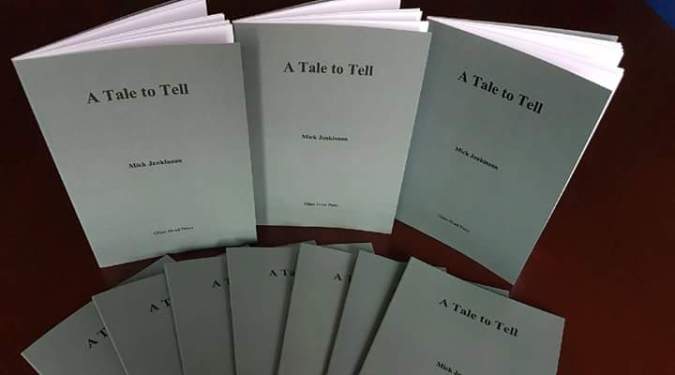
Wombwell Rainbow Interviews: Mick Jenkinson

Wombwell Rainbow Interviews

I am honoured and privileged that the following poets, local, national and international have agreed to be interviewed by me. I gave the writers two options: an emailed list of questions or a more fluid interview via messenger.
The usual ground is covered about motivation, daily routines and work ethic, but some surprises too. Some of these poets you may know, others may be new to you. I hope you enjoy the experience as much as I do.
29261673_2161227613887344_3361518890801692672_o

Mick Jenkinson

1. What were the circumstances under which you began to write poetry?

Morning Paul. When I try to recall poetry in my teens I struggle to put it into context. I enjoyed the poetry we did for O Level, and D Thomas, Elliot, Blake and John Donne left an impression, but I don’t recall being required to write poetry at school. More likely it was song lyrics, particularly Dylan, that inspired me to write. Friends of mine who had a band set a poem of mine to music and that definitely spurred me to pick up a guitar. For the next 30+ years, all my written output, I would say, was intended to be song lyrics rather than poems. To put that in context, though, interspersed with working as a musician, there were long periods where I did no writing – family priorities, running a business and heavy academic studies took up a lot of time and energy. And, is was the process of searching out renewed inspiration to write songs 6-ish years ago that led me to a class that Ray Hearne was instigating – I knew him as an excellent song writer, but had not been aware of the depth of his poetic knowledge. Almost without realising it, my writing began to lean more self-consciously towards poetry than lyrics,
1.1 How much is music an influence on your style?

I have great difficulty analysing or enunciating my style at all! That might be because I don’t spend too much time thinking in those terms. I have always leaned to wards music where one would say the lyrics are of particular importance – Dylan, Springsteen, Steve Earle, Elvis Costello; protest singers and also the so-called singer-songwriter movement. I also love folk music and its emphasis on telling stories, but counter-intuitively,­ my poems lean towards a lyric rather than narrative style. Although I treat song lyrics with the same respect as poems, I would say that in terms of influence it’s more by osmosis that anything conscious.

1.2 What was it about D Thomas, Elliot, Blake and John Donne that stayed with you?

That’s a big question! A couple of generalisations: poets who can paint pictures with words – Blake’s work is intensely visual, and I recall reading Elliot’s Journey of the Magi and feeling as if I were in a film. The way language which appears oblique on the page could have such emotional resonance – both Elliot and Thomas are masters of taking you on an odyssey without you having to understand each sentence. And existentialism, which has a strong undercurrent in my writing – I guess Donne’s No man is an island and Death be not proud would be good examples; there’s an element of that which appeals to teenage angst. Hopefully I’ve leaned to articulate it in a more mature manner in the intervening years!

3. How aware were you of the dominating presence of older poets?

Is that question deliberately in the past tense, i.e. as I was first exposed to poetry? I would say not at all. Obviously among those who I listed as early favourites, they span from Donne in the 16th century to Thomas, writing in the 30’s and 40’s, but since I had not formal poetic tuition, the period of their output, historical context and their relevance to poetry as a genre was entirely lost on me. I can remember, shortly after, discovering – still 10 years after the fact – the Liverpool poets, and feeling some sort of kinship or recognition that they were speaking a language more closely allied to my own.

4. What is your daily writing routine?

I don’t have a routine. My life is too crammed with other obligations – family and day-job as well as music and poetry commitments – to adopt a formal routine; at least, that’s my excuse! It is an ambition, I’d even call it a plan, to organise life in future to give me the license to make more structured creative time.

5. What motivates you to write?

That’s difficult as it’s so ingrained in me that it can be anything. I have a passion for writing about the locality, so am constantly aware of the landscape and social politics of Doncaster and district, as well as being inspired by travel and my interaction with other places. I can be inspired by art, but that’s a more deliberate and self -conscious exercise. A relatively recent phenomenon for me is a consideration of my own past lives and relationships; what went right and what went wrong, and how I ended up where I am. I hope that’s not a form of mid-life crisis, but either way, I am finding that is fertile ground for self-reflection and exploring my attitudes.

6. What is your work ethic?

I am good at deadlines. I am an inveterate scribbler of notes and ideas, but not very good at the self motivation it takes to hone them into finished articles, But if I am told, or make someone a promise, to deliver a poem by tomorrow, it becomes, by magic, an obligation I am duty-bound to fulfil and I will skip meals, sleep and whatever else to achieve it.

7. How do the writers you read when you were young influence you today?

The writers I have listed were foisted on me, I suppose, and unless there are others who I have conveniently written out of my memory, I would say the choices were pretty good ones as they have stayed with me. Working with mentors – Ray Hearne and, more recently, a very close relationship with Ian Parks – has opened lots of new doors, but, just as importantly, has rekindled my interest and given new perspectives to what I was already familiar with. I think the process of studying poetry, as much as the influence of particular poets, is what inspires me to write of late.

8. Who of today’s writers do you admire the most and why?

JH Prynne continues that lineage of poems that can look willfully obscure but be very moving, I have a lot of time for Simon Armitage for his micro-observational sense, Alice Oswald has that intense use of visuals that I referred to earlier, and Don Patterson, who is great at breathing new life into the traditional forms of poetry as well as for achieving a sense of transcendence that makes me somewhat jealous. I can’t not mention our own Ian Parks, who in recent years has been the biggest single influence, both for his poetic practice and for the weaving of the personal and the universal into poems with a politically radical edge.

9. Why do you write?

I have always felt, even in the protracted periods I have produced little or nothing, that it’s one of the activities that defines me and gives my life value as well as being personally fulfilling. I see it as a way of making sense of the world around me.

10. What would you say to someone who asked you “How do you become a writer?”

Ha. I don’t consider myself qualified for that, but in my experience 1) Have a piece of paper constantly to hand and write something, anything, as often as possible. 2) Give yourself some reflective time with all your scraps of paper and tell yourself you will produce something complete that you believe in, and 3) Join a writing group. I can’t comment on the quality of these in general, I might just have been lucky, but for me it has put me in the proximity of people from all walks of life, with every sort of prior experience, but each of whom has something to teach me, and the act of being in that environment is a great spur to write.
I was lucky enough to have had a pamphlet published this year. It’s the first time I’ve been referred to as a poet and felt I could accept is as both an appellation and a compliment without feeling an impostor, and that feels good.

11. Tell me about the writing projects you have on at the moment.

I want to produce a larger and more consistent body of work to either form a second pamphlet or a more substantial first book collection. I need to both make more time to write and to seek out opportunities to perform in order to improve my on-stage delivery to do the poems justice.
I have an ongoing writing project with Ian Parks, in which relationship I cede the lyric writing to Ian while I concentrate on the music and arrangements, We produced an album – Songs of our Town – last year, of which we are both immensely proud. That arrangement remains constantly fruitful and a second CD will almost certainly appear in 2019.
I also work with a rock band, a bunch of musician friends that have been friends for more years than we care to admit. We released our first album for 35 years in 2018, and the reception that it received has inspired us to pursue that with a little more vigour, so that will be my outlet for the songwriting side of my written output.
Tied up with all these is to shed a few responsibilities of my day job, which is not proving as easy as it ought. Some sort of semi retirement is the goal, though I hesitate to use the word retirement, as the intention is just to shift time and energy towards the things I love doing most.

No Account of Trifles, a poem . . . and your Wednesday Writing Prompt. Anyone may submit a poem and have it featured next Tuesday.

via No Account of Trifles, a poem . . . and your Wednesday Writing Prompt

Wombwell Rainbow Interviews: Sofia Kioroglou

Wombwell Rainbow Interviews
I am honoured and privileged that the following poets, local, national and international have agreed to be interviewed by me. I gave the writers two options: an emailed list of questions or a more fluid interview via messenger.
The usual ground is covered about motivation, daily routines and work ethic, but some surprises too. Some of these poets you may know, others may be new to you. I hope you enjoy the experience as much as I do.

IMG_1359-768x1088

Sofia Kioroglou

According to her WordPress site: “is an award winning poet, 2017 Best of the Net Award nominee by Sundress Publications, author of two poetry books, translator,lexicographer, journalist and painter born and bred in Athens, Greece. She is an avid reader and iconographer of saints and believes in human kindness and sacrifice. She would be a cave recluse in Raitho or Sinai had she not met her husband Peter in Jerusalem at the Holy Light Ceremony in 2012. Her work has won a number of distinctions and commendations in the international press, and has appeared in many international literary journals and books such as Silverbirchpress, Galleon Literary Magazine, Outlaw Poetry, Lunaris Review, The Blue Nib, In between Hangovers, Basil o ‘Flaherty, The Galway Review, Verse-Virtual, Winning Writers, Winamop, Halkyon Days, Ashvamegh, Aenaon, Pengician, Poet’s Corner, Writink Page, I am not a silent Poet, Poetic Diversity, Epok.gr, Dumas de Demain, Visual Verse, tovivlio.net, Greek Poets of the Internet, Fractal, Festival for Poetry, Hephaestus Wein, Bonsaistories, the Poets of the World that I Loved, as well as in many anthologies like the Poetry against Terror Anthology, Singing together for  , the Spiritual Horizons Anthology, the Poetry Against Inequality Anthology ,Voices without Veils, By Land and By Seas,56 Female Voices for Poetry, Haiku and Tanka, the Universal Values Anthology to name but a few. Her flash fiction “Cubicle Coma” was selected for publication in Books’ Journal and Planodion. Sofia is a member of the Poets Unite Worldwide.  Her poem” They bite the hand that feeds them ” was voted one of the best of February 2017 at the Festival of Poetry to be made into a movie.”


The Interview

1. What were the circumstances under which you began to write poetry?

I began to write poetry after the death of my father. All the woe and grief I felt had to find an outlet and poetry was the perfect countervailing force.

2. Who introduced you to poetry?
It has been an innate need since I was a little girl to write down my feelings in a poetic form. I have stacks of poetry chapbooks gathering dust on the shelves dating to my childhood years.

3. How aware were you of the dominating presence of older poets?

Poets like Gatsos, Elytis and Sachtouris have been a poetic  beacon for many aspiring poets like me but I reckon I will never live up to the high caliber of their work.
4. What is your daily writing routine?

If truth be told, I write in snatches! I go by my gut. There are fallow periods of writing followed by really creative bursts.

5. What motivates you to write?

Real life events. I don’t like romanticism nor do I crave recognition pandering to the demands of publishing houses just to sell something. My poetry is also inspired by my travels to holy lands and partakes of a religious element.

6.. What is your work ethic?

For some reason, I am averse to criticizing other people’s work nor would I write anything that would make anyone feel bad. We all write because we want to express something that gnaws away at our innards. How would I say anything negative about the way somebody feels and expresses through his writings? I am also against plagiarism and I abhor excessive self-publicity. This is sometimes done inadvertently but it is ruining our case.

7.. How do the writers you read when you were young influence you today?

I go back over their work and find their work more apposite than ever. Their work is timeless and certainly has left a mark on the way I write.

8. Who of today’s writers do you admire the most
and why?

Vincent Zepp, Firestone Feinberg, Donna Hilbert, Rick Lupert, James Walton and Rich Quatrone. They are all exceptional poets with a distinctive voice.

9. Why do you write?

Because I can’t live without writing.

10. What would you say to someone who asked you “How do you become a writer?”
By writing your true you and not what others want to hear.

11. Tell me about the writing projects you have on at the moment.

I have two new books coming out. The first one is slated for publication by Gramma Publications and Promachos at Christmas and the next is a children’s book probably making its bow in June, God willing and the creek don’t rise

Wombwell Rainbow Interviews: Duane Vorhees

Wombwell Rainbow Interviews

I am honoured and privileged that the following poets, local, national and international have agreed to be interviewed by me. I gave the writers two options: an emailed list of questions or a more fluid interview via messenger.

The usual ground is covered about motivation, daily routines and work ethic, but some surprises too. Some of these poets you may know, others may be new to you. I hope you enjoy the experience as much as I do.

41QhdHnsQFL._SX322_BO1,204,203,200_

Duane Vorhees

According to Amazon Duane has been a scholar, professor, performer, actor, model, journalist (dish washer, truck driver, lifeguard, door-to-door salesman, labourer…), and poet. Now retired, he divides his time between Thailand and Ohio with his wife and son and finds that he has plenty of time to write and speculate while managing duanespoetree1.blogspot.com, a site devoted to literature and the other creative arts.

The Interview

What were the circumstances under which you began to write poetry?

Like others in my 6th grade class, I had to write poetry as a Christmas assignment. I think I wrote three, and two of them were published in the school paper. But I was a bit upset because one of my classmates had three accepted. It wasn’t that he had more, but that he misused “forlorn” so it would rhyme with “morn.”

Who introduced you to poetry?

Poetry was a bad blind date on many occasions. I never had a teacher who made me overcome my dislike of the subject. The one, partial, exception to that was a writer in residence at Bowling Green State University; he introduced me to a lot of avant-garde poets of the day, when concrete poetry was a fad. I didn’t much like the poets but they did widen my eyes to possibilities. A student in class brought in Leonard Cohen’s first album, beginning a love-hate relationship that still persists.

How aware were you of the dominating presence of older poets?

I have never been aware of them, I guess because I’ve never been part of any poetry circle or coterie.

What is your daily writing routine?

I don’t have one. I wrote when “the spirit moves me.” When that happens I cannot NOT write.

What motivates you to write?

I used to write as a rule-breaking exercise. I would come across some teacher, critic, or writer who would dictate some sort of prohibition, and I would often try to see for myself if that were true. They were usually wrong. That developed into a less contrarian approach. I stumble organically upon some form or pattern, and then try to develop it into a consistent approach for that particular poem. This is poetry as puzzle solving or the solution of a problem in geometry.

What is your work ethic?

I’ve never been able to write a poem on schedule or with an end in mind. I’m always surprised about the way it develops. But once I get started I go at it tenaciously until the poem is finished — or I am. I can get pretty persnickety about it all, and typically I go through a lot of revisions. It’s an odd process, one that begins in inspiration and ends in perspiration.

How do the writers you read when you were young influence you today?

When I find myself being influenced by Cohen or cummings or the Henry Reed of “Naming of Parts” I know that it is time to stop what I’m doing and start over. I hope that I catch myself doing so in time.

Who of today’s writers do you admire the most and why?
I run a daily blog, duanespoetree.blogspot.com, which is philosophically an electronic open mic, and I admire all of the poets who are brave enough to expose themselves to the madding crowds.

Why do you write?

Why do birds fly?

What would you say to someone who asked you “How do you become a writer?”

Buy a pencil. And lots of erasers.

Tell me about the writing projects you have on at the moment.

I just published a collection of poems, “Love’s Autobiography,” a truncated version of “The Many Loves of Duane Vorhees,” the skeleton framework of a novel or movie examining loves. The published part explores a youthful naïve relationship, a sex-and-insecurity fuelled romance, and a marriage/and/divorce. I’d like to publish the rest of the book, dealing with midlife-crisis pursuits, a late-blooming fling, a coming to grips with aging, depressing, and the love of death, and finally, against all odds, a relapse into a loving relationship. I also have a more experimental, less thematic, series of poems, and some translations from Korean and Chinese. I also want to rewrite my PhD dissertation on Immanuel Velikovsky and put him in his various milieus.


“Born on the Wind” . . . and other responses to the last Wednesday Writing Prompt. Delighted to have four poems featured in The Poet By Day among outstanding talent. Thankyou, Jamie.

via “Born on the Wind” . . . and other responses to the last Wednesday Writing Prompt