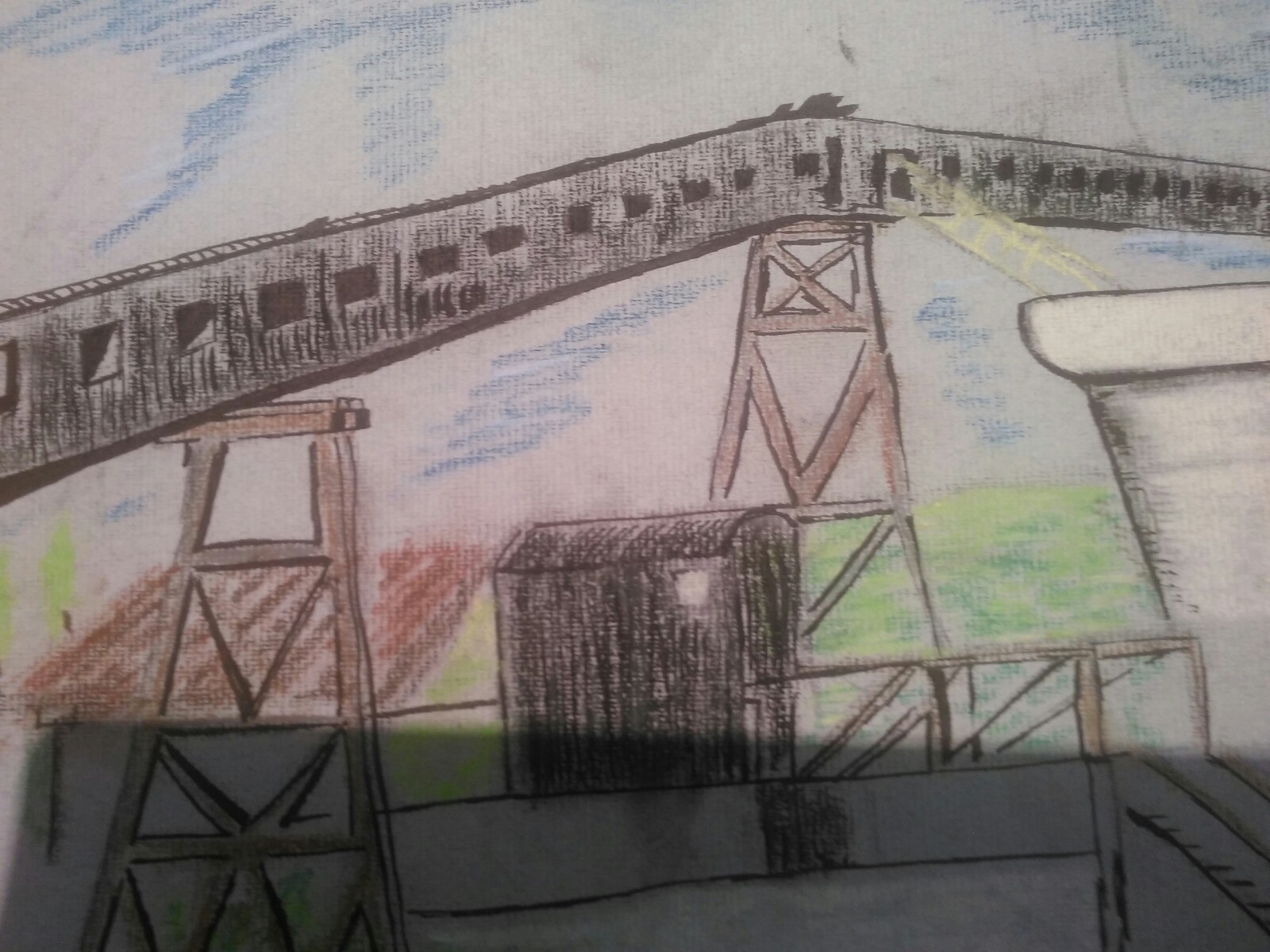
Land Is History

Is a past pitman. Father, a nailmaker whose strong coffin nails  stout fastened the woods  grain swish as land without a skeleton to hold its’ skin.

Both, like open cast places. Redundancy has ripped old features from their faces, old skulls from beneath their skins.

Redundancy within weeks drained the Dearne from arteries, smoothed disused canals from cheeks, wetlands asset-stripped from eyes.

And children sit on father’s knee as on a hill hear how men made hills a sack of land a weight of meaning emptied.

Land no longer propped  by miners hands                               subsides

into history. via WordPress for Phone http://goo.gl/j6Fzhf

Day the statues came alive in Barnsley

Day the statues came alive in Barnsley
Outside college Dickie put his finger down

Day the statues came alive in Barnsley
Outside Tarn Hall soldier slumped after years of standing

Top of Kendray hill a Golden man was lifted by an angel into heaven
Day the statues came alive in Barnsley

via WordPress for Phone http://goo.gl/j6Fzhf

Two Female Eighteenth Century Rivals Gain All You Can (Quack Peggy Mock, extract)

Gain All You Can
I heard eighty three year old John Wesley speak today from the mounting steps of The White bear Inn. His step was firm, his appearance vigorous and muscular. A clear, smooth forehead, an aquiline nose, lightest and most piercing eyes, freshness of complexion. His countenance and demeanour was cheerfulness mixed with gravity; an unusual flow of spirits but a mark of tranquillity. In dress, a pattern of neatness and simplicity. A narrow plaited stock, a coat with a small upright collar, no buckles at his knee, no silk or velvet in any part of his apparel and a head as white as snow.
He preached for an hour or so, filled out and varied the basic material with anecdotes and illustrations. Throughout he spoke in plain language. His subject appropriate for this commercial town: gain all you can, save all you can, give all you can. When we gain all we can it must be from honest trades, we must not haggle over prices and usury should not be tolerated. Conspicuous consumption is wastefulness. We gain and save only to give, and when we give we should do so to the poor. Salvation for all is not dependent on good works but must issue from good works as part of our progress.
He who is holy, humble, courteous, mild,
And who, as heav’n’s viceregent strives to prove Himself entitled to the rank he holds,
Deserves our admiration and applause.
What an economist thou wast of time; What method, regularity, and form, Thou shew’dst in ev’ry action of thy life, And all this for the honour of thy God, And the advantage of thy fellow men, without a mercenary view in it,
I cannot but applaud thee for such deeds Admire thy ardour, venerate thy name, And eulogize thee, as the best of men.
Philanthropy
Friend Richard Peaudane has removed his garish dress and thinks to impress me with this. I reminded him of my other stipulation: plainness of manner. He says he has observed John Wesley preaching in the town and would hold him also as another example of neatness and cleanliness. Methodists hold much the same persecuted position in this society as we held in the previous century; prone to preaching so as to change society, a cause we have fallen from, after much of our brethren were persecuted. Though, it must be said they support our Friend William Wilberforce in his fight against slavery, Perhaps Friend Peaudane is correct in following John Wesleys example: A black frock without decoration and a white ruffle, In appearance, at least, he is what I would hope for in a spouse. I then reminded him, that though plain in appearance, the nature of a Quaker is consideration for others. I espoused my belief in the evils of slavery. A commercial man, I was surprised that he also felt the indignity, the horrific notion of one man the slave of another as the basis for a good society was a venal sin. With each conversation and change in ‘ the man, if only cosmetic, I begin to see his fair and just side. This has impressed upon me more than his change of costume.


Wild Woman (2)
Unmanned, like a bull bereft of all; a flaccid decoration without use;
at least if thee had what I have thou could be a woman; eunuch hiding your treasure for marriage
and hypocrisy. And leave me with empty decoration; rings without sense,
dresses without purpose.
Go about your business thou say
I want nothing to do with thee now;
yet not a month ago it was all Peggy this,
Peggy that; such are the changes of the seasons.

I cannot give birth to an empty ache;
wet nurse it; teach it its fathers worth;
I cannot tell the ache how we loved,
how we met, how we joyed.

I cannot sit round this mughouse days and months

I must out into the world roll in the smell of Man again
with a jug of ale in one hand
and earning a stony crust
from some wight with a jangling purse.

And forget the bull that was castrated.
Helping Joseph
Joseph Lister is one of my many custom weavers. I shall offer him board in my premises. It will remove my loneliness awhile and further prove to Sarah my will to have her bound to me.
Joseph and his brother James have inherited a four-loom shop at Beaver Hoyle from their uncle, John Lupton. Joseph has acquired a wife, Susannah Bottomley of Wooldale and a son. Susannah is pregnant again. John wishes to make a life separate from his brother James. He is a regular and fastidious workman like his uncle. And John Lupton portrays his nephew as a pattern of industry. As he produces the linen that we may spread it out on the fields to dry, to croft, so he may gather it up and store it in my attendant warehouse. If I cannot help him in his progress then I am the poorer man as my future wife Sarah has taught me.
As I observe Susannah with Joseph, she is constantly curbing his generous nature. A beggar came to our door and asked for shoes and Joseph gave him his best brogues without a thought. Susannah scolded Joseph with the words: We have not enough for our own feet and you give away our best. We must gain and save before we can give! Joseph, smiles and kisses her pregnant stomach. As I presumed a wife becomes more than a companion, but a moral arbiter. A family dispels the disconsolate air. This place of mine does not feel so empty. It only lacks a wife for myself.

Lost to Women
O monster of Reason what have you forgotten: how we wet the drying fields of linen

and Barley where you ground my com
with a jug of mughouse ale
and fresh and naughty manners; this was our rusticating;
you strode a giant amongst my hills and made the river flow.
Now you stride through town cocking a snoop at all you laughed and jollied with before; nothing but a prig made up to look like summat.
But your dear pouch must yearn like a custom weavers shuttle for some
decent to and fro.
I know my threads are breaking without your damp,
snapping like twigs in Autumn,
Arid dry as an empty jug.
 Means not Ends
I went for a walk with Friend Dearman at Dearne Flats. I have decided that this relationship should become more public and thereby confirm the rumours of our companionship.

The River Dearne, though prone to dangerous flooding has its own delights. And The Flats are known for their courting couples and rusticating. A note upon this word: rusticating would once have been frowned upon. After all, what can be gained from grass and trees for they are wasteland. Just as the soul can be desolate and made beautiful, perhaps with change in mood, even the worst excesses of tree, grass and river can be seen to improve the soul.
Still Friend Dearman sees philanthropy towards others, plainness of dress and mildness of manner as ends in themselves. I told him that the only path by which he can show real change is for him to have ideas and manners of his own. Too many Commercial men are taken in by the mechanical nature of change. It is the human heart that must change too. He must no longer see the Dearne as a navigable waterway and more as a stream that gives life to its surroundings. I am not only to be his wife but a companion too.

prosperity

I said to Friend Peaudane, as we walked Dearne Flats by the serpentine river that he has more than proved his worth as a husband. I would gladly accept him in such a position and be willing to bear him children to cement our association. He answered that it is only a beginning and we must both strive for the ends I described to him at the beginning, extravagance in our generosity towards others, both personally and publicly. It is now Friend Peaudane, that wishes me to call him Richard as he shall call me Sarah and that we should wait a time yet till we are married. He has his duty to Joseph and family to fulfill.
Yesterday he was present when Susannah, Joseph’s wife gave birth to their second son. Joseph and his brother James who is now living there too pacing up and down, wanting to drown his sorrows Clearly, since I ventured upon this self improvement my mind has moved to the self improvement of others and I find I like myself. I should be wary of too much pride in what I know of myself New converts are likely to be over vociferous for others conversion. Knowledge is power.

via WordPress for Phone http://goo.gl/j6Fzhf

Thomas Laurence, Coal Merchant and sloop owner

wpid-avatar_1395167284257.jpg

Thomas LAURENCE owned shares in a sloop, called ‘Alpha’, that exported corn to Hull, importing coal on the return journey. 

According to local newspaper reports the sloop “Alpha” under Mark AARON’s Captainship also transported coal and goods to Wisbech, Cambridgeshire from Goole returning with corn and fruit. Goole to Wisbech converted to statutory miles is 127.16. Hull to Louth is 32.86. Both would take a few days I reckon. Then there is loading time to add.

One example I have found in the local newspapers. The Alpha under Mark AARON in the Leeds Intelligencer, 18/06/1842, for period June 9-16 coasters inwards for Wisbech with coal, then Lincolnshire Chronicle, 24/06/1842, sailed for Goole with corn and fruit.      

         The `Alpha`, official number (14410) In the Goole shipping register, NSG/3 page 11, entry relating to ‘Alpha’ dated Jul 1841, the Registration number/year is 30/1841 and name of master: Mark AARON. It states it was built in Thorne in 1841 by William ATKINSON as a sloop. The names of owners at time of registration were Mark AARON, Thorne, master mariner, Thomas LAWRENCE, Louth, merchant, John Booth SHARPLEY, Louth, merchant. Last entry: includes entries to 1854.

Other sections include: burthen: 43 2481 over 3500 tons, Surveying Officer: Thomas Parry TIDE, number of decks: one, number of masts: one, length from inner part of the Main Stem to the fore part of the Stern aloft is 5 feet, breadth in Midships is 13 feet, depth in the hold at Midships is 6 feet one tenth, type of bowsprit: round, number of shares for each owner: Mark had 22, Thomas and John 21 each to make up the 64 shares that were had in a vessel.

Mark had the controlling shares, so Goole to Wisbech and back may well have been his own.

William Atkinson (19 Mar 1787-Sept 1854) was from a shipbuilding family, canal side, Thorne, nr. Doncaster. Mark AARON (1791-6 July 1865), also had a son of same name (1828-1874), who took over captainship of ‘Alpha’.

In 1848, Thomas sold his shares back to John Booth SHARPLEY, who in turn in 1867, sold the ship to William BELL of Hull. Tom LAURENCE became insolvent in 1851.

Sloops mainly handled bulk cargoes between the Humber ports, carrying farm produce from Lincolnshire, coal from the West Riding, bricks and tiles between both sides, cement and chalk stone from Barton and South Ferriby to Hull and transhipping phosphates back to the fertiliser works. In summer the sea going trade would be to Louth, Saltfleet, the ports of the Wash and on south to the Thames, to the north trade would be to Bridlington, the Tyne and all ports between.


Louth Navigation Trust (http://www.louthcanal.org.uk/)
are doing a brilliant job of researching the canal, recording its history and looking after the canal itself

via WordPress for Phone http://goo.gl/j6Fzhf

Who was Dr. Laurence?

20110804_151208_laurenceg01

The Times, Saturday, Oct 14, 1978 it was reported that George Laurence died at home aged ,88 and a memorial service for him and his wife Minnie who died in June of that year was held at 11.00 on Saturday 28 October 1978 at St. Marys Parish Church.I never met my ancestor but would liked to have known him. Did you know him?   He was born into a Quaker family on 19 October 1880 in West Derby, Liverpool of Thomas Davy Laurence, a prosperous Temperance Hotel proprietor, Chairman of the Select Vestry who organised the Liverpool Workhouse and soon to be magistrate. His mother was Kate Parkes whose father was an independent clergyman. In 1904 George qualified in London as a doctor and surgeon and in 1915 as a surgeon in Edinburgh. Whilst training to be a Doctor he married his first wife Olive in 1907. Once qualified he worked as a local doctor in Chippenham, Wiltshire. In 1934 his father who was living with him died. George had also been present in Torquay in 1929 when his mother Kate died. In 1922 when the Temperance Hotel was demolished Thomas had resigned as local magistrate to look after his sick wife in Torquay. After her death he moved to Chippenham to live with his son George. Olive had two children, Robert Wilton and Mary Blanche. From June 1942 to end of May 1954 he was employed as Works Medical Officer who was also in charge of Welfare being Chairman of the Works entertainment committee for Westinghouse Brake and Signal, whose employees rose from 2,500 in 1942  to around 4,500 in 1954. In 1953 his first wife died and he married Minnie Pike. Upon retirement he moved into private practice in Wargrave, specialising in homeopathy. In collaboration with two others he published a book called Psionic Medicine and founded the Psionic Medical Society. He lived at Mumbery Lodge, School Hill which he had built for him, now demolished. Were you one of his patients, did you know him? Please could you tell me more about him

Letter printed in the Wargrave Times via WordPress for Phone http://goo.gl/j6Fzhf

Signs of his Presence/Safety


SIGNS OF HIS PRESENCE

Kitchen door dented

where your ex flew off the handle

 at the slightest.

 Your ears are attuned to strange cars moving in the cul-de-sac.

You twitch
. open the curtains and check.

 You could not
 say his name for six months

after
 you told him to go.

SAFETY 

 A dumb-bell by your bedside.


Under your pillow a baseball bat.

Knives on the surfaces
 lead poker on the landing,
 Or are these in your head?

 The knives are sharp,
 the dumb-bell heavy
 as the stories of his holding
 a frying-pan above your head

make his point,

 He is here
 in the household waiting

for you to be alone
 to bring him out of hiding.

Copyright Paul Brookes, ‘The Place For Breath’ (1995)
via WordPress for Phone http://goo.gl/j6Fzhf

The Need to Move

from a state of siege,
from neighbours eyes,
from counting pennies,
from doing without

from checking windows,
from skimp, save
and charity,worn furniture

Clothes prying eyes
 from called ‘permissive’, abnormal,
 idle, sponger, mother to undisciplined kids, a threat to The Family.

to a new boyfriend
 who stays over
 without Social
 saying we’re married

after three consecutive nights,
 withdraw my book
 and tell him he’s to support us

From never depending on a man,
 his money his car, his reliabliity, his word

to a state of independence

Copyright Paul Brookes from ‘The Place Of Breath’ (1993)

via WordPress for Phone http://goo.gl/j6Fzhf

Two Eighteenth Century Female Rivals (Extract from ‘Quack Peggy Mock’

Beast
 She’s turned you into a beast; a gamboling bear in the market place. Turning at her dry stick this way and that. Dancing to the beat of her words to earn a pittance of her crust.
 I forget myself you are not lonely that is not the reason for marriage; you just want your reputation back. Some wights took it away from you shouting about the town. Well when you have it back I’m waiting awhile till your senses return and we can salt each others meat again.
 She’s a peach your little quaker girl; that glory of red and yellow that has the ripeness of summer sun rising and nothing of the cold sun setting. She’s a globe, new land awaiting your travelled feet upon her shore. You would pluck her, and bite into her softness till the juice of pleasure washed both of you into joy, and she would bite into you, for you would be a peach too and both would joy until as two seeds lain side by side you marvelled at being fruit enough for the others pleasure. But I forget you are quakers and must give over such pleasures.
 Plain is Good
 Friend Richard Peaudane has attended our Meeting once more. His outward appearance has not altered and I fear the worst for my advice. The accused, being himself: has turn’ d the accuser. Openly, he sallied forth in the town and shouted his accusers were thieves. He has told all the town, enlarg’ d, vociferated, made some believe, and some like myself to stand in doubt. He says he has made the tale-bearers look like fools. I told him one pronouncement does not show a changed nature. If he is to attend our meeting again and have words with me he must endeavour to go beyond the artificial changes he is making. I hold out hope that on our next meeting we may be nearer husband and wife.

via WordPress for Phone http://goo.gl/j6Fzhf

The Light 1985

I like light to come to my eyes gradually.

I will stand on the slagheap at midday and watch the fleeting clouds pass their shadows over the pit built solidly below.

It reminds me of wind gusting through cornfields. White clouds moving over hills in the Lake District or the Peak.

I sit on the edge of the manmade hill and see the different shadows ripple over the great washer building, over the cylindrical slurry tanks, move flat across the concrete bunkers where lie the remains of unused sand, gravel and lime. wpid-img_20140428_100148.jpg
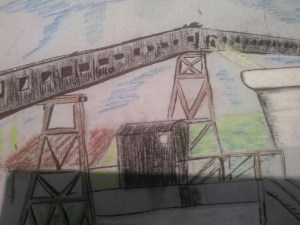
It reminds me of the darkness a few days before when I was on nightshift at this place. Freezing till the veins of my hands stood up purple and ice encrusted in the ground made the concrete more hurtful when you fell like when I delivered the post one Christmas in Royston and slipped, the weight of the bag hauling me down to push and prise open the sprung letter boxes put the letter through so your whole hand went inside the house and then quick out for the lid to slam shut in your face.

The shadows are never what they seem and as the long night becomes morning without getting lighter you imagine bushes are people: old men slumped down after working the pit, Gentlemen in cloaks, or women in jeans so during the day real people seem like those shadows. Never what they seem.

 I think whoever I meet wants to hurt me. The brash people are like lights snapping on. They hurt my eyes. They frighten me. I want the darkness again. And yet the darkness always makes them what they are not.

I imagine shapes that revealed in the spotlight of my hat lamp are not what I imagined. wpid-img_20140428_100213.jpg
My father hit me when I was nine in a room whose electric brightness was too much for me . It invaded the darkness behind my wet eyes when closed.

My mother tried to hug me ironing her dress for going out. She was in her bra and panties. She hugged me to her and all I could saw was bright light, blinding me.

I turned away from her away from the light. Used my own body as a shield for my eyes.

Electric light reminds me of grief and tears.

The bulb was especially bright the night my mother told my sister and myself that dad and her were divorcing.

It had been too bright all the evenings they were arguing themselves into it.

I learn gradually. The light dawns as the cliche goes. When someone tells me something I look bemused because it takes a long time for the light to dawn.

I have no flashes of inspiration. My intuition is gradual, cumulative. People shine bright lights in my eyes when they try to hurry my thinking along. Because I do not think as fast as they would like me to.

My thoughts are clouds passing over the redundant pit and this is my life as far as I am concerned.

My last girlfriend dimmed harshness of the lounge light before we had sex on the couch awaiting her son, whom she said did not know we slept together. He would call out, ‘Mum. When you coming to bed?’

I always waited half between awake and asleep for his call like a harsh light in the eyes to come and alter the situation, for she always went upstairs and I was left.

Once I worked in a department store due to be closed because of the Recession.

 On the day we received, without warning, our redundancy notices, the section manager said ” Can We move those light fittings over there and bring those shades over here.”

On the training course they had explained that customers need to have fresh items to buy. They soon get bored. They need a thirty day or less ‘item bite’.

The job centre I’d worked at six months previous held the same opinion. Jobs on the boards were replaced every day by new ones.

John the lad I’d shared a house with three months could not stay in one place too long. He got bored. Same with his girlfriends.

Once we had shifted the items. put those that were not selling at best selling height we had lunch. I went out for fresh air. A demolition crew were knocking down the last of St. George’s church. I saw the new roundabout at Townend and the shop that had changed it’s name from Leos to Pioneer.

It struck me all of a sudden.

I saw the corrugated roofs of the new shops and knew every building, every person in the town was temporary.

It had been a local joke that the council ignored preservation orders and knocked down old buildings. There was still nostalgia for the best market in Britain that had been ‘improved’ by a concrete indoor market, after the flood of 1968.

Workmen are always digging up the recently laid pedestrian precinct. Plenty of jobs in the demolition and construction trade.

Recently, the closure of all pits in the area, renowned for its mining had enlarged the unemployment figures. They said the ‘shanty towns’ would become ‘ghost towns’. This town is a shanty town.


We are all gypsies. ‘Go,move,shift’ by our own decision but mainly others. The supermarket had renamed itself correctly. This is a frontier town.

Temporary and shifting. The place does not move. The people and buildings ever on the border.

I return to my bedsit, at the end of day, in preparation for the job hunt the following day. I learn my landlord has been registered an undischarged bankrupt.

UPDATE 2014 Psychogeography

Dodworth pit is now an out of Town industrial estate, that the overgrown green pitstack rises above like an Alpine hill.

Pioneer demolished, is now Lidl and Bargain Store.

And secret river Sough Dyke flies under the road downhill from Posh Pogmoor to Townend, where once Linen reservoirs once flowed onwards into the Dearne is now a lovely park for winos And some early early mornings you can hear Sough Dyke rushing under the road. Bottom of Market Hill when excavated workmen discovered the remains of an Eighteenth Century bridge over the Sough. So Market Hill used to be steeper. History is buried.

via WordPress for Phone http://goo.gl/j6Fzhf
A Dad

He loves women with walloping big breasts.
“It will not always be dark at seven.”
His favourite phrase.
An orphan. Parents could not cope. Put him away. He suffered bullies, brought up his brother.
Never went to his mother’s funeral.
His wife nags and shouts, off work with her leg.
The firm will not give her a sit down job.
Doctors can find nothing wrong.
Suffered illness all her life, all his married life.
Asked her husband to take her out.
“You must be joking!” he replied.
He only stays with her because of their son. He talks and talks of his son.
He says, “My boy when he were small used to say: ‘Me can do it! Me can do it!’
Well told him he couldn’t. ‘KICK DEE! KICK DEE!’
he would shout.” And this dad laughs away his disabled
wife.
Some psychologist might say this dad needs a mother. Why else love women with walloping big breasts?