Thomas Laurence, Coal Merchant and sloop owner

wpid-avatar_1395167284257.jpg

Thomas LAURENCE owned shares in a sloop, called ‘Alpha’, that exported corn to Hull, importing coal on the return journey. 

According to local newspaper reports the sloop “Alpha” under Mark AARON’s Captainship also transported coal and goods to Wisbech, Cambridgeshire from Goole returning with corn and fruit. Goole to Wisbech converted to statutory miles is 127.16. Hull to Louth is 32.86. Both would take a few days I reckon. Then there is loading time to add.

One example I have found in the local newspapers. The Alpha under Mark AARON in the Leeds Intelligencer, 18/06/1842, for period June 9-16 coasters inwards for Wisbech with coal, then Lincolnshire Chronicle, 24/06/1842, sailed for Goole with corn and fruit.      

         The `Alpha`, official number (14410) In the Goole shipping register, NSG/3 page 11, entry relating to ‘Alpha’ dated Jul 1841, the Registration number/year is 30/1841 and name of master: Mark AARON. It states it was built in Thorne in 1841 by William ATKINSON as a sloop. The names of owners at time of registration were Mark AARON, Thorne, master mariner, Thomas LAWRENCE, Louth, merchant, John Booth SHARPLEY, Louth, merchant. Last entry: includes entries to 1854.

Other sections include: burthen: 43 2481 over 3500 tons, Surveying Officer: Thomas Parry TIDE, number of decks: one, number of masts: one, length from inner part of the Main Stem to the fore part of the Stern aloft is 5 feet, breadth in Midships is 13 feet, depth in the hold at Midships is 6 feet one tenth, type of bowsprit: round, number of shares for each owner: Mark had 22, Thomas and John 21 each to make up the 64 shares that were had in a vessel.

Mark had the controlling shares, so Goole to Wisbech and back may well have been his own.

William Atkinson (19 Mar 1787-Sept 1854) was from a shipbuilding family, canal side, Thorne, nr. Doncaster. Mark AARON (1791-6 July 1865), also had a son of same name (1828-1874), who took over captainship of ‘Alpha’.

In 1848, Thomas sold his shares back to John Booth SHARPLEY, who in turn in 1867, sold the ship to William BELL of Hull. Tom LAURENCE became insolvent in 1851.

Sloops mainly handled bulk cargoes between the Humber ports, carrying farm produce from Lincolnshire, coal from the West Riding, bricks and tiles between both sides, cement and chalk stone from Barton and South Ferriby to Hull and transhipping phosphates back to the fertiliser works. In summer the sea going trade would be to Louth, Saltfleet, the ports of the Wash and on south to the Thames, to the north trade would be to Bridlington, the Tyne and all ports between.


Louth Navigation Trust (http://www.louthcanal.org.uk/)
are doing a brilliant job of researching the canal, recording its history and looking after the canal itself

via WordPress for Phone http://goo.gl/j6Fzhf

Who was Dr. Laurence?

20110804_151208_laurenceg01

The Times, Saturday, Oct 14, 1978 it was reported that George Laurence died at home aged ,88 and a memorial service for him and his wife Minnie who died in June of that year was held at 11.00 on Saturday 28 October 1978 at St. Marys Parish Church.I never met my ancestor but would liked to have known him. Did you know him?   He was born into a Quaker family on 19 October 1880 in West Derby, Liverpool of Thomas Davy Laurence, a prosperous Temperance Hotel proprietor, Chairman of the Select Vestry who organised the Liverpool Workhouse and soon to be magistrate. His mother was Kate Parkes whose father was an independent clergyman. In 1904 George qualified in London as a doctor and surgeon and in 1915 as a surgeon in Edinburgh. Whilst training to be a Doctor he married his first wife Olive in 1907. Once qualified he worked as a local doctor in Chippenham, Wiltshire. In 1934 his father who was living with him died. George had also been present in Torquay in 1929 when his mother Kate died. In 1922 when the Temperance Hotel was demolished Thomas had resigned as local magistrate to look after his sick wife in Torquay. After her death he moved to Chippenham to live with his son George. Olive had two children, Robert Wilton and Mary Blanche. From June 1942 to end of May 1954 he was employed as Works Medical Officer who was also in charge of Welfare being Chairman of the Works entertainment committee for Westinghouse Brake and Signal, whose employees rose from 2,500 in 1942  to around 4,500 in 1954. In 1953 his first wife died and he married Minnie Pike. Upon retirement he moved into private practice in Wargrave, specialising in homeopathy. In collaboration with two others he published a book called Psionic Medicine and founded the Psionic Medical Society. He lived at Mumbery Lodge, School Hill which he had built for him, now demolished. Were you one of his patients, did you know him? Please could you tell me more about him

Letter printed in the Wargrave Times via WordPress for Phone http://goo.gl/j6Fzhf

Signs of his Presence/Safety


SIGNS OF HIS PRESENCE

Kitchen door dented

where your ex flew off the handle

 at the slightest.

 Your ears are attuned to strange cars moving in the cul-de-sac.

You twitch
. open the curtains and check.

 You could not
 say his name for six months

after
 you told him to go.

SAFETY 

 A dumb-bell by your bedside.


Under your pillow a baseball bat.

Knives on the surfaces
 lead poker on the landing,
 Or are these in your head?

 The knives are sharp,
 the dumb-bell heavy
 as the stories of his holding
 a frying-pan above your head

make his point,

 He is here
 in the household waiting

for you to be alone
 to bring him out of hiding.

Copyright Paul Brookes, ‘The Place For Breath’ (1995)
via WordPress for Phone http://goo.gl/j6Fzhf

The Need to Move

from a state of siege,
from neighbours eyes,
from counting pennies,
from doing without

from checking windows,
from skimp, save
and charity,worn furniture

Clothes prying eyes
 from called ‘permissive’, abnormal,
 idle, sponger, mother to undisciplined kids, a threat to The Family.

to a new boyfriend
 who stays over
 without Social
 saying we’re married

after three consecutive nights,
 withdraw my book
 and tell him he’s to support us

From never depending on a man,
 his money his car, his reliabliity, his word

to a state of independence

Copyright Paul Brookes from ‘The Place Of Breath’ (1993)

via WordPress for Phone http://goo.gl/j6Fzhf

Two Eighteenth Century Female Rivals (Extract from ‘Quack Peggy Mock’

Beast
 She’s turned you into a beast; a gamboling bear in the market place. Turning at her dry stick this way and that. Dancing to the beat of her words to earn a pittance of her crust.
 I forget myself you are not lonely that is not the reason for marriage; you just want your reputation back. Some wights took it away from you shouting about the town. Well when you have it back I’m waiting awhile till your senses return and we can salt each others meat again.
 She’s a peach your little quaker girl; that glory of red and yellow that has the ripeness of summer sun rising and nothing of the cold sun setting. She’s a globe, new land awaiting your travelled feet upon her shore. You would pluck her, and bite into her softness till the juice of pleasure washed both of you into joy, and she would bite into you, for you would be a peach too and both would joy until as two seeds lain side by side you marvelled at being fruit enough for the others pleasure. But I forget you are quakers and must give over such pleasures.
 Plain is Good
 Friend Richard Peaudane has attended our Meeting once more. His outward appearance has not altered and I fear the worst for my advice. The accused, being himself: has turn’ d the accuser. Openly, he sallied forth in the town and shouted his accusers were thieves. He has told all the town, enlarg’ d, vociferated, made some believe, and some like myself to stand in doubt. He says he has made the tale-bearers look like fools. I told him one pronouncement does not show a changed nature. If he is to attend our meeting again and have words with me he must endeavour to go beyond the artificial changes he is making. I hold out hope that on our next meeting we may be nearer husband and wife.

via WordPress for Phone http://goo.gl/j6Fzhf

The Light 1985

I like light to come to my eyes gradually.

I will stand on the slagheap at midday and watch the fleeting clouds pass their shadows over the pit built solidly below.

It reminds me of wind gusting through cornfields. White clouds moving over hills in the Lake District or the Peak.

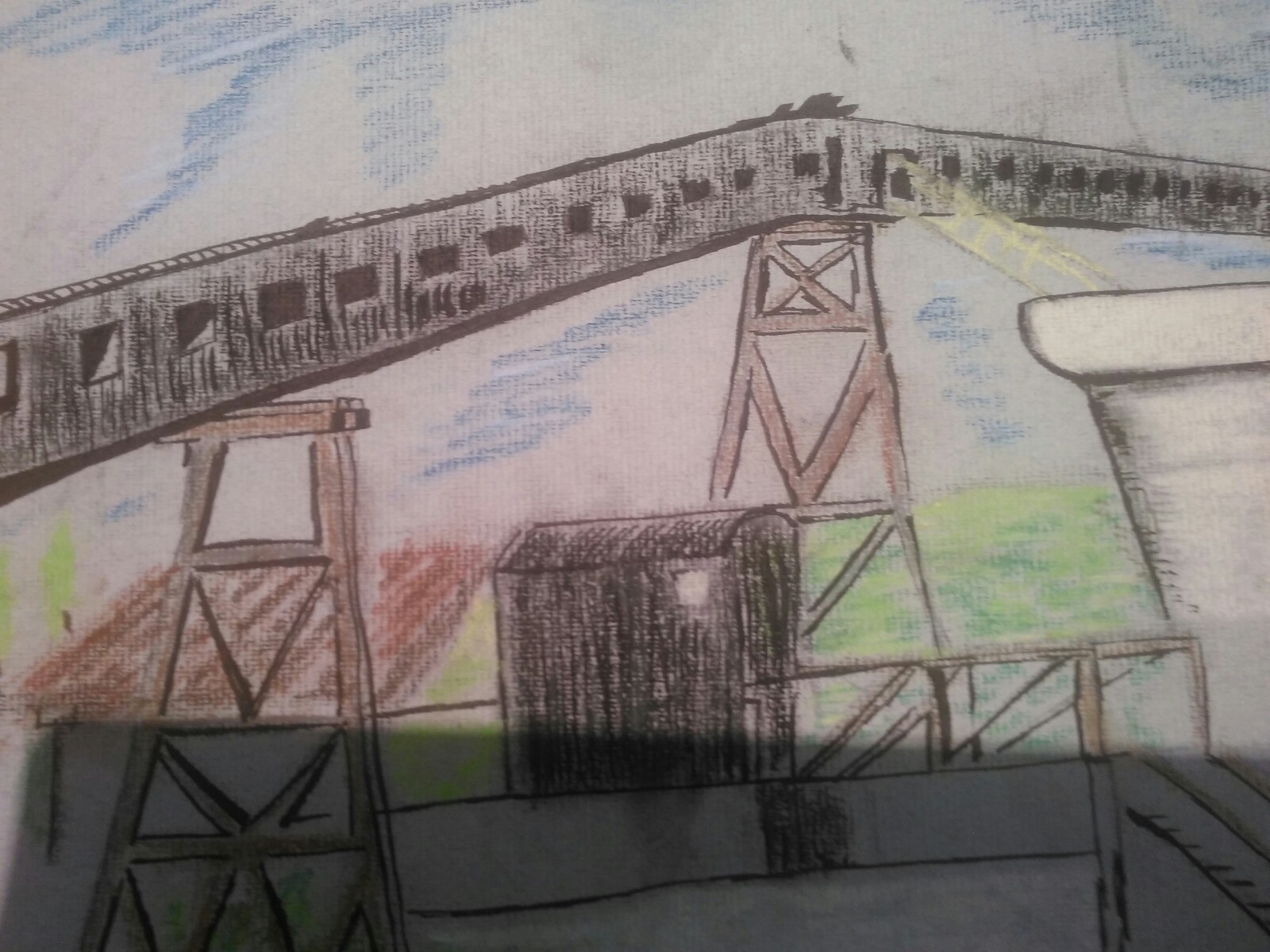
I sit on the edge of the manmade hill and see the different shadows ripple over the great washer building, over the cylindrical slurry tanks, move flat across the concrete bunkers where lie the remains of unused sand, gravel and lime. wpid-img_20140428_100148.jpg
It reminds me of the darkness a few days before when I was on nightshift at this place. Freezing till the veins of my hands stood up purple and ice encrusted in the ground made the concrete more hurtful when you fell like when I delivered the post one Christmas in Royston and slipped, the weight of the bag hauling me down to push and prise open the sprung letter boxes put the letter through so your whole hand went inside the house and then quick out for the lid to slam shut in your face.

The shadows are never what they seem and as the long night becomes morning without getting lighter you imagine bushes are people: old men slumped down after working the pit, Gentlemen in cloaks, or women in jeans so during the day real people seem like those shadows. Never what they seem.

 I think whoever I meet wants to hurt me. The brash people are like lights snapping on. They hurt my eyes. They frighten me. I want the darkness again. And yet the darkness always makes them what they are not.

I imagine shapes that revealed in the spotlight of my hat lamp are not what I imagined. wpid-img_20140428_100213.jpg
My father hit me when I was nine in a room whose electric brightness was too much for me . It invaded the darkness behind my wet eyes when closed.

My mother tried to hug me ironing her dress for going out. She was in her bra and panties. She hugged me to her and all I could saw was bright light, blinding me.

I turned away from her away from the light. Used my own body as a shield for my eyes.

Electric light reminds me of grief and tears.

The bulb was especially bright the night my mother told my sister and myself that dad and her were divorcing.

It had been too bright all the evenings they were arguing themselves into it.

I learn gradually. The light dawns as the cliche goes. When someone tells me something I look bemused because it takes a long time for the light to dawn.

I have no flashes of inspiration. My intuition is gradual, cumulative. People shine bright lights in my eyes when they try to hurry my thinking along. Because I do not think as fast as they would like me to.

My thoughts are clouds passing over the redundant pit and this is my life as far as I am concerned.

My last girlfriend dimmed harshness of the lounge light before we had sex on the couch awaiting her son, whom she said did not know we slept together. He would call out, ‘Mum. When you coming to bed?’

I always waited half between awake and asleep for his call like a harsh light in the eyes to come and alter the situation, for she always went upstairs and I was left.

Once I worked in a department store due to be closed because of the Recession.

 On the day we received, without warning, our redundancy notices, the section manager said ” Can We move those light fittings over there and bring those shades over here.”

On the training course they had explained that customers need to have fresh items to buy. They soon get bored. They need a thirty day or less ‘item bite’.

The job centre I’d worked at six months previous held the same opinion. Jobs on the boards were replaced every day by new ones.

John the lad I’d shared a house with three months could not stay in one place too long. He got bored. Same with his girlfriends.

Once we had shifted the items. put those that were not selling at best selling height we had lunch. I went out for fresh air. A demolition crew were knocking down the last of St. George’s church. I saw the new roundabout at Townend and the shop that had changed it’s name from Leos to Pioneer.

It struck me all of a sudden.

I saw the corrugated roofs of the new shops and knew every building, every person in the town was temporary.

It had been a local joke that the council ignored preservation orders and knocked down old buildings. There was still nostalgia for the best market in Britain that had been ‘improved’ by a concrete indoor market, after the flood of 1968.

Workmen are always digging up the recently laid pedestrian precinct. Plenty of jobs in the demolition and construction trade.

Recently, the closure of all pits in the area, renowned for its mining had enlarged the unemployment figures. They said the ‘shanty towns’ would become ‘ghost towns’. This town is a shanty town.


We are all gypsies. ‘Go,move,shift’ by our own decision but mainly others. The supermarket had renamed itself correctly. This is a frontier town.

Temporary and shifting. The place does not move. The people and buildings ever on the border.

I return to my bedsit, at the end of day, in preparation for the job hunt the following day. I learn my landlord has been registered an undischarged bankrupt.

UPDATE 2014 Psychogeography

Dodworth pit is now an out of Town industrial estate, that the overgrown green pitstack rises above like an Alpine hill.

Pioneer demolished, is now Lidl and Bargain Store.

And secret river Sough Dyke flies under the road downhill from Posh Pogmoor to Townend, where once Linen reservoirs once flowed onwards into the Dearne is now a lovely park for winos And some early early mornings you can hear Sough Dyke rushing under the road. Bottom of Market Hill when excavated workmen discovered the remains of an Eighteenth Century bridge over the Sough. So Market Hill used to be steeper. History is buried.

via WordPress for Phone http://goo.gl/j6Fzhf
A Dad

He loves women with walloping big breasts.
“It will not always be dark at seven.”
His favourite phrase.
An orphan. Parents could not cope. Put him away. He suffered bullies, brought up his brother.
Never went to his mother’s funeral.
His wife nags and shouts, off work with her leg.
The firm will not give her a sit down job.
Doctors can find nothing wrong.
Suffered illness all her life, all his married life.
Asked her husband to take her out.
“You must be joking!” he replied.
He only stays with her because of their son. He talks and talks of his son.
He says, “My boy when he were small used to say: ‘Me can do it! Me can do it!’
Well told him he couldn’t. ‘KICK DEE! KICK DEE!’
he would shout.” And this dad laughs away his disabled
wife.
Some psychologist might say this dad needs a mother. Why else love women with walloping big breasts?

Mother Mouth

I screamed too much. Didn’t I.

You didn’t like father and I screamed. I screamed all through your life.

And you attended.

I wanted. You gave. Gave everything. ALL.

Straightened my collar. Set my tie.

Listened.

The ground I stand on. Is you. Don’t go. Don’t go.

Please stay. I love you.

The air I breathe. My doing. An end. I know an end. Don’t go.

Please stay.

If I ask politely will death not take you away. Will it?

Please death don’t take my mummy away.

Copyright Paul Brookes from 1993 Anthology ‘Rats For Love: The Book’, Bristol Broadsides.

My Mother died of Cancer in 1997, after a seven year battle. This is for her.

Bait

Married forty years to the same man. Ate with her mouth open.
Talked with her mouth full. Masticated his forgetfulness
through two romantic lovers
between the pages.
Cut with some bloodless cold steel then tongued from cheek to cheek morsels of his past with her:
Who lost his false teeth …
… Ieft his pipe on the bin lid outside
… kept new clothes unwrapped for years … did not like driving in the dark … ?
She levered chewed events from good teeth, pushed them down to the acid below
through shredding walls to feed
blood and bile that formed into words goading him to grab the bait.
And when he did she hauled him
in to be filleted, iced and sold to others as good quality food to be eaten.

Heart Of It

This was the heart of it all. It was a two up, two down terraced house. The two down breathed out all the Badness, distributing the wealth of waste from the houses toilets, bathrooms, and collected rubbish. The two up breathed in fresh air, providing the house with the vital spark, the urge to live.
Knave lived in the downstairs flat. while Ivanova occupied the upstairs.

Every morning Knave went out with the rubbish. Took the Bin van to the Tip.
It was a landfill site that stretched for miles. The rubbish where he could
find his meals. He was a bagman, rummaging for half eaten tins of beans, bacon
rinds and unwanted cereal. A discovery was a breath of fresh air and he stuffed it into his black bin bag. You collected your meals here. You did
not eat them. First you had to make yourself sick to dissolve the rubbish and
then suck it up the black tube, always carried as a night stick against your
thigh. If you had been a fly on the wall you would have agreed with Knave.
It was the only way to consume. The food was expelled as air out of his backside.
Ivanova, flying above him now, made his air breathable with the rapid flapping of her wings. She remembered their Allotment Day. This was the occasion when Two Ups and TWo Downs found their mate. Each had to tell the other a secret and if the both were entertained then each was allotted the other.
Ivanova told Knave the following tale:
I will tell you my secret if you will tell me yours.
Once I flew and flew and flew over the Tip till I came to the edge of it. There I saw a Fluid that took part of the Tip away every time it washed over it. I was afraid that the Tip would disappear and nothing would be left but the Fluid.
In my fear I flew and flew and flew over the Fluid till it came to the point where it touched upon the Tip again. Here I saw the tip being put back by the Fluid. I was afraid that the Fluid would disappear and nothing would be left but the Tip.
I flew and flew and flew upwards so high I could see the part which took away the Tip and the part which gave it back. I could see the shape of the Tip always changing.
This is my secret

Knave told Ivanova:
You have told me your secret I will tell you mine
Once I shat upon the Tip and sat to watch it. After a few weeks a tiny green stalk appeared. I watched it a further week and it grew wings like yours. Then it began to rain acid and I feared the stalk would die. The wings began to yellow at the edges and I wanted to step on it.
Then the sun came out and shone and the yellowing went and the wings became green again. But the sun shone week after week and the wings began to turn brown and I wanted to step on it. Then the rain came again and it turned green again.
This is my secret.”
As they returned home, him below and her above, she remembered his sign of pleasure as an expelling out of his back side that her wings gladly purified.